www.scielo.br/aabc
Penguins and their noisy world
THIERRY AUBIN
NAMC CNRS UMR 8620, Université Paris-Sud, Bât. 446, 91405 Orsay Cedex, France
Manuscript received on January 15, 2004; accepted for publication on February 5, 2004.
ABSTRACT
Penguins identify their mate or chick by an acoustic signal, the display call. This identification is realized in a particularly constraining environment: the noisy world of a colony of thousands of birds. To fully understand how birds solve this problem of communication, we have done observations, acoustic analysis, propagation and playback experiments with 6 species of penguins studied in the field. According to our results, it appears that penguins use a particularly efficient ‘‘anti-confusion’’ and ‘‘anti-noise’’ coding system, allowing a quick identification and localization of individuals on the move in a noisy crowd.
Key words:communication in noise, sound localization, vocal recognition, penguins.
INTRODUCTION
In penguins, the call an adult produces when seek-ing its chick or its partner among thousands of birds is transmitted in a context involving the noise gen-erated by the colony and the screening effect of the bodies. Both these factors drastically reduce the signal-to-noise ratio and mask the signal by a background noise with similar spectral and tempo-ral characteristics. In addition, in some penguin species, there is no nest: the brooder carries the egg or the small chick on the feet. This absence of visual landmarks enhances the difficulty of individuals to locate the right bird on the move in a noisy crowd. Faced with this difficult problem penguins neverthe-less succeed. How do they manage this? To answer to this question, we have conducted field studies in-volving signal analysis, propagation and playback experiments dealing with the identification calls of 6 species of penguins.
E-mail: [email protected]
MATERIALS AND METHODS
We have studied in Australia, Antarctica and sub-antarctic islands 2 species without a nest, the Em-peror (EP)Aptenodytes forsteriand the King (KP)A. patagonicusPenguins and 4 species with a nest, the Adélie (AP)Pygoscelis adeliae, the Gentoo (GP)P. papua, the Macaroni (MP)Eudyptes chrysolophus and the Little Blue (BP)Eudyptula minorPenguins. To fully understand an acoustic communica-tion, it is necessary to study each step of the process. This implies: 1) studying the coding process, by an-alyzing the structure of the acoustic signal; 2) evalu-ating the modifications of the signal during propaga-tion; 3) performing experiments with acoustic lures, i.e. using modified signals broadcast to the animal while observing the behavioral responses in order to emphasize the key information-bearing parameters.
RESULTS
The Display Call
280 THIERRY AUBIN
2 voices
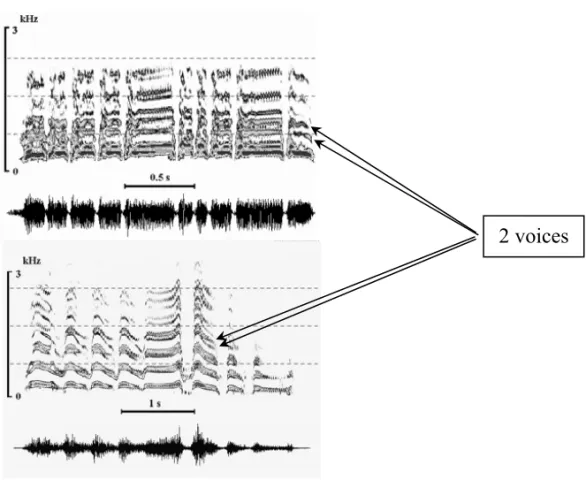
Fig. 1 – The ‘‘two voices’’ phenomenon in the calls of the Emperor Penguin (top) and of the King Penguin (bottom), evidenced as simultaneous and harmonically unrelated frequencies.
display call. It consists of a series of more or less similar sound components (the syllables) separated by strong amplitude declines. The syllable is a com-plex sound with harmonic series from 250 Hz to up to 5000 Hz. Among the 17 species of penguins, only two – the EP and the KP (Fig. 1) – use the ‘‘two-voices’’ (Brémond et al. 1990, Aubin et al. 2000). The ‘‘two-voices’’ phenomenon refers to the bird’s ability to produce two sounds, either simultaneously or independently, from their syrinx.
The Individual Stereotypy
PCA and Coefficient of Variation analysis, in the temporal and frequency domains, reveal that an in-dividual signature can be found in the display calls of all the species of penguin studied (Robisson et al. 1989, Jouventin and Aubin 2000, Aubin and Jou-ventin 2002a): for each individual, the structure of the signal is stereotyped (Fig. 2).
The Behavioral Strategies
To limit the time they take to identify the mate or chick, penguins use particular searching strategies. Although colonies often number thousands of individuals, an adult coming from the sea does not have to locate its partner or chick among all of these individuals. In fact, the search is limited to par-ticular ‘‘rendez-vous’’ sites: the nest or, for KPs, the previous feeding areas memorized by the birds (Lengagne et al. 1999c). To optimize the ‘‘active space’’ of their signal, penguins also adopt partic-ular signaling and hearing postures that limit the absorption caused by the screening effect of bod-ies of the birds gathered in dense flocks (Lengagne et al. 1999a).
The ‘‘Cocktail Party’’ Effect
The call is transmitted in a context involving the noise generated by the colony (about 75 dBSPL) and
282 THIERRY AUBIN
experiments (Aubin and Mathevon 1995, Aubin and Jouventin 1998), after 13 m of propagation, the am-plitude gaps that separate syllables and the peaks of frequencies tend to disappear into the background noise. Nevertheless, in natural conditions, birds are able to detect a familiar song at a longer distance (16 m). To estimate the minimal discrimination threshold in a jamming situation, a series of mixed signals was broadcast to individuals. The familiar call was combined with extraneous calls with differ-ent emergence levels, measured as signal-to-noise ratios. Our experiments with KPs indicate that birds detect a familiar call, even when its intensity is 6 dB below that of the noise of simultaneous calls pro-duced by other adults (Aubin and Jouventin 1998). This capacity to extract the familiar signal from sig-nals of other conspecifics is termed ‘‘cocktail-party effect’’ in speech intelligibility tests.
The Vocal Signature
Studying the discrimination of the adult call by the chick or the mate we have used play-back experi-ments modifying acoustic parameters to analyze the coding-decoding mechanisms of nesting (Jouventin and Aubin 2000, 2002, Searby et al. 2004) and non-nesting penguins (Robisson et al. 1993, Jouventin et al. 1999, Aubin et al. 2000, Lengagne et al. 2000). To extract a signal from the noise, penguins use two adaptive processes: analysis of call fre-quency bands for nesting penguins or analysis of frequency/time modulations for penguins without a nest. In addition, we have demonstrated that the penguins without nests use in fact a twin coding system since the beats generated by the interaction of the two voices convey also information about in-dividual identity (Aubin et al. 2000, Lengagne et al. 2001).
The frequency analysis used by nesting pen-guins is adequate for the easier problem of the in-dividual recognition in nesting birds, whereas the complex acoustic code of the non-nesting penguins is an adaptation to their extreme acoustic and breed-ing conditions.
The Redundancy of Information
The broadcast of one syllable of a familiar call against a normal background noise elicits weak re-sponses from the bird tested (Aubin and Jouventin 2002b). Although it contains the whole identity code, one syllable alone is not sufficient to reliably convey the information, given the ambient noise of the colony.
As predicted by information theory, birds must repeat the information to ensure an efficient com-munication in a noisy channel. This is verified in windy conditions: when the wind speed increases, this leads to a diminution of the signal-to-noise ratio and birds try to maintain the volume of information sent by increasing the number of syllables per call (Lengagne et al. 1999b). Thus, penguins apply the mathematical theory of information!
The Signal Localization
The syllabic organization of the call and the har-monic structure of the syllable apparently do not contribute to individual recognition but these struc-tures are not useless. We have shown by playback experiments (Aubin and Jouventin 2002b) that these structures help the bird to better localize the signal of the emitter and thus facilitate the meeting between individuals.
CONCLUSION
ACKNOWLEDGMENTS
Logistic supports were provided by the Institut Paul-Emile Victor. Many thanks to Christophe Hildebrant, Pierre Jouventin, Jacques Lauga, Thierry Lengagne and Patrice Robisson for their participation to the study.
RESUMO
Os pingüins identificam seu parceiro ou seu filhote através
de um sinal acústico, o grito de exibição. Esta
identifi-cação está realizada num ambiente particularmente exi-gente: o mundo barulhento de uma colônia de milhares
de aves. Para entender totalmente como essas aves
re-solvem este problema de comunicação, realizamos
obser-vações, análises acústicas e experiências de propagação
e de ‘‘play-back’’ com 6 espécies de pingüins estuda-dos no campo. Segundo nossos resultaestuda-dos, parece que
os pingüins usam um sistema de codificação
‘‘anti-con-fusão’’ e ‘‘anti-barulho’’ particularmente eficiente,
per-mitindo uma rápida identificação e localização dos
indi-víduos em movimento numa multidão barulhenta.
Palavras-chave:comunicação no barulho, localização de
som, reconhecimento vocal, pingüins.
REFERENCES
Aubin T and Jouventin P.1998. Cocktail-party effect
in King Penguin colonies. Proc R Soc Lond B265: 1665-1673.
Aubin T and Jouventin P. 2002a. How to identify
vocally a kin in a crowd? The penguin model. Adv Study Behav 31: 243-277.
Aubin T and Jouventin P.2002b. Localisation of an
acoustic signal in a noisy environment: the display call of the King Penguin. J Exp Biol 205: 3793-3798.
Aubin T and Mathevon N.1995. Adaptation to
se-vere conditions of propagation: long-distance dis-tress calls and courtship calls of a colonial seabird. Bioacoustics 6: 153-161.
Aubin T, Jouventin P and Hildebrand C.2000.
Pen-guins use the two-voice system to recognise each other. Proc R Soc Lond B267: 1081-1087.
Brémond JC, Aubin T, Mbu Nyamsi R and Robisson
P.1990. The song of the Emperor Penguin: research
of parameters likely to be used for individual recog-nition. CR Acad Sci 311: 31-35.
Jouventin P and Aubin T.2000. Acoustic convergence
in the calls of two nocturnal burrowing seabirds. Ex-periments with a penguin and a shearwater. Ibis 142: 645-656.
Jouventin P and Aubin T.2002. Acoustic systems are
adapted to breeding ecologies: individual recogni-tion in nesting penguins. Anim Behav 64: 747-757.
Jouventin P, Aubin T and Lengagne T.1999.
Find-ing a parent in a KFind-ing Penguin colony: the acoustic system of individual recognition. Anim Behav 57: 1175-1183.
Lengagne T, Aubin T, Jouventin P and Lauga L.
1999a. Acoustic communication in a King Penguin colony: importance of bird location within the colony and of the body position of the listener. Polar Biol 21: 262-268.
Lengagne T, Aubin T, Lauga J and Jouventin P.
1999b. How do King Penguins apply the Mathemat-ical Theory of Information to communicate in windy conditions? Proc R Soc Lond B266: 1623-1628.
Lengagne T, Jouventin P and Aubin T.1999c.
Find-ing one’s mate in a KFind-ing Penguin colony: efficiency of acoustic communication. Behaviour 136: 833-846.
Lengagne T, Aubin T, Jouventin P and Lauga J.
2000. Perceptual salience of individually distinctive features in the calls of adult King Penguins. J Acoust Soc Am 107: 508-516.
Lengagne T, Lauga J and Aubin T. 2001.
Intra-syllabic acoustic signatures used by the King Pen-guin in parent-chick recognition: an experimental approach. J Exp Biol 204: 663-672.
Robisson P, Aubin T and Brémond JC.1989.
Indi-vidual recognition by voice in the Emperor Penguin: respective parts of the temporal pattern and the sound structure of the courtship song. CR Acad Sci 309: 383-388.
Robisson P, Aubin T and Brémond JC.1993.
Individu-ality in the voice of the Emperor PenguinAptenodytes forsteri: adaptation to a noisy environment. Ethol-ogy 94: 279-290.
Searby A, Jouventin P and Aubin T.2004. Acoustic