RESUMO: A determinação do arranjo espacial da praga torna-se o primeiro passo para o estabelecimento de um plano de amostragem, pois, conforme o tipo de distribuição espacial da praga específica estudada, será necessário utilizar diferentes métodos de amostragem, variando o número e o tamanho da amostra na área. O presente tra-balho objetivou estudar a distribuição espacial das plantas infestadas por Bemisia tabaci em condições de campo, na cultura da soja, por meio da determinação dos índices de agregação e dos testes de qui--quadrado de aderência para os principais tipos de distribuições teóri-cas de frequência. Os resultados mostraram que a porcentagem média de infestação da mosca-branca (B. tabaci) foi aumentando a partir do estádio V1, atingindo a máxima infestação de 60,3% no estádio R1. A partir do estádio R2, a porcentagem de infestação variou entre 20% e 40%. Os modelos de distribuições teóricas estudados indicam que o modelo poisson é o que melhor define a distribuição da mosca-branca.
PALAVRAS-CHAVE: arranjo espacial; biótipo B; índice de dispersão; Glycine max.
ABSTRACT: The determination of the spatial distribution of a pest is the first step in the establishment of a sampling plan, as sampling methods are contingent upon the type of spatial distribution of the specific pest studied, varying according to the number and size of samples in the area. This work aimed to study the spatial distribution of soybean plants infested with Bemisia tabaci, under field conditions, through the determination of the aggregation indices and the chi-square test of fitness to the main types of theoretical frequency distributions. The average percentage of whitefly (B. tabaci) infestation increasing after the V1 stage, reaching the maximum infestation of 60.3% in the R1 stage. At the R2 stage, the percentage of infestation ranged from 20 to 40%. According to the models of theoretical distributions studied, the Poisson distribution best defines the distribution of the whitefly.
KEYWORDS: spatial arrangement; biotype B; dispersion index; Glycine max.
Spatial distribution of soybean plants infested
with whitefly
Bemisia tabaci
(Gennadius, 1889)
(Hemiptera: Aleyrodidae)*
Distribuição espacial de plantas infestadas por mosca-branca
Bemisia tabaci
(Gennadius, 1889) (Hemiptera: Aleyrodidae) em soja
Renato Suekane1**, Paulo Eduardo Degrande1, Elmo Pontes de Melo1, Thiago Moreira Azambuja1,
Carlos Tutida Menegati1
1Universidade Federal da Grande Dourados – Dourados (MS), Brazil
INTRODUCTION
The whitefly Bemisia tabaci (Gennadius, 1889) (Hemiptera:
Aleyrodidae) causes economic damage to several crops,
including soybean Glycine max (L.) Merrill, by extracting
a large amount of sap from the phloem and negatively affecting plant growth and development. This insect also excretes a large amount of molasses (honeydew), which is rich in sugar and serves as a substrate for the
develop-ment of the sooty mold-causing fungus Capnodium spp.
(Capnodiaceae), thereby decreasing photosynthesis and in some cases leading to plant death (LOPEZ et al., 2008). This species has the ability to transmit viruses, and in
soybeans, B. tabaci is a transmitter of the stem-necrosis
virus (Carlavirus), which can lead to death of the host. A range of resistance responses to this pest has been observed among soybean genotypes (DEGRANDE; VIVAN, 2010).
B. tabaci has been recognized as a pest for several crops for many years, but its populations used to be small to the point of not causing economic damages. However, from the year 2001 on, the first population outbreaks of this pest in potato crops were reported (LOURENÇÃO et al., 2003). Outbreaks have also been reported in the Central-West region of Brazil, where this pest has been economically damaging soybean crops (DEGRANDE; VIVAN, 2010).
In order to carry out the sustainable management of B. tabaci, reliable sampling plans that allow estimat-ing the population density of this pest have to be con-structed, as well as classifying its damages, and from this data, then make the appropriate decision (FARIAS et al. 2001). Thus, the determination of the spatial arrangement of the pest becomes the first step in the establishment of a sampling plan (FERNANDES et al., 2003), because the sampling method deployed will be contingent on the type of spatial distribution of the specific pest studied, vary-ing accordvary-ing to number and size of samples in the area (MELO et al., 2006).
In order to determine the spatial arrangement pat-tern of a given species, it is necessary to have count-ing data of individuals in the ecosystem under study. Therefore, it is key that the ecosystem in question allows for sampling. These sampling, according to YOUNG; YOUNG (1998), can be used to infer the distribution of the sampled population or the characteristics of its distribution. For the description of the distribution pat-terns of a population, aggregation indices and frequency distributions are used.
This work aimed to study the spatial distribution of plants infested by Bemisia tabaci, in a soybean crop, by deter-mining aggregation indices and the chi-square test of fitness to the main types of theoretical frequency distributions.
MATERIALS AND METHODS
The study was conducted at the experimental station of Centro Universitário da Grande Dourados (Unigran), located at the municipality of Dourados, state of Mato Grosso do Sul (MS), Brazil, latitude 22º14ºS, longitude 54º49ºW, and altitude of 458 m and a Cfa climate (humid mesothermic climate with-out drought).
Seeding was performed on December 5th, 2009. The
cul-tivar used for the study was Don Mario 7.0i (BMX Magna®
RR). Line spacing was 0.45 meters with 14 plants per meter. There was no insecticide seed treatment. Control of weeds and diseases were performed with specific herbicides and fungi-cides recommended for the crop that do not affect the whitefly population. The control of defoliating pests was carried out with biological insecticide Dipel®, with Bacillus thuringiensis
as active ingredient, innocuous to the whitefly.
In the experiment, the data of 11,000 plants were counted in total from the evaluations. Each experimental unit con-sisted of 22 rows by ten meters in length (99 m²); 100 plots were evaluated at each time point, occupying an area of 1 hectare. In each plot, ten plants were evaluated in a total of 1,000 plants per time point. The sampling was carried out in the dates of 12/15/2009, 12/21/2009, 12/28/2009, 01/05/2009, 01/12/2009, 01/18/2009, 01/29/2009, 02/01/2009, 02/08/2009, 02/18/2009 and 02/23/2009, totaling 11 evaluations.
The sampling was conducted as described by MELO et al. (2006), evaluating presence-absence of infested plants. A plant was considered infested when a nymph and/or an adult of the pest were found. The presence-absence sampling type is similar to that adopted by ELLSWORTH; DIEHL (1997). This type of evaluation has advantages, including smaller variation among the samplers and, at the same time, presents greater efficiency and precision for decision-making. In the presence-absence observations of plants infested by the pest, the direct counting technique reported by RODRIGUES et al. (2010) was employed.
The data obtained in each of the samples were used for the mathematical description of the spatial dispersion of the insect population. The mean, variance and aggregation indi-ces were determined. The following theoretical distributions of frequencies were used as models for population samples: Poisson distribution, negative binomial distribution and pos-itive binomial distribution. Then, the theoretical frequency distribution models’ fitness to the data obtained in the field were compared using the chi-squared statistic.
The aggregation indices used to verify the degree of aggre-gation of the whitefly were: variance/mean ratio, morisite
index and K index as reported by PEREIRAet al. (2004)
and the theoretical frequency distributions used to evaluate
the spatial distribution of Bemisia tabaci were:
binomial distribution, according to the methodology used by MELO et al. (2006).
RESULTS AND DISCUSSION
Pest Population Dynamics
The mean percentage of whitefly infestation (B. tabaci)
increased after the V1 stage, reaching the maximum
infesta-tion of 60.3% in the R1 stage (January 11th, 2010). At the R2
stage, the percentage of infestation ranged from 20 to 40%, making a total of 447 to 603 nymphs or adults of whitefly between the R1 and R2 stages of the total soybean plants per evaluation (Fig. 1). This whitefly population peak in January was also reported by RODRIGUES et al. (1997), in which
the author cites the favorable conditions for the development of the pest registered in the month of January.
These developments of population peaks were also favored by the environmental conditions, with the average tempera-ture varying between 24.9ºC and 25.9ºC from December, 2009 to February, 2010. The average temperature in the field studied was favorable for the development of whitefly popu-lations, because, according to ALBERGARIA et al. (2002), the temperature range of 25ºC to 30ºC is favorable for the survival rate of the pest, with an acceleration in the white-fly biological cycle of 70.9 days at a temperature of 15ºC to 21.8 days at 30ºC.
Dispersion indices
Based on the samplings performed in the study, the variance/ mean ratio (I), Morisita index (Iδ) and K index values (Table 1) were calculated. In the experiment, it was observed that the values obtained for index I did not show significant differences, indicating a random distribution of the pest. The Iδ index was not statistically significant, also indicating a random distribu-tion. It was observed, however, that index I and index Iδ in the sixth, eighth, ninth, tenth and eleventh samplings, tended to uniformity, since the values of both indices are smaller than the unit. The values found for the K index showed an aggregate distribution in the first four evaluations. Between the fifth and seventh evaluations, there was a shift in the distribution pat-tern of plants infested by whitefly (B. tabaci), since the values tended to be randomized, while in the sixth evaluation, they indicated a uniform distribution, again indicating the same uniform arrangement from the eighth evaluation.
The samplings indicate that, for index I, a random dis-tribution was shown, since its values were not significantly
Sampling Date Phonological State Mean Variance I Iδ K
1 15/12/09 V1 0.430 0.631 1.468ns 2.104ns 0.918AG
2 21/12/09 V2 1.320 2.341 1.773ns 1.584ns 1.706AG
3 28/12/09 V4 1.510 2.171 1.438ns 1.289ns 3.446AG
4 05/01/10 V7 3.350 5.300 1.582ns 1.172ns 5.753AG
5 12/01/10 R1 6.030 6.716 1.113ns 1.018ns 52.980RD
6 18/01/10 R2 4.470 2.494 0.558ns 0.902ns -10.112UN
7 29/01/10 R4 2.150 2.230 1.037ns 1.017ns 57.927RD
8 01/02/10 R4 2.830 2.162 0.764ns 0.917ns -12.002UN
9 08/02/10 R5.1 3.720 3.072 0.825ns 0.953ns -21.366UN
10 18/02/10 R5.3 2.620 1.672 0.638ns 0.863ns -7.243UN
11 23/02/10 R5.4 3.880 2.470 0.637ns 0.907ns -10.679UN
Table 1. Dispersion indices or aggregation, evaluation date, medium of infested plants, variance and spatial distribution indices
used for infested plants by whitefly (B. tabaci) during the 11 evaluations. I (variance/mean ratio), Iδ (morisite index) and K (K index). Dourados, MS, 2010.
nsindicates non-significant 5% probability; AGAggregate; UNUniform; RDRandom Figure 1. Occurrence and standard error of the mean number
of plants infested by the whitefly in the experimental area in the phonological stages of the soybean cultivar Don Mario® 7.0i.
Dourados, MS, 2010.
Number of inf
ested plants
700 600 500
400 300
200 100 0
Phonological state V1 V2 V4 V7 R1 R2 R4 R4
different from on (01). When analyzing the Iδ index, it was inferred that a sufficient number of infested plants was found in all samples to allow the determination of the index; the calculated values did not differ significantly from the unit thereby framing them in a random arrangement. Thus, it is observed that the values for both indices indicate a random distribution. However, from the eighth evaluation, there was a tendency for uniformity, since its values were smaller than one. For index K, the distribution was indicated to be aggregated in the initial infestations, and became uniform throughout the evaluations (Table 1). This was explained by BARBOSA; PERECIN (1982): in situations of high infestation, there is a tendency for uniform distribution and, according to MELO et al. (2006), this behavior may be related to the increase of intraspecific competition that causes individuals from the same population to move as far apart as possible from each other.
Frequency Distributions
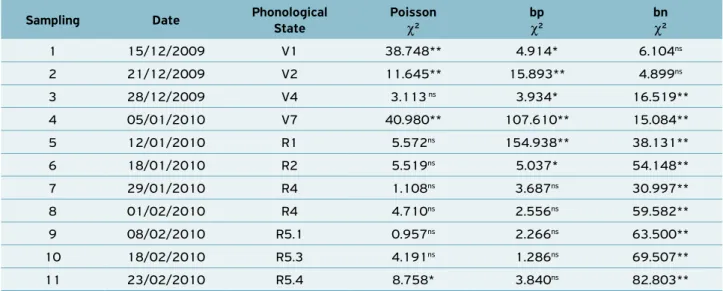
The values of the chi-squares obtained for the plants infested
with B. tabaci were included in the three theoretical
fre-quency distribution models (Table 2). Significant values can be observed, indicating that the field counting data do fit the theoretical distribution models considered: four samplings fit the Poisson distribution (1st, 2nd, 4th, 8th and 11th), six fit
posi-tive binomial (1st, 2nd, 3rd, 4th, 5th and 6th) and 8 fit negative
binomial (3rd, 5th, 6th, 7th, 8th, 9th, 10th and 11th). In the
con-text of ecological statistics, it can be accepted that the best fit is represented by the frequency distribution that presents the lowest value of the calculated χ2. In the present study, it was
noted that the beginning of the infestation of soybean plants
by whitefly occurs in aggregate form, going through a tran-sition in the third evaluation to random, and to aggregated in the fourth evaluation, returning to be random from the fifth to the seventh evaluation. From the eighth evaluation, a shift occurred again, tending to a uniform distribution in the eighth evaluation, random in the ninth evaluation and remaining uniform in the last two evaluations. Several stud-ies considering the presence-absence of pest insects point to this uniformity at a given moment of the infestation of the pests to the field (VILLACORTA; GUTIERREZ, 1989; FARIAS et al., 2001).
According to the frequency distributions data, the behav-ior of the plants infested by the species B. tabaci occurred at first in an aggregated form, characterizing the beginning of the infestations. After the establishment of the whitefly in the soybean field, the infested plants were characterized in a random arrangement and, finally, when a widespread infes-tation occurred in the soybean field, where the pest popula-tion the reached its maximum size, the uniform model best describes the arrangement of the infested plants. This pat-tern of spatial distribution of infested plants, in which the pest population goes through these three distinct stages, is common for insect pest populations that multiply in a short time. This same behavior was also observed by MELO et al. (2006) while studying the distribution of plants infested by
Spodoptera frugiperda in maize. Due to the adjustment of the three theoretical frequency distributions used in this work to the counting data obtained in the sampled area, it is not pos-sible, based only on the chi-square tests, to discard any theo-retical dispersion pattern.
The aggregation of insects can occur when there is repro-ductive purpose, in response to meteorological changes such as
Sampling Date Phonological State
Poisson
χ2
bp
χ2
bn
χ2
1 15/12/2009 V1 38.748** 4.914* 6.104ns
2 21/12/2009 V2 11.645** 15.893** 4.899ns
3 28/12/2009 V4 3.113 ns 3.934* 16.519**
4 05/01/2010 V7 40.980** 107.610** 15.084**
5 12/01/2010 R1 5.572ns 154.938** 38.131**
6 18/01/2010 R2 5.519ns 5.037* 54.148**
7 29/01/2010 R4 1.108ns 3.687ns 30.997**
8 01/02/2010 R4 4.710ns 2.556ns 59.582**
9 08/02/2010 R5.1 0.957ns 2.266ns 63.500**
10 18/02/2010 R5.3 4.191ns 1.286ns 69.507**
11 23/02/2010 R5.4 8.758* 3.840ns 82.803**
Table 2. Chi-square test (χ²) for fitness of theoretical Poisson, positive binomial (bp) and negative binomial (bn) frequencies for
plants infested by whitefly (B. tabaci) during the 11 evaluations. Dourados, MS, 2010
temperature, humidity, wind, and lightness, in case of social attractions and in situations where the unequivocal action of parasitoids and predators occurs (MESINA, 1986).
According to FERNANDES (2002), a population that characteristically presents aggregate type distribution, for example, can alternate this model to random or uniform due to the influence of biotic or abiotic factors. This shift has been
observed in the population of Alabama argillacea.
When the spatial arrangement of the pest is random, any dimension of the sample unit is equally efficient for the estima-tion of populaestima-tion parameters, and this efficiency is defined in terms of the relative quantity of sample units needed to pro-vide estimates of desirable accuracy (FERNANDES, 2003). However, the number of sample units to determine the spe-cial arrangement, according to this same author, is always suggested to be large samples, that is, over 50 units for the most complicated case in a population of the contagious type. For this study, double the suggested experimental units were used, that is, 100 units were evaluated in order to have accu-racy in the obtained data.
At the moment when the calculated aggregation indices indicated the random distribution of the infested plants, there is a tendency of the pest to disperse and to arrange in a random way due to its capacity of dispersion, migratory activity and search for food. Similar behavior was men-tioned in the works by MELO et al. (2006) and FARIAS et al. (2001).
Based on dispersion indices and theoretical frequency distribution models, the Poisson model best defines the distribution of the infested plants in the soybean crop, evi-dencing that the distribution of infested plants is random in the field. Thus, all individuals have the same probabil-ity of occupying any place in space, and the presence of an individual in one place does not affect the presence of another in a place near it (GREEN, 1966). This fact differs
in relation to different crops, as in the case of beans, in which PEREIRA et al. (2004) describes the spatial distribution of whitefly as being regular or uniform. In the case of cotton, RODRIGUES et al. (2010) describes an aggregate arrange-ment of B. tabaci in both the Bt and conventional cultivars. Also, in cucumber crops, MOURA et al. (2003) defines the arrangement of the pest as an aggregate, showing that this pest, besides poly-phase (FONTES et al., 2010), is distrib-uted in different arrangements.
From the information obtained in this study, we suggest the elaboration of a sequential sampling plan of infested plants for the soybean crop, since these plans are elaborated based on their arrangement (be it random, aggregate or uniform), varying mainly in the number of points to be sampled in the field, obtaining faster and more efficient information in the samples of the fields of soy production where the problem with this pest occurs.
CONCLUSION
The spatial distribution of soybean plants infected by white-fly (B. tabaci), according to the theoretical distribution mod-els applied, indicates that the Poisson model best defines the distribution of this pest in the soybean fields, showing that the pest is distributed randomly in the field.
ACKNOWLEDGMENTS
The authors are would like to thank Capes (Coordination of Improvement of Higher Level Personnel) for the master’s degree scholarship granted to the first author.
REFERENCES
ALBERGARIA, N.M.M.S; CIVIDANES, F.J. Exigências térmicas de Bemisiatabaci (Genn.) biótipo B (Hemiptera: Aleyrodidae). Neotropical Entomology, v.31, p.359-363, 2002.
BARBOSA, J.C.; PERECIN, D. Modelos probabilísticos para distribuição de lagartas de Spodopterafrugiperda (J.E. Smith,
1797), na cultura do milho. Científica, v.1, n.1, p.181-191, 1982.
BYRNE, D.N. Migration and dispersal by the sweet potato whitefly,
Bemisiatabaci. Agriculture for Meteorology, v.97, n.1, p.309-316, 1999. DEGRANDE, P.E.; VIVAN, L.M. Boletim de pesquisa de soja 2010.
Fundação MT, v.1, n.1, p.152-215, 2010.
ELLSWORTH, P..; DIEHL, J. Whiteflies in Arizona: Evaluation of sampling plans. Cooperative Extension, v.1, n.1, p.2, 1997.
FARIAS, P.R.S.; BARBOSA, J.C.; BUSOLI, A.C. Amostragem sequencial (presença-ausência) para Spodoptera frugiperda (J.E. Smith) (Lepidoptera: Noctuidae) na cultura do milho. Neotropical Entomology, v.30, n.4, p.691-695, 2001.
FARIAS, P.R.S.; BARBOSA, J.C.; BUSOLI, A.C. Distribuição espacial da lagarta-do-cartucho, Spodoptera frugiperda (J.E.Smith) (Lepidoptera: Noctuidae), nacultura do milho. Neotropical Entomology, v.30, n.4, p.681-689, 2001. http://dx.doi.
FERNANDES, M.G., BUSOLI, A.C., BARBOSA, J.C. Distribuição espacial de Spodoptera frugiperda (J.E. Smith, 1797) (Lepidoptera, Noctuidae) em algodoeiro. Revista Brasileira de Agrociência, v.8, n.3,
p.203-211, 2002. http://dx.doi.org/10.12741/ebrasilis.v10i2.683
FERNANDES, O.D.; PARRA, J.R.P.; FERREIRA NETO, A.; PÍCOLI, R., BORGATTO, A.F.; DEMÉTRIO, G.B. Efeito do milho geneticamente modificado (MON810) sobre a lagarta-do-cartucho Spodoptera frugiperda (J.E. Smith, 1797) (Lepdoptera: Noctuidae). Revista Brasileira de Milho e Sorgo, v.2, n.1, p.25-35, 2003. http://dx.doi. org/10.18512/1980-6477/rbms.v2n2p25-35
FONTES, F.V.H.M.; COLOMBO, C.A.; LOURENÇÃO, A.L. Caracterização molecular e divergência agenética de Bemisia tabaci(Genn.)
(Hemiptera: Aleyrodidae) em diferentes culturas e locais de cultivo. Neotropical Entomology, v.39, n.2, p.221-226, 2010. GREEN, R.H. Measurement of non-randomness in spatial distributions. Research Population Ecology, v. 8, n. 1, p. 1-7, 1966.
LOPEZ V.; VOS, J.; POLAR, P.; KRAUSS, U. Discovery learning about sustainable management of whitefly pests and whitefly-borne viruses. International Centre for Tropical Agriculture, v.1, n.1,
p.12-29, 2008.
LOURENÇÃO A.L.; SOUSA DIAS, J.A.; FUGI, C.Q. Mosca-branca: superpraga da agricultura mundial ameaça a bataticultura brasileira. Batata Show, v.6, n.1, p.7-8, 2003.
MELO, E.P.; FERNANDES, M.G.; DEGRANDE, P.E.; CESSA, R.M.A.; SALOMÃO, J.L.; NOGUEIRA, R.F. Distribuição espacial de plantas infestadas por Spodoptera frugiperda (J.E. Smith) (Lepdoptera: Noctuidae) na cultura do milho. Neotropical Entomology,
v.35, n.5, p.689-697, 2006. http://dx.doi.org/10.1590/ S1519-566X2006000500018
MESINA, R.R.V. Disposição espacial de Panonychusulmi (Koch, 1836) (Acarina: Tetranychidae) e determinação do número de
amostras na macieira. 1986. 88f. Dissertação (Mestrado em Entomologia) - Universidade Federal do Paraná, Curitiba, 1986.
MOURA, M.F.; PICANÇO, M.C.; SILVA, E.M.; GUEDES, R.N.C.; PEREIRA, J.L. Plano de amostragem do biótipo B de Bemisia tabaci na cultura do pepino. Pesquisa Agropecuária Brasileira, v.38, n.12, p.1357-1363, 2003.
NARANJO, S.; FLINT, H.M. Spatial distribution of adult Bemisia tabaci (Homoptera: Aleyrodidae) in cotton and development of fixed-precision sequential sampling plans for estimating population density. Environmental Entomology, v.24, n.2, p.261-270, 1995. PEREIRA, M.F.A.; BOIÇA JR., A.L.; BARBOSA, J.C. Distribuição espacial de Bemisia tabaci (Genn) Biótipo B (Hemiptera: Aleyrodidae) em Feijoeiro (Phaseolus vulgaris L.). Neotropical Entomology, v.33, n.4, p.493-498, 2004. http://dx.doi. org/10.1590/S1519-566X2004000400015
RODRIGUES, T.R.; FERNANDES, M.G.; SANTOS, H.R. Distribuição espacial de Aphis gossypii (Glover) (Hemiptera, Aphididae) e
Bemisia tabaci (Gennadius) biótipo B (Hemiptera, Aleyrodidae) em algodoeiro Bt e não-Bt. Revista Brasileira de Entomologia, v.54, n.1, p.136-143, 2010. http://dx.doi.org/10.1590/ S0085-56262010000100019
RODRIGUES, F.A; BORGES, A.C.F.; SANTOS, M.R.; FERNANDES, J.J.; FREITAS JUNIOR, A. Flutuação populacional da mosca-branca e a incidência de mosaico dourado em feijoeiro. Pesquisa Agropecuária Brasileira, v.32, n.10, p.1023-1027, 1997.
VILLACORTA, A.; GUTIERREZ, A.P. Presence-absence sampling decision rules for the damage cause by the coffee leaf miner (Leucoptera coffeella Guerin-Meneville, 1842). Pesquisa Agropecuária Brasileira, v.24, n.5, p.517-525, 1989.
YOUNG, L.J.; YOUNG, J.H. Statistical ecology: a population perspective. Kluwer Academic Publishers, v.1, n.1, p.565, 1998.