
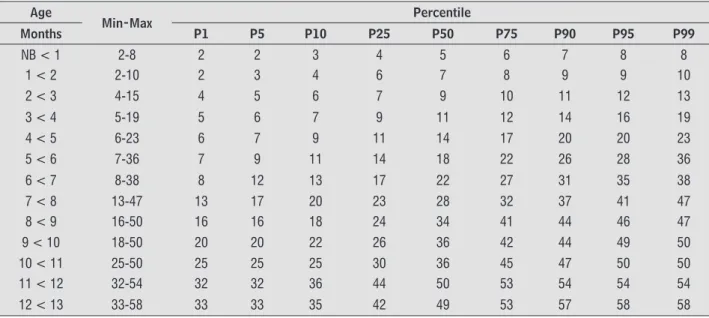
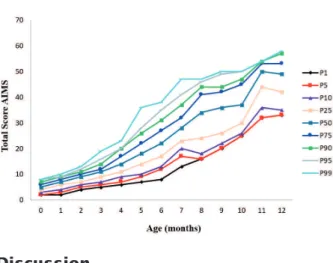
Motor development’s curves of premature infants on the first year of life according to Alberta Infant Motor Scale
Texto
Imagem

Documentos relacionados
More specifically, it is concluded that the children born at full-term acquired a greater number of skills in the same period than the preterm group, which can be seen from the
The purpose of the study was to assess the gro s s motor development of pre t e rm infants, with low-risk for major motor neurological problems, during the first year of corrected
Objective: To compare gross motor development of preterm infants (PT) without cerebral palsy with healthy full-term (FT) infants, according to Alberta Infant Motor Scale (AIMS);
addressing facial preferences during the first two days of life and comparing the reaction of preterm and term new- born infants to the exposure to natural and distorted
his study found that the motor behavior of very low birth weight premature infants was worse than that of low birth weight premature infants, and, in the age groups evaluated,
Purpose: To assess the accuracy of the Preterm Oral Feeding Readiness Scale (POFRAS) on the beginning of oral feeding in preterm infants and to verify the concordance between
Preterm infants of , 32 weeks gestational age were classified into 4 groups according to the support needed during the first 2 hours of life: room air, nasal continuous positive
OBJECTIVES: To analyze the motor development of late preterm newborn infants (LPI) from birth to term- corrected age using the Test of Infant Motor Performance (TIMP) and to compare
