ARTICLE
Differences in walking attainment ages
between low-risk preterm and healthy
full-term infants
Diferenças na idade de aquisição da marcha entre lactentes pré-termo
de baixo risco e a termo saudáveis
Ana P. Restiffe1, José Luiz D. Gherpelli2
During the past decades there was an increase in the sur-vival rate of infants born very preterm (gestational age <32 weeks) and with very low birth weight (VLBW). However, this was associated with an increased rate of adverse develop-mental outcome, which in turn has raised important issues regarding the quality of life of these infants1.
he incidence cerebral palsy (CP) ranges from 5 to 15% and is inversely related to birth weight and gestational age. CP is often detected during the irst year of life2. Minor
neu-rological dysfunctions (MND) such as motor coordination disorder or clumsiness, behavioral problems, and learning
disorders range from 40 to 70% and usually become more ap-parent as the child grows older3.
Whether delay in achieving developmental milestones
is a marker of MND4 or a variation of normal motor
devel-opment in preterm infants is a matter still under debate5.
Developmental abnormalities and delays diagnosed early in life in preterm infants may be transient and may fade away as a result of the interaction between genetic and environmental factors6, and also the interaction of various systems,
includ-ing the neuromuscular, sensory, biomechanical, and central nervous systems7.
1Physical Therapist (PT) ScD; Department of Neurology, Medical School, Universidade de São Paulo (USP), São Paulo SP, Brazil; 2Pediatric Neurologist (MD) PhD; Department of Neurology, Medical School, USP, São Paulo SP, Brazil.
Correspondence: Ana P. Restiffe; Rua Lourenço de Almeida 772/51; 04508-001 São Paulo SP - Brasil; E-mail: [email protected]
Support: This study was supported by Fundação de Amparo à Pesquisa do Estado de São Paulo (FAPESP), Process nº 04/15332-0; Ana P. Restiffe received a scholarship grant from (CAPES).
Conflict of interest: There are no conflicts of interest to declare.
Received 19 February 2012; Received in final form 03 April 2012; Accepted 10 April 2012 ABSTRACT
Objective: To compare gross motor development of preterm infants (PT) without cerebral palsy with healthy full-term (FT) infants, according to Alberta Infant Motor Scale (AIMS); to compare the age of walking between PT and FT; and whether the age of walking in PT is affected by neonatal variables. Methods: Prospective study compared monthly 101 PT and 52 FT, from the first visit, until all AIMS items had been ob-served. Results: Mean scores were similarity in their progression, except from the eighth to tenth months. FT infants were faster in walking attainment than PT. Birth weight and length and duration of neonatal nursery stay were related to walking delay. Conclusion: Gross motor development between PT and FT were similar, except from the eighth to tenth months of age. PT walked later than FT infants and predictive variables were birth weight and length, and duration of neonatal intensive unit stay.
Key words: Alberta Infant Motor Scale, child development, infant, premature, motor activity.
RESUMO
Objetivo: Comparar o desenvolvimento motor de lactentes pré-termo sem paralisia cerebral (PT) com lactentes normais nascidos a termo (T), de acordo com Escala Motora Infantil de Alberta (AIMS); comparar idade da marcha entre PT e T e se a idade da marcha em PT é passível de ser afetada. Métodos Estudo prospectivo com 101 PT e 52 T, seguidos mensalmente até que todos os itens da AIMS tivessem sido obser-vados. Resultados: Os escores médios apresentaram semelhanças entre os grupos, com exceção do oitavo ao décimo meses. Os lactentes T iniciaram marcha antes dos PT. Peso, estatura ao nascimento e tempo de internação na unidade de terapia intensiva neonatal (UTIN) foram preditivos. Conclusão: O desenvolvimento motor entre PT e T foi semelhante, exceto entre o oitavo e o décimo meses de idade. PT andaram mais tardiamente e variáveis preditivas foram peso, estatura ao nascimento e o tempo de permanência na UTIN.
Walking is considered an important motor developmen-tal milestone and has a predictive value for future motor abili-ties, but virtually nothing is known about such relationship8.
Studies that compared walking onset ages between preterm infants without major neurological disabilities and normal
full-term infants were inconclusive9-14. Some studies showed
that preterm infants walk at older ages10-12,14, while others
re-ported walking at similar ages as term infants9,13. Normal
full-term infants usually attain independent walking at about 12 months of age, and continuously reine their movement in the following years to establish a mature walking pattern8,9,14.
Accumulating data on preterm infants have shown that the measure of age at onset of walking relects various degrees of motor delay8-10,14. hese indings suggest that age at onset and
quality of walking movement may be useful measures for
diag-nosing future minor motor abnormalities in preterm infants14.
We hypothesized that infants born preterm without ma-jor neurological disabilities have a diferent pattern of early gross motor development compared to healthy full-term in-fants. More speciically, the onset of independent walking among preterm infants is later than full-term infants. We also hypothesized that these variations are related to speciic bio-logical and/or non-biobio-logical variables, considered in this in-vestigation as predictor variables.
Herein the objectives of this study were: to compare pro-spectively gross motor performance of preterm infants with low risk for major neurological disabilities with healthy full-term infants based on the Alberta Infant Motor Scale
(AIMS)15, to compare the age at onset of independent walking
between low risk preterm infants and healthy infants born at term and to investigate whether the age of onset walking in infants born preterm was afected by perinatal and/or socio-demographic variables.
METHODS
From June 2004 to August 2005, the researcher (A.P.R.) re-cruited and assessed consecutively and in a non-randomized way, 101 preterm infants with low risk for neurological prob-lems, and 52 healthy full-term infants, at the irst hospital follow-up visit. Preterm and full-term infants were followed prospectively and examined monthly, until 18 months of cor-rected and chronological age, respectively. At this age, all in-fants underwent a full neurologic evaluation performed by a neurologist (J.L.D.G.) to exclude a major neurological abnor-mality (cerebral palsy, severe motor delay, relex abnorabnor-mality, muscle tone abnormality, focal neurological signs, persisting asymmetry, or seizures).
All preterm infants were inborn at the Clinics Hospital of the Universidade de São Paulo (USP) Medical School. Inclusion criteria were: gestational age (GA) <37 weeks and the mother’s willingness to participate in the study. Exclusion criteria were: presence of congenital or chromosomal anomalies and major
neonatal diseases that could impair neurodevelopment, such as grade III and IV intraventricular hemorrhages16,
periventric-ular leukomalacia, moderate or severe hypoxic ischemic
en-cephalopathy17, meningitis, encephalitis and cerebral
malfor-mation, severe retinopathy of prematurity (stage III-IV), visual and hearing deicits, seizures, and absence on more than three consecutive appointments.
Full-term infants were born at the Hospital of the USP. he inclusion criteria were: singleton, inborn, gestational age between 37 and 42 weeks, Apgar score >5 points at 10
minutes, birth weight ≥2.5 kg and absence of maternal and
perinatal complications and of signiicant medical problems in the neonatal period and/or during the follow-up period, plus mother’s willingness participate in the study. he exclu-sion criteria were: presence of abnormal neurological impair-ments during follow-up or at 18 month chronological-age; presence of delay in the spheres of adaptive, language, and social development; and failure to attend more than three consecutive appointments.
We deined independent walking onset as the moment when the infants were able to move for ive successive steps without support15.
If an abnormal neurological impairment was detect-ed during follow-up and/or at 18 months of correctdetect-ed and chronological age the child was excluded. None of children underwent rehabilitation during follow-up.
Gestational age (GA) was estimated based on the date of the mother last menstrual period and conirmed by early ul-trasound scan performed before 20 weeks of gestation. Some
cases had their GA estimated by the New Ballard assessment18
scores (preterm infants) or by the Capurro19 assessment (at
term). Corrected age was calculated by subtracting to the de-gree of prematurity from the chronological age and was used during the study period for all preterm infants.
his study was approved by the Ethics Committees of University Hospital of the USP and the Clinics Hospital of the University of São Paulo Medical School, Brazil before re-cruitment of participants. All parents signed an informed consent form.
replayed thoroughly, without being edited, so that the only investigator could score the infant motor function, according to the AIMS assessment tool criteria15.
Perinatal data were collected from medical records. Socioeconomic variables included race and mother’s edu-cation and occupational level and socioeconomic classii-cation. he latter was expressed as four indicators: family’s monthly income according to multiples of one minimum monthly wage, household resources, housing quality, and pa-rental literacy20.
Statistical analysis
A total sample size of 40 infants was needed to demon-strate comparison group diferences in the age of walking at-tainment equal or greater than two months. It was assumed that all infants (preterm and full term) had a constant chance of a speciic event (i.e. independent walking attainment) to happen throughout the observation period. he power of the study was 90% and the signiicance level was 0.05.
For each month, individual full-term and preterm infants’ AIMS raw scores according to chronological and corrected
ages, were clustered to calculate monthly mean scores21. To
demonstrate statistical diference between the groups, the variability in the AIMS mean scores was measured by cal-culating monthly standard error. If monthly standard error scores between comparison groups overlapped, it indicated absence of statistical diference in the AIMS scores between the groups in that speciic month. he AIMS mean score was calculated only until children reached 16 months of correct-ed age because after that almost all infants had completcorrect-ed all the 58 AIMS items.
Walking onset age between preterm and full-term infants was estimated by Kaplan-Meier function and Turnbull methods21.
he relationships between independent variables (peri-natal and/or socio-demographic and walking attainment age) were analyzed using Cox’s proportional hazard regres-sion models.
Statistical analyses were performed using SPSS version 10.0, Microsoft Excel version 2002, MINITAB version 14, R version 2.2.0, and SAS System, version 8.0.
RESULTS
Sample characteristics
Forty-nine full-term infants and 77 preterm infants com-pleted the study. All infants had a normal neurological exami-nation at 18 months. hree full-term infants were excluded from the study; 2 were lost to follow-up and 1 had a mild motor delay at 18 months. Twenty-four preterm infants were exclud-ed: ten infants (10/24; 42%) were diagnosed as having cerebral palsy; six preterm infants (6/24; 25%) were still not walking at the end of the study period; two infants (2/24; 8.5%) died and two (2/24; 8.5%) were lost to follow-up. here were four pairs of identical twins and one infant of each pair (4/24; 16%) was randomly excluded, due to sibling dependence.
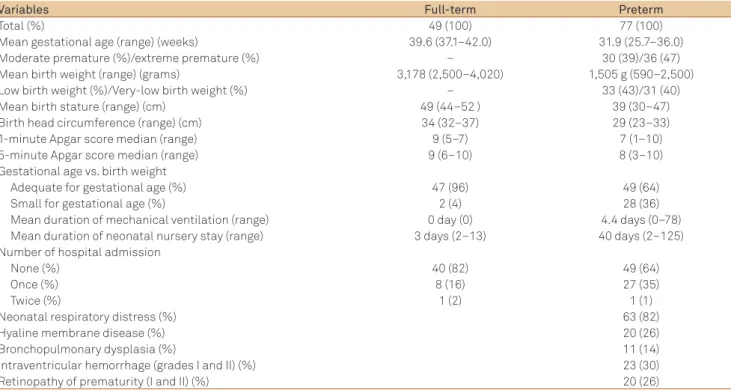
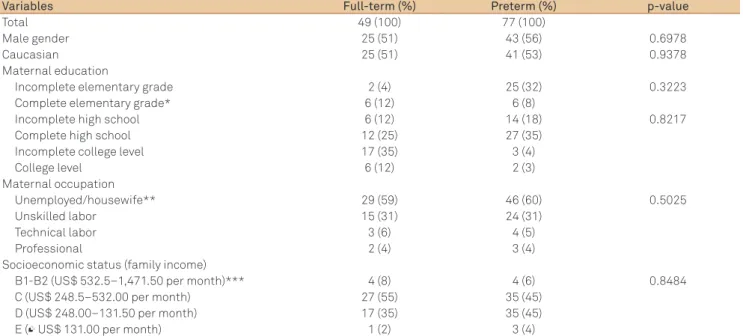
Table 1 shows perinatal characteristics of full-term and preterm infants and preterm perinatal morbidities which variables were also used in the Cox’s proportional hazard re-gression models. Analysis of socioeconomic characteristics revealed similarly distribution across the studied groups as shown in Table 2.
Table 1. Perinatal characteristics of full-term and preterm infants and preterm perinatal morbidities.
Variables Full-term Preterm
Total (%) 49 (100) 77 (100)
Mean gestational age (range) (weeks) 39.6 (37.1–42.0) 31.9 (25.7–36.0)
Moderate premature (%)/extreme premature (%) – 30 (39)/36 (47)
Mean birth weight (range) (grams) 3,178 (2,500–4,020) 1,505 g (590–2,500)
Low birth weight (%)/Very-low birth weight (%) – 33 (43)/31 (40)
Mean birth stature (range) (cm) 49 (44–52 ) 39 (30–47)
Birth head circumference (range) (cm) 34 (32–37) 29 (23–33)
1-minute Apgar score median (range) 9 (5–7) 7 (1–10)
5-minute Apgar score median (range) 9 (6–10) 8 (3–10)
Gestational age vs. birth weight
Adequate for gestational age (%) 47 (96) 49 (64)
Small for gestational age (%) 2 (4) 28 (36)
Mean duration of mechanical ventilation (range) 0 day (0) 4.4 days (0–78) Mean duration of neonatal nursery stay (range) 3 days (2–13) 40 days (2–125) Number of hospital admission
None (%) 40 (82) 49 (64)
Once (%) 8 (16) 27 (35)
Twice (%) 1 (2) 1 (1)
Neonatal respiratory distress (%) 63 (82)
Hyaline membrane disease (%) 20 (26)
Bronchopulmonary dysplasia (%) 11 (14)
Intraventricular hemorrhage (grades I and II) (%) 23 (30)
Longitudinal Alberta Infant Motor Scale scores
Fig 1 shows the mean and standard error score of the AIMS curves of preterm versus full-term infants throughout the follow-up period. Both curves were similar in their pro-gression pattern. Full-term infants mean scores were higher than those for preterm infants during follow-up, except in the irst month. he greatest diference in scores between
groups was observed from the 8th to the 11th months. From
the 12th up to the 16th month, the diference gradually
de-creased. Fig 1 shows that there was less variability in AIMS scores in the irst 6 months for both infant groups, while the greatest variability was observed from 7 to 12 months. From this point onwards, the variability tended to decrease as the infants reached the end of the evaluation. Fig 1 shows that the AIMS standard errors overlapped throughout the follow-up period, with the exception of the eighth, ninth, and tenth months of age.
Predictive value of multiple variables on walking attainment
Fig 2 shows Kaplan-Meier function plots of age of walk-ing attainment distribution for preterm and full-term infants. Fig 2 shows that full-term infants were faster in walking at-tainment than preterm infants. Mean age of onset of walking among full-term was 368.6 days (299–436), whereas among preterm it was 381.6 days (288–470). he diference remained signiicant when 95% conidence interval age of walking at-tainment between preterm and full-term infants was esti-mated (95%CI -1.268–0.162; p<0.05). he percentage of likeli-hood ratio of full-term infant to walk earlier than preterm is 51% (risk ratio=1.51; 95%CI 1.176–3.554).
Regarding mean age at the irst assessment among full-term and prefull-term infants was respectively, 45 days (21–111) and 75 days (11–164), while mean age of completing all 58
Table 2. Socio-demographic characteristics of full-term and preterm infants.
Variables Full-term (%) Preterm (%) p-value
Total 49 (100) 77 (100)
Male gender 25 (51) 43 (56) 0.6978
Caucasian 25 (51) 41 (53) 0.9378
Maternal education
Incomplete elementary grade 2 (4) 25 (32) 0.3223
Complete elementary grade* 6 (12) 6 (8)
Incomplete high school 6 (12) 14 (18) 0.8217
Complete high school 12 (25) 27 (35)
Incomplete college level 17 (35) 3 (4)
College level 6 (12) 2 (3)
Maternal occupation
Unemployed/housewife** 29 (59) 46 (60) 0.5025
Unskilled labor 15 (31) 24 (31)
Technical labor 3 (6) 4 (5)
Professional 2 (4) 3 (4)
Socioeconomic status (family income)
B1-B2 (US$ 532.5–1,471.50 per month)*** 4 (8) 4 (6) 0.8484
C (US$ 248.5–532.00 per month) 27 (55) 35 (45)
D (US$ 248.00–131.50 per month) 17 (35) 35 (45)
E (≤ US$ 131.00 per month) 1 (2) 3 (4)
*Reference variable: complete high-school; **Reference variable: Unemployed/housewife; ***Reference variable: C/D/E. p<0.05%.
Full-term chronological age Pre-term corrected age Age (months)
Scor
es
0 0 10 20 30 40 50 58
1 2 3 4 5 6 7 8 9 10 11 12 13 14 15 16
Preterm Full-term
1.0
Age (days)
Pr
opor
tion unabl
e t
o w
alk
0 100 200 300 400 500 600
0.0 0.2 0.4 0.6 0.8
Fig 1. Progression of the Alberta Infant Motor Scale mean scores (one standard error) of full-term and preterm infants.
AIMS items among full-term and preterm infants was re-spectively, 414.6 days (333–488) and 424.3 days (328–526).
he perinatal independent variables that were statistical-ly signiicant related to walking attainment delay were: birth weight (p<0.0022), birth length (p<0.022), and duration of neonatal nursery stay (p<0.0465). None of the socioeconomic variables were statistically related to walking attainment de-lay (p-value in Table 2).
Univariate proportional hazard regression analysis of perinatal risk factors for late walking attainment among pre-term infants showed that a 100 g increment in birth weight increases by 11% the likelihood ratio of walking attainment (risk ratio=1.108; 95%CI 1.044–1.170) and an 1 cm increment to birth length increases in 12% the likelihood ratio of walk-ing attainment (risk ratio=1.116; 95%CI 1.033–1.207). A de-crease of 10 days of neonatal nursery stay inde-creases by 14% the likelihood ratio of walking attainment (risk ratio=1.137; 95%CI 1.025–1.260).
DISCUSSION
We identiied diferences in early gross motor develop-ment between low risk preterm infants compared with nor-mal full-term infants. here was no statistical diference be-tween preterm and full-term infant AIMS mean scores, with the exception of the eighth, ninth and tenth month periods.
Comparison of the AIMS scores between the preterm and full-term groups was previously reported11,22-26, however the
methodologies were distinct among studies, jeopardizing data comparison.
Formiga and Linhares24 found that the preterm infants
pre-sented greater delay in the AIMS mean scores, especially from 9 to 12 months, while van Haastert et al.22 reported
signiicant-ly lower mean scores at all age levels. In a previous study25, we
did not ind statistical diferences in the AIMS mean scores be-tween the preterm infant group and the AIMS normative data, during the irst year of life.
Regarding the study design, we followed our in-fants longitudinally from the irst hospital visit until all infants had completed the 58 AIMS items and had under-gone a comprehensive neurological examination. As we in-tended to draw the typical motor development pattern of the preterm infants over time, we chose to test both
in-fant groups monthly, rather than doing it twice5 or at
ev-ery three months up to 18 months23. Interestingly, we found
diferences between the groups only at eight, nine, and ten months, when preterm infant mean scores were statisti-cally lower than full-term infants’. A longitudinal study of infant performance on the AIMS revealed that measure-ments (raw scores, percentile ranks) varied from age to
age with no systematic pattern within individual infants27.
herefore, this inding may suggest that preterm infants have a diferent pattern of score progression than full-term
infants, which could be a biological variability between preterm and full-term infants. Alternatively, it is possible
that the period between the 8th and 12th months is of
spe-cial importance for early gross motor development due to the greatest score increase and the greatest diference in mean scores between our comparison groups. Darrah et
al.27 observed that the rate of motor development in
nor-mal developing infants is characterized by within-subject variability and non-linearity of skill emergence. here are peaks, valleys, and plateaus in the neuro-developmental trajectories of standardized measures to provide informa-tion about child skill development, which indicates peri-ods of acceleration, deceleration, or quiescence of activity. Preterm infant motor trajectories resemble those of full-term infants, as characterized by gradual increase in the AIMS scores with advancing age, alternating with periods of more or less quiescence. Both of our groups exhibited the
greatest score increase between the 8th and 12th months of
age. In the irst three months and between the 12th and 16th
months, the score slope of preterm infants showed a slow increase with a tendency of quiescence, characterized by at-tainment of few new motor skills. he small score increase or variation is limited towards the two ends of the mea-surement (in the irst trimester and from 12 to 16 months), whereas the period between 8 and 12 months shows great-er score variation. During this pgreat-eriod, the AIMS items ag-gregate at the middle range of diiculty level, which sug-gests that the AIMS is suiciently precise to discriminate among infants whose ability levels are in the middle range, but not at the lowest nor at the highest ability ends. Small score variation in the irst three months may be due to the fact that there are only a few items in prone and supine po-sitions that are commonly observed in infants at this age. However, after walking attainment (between 12 and 16 months), there are only standing items available to com-plete the 58 items28.
Alternatively, this variability in the AIMS scores in these speciic months may be related to limitations of the scaling of the AIMS items, as there is a discontinuity in item diiculty28.
here are gaps at several diiculty levels, which indicate that a large jump in ability level is required to pass one or more items around the gap.
We observed delay of approximately one month in walking attainment among preterm infants (the mean age of onset walking in preterm: 381.6 days; and in full-term infants: 368.6 days), which agreed with some stud-ies8,13,14. The age of onset of walking of our full-term
in-fants was close to that reported by Allen and Alexander9.
Some studies8,12 suggested that the age of walking
to verify the predictive value in other areas of the
neuro-motor development. Johnson, Goddard and Ashurst12
ob-served that more than half of the late walkers had an asso-ciated neurological abnormality diagnosed before the age of 3, whereas 15% had no neurological dysfunction. It is a matter of speculation whether delay in walking among extremely low birth weight children can indicate subtle damage to motor control functions seen in “soft” or MND.
Bartlett et al.29 reported that a significant proportion of
children born preterm without major neurological condi-tion were delayed in the acquisicondi-tion of antigravity postur-al control and motor development, such as wpostur-alking mile-stone. We found that birth weight and length and duration of nursery stay in the neonatal period had strong associa-tion with delay in preterm walking attainment.
Our results agree with studies10,11,30 that found a negative
relation between late attainment of walking and extreme prematurity, small-for-gestational-age, and very-low birth weight infants.
We conclude that preterm infants walk later than full-term infants, and that very low birth weight and length, and duration of neonatal nursery stay were predictive of late walking in preterm infants.
ACKNOWLEDGMENTS
To Applied Statistics Center (CEA), from Statistics and Mathematics Institute of Universidade de São Paulo (IME-USP) and all infants and their families.
1. Wilson-Costello D. Is there evidence that long-term outcomes have improved with intensive care? Semin Fetal Neonatol Med 2007;12:344-354.
2. Han TR, Bang MS, Lim JY, Yoon BH, Kim IO. Risk factors of cerebral palsy in infants. Am J Phys Med Rehabil 2002;81: 297-303.
3. Hadders-Algra M. Two distinct forms of neurological dysfunction: perspectives emerging from review of data of the Groningen Perinatal Project. Dev Med Child Neurol 2002;44:561-571.
4. Marlow N, Henessy EM, Bracelwell MA, Wolke D, EPICure Study Group. Motor and executive function at 6 years of age after extremely preterm birth. Pediatrics 2007;120:793-804.
5. Piper MC, Byrne PJ, Darrah J, Watt MJ. Gross and fine motor development of preterm infants at eight and 12 months of age. Dev Med Child Neurol 1989;31:591-597.
6. Vaivre-Douret L, Ennouri K, Jrad I, Garrec C, Papiernik E. Effect of positioning on the incidence of abnormalities of muscle tone in low-risk infants. Eur J Paediatr Neurol 2004;8:21-34.
7. Kamm K, Thelen E, Jensen JL. A dynamical system approach to motor development. Phys Ther 1990;70:763-775.
8. Kokubun M, Haishi K, Okuzumi H, Hosobuchi T, Koike T. Predicitive value of age of walking for later motor performance in children with mental retardation. J Intellect Disabil Res 1996;40:529-534. 9. Allen MC, Alexander GR. Screening for cerebral palsy in preterm
infants: delay criteria for motor milestones attainment. J Perinatol 1994;14:190-193.
10. Largo RH, Molinari L, Weber M, Pinto LC, Duc G. Early development of locomotion: significance of prematurity, cerebral palsy and sex. Dev Med Child Neurol 1985;27:183-191.
11. Jeng S, Yau K, Liao H, Chen L, Chen P. Prognostic factors for walking attainment in very low-birthweight infants. Early Hum Dev 2000;59:159-173.
12. Johnson A, Goddard O, Ashurst H. Is late walking a marker of morbidity? Arch Dis Child 1990;65:486-488.
13. De Groot L, de Groot CJ, Hopkins B. An instrument to measure independent walking: are there differences between preterm and fullterm infants: J Child Neurol 1997;12:37-41.
14. Jeng SF, Lau TW, Hsieh WS, et al. Development of walking in preterm and term infants: age of onset, qualitative features and sensitivity to resonance. Gait Posture 2008;27:340-346.
15. Piper MC, Darrah J. Motor assessment of the developing infant. Philadelphia: W.B. Saunders, 1994.
16. Papile LA, Burstein J, Burstein R, Koffler H. Incidence and evolution of subependymal and intraventricular hemorrhage: a study of infants with birth-weights less than 1,500 gm. J Pediatr 1978;92:529-534. 17. Sarnat HB, Sarnat MS. Neonatal encephalopathy following fetal
distress: a clinical and eletroencephalographic study. Arch Neurol 1976;33:696-705.
18. Ballard JL, Khoury JC, Wedig K, Wang L, Eliers-Walsman BL, Lipp R. New Ballard Score: expanded to include extremely premature infants. J Pediatr 1991;119:417-423.
19. Capurro H, Korichzky S, Fonseca O, Caldeiro-Barcia R. A simplified method for diagnosis of gestational age in the newborn infant. J Pediatr 1978;93:120-122.
20. Rutter M. Pesquisa de mercado. São Paulo: Ática, 1988.
21. Lee ET. Statistical methods for survival data analysis. Belmont: Wadsworth, 1980.
22. van Haastert IC, de Vries LS, Helders PJM, Jognmans MJ. Early gross motor development of preterm infants according to the Alberta Infant Motor Scale. J Pediatr 2006;149:617-622.
23. Pin TW, Eldridge B, Galea MP. Motor trajectories from 4 to 18 months corrected age in infants born at less than 30 weeks of gestation. Early Hum Dev 2010;86:573-580.
24. Formiga CKMR, Linhares MBM. Motor development curve from 0 to 12 months in infants born preterm. Acta Paediatr 2011;100:379-384. 25. Restiffe AP, Gherpelli, JLD. Comparison of chronological and corrected
ages in the gross motor assessment of low-risk preterm infants during the first year of life. Arq Neuropsiquiatr 2006;64:418-425. 26. Giachetta L, Nicolau CM, Costa, APBM, Zuana AD. Influência do tempo
de hospitalização sobre o desenvolvimento neuromotor de recém-nascidos pré-termo. Fisioter Pesq 2010;17:24-29.
27. Darrah J, Redfern L, Maguire TO, Beaulne AP. Intra-individual stability of rate of gross motor development in full term infants. Early Hum Dev 1998;52:169-179.
28. Liao PM, Campbell SK. Examination of item structure of the Alberta Infant Motor Scale. Pediatr Phys Ther 2004;16:31-38.
29. Bartlett DJ, Fanning JK, Miller L, Conti-Becker A, Doralp S. Development of the Daily Activities of Infant Scale: a measure supporting early motor development. Dev Med Child Neurol 2008;50:613-617. 30. Marín Gabriel MA, Pallás Alonso CR, De La Cruz Bértolo J, et al. Age of
sitting unsupported and independent walking in very low birth weight preterm infants with normal motor development at 2 years. Acta Paediatr 2009;98:1815-1821.