Abstract
Objectives: To compare Alberta Infant Motor Scale scores for Brazilian infants with the Canadian norm and to construct sex-speciic reference curves and percentiles for motor development for a Brazilian population.
Methods: This study recruited 795 children aged 0 to 18 months from a number of different towns in Brazil. Infants were assessed by an experienced researcher in a silent room using the Alberta Infant Motor Scale. Sex-speciic percentiles (P5, P10, P25, P50, P75 and P90) were calculated and analyzed for each age in months from 0 to 18 months.
Results: No signiicant differences (p > 0.05) between boys and girls were observed for the majority of ages. The exception was 14 months, where the girls scored higher for overall motor performance (p = 0.015) and had a higher development percentile (0.021). It was observed that the development curves demonstrated a tendency to nonlinear development in both sexes and for both typical and atypical children. Variation in motor acquisition was minimal at the extremes of the age range: during the irst two months of life and from 15 months onwards.
Conclusions: Although the Alberta Infant Motor Scale is widely used in both research and clinical practice, it has certain limitations in terms of behavioral differentiation before 2 months and after 15 months. This reduced sensitivity at the extremes of the age range may be related to the number of motor items assessed at these ages and their dificulty. It is suggested that other screening instruments be employed for children over the age of 15 months.
J Pediatr (Rio J). 2012;88(1):40-7: Assessment, motor skills, child development. Copyright © by Sociedade Brasileira de Pediatria
40 Introduction
Early identiication of motor dysfunction in children is a challenge for professionals working in preventative programs,1-3 particularly those working with the Brazilian
population for whom there is a lack of validated and standardized instruments. A number of different scales have been used for this purpose.4 However, the use of instruments
without regard for the necessary cultural adaptations can lead
to erroneous characterization of motor development.5 The
results of instruments that have been standardized in their
country of origin may suffer interference after adaptation to
other locations and from a range of socioeconomic, ethnic and cultural factors.5
The Alberta Infant Motor Scale (AIMS) is an observational
instrument for measuring gross motor function which
assesses antigravity musculature control in four different positions.6 It is used in research, clinical practice and
Reference curves for the Brazilian Alberta Infant Motor Scale:
percentiles for clinical description and follow-up over time
Raquel Saccani,1 Nadia C. Valentini2
1. Doutoranda, Ciências do Movimento Humano, Escola Superior de Educação Física, Universidade Federal do Rio Grande do Sul (UFRGS), Porto Alegre, RS, Brazil.
2. PhD, Health and Human Performance, Auburn University, Auburn, USA.
No conflicts of interest declared concerning the publication of this article.
Suggested citation: Saccani R, Valentini NC. Reference curves for the Brazilian Alberta Infant Motor Scale: percentiles for clinical description and follow-up over time. J Pediatr (Rio J). 2012;88(1):40-7.
Manuscript submitted Apr 23 2011, accepted for publication Aug 22 2011. http://dx.doi.org/10.2223/JPED.2142
intervention activities.4 The AIMS has been used to identify
developmental delays or abnormalities, to monitor children’s development, to detect subtle changes and to assess the eficacy of interventions.4,6 In response to the widespread use
of AIMS, researchers from different countries have proposed
adaptations of the instrument to respond to the cultural and
socioeconomic diversity of different populations.7-14
The AIMS was recently validated for the Brazilian population, resulting in a Brazilian version, entitled Escala Motora Infantil de Alberta. The validation study reported that the adapted version possessed content, criterion and construct validity, reafirming the AIMS’ potential for scientiic research and clinical use.14 However, that study
did not propose speciic references for normality to be
used in the analysis of the motor performance of Brazilian
children. Therefore, although the scale has been validated, the norms used for performance and their respective reference values for describing motor acquisition and dysfunction in research are still the Canadian standards. It is therefore essential that motor performance curves be constructed from normative parameters that can be used
for the comparison of Brazilian children
.
An individual’sscore in a given test is only meaningful when compared with the results of a representative group drawn from the same population.5,6,9,14 Therefore, the objectives of this study were to compare data from Brazilian children with
the Canadian standard and to develop sex-speciic motor development reference curves and calculate percentiles for use with the Brazilian population.
Methods
Study design and participants
First, health and education departments were contacted. After the study had been approved, the parents and/or legal guardians of children (0 to 18 months) at institutions that agreed to take part (n = 150) were contacted. Children (n = 795) were recruited consecutively over a 3-year data collection period from infant schools, basic healthcare
centers and institutions in the state of Rio Grande do Sul
that did not take part in intervention programs. The following
exclusion criteria were applied: conditions affecting the
bones, muscles and joints, such as fractures, peripheral nerve injuries, musculoskeletal infections, and others. The study was approved by the Research Ethics Committee and
only children whose guardians signed free and informed
consent forms took part.
The age group was chosen in accordance with the protocol
for the original instrument.6 The sample size calculation was
performed using Programs for Epidemiologists version 4.0, for a 95% conidence level, a 50% proportion of responses and a 4% margin of error, which resulted in a minimum of 600 children. The number of participants was then increased
until a minimum of 30 children were recruited for each
month of age (Table 1). Data from a census conducted by the Brazilian Institute of Geography and Statistics (Instituto Brasileiro de Geograia e Estatística, IBGE)15 were used to
ensure that the sample had a representative distribution in terms of sex, gestational age at birth in weeks, geographical location (representation of provincial towns and the state capital) and social classes. A similar proportion of preterm to
full term children as used in the original Canadian study6 was
also adopted for this study. The resulting sample comprised 407 girls and 388 boys (658 full term and 137 preterms), from provincial towns (ive) and from the state capital and from different socioeconomic classes. Family income varied from R$ 200.00 to R$ 7,000.00 per month, with a mean of R$ 1,351.00 (standard deviation = R$ 1,255) and a median of R$ 700.00 (P25 = R$ 600.00; P75 = R$ 1,725.00). A
statistical comparison of the IBGE census data15 and the
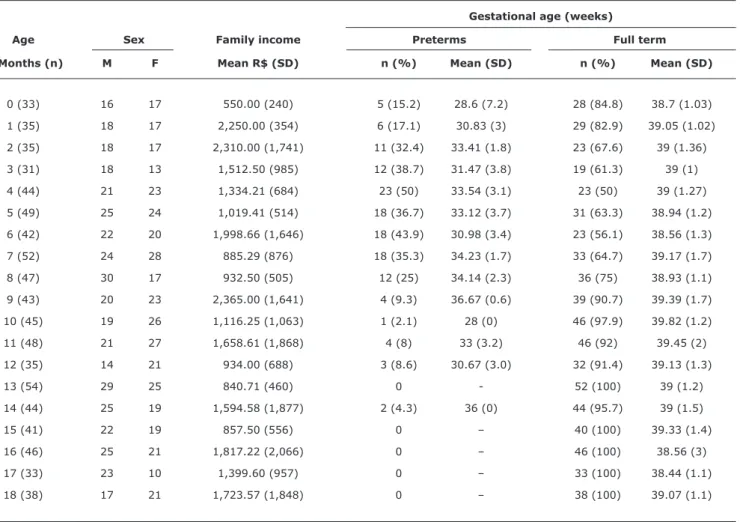
sample conirmed that the population of this study was adequately representative (Chi square = 0.50; p = 0.48). Outliers were identiied using box-plots (with cutoff points at 10% from the maximum and minimum values) and 23 children were excluded on this basis. Table 1 lists the sample characteristics by months of age, in terms of sex, percentage prematurity, gestational age and socioeconomic status.
Instruments and procedures
The Brazilian version of the AIMS was the subject of this study. Its validation is described in another paper.14
The results of that validation demonstrated the following: 1) content validity for clarity (
α
= 66.7 toα
= 92.8) and relevance (greater than 0.98); 2) reliable test/retest indices, with stability over time and robust reliability for total scores (α
= 0.88) and for the four different positions (α
prone = 0.86;α
supine = 0.89;α
sitting = 0.80; andα
standing =0.85); and discriminatory capacity (-4.842; p < 0.001).14
The AIMS is made up of 58 motor criteria in four subscales, describing the development of spontaneous movements
and motor abilities of children aged 0 to 18 months in
the prone (21), supine (9), sitting (12) and standing (16) positions. The overall score is obtained by summing the scores for each of the subscales and is then converted into a percentile. Percentiles are grouped into motor development categories: when the percentile is below 5%, the child is judged to have abnormal motor performance; from 5% to 25%, motor performance is suspect; and above 25%, motor performance is considered normal.6
Tests lasted an average of 20 minutes, were conducted in a calm environment at the institutions from which children were recruited and were ilmed for later analysis. During assessment of the ilms, three independent assessors examined the child’s free movement, focusing on aspects such as the body surface that was bearing weight, posture and antigravity movements. The rate of agreement between examiners was high (intraclass correlation coeficients from
Gestational age (weeks)
Age Sex Family income Preterms Full term
Months (n) M F Mean R$ (SD) n (%) Mean (SD) n (%) Mean (SD)
0 (33) 16 17 550.00 (240) 5 (15.2) 28.6 (7.2) 28 (84.8) 38.7 (1.03)
1 (35) 18 17 2,250.00 (354) 6 (17.1) 30.83 (3) 29 (82.9) 39.05 (1.02)
2 (35) 18 17 2,310.00 (1,741) 11 (32.4) 33.41 (1.8) 23 (67.6) 39 (1.36)
3 (31) 18 13 1,512.50 (985) 12 (38.7) 31.47 (3.8) 19 (61.3) 39 (1)
4 (44) 21 23 1,334.21 (684) 23 (50) 33.54 (3.1) 23 (50) 39 (1.27)
5 (49) 25 24 1,019.41 (514) 18 (36.7) 33.12 (3.7) 31 (63.3) 38.94 (1.2)
6 (42) 22 20 1,998.66 (1,646) 18 (43.9) 30.98 (3.4) 23 (56.1) 38.56 (1.3)
7 (52) 24 28 885.29 (876) 18 (35.3) 34.23 (1.7) 33 (64.7) 39.17 (1.7)
8 (47) 30 17 932.50 (505) 12 (25) 34.14 (2.3) 36 (75) 38.93 (1.1)
9 (43) 20 23 2,365.00 (1,641) 4 (9.3) 36.67 (0.6) 39 (90.7) 39.39 (1.7)
10 (45) 19 26 1,116.25 (1,063) 1 (2.1) 28 (0) 46 (97.9) 39.82 (1.2)
11 (48) 21 27 1,658.61 (1,868) 4 (8) 33 (3.2) 46 (92) 39.45 (2)
12 (35) 14 21 934.00 (688) 3 (8.6) 30.67 (3.0) 32 (91.4) 39.13 (1.3)
13 (54) 29 25 840.71 (460) 0 - 52 (100) 39 (1.2)
14 (44) 25 19 1,594.58 (1,877) 2 (4.3) 36 (0) 44 (95.7) 39 (1.5)
15 (41) 22 19 857.50 (556) 0 – 40 (100) 39.33 (1.4)
16 (46) 25 21 1,817.22 (2,066) 0 – 46 (100) 38.56 (3)
17 (33) 23 10 1,399.60 (957) 0 – 33 (100) 38.44 (1.1)
18 (38) 17 21 1,723.57 (1,848) 0 – 38 (100) 39.07 (1.1)
Table 1 - Sample characteristics by age in months
M = male; F = female; n = number of children; SD = standard deviation.
detect signiicant differences between the three assessors’ results (p > 0.05).
A questionnaire was given to each child’s parents and/or legal guardians in order to provide a basis for characterization of the sample and for pairing groups. The questionnaire covered the following: date of birth, sex, type of delivery, gestational age at birth in weeks, 5 minute Apgar score, birth weight, length at birth, head circumference and monthly family income.
Data analysis
Analyses were conducted using Excel XP and SPSS version 17.0. The raw AIMS scores were described as means, medians, standard deviations, minimum and maximum values and percentiles (5, 10, 25, 50, 75 and 90%) by sex and for each age in months from 0 to 18 months. Student’s
t test for independent samples was used to compare sex and one-sample t test was use to compare countries. The
signiicance level was set at 5% (p ≤ 0.05).
Results
Table 2 shows the means for the Brazilian children’s raw scores and the reference values from the Canadian population. Motor behaviors were similar for newborn children and for 7, 8, 14, 16 and 17 months of age. At all other ages signiicant differences were detected. The Brazilian children’s motor acquisition scores were lower that the Canadian norm at all ages except 18 months.
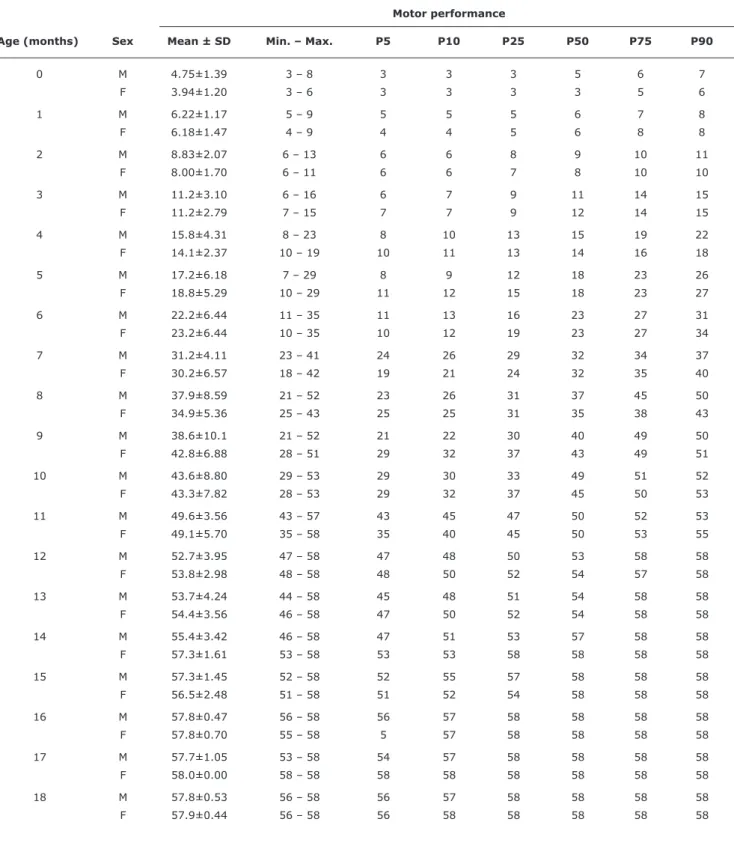
When percentiles and raw scores were broken down by sex, no signiicant differences (p > 0.05) between boys and girls were detected, with the exception of 14 months,
where the girls had better performance in terms of total
score (p = 0.015) and percentile (p = 0.021).
Table 2 - Mean motor performance (raw scores) and comparisons for a Brazilian and a Canadian population, by age in months
M = mean; SD = standard deviation. * Statistical significance.
Student's t test for one-sample.
observed that there is little behavioral differentiation from 15 months of age onwards and little variation in acquisition at the extremes of the age range. Standard deviations were low for the irst 2 months of life and from 15 months onwards, indicating a low capacity for differentiating between typical, suspect and atypical behaviors. Also of note is the fact that many of the cutoff points were the same at these ages, which is not the case for 3 to 13 months of age. The results for males and females were similar, since there was homogeneity
in different age groups and minimal differentiation between
children’s motor acquisitions from 14/15 months of age onwards. Furthermore, the 17-month-old children all had similar behavior and no differences in motor acquisitions were detected in this age group. Analysis of percentiles by age (P5, P10, P25, P50, P75, P90) detected little difference
between children with high and low performance scores
for the irst months and from 14 and 15 months onwards among the girls and boys respectively.
Figure 1 illustrates the sample’s performance in the form of percentile curves. With reference to some of the cutoff points (P5, P10 and P25), it will be observed that motor acquisition was nonlinear. After approximately 15 months of age, plateaus appear in curves for both sexes. Once more,
the low degree of variability at the age extremes is notable,
particularly from 15 months of age onwards and up to the
second month of life. For both sexes, greater variability occurred from 3 to 13 months of age.
Discussion
This is the irst study designed to produce standardized AIMS scores for the Brazilian infant population. Previous
studies7,14 have not established reference norms based on
the developmental path of Brazilian children. It should be pointed out that the validation process, which has been completed for Brazil,14 and the establishment of norms are
distinct objectives. When an instrument possesses validity for a speciic population, new norms should be established that best represent that population,5,6,9,17,18 and that was
the objective of this study.
There have been no Brazilian studies that have
standardized AIMS using full term and preterm children
aged 0 to 18 months and, internationally, there have been just two studies, one in Holland and the other in Greece.5,17
Fleuren et al.,5 assessed 100 children and concluded that
new percentiles should be deined for Holland because the
Brazil Canada Independent
Age (months) M score ± SD M score ± SD t test p
0 4.33±1.34 4.55±1.35 -0.93 0.36
1 6.20±1.30 7.3±1.95 -5.0 < 0.0001*
2 8.43±1.91 9.8±2.45 -4.23 < 0.0001*
3 11.2±2.93 12.6±3.3 -2.67 0.012*
4 14.9±3.50 17.85±4.14 -5.57 < 0.0001*
5 18.0±5.75 23.2±4.75 -6.35 < 0.0001*
6 22.6±6.38 28.3±5.55 -5.75 < 0.0001*
7 30.7±5.54 32.25±6.85 -2.08 0.43
8 36.8±7.66 39.75±8.7 -2.614 0.12
9 40.8±8.66 45.45±7.45 -3.49 0.001*
10 43.4±8.15 49.3±5.9 -4.85 < 0.0001*
11 49.3±4.84 51.25±7.1 -2.77 0.008*
12 53.4±3.39 55.55±4.5 -3.81 0.01*
13 54.0±3.92 55.6±5.05 -2.93 0.005*
14 56.3±2.92 56.85±1.95 -1.36 0.18
15 56.9±2.00 57.8±0.4 -2.79 0.008*
16 57.8±0.58 57.8±0.5 0.051 0.96
17 57.8±0.88 57.85±0.35 -0.21 0.84
Motor performance
Age (months) Sex Mean ± SD Min. – Max. P5 P10 P25 P50 P75 P90
0 M 4.75±1.39 3 – 8 3 3 3 5 6 7
F 3.94±1.20 3 – 6 3 3 3 3 5 6
1 M 6.22±1.17 5 – 9 5 5 5 6 7 8
F 6.18±1.47 4 – 9 4 4 5 6 8 8
2 M 8.83±2.07 6 – 13 6 6 8 9 10 11
F 8.00±1.70 6 – 11 6 6 7 8 10 10
3 M 11.2±3.10 6 – 16 6 7 9 11 14 15
F 11.2±2.79 7 – 15 7 7 9 12 14 15
4 M 15.8±4.31 8 – 23 8 10 13 15 19 22
F 14.1±2.37 10 – 19 10 11 13 14 16 18
5 M 17.2±6.18 7 – 29 8 9 12 18 23 26
F 18.8±5.29 10 – 29 11 12 15 18 23 27
6 M 22.2±6.44 11 – 35 11 13 16 23 27 31
F 23.2±6.44 10 – 35 10 12 19 23 27 34
7 M 31.2±4.11 23 – 41 24 26 29 32 34 37
F 30.2±6.57 18 – 42 19 21 24 32 35 40
8 M 37.9±8.59 21 – 52 23 26 31 37 45 50
F 34.9±5.36 25 – 43 25 25 31 35 38 43
9 M 38.6±10.1 21 – 52 21 22 30 40 49 50
F 42.8±6.88 28 – 51 29 32 37 43 49 51
10 M 43.6±8.80 29 – 53 29 30 33 49 51 52
F 43.3±7.82 28 – 53 29 32 37 45 50 53
11 M 49.6±3.56 43 – 57 43 45 47 50 52 53
F 49.1±5.70 35 – 58 35 40 45 50 53 55
12 M 52.7±3.95 47 – 58 47 48 50 53 58 58
F 53.8±2.98 48 – 58 48 50 52 54 57 58
13 M 53.7±4.24 44 – 58 45 48 51 54 58 58
F 54.4±3.56 46 – 58 47 50 52 54 58 58
14 M 55.4±3.42 46 – 58 47 51 53 57 58 58
F 57.3±1.61 53 – 58 53 53 58 58 58 58
15 M 57.3±1.45 52 – 58 52 55 57 58 58 58
F 56.5±2.48 51 – 58 51 52 54 58 58 58
16 M 57.8±0.47 56 – 58 56 57 58 58 58 58
F 57.8±0.70 55 – 58 5 57 58 58 58 58
17 M 57.7±1.05 53 – 58 54 57 58 58 58 58
F 58.0±0.00 58 – 58 58 58 58 58 58 58
18 M 57.8±0.53 56 – 58 56 57 58 58 58 58
F 57.9±0.44 56 – 58 56 58 58 58 58 58
Table 3 - AIMS reference values for motor performance of Brazilian children (raw scores and percentiles), by age and by sex
AIMS = Alberta Infant Motor Scale; SD = standard deviation; M = males; F = females.
Descriptive analysis: mean, standard deviation, minimum, maximum and percentiles (5, 10, 25, 50, 75 and 90%).
motor performance scores they observed were below the Canadian standard. In contrast, Syrengelas et al.17 conducted
a study with 424 full term Greek babies and found that their development path was similar to that of the Canadian
children, demonstrating that the AIMS reference values could be used without loss of important clinical information. In Brazil, Formiga et al.18 described development curves
for national parameters to be created and adopted after
observing that the motor performance of preterm Brazilian children was inferior to the Canadian norm.18 This is in
contrast to another Brazilian study that identiied similarities in the behavior of Brazilian and Canadian babies.19
This study was designed to analyze a sample that
adequately represents the population, including equivalent
numbers of male and female children and a similar
distribution of subjects from the provinces and the city, as is the case in the IBGE data,15 use of similar parameters as
the Canadian norm in terms of the participation of preterm
and full term children and use of corrected age.6 All age
groups were covered adequately, avoiding any possibility of sample size bias. Since the results demonstrated that the Brazilian children’s scores were lower (both raw and percentiles) than the Canadian norm, which indicates different development paths, new norms were established with an adequate and reliable categorization of the motor performance of the Brazilian infant population.
It should be pointed out that the properties of any assessment instrument will suffer interference from adaptation to a different scenario and from different
socioeconomic, ethnic and cultural factors.5,9 Prior research has already demonstrated that the motor performance of Brazilian children in this age group is inferior to results that
have been observed in other countries7,18,20 and is probably
determined by multiple factors that involve increased daily exposure to biological and contextual risk factors.21,22
Biological risks (low birth weight, prematurity and malnutrition, for example)21-23 and social, economic
and cultural risks such as: 1) parents with little formal
education22; 2) low spending power21,22; 3) maternal
habits of carrying children and putting them in cots or pushchairs24-26; 4) a limited variety of stimulation at home,
including toys that are appropriate for development24,27,28;
and 5) a large number of children cared for by a single adult,22 all affect the acquisition of motor abilities and
potentiate motor development delays.
More speciically, several researchers have pointed out that the when the supine position predominates when awake
and when playing24,29 and also when asleep25,26 this tends to
decelerate acquisition of straightening reactions and postural adjustments.24,29 Publicity campaigns30 have encouraged
mothers to adopt the supine position for their children, which may result in restrictions to postural development. In Holland, similar government campaigns have been
considered important mediators of poor motor performance
among children assessed using AIMS.5 Future research
that investigates maternal practices could contribute to an understanding of the different infant motor development paths in different cultures.
With regard to sex, it was observed that Brazilian girls and boys have a similar motor acquisition pattern up to 13 months. The signiicantly superior motor performance at 14 months of age of the girls, when compared with the boys, contrasts with previous studies.6,7,31 This result is intriguing
since previous Brazilian studies with similar age groups, one
with a population from Rio Grande do Sul state7 and another
from the Northeast of Brazil,31 did not observe differences
between the sexes. Differences between sexes could be the
result of expectations in terms of what is considered most
appropriate for each sex.32 As age increases, disparities in motor abilities accentuate32 and from two years of
age onwards different social and motor behaviors can be
References
1. Vanderveen JA, Bassler D, Robertson CM, Kirpalani H. Early interventions involving parents to improve neurodevelopmental outcomes of premature infants: a meta-analysis. J Perinatol. 2009;29:343-51.
2. Blackman JA. Early intervention: a global perspective. Inf Young Children. 2002;15:11-19.
3. Blauw-Hospers CH, de Graaf-Peters VB, Dirks T, Bos AF, Hadders-Algra M. Does early intervention in infants at high risk for a developmental motor disorder improve motor and cognitive development? Neurosci Biobehav Rev. 2007;31:1201-12. 4. Spittle AJ, Doyle LW, Boyd RN. A systematic review of the clinimetric
properties of neuromotor assessments for preterm infants during the irst year of life. Dev Med Child Neurol. 2008;50:254-66 5. Fleuren KM, Smit LS, Stijnen T, Hartman A. New reference values
for the Alberta Infant Motor Scale need to be established. Acta
Paediatr. 2007;96:424-7.
6. Piper MC, Darrah J. Motor assessment of the developing infant. Philadelphia: WB Saunders Company; 1994
7. Saccani R, Valentini NC. Análise do desenvolvimento motor de crianças de 0 a 18 meses de idade: representatividade dos itens da Alberta Infant Motor Scale por faixa etária e postura. Rev. bras. crescimento desenvolv. hum. 2010;20:753-64.
8. Liao PJ, Campbell SK. Examination of the item structure of the Alberta infant motor scale. Pediatr Phys Ther. 2004;16:31-8. 9. Jeng SF, Yau KI, Chen LC, Hsiao SF. Alberta infant motor scale:
realiability and validity when used on preterm infant in Taiwan. Phys Ther. 2000;80:168-78.
10. Darrah J, Piper M, Watt MJ. Assessment of gross motor skills of at-risk infants: predictive validity of the Alberta Infant Motor Scale. Dev Med Child Neurol. 1998;40:485-91.
11. Heineman KR, Bos AF, Hadders-Algra M. The Infant Motor Proile: a standardized and qualitative method to assess motor behaviour in infancy. Dev Med Child Neurol. 2008; 50:275-82.
12. Tse L, Mayson TA, Leo S, Lee LL, Harris SR, Hayes VE, et al. Concurrent validity of the Harris Infant Neuromotor Test and the Alberta Infant Motor Scale. J Pediatr Nurs. 2008;23:28-36. 13. Bartlett DJ, Fanning JK, Miller L, Conti-Becker A, Doralp S.
Development of the daily activities of infants scale: a measure supporting early motor development. Dev Med Child Neurol. 2008;50:613-7.
14. Valentini NC, Saccani R. Escala motora infantil de Alberta: validação para uma população. Rev Paul Pediatr. 2011;29:231-8. 15. Instituto Brasileiro de Geografia e Estatística (IBGE).
Censo demográico 2010. http://www.ibge.gov.br. Access: 12/12/2010.
16. Callegari-Jacques SM. Bioestatística: princípios e aplicações. Porto Alegre: Artmed; 2003.
17. Syrengelas D, Siahanidou T, Kourlaba G, Kleisiouni P, Bakoula C, Chrousos GP. Standartization of the Alberta Infant Motor Scale in full term Greek infants: Preliminary results.Early Hum Dev. 2010;86:245-9.
18. Formiga CKMF, Linhares MB. Motor development curve from 0 to 12 months in infants born preterm. Acta Paediatr. 2011;100:379-84.
19. Manacero S, Nunes ML. Avaliação do desempenho motor de prematuros nos primeiros meses de vida na Escala Motora Infantil de Alberta (AIMS). J Pediatr. 2008;84:53-9.
20. Lopes VB, Lima CD, Tudella E. Motor acquisition rate in Brazilian infants. Inf Child Dev. 2009;18:122-32.
observed.33 The results of this study suggest that these
differences may occur even earlier.
The results of this study underscore the adequacy
of AIMS for assessing the motor performance of babies
aged 3 to 14 months. However, it was observed that the
instrument has limited capacity for differentiating motor
behaviors at the extremes of the age range, up to 2 months of age and after 15 months, since the percentiles at several cutoff points varied little or even remained equal. This
reduced differentiation can also be seen in the Canadian
reference values,6 since plateaus have been reported in the
development curves after 15 months of age and few motor acquisitions are seen during the irst 2 months,6 which is
similar to the results reported here.
The motor performance of this sample followed a
nonlinear pattern of motor acquisition, which has been reported in previous studies18,20; but these differences
do not necessarily indicate motor delay, since the scale’s degree of dificulty appears to change at different ages. These results lead us to question the low number of items
included and also which of these items are actually capable of determining and differentiating motor performance
in children over 15 months, since a large proportion
of the sample easily performed all of the items at this
age. Previous studies have also pointed to the limited sensitivity of AIMS and questioned its applicability at the extremes of the age range.8,9 For example, Liao et
al.8 pointed out how few of the items were capable of
differentiating infants with advanced development and the discontinuity in intensity of the levels of dificulty at different ages. It is suggested that the scale be treated with caution for infants over 15 months old and younger
than two months and that supplementary instruments also
be used, in order to provide a clear picture of children’s motor development categories.
The scientiic and clinical relevance of this study increases
in line with the use of AIMS in Brazil and is based on the clear necessity for using national references to describe
children’s motor acquisitions and disorders
.
Using normsthat are not Brazilian and have not been validated for our population restricts health professionals’ activities. Although this sample was an adequate representation of the infant population of Rio Grande do Sul, there are limitations to
the extent to which it can be generalized for the entire
Brazilian infant population.
In order to achieve a wide-ranging characterization of Brazilian motor development, future studies must be conducted that include all regions, with a stratiied sample of the whole country, which may reveal intercultural variations. It is recommended that the parameters developed in this study only be used with populations with similar socioeconomic characteristics. It is worth
reiterating the importance of research designed to
standardize AIMS scores, particularly in South America,
where sociocultural characteristics are different from those
21. Walker SP, Wachs TD, Gardner JM, Lozoff B, Wasserman GA, Pollitt E, et al. Child development: risk factors for adverse outcomes in developing countries. Lancet. 2007;369:145-57.
22. Halpern R, Giugliani ER, Victora CG, Barros FC, Horta BL. Risk factors for suspicion of developmental delays at 12 months of age. J Pediatr (Rio J). 2000;76:421-8.
23. Van Haastert IC, de Vries LS, Helders PJ, Jongmans MJ. Early gross motor development of preterm infants according to the Alberta Infant Motor Scale. J Pediatr. 2006;149:617-22. 24. Bartlett DJ, Kneale Fanning JE. Relationships of equipment use and
play positions to motor development at eight months corrected
age of infants born preterm. Pediatr Phys Ther. 2003;15:8-15.
25. Majnemer A, Barr RG. Inluence of supine sleep positioning on early motor milestone acquisition. Dev Med Child Neurol. 2005;47:370-6.
26. Majnemer A, Barr RG. Association between sleep position and early motor development. J Pediatr. 2006;149:623-9.
27. Hamadani JD, Tofail F, Hilaly A, Huda SN, Engle P, Grantham-McGregor SM. Use of family care indicators and their relationship with child development in Bangladesh. J Health Popul Nutr. 2010;28:23-33.
28. Raniero EP, Tudella E, Mattos RS. Pattern and rate of motor skill acquisition among preterm infants during the irst four months corrected age. Rev Bras Fisioter. 2010;14:396-403.
29. Fetters L, Huang HH. Motor development and sleep, play, and feeding positions in very-low-birthweight infants with and without white matter disease. Dev Med Child Neurol. 2007;49:807-13.
30. Brasil, Ministério da Saúde, Conselho Nacional de Saúde. Pastoral da Criança lança campanha “Dormir de barriga para cima é mais seguro”. http://conselho.saude.gov.br/ultimas_noticias/2009/23_ jun_barriga.htm. Access: 15/03/2011.
31. Eickmann SH, de Lira PI, Lima MC, Coutinho SB, Teixeira ML, Ashworth A. Breast feeding and mental and motor development at 12 months in a low-income population in northeast Brazil. Paediatr Perinat Epidemiol. 2007;21:129-37.
32. Cardoso FL. O conceito de orientação sexual na encruzilhada entre sexo, gênero e motricidade. Interam J Psychol. 2008;42:69-79. 33. Lung FW, Chiang TL, Lin SJ, Feng JY, Chen PF, Shu BC. Gender
differences of children´s developmental trajectory from 6 to 60 months in the Taiwan Birth Cohort Pilot Study. Res Dev Disabil. 2011;32:100-6.
Correspondence: Nadia Cristina Valentini
Escola de Educação Física UFRGS
Rua Felizardo Furtado, 750 - Bairro Jardim Botânico CEP 90690-200 - Porto Alegre, RS - Brazil