http://www.uem.br/acta ISSN printed: 1679-9275 ISSN on-line: 1807-8621
Doi: 10.4025/actasciagron.v37i1.18397
Interaction of
Saccharomyces cerevisiae
and
Lactococcus lactis
in the
fermentation and quality of artisanal cachaça
Fernanda Paula Carvalho1, Whasley Ferreira Duarte1, Disney Ribeiro Dias2, Roberta Hilsdorf
Piccoli2 and Rosane Freitas Schwan1*
1
Departamento de Biologia, Universidade Federal de Lavras, Cx. Postal 3037, 37200-000, Lavras, Minas Gerais, Brazil. 2
Departamento de Ciência dos Alimentos, Universidade Federal de Lavras, Lavras, Minas Gerais, Brazil. *Author for correspondence. E-mail: [email protected]
ABSTRACT. Lactococcus lactis and Saccharomyces cerevisiae in co-culture were evaluated during sugar cane fermentantion for cachaça production. The inocula containing L. lactis UFLA CA 312 and S. cerevisiae
UFLA CA 11 were used in the population of approximately 105 CFU mL-1 and 108 CFU mL-1,
respectively. The sugar cane medium plus 1% of yeast extract (SCM) was efficient for growth of L. lactis
UFLA CA 312 and S. cerevisiae UFLA CA 11 (letter ‘b’-Tukey test). In flasks and vats fermentation the growth of UFLA CA 11 was not negatively influenced by L. lactis UFLA CA 312. However, after 19 hours of fermentation, bacterial population showed a slight decrease. Considering parameters higher alcohols and aldehydes, cachaça produced by pure culture of S. cerevisiae was similar to cachaça produced by mixed culture. Cachaça produced by mixed culture showed high values of volatile acidity (letter ‘b’-Tukey test) being characterized by this parameters in the principal component analysis. High percentage of acceptance (81.10%) for the attribute aroma was observed in samples from cachaça produced by mixed culture.
Keywords: sugar cane spirit, mixed culture, lactic acid bacteria, starter culture.
Interação de
Saccharomyces cerevisiae
e
Lactococcus lactis
na fermentação e qualidade da
cachaça artesanal
RESUMO. Lactococcus lactis e Saccharomyces cerevisiae foram avaliados em co-cultura durante fermentação para a produção de cachaça. L. lactis UFLA CA 312 e S. cerevisiae UFLA CA 11 foram utilizados com populações de aproximadamente 105 CFU mL-1 e 108 UFC mL-1, respectivamente. O meio contendo caldo
de cana de açúcar, adicionado de 1% de extrato de levedura (SCM) foi eficiente para o crescimento de
L. lactis UFLA CA 312 e S. cerevisiae UFLA CA 11 (letra ‘b’ no teste de Tukey). Nas fermentações conduzidas em frascos e dornas o crescimento da levedura não foi influenciado negativamente pela bactéria lática. Entretanto, após 19h de fermentação, a população bacteriana apresentou pequeno decréscimo. Considerando os parâmetros alcoóis superiores e aldeídos, a cachaça produzida pela cultura pura de
S. cerevisiae foi semelhante à cachaça produzida pela cultura mista. A cachaça produzida pela cultura mista apresentou elevados valores de acidez volátil (letra ‘b’ no teste Scott-Knott), sendo caracterizada por este parâmetro na análise de componente principal. Uma elevada porcentagem de aceitação (81,10%) para o atributo aroma foi observada para as amostras de cachaça produzidas com a cultura mista.
Palavras-chave: destilado, cultura mista, bactéria lática, cultura iniciadora.
Introduction
Cachaça is a typical and exclusive designation of sugar cane spirit produced in Brazil, with an
alcoholic degree of 38 to 48% v v-1 at 20°C (BRASIL,
2005). The beverage is obtained by the distillation of fermented sugar cane juice and has singular sensorial features. Cachaça is the most traditional distilled beverage in Brazil, with an average of 11 L consumed per individual per year. The annual cachaça production in Brazil is estimated at 1.3 billion litres. The state of Minas Gerais has approximately 8,000 traditional distilleries producing a total of 230 million L of cachaça per year.
In the traditional process of fermentation the microbiota is complex and consists of yeast such as
start-up, low contamination risk by spontaneous fermentation, more rapid and uniform fermentation rates, lower competition for essential nutrients, higher beverage yield, lower levels of residual sugars and the maintenance of beverage flavor properties (BERNARDI et al., 2008; CAMPOS et al., 2010; SILVA et al., 2006). The community of bacteria in the cachaça fermentation process is complex. Lactic acid bacteria (LAB) are the main group found during fermentation (GOMES et al., 2010), and
species as L. lactis, L. plantarum and L. fermentum were
abundantly identified. L. lactis was frequently found
in sugar cane fermentations as contaminant during cachaça and other alcoholic fermentation (SKINNER; LEATHERS, 2004). According to Narendranath et al. (1997) LAB can cause reduction in ethanol yield by the consumption of carbohydrates to produce lactic acid. Although in wine the use of bacteria in malolactic fermentation contributes to improving the organoleptic quality (RIBÉREAU-GAYON et al., 2006), in cachaça production there are very few studies on the characterization of bacterial populations present in the fermentation vats and the relationship of these microorganisms with the production of secondary compounds responsible for the flavor of the beverage (DUARTE et al., 2011; GOMES et al., 2010). The aim of this study was to evaluate
the influence of a mixed culture of S. cerevisiae and
L. lactis in the quality of cachaça and additionally evaluate the feasibility of the use of sugar cane juice to obtain yeast and bacteria biomass.
Material and methods
Microorganisms
Saccharomyces cerevisiae UFLA CA 11 and
Lactococcus lactis UFLA CA 312 were isolated from spontaneous fermentation of sugar cane juice and belong to the Microbial Physiology Laboratory
Culture Collection at DBI⁄UFLA. Yeast and bacteria
were cultured on YPD medium (g L-1: dextrose, 20,
bacteriological peptone, 20, yeast extract, 10), solidified with 1.5% of agar when required, prior to use in fermentation at 28 and 35°C, respectively, for 24 hours.
Evaluation of sugar cane juice as an alternative medium to multiply biomass of S. cerevisiae and L. lactis
S. cerevisiae UFLA CA 11 and L. lactis UFLA CA 312 were cultivated in two different culture media: YPD (reference medium) and culture medium containing autoclaved (121ºC for 15 min.) sugar cane juice 5ºBrix supplemented with 1% yeast
extract (SCM). Sugar cane juice was previously autoclaved to eliminate indigenous microorganisms from sugar cane and from the equipment used to extract the juice. The experiment was performed in triplicate in flasks containing 250 mL of culture medium and incubated at 28°C (yeast) and 35°C (bacteria) at 30 rpm for 48 hours. The growth of yeast and bacteria was monitored by plating in YPD
agar and TSA (g L-1: casein peptone, 15, soy peptone,
5; sodium chloride, 5 and agar, 15), respectively. The plates were incubated at 28 and 37°C for 48 hours for yeasts and bacteria respectively.
Evaluation of the co-incubation of S. cerevisiae and L. lactis
during alcoholic fermentation
The evaluation of the co-incubation of
S. cerevisiae UFLA CA 11 and L. lactis UFLA CA 312 was performed in two steps. In a first step, the interaction was studied in flasks of 1600 mL and, in a second step, in batch fermentations in 20 L stainless steel vats containing sugar cane juice at
15oBrix (soluble solids content).
Flasks containing 1,600 mL of sugarcane juice
15ºBrix were inoculated separately with (1) L. lactis
UFLA CA 312(105 CFU mL-1), (2) S. cerevisiae UFLA
CA 11 (108 CFU mL-1) and (3) with mixed culture of
L. lactis UFLA CA 312and S. cerevisiae UFLA CA 11
(105 CFU mL-1 bacteria; 108 CFU mL-1 yeast).
Batch fermentations were carried out in stainless steel 20 L vats containing sugar cane (cultivar SP
801816) juice at 15oBrix (soluble solids content).
Four batches (4 cycles of fermentation) were
performed consecutively. The 2nd, 3rd and 4ht batches
were performed using recycled inocula of S. cerevisiae
UFLA CA 11, L. lactis UFLA CA 312and S. cerevisiae
UFLA CA 11 + L. lactis UFLA CA 312.
The fermentation temperature for cachaça
production was approximately 30oC, and no stirring
was performed during any stage of the fermentation. For each vat the initial inoculum was adjusted to
obtain a final population of approximately 108 CFU
mL-1 of yeast and 105 CFU mL-1 of bacteria in all
fermentations. The maximal fermentation rate was determined by the maximum ethanol production. The fermentation was considered complete when the Brix levels stabilized. Fermentations were conducted in a simple batch system, and each batch fermentation was carried out at least four times. Samples were taken at the indicated points and analyzed microbiologically and chemically. The growth of yeast and bacteria was monitored by serial dilutions and plating in YPD added of ampicillin
The plates were incubated at 28 and 35°C for 48 hours for yeasts and bacteria count, respectively.
Distillation
Distillation was carried out in a copper still with a working capacity of 50 L, equipped with a condenser and gas heater. The temperature of the sugar cane wine was controlled between about
91 and 97oC to maintain the distillation rate at about
1 L h-1. The head (first fraction of distillate), heart
fraction (intermediate fraction of distillate) and the tail fraction (last fraction distillate) were collected separately as proposed by Campos et al. (2010). The ‘heart fraction’ (cachaça) was stored for thirty days in wooden (oak) barrels and maintained at room
temperature in a cool place (approximately 20oC) for
later sampling and sensory analysis.
Analytical methods
Moisture, dry matter, protein, ash, soluble solids, pH, acidity, reducing sugars (glucose), non-reducing sugars (sucrose), total sugars, calcium, phosphorus, potassium, magnesium, sulfur, nitrogen, copper, iron, zinc and sodium were performed in sugar cane juice according to AOAC (1990), Yemn and Willis (1954) and Miller (1959). Reducing sugar concentrations in sugar cane juice were determined by dinitrosalicylic acid (DNS) method (MILLER, 1959).
Analyses of pH, density, ethanol content and concentration of volatile acids, higher alcohols, aldehydes, esters, methanol and secondary metabolites were performed according to the methodology proposed by Fernandes et al. (2007), Brasil (1988) and the AOAC (1990). Higher alcohols (2-butanol, butanol, isobutanol, propanol, isoamyl alcohols, amyl alcohols and hexanol), were analyzed by gas chromatography (GC) using a Shimadzu model 17A, equipped with a flame ionization detector (FID) and using a capillary column of silica HP FFAP (30 m x 0.25 mm i.d. x
0.25 m) (J and W Scientific, Folsom, USA). The
conditions for GC analysis were those proposed by Duarte et al. (2011). The identification of volatile compounds was done by comparison of their retention times with those of standards. One sample, which contained the internal standard and the standard compounds at concentrations similar to those found in the cachaça, was also treated in the same way as the cachaça samples and the final calculations are described on the basis of the concentration of this reference solution (DUARTE et al., 2009). Evaluation of the different compounds was performed in triplicate.
Sensory evaluation
The final beverage was evaluated by 40 panellists, males and females, 22 to 50 years of age. The panellists were selected based on their preference for distilled beverages, interest, and availability. Randomized, samples of 10–15 mL were served in clear glasses with a volume of 20 mL. Distilled water was provided for rinsing of the palate during the testing. Evaluations took place in the mornings between 9 and 10 am and were conducted at room
temperature (22–25oC) under white light. Cachaça
samples were evaluated for taste, clarity, colour, and general acceptability according to the hedonic scale of nine categories: Dislike Extremely = 1, Dislike Much = 2; Dislike Moderately = 3; Dislike Slightly = 4, Neither Dislike nor Like = 5, Like Slightly = 6; Like Moderately = 7; Like Much = 8 , Like Extremely = 9 (DUARTE et al., 2011). The percentage of acceptance was calculated taking into account the number of tasters that has attributed grades (categories) 8 and 9 for the evaluated attributes.
Statistical analysis
The Tukey test was performed using the SISVAR 5.0 software. Data from fermented must and final beverages were compared by principal component analysis (PCA) using XLstat 7.5.2 (Addinsoft’s, New York, NY, USA) software. Internal preference mapping was carried out on the hedonic ratings by the 50 volunteers.
Results and discussion
The efficiency of sugar cane juice 5ºBrix with 1% of yeast extract (SCM) as an alternative low cost medium to obtain bacterial and yeast biomass (for use as inoculum in laboratorial scale) was observed
by the comparison with the growth of L. lactis UFLA
CA 312 and S. cerevisiae UFLA CA 11 (Figure 1).
When compared to YPD, SCM medium showed a significant increase (letter ‘b’-Tukey test 5%) in the population of the yeast. The maximum yeast
biomass production (10.8 log CFU mL-1) was
reached at 28 h of incubation (Figure 1A). This result is probably related to the composition of sugar cane juice (Table 1). Sugar cane juice was obtained by crushing sugar cane and contains glucose, sucrose and many vitamins and minerals suitable for
Figure 1. (A) S. cerevisiae growth in YPD and sugar cane juice 5ºBrix plus 1% yeast extract (SCM). (B) L. lactis growth in YPD and sugar cane juice plus 1% yeast extract. Values identified by the same letters are not significantly different at the 0.05 level (Tukey test).
Table1. Physico-chemical analysis of sugar cane juice before and after sterilization.
Characteristics Sugar cane juice Not sterilized
Sugar cane juice Sterilized
Moisture 79.85% 80.45%
Dry matter 20.15% 19.55%
Protein 0.44% 0.46%
Ash 0.49% 0.55%
Total soluble solids 25.00% 23.50%
pH 5.72 5.60
Reducing sugars (glucose) 1.79% 1.75% Non reducing sugars (sucrose) 19.05% 19.40% Total sugars 20.84% 22.15%
Calcium 0.06% 0.07%
Phosphorus 0.03% 0.03%
Potassium 0.04% 0.05%
Magnesium 0.01% 0.01%
Sulfur 0.10% 0.12%
Nitrogen 0.07% 0.08%
Copper 0.30 mg 100 g-1
0.33 mg 100 g-1
Iron 0.19 mg 100 g-1 0.22 mg 100 g-1
Zinc 2.54 mg 100 g-1 2.61 mg 100 g-1
Sodium 6.22 mg 100 g-1 6.27 mg 100 g-1
In Figure 1B, at times 14 and 21 hours of incubation, it was found higher efficiency (letter ‘b’-Tukey test 5%) of the SCM medium for
the growth of L. lactis UFLA CA 312. These results
can be correlated with the results in the Table 1 where the characterization of sugar cane juice allowed the identification and quantification of nutrients such as magnesium, phosphorus, calcium,
iron, zinc and sodium that are required for the
growth of L. lactis (COCALGN-BOUSQUET
et al., 1995; JENSEN; HAMMER, 1993; MØRETRØ et al., 1998; NOVAK et al., 1997). Our results are in good agreement with those found by Timbuntam et al. (2006). These authors showed that sugar cane juice added of 1% of yeast extract
was an efficient culture medium for Lactobacillus sp.
growth and lactic acid production.
Evaluation of the interaction of S. cerevisiae and L. lactis
during alcoholic fermentationin flasks
As far as we know this work is the first report
about the interaction of L. lactis and S. cerevisiae in
the fermentation of sugar cane juice to produce cachaça. In fermentation inoculated with mixed
culture of L. lactis UFLA CA 312 and S. cerevisiae
UFLA CA 11, L. lactis did not negatively affect the
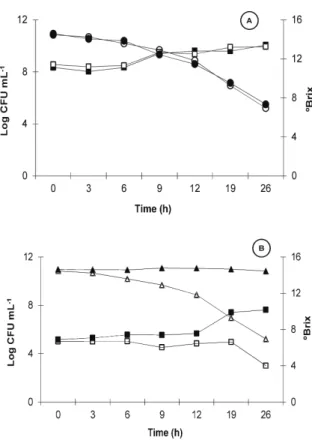
growth of yeast UFLA CA 11 (Figure 2A), as observed by Nobre et al. (2007) in co-cultivation of
L. fermentum and S. cerevisiae. After 19 hours of
fermentation, L. lactis population decreased from
5 log CFU mL-1 to 3.3 log CFU mL-1 (Figure 2B).
The reduction in bacterial growth may be due to the competition with yeast by essential nutrients. Since the yeast cell size is approximately 20-50 times greater than that of bacterial cells, on a cell basis a greater proportion of nutrients would be taken up by yeast cells.
Another possible reason for the reduction of bacterial growth is that alcohol produced by the yeast can exert inhibitory effects on the multiplication of lactobacilli (THOMAS et al., 2001). The reduction in Brix value during fermentation was similar in the growth of yeast or co-incubation of yeast and bacteria (Figure 2A). The
decrease in Brix was minimal when L. lactis UFLA
CA 312 was grown in pure culture (Figure 2B). The
low consumption of sugars by L. lactis UFLA CA
312 in pure culture could not be measured by the use of refractometer. This fact may result from the sensitivity of the refractometer and because the Brix result is not only from the measurement of sugars such as glucose, fructose, and sucrose. Considering the profile of reducing sugars (data not shown), it
was observed that the cultivation of L. lactis UFLA
CA 312 in pure culture led to a consumption of
approximately 1 g L-1 of reducing sugars (as
glucose). The profile of reducing sugars for the mixed culture was similar to the one profile found
for the pure culture of S. cerevisiae UFLA CA 11,
showing that the use of L. lactis UFLA CA 312 in
Figure 2. Brix value and growth of S. cerevisiae (A)and L. lactis
(B) during alcoholic fermentation in flasks. (A) solid soluble consumption (Brix) for mixed culture of S. cerevisiae and L. lactis
(open circle); solid soluble consumption for pure culture of
S. cerevisiae (filled circle); yeast growth in mixed culture (open
square); yeast growth in pure culture (filled square). (B) solid soluble consumption for mixed culture of S. cerevisiae and L. lactis
(open triangles); solid soluble consumption for pure culture of
L. lactis (filled triangles); L. lactis growth in mixed culture (open
square); L. lactis growth in pure culture (filled square).
Fermentation in stainless steel vats
During vats fermentation samples were taken immediately after filling the vats with sugar cane
juice to fermentation (Initial Time – Ti) and after
removal of the fermented sugar cane juice (End
Time – Tf). The yeasts and bacteria biomass found
after beginning of fermentation were higher than expected from inocula. It might be due to sedimentation and difficult to homogenize during sampling. It was observed for pure culture of UFLA CA 11 an increase in the population between 1st and
4th batches, both for Ti and for Tf. In Ti, yeast
population ranged from 10.58 log CFU mL-1
(1st batch) to 11.77 log CFU mL-1 (4th batch). In T
f,
the yeast population increased from 13.73 log CFU
mL-1 in the first batch to 15.75 log CFU mL-1 in the
fourth batch.
Among the population in Tf of a batch (e.g first
batch) and the population in Ti of next batch
(e.g second batch), the count in Tf was bigger than
the count in Ti of next batch. This fact occurred due
to the higher volume of sugar cane juice inside the
vats on Ti (20 L). After removal of the fermented
sugar cane juice (Tf), within the vat was 5 liters of
sugar cane juice corresponding to ‘pé-de-cuba’ (inoculum for the next batch). This change in the ratio biomass/volume and the difficulty of homogenizing the sample due the yeast UFLA CA 11 flocculation led to obtaining a higher apparent
population of S. cerevisiae UFLA CA 11 in Tf.
In mixed culture of L. lactis UFLA CA 312 +
S. cerevisiae UFLA CA 11, the values for S. cerevisiae
UFLA CA 11 population (Figure 3) were similar to those observed when the yeast was grown in pure
culture. The effect of the ratio biomass volume-1
(apparent high population) was also observed for
S. cerevisiae UFLA CA 11 and L. lactis UFLA CA 312 populations during vats fermentation using the mixed inocullum.
No significant changes were found in the
population of S. cerevisiae UFLA CA 11 and L. lactis
UFLA CA 312 through the four batches fermentation. This result is different from that
found for the population of L. lactis UFLA CA 312
during the fermentation in flask (Figure 2B) where at the end of fermentation was observed a decrease in the bacteria count. This change can result from the scale up or from the addition of new substrate after 24 hours of fermentation between consecutives batches.
Physico-chemical analyses
Chemical analyses were performed on cachaça samples after aging (30 days) in a 5 L oak barrel. The results for chemical analyses are the average of data from four successive batches fermentation and distillation (Table 2).
The relative density of the beverage produced in all fermentations was similar with values of 0.9502 and 0.9491 for cachaça
produced by S. cerevisae UFLA CA11 and mixed
culture (L. lactis with S. cerevisiae), respectively.
The concentrations of aldehydes, esters, methanol, alcohol and volatile acids in the aged beverages were within the legal limits of Brazilian law (Table 2). The values for parameters copper, alcoholic degree and volatile acidity (as acetic acid) were different (Tukey test 5%) between cachaça produced by pure
culture of S. cerevisiae UFLA CA 11 and mixed
culture (S. cerevisiae UFLA CA 11 + L. lactis
Figure 3. Growth of S. cerevisiae UFLA CA 11and L. lactis UFLA CA 312in mixed culture in the initial (Ti) and final time (Tf) during four successive batches fermentations. S. cerevisiae UFLA CA 11 in Ti ; S. cerevisiae UFLA CA 11 in Tf ; L. lactis in Ti ; L. lactis in Tf .
The differences found for copper and alcoholic degree were probably caused by the separation of the volumes of the distillate fractions (head, heart and tail) during the distillation process or by the higher acidity of the beverage produced by the mixed culture.
Table 2. Results of physico-chemical analyses* of distilled beverages produced from fermentations inoculated with mixed culture and S. cerevisiae and the allowed limit of each parameter in accordance with Brasil (2005).
Parameters
Limit
Mixed culture S. cerevisiae
Min. Max.
Organoleptic characteristics - - Normal Normal Relative density - - 0.9502a 0.9491a
Copper (mg L-1) - 5 3.66b 2.96a
Dry extract (g L-1) - - ND ND
Alcoholic degree (GL) 38 48 40.25a 42.50b
Volatile acidity as acetic acid
(mg 100 mL-1 anhydrous alcohol) - 150 19.54b 15.73a
Higher alcohols
(mg 100 mL-1 anhydrous alcohol) - 360 307.41a 315.69a
Furfural (mg 100 mL-1
anhydrous alcohol) - 5 ND ND Aldehydes (as acetic aldehyde)
(mg 100 mL-1 anhydrous alcohol) - 30 5.93a 6.13a
Esters (as ethyl acetate)
(mg 100 mL-1 anhydrous alcohol) - 200 36.47a 34.65a
Total secondary compounds
(mg 100 mL-1 anhydrous alcohol) 200 650 369.34a 373.98a
Methanol
(mg 100 mL-1 anhydrous alcohol) - 20 0.02a 0.01a
Total sugars (g L-1 in sucrose) > 6 ≤ 30 ND ND
ND not detected; min minimum; max maximum value; *average of four batches;
Values identified by the same letters are not significantly different at the 0.05 level (Tukey test).
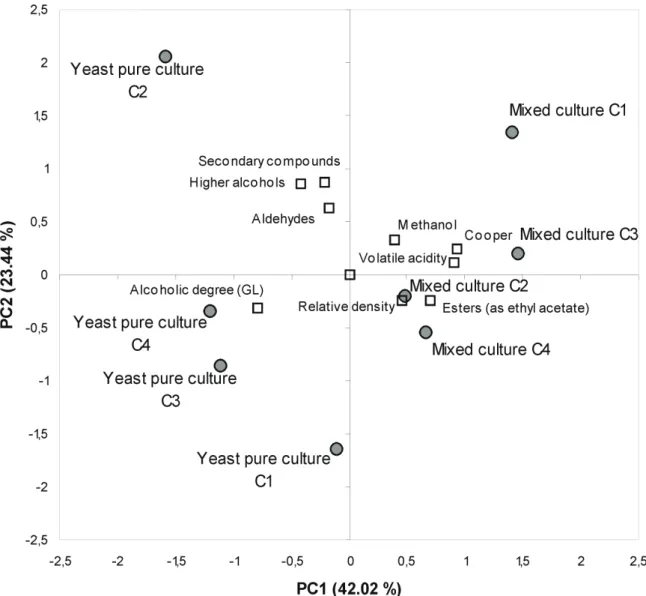
The results of physical-chemical properties were subjected to principal component analysis (PCA) to better understand the relationship between the
inocula (S. cerevisiae or S. cerevisiae + L. lactis) used
and the parameters analyzed. As can be seen in Figure 4 the first principal component (PC1), corresponding to 42.02% of total variance and allowed the differentiation between cachaça
produced with the pure culture of S. cerevisiae UFLA
CA 11 and the mixed culture of S. cerevisiae UFLA
CA 11 + L. lactis UFLA CA 312 (for four batches).
The beverages produced with S. cerevisiae UFLA
CA 11 were related to parameters secondary compounds, higher alcohols, aldehydes, and alcoholic degree (Figure 4), while the beverages produced with the mixed culture were characterized by methanol, esters, and volatile acidity (as acetic acid ) (Figure 4).
According to Silva et al. (2006) acidity has a significant influence on the sensorial quality of cachaça.
The higher alcohols identified in three fractions (head, heart and tail) and their concentrations are presented in Table 3.
Table 3. Concentration (mg 100 mL-1 of anhydrous alcohol) of higher alcohols in three different fractions (head, heart and tail) of evaluated cachaça.
Higher alcohols Fractions Beverages
Yeast pure culture Mixed culture
Propanol
Head 20.86±1.41 64.10±4.69 Heart 32.37±0.98 39.37±1.90
Tail ND 18.40±0.94
Isobutanol
Head 16.70±0.54 51.50±2.83 Heart 17.37±1.16 18.84±0.82
Tail ND ND
Isoamyl alcohol
Head 282.47±5.72 810.21±15.84 Heart 261.45±7.94 266.52±9.36
Tail 124.50±3.96 319.10±4.80 Tail
Figure 4. Principal component analysis for the physico-chemical analysis of the beverages produced from S. cerevisiae pure culture and mixed culture (S. cerevisiae + L. latics). C# corresponds to the consecutive batches.
The concentrations of propanol, isobutanol and isoamyl alcohol found in the heart fraction were slightly higher in the beverage produced with a mixed culture (Table 3). The beverage produced with mixed culture showed a higher proportion isoamyl alcohol: isobutanol (15:05). According to Campos et al. (2010) this ratio between higher alcohols is related to the quality of cachaça. The amount of propanol ranged from 32.37 to
39.37 mg mL-1 of anhydrous alcohol, in cachaça
produced by S. cerevisiae UFLA CA 11 and mixed
culture, respectively. The occurrence of low concentrations of propanol has been related to the cachaça with superior quality in sensory analysis (BOZA; HORII, 1998; LIMA et al., 2009).
Sensory evaluation
The final beverages were subjected to sensory analysis to assess its acceptance among the
consumers. In the sensory analysis the attributes appearance, aroma, taste and overall were evaluated. For all attributes the acceptance was higher than 50% (Table 4).
Table 4. Percentage of acceptance of cachaças produced by S.
cerevisiae pure culture and mixed culture (S. cerevisiae + L. lactis).
Attribute UFLA CA 11 UFLA CA 11 + L. lactis
Appearance 75.70 81.10
Aroma 73.00 81.10
Taste 75.70 75.70
Overall 83.80 75.70
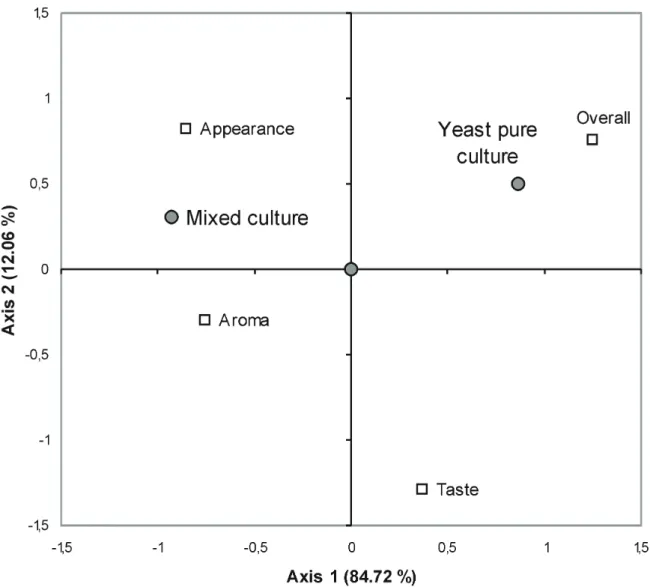
Figure 5. Internal preference mapping for the sensory analysis of the beverages Produced from S. cerevisiae UFLA CA 11pure culture and mixed culture (S. cerevisiae UFLA CA 11 + L. latics UFLA CA 312).
However, beverage produced with a mixed culture was associated with attribute aroma (Figure 5) and esters (Figure 4).
The data from sensory analysis (percentage of acceptance), were subjected to principal components analysis (PCA) as internal preference mapping. In the first axis (corresponding to 84.72% of variance) the beverage produced with mixed culture was characterized by the attributes appearance and aroma,
while beverage produced with S. cerevisiae UFLA CA
11 in pure culture was characterized mainly (axis 1) by attribute overall (Figure 5). According to Nurgel et al. (2002), specific compounds are responsible for the typical characteristics of smell and taste. The main source of these compounds is the metabolism of yeast during fermentation.
Conclusion
The results of this work showed that the SCM
provided good results for the growth of L. lactis
and S. cerevisiae. This culture medium can be used
as low-cost way for multiplication of L. lactis and
S. cerevisiae in laboratory scale. Our results
indicate that, although the use of L. lactis and
S. cerevisiae in co-culture led to an increase in the acidity of the beverage, the use of bacteria did not affect the yeast activity and improved the cachaça aroma. These results set a precedence for the new
studies with L. lactis and other LAB in cachaça
production.
References
AOAC-Association of official analytical chemists. Official methods of analysis. 18th ed. Gaithersburg: AOAC, 1990.
BERNARDI, T. L.; PEREIRA, G. V. M.; CARDOSO, P. G.; DIAS, E. S.; SCHWAN, R. F. Saccharomyces cerevisiae
molecular methods (PCR, PFGE and mtDNA-RFLP.)
World Journal of Microbiology and Biotechnology, v. 24, n. 11, p. 2705-2712, 2008.
BOZA, Y.; HORII, J. Distillation influence on the composition and sensorial quality of sugar cane distilled beverage. Ciência e Tecnologia de Alimentos, v. 18, n. 4, p. 391-396, 1998.
BRASIL. Ministério da Agricultura e do Abastecimento. Lei n.º 7678, de 8 de outubro de 1988. Diário Oficial da União, Brasilia, 1988. Seção 1, p. 21561.
BRASIL. Ministério da Agricultura, Pecuária e Abastecimento. Instrução normativa n.º 13, de 29 de junho de 2005. Aprova o regulamento técnico para fixação dos padrões de identidade e qualidade para aguardente de cana e para cachaça. Diário Oficial da União, Brasília, 2005. Seção 1, p. 3-4.
CAMPOS, C. R.; SILVA, C. F.; DIAS, D. R.; BASSO, L. C.; AMORIN, H. V.; SCHWAN, R. F. Features of
Saccharomyces cerevisiae as a culture starter for the production of the distilled sugar cane beverage cachaça in Brazil. Journal of Applied Microbiology, v. 108, n. 6, p. 1871-1879, 2010.
COCALGN-BOUSQUET, M.; GARRIGUES, C.; NOVAK, L.; LINDLEY, N. D.; LOUBIERE, P. Rational development of a simple synthetic medium for the sustained growth of Lactococcus lactis. Journal of Applied Bacteriology, v. 79, n. 1, p. 108-116, 1995.
DUARTE, W. F.; DIAS, D. R.; PEREIRA, G. V. M.; GERVÁSIO, I. M.; SCHWAN, R. F. Indigenous and inoculated yeast fermentation of gabiroba (Campomanesia pubescens) pulp for fruit wine production. Journal of Industrial Microbiology and Biotechnology, v. 36, n. 4, p. 557-569, 2009.
DUARTE, W. F.; SOUSA, M. V. F.; DIAS, D. R.; SCHWAN, R. F. Effect of Co-Inoculation of
Saccharomyces cerevisiae and Lactobacillus fermentum on the quality of the distilled sugar cane beverage cachaça.
Journal of Food Science, v. 76, n. 9, p. C1307-C1318, 2011.
FERNANDES, W. J.; CARDOSO, M. G.; VILELA, F. J.; MORAIS, A. R.; SILVA, V. F.; NELSON, D. L. Physicochemical quality of a blend of domestic cachaças from the south of Minas Gerais. Journal of Food Composition and Analysis, v. 20, n. 3-4, p. 257-261, 2007.
GOMES, F. C. O.; SILVA, C. L. C.; VIANNA, C. R.; LACERDA, I. C. A.; BORELLI, B. M.; NUNES, A. C.; FRANCO, G. R.; MOURÃO, M. M.; ROSA, C. A. Identification of lactic acid bacteria associated with traditional cachaça fermentations. Brazilian Journal of Microbiology, v. 41, n. 2, p. 486-492, 2010.
JENSEN, P. R.; HAMMER, K. Mininal requirements for exponential growth of Lactococcus lactis. Applied and Environmental Microbiology, v. 59, n. 12, p. 4363-4366, 1993.
LIMA, A. J. B.; CARDOSO, M. G.; GUIMARÃES, L. G. L.; LIMA, J. M.; NELSON, D. L. Effect of copper
removing substances on the amount of secondary compounds of sugar cane spirit. Química Nova, v. 32, n. 4, p. 845-848, 2009.
LIMTONG, S.; SRINGIEW, C.; YONGMANNITCHAI, W. Production of fuel ethanol at high temperature from sugar cane juice by a newly isolated Kluveromyces marxianus.
Bioresource Technology, v. 98, n. 17, p. 3367-3374, 2007. MILLER, G. L. Use of dinitrosalicylic acid reagent for determination of reducing sugar. Analytical Biochemistry, v. 31, n. 3, p. 426-428, 1959.
MØRETRØ, T.; HAGEN, B. F.; AXELSSON, L. A new, completely defined medium for meat lactobacilli. Journal of Applied Microbiology, v. 85, n. 4, p. 715-722, 1998. NARENDRANATH, N. V.; HYNES, S. H.; THOMAS, K. C.; INGLEDEW, W. M. Effects of lactobacilli on yeast-catalyzed ethanol fermentations. Applied and Enviromental Microbiology, v. 11, n. 11, p. 4158-4163, 1997.
NOBRE, T. P.; HORRI, J.; ALCARDE, A. R. Viabilidade celular de Saccharomyces cerevisiae cultivada em associação com bactérias contaminantes da fermentação alcoólica.
Ciência e Tecnologia de Alimentos, v. 27, n. 1, p. 21-25, 2007.
NOVA, M. X. V.; SCHULER, A. R. P.; BRASILEIRO, B. T. R. V.; MORAIS JÚNIOR, M. A. Yeast species involved in artisanal cachaça fermentation in three stills with different technological levels in Pernambuco, Brazil.
Food Microbiology, v. 26, n. 5, p. 460-466, 2009. NOVAK, L.; COCALGN-BOUSQUET, M.; LINDLEY, N. D.; LOUBIERE, P. Metabolism and energetics of
Lactococcus lactis during growth in complex or synthetic media. Applied and Enviromental Microbiology, v. 63, n. 7, p. 2665-2670, 1997.
NURGEL, C.; ERTEN, H.; CANBAS, A.; CABAROGLU, T.; SELLI, S. Influence of Saccharomyces cerevisiae strain on fermentation and flavor compounds of white wines made cv. Emir grown in Central Anatolia, Turkey. Journal of Industrial Microbiology and Biotechnology, v. 29, n. 1, p. 28-33, 2002.
RECHE, R. V.; NETO, A. F. L.; SILVA, A. A.; GALINARO, C. A.; OSTI, R. Z.; FRANCO, D. W. Influence of type of distillation apparatus on chemical profiles of Brazilian cachaças. Journal of Agricultural and Food Chemistry, v. 55, n. 16, p. 6603-6608, 2007. RIBEREAU-GAYON, P.; DUBOURDIEU, D.; DONECHE, B.; LONVAUD, A. Red winemaking. Handbook of enology: the microbiology of wine and vinifications. Chichester: John Wiley and Sons Ltd., 2006. SAITOH, S.; ISHIDA, N.; ONISHI, T.; TOKUHIRO, K.; NAGAMORI, E.; KITAMOTO, K.; TAKAHASHI, H. Genetically engineered wine yeast produces a high concentration of L-lactic acid of extremely high optical purity. Applied and Environmental Microbiology, v. 71, n. 15, p. 2789-2792, 2005.
fermentations. Antonie Van Leeuwenhoek, v. 79, n. 1, p. 89-96, 2001.
SILVA, C. L. C.; ROSA, C. A.; OLIVEIRA, E. S. Studies on the kinetic parameters for alcoholic fermentation by flocculent Saccharomyces cerevisiae strains non-hydrogen sulfide-producing strains.World Journal of Microbiology and Biotechnology, v. 22, n. 8, p. 857-863, 2006.
SKINNER, K. A.; LEATHERS, T. D. Bacterial contaminants of fuel ethanol production. Journal of Industrial Microbiology and Biotechnology, v. 31, n. 9, p. 401-408, 2004.
THOMAS, K. C.; HYNES, S. H.; INGLEDEW, W. M. Effect of lactobacilli on yeast growth, viability and batch and semi-continuous alcoholic fermentation of corn mash. Journal of Applied Microbiology, v. 90, n. 5, p. 819-828, 2001.
TIMBUNTAM, W.; SRIROTH, K.; TOKIWA, Y. Lactic acid production from sugar-cane juice by a newly isolated
Lactobacillus sp. Biotechnology Letters, v. 28, s/n., p. 811-814, 2006.
YEMM, W. E.; WILLIS, A. J. The estimation of carbohydrates in plant extracts by anthrone. Biochemical Journal, v. 57, n. 3, p. 508-514, 1954.
Received on August 24, 2012. Accepted on November 7, 2012.