Ichthyofauna of the Mamanguape river basin, Northeastern, Brazil
Leonardo Oliveira-Silva1, Telton Pedro Anselmo Ramos1,2, Yuri Gomes Ponce Carvalho-Rocha1,
Katherine Morais Porto Viana3, Raizze da Costa Avellar1 & Robson Tamar da Costa Ramos1*
1Universidade Federal da Paraíba, Laboratório de Sistemática e Morfologia de Peixes,
João Pessoa, PB, Brasil
2Universidade Federal do Rio Grande do Norte, Departamento de Botânica, Ecologia e Zoologia, Campus
Central, Lagoa Nova, Natal, RN, Brasil
3Universidade Federal da Paraíba, Laboratório de Ictiologia, João Pessoa, PB, Brasil
*Corresponding author: Robson Tamar da Costa Ramos, e-mail: [email protected]
OLIVEIRA-SILVA, L., RAMOS, T. P. A., CARVALHO-ROCHA, Y. G. P., VIANA, K. M. P., AVELLAR, R. C., RAMOS, R. T. C. Ichthyofauna of the Mamanguape river basin, Northeastern, Brazil. Biota Neotropica. 18(3): e20170452. http://dx.doi.org/10.1590/1676-0611-BN-2017-0452
Abstract: The Mamanguape River Basin is located in a peripheral semi-arid area of South America, with its headwaters and middle reaches running through the Caatinga (from wetter to drier) and its lower reaches through
the Atlantic Forest. The objective of this study was to inventory the fish fauna of the Mamanguape river basin
through a comprehensive sampling and to discuss its ichthyofaunal dominance pattern. Sampling was conducted
between 2015 and 2016 at 38 points throughout. The main river course was sampled at 18 fixed points during two expeditions (dry and wet seasons) using traw nets, cast nets, and dip nets, with a standardized effort. The tributaries
were sampled during the dry season at 20 points using an adaptaptation of the AquaRAP methodology. A total
of 32 freshwater fish species belonging to 26 genera, 16 families and six orders were recorded, predominantly
from the order Characiformes and the family Characidae. Astyanax fasciatus had widest distribution and greatest
abundance in the basin. Siluriformes were the second most prevalent order, with five species recorded. Cichla cf. monoculus, Poecilia reticulata and Oreochromis niloticus were non-native records for the basin. Apareiodon davisi, an Endangered species, was recorded.
Keywords: Neotropical Region, Brazilian Semiarid, Freshwater Fish, Species List, Dominance, Endemism.
Ictiofauna da bacia do rio Mamanguape, Nordeste, Brasil
Resumo: A bacia do rio Mamanguape está situada numa área periférica do semiárido, suas nascentes e porção média correndo em área de domínio da Caatinga – de mais úmida a mais seca, e sua porção baixa em área de Mata Atlântica. O estudo teve por objetivo inventariar a fauna de peixes da bacia do rio Mamanguape, através de uma amostragem abrangente de suas drenagens, e discutir o padrão de dominância de sua ictiofauna. O trabalho de coleta foi realizado entre os anos de 2015 e 2016, em 38 pontos distribuídos em toda a bacia. Dezoito pontos foram amostrados ao longo do curso principal do rio (Pontos Fixos), em duas expedições (seca e cheia), através
de arrasto, tarrafa e puçá, com esforço padronizado. Os afluentes foram amostrados durante a estação seca, em
20 pontos, utilizando-se uma adaptação da metodologia AquaRap. Foram registradas 32 espécies de peixes de água doce pertencentes a 26 gêneros, 16 famílias e seis ordens, com predominância da ordem Characiformes e da família Characidae, sendo Astyanax fasciatus a espécie de maior distribuição e abundância na bacia. Siluriformes foi a segunda ordem de maior predominância, com cinco espécies. Cichla cf. monoculus, Oreochromis niloticus e Poecilia reticulata constituíram registros de introdução na bacia; foi registrada Apareiodon davisi, uma espécie ameaçada de extinção (Em Perigo).
Introduction
The greatest diversity of freshwater fish in the world is found in the
Neotropics (Albert & Reis 2011), and Brazil contains approximately 43% of this diversity (Buckup et al. 2007). Reis et al. (2016) report
5,617 described neotropical freshwater fish species. Given that Reis et al. (2003) listed 4,475 described species, there has been a significant
advance in the taxonomic knowledge of neotropical ichthyofauna, with approximately 28% of the ichthyofauna described in the last eleven years. Approximately 100 species have been described per year, and
estimates suggest a total of roughly 9,000 neotropical freshwater fish
species (Reis et al. 2016). However, there is still a lack of information on the composition and distribution of this fauna in certain regions of Brazil such as the many coastal basins in the Northeast region which is part of the Northeastern Caatinga and Coastal Drainages ecoregion
(NCCD, sensu Abell et al. 2008). Sampling efforts in these regions
are needed to increase the level of knowledge about the composition
of these fish fauna and to support an understanding of their historical
patterns, as suggested by Langeani et al. (2009).
The Mamanguape River Basin in the NCCD ecoregion is an
example of an area with a poorly known freshwater fish taxocene.
A single previous study was conducted in the basin (Rosa & Groth 2004), aiming to evaluate the number of species occurring in Brejos de Altitude (high altitude rainforest enclaves occurring in semiarid zone of Northeastern Brazil, Prado 2003) of the States of Paraíba and
Pernambuco. However, no list of fish species to the that river basin was
provided. The Mangaguape River basin is one of many small systems that drain to the Atlantic Ocean, and as most northeastern Brazilian
coastal drainages, it is influenced by different morphoclimatic zones
such as the Caatinga and the Atlantic Forest (Andrade 1997; Langeani et al. 2009). The basin is located in the peripheral region of South America, which is highlighted by Albert et al. (2011) as an area with low species richness but with high degree of endemism. The objective
of the present study was to produce a comprehensive freshwater fish
survey of the Mamanguape river basin and to provide an understanding
on the dominance of fish groups along the basin.
Material and Methods
1. Study area
The Mamanguape River Basin has its headwaters located on the eastern slope of the Borborema mountain range, at a mesoregion named
Agreste (characterized by a more humid Caatinga, as defined by Prado
2003), and extends towards the northern coast of Paraíba State, where
it flows to the Atlantic Ocean. It drains an area of 3,525.00 km², and is
bordered by the Curimataú and Camaratuba River Basins on the North, by the Paraíba do Norte and Miriri River Basins on the West and South, and by the Atlantic Ocean on the East (CERH/PB 2004). Two-thirds of
the basin are under the influence of a semi-arid climate, which causes intermittent flow regime in most of the basin. Pools of varying sizes remains along the river bed when the flow is interrupted. The river is perennial near the coast, where the basin is influenced by tributaries
from wetter areas (Andrade 1997). In the present study, the basin was
classified into reaches (Upper, Middle and Lower) according with the
variation of the relief and vegetation as suggested by Andrade (1997).
The Upper Reaches comprise areas with elevations between 600 and
200 meters, and the vegetation is predominantly humid Caatinga, which is more arborescent and typical of Brejos; the Middle Reaches comprise areas with elevations between 200 and 70 meters and the vegetation is dry Caatinga, which is more shrubby and is typical of the Agreste; the Lower Reaches comprise areas with elevations below 70 meters associated to remnants of the Atlantic Forest (excluding estuarine domain).
2. Data collection
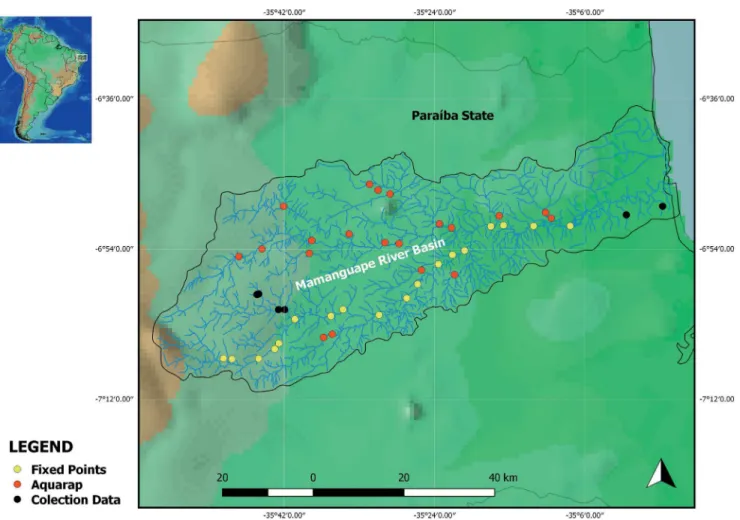
Sampling was performed at 38 collection points; 18 of which were distributed along the main river (named Fixed Points), and 20 were distributed along the northern and southern tributaries of the basin (named AquaRAP points) (Figure 1, Table 1). The18 points along the main river were sampled during the wet season (September to October 2015) and the dry season (February to August 2016) using a trawl net (4 m long, 5 mm mesh), a cast net (15 mm mesh) and a dip net (5 mm mesh) with a standardized number of throws for each method of collection. The sampling of the tributaries was conducted during the months of February and March of 2016 using the same tools but following the adaptation of Willink et al. (2000)’s AquaRAP methodology: the three collection tool were used when the site’s characteristic allowed its use the most frequent circumstance; when the collection site was restricted, only dip net was used. During the AquaRAP survey, some tributaries or their reaches closer to the headwaters were not sampled due to lack of access or pools. Sampling was permitted by ICMBio/SISBIOthroughlicense #48004-1/2015. The specimens were anesthetized with eugenol (10 ml of eugenol in 90 ml of ethyl alcohol, Lucena et al. 2013),
fixed in 10% formalin for 2 to 8 days, and then transferred to a 70% ethanol solution (Malabarba & Reis 1987). Sorting and taxonomic
identification of specimens and subsequent labeling was performed
at the Laboratório de Sistemática e Morfologia de Peixes of the
Federal University of Paraíba (LASEP/UFPB). Available material from the study area deposited at UFPB Ichthyological Collection but not collected during the field work was included in the list of species
(SR, secondary records of table 2). Specimens were photographed
in the field and in the laboratory. After identification, the lots were registered and deposited in the UFPB Ichthyological Collection
(number of voucher specimens in Table 2).
3. Data analysis
Sampling effectiveness was evaluated using a rarefaction curve
(Colwell et al. 2012). Richness was assessed using bootstrap (Efron 1979) estimator. A heatmap (Singh et al. 2011) was generated
using a species presence/absence matrix to provide a visual profile
of occurrence throughout the basin. For this visualization, points
were ordered according to the position in the basin (Upper, Middle and Lower Reaches) and were identified by the abbreviations
FP (Fixed Point, mainstream wet and dry season data) or AP (AquaRAP Point) added the number of the collection point. The analysis used the vegan, indicspecies, cluster and gplots packages in R (R Development Core Team 2015). The statistical analyses and subsequent results consider only the 29 species sampled. The species
Figure 1. Distribution of the sampling points in the Mamanguape River Basin, State of Paraíba, Brazil.
Results
A total of 26,805 specimens of 29 species, 24 genera, 14 families
and six orders were collected (Table 2, figures 2 and 3). Callichthys callichthys, Gymnotus cf. carapo, and Hemigrammus unilineatus, were not sampled in the present study, but had been previously
recorded in the UFPB Ichthyological Collection. Thus, the total
number of taxa recorded from the basin is 32 species, 26 genera, 16 families and six orders.
Visual inspection of the rarefaction curve shows that the asymptote
was reached (Figure 4), indicating an effective sampling of the studied
area. The richness estimator yielded numbers of species approximately
equal to that recorded in the field (29): boot, 28.8. Figure 5 shows that the different sampling approaches used in different areas of the basin
produced similar results. The pattern of species dominance observed in
the main river, which was sampled at fixed points during the wet and
dry seasons, was similar to that of the tributaries, which were sampled by AquaRAP during the dry season.
Seven families were recorded from the order Characiformes, comprising 15 species and 52% of the species collected (including introduced species); one family was recorded from the order
Cichliformes, comprising five species (two introduced) and 17% of
the registered species; and two families were recorded from the order Siluriformes, comprising four species (12.5%) (Table 2). Characidae
was the family with the highest species richness (nine species or 31%),
followed by Cichlidae (five species, 17%), Loricariidae (three species,
9%) and Poeciliidae (two species, 6%). Only one species was recorded from each of the other families, each representing 3% of the total species richness (Table 2).
Eight individuals of Apareiodon davisi, a threatened species (Endangered, according to Portaria nº 445, December 17, 2014) (Brasil
2014), were recorded at five sampling points in areas of perennial flow or high to moderate flow (FP18, AP4, AP11, AP12 and AP14)
and were recorded in all three reaches of the basin. Three exotic species were recorded to the Mamanguape River Basin: two from the family Cichlidae, the tucunaré Cichla cf. monoculos and the tilápia (or Xilapo, Xilapa) Oreochromis niloticus, and the guarú (or Barrigudinho) Poecilia reticulata (Poeciliidae). Two undescribed species of the genus Parotocinclus were recorded. Parotocinclus sp. 1, sampled at Upper and Middle Reaches (FP3, FP6 and FP7) of the main river, and Parotocinclus sp. 2, sampled at a single point in the Middle Reaches, the Jacaré River (AP11), one of the major tributaries of the basin. Apareiodon davisi, Cheirodon jaguaribensis and Hypostomus pusarum are endemic to the NCCD (Rosa et al. 2003).
Table 1. Municipalities, elevation (m), and geographical coordinates of the 38 collection points distributed throughout the Mamanguape river basin.
Collect
point Municipalities Elevation
Geographical Coordinates
FP1 Lagoa Seca 494 07°07’13”S, 035°49’34”W
FP2 Lagoa Seca 495 07°07’22”S, 035°48’32”W
FP3 Matinhas 321 07°07’16”S, 035°45’12”W
FP4 Matinhas 269 07°06’01”S, 035°43’20”W
FP5 Matinhas 239 07°05’32”S, 035°42’70”W
FP6 Alagoa Grande 151 07°02’44”S, 035°40’78”W
FP7 Alagoa Grande 133 07°02’06”S, 035°36’46”W
FP8 Alagoa Grande 119 07°01’28”S, 035°35’01”W
FP9 Mulungu 111 07°01’92”S, 035°30’69”W
FP10 Mulungu 94 06°59’93”S, 035°27’38”W
FP11 Mulungu 97 06°58’24”S, 035°26’07”W
FP12 Guarabira 69 06°55’84”S, 035°23’57”W
FP13 Araçagi 59 06°54’73”S, 035°21’89”W
FP14 Araçagi 45 06°54’21”S, 035°20’44”W
FP15 Itapororoca 25 06°51’31”S, 035°17’28”W
FP16 Itapororoca 36 06°51’19”S, 035°15’78”W
FP17 Mamanguape 17 06°51’27”S, 035°12’17”W
FP18 Mamanguape 20 06°51’25”S, 035°07’78”W
AP1 Areia 546 06°54’93”S, 035°47’50”W
AP2 Areia 445 06°54’02”S, 035°44’72”W
AP3 Solânea 434 06°48’91”S, 035°42’14”W
AP4 Pilões 208 06°51’42”S, 035°34’61”W
AP5 Pilões 458 06°54’55”S, 035°39’04”W
AP6 Pilões 390 07°04’89”S, 035°38’12”W
AP7 Alagoa Grande 233 07°04’99”S, 035°37’96”W
AP8 Pirpirituba 106 06°46’97”S, 035°30’79”W
AP9 Pirpirituba 103 06°46’27”S, 035°31’82”W
AP10 Pirpirituba 196 06°47’43”S, 035°29’37”W
AP11 Guarabira 109 06°53’38”S, 035°28’28”W
AP12 Cuitegi 101 06°53’26”S, 035°29’98”W
AP13 Alagoa Grande 173 07°04’21”S, 035°36’19”W
AP14 Itapororoca 87 06°50’06”S, 035°16’29”W
AP15 Araçagi 69 06°51’00”S, 035°23’44”W
AP16 Mulungu 88 06°57’10”S, 035°21’64”W
AP17 Mamanguape 43 06°49’65”S, 035°10’74”W
AP18 Mamanguape 61 06°50’34”S, 035°10’05”W
AP19 Araçagi 62 06°51’48”S, 035°22’03”W
AP20 Mulungu 68 06°56’55”S, 035°25’60”W
Table 2. List of freshwater fish species of the Mamanguape River Basin identified
in the present study: (I) Introduced; (T) Threatened; (SR) Secondary record (i.e., not collected during the present study).
ORDER/Family/species N VOUCHER
CHARACIFORMES
Parodontidae
Apareiodon davisi Fowler, 1941(T) 7 UFPB 10919
Curimatidae
Steindachnerina notonota Miranda-Ribeiro, 1937 1901 UFPB 10736
Prochilodontidae
Prochilodus brevis Steindachner, 1875 11 UFPB 10706
Anostomidae
Leporinus piau Fowler, 1941 53 UFPB 10731
Crenuchidae
Characidium bimaculatum Fowler, 1941 683 UFPB 10910
Characidae
Astyanax bimaculatus (Linnaeus, 1758) 2220 UFPB 10690
Astyanax fasciatus (Cuvier, 1819) 9683 UFPB 10691
Compsura heterura Eigenmann, 1915 1991 UFPB 10699
Cheirodon jaguaribensis Fowler, 1941 784 UFPB 10717
Hemigrammus marginatus Ellis, 1911 370 UFPB 10784
Hemigrammus rodwayi Durbin, 1909 352 UFPB 10782
Hemigrammus unilineatus (Gill, 1858)(SR) 28 UFPB 11208
Hyphessobrycon parvellus Ellis, 1911 250 UFPB 10825
Serrapinnus heterodon (Eigenmann, 1915) 3297 UFPB 10822
Serrapinnus piaba (Lutken, 1875) 739 UFPB 10818
Erythrinidae
Hoplias malabaricus (Bloch, 1794) 143 UFPB 10901
SILURIFORMES
Callichthyidae
Callichthys callichthys (Linnaeus, 1758)(SR) 3 UFPB 4534
Loricariidae
Hypostomus pusarum (Starks, 1913) 60 UFPB 10776
Parotocinclus sp.1 11 UFPB 10064
Parotocinclus sp.2 18 UFPB 10500
Heptapteridae
Rhamdia quelen (Quoy & Gaimard, 1824) 24 UFPB 10766
GYMNOTIFORMES
Gymnotidae
Gymnotus cf. carapo Linnaeus, 1758(SR) 1 UFPB 5686
CYPRINODONTIFORMES
Poeciliidae
Poecilia reticulata Peters, 1859(I) 1130 UFPB 10744
ORDER/Family/species N VOUCHER
SYNBRANCHIFORMES Synbranchidae
Synbranchus aff. marmoratus Bloch, 1795 6 UFPB 10801
CICHLIFORMES
Cichlidae
Cichla cf. monoculus Agassiz, 1831(I) 6 UFPB 10075
Cichlasoma orientale Kullander, 1983 136 UFPB 10753
Crenicichla menezesi Ploeg, 1991 70 UFPB 10788
Geophagus brasiliensis (Quoy & Gaimard, 1824) 455 UFPB 10837
Oreochromis niloticus (Linnaeus, 1758)(I) 88 UFPB 10904
GOBIIFORMES
Gobiidae
Awaous tajasica (Lichtenstein, 1822) 5 UFPB 10784
Eleotridae
Eleotris pisonis (Gmelin, 1789) 2 UFPB 10812
vivipara, Serrapinnus heterodon, Serrapinnus piaba and Steindachnerina notonota are distributed throughout the drainage network and form the main cluster in the heatmap (Figure 5, cluster 1). In contrast, the heat map shows that some species were restricted to individual collection points such as Parotocinclus sp. 2, recorded at point AP11, and Eleotris pisonis, collected at point FP18 (clusters 6 and 7, respectively). Rhamdia quelen and Synbranchus cf. marmoratus, although collected at only four and six points, respectively, were recorded in all three Reaches of the basin (clusters 2 and 6, respectively). Awaous tajasica occurred only in the lower reaches (cluster 4), whereas Parotocinclus sp. 1 occurred in the upper and lower reaches (cluster 2). The introduced species Cichla cf. monoculus was recorded at only two points in the lower reaches (cluster 4), and Oreochromis niloticus was recorded at six points in the middle and lower reaches (cluster 5).
The primary group produced by the heatmap (cluster 1) consisted
of fifteen species belonging to eight families: Characidae (6 species),
Cichlidae (2 species), Poeciliidae (2 species), Anostomidae (1 species), Crenuchidae (1 species), Curimatidae (1 species), Erythrinidae (1 species) and Loricariidae (1 species). The family Characidae had the broadest distribution and was the most common family in the entire basin, with one or more species present at 35 of 38 collection points. At the Fixed Points, which had more regular and extensive sampling, Characidae had an average of 30% of the species occurring in the three reaches. The species Astyanax bimaculatus, Astyanax fasciatus, Compsura heterura, Serrapinnus heterodon and Serrapinnus piaba, which occurred in all three reaches, co-occurred at 14 points (36.8% of the points). The species Cheirodon jaguaribensis, Hyphessobrycon parvellus and Hemigrammus rodwayi co-occurred with one or more species of Characidae at seventeen, ten and six points, respectively, whereas Hemigrammus marginatus co- occurred with other Characidae
at five points, but only in the lower reaches (Figure 5).
Discussion
Although two sampling methods were employed (Fixed Points in both wet and dry seasons vs. AquaRAP in the dry season) and performed
in different areas of the basin (main river vs. tributaries), the results
showed a similar pattern of species occurrence for both methods in both areas of the basin. This reinforces the existence of such patterns of distribution, as indicated by the heatmap. The pattern of species occurrence in the main river (higher frequency by collection point)
may be due to the greater sampling effort: all gear types were used at
all collection points, and a higher number of throw per gear type vs. selective gear used depending on the environmental structure. Moreover, the total mainstream sampling área was greater (greater volume of water sampled) than that of the tributaries, given the greater channel width and the formation of larger pools in themainstream.
The species grouped in the main cluster (cluster 1) were
generalists, as is common for small fishes (Pelicice & Agostinho
2006, Fiori et al. 2016), or piscivorous such as Hoplias malabaricus (Rodrigues et al. 2017). Prochilodus brevis, a specialist detritivore (mud eaters – Silva et al. 2010), occurred only in the lower and middle reaches of the basin. Ramos (2012), citing the River Continuum Concept (Vannote et al. 1980), suggested the higher occurrence of detritivores, such as those of the genus Prochilodus, should be expected in the lower reaches of the basin, which have a larger amount of accumulated material in the river bottoms. Consistent with this prediction, the heatmap shows that Prochilodus brevis is more abundant in the lower reaches. Awaous tajasica and Eleotris pisonis were among the less common species and were collected only in the Lower Reaches of the main river. These two species are widely distributed in the coastal region of South America and are of marine-estuarine origin (Pezold & Cage 2002, Sarmento- Soares 2007). Poecilia reticulata and P. vivipara are widely distributed,
the first was introduced into neotropical freshwater environments
by release from aquariums or from use as controller of biological vectors (Ramos 2012).
Rosa et al. (2003) emphasized that Siluriformes dominate over
Characiformes in the ecoregions under the influence of the Caatinga
(101 vs. 89 species), a statement also made by Lima et al. 2017 (143 vs. 132). However, it differs from the results of the present study, with 16 species distributed in seven families of Characiformes, whereas the
Siluriformes are represented by five species belonging to three families
(Callichthyidae, Loricariidae and Heptapteridae). In all the previously surveyed basins in NCCD, it was recorded a similar pattern of species composition in which the number of Siluriformes is smaller than those of Characiformes: in the Curimataú basin (12 characiform vs. one siluriform species, Ramos et al. 2005), in the Seridó basin (21 vs. 6, Silva et al. 2014), in a general survey of the ichthyofauna of the Rio Grande do Norte State basins (21 vs. 6, Nascimento et al. 2004) and in a survey of the ichthyofauna of the Mundaú River (16 vs. 6, Teixeira et al. 2017); the same was recorded in Parnaíba ecoregion (59 vs. 48, Ramos et al. 2014) and in Northeastern Mata Atlântica ecoregion (91 vs. 75, Camelier & Zanata, 2014). Only in the
Figure 2. Species of the order Characiformes collected in the Mamanguape River Basin. a) Astyanax fasciatus (58.3 mm SL), b) Compsura
heterura (39.2 mm SL), c) Cheirodon jaguaribensis (41.3 mm SL), d) Hemigrammus marginatus (38.8 mm SL), e) Hyphessobrycon
parvellus (33.8 mm SL), f) Serrapinnus heterodon (35.6 mm SL), g) Hoplias malabaricus (105.5 mm SL), h) Apareiodon davisi (71.8 mm
SL), i) Characidium bimaculatum (34.6 mm SL), j) Prochilodus brevis (98.5 mm SL), l) Leporinus piau (83.8 mm SL), m) Steindachnerina
Figure 3. Species belonging to the orders Siluriformes: a) Hypostomus pusarum (102.4 mm SL), b) Parotocinclus sp.1 (38.3 mm SL), c)
Parotocinclus sp.2 (41.1 mm SL), d) Rhamdia quelen (104.5 mm SL); Synbranchiformes: e) Synbranchus aff. marmoratus (178.8 mm SL);
Cyprinodontiformes: f) Poecilia vivipara (28.6 mm SL); Cichliformes: g) Cichla cf. monoculus (91.7 mm SL), h) Cichlasoma orientale
Figure 4. Rarefaction curve generated from the species abundance matrix for the Mamanguape River Basin. Vertical bars represent the confidence interval.
Figure 5. Heatmap generated from the species presence/absence matrix for the Mamanguape River Basin. Black represents the absence of species, and gray represents the presence of species. FP – fixed point; PA – AquaRap point. Epi
= Eleotris pisonis; Ada = Apareiodon davisi; Psp2 = Parotocinclus sp2; Sma
= Synbranchus cf. marmoratus; Pbr = Prochilodus brevis; Oni = Oreochromis
niloticus; Cmo = Cichla cf. monoculus; Ata = Awaous tajasica; Hro =
Hemigrammus rodwayi; Hpa = Hyphessobrycon parvellus; Hma = Hemigrammus
marginatus; Cme = Crenicichla menezesi; Psp1 = Parotocinclus sp1; Rqu =
Rhamdia quelen; Hpu = Hypostomus pusarum; Lpi = Leporinus piau; Hja =
Cheirodon jaguaribensis; Spi = Serrapinnus piaba; Sno = Steindachnerina
notonota; Gbr = Geophagus brasiliensis; Hmal = Hoplias malabaricus; Cor =
Cichlasoma orientale; Pre = Poecilia reticulata; She = Serrapinnus heterodon;
Cbi = Characidium bimaculatum; Che = Compsura heterura; Pvi = Poecilia
vivipara; Afa = Astyanax fasciatus; Abi = Astyanax bimaculatus.
São Francisco ecoregion Siluriformes dominate over Characiformes (85 vs. 77 species) (Barbosa et al. 2017). The above observations suggest that instead of the pattern of species dominance recorded in the whole Caatinga (Rosa et al. 2003, Lima et al. 2017), when comparing the dominance of Siluriformes and Characiformes in each particular basin of this domain, no siluriform dominance is recorded. In truth, the particular basins seem to include a relatively larger number of
endemic siluriform than endemic characiform species to each of them, explaining the apparent dominance of Siluriformes when the numbers of the Caatinga basins are put together. However, it should
be only a differential effect of the peripheral high level of endemism
of South America (Albert et al. 2011) which is larger in Siluriformes than in Characiformes in each particular basin of the Caatinga domain, although the dominance pattern of the basins running in a large part of the Caatinga reveals a Characiform dominance.
Among the recorded species, only Apareiodon davisi is listed as endangered (Brasil 2014), with distribution restricted to points with
perennial flow. This species, and the entire family Parodontidae, prefers
environments with more turbulent waters, where it lives in proximity to the substrate (Graça & Pavanelli 2007). Ramos et al. (2005), Medeiros et al. (2006; 2010) and Costa et al. (2017) recorded this species in lentic environments at Seridó and Paraíba do Norte rivers, which are rocky residual environments within intermittent rivers and are probably
lotic during the flood period, which is consistent with the observations
reported by Graça & Pavanelli (2007). This species was considered endemic to the coastal drainages of the mid-northeastern Caatinga (Rosa et al. 2003), which corresponds to the Caatinga region of the NCCD. The occurrence of A. davisi is currently recorded for the Jaguaribe, Piranhas-Açu, Paraíba do Norte, Curimataú, Ipojuca (Reis et al. 2003, Ramos et al. 2005, Costa et al. 2017, ICMBio 2017) and Mamanguape (present study) rivers. Characidium bimaculatum, previously considered to be endemic to NCCD (Rosa et al. 2003), is known from records in the São Francisco ecoregion (Melo & Espindola 2016) and possibly from Parnaíba basin (Ramos et al. 2014, listed as Characidium bimaculatum).
Some surveys of the freshwater fish of the NCCD ecoregion have been published, usually with limited sampling efforts or partial evaluating of the fish fauna composition. Rosa & Groth (2004), as
mentioned above, surveyed a limited area of the Mamanguape River Basin but did not report the presence or abundance of species. Ramos et al. (2005) recorded 22 species in the Curimataú River Basin. The same richness (22 species) was observed by Torelli et al. (1997) and Gomes-Filho & Rosa (2001) in the Gramame River drainage (Paraíba State). Silva et al. (2014) recorded 35 species in the middle reaches of the Piranhas-Açu River Basin (Paraíba and Rio Grande do Norte States); Paiva et al. (2014) recorded 13 species in the Pratagi River Basin (Rio Grande do Norte State). The richness recorded in the
present study, (32 species) apparently reflects a good estimate of the local fish fauna composition, as indicated by the estimators used.
Moreover, the sampling showed a consistent pattern of ichthyofaunal composition for both the main course and its tributaries (Figure 5)
despite different sampling methods.
Figure 6. Human impacts recorded in the Mamanguape River Basin. a) removal of riparian vegetation (FP10), b) silted section from which sand was removed to form an artificial pool (FP2), c) at the bottom, upper right corner of the photo is a sand dredging tower (see arrow, AP12), d) animal rearing and disposal of garbage (see arrows, FP8).
species in the NCCD. Among the species considered endemic to this ecoregion Apareiodon davisi, Cheirodon jaguaribensis and Hypostomus pusarum (according to Rosa et al. 2003, Reis et al. 2003, and Buckup et al. 2007) were recorded in the Mamanguape River basin.
Reis et al. (2016) treated the NCCD and Parnaíba ecoregions as a unit termed Northeast Atlantic basin complex (ecoregions 325 and 326 of Abell et al. 2008, respectively) based on a low species diversity (<200 species). The authors documented 65 endemic species in their proposed basin complex. However, the authors did not cite Ramos et al. (2014), which recorded 146 species in the Parnaíba basin, 54 of which endemic. Addionally, Silva et al. (2015) surveyed the Gurgueia river, the main tributary of the Parnaíba basin. Adding their list to the survey carried out by Ramos et al. (2014) of Parnaíba basin, established its ichthyofauna as composed of 152 species. Rosa et al. (2003) cite a diversity of 82 species, 30 endemic to the NCCD, whereas Albert et al. (2011) proposed to the same region a list of 88 species, 38 of which endemic. Recent descriptions have added six more endemic species to the ecoregion: Anablepsoides cearensis (Costa & Vono 2009), Hypostomus sertanejo Zawadzki, Ramos & Sabaj 2017, Hypsolebias longignatus Costa 2008, H. faouri Britzke, Nielsen & Oliveira 2016, Parotocinclus seridoensis Ramos, Barros-Neto, Britski & Lima 2013 and Serrapinnus potiguar Jerep & Malabarba 2014,
bringing the total to 94 species, 44 of which are endemic. In addition to the number of occurrence and endemic species of the Parnaíba (152/54; Ramos et al. 2014; Silva et al. 2015) and NCCD ecoregions (94/44, present compilation), the number of species is 246 with 98 endemic species. Thus, the two ecoregions should be treated separately, based on the criterion used by Reis et al. (2016). In this case, the number of endemic species is considerable, which corroborates the results of Albert et al. (2011).
In the field, it was possible to observe the direct result of human
action on the environment, primarily at the margins of rivers and streams. The suppression of riparian vegetation, the development of agricultural practices, the dredging of sand from the river bed and the breeding of animals were the most evident human activities. Elimination of riparian vegetation was observed throughout the Mamanguape basin, primarily in the middle and lower reaches (Figure 6). This habitat
modification, besides of other harms imposed to the ecossistem, opens
Acknowledgements
The authors are grateful to Ricardo S. Rosa and Braulio A. Santos for important suggestions during the construction of the manuscript. Isabelle Andrade, Joanderson Pereira, Thalia Andrade and Marcus Paulo (in memoriam) helped in sorting of specimens. CAPES provided
fieldwork financial resources.
Author Contributions
Katherine Morais Porto Viana, Raizze da Costa Avellar: contributed with data collection.
Leonardo Oliveira Silva: contributed with data collection, manuscript preparation, data analysis and interpretation.
Robson da Costa Tamar Ramos: contributed with the manuscript preparation, data analysis and interpretation.
Telton Pedro Anselmo Ramos: contributed with data collection, and data analysis and interpretation.
Yuri Gomes Ponce Carvalho-Rocha: contributed with data collection, and data analysis and interpretation.
Conflicts of interest
The authors declare that they have no conflict of interest related to
the publication of this manuscript.
References
ABELL, R., THIEME, M.L., REVENGA, C., BRYER, M., KOTTELAT, M., BOGUTSKAYA, N. COAD, B., MADRAK, N., BALDERAS, S. C., BUSSING, W., STIASSNY,M.J.J.,SKELTON,P.,ALLEN,G.D.R.,UNMA XK,P.,NASEKA,A.,NG,R.,ROBERTSON,J.,ARMIJO,E.,HIGGINS,J.V., HEIBEL,T.J.,OLSON,E.,LOPEZ, H. L., REIS, R. E., LUNDBERG, J. G., PEREZ, M. H. S., & PETRY, P. L. 2008. Freshwater ecoregions of the world: a new map of biogeographic units for freshwater biodiversity conservation. BioScience. 58(5): 403-414.
ALBERT, J.S. & REIS, R.E. 2011. Introduction to Neotropical Freshwaters. In Historical Biogeography of Neotropical Freshwater Fishes (Albert, J. S. & Reis, R. E., eds), CA: University of California Press, Berkeley. p. 3-19. ALBERT, J.S., PETRY, P. & REIS, R.E. 2011. Major biogeographic and
phylogenetic patterns. In Historical Biogeography of Neotropical Freshwater Fishes (Albert, J. S. & Reis, R. E., eds), CA: University of California Press, Berkeley. p. 21-58.
ANDRADE, M.C. 1997. O rio Mamanguape. In Os rios-do-açúcar no Nordeste Oriental/Gilberto de Andrade, Manoel Correia de Andrade – João Pessoa: Editora Universitária/UFPB, Conselho Estadual de Cultura. 1959. BARBOSA, J.M. & SOARES, E.C. 2009. Perfil da ictiofauna da bacia do São
Francisco: estudo preliminar. Revista Brasileira de Engenharia de Pesca. 4(1): 155-172. http://ppg.revistas.uema.br/index.php/REPESCA/article/ view/140, 13/08/2016
BARBOSA, J. M., SOARES, E. C., CINTRA, I. H. A., HERMANN, M., & ARAÚJO, A. R. R. 2017. Perfil da ictiofauna da bacia do rio São Francisco/ Profile of the fish fauna of the São Francisco river basin. Acta Fish. Aquat. Res. 5(1): 70-90.
BRASIL. 2014. Lista Nacional Oficial de Espécies da Fauna Ameaçada de Extinção - Portaria Nº 443, de 17 de dezembro de 2014. Ministério do Meio Ambiente. Diário Oficial da União, Brasília, Seção 1(245): 121-130. BRITZKE. R., NIELSEN, D.T.B. & OLIVEIRA, C. 2016. Descrição de duas
novas espécies de peixes anuais do grupo de espécies Hypsolebias antenori
(Cyprinodontiformes:Rivulidae), do Nordeste do Brasil. Zootaxa. 4114(2): 123-138.
BUCKUP, P.A., MENEZES, N.A. & GHAZZI, M.S. 2007. Catálogo dasespécies de peixes de água doce do Brasil. Rio de Janeiro, Museu Nacional. CAMELIER, Priscila; ZANATA, Angela M. 2014. Biogeography of freshwater
fishes from the Northeastern Mata Atlântica freshwater ecoregion: distribution, endemism, and area relationships. Neotrop. ichthyol., Porto Alegre , v. 12, n. 4, p. 683-698.
CASATTI, L. 2010. Alterações no Código Florestal Brasileiro: impactos potenciais sobre a ictiofauna/Changes in theBrazilian Forest Code: potentialimpactsontheichthyofauna. Biota Neotrop. 10(4): 31. http://www. biotaneotropica.org.br/v10n4/pt/abstract?article+bn00310042010. CASATTI, L., FERREIRA, C.P. & CARVALHO, F.R. 2009. Grass-dominated
stream sites exhibit low fish species diversity and dominance by guppies: an assessment of two tropical pasture river basins. Hydrobiologia, 632: 273-283.
CERH/PB - Conselho Estadual de Recurso s Hídricos do Estado da Paraíba. 2004. Proposta de instituição do Comitê das Bacias Hidrográficas do Litoral 47 Norte. João Pessoa – PB.
COLWELL, R.K., CHAO, A., GOTELLI, N.J., LIN, S.Y., MAO, C.X., CHAZDON, R.L. & LONGINO, J.T. 2012. Models and estimators linking individual-based and sample-based rarefaction, extrapolation and comparison of assemblages. J. Plant Ecol. 5: 3-21.
COSTA, W.J.E.M. 2008. Simpsonichthys longignatus um novo assassino sazonal do grupo S. flammeus da bacia do rio Pacoti, no Nordeste do Brasil (Cyprinodontiformes: Rivulidae). Ichthyol. Explor. Freshwat. 19(2): 155-159.
COSTA, W.J.E.M. & VONO, V. 2009. Rivulus cearensis, a new aplocheiloid killifish from northeastern Brazil (Cyprinodontiformes: Rivulidae). Ichthyol. Explor. Fresh. 20(1): 7-11.
COSTA, S.Y.L., BARBOSA, J.E. DE L., VIANA, L.G. & RAMOS, T.P.A. 2017. Composition of the ichthyofauna in Brazilian semiarid reservoirs. Biota Neotrop. 17(3):1-11. http://dx.doi.org/10.1590/1676-0611-bn-2017-0334. CRUZ, B.B., MIRANDA, L.E., & CETRA, M. 2013. Links between riparian
landcover, instream environment and fish assemblages in headwater streams of south eastern Brazil. Ecology of Freshwater Fish. 22(4): 607-616. EFRON, B. 1979. Bootstrap Methods: Another Look at the jackknife. Ann.
Statist 7 (1): 1-26.
DUDGEON, D. (Ed.). 2011. Tropical stream ecology. Academic Press. FIORI, L.F., ALVES, G.H.Z., HAHN, N.S. & BENEDITO, E. 2016. Influence
of feeding plasticity on the fitness of small Neotropical characids. Iheringia. Série Zoologia, 106.
GOMES-FILHO, G. & ROSA, S.R. 2001. Inventário da Ictiofauna da Bacia do Rio Gramame, Paraíba, Brasil. In A Bacia do Rio Gramame: Biodiversidade, Uso e Conservação. (Watanabe, T ed.). João Pessoa: Prodema. p 167-173. GRAÇA, W.J. & PAVANELLI, C.S. 2007. Peixes da planície de inundação do alto rio Paraná e áreas adjacentes. Maringá: EDUEM, 241 p. Kohnem, U. P. 1991. O guppy–criação e desenvolvimento. São Paulo: Nobel. 09-26.
ICMBio.http://www.icmbio.gov.br/portal/faunabrasileira/lista-de-especies/6175-especie-6175, (last access in 26/06/2017)
JEREP F.C. & MALABARBA L.R. 2014. A new species of SerrapinnusMalabarba, 1998 (Teleostei: Characidae: Cheirodontinae) from Rio Grande do Norte State, northeastern Brazil. Neotrop.Ichthyol. 12(2):301-308.
LANGEANI, F., BUCKUP, P.A., MALABARBA, L.R., PY-DANIEL, L.H.R.,LUCENA, C.A.S., ROSA, R.S., ZUANON, J.A.S., LUCENA, Z.M.S., DE BRITTO, M.R., OYAKAWA, O.T. & GOMES-FILHO, G. 2009. Peixes de Água Doce. In Estado da arte e perspectivas para a zoologia no Brasil (R.M. Rocha, & W.A.P. Boeger, orgs.). Ed. UFPR, Curitiba, p.211-230.
LOWE-MCCONNELL, R.H. 1991. Natural history of fishes in Araguaia and Xingu Amazonian tributaries, Serra do Roncador, Matto Grosso, Brazil. Ichthyol. Explor. Freshwat. 2:63-82.
LUCENA, C.A., CALEGARI, B., PEREIRA, E. & DALLEGRAVE, E., 2013. O usode óleo de cravo na eutanásia de peixes. Boletin Sociedade Brasileira de Ictiologia. 105: 20-24.
MALABARBA, L.R., REIS, R.E. 1987. Manual de técnicas para a preparação de coleções zoológicas. Sociedade Brasileira de Zoologia (Campinas) 36:1-14. MEDEIROS, E.S.F., DA COSTA RAMOS, R.T., RAMOS, T.P.A., & DA SILVA, M.J. 2006. Spatial variation in reservoir fish assemblages along semi-arid intermittent river, Curimataú River, northeastern Brazil. Revista de Biologia e Ciências da Terra. (1).
MEDEIROS, E.S.F., SILVA, M.J., FIGUEIREDO, B.R.S., RAMOS, T.P.A. & RAMOS, R.T.C. 2010. Effects of fishing technique on assessing species composition in aquatic systems in semi-arid. Braz. J. Biol. 70(2): 255-262. MELO, M.R. & ESPINDOLA, V.C. 2016. Description of a new species of
Characidium Reinhardt, 1867 (Characiformes: Crenuchidae) from the
Chapada Diamantina, Bahia, and redescription of Characidium bimaculatum
Fowler, 1941. Zootaxa, 4196(4): 552-568.
NASCIMENTO, W.S., BARROS, N.H.C., DE ARAÚJO, A.S., DE LIMA GURGEL, L., CANAN, B., MOLINA, W.F., ROSA, R.S. & CHELLAPPA, S. 2014. Composição da ictiofauna das bacias hidrográficas do Rio Grande do Norte, Brasil. Biota Amazônia. 4(1): 126-131.
NELSON, J.S., GRANDE, T.C. & WILSON, M.V.H. 2016. Fishes of the World. John Wiley & Sons.
PAIVA, R.E.C.,LIMA,S.M.Q.,RAMOS,T.P.A.&MENDES,F.L.2014.Fish fauna of Pratagi River coastal microbasin, extreme north Atlantic Forest, Rio Grande do Norte state, northeastern Brazil. CheckList. 10(5):968-975. PELICICE, F.M. & AGOSTINHO, A. 2006. A. Feeding ecology of fishes
associated with Egeria spp. patches in a tropical reservoir, Brazil. Ecology of Freshwater Fish. 15(1): 10-19.
PEZOLD, F. & CAGE, B. 2002. A review of the spinycheek sleepers, genus Eleotris (Teleostei: Eleotridae), of the Western Hemisphere, with comparison to the West African species. Tulane Stud. Zool. Bot. 31(2): 19-63. PRADO, D. E. 2003. As Caatingas da América do Sul. In Ecologia e Conservação
da Caatinga (I.R. Leal, M. Tabarelli & J.M.C. Silva eds.). Editora Universitária da Universidade Federal de Pernambuco, Recife, p.135-180. RCORETEAM.2015.R:Alanguageandenvironmentforstatistical computing.
R Foundation for Statistical Computing, Vienna, Austria.https://www.R-project.org/.
RAMOS, R.T.C., RAMOS, T.P.A., ROSA, R.S., BELTRÃO, G.B.M. & GROTH, F. 2005. Diversidade de Peixes (Ictiofauna) da bacia do rio Curimataú, Paraíba. In: Araujo, F.S., Rodal, M.J.N. & Barbosa, M.R.V. Análise das variações da biodiversidade do bioma caatinga: suporte dasestratégias regionais de conservação. Brasília: Ministério do Meio Ambiente, p. 291-318.
RAMOS T.P.A., BARROS-NETO, L.F., BRITSKI, H.A. & LIMA S.M.Q. 2013.
Parotocinclus seridoensis, a new hypoptopomatine catfish (Siluriformes:
Loricariidae) from the upper rio Piranhas-Açu basin, northeastern Brazil. Neotrop. Ichthyol. 11(4): 787-796.
RAMOS, T.P.A., RAMOS, R.T.C., & RAMOS, S.A.Q. 2014. Ichthyofauna of the Parnaíba river basin, northeastern Brazil. Biota Neotropica. 14(1). http:// dx.doi.org/10.1590/S1676-06020140039
RAMOS, T.P.A. 2012. Ictiofauna de Água Doce da Bacia do Rio Parnaíba. Unpublished Ph.D. Universidade Federal da Paraíba, João Pessoa. REIS, R.E., ALBERT, J.S., DI DARIO, F., MINCARONE, M.M., PETRY, P.,
&ROCHA, L.A. 2016. Fish biodiversity and conservation in South America. J. Fish. Biol. 89(1): 12-47.
REIS, R.E.; KULLANDER, S.O. & FERRARIS JR, C. 2003.Check list of the freshwater fishes of South and Central America. Porto Alegre: Edipucrs.
RODRIGUES, L.C., SANTOS, A.C.G., FERREIRA, E.M., TEÓFILO, T.S., PEREIRA, D.M. & COSTA, F.N. 2017. Aspectos parasitológicos da traíra
(Hoplias malabaricus) proveniente da cidade de São Bento, MA. Arquivo
Brasileiro de Medicina Veterinária e Zootecnia. 69(1): 264-268
ROSA, R.S. & GROTH, F. 2004. Ictiofauna dos Ecossistemas de Brejos de Altitude de Pernambuco e Paraíba. In: Kátia C Porto; J. J. P. Cabral. p.201-210
ROSA, R.S., MENEZES, N.A., BRITSKI, H.A., COSTA, W.J.E. & GROTH F. 2003.Diversidade, padrões de distribuição e conservação dos peixes da caatinga. In Ecologia e Conservação da Caatinga (I.R. Leal, M. Tabarelli & J.M.C. Silva eds.). Editora Universitária da Universidade Federal de Pernambuco, Recife, p.135-180.
SARMENTO-SOARES, L. M., MAZZONI, R., & MARTINS-PINHEIRO, R. F. 2007.A fauna de peixes na bacia do Rio Peruípe, extremo Sul da Bahia. Biota Neotrop. 7(3): 291-308. http://www.biotaneotropica.org.br/v7n3/pt/ fullpaper?bn02107032007+pt
SILVA, M. J.D., COSTA, B. G., RAMOS, T. P. A., AURICCHIO, P., & LIMA, S. M. Q. 2015. Ichthyofauna of the Gurgueia river, Parnaíba river basin, northeastern Brazil. Check List, 11(5), 1765.
SILVA, M.J. DA, FIGUEIREDO, B.R.S., RAMOS, R.T.C., & MEDEIROS, E.S.F.2010. Food resources used by three species of fish in the semi-arid region of Brazil. Neotrop. Ichthyol. 8(4): 819-825.
SILVA, M.J.D., RAMOS, T.P.A., DINIZ, V.D., RAMOS, R.T.D.C., &MEDEIROS, E.S.F. 2014. Ichthyofauna of Seridó/Borborema: a semi-arid region of Brazil. Biota Neotrop. 14(3): 1-6. http://dx.doi.org/10.1590/1676- 06032014007713
SINGH, W., HJORLEIFSSON, E., & STEFANSSON, G. 2011. Robustness of fishassemblages derived from three hierarchical agglomerative clustering algorithms performed on Icelandic groundfish survey data. ICES Journal of Marine Science: J conseil. 68(1): 189-200.
SWEENEY, B.W., BOTT, T.L., JACKSON, J.K., KAPLAN, L.A., NEWBOLD, J.D., STANDLEY, L. J., HESSION, W.C., HORWITZ, R.J. & COLMAN, M.G. 2004.Riparian deforestation, stream narrowing, and loss of stream ecosystem services. Proc Natl Acad Sci U S A. 101(39): 14132-14137. TEIXEIRA, F.K., RAMOS, T.P.A., PAIVA, R.E.C., TÁVORA, M.A. LIMA,
S.M.Q.& REZENDE, C. F. 2017. Ichthyofauna of Mundaú river basin, Ceará State, Northeastern Brazil.Biota Neotrop. 17(1): e20160174. http:// dx.doi.org/10.1590/1676-0611-BN-2016-0174
TORELLI, F.B. & CASATTI, L. 2010. Importância da vegetação ripária degradada em região intensamente desmatada no sudeste do Brasil: um estudo com peixes de riacho. Panam J AquatSci. 5(3): 444-453.
TORELLI, J., ROSA, I.L., & WATANABE, T. 1997. Ictiofauna do rioGramame, Paraíba, Brasil. Iheringia Sér. Zool. 82(1): 67-73.
VANNOTE, R.L., MINSHALL, G.W., CUMMINS, K.W., SEDELL, J.R. &CUSHING, C.E. 1980. The river continuum concept.Canadian journal of fisheries and aquatic sciences. 37(1): 130-137.
ZAWADZKI, C.H., RAMOS, T.P.A. & SABAJ M. 2017. Hypostomus sertanejo
(Siluriformes: Loricariidae), new armoured catfish species from north-eastern Brazil. J. Fish. Biol. 2: 1-14.
WILLINK, P. W., FROEHLICH, O., MACHADO-ALLISON, A., MENEZES, N., OYAKAWA, O., CATELLA, A., CHERNOFF, B., LIMA, F.C.T., TOLEDO-PIZA, M., ORTEGA, H., ZANATA, A. M., BARRIGA, R. 2000. Fishes of the rios Negro, Negrinho, Taboco, Aquidauana, Taquari, and Miranda, Pantanal, Brasil: diversity, distribution, critical habitats and value. In: A Biological Assessment of the Aquatic Ecosystems of the Pantanal, Mato Grosso do Sul, Brasil (P. W. Willink, B. Chernoff, L.E. Alonso, J. R. Montambault & Reinaldo Lourival, Eds). Conservation International. Washington, p. 63-81.