A R T I G O O R I G I N A L
P A T I E N T S
’
A N D P H Y S I C I A N S’
P R I O R I T I E S F O R I M P R O V E M E N T
.
T H E C A S E O F R H E U M A T I C D I S E A S E S
J.A. P. da Silva
*, S. Ramiro
**, S. Pedro
***,A. Rodrigues
***, J.C.Vasconcelos
***, E. Benito-Garcia
****Department of Rheumatology, Hospitais da Universidade de Coimbra, Portugal
**Department of Rheumatology, Hospital Garcia de Orta, Portugal ***Bioepi Clinical & Translational Research Center,Taguspark, Núcleo Central, 241, 2740-122 Oeiras, Portugal
was more pronounced in RA than in OA. Studying and addressing such differences may support physicians and institutions to better achieve the prime goal of incorporating and responding to pa-tients’ needs and preferences.
Keywords: Patients report priorities; Pain; Function.
Introduction
Physician and patient assessment of patients’ health
status and health priorities may diverge1. Physicians
may have a tendency to focus on markers of biolo-gical processes and long term structural prognosis
rather than patients’ needs and preferences2. In a
re-cent study, the International Classification of Functioning, Disability and Health (ICF) of WHO was used to contrast patient and physician’s views. Patient focused groups confirmed 74 out of 76 ICF
Abstract
Objectives: To compare the health priorities
elec-ted by patients with rheumatic diseases and by their attending rheumatologists.
Patients and Methods: We undertook a
cross-sec-tional study among patients and rheumatologists in Portuguese rheumatology outpatient clinics. 75% of all Portuguese Rheumatology Departments agreed to participate. Rheumatologists from non-participating hospital departments were asked to collaborate through their private practices. All pa-tients were eligible for inclusion except if they were under 18 years of age or had a mental disorder that would affect their participation. Data were collec-ted through dedicacollec-ted questionnaires. Patients were asked to indicate 3 priorities for improvement out of 12 health domains (Arthritis Impact Measu-rement Scale 2) regarding their rheumatic disease. Rheumatologists were asked similar questions fo-cused around rheumatoid arthritis (RA) and osteo-arthritis (OA).
Results: 1,868 patients and 56 rheumatologists
en-tered the study. The most commonly selected prio-rities by patients with rheumatic diseases were: “Rheumatic pain” (70%), “Walking and bending” (45%), and “Hand and Finger Function” (40%). The main priority for improvement among patients with RA was “Rheumatic Pain” (69%), while rheu-matologists more commonly elected “Work” (55%) as their main priority for these patients. Among pa-tients with OA, “Rheumatic Pain” was the first prio-rity for both patients and doctors (elected by 75%, and 55% of respondents, respectively).
Conclusions: Our study showed discordance
between the priorities for improvement elected by patients and by their respective physicians. This
«What this paper adds» box
• Physicians seem to have a tendency to focus on markers of biological processes and long--term structural prognoses rather than pa-tients' needs and preferences. There is a con-sistent call by diverse international groups and regulatory bodies towards the development and regular use of patient-reported outcomes in clinical research. However, current know-ledge on patients’ preferences is scarce. • This paper finds that priorities elected by
Por-tuguese patients with rheumatic conditions are quite consistent with those observed in dif-ferent European countries; however, there is considerable discordance between patient and their rheumatologists´ elected priorities. Such studies may assist physicians in giving appropriate consideration to patients' values and expectations when designing their clini-cal strategies.
J. A. P. D A S I LVA E C O L.
categories previously selected by physicians to be included in the Comprehensive ICF Core Set for RA. However they identified 62 additional catego-ries which should be considered, mainly related to bodily functions, environmental factors, activities and social participation3.
Shared patient and physician decision-making in disease management ranks very high among pa-tients’ concerns and inclusion of papa-tients’ views in assessment and research can contribute to better doctor-patient communication, leading to more
appropriate therapeutic options4-7. Workshops at
OMERACT (Outcome Measures in Rheumatoid Arthritis Clinical Trials) reviewed outcome
measu-res used in rheumatoid arthritis5and suggested the
inclusion of patients’ perspectives including their priorities for treatment, using measures like the
Arthritis Impact Measurement Scale 25,8. The same
group has recently promoted the concept of PLIMs
(Personal Life Impact Measures)9. The Food and
Drug administration of the USA has recommended that patient reported outcomes should be develo-ped and used to incorporate patients’ perspectives in clinical trials10. The National Institutes of Health
of the USA are actively promoting an ambitious program to address the same needs (PROMIS – Pa-tient Reported Outcomes Measurement Informa-tion System)11.
Literature on patient’s preferences is scarce and few studies have been specifically applied to the rheumatic diseases. Patients with rheumatic di-seases tend to prefer treatments that increase their
degree of independence12,13. However, cultural
di-versity in patients’ preferences in some particular aspects of health care has been demonstrated and several other factors might be influential6,14-16.
Por-tuguese patients, for instance, seem to be less pro-active and more dependent on their physicians’ views and tend to give more importance to an in-dividualized approach with a focus on emotional and personal issues rather than on shared
deci-sion-making regarding their treatment6.
Understanding such diversities will be pivotal to incorporate patients’ perspectives and fine tuning therapeutic strategies towards endpoints that are
relevant to patients5. We determined and
compa-red the aspects of rheumatic diseases where Por-tuguese patients and physicians would most like to see improvements. We investigated whether these priorities were affected by sex, age, profession, and educational level, type of rheumatic disease, pain or emotional status of patients.
Patient and Methods
Setting and patients. This cross-sectional
multi-center study was carried out between March 2007 and January 2008 in outpatient clinics of Portu-guese rheumatology departments. Rheumatolo-gists from non-participating hospital departments were asked to collaborate through their private practices.
Patients. All patients attending the
rheumato-logy outpatient clinics of the collaborating hospi-tals were invited to participate. Patients were only excluded if they were aged under 18, refused to participate, presented any mental disturbance which could affect the interview or if they were at-tending their first appointment, as no diagnosis or therapeutic management could be assigned to the visit. The number of patients included from each hospital was proportional to the hospitals’ affluen-ce, varying from 60 to 300. Private practices inclu-ded 30 to 50 patients per rheumatologist.
Patients were interviewed in the waiting room and questionnaires included demographic varia-bles, diagnoses, drug treatments currently used, pain level, and the identification of the rheumato-logist responsible for their treatment.
Rheumatologists. All rheumatologists working
at the collaborating Hospitals were invited to par-ticipate. Rheumatologists from non-participating hospitals were invited to allow access to patients from their private practices. Information from physicians was collected by a self-administered questionnaire, which included physician’s demo-graphic characteristics (age and gender), and a self-reported measure of “aggressiveness” in the treat-ment of pain.
Assessment of priorities for health improve-ment. Patients were asked to elect three priorities
for improvement in their disease by answering question 60 of Arthritis Impact Measurement Sca-le 2 (AIMS2). This includes 12 areas of health (Sca-le- (le-vel of mobility, walking and bending, hand and fin-ger function, arm function, self-care tasks, house-hold tasks, social activity, support from family and friends, rheumatic pain, work, level of tension and mood). Rheumatologists were asked to answer the same question, separately considering their pati-ents with rheumatoid arthritis (RA) and with oste-oarthritis (OA).
Other variables of interest. Since many factors
may influence patients’ priorities, we registered patients’ age, gender, educational level, marital
P R I O R I T I E S O F PAT I E N T S A N D P H Y S I C I A N S
and work status, profession, diagnosis, disease du-ration, pain severity and emotional status. Rheu-matologists’ age and gender were also recorded.
Profession. We used the national classification of
professions (Portuguese Institute for National Sta-tistics) and grouped them into two categories: non-active (unemployed, domestic, retired and stu-dents), and active. The latter included: non-quali-fied workers, manual workers (services and sales; farmers and qualified workers of the agricultural and fishing industries; workers, artifices, and ins-tallations and mounting workers) and intellectual workers (armed forces; public administration se-nior managers, company leaders and sese-nior mana-gers; intellectual and scientific professions specia-lists and scientific professionals; technicians and professionals of intermediate level; administration personnel).
Diagnoses: Patients’ self-reported diagnoses
were used and a main diagnosis was attributed. These included RA, systemic lupus erythematosus (SLE), psoriatic arthritis (PA), other seronegative spondyloarthropathies (SpA), fibromyalgia (FM), localized soft-tissue disease (STD), osteoporosis, and osteoarthritis (OA). Other diagnoses were grouped into 3 categories: 1) Other Connective Tis-sue Diseases (OCTD), including systemic sclerosis (Scl), Behçet´s disease (BD), Sjögren´s syndrome (SS) and overlapping syndromes; 2) Periphe-ral/Axial joint pain (PAJP): cervical pain, low back pain, spine disturbances and non-specific arthral-gia; 3) Other diseases, including gout, Paget´s di-sease (PD) and diverse rare diagnoses. Whenever patients referred having more than one disease, the main diagnosis was established in accordance with the highest of the following hierarchy: RA, SLE, OCTD, PA, SpA, OP, OA, FM, PAJP, STD and other diseases.
Patients’ self-reported bodily pain. The bodily
pain dimension of health status from the Short--Form-36 was chosen. Bodily pain is scored as a continuous variable ranging from 0 to 100, where 0 indicates worst pain. It is constructed based on 2 variables, each assessed by a question – Pain In-tensity (“How much bodily pain have you had du-ring the past 4 weeks?”) and Pain Interference with Work (“During the past 4 weeks, how much did pain interfere with your normal work?”). The cons-truction of these instruments is explained in detail elsewhere and they have been validated for the
Portuguese population17,18.
Patients’ mental health status. This was assessed
through the SF-36 Mental Component, ranging from 0 to 100, where 0 indicates worst mental he-alth status. The mental hehe-alth subscale of SF-36 is composed of 5 questions: “How much of the time during the past 4 weeks”: 1) “have you been a very nervous person?”; 2) “have you felt so down in the dumps that nothing could cheer you up?”; 3) “have you felt calm and peaceful?”; 4) “have you felt downhearted and blue?”; 5) “have you been a hap-py person?”.
Confidentiality and ethical approval: Patients’
confidentiality was assured by the non-existence of personal identifiers. Patients identified their rheu-matologist but this information was only used if the physician expressed the wish to receive a per-sonalized analysis regarding his group of patients (with no patient identifiers, since these were non-existent). This option was introduced with the aim of contributing to physicians’ education. Otherwi-se, data was confidential. The study was approved by each Hospital’s Ethics Committee.
Statistical analyses. Descriptive statistics were
used to describe demographic and clinical cha-racteristics. Continuous data were presented as means and standard deviations (SD). Categorical data were described as percentage (number).
Logistic regression models were used to deter-mine which sociodemographic and clinical factors were associated with the choice of health priorities
by patients. We present Odds Ratios (OR) and
res-pective 95% confidence intervals. Univariate and age and sex-adjusted models were carried out. Sta-tistical significance was considered at the 5% level. Data were analysed using the statistical softwa-re package Stata version SE 10.
Results
Socio-demographic and clinical characteristics.
Nine of the twelve Portuguese public hospital rheu-matology departments agreed to participate. De-mographic and clinical characteristics of patients are shown in Table I. Data from 1,868 patients, 79% women, with a mean age of 56.8 years and a mean educational level of 7.1 (SD 4.5) years, were ana-lyzed. Eighty-one percent were followed in outpa-tient clinics of nine public hospitals and 19% were recruited in private practices. Thirty-six percent of the patients were professionally active, and 64% were non-active, 41% being retired. RA was the most commonly reported main diagnosis (37%),
J. A. P. D A S I LVA E C O L.
Fifty-six rheumatologists (27 women), 11 repre-senting private practices, entered the study. This represents over 50% of all rheumatologists practi-sing in Portugal. The average age of these physi-cians was 42.3 (SD 9.7) years.
Overall priorities of patients with rheumatic diseases and their relation with pain severity. Overall, the top 3 priorities for improvement elec-ted by the patients were: “Rheumatic pain” (70%, n=1,315), “Walking and bending” (45%, n=841), and Hand and Finger Function (40%, n=747). The-se were followed by “Mobility” (29%, n=545), “Le-vel of tension” (21%, n=388), “Arm function” (21%, n=383), “Household tasks” (17%, n=325), “Mood” (12%, n=223), “Family support” (5%, n=101), “So-cial activities” (4%, n=75), “Self-care” (4% (n=74). To study the impact of pain severity on the selec-tion of priorities we performed a similar analysis restricted to the patients who reported more pain (the top 25%): there were no relevant differences (data not shown).
Priorities for RA: patients’ and rheumatologists’ perspectives
Priorities for improvement for RA, by rheumatolo-gists and by patients with this disease (n=667) are presented in Figure 1. Physicians and patients agreed in electing “Hand and finger function” as their second most important priority, with a simi-lar expression in both groups (51% of patients and 45% of physicians). However, the first priority for RA patients, “Rheumatic pain”, elected by 69% of patients, was selected by only 38% of physicians (third in rank). The third of patients’ priorities, “Walking and bending” was elected out by 48% of patients but only by 5% of rheumatologists.
“Work” was the most commonly elected priority by physicians regarding RA (55%). This was not so important for RA patients (11% of patients elected
work, making it the 8th priority in ranking). Two
other areas showed a greater gap (>10%) between patients and doctors selections. These were “Arm function”, selected by 22% of the patients and 4% physicians, and “Self-care” (5% patients and 23% physicians).
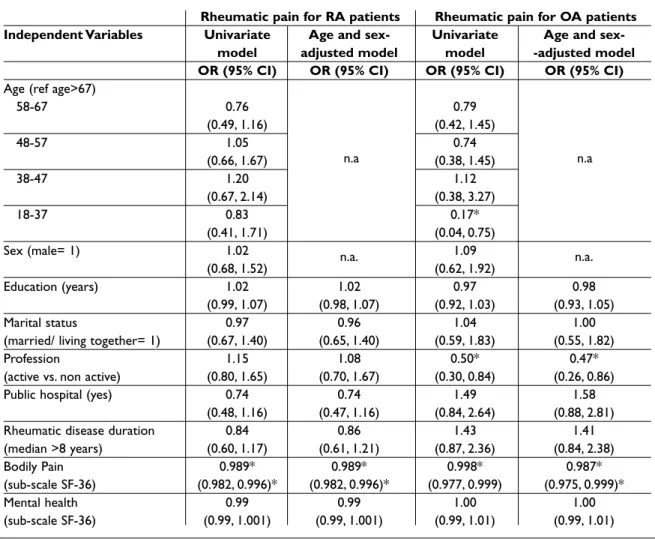
Investigating the factors that might be associa-ted with the choice of “Rheumatic pain” as a prio-rity among RA patients, we found that only the se-verity of pain reported by the patient (by the SF-36 bodily pain) was significantly associated. The elec-tion of “rheumatic pain” as a priority was more fre-followed by OA (19%) and OP (12%). The average
duration of the rheumatic disease was 11.4 (SD 10.8) years.
Table I. Socio-demographic and clinical patient characteristics Mean (SD) or % (n) Variables (N=1868) Sex, female 79 (1468) Age, years 56.8 (14.2)
Level of Education, years 7.1 (4.5)
Retired 41 (770)
Active 36 (671)
Married/living together 73 (1354)
Duration of rheumatic disease, years 11.4 (10.9)
SF-36 Mental health (0-100,0 is worst) 53.5 (24.3)
SF-36 Bodily Pain (0-100,0 is worst) 37 (23)
Main Diagnosis: RA 37 (667) SLE 5 (94) OA 19 (336) OCTD 5 (96) FM 7 (125) SpA + PA 4 (71) OP 12 (209) Other diseases 2 (32)
Note. Missing data: age – 3 cases; gender – 4 cases; Education – 20 cases; Mental health – 2 cases.
0 1
1: R. pain 2: W&B 3: H&F 4: Mob 5: Ten 6:HT 7: Arm 8: Work 9: Mood 10: FS 11: SA 12: SC
2 3 4 5 6 7 8 9 10 11 12 100 10 40 20 30 50 60 80 70 90 Pe rc enta ge (% ) RA patient's priorities
Physicians' priorities for RA patients
Figure 1. Rheumatoid arthritis: patients and physicians'
priorities. Columns represent the percentages of RA patients (n=667) and physicians who included the respective area among their three main priorities for improvement in RA. (R. pain: Rheumatic pain;W&B:Walking and bending; H&F: Hands and finger function; Mob: Mobility;Ten: Psychological tension and anxiety; HT: Household tasks;Arm:Arm function; FS Family support; SA: Social activities; SC: Self care)
P R I O R I T I E S O F PAT I E N T S A N D P H Y S I C I A N S
quent among patients with more pain (Table II). Priorities for OA: patients’ and doctors’ perspective. Regarding OA (Figure 2), patients (n=336) and rheu-matologists agreed on the election of “Rheumatic Pain” as the first priority (elected by 75% patients and 55% physicians). “Walking and bending” was the second choice for patients (50%) and physicians (43%). The third priority for patients, “Hand and Fin-ger Function” was selected by 41% of respondents but was highlighted by only 5% of the rheumatolo-gists. Together with “Walking and bending” physi-cians elected “Mobility” and “Work” as their second most popular priority regarding their OA patients, but “Mobility” was only chosen by 27% of the pa-tients (4th in rank) and “Work” by 10% (8th in rank).
Physicians and patients also diverged in the
ranking of other priorities. None of the Rheuma-tologists chose “Arm function” as a priority while 23% of the patients did. On the contrary, 23% of the physicians’ chose “Family support” as a priority whereas only 5% of the patients felt this was among their most pressing problems.
The exploration of factors related to the selec-tion of “Rheumatic Pain” as a top priority among patients with OA (Table II), showed that this was especially common among those professionally “non-active” (twice as much when compared to active patients, OR 0.50; 95% CI 0.30-0.84) even when adjusted for age and sex. Younger patients with OA (below 37 years of age) tended to elect rheumatic pain less often than older patients. Pa-tients with more severe bodily pain also elected pain more often as priority.
Table II. Univariate and age and sex-adjusted logistic models for the first priority of RA and OA patients. Rheumatic pain for RA patients Rheumatic pain for OA patients Independent Variables Univariate Age and sex- Univariate Age and
sex-model adjusted model model -adjusted model OR (95% CI) OR (95% CI) OR (95% CI) OR (95% CI)
Age (ref age>67)
58-67 0.76 0.79 (0.49, 1.16) (0.42, 1.45) 48-57 1.05 0.74 (0.66, 1.67) (0.38, 1.45) 38-47 1.20 1.12 (0.67, 2.14) (0.38, 3.27) 18-37 0.83 0.17* (0.41, 1.71) (0.04, 0.75) Sex (male= 1) 1.02 1.09 (0.68, 1.52) n.a. (0.62, 1.92) n.a. Education (years) 1.02 1.02 0.97 0.98 (0.99, 1.07) (0.98, 1.07) (0.92, 1.03) (0.93, 1.05) Marital status 0.97 0.96 1.04 1.00
(married/ living together= 1) (0.67, 1.40) (0.65, 1.40) (0.59, 1.83) (0.55, 1.82)
Profession 1.15 1.08 0.50* 0.47*
(active vs. non active) (0.80, 1.65) (0.70, 1.67) (0.30, 0.84) (0.26, 0.86)
Public hospital (yes) 0.74 0.74 1.49 1.58
(0.48, 1.16) (0.47, 1.16) (0.84, 2.64) (0.88, 2.81)
Rheumatic disease duration 0.84 0.86 1.43 1.41
(median >8 years) (0.60, 1.17) (0.61, 1.21) (0.87, 2.36) (0.84, 2.38)
Bodily Pain 0.989* 0.989* 0.998* 0.987*
(sub-scale SF-36) (0.982, 0.996)* (0.982, 0.996)* (0.977, 0.999) (0.975, 0.999)*
Mental health 0.99 0.99 1.00 1.00
(sub-scale SF-36) (0.99, 1.001) (0.99, 1.001) (0.99, 1.01) (0.99, 1.01)
* Statistically significant factors; n.a: not applicable
J. A. P. D A S I LVA E C O L.
Discussion
Overall, the most commonly selected priorities for improvement among patients with rheumatic di-seases were “Rheumatic pain”, “Walking and ben-ding”, and “Hand and Finger Function”. Results showed differences in priorities between patients with RA and OA: as expected, patients with diffe-rent diagnoses had diffediffe-rent health needs.
For patients with RA the most important priori-ties were “Rheumatic Pain”, “Hand and Finger Function”, and “Walking and bending”. Our results showed relevant and meaningful differences between patients’ and rheumatologists’ priorities. Doctors’ priorities for RA were “Work”, “Hands and Finger Function”, and “Rheumatic Pain”. The elec-tion of “Rheumatic Pain” as a priority by RA pa-tients was only associated with the severity of re-ported pain and it was not related to age, gender, profession, educational level, disease duration or mental health status.
OA patients referred “Rheumatic Pain”, “Walking and bending”, and “Hands and Finger Function” as the most important areas in need of improvement, and Rheumatologists also elected “Rheumatic Pain” as the first priority, but this was followed by “Mobility” and “Work” and only then by “Walking and bending”. The choice of “Rheumatic Pain”, as a priority by OA patients, was more common among those who reported more severe bodily pain, were aged more than 37 years and were
pro-fessionally non-active. This was not related to gen-der, educational level, disease duration or mental health status. Interestingly, in both diseases, physi-cians gave higher priority to psychological and so-cial aspects of the disease than patients did.
We are very confident that our results are a good representation of reality in Portugal: we included patients and rheumatologists from the vast majo-rity of rheumatology departments in the country and all patients attending the outpatients de-partment were invited to participate with very li-mited exclusion criteria. Very few patients refused to answer the questionnaires. However, while in-terpreting our results it is important to keep in mind that physicians selected their priorities based on a general view of their practice and concerns for RA and OA, but not specific to each patient. Al-though the inclusion of a large number of patients and physicians can be expected to reduce the in-fluence of individual variations, it is not impossi-ble that priorities of doctors and patients would have been closer if we had asked doctors to res-pond to this question considering specific cases.
Patients’ and physicians’ priorities may be ex-pected to differ according to cultural background. Although we did not find a significant influence of educational level on the selection of the main prio-rity by patients and despite a good parallel with published studies from other countries, our results cannot be generalised to other settings without caution. The number of years of formal education (quite low in our case compared with European standards), the universal access to the national health system and to social security are just a few of many confounders that can come into play. The-refore, we do not mean that our conclusions apply elsewhere but rather wish to stress that similar stu-dies may be equally useful in other settings.
Overall, our findings followed a trend also seen in other European countries: the first priorities for improvement were seen among physical aspects of disease and the last choices were made on
emotio-nal and social aspects of life6,13,19. They may be
in-terpreted in line with Ahlmen et al., who found in a qualitative study, that patients with rheumatic diseases wanted improvements in areas related to increased independence and undertaking of daily living activities12.
Our results are in close agreement with those of studies performed in Norway and in the Nether-lands where pain was also the major cause for
con-cern among RA patients13,19. The second and third
0 1
1: R. pain 2: W&B 3: H&F 4: Mob 5: Ten 6:HT 7: Arm 8: Work 9: Mood 10: FS 11: SA 12: SC
2 3 4 5 6 7 8 9 10 11 12 100 10 40 20 30 50 60 80 70 90 Pe rc enta ge (% ) OA patient's priorities
Physicians' priorities for OA patients
Figure 2. Osteoarthritis patients and physicians' priorities.
Columns represent the percentages of OA patients (n=336) and physicians who included the respective area among their three main priorities for improvement in OA. (R. pain: Rheumatic pain;W&B:Walking and bending; H&F: Hands and finger function; Mob: Mobility;Ten: Psychological tension and anxiety; HT: Household tasks;Arm:Arm function; FS Family support; SA: Social activities; SC: Self care)
P R I O R I T I E S O F PAT I E N T S A N D P H Y S I C I A N S
priorities are also similar: “Hand and Finger func-tion” was considered more important than “Wal-king and bending”. It is interesting to note that, in a recent study, patients with RA from 10 different European countries reached very similar conclu-sions when asked to identify and rank the most
important domains of their disease20.
Regarding RA, our physicians elected “Work” as their most pressing priority, in clear contrast with patients. The same first priority was elected by four American rheumatologists according to Kwoh and Ibrahim, but this was also the case with 62% of the
79 rheumatic patients included21. Regarding OA,
“Work” was, again in our study, given a higher prio-rity by physicians than by patients.
The priorities set by physicians and their com-parison with those of patients in the present study raise three main considerations:
Physicians may be too focused on classical pa-radigms of the disease: High rank for “hands and finger function” with low rank for “Walking and bending” in RA. High rank for “Walking and ben-ding” as well as for “Mobility” with low rank for “hands and finger function” in OA. Patients’ prio-rities seem to call physicians for a broader perspec-tive of the disease in terms of anatomical areas of impact.
Physicians rank the ability to work as a much higher priority than patients. Although, this may be related to the reasonable access of our patients to social security support, the reasons behind this re-markable discrepancy cannot be addressed on the basis of this study. However, they certainly deser-ve attention as efforts to keep patients professio-nally active can drive physicians into more aggres-sive therapies whilst not serving the patients’ objectives and values.
Physicians gave the psycho-social dimensions of these rheumatic diseases a higher priority than patients did. This may represent a true difference in the representation of the disease, but other fac-tors, including patients’ formal educational level and education about the disease, need to be con-sidered before practical implications can be drawn. Facing the results of this and similar studies, physicians and policy makers may find reasons to reconsider how much (scientific and personal) attention we are paying to the diseases we treat as opposed to the persons we care for. They also give us reason to re-visit our paradigms regarding the main objectives of treatment: disease process and productivity versus quality of life.
We see no reason why these issues would be li-mited to rheumatic diseases. Similar observations have been made in other areas and more will
su-rely emerge if more studies are performed10,11,22-24.
This supports the need to promote the incorpora-tion of validated patient reported outcomes in the evaluation of diseases and treatments if physicians are to achieve the most noblest aim of the profes-sion: patient’s satisfaction and quality of life.
Acknowledgements
This work was partially supported by an unrestricted educational grant by Grunenthal Foundation, Portugal. The authors wish to recognize the contribution of all the participating Rheumatology Departments:
Hospital da Universidade de Coimbra; Hospital Conde de Bertiandos, Ponte de Lima; Hospital Infante D. Pedro, Aveiro; Centro Hospitalar das Caldas da Rainha; Hospital Garcia de Orta, Almada; Hospital Egas Moniz, Lisboa; Hospital Militar Principal, Lisboa; Hospital Santa Maria, Lisboa; Hospital do Divino Espírito Santo, Ponta Delgada. Special thanks to participating physicians: Ana Filipa Mourão, Anabela Barcelos, António Alves de Matos, António Vilar, Augusto Manuel Faustino, Carlos Romeu, Carlos Vaz, Cátia Duarte, Fátima Maria Godinho, Fernando Saraiva, Guilherme Figueiredo, Inês Cunha, Jorge Espírito Santo, Jorge Silva, José Bravo Pimentão, José Canas da Silva, Luís Inês, Luís Maurício, Margarida Cruz, Margarida Mateus, Maria Teresa Nóvoa, Pedro Abreu, Pedro Machado, Rui André Santos, Sandra Garcês, Sérgio Alcino and all the remaining ones, who elected to remain anonymous.
Correspondence to
José António Pereira da Silva, MD, PhD, Professor of Rheumatology
Serviço de Reumatologia, Hospitais da Universidade de Coimbra
3000-075 Coimbra
E-mail: [email protected]
References
1. Kwoh CK, O'Connor GT, Regan-Smith MG et al. Con-cordance between clinician and patient assessment of physical and mental health status. J Rheumatol 1992;19:1031-1037.
2. Tallon D, Chard J, Dieppe P. Exploring the priorities of patients with osteoarthritis of the knee. Arthritis Care Res 2000;13:312-319.
3. Coenen M, Cieza A, Stamm TA, Amann E, Kollerits B, Stucki G. Validation of the International Classificati-on of FunctiClassificati-oning, Disability and Health (ICF) Core Set for rheumatoid arthritis from the patient pers-pective using focus groups. Arthritis Res Ther 2006;8:R84.
4. Heller JE, Shadick NA. Outcomes in rheumatoid arthritis: incorporating the patient perspective. Curr Opin Rheumatol 2007;19:101-105.
J. A. P. D A S I LVA E C O L.
the Patient Perspective Workshop at OMERACT 6. J Rheumatol 2003;30:868-872.
6. Grol R, Wensing M, Mainz J et al. Patients' priorities with respect to general practice care: an international comparison. European Task Force on Patient Evalua-tions of General Practice (EUROPEP). Fam Pract 1999;16:4-11.
7. Schattner A, Bronstein A, Jellin N. Information and shared decision-making are top patients' priorities. BMC Health Serv Res 2006;6:21.
8. Kirwan JR, Ahlmen M, de Wit M et al. Progress since OMERACT 6 on including patient perspective in rheumatoid arthritis outcome assessment. J Rheu-matol 2005;32(11):2246-2249.
9. Sanderson T, Kirwan J. Patient-reported outcomes for arthritis: time to focus on personal life impact measures? Arthritis Rheum 2009;61:1-3.
10. Guidance for industry: patient reported outcome measures. Use in medical product development to support labeling claims.: Food and Drug Administra-tion, 2006.
11. Fries JF, Krishnan E. What constitutes progress in as-sessing patient outcomes? J Clin Epidemiol 2009;62:779-780.
12. Ahlmen M, Nordenskiold U, Archenholtz B et al. Rheumatology outcomes: the patient's perspective. A multicentre focus group interview study of Swedish rheumatoid arthritis patients. Rheumatology (Ox-ford) 2005;44:105-110.
13. Heiberg T, Kvien TK. Preferences for improved health examined in 1,024 patients with rheumatoid arthri-tis: pain has highest priority. Arthritis Rheum 2002;47:391-397.
14. Schnittker J, Bhatt M. The role of income and ra-ce/ethnicity in experiences with medical care in the United States and United Kingdom. Int J Health Serv 2008;38:671-695.
15. Crawley LM. Racial, cultural, and ethnic factors influ-encing end-of-life care. J Palliat Med 2005;8:S58-69.
16. Schouten BC, Meeuwesen L, Tromp F, Harmsen HA. Cultural diversity in patient participation: the influ-ence of patients' characteristics and doctors' com-municative behaviour. Patient Educ Couns 2007;67: 214-223.
17. Severo M S, A S, Lopes, C, Barros, H. Reliability and validity in measuring physical and mental health construct of the Portuguese version of MOS SF-36. Acta Med Port 2006;19:281-288.
18. Ferreira P. A Medição do Estado de Saúde: Criação da Versão Portuguesa do MOS SF-36. 1998.
19. ten Klooster PM, Veehof MM, Taal E, van Riel PL, van de Laar MA. Changes in priorities for improvement in patients with rheumatoid arthritis during 1 year of anti-tumour necrosis factor treatment. Ann Rheum Dis 2007;66:1485-1490.
20. Gossec L, Dougados M, Rincheval N et al. The elabo-ration of the preliminary Rheumatoid Arthritis Im-pact of Disease (RAID) score: a EULAR initiative. Ann Rheum Dis 2009;68:1680-1685.
21. Kwoh CK, Ibrahim SA. Rheumatology patient and physician concordance with respect to important health and symptom status outcomes. Arthritis Rheum 2001;45:372-377.
22. Chartier-Kastler E, Amar E, Chevallier D et al. Does management of erectile dysfunction after radical prostatectomy meet patients' expectations? Results of a national survey (REPAIR) by the French Urologi-cal Association. J Sex Med 2008;5:693-704.
23. Varonen H, Sainio S. Patients' and physicians' views on the management of acute maxillary sinusitis. Scand J Prim Health Care 2004;22:22-26.
24. Hall JA, Stein TS, Roter DL, Rieser N. Inaccuracies in physicians' perceptions of their patients. Med Care 1999;37:1164-1168.