Earth mortars constructive use on neolithic domestic
structures. Some case studies in Alentejo, Portugal.
Patrícia Bruno
Architect, Mbc Architectonic and Landscape Heritage Restoration, PhD student in Pre-history/ University of Lisbon, 1600-214 Lisboa, Portugal, [email protected]
Paulina Faria
Civil Engineering, PhD in Architectural Heritage Rehabilitation, Assistant Professor/ Nova University of Lisbon, 2829-516 Caparica, Portugal, [email protected]
SUMMARY: Earth mortars were constructively used since Ancient Neolithic in Southwest Iberia pre-historic habitat places.
According to archaeological information, these materials were applied on Neolithic Period to render ditches; latter, on Copper and Bronze Age, earth mortars were also used binding stone masonry, covering and filling vegetable structures, in mudbrick masonry and probably in massive walls.
This paper aims to show some specific information about earth constructive traces obtained in interior Alentejo neolithic settlements of Defesa de Cima 2, Lajinha 8, Horta do Albardão 3, Valada do Mato (Évora district) and Toca da Raposa (Portalegre district).
The analysed materials were composed by samples of burned clayish mortars coming from renderings or small thickness walls of probable storage bins and combustion structures. The samples descriptions include the drawing, measurement and photographic record of the chosen traces and also structural and granulometric analysis.
The authors believe these analyses can contribute to deeper the knowledge of pre-historic domestic structures and constructive techniques, making possible technological reproduction of habitat settlements.
KEY-WORDS: archaeological traces, characterisation, earth mortar, Neolithic habitat
INTRODUCTION
Archaeological materials exhumed in south Portugal settlements show that earth mortars were largely used on pre-historic domestic structures.
(Santiago do Cacém, Setúbal), where renderings with 2 to 5 cm thickness, were found in situ, covering ditches with several shapes and dimensions (Albergaria [1], Santos [2], Gaspar [3], Santos [4], Gonçalves [5, 6, 7], Silva [8]).
In Xarez 12 some of the earth structures, interpreted has culinary ovens, seem to have moulded walls, with thickness until 30 cm, prolonged above the ditches (Gonçalves [9]). Later, on Cooper Age, the presence of earth vestiges showing negative prints of ramifications is dominant. These materials, probably coming from covering and filling hut’s vegetable structures, were found in São Pedro (Redondo, Évora), Monte da Ponte (Nossa Senhora da Tourega, Évora), Monte Novo dos Albardeiros, Torre do Esporão 3 (Reguengos de Monsaraz, Évora), Porto das Carretas, Mercador, Moinho de Valadares 1 (Mourão, Évora), Porto Torrão (Ferreira do Alentejo, Beja), Cerro do Castelo de Santa Justa, Cerro do Corte João Marques (Alcoutim, Faro) and Alcalar (Portimão, Faro) (Mataloto [10], Hock [11], Gonçalves [12, 13], Silva [14], Valera [15, 16, 17], Gonçalves [18], Morán [19]). In some of these settlements, earth mortars were also used binding stone blocks of defensive walls and hut bases.
As to mudbrick masonry, traces were found in Monte da Tumba (Torrão, Alcácer do Sal, Setúbal) and Alto do Outeiro (Baleizão, Beja) (Silva [20], Grilo [21]).
Earth was probably used on the construction of massive walls, as it seems in Alcalar’s hut from “Corte 5”, still in excavation.
Claysh renderings covering underground structures (bins and a water tank) were also found in calcolithic settlements, like Alto do Outeiro and Alcalar (Grilo [21], Morán [22]).
On Bronze Age, in spite the lack of domestic structures vestiges, earth mortars seem to be largely used, mostly covering and filling hut’s vegetable structures; traces were found in Rocha do Vigio 2 (Reguengos de Monsaraz, Évora) and Castro dos Ratinhos (Moura, Beja) (Bruno [23], Calado [24], Silva [25]). In Castro dos Ratinhos, archaeologists also found traces of earth renderings from a hut stone base.
Figures 3 and 4 - Mudbrick fragment from Alto do Outeiro calcolithic settlement; fragment of earth mortar, with ramification traces and straw addiction, from Rocha do Vigio 2 (Bronze Age settlement)
NEOLITHIC EARTH VESTIGES
Methodology
On a first stage, samples were measured, designed and photographed; the second stage, still running, consists on laboratorial analyses (microestructural morphology by binocular glass observation, granulometry and mineralogical interpretation).
Defesa de Cima 2 (Torre de Coelheiros, Évora)
Chosen samples belonged to the renderings of two Ancient Neolithic ditches, probably used as storage bins, bothexcavated in the granitic substrate.
These renderings, with about 2 to 3 cm thickness, were exposed to combustion by fire, after application in the ditches walls (and in some ditches, in the bases). According to archaeologists of Defesa de Cima 2, this procedure could be intentional, with the objective of waterproofing the bins interior (Santos [26]).
Ditch 5 had circular plan, with 80 cm of diameter and maximum preserved depth of 83 cm; inside, close to the basis, contained imbricate stones with combustion vestiges. Clayish renderings were continuous, surfacing the lateral walls of the ditch.
Ditch 16 was too much destroyed. It had circular plan, with 80 cm diameter and maximum preserved depth from 40 to 50 cm. Only part of lateral renders was preserved.
Vestiges were composed by small nodules and plaques of various dimensions, with 3 cm of maximum thickness. Concave faces of the plaques were smoothed and some of them had finger prints.
Pastes had brown-reddish colors and homogeneous compositions. As to the proportion between aggregates, fine elements (ilithic clays and sands) were dominant. At binocular glass the presence of quartz and feldspar was observable.
Different layers on the renderings, negative traces of organic materials, animal or vegetable fibers were not detected.
Pastes presented little pores, with diameters until 1000 μ (1 mm); microfissures were also rare, with apertures until 200 μ (0.2 mm).
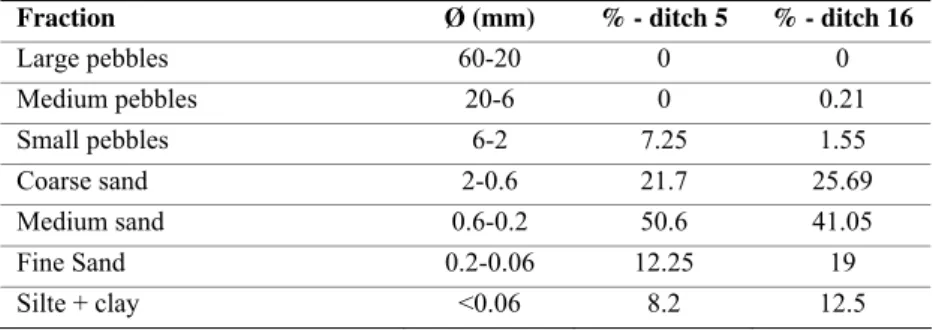
The following results were obtained in granulometry tests:
Fraction Ø (mm) % - ditch 5 % - ditch 16
Large pebbles 60-20 0 0
Medium pebbles 20-6 0 0.21
Small pebbles 6-2 7.25 1.55
Coarse sand 2-0.6 21.7 25.69
Medium sand 0.6-0.2 50.6 41.05
Fine Sand 0.2-0.06 12.25 19
Silte + clay <0.06 8.2 12.5
Figures 5 and 6 - Defesa de Cima 2: left, Ditch 5 after excavation; right, detail of Ditch 5 interior renderings (photo: Filipe Santos/ Arqueohoje)
Figures 7 and 8 – Defesa de Cima 2: left: some samples from Ditch 5; right, photo of a sample from Ditch 5, with binocular glass, 20x amplified
Lajinha 8 (São Manços, Évora)
Samples from Lajinha 8 Ancient Neolithic settlement came from combustion structure L8.1, apparently a kind of oven (Gaspar [27]).
Structure L8.1 was made upon a ditch with 90 cm of diameter and 20 cm of depth. Claysh renderings surfaced the walls and the base of the ditch; inside archaeologists found combustion vestiges termoclasts.
The structure was probably arched covered by claysh materials, thrown down above the ditch’s fill.
Negative traces of organic materials, animal or vegetable fibers were not detected. Pastes presented some pores, with diameters until 1000 μ (1 mm); microfissures were also rare, with apertures until 500 μ (0.5 mm)
Figures 9 and 10 - Combustion structure L8.1 of Lajinha 8: left, before dismounting, with vestiges from the probable covering; right, final aspect of the structure, with renderings vestiges in situ
Horta do Albardão 3 (São Manços, Évora)
Earth vestiges from Early Neolithic settlement of Horta do Albardão 3 probably belonged to a combustion structure made upon a ditch, excavated in the granitic substrate. This artificial concavity had oval plan, measuring 0.76m x 0.89 m and 0.39 m to 0.44m deep.
Materials were collected from the interior of the ditch, above a stone layer with traces of combustion; archaeologists think that they probably belonged to the structural walls or an arched covering (Santos, [28]).
Vestiges were composed by plaques of burnt claysh pastes, with 5 to 6.5 cm thickness, smoothed in one of the faces. Only one sample presented ramification traces (in the opposite face of the one that seem to be smoothed).
Pastes had brown-reddish colors and homogeneous compositions. Fine elements quantities were superior to larger aggregates; sands were mostly composed by quartz, with diameters until500 μ (0.5 mm).
Negative traces of organic materials, animal or vegetable fibers were not detected. Pastes had some porosity, with circular and oval pore, no larger than 500 μ (0.5 mm) diameter; fissures had apertures until 200 μ (0.2 mm).
Valada do Mato (São Matias, Évora)
Materials from Ancient Neolithic settlement of Valada do Mato were collected from a thrown down, mixed with many stone blocks, that probably belonged to an oval plan domestic structure (Diniz [29]).
Vestiges were composed by small plaques of burnt claysh pastes, with 1 to 2.5 cm thickness, smoothed in one of the faces and irregular on the other. Pastes had brown-reddish colors and revealed some homogeneity on composition. As to the proportion between aggregates, it was possible to observe the dominance of fine elements and the presence of quartz sands, with diameters until 500 μ (0.5 mm).
Negative traces of organic materials, animal or vegetable fibers were not detected. Pastes had some porosity, with elongated pores (like pore-fissures), with diameters until 1000 μ (1 mm);rare fissures were detected, with apertures until 100 μ (0.1 mm).
Figures 13 and 14 - Valada do Mato: left, materials from unit 9/19; right, photo of a sample from the same unit, with binocular glass, 20x amplified
Toca da Raposa (Alter do Chão, Portalegre)
Figures 15 and 16 - Toca da Raposa: left, possible combustion base (photo: Jorge Oliveira); right, photo of a sample of the same structure, with binocular glass, 20x amplified
DISCUSSION
All pastes presented homogeneous mixtures, by binocular glass observation, due to good kneading. Fine elements were dominant, with large quantities of sands. Pastes had some porosity and micro fissures with apertures only until 1 mm.
Except materials from Horta do Albardão 3 (plaques with 5 to 6.5 cm of thickness), all samples seem to come from renderings, with 1 to 3 cm of thickness and smoothing in one of the faces. In two cases – Defesa de Cima 2 and Lajinha 8 – pastes were still above buttress (walls and bottoms of the ditches).
After materials extraction (clay, sand), mixing and kneading, pastes would be hand laid above buttress, in only one layer. Posteriorly, renderings would be manually smoothed. All materials were burnt by fire, and in the case of vestiges interpreted as combustion structures that enforces those interpretations. However, in Defesa de Cima 2, where ditches were interpreted as storage bins, two suppositions stand:
- Renderings combustion was made only to waterproof the bins interior;
- Renderings combustion was made to toast cereals, to better conserve them and, in this case, structures would have two functions – storage and combustion.
Due to maximum conserved depths of many structures of Defesa de Cima 2 – until 83 cm – it seems highly probable that those ditches function was related with storage, has archaeologists support.
CONCLUSIONS AND FUTURE DEVELOPMENTS
From a data base which includes all the main excavated habitat places in South Portugal, it will be possible to identify some of the techniques and typologies used on the construction of domestic structures, since Ancient Neolithic to Bronze Age.
REFERENCES
1
ALBERGARIA, João - O sítio neolítico das Atafonas (Torre de Coelheiros, Évora). Revista Portuguesa de Arqueologia, 10-1, 2007, p. 5-35.
2
SANTOS, Filipe & CARVALHO, Pedro - O sítio neolítico da Defesa de Cima 2 (Torre de Coelheiros, Évora). Primeiros resultados. III Coloquio de Arqueologia do Sudoeste Peninsular – Aljustrel, Outubro de 2006, in press.
3
GASPAR, Rita - Intervenção arqueológica na Lajinha 8 (São Manços, Évora). Relatório Final. Archeo’Estudos, 2008.
4
SANTOS, Filipe - Minimização de impactes sobre o património cultural decorrentes da construção do canal da conduta C1_3 do Bloco 3 do Bloco de Rega do Monte Novo. Sítio do Neolítico Final/Calcolítico da Horta do Albardão 3 (S. Manços, Évora). Trabalhos arqueológicos. Relatório Final (Novembro 2006). Arqueohoje, 2006.
5
GONÇALVES, Victor dos Santos - Intervenções na área da barragem do Alqueva (2000). Bloco 3. Habitats Sítio: Carraça 1. IPA, 2000.
6
GONÇALVES, Victor dos Santos - Intervenções na área da barragem do Alqueva (2001). Bloco 3. Povoados. Sítio: Carraça 1. IPA, 2001
7
GONÇALVES, Victor dos Santos - Comer em Reguengos, no Neolítico. As estruturas de combustão da Área 3 de Xarez 12. Muita gente, poucas antas? Origens, espaços e contextos do Megalitismo. Actas do II Colóquio Internacional sobre Megalitismo. Lisboa, 2003, p.81-91.
8
SILVA, Carlos Tavares & SOARES, Joaquina - Pré-História da Área de Sines. Gabinete da Área de Sines, Lisboa, 1981.
9
GONÇALVES, Victor dos Santos - Comer em Reguengos, no Neolítico. As estruturas de combustão da Área 3 de Xarez 12. Muita gente, poucas antas? Origens, espaços e contextos do Megalitismo. Actas do II Colóquio Internacional sobre Megalitismo. Lisboa, 2003, p.81-91.
10
MATALOTO, Rui, ESTRELA, Susana & ALVES, Catarina - As fortificações calcolíticas de São Pedro (Redondo, Alentejo Central, Portugal). Los primeros campesinos de La Raya. Aportaciones recientes al conocimiento del Neolítico y Calcolítico en Extremadura y Alentejo. Actas de las Jornadas de Arqueología del Museo de Cáceres. Cáceres, 2007, p. 113-141.
11
HOCK, Martin & KALB, Philine - O povoado fortificado calcolítico do Monte da Ponte, Évora. Actas do 2º Congresso de Arqueologia Peninsular, Zamora, 1996. Zamora, 1997, II, p. 417-423.
12
GONÇALVES, Victor dos Santos - A ocupação pré-histórica do Monte Novo dos Albardeiros (Reguengos de Monsaraz).Portugália. IX-X, 1989.
13
GONÇALVES, Victor dos Santos - TESP3: o povoado pré-histórico da Torre do Esporão (Reguengos de Monsaraz). Portugália. 11-12, 1991, p.53-72.
14
15
VALERA, António Carlos - Moinho de Valadares e transição Neolítico final/ Calcolítico na margem esquerda do Guadiana: uma análise preliminar. Era Arqueologia. 1, 2000, p. 24-37.
16
VALERA, António Carlos - A ocupação pré-histórica do sítio do Mercador (Mourão): a campanha de 2000. Era Arqueologia. 3, 2002, p. 42-57.
17
VALERA, António Carlos & FILIPE, Iola - O povoado do Porto Torrão (Ferreira do Alentejo). Era Arqueologia. 6, 2004, p. 28-61.
18
GONÇALVES, Victor dos Santos - Megalitismo e metalurgia no alto Algarve oriental, uma aproximação integrada. INIC/ UNIARQ, Lisboa, 1989.
19
MORÁN, Elena - Conjunto Megalítico de Alcalar (Portimão). Povoado de Alcalar. Parcela 15L. Campanha 3(2001). Relatório preliminar dos trabalhos de terreno efectuados no corte 04. IPA, 2001.
20
SILVA, Carlos Tavares & SOARES, Joaquina - O povoado fortificado calcolítico do Monte da Tumba - Escavações arqueológicas de 1982-86 (resultados preliminares). Setúbal Arqueológica. 8, 1987, p.29-79.
21
GRILO, Carolina - O povoado pré-histórico do Alto do Outeiro, Baleizão, Beja. III Coloquio de Arqueologia do Sudoeste Peninsular – Aljustrel, Outubro de 2006, in press. 22
MORÁN, Elena - Relatório dos trabalhos arqueológicos efectuados em Março-Abril de 1999 no povoado calcolítico de Alcalar. Parcela nº 16-L propriedade de Uta Tackenber. IPA, 1999.
23
BRUNO, Patrícia - O uso da terra na construção de uma cabana do Bronze final. Estudo dos materiais provenientes do sítio proto-histórico Rocha do Vigio 2 (Campinho, Reguengos de Monsaraz). Terra: forma de construir. Arquitectura-Antropologia-Arqueologia. Lisboa, 2006, p. 67-73.
24
CALADO, Manuel, MATALOTO, Rui & ROCHA, Artur - Povoamento proto-histórico na margem direita do Regolfo de Alqueva (Alentejo – Portugal). Arqueologia de la tierra. Paisajes rurales de la Protohistoria Peninsular. Cáceres, 2007, p. 129-179.
25
SILVA, António Carlos & BERROCAL-RANGEL, Luis - Castro dos Ratinhos. Relatório. 4ª Campanha - 2007. Edia/ Projecto Arqueológico dos Ratinhos, 2007.
26
SANTOS, Filipe & CARVALHO, Pedro - O sítio neolítico da Defesa de Cima 2 (Torre de Coelheiros, Évora). Primeiros resultados. III Coloquio de Arqueologia do Sudoeste Peninsular – Aljustrel, Outubro de 2006, in press.
27
GASPAR, Rita - Intervenção arqueológica na Lajinha 8 (São Manços, Évora). Relatório Final. Archeo’Estudos, 2008.
28
SANTOS, Filipe - 2006. Minimização de impactes sobre o património cultural decorrentes da construção do canal da conduta C1_3 do Bloco 3 do Bloco de Rega do Monte Novo. Sítio do Neolítico Final/Calcolítico da Horta do Albardão 3 (S. Manços, Évora). Trabalhos arqueológicos. Relatório Final (Novembro 2006). Arqueohoje.
29
DINIZ, Mariana - O Sítio de Valada do Mato (Évora): aspectos da neolitização no Interior/ Sul de Portugal. IPA, Lisboa, 2007.
30