Effects of dietary valine:lysine ratios on lactation performance of
primiparous sows nursing large litters
Subramaniam Mohana Devi1, Jae Won Park1, In Ho Kim1 1 Dankook University, Department of Animal Resource & Science, Cheonan, Chungnam, South Korea.
ABSTRACT - Eighteen sows were used to determine the effect of dietary valine:lysine (val:lys) ratios on lactation performance in primiparous sows and litter performance. Sows, raised in individual pens, were randomly assigned to 1 of 2 experimental diets containing different standardized ileal digestibility (SID) val:lys ratios of 0.80 or 0.85. Corn-soybean-wheat-based diets were formulated to achieve the dietary treatments (0.86% or 0.87% SID lysine, and 0.69% or 0.74% SID valine). All diets were formulated to have 3,450 kcal metabolizable energy/kg. The experiment lasted 24 d. At the end of the experiment, body weight loss, backfat loss, average daily feed intake, and days to return to estrus were not affected by the different dietary val:lys ratios. Furthermore, no difference was observed in number of piglets weaned, piglet survival rate, weaning litter weight, litter weight gain, piglet weaning body weight, piglet gain, or piglet daily gain between the two dietary treatments. However, increasing the dietary val:lys ratio increased arginine and threonine concentrations in the milk. Dietary val:lys ratios of 0.80 and 0.85 do not affect the lactation performance of primiparous sows nursing large litters, but increase the arginine and threonine concentrations in milk as the dietary val:lys ratio are increased.
Key Words: amino acid, body weight, feed intake, pigs
ISSN 1806-9290
www.sbz.org.br R. Bras. Zootec., 44(12):420-424, 2015
Received June 3, 2015 and accepted September 29, 2015. Corresponding author: [email protected]
http://dx.doi.org/10.1590/S1806-92902015001200002
Copyright © 2015 Sociedade Brasileira de Zootecnia. This is an Open Access article distributed under the terms of the Creative Commons Attribution License (http://creativecommons.org/licenses/by/4.0/), which permits unrestricted use, distribution, and reproduction in any medium, provided the original work is properly cited.
Introduction
The amino acid (AA) requirement is an important issue in swine nutrition. As genetic improvements have increased milk production and litter size in sows, nutritional requirements need to be re-evaluated. The three most limiting AA in a corn-soybean meal diet for lactating sows calculated from National Research Council (NRC, 2012) are, in descending order, lysine, valine, and threonine. This order of limitation remains fixed regardless of the rate of sow body tissue mobilization. The concept of a dynamic ideal AA pattern was expanded to the lactating sow by the elegant work of Kim et al. (2001), whose results suggested that the ideal AA changes in relation to the rate of sow body tissue mobilization during lactation. In the research of Kimand Easter (2001), regardless of the nature of the body tissue loss rate (i.e., extreme, high, or zero), valine was the third limiting AA in lactating sows. Several reports (Johnston et al., 1993; Knabe et al., 1996) have
suggested that high-producing, lactating sows require higher concentrations of dietary lysine than the previous standard. As such, the requirement of valine for lactating sows seems to increase. Therefore, a number of studies have been conducted to evaluate the valine nutrition in lactating sows. However, there has been a great deal of disparity among these trials. Richert et al. (1996; 1997ab) reported that a val:lys ratio of at least 1.15:1 was needed to maximize litter growth rate. However, Southern et al. (2000) reported no improvement in sow productivity when the val:lys ratio was increased from 0.85 to 0.94:1 using hydrolyzed feather meal as a source of valine. Similarly, Gaines et al. (2006) showed that a val:lys ratio in excess of 0.86 did not conserve maternal tissue loss or improve piglet growth rate, but that a val:lys ratio of 0.73 might compromise the litter growth rate. Also, Carter et al. (2000) indicated that there is no benefit of elevated dietary valine for lactating sows nursing more than 10 piglets and consuming a corn-soybean meal diet containing 0.90% lysine and 0.80% valine.
Material and Methods
The animal care protocol was approved by the Laboratory Animal Care Committee of the Dankook University, South Korea.
Eighteen Landrace × Yorkshire breed primiparous sows were used in this experiment. During gestation, sows were fed the same diet (containing 12% crude protein, CP; 0.60% lysine) and each sow was provided with 1.8 kg feed per day. On d 107 of gestation, sows were moved into farrowing crates in an environmentally regulated farrowing room. Farrowing crates (2.1 × 0.6-m) contained an area for newborn pigs on each side after birth, and the temperature in the farrowing house was maintained at a minimum of 18 °C. Supplemental heat was provided for piglets using heat lamps, and zone cooling directed to the heads of sows (snout cooling) was provided in hot summer weather. Each farrowing stall had a drinker and a feeder. Piglets were treated according to routine management practices that included teeth clipping, tail docking, ear notching, and subcutaneous iron dextran injections (50 mg/pig) within 24 h.
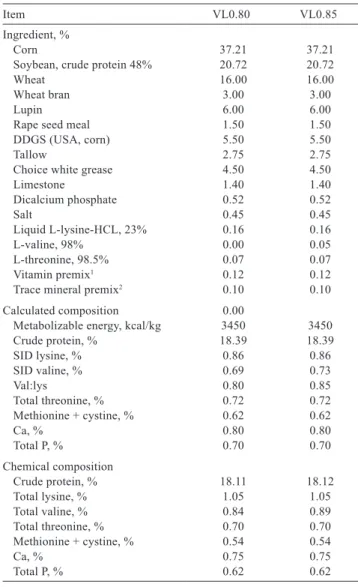
Eighteen primiparous sows were used to determine the effect of increasing the val:lys ratio in lactating sows. All sows were allocated into one of the two treatments. Dietary treatments were formulated to achieve SID val:lys ratios of 0.80 or 0.85. Diets were based on corn and soybean meal and contained 16% wheat and 0.16 liquid L-lysine HCl (lysine, 23%) (Table 1). Dietary valine was increased by the addition of synthetic valine. The calculated ratio of other essential AA to lysine and other nutrients exceeded the NRC (2012) recommendations. Sows were fed twice at 07.00 h and 16.00 h daily. During lactation, sows were fed
ad libitum, and feed disappearance was monitored daily. Sows were weighed within 24 h after farrowing and at weaning (d 24). Sow weight change during farrowing was calculated by subtracting sow weight after farrowing from sow weight at weaning. Sows’ backfat was measured 6-cm off the midline on both sides of the body at the tenth rib to determine backfat thickness within 24 h after farrowing and at weaning. On the day of weaning, sows were moved to an environmentally regulated breeding facility for observation. The return-to-estrus interval was recorded for each sow up to 15 days after weaning. Sows not expressing estrus within 15 days after weaning were assigned a value of 15 days for return to estrus.
Litter size was standardized to 12 piglets within 24 h after farrowing. Piglets were weighed at birth and weaning (24 d of age). Litter weight gain was calculated by subtracting birth weight from weaning weight. Creep feed was not offered to litters.
Diets were analyzed for CP, Ca, P, and amino acids by AOAC (2000) procedures. Crude protein was determined by the Kjeldahl method (N × 6.25). Dietary Ca was assayed by atomic absorption spectrophotometry after wet ash procedures, and P was determined by a colorimetric procedure. Individual amino acid composition was measured using an amino acid analyzer (Beckman 6300, Beckman Coulter, Inc., Fullerton, USA) after 24 h of 6 N
HCl hydrolysis at 110 °C (AOAC, 2000). Performic acid was used before hydrolysis to oxidize cysteine and methionine to cysteic acid and methionine sulfone, respectively. Gross energy was analyzed using an oxygen bomb calorimeter (Parr Instrument Co., Moline, USA).
Table 1 - Composition of experimental diets (as-fed basis)
Item VL0.80 VL0.85
Ingredient, %
Corn 37.21 37.21
Soybean, crude protein 48% 20.72 20.72
Wheat 16.00 16.00
Wheat bran 3.00 3.00
Lupin 6.00 6.00
Rape seed meal 1.50 1.50 DDGS (USA, corn) 5.50 5.50
Tallow 2.75 2.75
Choice white grease 4.50 4.50
Limestone 1.40 1.40
Dicalcium phosphate 0.52 0.52
Salt 0.45 0.45
Liquid L-lysine-HCL, 23% 0.16 0.16 L-valine, 98% 0.00 0.05 L-threonine, 98.5% 0.07 0.07 Vitamin premix1 0.12 0.12
Trace mineral premix2 0.10 0.10
Calculated composition 0.00
Metabolizable energy, kcal/kg 3450 3450 Crude protein, % 18.39 18.39 SID lysine, % 0.86 0.86 SID valine, % 0.69 0.73
Val:lys 0.80 0.85
Total threonine, % 0.72 0.72 Methionine + cystine, % 0.62 0.62
Ca, % 0.80 0.80
Total P, % 0.70 0.70
Chemical composition
Crude protein, % 18.11 18.12 Total lysine, % 1.05 1.05 Total valine, % 0.84 0.89 Total threonine, % 0.70 0.70 Methionine + cystine, % 0.54 0.54
Ca, % 0.75 0.75
Total P, % 0.62 0.62
SID - standardized ileal digestibility; DDGS - distiller’s dried grains with solubles. VL0.80, val:lys ratio = 0.80; VL0.85, val:lys ratio = 0.85.
1 Premix supplied per kilogram of diet: vitamin A, 4000 IU; vitamin D3, 400 IU;
vitamin E, 50 IU; vitamin K (menadione), 1.0 mg; vitamin B12, 30 µg; vitamin B6, 2.0 mg; riboflavin, 5.0 mg; niacin, 20 mg; choline, 2.0 mg; biotin, 0.40 mg; pantothenic acid, 25 mg; folacin, 3.0 mg.
2 Premix supplied per kilogram of diet: Mn (Mn SO
4), 30 mg; Zn (Zn SO4), 270 mg;
All sows were milked manually on d 14 of lactation. Sows were separated from their litters. All sows were milked after the initial morning feeding. Milk was collected from the first and last productive glands on both sides of the body. Each gland was milked until 50 mL of milk was collected. Milk excretion was enhanced by infusing 10 IU of oxytocin into an ear vein of the sow. Milk samples from each gland were pooled for chemical analysis and stored at 4 °C. All analyses were conducted within 48 h after collection. The milk sample was then freeze-dried by a freeze dryer (Ilshin. Lab. Co. Ltd, Daejeon, South Korea). Dry matter was determined according to AOAC (2000) procedures for milk samples. Individual amino acids were measured using an amino acid analyzer (Beckman 6300, Beckman Coulter, Inc., Fullerton, USA) (AOAC, 2000).
Data for lactation performance and litter growth performance were subjected to ANOVA by using the General Linear Models procedure of SAS (Statistical Analysis System, version 7.0). An individual sow or litter was considered the experimental unit. Differences among treatments were evaluated by the t-test option of SAS. The results were expressed as the least squares means and standard error of mean (SEM). Probability values lower than 0.05 were considered significant.
Results
No difference (P>0.05) was observed with respect to sow body weight after farrowing, sow body weight at weaning, and sow body weight loss between the two dietary treatment groups (Table 2). In addition, the backfat thickness of the sow at farrowing and weaning and the loss of backfat thickness were not affected by dietary val:lys ratios (P>0.05 each). Days to return to estrus and ADFI
were also not influenced by dietary treatments (P>0.05 each).
No difference (P>0.05) was observed with regard to the number of weaned piglets and piglet survival rate between the two dietary treatments (Table 3). Weaning litter weight, litter weight gain, piglet weaning weight, piglet gain, and piglet daily gain were not affected (P>0.05)by dietary val:lys ratios.
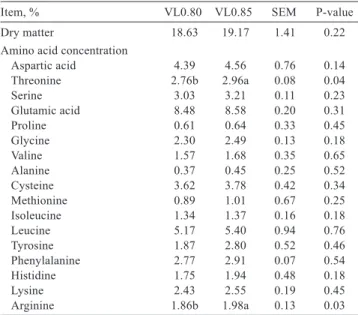
No difference (P>0.05) was observed in the DM of milk between the two dietary treatments (Table 4). Most amino acid concentrations were not influenced (P>0.05) by the dietary val:lys ratio. However, sows fed the diet with a val:lys ratio of 0.85 had a higher (P<0.05) threonine concentration in milk than that those fed the diet with a val:lys ratio of 0.80. The arginine concentration in milk was also higher (P<0.05) in the treatment with a val:lys ratio of 0.85 than in the group receiving a val:lys ratio of 0.80.
Table 2 - Effect of dietary valine:lysine ratio on lactation performance in sows
Item VL0.80 VL0.85 SEM P-value Number of sows 9 9
Parity 1 1
Sow body weight, kg
Farrowing 233.2 225.1 6.87 0.13 Weaning 210.9 210.0 8.98 0.57 Body weight loss, kg 41.8 37.7 2.84 0.08 Sow backfat, mm
Farrowing 28.5 24.7 1.54 0.09 Weaning 22.4 17.8 1.76 0.10 Backfat loss, mm 5.5 7.9 0.99 0.08 ADFI, kg 5.39 5.72 0.44 0.33 Days to return to estrus 5.5 5.8 0.21 0.47
SEM - standard error of the mean; ADFI - average daily feed intake. VL0.80, val:lys ratio = 0.80; VL0.85, val:lys ratio = 0.85.
Table 3 - Effect of dietary valine:lysine ratio on piglet performance
Item VL0.80 VL0.85 SEM P-value Number of pigs farrowed/sow 12.13 11.89 0.26 0.48 Pigs weaned/sow 11.75 11.67 0.28 0.53 Piglet survival, % 97.03 98.15 1.76 0.39 Initial litter weight, kg 16.36 14.73 0.65 0.12 Litter weaning weight, kg 83.60 81.49 3.42 0.25 Litter gain, kg 67.25 66.76 3.01 0.17 Piglet initial weight, kg 1.39 1.26 0.04 0.06 Piglet weaning weight, kg 7.14 6.99 0.29 0.34 Piglet gain, kg 5.75 5.73 0.26 0.89 Piglet daily gain, g/d 239.77 238.98 11.00 0.75
SEM - standard error of the mean.
VL0.80, val:lys ratio = 0.80; VL0.85, val:lys ratio = 0.85.
Table 4 - Effect of dietary valine:lysine ratio on milk dry matter and amino acid concentration of sows
Item, % VL0.80 VL0.85 SEM P-value Dry matter 18.63 19.17 1.41 0.22 Amino acid concentration
Aspartic acid 4.39 4.56 0.76 0.14 Threonine 2.76b 2.96a 0.08 0.04 Serine 3.03 3.21 0.11 0.23 Glutamic acid 8.48 8.58 0.20 0.31 Proline 0.61 0.64 0.33 0.45 Glycine 2.30 2.49 0.13 0.18 Valine 1.57 1.68 0.35 0.65 Alanine 0.37 0.45 0.25 0.52 Cysteine 3.62 3.78 0.42 0.34 Methionine 0.89 1.01 0.67 0.25 Isoleucine 1.34 1.37 0.16 0.18 Leucine 5.17 5.40 0.94 0.76 Tyrosine 1.87 2.80 0.52 0.46 Phenylalanine 2.77 2.91 0.07 0.54 Histidine 1.75 1.94 0.48 0.18 Lysine 2.43 2.55 0.19 0.45 Arginine 1.86b 1.98a 0.13 0.03
a,b - means in the same row followed by different letter differ (P<0.05). SEM - standard error of the mean.
Discussion
Livestock production can make good use of resources, which contributes with high quality nutrients to the human diet (Mohana Devi et al., 2014a). Carter et al. (2000) reported that increasing the dietary valine from 0.70 to 1.07% (val:lys ratio from 0.80 to 1.25) did not affect the number of pigs weaned per sow, survival rate, sow performance, or litter performance. The results of our experiment were in agreement with their report. However, contrasting results were found by Richert et al. (1997a), who reported that increased dietary valine from 44.7 to 64.7 g/d (0.72 to 1.07%, val:lys ratio of 0.78 to 1.15) increased litter weights (d 14, 46.5 vs. 48.0 kg; weaning, 62.0 vs. 64.1 kg) and litter weight gain (d 14, 29.8 vs. 31.0; weaning 45.4 vs 47.1 kg) at d 14 and weaning. Mohana Devi et al. (2014b), reported that supplementation of protein sources in growing pig diets improved their growth rate and feed intake.
Richert et al. (1997b) reported that first-parity sows were more susceptible to increasing valine than second-parity sows. However, Carter et al. (2000) reported no effect in first-, second-, third-, fourth- or higher-parity sows in response to dietary valine levels. The inconsistent results might be because the two val:lys ratios were very close, or that the valine and lysine concentration in our experimental diet was low for sows nursing large litters. In our study, the dietary valine and lysine concentrations were 0.69% or 0.74% and 0.86% or 0.87%, respectively, which were lower than the previous studies and the NRC recommendation of valine and lysine concentrations, which are about 0.77 and 0.90%, respectively (as SID basis, daily weight gain of piglets = 250 g/d). The correlation between litter growth rate and lysine intake of the lactating sow was first proposed by Pettigrew (1993) in the following manner: total dietary lysine, g/d = –8.38 + 26 (litter ADG, kg/d). Subsequently, the equation was adjusted by Boyd et al. (2000) in the following manner: total dietary lysine, g/d = 0.0266 (litter growth rate, kg/d) – 7.55 (R2 = 0.63). According to the two formulations, the average dietary requirement of sows in our experiment was about 60.3 and 59.6 g/d; however, the average lysine intakes in our experiment were 46.4 and 49.8 g/d, respectively. Although the dietary concentrations of valine and lysine were lower, in our experiment, the piglet weight daily gain reached 240 g/d, which might indicate that the dietary valine and lysine concentrations are sufficient for the growth performance of piglets. The sows’ backfat loss was numerically higher, while their body weight loss was lower at the higher dietary val:lys ratio. The increasing backfat loss is supported by Richert et al. (1997a), who reported that increasing dietary valine concentrations
from 0.72 to 1.07% increased sow backfat loss. However, other studies (Richert et al., 1996; 1997ab) did not observe a valine response to sow BW loss. Furthermore, the backfat loss in our research was much higher compared with other studies. This might be because primiparous sows generally lose more backfat.
Although we did not find any difference in the valine concentration in the milk, the arginine and threonine concentrations were increased in response to the dietary increase of the val:lys ratio. No evidence from previous studies can be used to support our findings. However, the results may indicate that the dietary val:lys ratio can influence arginine and threonine metabolism in the sow mammary gland. As an essential amino acid for young piglets, arginine in sow milk is usually deficient for the requirements of the piglets (Wu et al., 2000). The output of arginine in sow milk is much lower than the uptake of plasma arginine by the lactating mammary gland (Trottier et al., 1997). Because there is little arginase activity in the small intestine of neonates (Wu et al., 1996) and a low ability to synthesize proline (an essential amino acid for young piglets) (Wu et al., 1994), the increasing milk-borne arginine may be of nutritional importance for the growth and development of the neonatal piglets. Threonine is usually the second or third limiting AA in cereal-based diets fed to swine (Lewis, 2001), and is a major component of plasma globulin in poultry (Azzam et al., 2011). For pigs, a decrease in plasma IgG in sows was alleviated by feeding a threonine-supplemented diet (Cuaron et al., 1984). Taken together, these data suggest a role for threonine in immune function. Therefore, increasing the threonine concentration in milk in certain instances may bring positive effects to the immune system of piglets and help to protect piglets from disease.
Conclusions
Dietary valine:lysine ratios of 0.80 and 0.85 do not affect the lactation performance of primiparous sows or growth performance of piglets, but the arginine and threonine concentrations in the milk are increased with increased dietary valine:lysine ratios. This study is unique, because of its increase in valine, relative to lysine along with increase in soybean meal.
References
Boyd, R. D.; Touchette K. J.; Castro, G. C.; Johnston, M. E.; Lee, K. U. and Han, I. K. 2000. Recent advances in amino acid and energy of prolific sows: Review. Asian Australasian Journal of Animal Science 13:1638-1652.
Azzam, M. M. M.; Zou, X. T.; Dong, X. Y. and Xie, P. 2011.Effect of supplemental L-threonine on mucin 2 gene expression and intestine mucosal immune and digestive enzymes activities of laying hens in environments with high temperature and humidity. Poultry Science 90:2251-2256.
Carter, S. D.; Hill, G. M.; Mahan, D. C.; Nelssen, J. L.; Richert, B. T. and Shurson, G. C. 2000. Effects of dietary Val concentration on lactational performance of sows nursing large litters. Journal of Animal Science78:2879-2884.
Cuaron, J. A.; Chapple, R. P. and Easter, R. A. 1984. Effect of Lys and threonine supplementation of sorghum gestation diets on nitrogen balance and plasma constituents in first-litter gilts. Journal of Animal Science58:631-637.
Gaines, A. M.; Boyd, R. D.; Johnston, M. E.; Usry, J. L.; Touchette, K. J. and Allee, G. L. 2006. The dietary Val requirement for prolific lactating sows does not exceed the National Research Council estimate. Journal of Animal Science 84:1415-1421.
Johnston, L. J.; Pettigrew, J. E. and Rust, J. W. 1993. Response of maternal-line sows to dietary protein concentration during lactation. Journal of Animal Science71:2151-2156.
Kim, S. W.; Baker, D. H. and Easter, R. A. 2001. Dynamic ideal protein and limiting amino acids for lactating sow: The impact of amino acid mobilization. Journal of Animal Science 79:2356-2366. Kim, S. W. and Easter, R. A. 2001. Nutrient mobilization from body
tissues as influenced by litter size in lactating sows. Journal of Animal Science79:2172-2178.
Knabe, D. A.; Brendemuhl, J. H.; Chiba, L. I. and Dove, C. R. 1996. Supplemental Lys for sows nursing large litters. Journal of Animal Science74:1635-1640.
Lewis, A. J. 2001. Amino acids in swine nutrition. p.131-150. In: Swine nutrition. 2nd ed. Lewis, A. J. and Southern, L. L., eds. CRC Press, Boca Raton, Florida.
Mohana Devi, S.; Balachandar. V.; Lee, S. I. and Kim, I. H. 2014a. An outline of meat consumption in the Indian population – A pilot
review. Korean Journal for Food Science of Animal Resource 34:507-515.
Mohana Devi, S.; Devi, U. S. and Kim, I. H. 2014b. Evaluation of dietary sources of protein on growth performance in pigs. Veterinarni Medicina 59:247-253.
NRC - National Research Council. 2012. Nutrient requirements of swine. 11th ed. National Academy Press, Washington, DC. Pettigrew, J. E. 1993. Amino acid nutrition of gestating and lactating
sows. Biokyowa Technical Review #5. Nutrition-Quest, Inc., Chesterfield, MO.
Richert, B. T.; Good, R. D.; Tokach, M. D. and Nelssen, J. L. 1997a. Increasing Val, isoleucine, and total branched-chain amino acids for lactating sows. Journal of Animal Science 75:2117-2128. Richert, B. T.; Tokach, M. D.; Goodband, R. D.; Nelssen, J. L.;
Campbell, R. G. and Kershaw, S. 1997b. The effect of dietary Lys and Val fed during lactation on sow and litter performance. Journal of Animal Science 75:1853-1860.
Richert, B. T.; Tokach, M. D.; Goodband, R. D.; Nelssen, J. L.; Pettigrew, J. E.; Walker, R. D. and Johnston, L. J. 1996. Val requirement of the high-producing lactating sow. Journal of Animal Science 74:1307-1313.
Southern, L. L.; LeMieux, F. M.; Matthews, J. O.; Bidner, T. D. and Knowles, T. A. 2000. Effect of feather meal as a source of Val for lactating sows. Journal of Animal Science 78:120-123.
Trottier, N. L.; Shipley, C. F. and Easter, R. A. 1997. Plasma amino acid uptake by the mammary gland of the lactating sow. Journal of Animal Science 75:1266-1278.
Wu, G.; Borbolla, A. G.; and Knabe, D. A. 1994. The uptake of glutamine and release of arginine, citrulline and proline by the small intestine of developing pigs. Journal of Nutrition 124:2437-2444. Wu, G.; Knabe, D. A.; Flynn, N. E.; Yan, W. and Flynn, S. P. 1996.
Arginine degradation in developing porcine enterocytes. American Journal of Physiology Gastrointestinal and Liver Physiology 271:G913-G919.