Education for peace in the primary school teachers’
education in Portugal between 1890-1936
Margarida Louro Felgueiras
Abstract –In the late nineteenth century, Portuguese educators question the concept of patriotism (César Porto, 1902) and appeal for peace (Alice Pestana, 1898). César Porto wondered about the reasons that would lead those who advocated “a religion of civility” to devastate other homelands when the political preponderance of theirs was in danger. The understanding of the origin of conflicts, the classification of wars in offensives and de-fensives and the critique to the concept of patriotism are present in some educators. The article aims to analyse in what way the training of teachers in Portugal addressed the issue of peace in the period between 1890-1936. We interrogate the ability of the education to contribute to peace, creating a repulse for war and the need to seek peaceful solutions for conflicts. The analysis will cover the end of the monarchy and the republican and demo-cratic Portuguese period. We will use as sources some manuals used in the teachers’ education at the Normal School, particularly in the one in Porto. We will also confront the positions presented by primary teachers in con-gresses and some opinions expressed in newspaper articles. By asking ourselves about the ability of education to contribute for peace, we are reflecting and questioning the foundations of the exercise of the teaching profes-sion. The analysis of the textbooks used in the Normal Schools allows us to conclude that the training of primary school teachers in Portugal rarely touched the problem of peace.
Riassunto – Alla fine del XIX secolo, il concetto di patriottismo fu al centro della riflessione degli educatori portoghesi (César Porto, 1902) unitamente alla richiesta della pace (Alice Pestana, 1898). César Porto era sorpreso dalle ragioni di coloro che, in nome di una “religione civile”, chiedevano a gran voce la distruzione delle patrie altrui quando era in pericolo la preponderanza politica delle loro. La comprensione delle origini del conflitto, la catalogazione delle guerre in offensive e difensive e la critica all’idea stessa di patriottismo è presente in molti educatori. Questo contributo mira a analizzare come la formazione degli insegnanti in Portogallo svolse le istanze alla pace nel periodo 1890-1936. Ci si chiede quale capacità possa avere l’educazione di contribuire alla pace, creando un rifiuto per la guerra e il bisogno della ricerca di soluzioni non militari ai conflitti. L’analisi riguarda il periodo della fine della monarchia e degli anni repubblicani e democratici. Ci serviremo come fonti di manuali usati nelle scuole normali per la preparazione dei maestri, soprattutto a Oporto, ma si confronteranno anche le posizioni espresso dai maestri nei congressi e le opinioni pubblicate in giornali dell’epoca. Interrogandoci sulla relazione tra educazione, guerra/pace, ci interroghiamo di fatto sui fondamenti dell’esercizio della professione docente. L’analisi dei libri di testo usati nelle scuole normali ci consente di rilevare, in conclusione, come la questione della pace fu raramente toccata nella formazione degli insegnanti della scuola elementare in Portogallo.
Keywords – peace, war, education for peace, teachers’ training, Portuguese educators and the issue of peace between 1890-1936
Parole chiave – pace, guerra, educazione alla pace, formazione degli insegnanti, educatori portoghesi e pace nel periodo 1890-1936
Margarida Louro Felgueiras (Outil – Cantanhede, 1951) teaches History of contemporary education at the Uni-versity of Porto and she is Coordinator of the Education and Cultural Heritage Master Course and of the work group History of Education, Cultural Heritage and Museology, of the Research Centre for Research and
Interven-__________________________________________________________________________________________ 130 – “Annali online della Didattica e della Formazione Docente” – Vol. 8, n. 12/2016 – ISSN 2038-1034 tion in Education. She has been visiting professorat USP and several federal and state Brazilian universities. She has been coordinator of the History of Education Section of the Portuguese Society of Educational Sciences – SPCE (2007-2010). Her main researches refer to Social History of Education with a particular focus in the his-tory of the educational institutions, its daily life from the organizational and student’s experience point of view; the childhood social history and school material culture in a boarding school context and cultural heritage as com-plementary areas; literature, feminist movement, women’s life stories and school museology as auxiliary sub-jects, developed in interaction with museum conservation and educational intervention, with particular interest in the study of the school’s material culture resorting to Oral history and daily life study. Among her recent essays, see: C. A. Castro, S. L. Velazquez Castellanos, M. Louro Felgueiras (Org.), Escritos da História da Educação: Brasil e Portugal, Sao Luis, Café e Lápis, 2012; A dificil e frágil emergência de um ensino privado não confessio-nal em Portugal (in J. Pintassilgo (Coord.), Laicidade, Religiões e Educação na Europa do Sul no Século XX, Li-sboa, Instituto de Educação, Universidad de LiLi-sboa, 2013).
1. Introduction
The late Nineteenth century saw the intensification of the imperialist rivalries at the same time that the initiatives of discussion and action were being developed for the sake of interna-tional peace. The Portuguese participate in this European movement seeking to create inter-nal civic consciousness through debate, publications and the creation of institutions that would promote a pacifist thought. In Portugal, that had lived the English Ultimatum (1890), the repub-lican movement grows, with a preponderant presence of the Portuguese freemasonry led by Magalhães Lima and the feminist movement, with Alice Pestana (1898). These movements were clearly against war and in favour of conflict resolution through arbitration courts. It is in that context, that Portuguese educators such as César Porto, in 1902, write and participate in conferences about the subject of war. The issue concerned the social movements, in particu-lar women and workers of education.
Alice Pestana creates the Portuguese League of Peace, that brings together women of various political tendencies, “18 May 1899, opening day of the Hague Peace Conference”1,
with the common goal of promoting Peace. With that purpose, already in 1898 the author had written an appeal to the Portuguese mothers2. In May of 1906 the League holds the 1st
Portu-guese Congress for Peace and “in December, it is constituted the PortuPortu-guese section of the French association La Paix et le Désarmement pour les femmes, founded in 1899 by Sylvie Cammille Flammarion”3.
The educator César Porto (1902), active member in the associative movement of teachers and supporter of the New School movement, wondered about the reasons that would lead “men with principles”, that defended “a religion of civility” to murder others and to devastate other homelands, when the political preponderance of theirs was in danger. In “A Guerra não
1 F. Mariano, Pacifismo e feminismo em Portugal nas vésperas da 1ª guerra mundial, Comunicação
apresentada no I Encontro anual A Europa no Mundo”Pela Paz” (1849-1945), Faculdade de Letras da Universidade de Coimbra, 4 e 5 de Abril de 2013.
2 A. Pestana, La femme et la paix: appel aux méres portugaises, Lisboa, Imprensa Nacional, 1898. 3 Ibidem.
__________________________________________________________________________________________ 131 – “Annali online della Didattica e della Formazione Docente” – Vol. 8, n. 12/2016 – ISSN 2038-1034 findará? A Guerra e a sua extinção evolutiva”4, he classifies the different types of war and
crit-icizes the concept of patriotism.
However, Portugal ends up getting into the 1st World War by the action of the republican governments. Women will be called to participate in this war effort, and meet at the Republi-can League of Portuguese Women. Many RepubliRepubli-cans and feminists, defenders of the peace-ful resolution of conflicts, argue with the right of defence of the threatened colonial territories and with the duty to support the old ally England. Eventually they accept the necessity of war to achieve peace! The contradiction between what they previously defended and what reality has led them to accept appears evident.
Among the educators in general there was a certain withdrawal of thought in the discursive fight against war. The question before us when we question the role of school in a period dom-inated by militarism claim, is knowing the extent to which educators have autonomy in the na-tional education systems to implement an education for Peace. What is the possibility that school education can be an antidote against the violence and the use of force in the resolution of social and individual conflicts? The Education for Peace is a key issue, which challenges educators and the education system as a whole, to the possibility of contributing to the aware-ness and to the active responsibility of citizens in favour of peaceful solutions. This question arises in the purposes and in the search of meaning of the education as cross-cutting issue to all knowledge. It implies from the educators’ perspective an educational design that includes a pacifist vision of the human relations and information on how to introduce the topic in the ped-agogical practice. Which led us to question if the training of primary school teachers in Portu-gal addressed the issue of peace in the period between 1890-1936.
2. The manuals of Pedagogy and of Civic Education and its analysis
To analyse how the training of primary school teachers approached the education for peace, we sought between the textbooks used in Normal Schools those that could address this issue. Thus, we constituted a documentary corpus of ten manuals of moral and civic education and pedagogy, availa-ble for teachers and students in the Normal School of Porto between 1890 e 19365.
4 C. Porto, “A Guerra não findará? A Guerra e a sua extinção evolutiva, 7.ª Conferência da Liga Portuguesa
da Paz,1902.
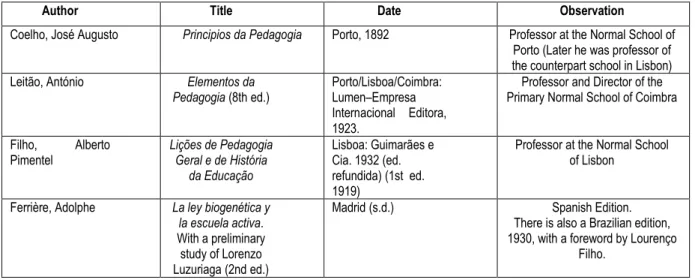
__________________________________________________________________________________________ 132 – “Annali online della Didattica e della Formazione Docente” – Vol. 8, n. 12/2016 – ISSN 2038-1034 Table n. 1 – Manuals of Pedagogy in the Normal School of Porto
Author Title Date Observation
Coelho, José Augusto Principios da Pedagogia Porto, 1892 Professor at the Normal School of
Porto (Later he was professor of the counterpart school in Lisbon)
Leitão, António Elementos da
Pedagogia (8th ed.)
Porto/Lisboa/Coimbra: Lumen–Empresa Internacional Editora, 1923.
Professor and Director of the Primary Normal School of Coimbra
Filho, Alberto Pimentel Lições de Pedagogia Geral e de História da Educação Lisboa: Guimarães e Cia. 1932 (ed. refundida) (1st ed. 1919)
Professor at the Normal School of Lisbon
Ferrière, Adolphe La ley biogenética y
la escuela activa. With a preliminary study of Lorenzo Luzuriaga (2nd ed.)
Madrid (s.d.) Spanish Edition.
There is also a Brazilian edition, 1930, with a foreword by Lourenço
Filho.
Table n. 2 – Manuals of Civic education in the Normal School of Porto
Author Title Date Observation
Bonne, Louis-Charles Cours élémentaire et
pratique de morale pour les écoles pri-maires et les classes d’adultes (4th ed.)
1867 (1st ed.) Approved by the religious
au-thority.
Nogueira, Domingos
d’Almeida Primeiras noções de Educação Cívica Lisboa, A Liberal, 1903
Junior, F. J. Cardoso Moral em Narrativas e
Preceitos (4th ed.) Porto, J. Pereira da Silva ed. (1st ed. 1912) Professor at the Normal School of Porto Leitão, António
Instrução cívica Porto, Livraria Chardron, 1913
Professor at the Primary Nor-mal School of Coimbra
Droz, Numa Manual de Instrução Cívica Lisboa, Livraria Aillaud e
Bertrand, 1914 Portuguese version of the Re-publican educator João de Barros
Portugal, João Boavida Educação cívica Lisboa, Livraria Clássica
editora, 1917 For the Primary, Normal and Post school instruction. Jour-nalist.
__________________________________________________________________________________________ 133 – “Annali online della Didattica e della Formazione Docente” – Vol. 8, n. 12/2016 – ISSN 2038-1034
The presented textbooks have different status which should be taken into account in its analysis. All were used in the training of young teachers in the Normal Schools of Porto, Coimbra and Lisbon and were available in the respective school libraries. Some are specifical-ly tailored to the normal school students, while two of them seem to have as first target school children, as is the case of Nogueira (1903) and Cardoso Junior (1912). There are four that are of Pedagogy – Coelho (1892), Leitão (1923), Pimentel Filho (1932), and Ferrière (1930) – and the rest of them are of Civic Education. Among these there is a Swiss author Droz (Portu-guese version of 1914) and French author (Bonne). The book of Ferrière has two editions, one Spanish and one Brazilian. The presence of these manuals shows the circulation of books and ideas between France, Switzerland and Portugal and their appropriations: in some cases it gives origin to modified and adapted translations to the Portuguese reality, in other cases the ideas circulate through a Spanish translation and a Brazilian edition. The Droz’s book is an example of the first case and has met two translations (the 1st of a poet, Trindade Coelho, the second one of a Republican educator). The books in French or Spanish must have served and circulated mainly among teachers of the Normal School. The teaching manuals, except for Coelho, whose edition is from the monarchical period, are posterior to the 1st World War. Amongst the civic education textbooks, two are from the monarchic period (Bonne; Nogueira), three are of the early republican period and one is from the end of the war.
For the analysis of the problematic of Peace in school textbooks we defined the categories war, peace and patriotism, in order to analyse how these concepts were defined and to inter-pret what messages they conveyed. We sought to locate in what context and theme they were entered and to identify what other concepts they had associated. We asked ourselves, to what extent could the training of teachers and the School be an antidote against intolerance? Could it develop an education of pacifist content? If so, how to sustain a pacifist speech in a belliger-ent country or in a dictatorship?
3. Peace, War and Patriotism in the training manuals of primary schoolteachers.
The identified manuals were divided into two groups related to the respective disciplines, which were part of the education curriculum of primary school teachers and for which they provided the key information: Pedagogy and Civic Education.
3.1. The manuals of Pedagogy
We found that the terms peace, war and patriotism do not appear, in general, directly in teaching manuals for training of primary teachers. We then sought in the structure of the theme books that could fit some rough reflection of the valuation of peace, framing it in the theoretical context in which each author is situated.
Thus, in the oldest manual (Coelho 1892) there is a section on “The moral and psychologi-cal man” with two chapters – moral actions; conduct – with 25 pages, in which the author will talk about the moral good. This is identified with the realization of the fullness of individual life
__________________________________________________________________________________________ 134 – “Annali online della Didattica e della Formazione Docente” – Vol. 8, n. 12/2016 – ISSN 2038-1034 in harmony with the collective one6. Starting from a positivist conception of human progress
under the injunction of science and technique, of influence of Conte and Spencer, it is said that the progress of ideas will develop altruistic and solidarity feelings amongst the peoples, which will lead them from a destructive coexistence to a “cooperative” one. The balance be-tween the selfish and the altruistic feelings of humanity would generate the “great work of peaceful civilization”. On the basis of this belief it would be the progress of legal philosophy, which according to José Augusto Coelho, applied to relations between citizens it would depu-rate the civil laws of all the injustices and in the relations between peoples it would bring “the consolidation of the benefits of peace and the removal of the horrors of war”7. The
multiplica-tion of the means of producmultiplica-tion by the progress of science, the development of social relamultiplica-tions by decreasing the distances and the national rivalries would create “an abundant mediocrity of things useful for life, that both competes to men’s well-being”. Thus, it would promote the iden-tification of the real good with the ideal one, becoming this a fact and no longer a simple aspi-ration8.
We are in the presence of a pacifist thought, based on the belief that human progress, as it was thought in philosophy and positivist sociology, would necessarily lead to a peaceful civili-zation. Students should understand the war, the rivalries and the intolerance as delay symp-toms both individually and collective and an obstacle to the realization of a full life.
In the Volume II, Book II – A Instrução Primária, devotes a chapter to the pedagogical presentation of sociology, in which it proposes that the teacher starts from the family as a real-ity close to the child, to present the functions and the forms of social regulation, presenting the various types of power, the need for production, defence, solidarity interests of social struggle. Progressively the students would extend this knowledge to the country, as reality around them and that they were miniature citizens, and the most advanced in the complex unity of societies in general9. The history would appear in the end to show the social evolution over time,
through short stories, biographies, paintings, relating to the actions of men.10. In line of
thought, which defends the exclusion of primary education of the moral and religious teaching, because the imposition of dogma would not serve for anything, because they are incompre-hensible to children, who still live in a sensitive and selfishness state11. There is in this author
a thought guided by the positivist philosophy, of combat on dogma, of belief in progress and in the law as base of understanding between the peoples. Education would promote the under-standing of the laws of human progress. From Porto, José Augusto Coelho went to the Normal School of Lisbon, where later Alberto Pimentel Filho will give, in 1918, his General Education Lessons and Educational History.
In the manual Lições de Pedagogia Geral e de História da Educação, Alberto Pimentel Fil-ho (1st edition of 1919) makes the reasoning of Education through a psycFil-hological, sociologi-cal and historisociologi-cal approach, having as a reference to the same theoretisociologi-cal framework of its predecessor. However, as the title suggests, the work is divided into two parts: the first that
6 J. A. Coelho, Tomo I, p. 320. 7 Ibidem.
8 Idem, p. 322.
9 Idem, tomo II, pp. 329-331. 10 Ibidem, p. 340.
__________________________________________________________________________________________ 135 – “Annali online della Didattica e della Formazione Docente” – Vol. 8, n. 12/2016 – ISSN 2038-1034 deals with the reasoning of pedagogy in its relations with other sciences, namely psychology, biology and sociology; the second in which he traces the evolution of the history of the educa-tion. Imbued with the same idea of progress of Mankind, it doesn’t aim at the practical applica-tion of the presented contents, it only pretends to form the general pedagogical culture of the future teachers. Therefore, you cannot find references to pacifism or to the question of war or peace, although the book was written in the final phase of the war, given the explanation that the author does in the second edition12.
The book of Ferrière is placed on a strictly bio-psychological and pedagogical aspect, fo-cussed on the presentation of the contributes of the new education and its organization, it does not exist any reference to pacifism or war. It does not stop at moral education because it argues that “morality cannot be taught: it is lived”13. In your perspective, what would be at the
scope of the educator was to make the child feel with pleasure or pain, respectively, with what is morally ugly and with what is beautiful and good in a historical tale.
“What school life offers in itself, which work teaches, which spontaneously arises from the observation of human life [...] the clear sense of social cooperation, [...] assistance and recip-rocal love [...] constitute the better and the deepest, the only true moral education, which may not consist of sentences but in real reflections and real actions”14.
In this perspective, just as analysis of the facts that give rise to actual actions of solidarity, for example, one would expect that educators worked the notion of pacifism or war. But the author does not particularize that possibility. We only deduce it from the quoted text message. It would be up to the teachers to realize it or not. In the Portuguese case, some of these edu-cators linked to the movement of the new education will seek to realize this education through positive actions.
In other hand António Leitão, in Elementos de Pedagogia, presents a chapter entitled “Moral Education” set in a designated part as “Practical Education”. This consists of three chapters that deal with physical, intellectual and moral education, respectively. The Moral Ed-ucation, chapter IX, is defined as the “culture of sensitivity and will, in order to form the charac-ter.” In this chapter we find reference to the education of trends and to the growing of feelings of honour, personal dignity, sympathy and respect for others and to “patriotic feeling”. This is presented as “an altruistic feeling, the most sublime and complex and fundamental basis of civic education”15, by asking about how the teacher can instil this feeling in the child. It
com-pares the country to a large family that defends his children: all citizens are subject to the same laws, have the same language and common interests, and receive protection. The country would be something you love as you love your own family. It then clarifies the respon-sibility of that feeling, “patriotism it’s not just in disposing your life in the defence of the country, but also in working for its aggrandizement”16, recommending that the teacher encourages the
students throughout History to “follow with courage in the way of his illustrious ancestors”. Alt-hough patriotism is seen by António Leitão as the willingness to contribute to the country’s
12 Filho A. Pimentel, 2nd ed. 1932, pp. 8-9.
13 A. Ferrière (1929), A lei biogenética e a escola activa, São Paulo, Companhia Melhoramentos de São
Paulo, p. 52.
14 Ibidem.
15 A. Leitão, Elementos de Pedagogia, cit., p. 142. 16 Idem, p. 143.
__________________________________________________________________________________________ 136 – “Annali online della Didattica e della Formazione Docente” – Vol. 8, n. 12/2016 – ISSN 2038-1034 progress in a line that we can consider pacifist, it underlies the duty to sacrifice your life for the defence of the country, meaning to obey military service.
3.2. The manuals of Civic Education
Unlike the previous manuals, the ones of civic education all include explicit references to some of the considerated terms. Of the mannuals of civic education present in the Normal School of Porto, the one of Louis-Charles Bonne, Cours élémentaire et pratique morale pour
les écoles et les primaires classes d’adultes (4th ed), 1873, is the oldest and should have
exerted some influence early in the school, in the way to approach the moral education of male and female students. In the following of the duties to the state17, the respect for the laws
and magistrates, the payment of taxes, it appears a sunject on “Military service, patriotism and courage”, developed in four pages. The author starts from the premise that man is born for others, referring to Plato, which makes him part of his family, friends and country and for that he owes them love and must be prepared to sacrifice his life for its defense. The military service is presented as a duty of all citizens and aims to maintain order during peace and ensure the defense in wartime. Furthermore, the citizen owes the State the acceptance of public office, exercising them with dedication for the general good. It argues that all citizens can be useful to his country in the performance of their duties, in the performance of their daily professions giving evidence of what he calls “civil courage”18. This knows no age.
Another author of the final period of the monarchy, that publishes in 1903 a small book as support material for teachers in primary schools and according to the official program of 1902, was Domingos Nogueira. In Primeiras noções de Educação Civica, it appears that the au-thor’s choice is more political-administrative, featuring topics such as the state constitution, elections, free voting and duties of the citizens, including the “pay of the blood tribute “(Ch. X). The author states that without an army, the rights of a nation are not safe. Hence the author considers as a sacred tax, the duty of every true citizen of not evade the military service and the exercise of public functions, for which it has competence. Military service appears as an indisputable duty.
The novelty that the book contains is to consider education as a condition of the civilization and of the knowledge of rights and duties. So, it claims the duty of the State in making the ed-ucation improve and it claims the duty of the citizens to attend school and to be educated19. It
considers that there should be mutual assistance through the philanthropic institutions and the private practice of philanthropic that would obtain the esteem of his fellow citizens20.
Cardoso Júnior, professor of the Normal School of Porto, writes a small handbook for stu-dents of primary education – Moral em narrativas e preceitos (1912). It is also a textbook, adapted to the use of teaching practice and with a defined structure around of duties: to us, towards other people, parents, siblings, servants, teachers, animals, towards the homeland. The book deals with many issues and always have an appeal to personal improvement. The 17 L.-C. Bonne, Cours élémentaire et pratique de morale pour les écoles primaires et les classes d’adultes,
(4th ed.), 1873, p. 77.
18 Idem, pp. 81-84.
19 Nogueira Domingos d’Almeida, Primeiras noções de Educação Cívica, Lisboa, A Liberal, 1903, pp. 30-32. 20 Idem, p. 32.
__________________________________________________________________________________________ 137 – “Annali online della Didattica e della Formazione Docente” – Vol. 8, n. 12/2016 – ISSN 2038-1034 chapter on “Our duties” ends with a text entitled “Peace and war: the misery in the family”, il-lustrated with two pictures: a house where the husband is drunk and the woman cries leaning on the table – is representing the misery in the family; the other one shows a happy family around a table – and is representing peace in the family. The purpose is clearly to fight alco-holism, as a source of desolation and misery. The book devotes the final four pages to the du-ties to the Country. Cardoso Júnior starts from History to show that the country was made having as base the achievements, the fighting spirit, but finishes off “times have changed. The warrior enthusiasm of those times has disappeared”21. It stresses especially, the episodes of
defence against the aggressor. It refers the French invasions and the then recent invasion of Belgium by the Germans to establish the distinction between “legitimate and hateful wars”. Legitimate wars would be all the ones regarding the defence against the foreign aggressor, for freedom. It is in this context that the author inserts the duty to defend the homeland 22, which
is presented as a language, interests and customs community. The most representative text, entitled “Peace”, belongs to Cardoso Júnior. The ideas we already have found them in Alice Pestana, César Porto and educators linked to the movement of the new school, the Interna-tional Workers League of Education and the Teachers Association of Portugal, that the author is part off. Cardoso Júnior is decisive: only in case of foreign invasion our soldiers must fight. It notes that there are in other nations: war desires and that the press talks on the conquest of lands to nations with small armies. But says
But there are many who strive to avoid wars, knowing that men should be esteemed as brothers. And a day will come, perhaps, that even though the races, customs and languages are diverse, there will cease to exist flags representing the homelands and it will only exist one flag that represents all mankind.
It’s present here a message of peace based on an internationalist conception. The text continues regarding an engraving representing a session of the International Tribunal of Hague. Once again, we are in face of the great hope which represented the efforts to establish an international legal order capable of resolving conflicts by arbitration of justice. The text ends with a message of hope, expressed in the following dialogue:
“ – Will it come a time in which the soldiers will not be accurate, my father?”
“ – Of course. It will take many, many years. But we should all hope that justice will one day replace the law of force” (Cardoso Júnior, p. 98).
In the following text “The law – different ways of loving the motherland”, the child begins by stating that it no longer wants to be a soldier. The father will convince that he is wrong, because he will have to obey the law, which requires the military service to defend the country. “The law must be respected, because it is necessary to punish the bad and for the people to live in peace. Comply with the law, serve the motherland is being patriotic”23.
However, the author concludes the book with another small text “Not only as a soldier we serve the Fatherland”, in which he explains that those who contribute to the country’s wealth by their work, spreading the popular education, developing the strength and hygiene, fighting alcohol and tobacco and promoting the moral progress, which makes men more kind and
21 F.J. Cardoso Júnior, Op. cit., 1912, p. 97. 22 Idem, p. 98.
__________________________________________________________________________________________ 138 – “Annali online della Didattica e della Formazione Docente” – Vol. 8, n. 12/2016 – ISSN 2038-1034 sociable, is also serving the Fatherland24.
The book reflects well the pacifist aspiration, based on the affirmation of international law and at the same time the contradiction that the respect for the law generates, by requiring the military service. This contradiction is resolved by recouring to the concept of legitimate war – the one regarding the defense against the aggressor, where smaller countries are the most threatened. At the same time it patents the ambiguity lived by the teacher, in a context of growing bellicosity that the press echoes. Ought to educate for peace and for the recogning of the strenght of the law, it ends up having to accept the need of an army and the duty to perform military service. History is always used as an example of the warrior spirit of the past but also, to form new paths for the future.
António Leitão also wrote civics education textbooks. He wrote on the subject since 1905 and his works known several editions, which are being adapted to the requirements of the new programs enacted by governments. The author adopts a political and administrative approach seeking to present the notion of state, the division of powers, its operation and the institutions to which they give rise. It also presents the main principles underlying the Portuguese legal system and the rights and duties of the citizens. In the opening pages there is a picture of the Republic under the phrase “Peace and work” and a national flag with a caption “Public Education”. These were the main slogans of the republican regime, introduced in 1910.
In the subject IV National Defense, they show the military and the military service as an obligation. The author helds off explainning how the military recruitment works. The book has prints of a warship and of a rank of marching soldiers. Although the need for the armed forces is justified for reasons of “honor, independence and integrity of the Motherland”, there is nothing in order to emphasize the odious nature of war. The emphasis is mostly done on civic duties, the first being the payment of Taxes25, appearing at last the “blood tax”26, which
focuses on the lives of citizens and is presented as “the most noble duty of every good citizen”. The language itself refers to the nineteenth century, to a hierarchical society, centered in the language of duty and insensitive to the value of freedom or peace. This is not said. As images it comes up the oath of flag, the Electoral Act and the book closes with the image of a school battalion, labeled “School Battalion – for the Homeland and the Republic”. There is a huge gap in the way of seeing the social relations between this manual and the one of Cardoso Junior.
In the nineteenth century and up to the 30s, textbooks were not written only by teachers. We have found doctors, poets, men of letters, journalists, among others, that occupy them selves with education problems, write articles and often manuals. The following two manuals that we present were produced by a Republican lawyer, politician, man of letters and dedicated to educational issues, having collaborated on the development of some republican laws on education, and by a journalist, also a man of letters and a Republican.
João de Barros makes in 1914 a new adapted translation of Manuel d’instruction civique of Numa Droz, professor and Swiss democratic politician who advocated a secular state and the optional teaching of religion in primary school. The translation being a “deal”, as pointed out by
24 Ibidem.
25 A. Leitão, Instrução Cívica, Porto, Livraria Chardron, 1913, pp. 32-33. 26 Idem, p. 35.
__________________________________________________________________________________________ 139 – “Annali online della Didattica e della Formazione Docente” – Vol. 8, n. 12/2016 – ISSN 2038-1034 Faria Filho, it can also be understood as a political act27, which is applied with property to João
de Barros. Pugnador by a secular school and morals, the translation of the manual of Numa Droz, that Ramalho Ortigão appointed ironically as “catechism entitled of Civic Education” and “Gospel of democratic education”28, was inconsistent with his political and educational ideals.
The author begins by considering History as the auxiliary science of Civic Education and this, the discipline in which the youth studies should culminate. For him, History permits to know the development of the institutions and summarizes the human experiences in their reciprocal interactions. The book is divided into four parts: general principles; state organs and functions; international law or the law of nations; homelands institutions. Not being able to dwell on the analysis of the totality of this book, we find early on, in Chapter I, the definition of homeland and duties to her, the position of the author: the country as the homeland, family, house parents, the village and the villa, the territory. In the duties towards it stands out patriotism, defined as the love and the fulfillment of the duties to the homeland and its best defense. It alerts immediately against what he designates as the risks of selfishness and cosmopolitanism. The first one leads to the sole thinking of the private interests and the neglect of the participation in the public interest; the second is the utopia of internationalism, the love of a country without borders and without rivalries – the one of Mankind – what he considers a dangerous utopia29. Defending a fervent love of country, João de Barros models
that considerate patriotism consists both in the heroics acts on the battlefield as it does in the
civic courage, “which consists in saying and performing with pride what you hold out to be the
expression of the truth.”30.
In the chapter on national sovereignty it approaches the “right of intervention”, generally used as «cover of this odious principle “that the strenght crushes the right” » 31 and ultimately
it limits the right to intervene only “when a state is directly caused or in need to defend its nationals”32. The author, as a man of law and a diplomat, suspects about the uses and
invocations of the law in international relations. In Part III, International Law, it distinguishes the law in peacetime and in wartime. The first deals with treaties on people and property, the second one is about the “war fatality”, the legitimate war, the declaration of war, the law relating to people and property, the armistice and peace negotiations33.
The author presents the war as inevitable, something that gives place to wild massacres that tend to increase in direct proportion to the improvement of destructive forces. He believes that this could only be avoided when the international law starts to obligate the states to resolve conflicts on the basis of negotiation. Until then the Latin phrase “if you want peace, prepare for war”34, should be the motto of the patriot. This is contradictory to what he claimed
27 Vieira Cleber Santos, A tradução como ato político: o Dr. Domingos Jaguaribe e o Manual de Instrução
Cívica de Numa Droz. Revista História, n. 161, São Paulo, USP, 2009, pp. 65-189 (http://www.revistas.usp.br/re-vhistoria/issue/view/1468).
28 R. Ortigão, A revolução de Outubro, in Últimas Farpas, Lisboa, Clássica Editora, 1993, p. 11. 29 João de Barros, Manual de Instrução Cívica, cit., pp. 15-19.
30 Idem, p. 20. 31 Idem, p. 24. 32I dem, p. 25.
33 Idem, cap. 18, pp. 165-174. 34 Idem, p.165.
__________________________________________________________________________________________ 140 – “Annali online della Didattica e della Formazione Docente” – Vol. 8, n. 12/2016 – ISSN 2038-1034 before, that States impose sacrifices to maintain numerous armies always ready to intervene. João de Barros reaffirms that all war must be legitimate and that the state can only declare it in exceptional cases, when the defense or their rights are under risk. The text also gives information about the verified progress in the second half of the XIX century, the respect for the civilian population, the lives of prisoners, and the rescue to the wounded. Since 1865 that the relief to the injured by medical and nursing staff, and religious, marked with a red cross, is recognized. The attacker can also order goods, occupy public buildings or launch an extraordinary contribution to the army sustaining, but has the duty to pay to the population for food and other required work. At the signing of Peace he draws attention to the fact that peace treaties are perpetual and can not be reviewed unless due to a new war. The author points out, at the end of the chapter, that the arbitration is in fact the true legal mean of solving international conflicts and cites various treaties and conferences that have been inaugurate it, since the Vienna conference of 1814. He states that the pacifists ideas have made progress and that there will come a day when a permanent court will be able to settle peacefully the international disputes.
João de Barros adapted the translation of book of Droz to the postuguese context, especially in the fourth part, in which he presents the institutions. We did not have access to the original Droz, but we suppose by the biography of João de Barros, that existed from him an intellectual and political affinity with the Swiss author. The political moment demanded the formation of republicans frames and the normal schools could and should form them. These two factors have given rise to the writing of this manual. It is patent another approach to civic education, based on the law, the diplomatic experience, in the political sense of the formation of citizens, future professor.Pacifism is recognized as a symptom of the progress of nations but seeks to integrate it in the republican project, appealing to the international law, while fighting the internationalist ideas.
The manual of Boavida Portugal dates from 1917, decisive phase of World War I and it begins with two quotations, respectively from Numa Droz about civic education and from Compayré about the importance of History. The author also warns that the book was written in compliance with the program published in the Government Gazette on February 9, 1916 and was approved in a public competition, launched by the Ministry of Education. The orientation is the one present on the official program. It also states that it is the first manual of its kind that follows in its elaboration to a historical point of view, because it considers that the historical method applied to social sciences is the best to educate for democracy35. In fact the book’s
structure is based on a summary of the History of Portugal, which proposes to be an outline of a social history, from which it enters notions of the people, of the citizens’ rights, of the national sovereignty, the different powers, the local and colonial administration, in order to get to in Chapter X to the notion of military service and in the Chapter XI, to the notion of homeland. We will focuse on just these last two chapters.
To Boavida Portugal36 the states claim themselves by their economical power and it’s the
economical goals that determine the foreign policy. It is the conflict of interest that causes the war, which everyone claims to be on behalf of legitimate interests. It from there that the need
35 J. Boavida Portugal, Educação cívica, Lisboa, Clássica Editora, 1917, p. 6. 36 Idem, pp. 139-140.
__________________________________________________________________________________________ 141 – “Annali online della Didattica e della Formazione Docente” – Vol. 8, n. 12/2016 – ISSN 2038-1034 for defense arrises, because the greed of natural resources may endanger the freedom and independence. In his view, the democratic regimes have been able to decrease the frequency of wars but failed to end them. Portugal would make its general interest coincide in the respect for its history and for the right to live independent. The defense of the country is presented as a sacred duty, that is enforced on everyone, with the “blood tax”. It presents the constitutional article requiring citizens to military service37, without social class distinction, and the only
exempt are the disabled. For these there is the obligation to pay a military tax.
The age of 20 is presented as the turning point in the lives of young people as it marks their entry into active life, educated by the school, the preparatory military training and by the sports companies, making proof of their physical and intellectual development38. It implies the
recognition of their rights and duties. The duties are especially emphasized, including the tribute of blood, pay taxes, obey the laws and the constitution. From the compliance of these duties it will result the strength of the country.
The point of view adopted by Boavida Portugal leads him to overestimate the economical dimension in international relations, naturalizing wars and armies as a vital necessity. Republican of conservative nature, he doesn’t give room to the statement of pacifism, to the bargaining or arbitrational spirit and to the relations based on international law.
On the whole, we can say that the pacifist current is represented by two authors – José Augusto Coelho and Cardoso Júnior – albeit with different intensities and hues. João de Barros does not ignore it, but considereds it utopian and dangerous, because he integrates it in the internationalist movements, which in Portugal +were represented by the anarcho-syndicalism, socialism and communism. The remaining authors give evidence of a relatively conservative thought in their fundamentals and institutional in their positioning – seeking to adapt to the directives of the Education Ministry programs. The teachers are not represented here, but they acted and expressed themselves in other forums. The Journal of Social Education was one of those forums that brought together progressive teachers, who believed in another kind of education, able to create that “new man”, that João de Barros spoke about. 3. Conclusion
The thought and the pedagogical practices in Portugal were very linked with european thought of the same period. Countries like Switzerland, France and Belgium, but not only, inspired and were reference for the portuguese deciders and educators. The issue of education contributing to peace reflected by teachers and educators. The analysis of the textbooks used in the Normal Schools, particularly in Porto, allows us to conclude that the training of the primary school teachers in Portugal touched the issue of peace and war in different ways. Although present, especially in the books of Civic Education, it was meant to instill compliance with civic duties through his understanding, rather than to promote a pacifist spirit This one emerged amongnst the most progressive representatives of teachers, both in reflection and pedagogical reasons, whether directed to children and to teaching.
37 See Constituição da República Portuguesa, 1911, art. 68. 38 J. Boavida Portugal, Op. cit, p. 144.
__________________________________________________________________________________________ 142 – “Annali online della Didattica e della Formazione Docente” – Vol. 8, n. 12/2016 – ISSN 2038-1034
In general peace and war are absent in teaching manuals, with the exception for J.A. Coe-lho that presents war, rivalries and intolerance as delay symptoms both individually and collec-tive and an obstacle to the realization of a full life. Instead, war and patriotism will be very pre-sent in civics textbooks. In these there are prepre-sent diverse theoretical fundamentals (philo-sophical, sociological, economical, legal, and historical) but all giving huge attention to teach-ing and use of History as a means to introduce concepts, analysis of human experience and presentation of templates. The law appears as the great hope and the means to arbitrate in-ternational disputes. But there are authors for whom the war appears as natural and pacifism as a utopia, even dangerous.
The pacifist thought was expressed initially through the press, giving voice to feminist and republican movements. This first impulse finishes just as if swallowed in the maelstrom of World War I, since most of them end up accepting war as an inevitability. Subsequently they appeared more strongly in progressive pedagogical press, such as the Journal of Social Edu-cation, which we will not cover here, seeking to reach a larger number of teachers. It is this thought and belonging to the Association of Teachers of Portugal, connected to the Interna-tional League of Education Workers, in Belgium, that will be used to decapitate the associative movement of teachers, of pedagogical renewal and peace, from 1927. It is symptomatic that it only has entered the Library of Normal School of Porto, in the 1930s, the book of Ferrière, in its Brazilian edition. The regime adopted an active neutrality face to the 2nd World War, but that didn’t imply an adherence to pacifism, because internally it was based on the repression of the every organization and citizen, that opposed them, and ideological it was based in the nationalism and in the imperialism.
4. Bibliographical references
Bonne L.-C., Cours élémentaire et pratique de morale pour les écoles primaires et les
classes d’adultes, 18674.
Coelho J. A., Principios da Pedagogia, Porto, 1892.
Droz N., Manual de Instrução Cívica, Lisboa, Livraria Aillaud e Bertrand, 1914. Ferrière A., La ley biogenética y la escuela activa, Madrid, s.d., 2nd ed.
Filho Alberto Pimentel, Lições de Pedagogia Geral e de História da Educação, Lisboa, Guimarães e Cia, 1932 (ed. refundida).
Junior, F. J. Cardoso, Moral em Narrativas e Preceitos, Porto, J. Pereira da Silva, 4th ed. Leitão A., Instrução cívica, Porto, Livraria Chardron, 1913.
Leitão A., Elementos da Pedagogia, Porto/Lisboa/Coimbra, Lumen–Empresa Internacional Editora, 19238.
Nogueira Domingos d’Almeida, Primeiras noções de Educação Cívica, Lisboa, A Liberal, 1903.
Nóvoa A. (Dir.), Dicionário de Educadores Portugueses, Porto, Edições Asa, 2003. Nóvoa A., Evidentemente Histórias da Educação, Porto, Edições Asa, 2005.
Candeias A. Nóvoa A., Figueira M. H., Sobre a Educação Nova: Cartas de Adolfo Lima a
__________________________________________________________________________________________ 143 – “Annali online della Didattica e della Formazione Docente” – Vol. 8, n. 12/2016 – ISSN 2038-1034
Pintassilgo J., República e formação de cidadãos, A Educação Cívica nas escolas
primárias da Primeira República Portuguesa, Lisboa, Colibri, 1998.
Pestana A., La femme et la paix: appel aux méres portugaises, Lisboa, Imprensa Nacional, 1898.
Porto C., A Guerra não findará? A Guerra e a sua extinção evolutiva, 7.ª Conferência da Liga Portuguesa da Paz, 1902
Portugal João Boavida, Educação cívica, Lisboa, Livraria Clássica, 1917.
Received December 1, 2016 Revision received January 3, 2017 Accepted January 10, 2017