MASTERS
ECONOMICS AND INNOVATION MANAGEMENT
Design Thinking for Social Innovation
in an Era of Social Distancing: a
proposal for a workshop programme
Gabriel Tridente Palma
M
Design Thinking for Social Innovation in an Era of Social Distancing: a
proposal for a workshop programme
Gabriel Tridente Palma
Dissertation
Masters in Economics and Innovation Management
Advised by
Katja Tschimmel
Luís Carvalho
Acknowledgments
It was a tough year, with ups and downs, but in the end, everything worked out. There are plenty of people who I would like to acknowledge along this path. They supported me, pushed me further, and were there to listen and to comprehend all the constraints involved during this phase.
I would like to express my gratitude to my family, who even though being far away, are closer than ever. Last time I was with my father Edson Palma, my mother Elaine Tridente, and my brother Gustavo Palma I mentioned that: “even though are apart due to the distance, we are closer than ever”.
I also would like to thank my dearest friends, Eder Roveda and Nau Tonello, who among all the incredible people I have got the opportunity to know, have demonstrated how unique and supportive to get more insights into what I want to pursue.
I would like to acknowledge the Faculty of Economics of Porto University. This faculty, professors and everyone involved with the knowledge process during the Masters of Economics and Innovation Management deserve a big applause. They have not only pushed myself and the class forward but also have enlightened the importance of doing research.
Above all, I would like to demonstrate how thrilled and happy I am to have had opportunity to work with Professor Katja Tschimmel. Her support, comprehension, and passion for knowledge motivated and enlightened me during the thesis. Therefore, I would also like to thank her for everything.
Then, Professor Luís Carvalho, who demonstrated total support, kindness and motivation during the course, he made the difference during this path and, for that reason, I would like to express how grateful I am for just being there.
Abstract
The current study is about the application of Design Thinking (DT) for Social Innovation (SI) during a period of social distancing. The investigation started by reviewing the literature regarding DT, SI, and societal states (social distancing, social isolation and social interaction) to understand, related to the Covid-19 pandemic, how could look like a Social Innovation process based on a Design Thinking method through a workshop programme built on the Social Evolution 6 model. In which Design Thinking is an adequate method to generate Social Innovation solutions focused on the pandemic. The motivation for this study stems from the facts that rolled out in 2020, namely the worldwide pandemic, and the positive effects of DT and SI on society in fostering creativity and innovation. Due to this health crisis, the research was limited to a qualitative method with only the literature review and restricted to the elaboration of a workshop programme, which could be applied in a future research project.
Keywords: Design Thinking; Social Innovation; Social Distancing; Covid-19; Workshop
Summary
Acknowledgments...
iii Abstract... iv
1. Introduction ... 1
2. Conceptual Background ... 3
2.1 Design Thinking... 32.1.1 The Origins and Concept Evolution ... 4
2.1.2 Design Thinking Models ... 6
2.1.2.1 IDEO 3I Model ... 7
2.1.2.2 The Hasso-Plattner Model ... 8
2.1.2.3 The British Council Double Diamond Model ... 9
2.1.2.4 NESTA Triple Diamond Model ... 10
2.1.2.5 Google 3E’s Model ... 12
2.1.2.6 Mindshake Evolution 6 Model ... 13
2.2 Social Innovation ... 14
2.2.1 Definitions and Approaches ... 16
2.2.2 The Social Innovation Model ... 19
2.3 Societal States ... 26
2.3.1 Social Distancing ... 27
2.3.2 Social Isolation ... 28
2.3.3 Social Interaction ... 29
2.4 Design Thinking for Social Innovation ... 31
3. Development of STD Programme ... 34
3.1 Methodological Approach... 34
3.2 The Social Evolution 6 Model ... 35
3.4 Structure of the Programme ... 38
3.4.1 About the Programme ... 38
3.4.2 Characteristics of the Programme ... 39
3.4.3 Method and Tools ... 40
3.4.3.1 Empathy ... 41 3.4.3.2 Exploration ... 43 3.4.3.3 Elaboration ... 45 3.4.3.4 Exhibition ... 46 3.4.3.5 Execution ... 47 3.4.3.6 Expansion ... 49
4. Discussion ... 50
5. Conclusion ... 56
References...
58 Appendix...
64 Section 1 ... 64 Section 2 ... 65 Section 3 ... 73List of Figures
Figure 1. IDEO Design Thinking Diagram ... 7
Figure 2. HPS DT Six Phases Model. ... 8
Figure 3. Double Diamond Phases. ... 10
Figure 4. NESTA Triple Diamond. ... 11
Figure 5. NESTA Triple Diamond Persona model ... 11
Figure 6. Google 3Es for design thinking ... 12
Figure 7. The Evolution 6 Model ... 13
Figure 8. Social Innovation Six Stages Model ... 19
Figure 9. Social Evolution 6 model. ... 36
Figure 10. SDT Programme – Structure. ... 38
1. Introduction
At the beginning of 2020, the world encountered a challenge provoked by the new Corona virus. As one of the side effects, social distancing happened as a strategy from the public sector to mitigate risks and manage the situation, which not only raise concerns about the limits of someone being social distant but also uplift questions regarding social isolation.
Along with the countermeasures taken by health authorities against the pandemic and the different effects on society to discern how to promote social innovation and creativity toward solutions through Design Thinking techniques, are the reasons that motivated the study.
In furtherance of this aspect, the literature review of this thesis was structured in four sub-chapters: (i) Design Thinking, (ii) Social Innovation, (iii) the Societal States, and (iv) Design Thinking for Social Innovation. Moreover, the methodology was based on a qualitative analysis from the literature, where the Social Evolution 6 model supported the hypotheses that Design Thinking is an adequate method to generate Social Innovation solutions focused on the current pandemic.
Design Thinking is introduced from its origins and concept evolution, as well as several models from different organisations, namely IDEO, The Hasso-Plattner Institute, The British Council, NESTA, Google and Mindshake, each of which with their own DT model to understand the dynamics of both the private and public sector in-depth movements into the features to get the community engaged, and at the same time to tackle social issues (Kummitha, 2019).
Dealing with social problems may motivate further new movements into the economy with innovation practices that are able to revolutionise ground-breaking encounters along with cutting edge methods to develop innovative solutions, independently of the environment complexity.
For that reason, the second chapter takes Social Innovation definitions and approaches which is where the social environment gets ramified with innovation to allow social issues being addressed with the principles of Design through the SI spiral model (Martins, 2019; Wittmayer et al., 2019).
The paramount of rigid social systems carries a threefold state, displayed as ‘societal states’, such as social distancing, social isolation and social interaction. For each
of these states, both the positive and negative aspects on society are relevant for this study, not only by the fact that it is an ongoing barrier against creativity and innovation but also to understand the challenging situation where citizens are struggling from a countermeasure taken against the novel Covid-19 in 2020.
For this matter, both Design Thinking and Social Innovation appears to integrate creativity into the social scenario across the process of creating knowledge through social interactions that are focused on developing socially innovative solutions for wicked problems, and furthermore, to encounter with the goal of this research, that is to develop a workshop programme with the Social Evolution 6 model, developed by the Portuguese company Mindshake, to understand, related to the pandemic, how could be a workshop programme, as a guide for a Social Innovation process based on the Design Thinking method.
Through a qualitative cross-comparison method of analysis around the six stages of the Social Evolution 6 model, in addition to the models presented throughout the literature review, the collection of tools and the vast research around both Design Thinking and Social Innovation principles, it was possible to design and build the programme’s structure accordingly.
The discussion and conclusion of the study reinforce the adverse effects of societal states with a proposal to solve it within a programme that is based on both Design Thinking and Social Innovation processes applied as a workshop on a group of individuals. The programme was developed based on the Social Evolution 6 model to promote solutions with social impact, which are mostly related to the effects of societal states. Throughout the review of literature, the presentation of different DT models, the effects of societal states and the creation of this programme allowed the following research question to be uplifted: could a multidisciplinary group of individuals, guided by a programme, develop an innovative social solution in this period of social distancing with a Design Thinking method? Regarding this question, our hypotheses is that Design Thinking is a proper method for Social Innovation solutions related to the Covid-19 pandemic.
2. Conceptual Background
The literature review is divided into four sessions, which holds Design Thinking from its origins and concept evolution throughout time, the fundamental principles and mindsets, along with a variety of process models. The second part addresses Social Innovation definitions and approaches, as well as the process model designed. The third part is about societal states, namely social distancing, social isolation and social interaction, to provide a ground of each concept and their specification, both positive and negative effects carried by each state on individuals concerning creativity and innovation. The disclosure of the literature review addresses Design Thinking for Social Innovation.
2.1 Design Thinking
This chapter initiates the general idea toward Design Thinking from different perspectives, in what concerns its relation among creativeness and innovation and a brief review of social aspects of society, to develop further the concept of the method that also leads to the development of this study. The chapter is organised with brief discrimination of the method representation, to introduce the origins and concept evolution, as well as different models from a mix of organisations.
The interest of Design Thinking is because both creativeness and innovation enlighten a process of transformation and knowledge creation toward a different view of the world (i.e., the designer way of seeing things differently), which reinforce characteristics that leads to a transformative, evolutionary, and cognitive capabilities (Laursen & Tollestrup, 2017), and enlarge not only innovation but also the sense of community which is where Design Thinking also excels (Brown & Wyatt, 2010). Plus, DT has demonstrated an epic performance when users are in the middle of a process of creation when all players in that context are connected over one goal enriched by the main characteristics of the method, which highlights human-centred, an in-depth and a coherent process of interaction to engage the community effectively and foster further aspects of society (Kummitha, 2019).
In what consists the engagement around society toward usability of DT in both private and public sector, is foremost the development of innovative solutions, which fits
and supports the needs of the industry, of business, of cities and the social environment (e.g., stakeholders) without discriminating its ability to be creative as the designers are (Tschimmel, 2012). Amid the Design Thinking history line, as it will be further described in detail in the chapter that encounters its origins and evolution of the concept, has dramatically changed throughout time. From being associated with an innovative method, as a method that can address complex problems, as a working method, as a cognitive perspective, demands an intimate review due to this whole contrast (di Russo, 2016). Furthermore, due to the mix of models created to address different needs, from a variety of foundations and institutions, this study selected the following: NESTA, IDEO, The British Council, and the Hasso-Plattner Institute, as well as Google and Mindshake.
Besides, the criteria around the selection of the institutions mentioned above are due to their relation among social issues, which fits within the objective of this study, as well as the proposal to solve issues with innovative solutions and creativity.
2.1.1 The Origins and Concept Evolution
Design Thinking took as long as two decades to become popular in the ecosystem of innovation. The method has suffered several changes; it started as 'design thinking' (in lowercase), which was defined and studied, at first by an international group of researchers to address the cognitive process of designers' way of thinking, and the sophisticated insights while working on projects (Tschimmel, 2012). The method was also defined as an approach, in which "design thinking taps into capacities we all have but that are overlooked by more conventional problem-solving practices. Not only does it focus on creating products and services that are human-centred, but the process itself is also deeply human" (Brown & Wyatt, 2010).
Besides the written aspect of design thinking, its application to innovation, and its behaviour to tackle the complexity of issues have also changed throughout time, as per the method widely used among professionals and non-professionals designers spurred a misleading understanding and, therefore, an elusive definition of the concept (di Russo, 2016). This methodological approach had carried more pieces of history on the track, back in 1956, when Buckminster Fuller used it in MIT upon his Engineering, Science and Design classes. Then in 1969, when Herbert Simons published the paper entitled “Sciences of the Artificial” to provide perspectives regarding the usage of Design. Afterwards, in 1971, when Victor Papanek came with an anthropological and
ecological application of Design, and with a vision of Design, had made a relation onto a diversified structure (Szczepanska, 2017). In 1973, Horst Rittel and Melvin M. Webber branded the term ‘Wicked Problems’, due to the relation from the theory of Design, and its methods to address human experience and perception in the process of Design. Later in 1982, Nigel Cross moved a barrier by saying that “everyone can and does design”, notwithstanding, Richard Buchanan in the 1990s connected the previous theories to extend Design toward innovation (Szczepanska, 2017).
Between the 1990s, and the upcoming years, Design Thinking (now written in uppercase) became widely popular when IDEO applied the method within the scope of the industrial environment by developing their own DT model entitled as 3I's Design
Thinking Model, which involves acting upon wicked problems over socio paramount. In
2003, the Hasso-Plattner Institute and the University of Potsdam in Germany associated with both the Design School of Stanford University (i.e., d.School) and IDEO, to foster an open and dynamic method of Design Thinking for education with the DT model entitled as The Six Phases of the Design Thinking (Brown & Wyatt, 2010). Notwithstanding, in 2005, in Europe, another DT model appeared, the British Council developed the 4D
Model (i.e., Double Diamond Model), relatively to the aspect of a DT model designed to fit in
with both professional and non-professional designers, the Double Diamond model achieved to enable such aspect, as well as it has covered the main characteristics of the Design principle, which is a human-centred focus to research solutions and solve wicked problems (British Design Council, 2020).
After that in 2008, in the United States IDEO developed another DT model under the title of HCD, as to foster social innovation via NGOs. This model started from an initiative from the Bill & Melinda Gates foundation with IDEO to understand working methods in NGOs in developing countries (Brown & Wyatt, 2010). To develop such a model, IDEO co-operated with different organisations, such as the Heifer International, the International Centre for Research on Women and the International Development Enterprises, to map every process toward the design of solutions and build a connection with IDEOs own DT processes (Brown & Wyatt, 2010).
A few other models appeared along the years, not as models per se but as toolkits and different approaches, although continuously maintaining the focus on fostering a creative process of problem-solving and innovation. An example of that was an initiative from NESTA, namely the National Endowment for Science, Technology and the Arts, which benchmarked the Double Diamond model from The British Design
Council, to develop the Triple Diamonds DT model with principles of design and innovation policies to act against the challenges in developing countries (Casasbuenas, 2018).
Besides the models mentioned above, large technology companies and consultancies have also developed their own DT models. By the core of what Design Thinking stages, which implies to empower and generate creativeness to solve severe problems, Google came up with their own DT model, entitled as The 3 E’s for design
thinking in the year of 2019 (Pferdt, 2019). Notwithstanding, not only large technology
companies and foundations have, throughout the years, developed DT models, but also consultancies as well. In Porto, there is the Portuguese company Mindshake, which employs the Evolution 62 Model designed by Katja Tschimmel, between 2012 and 2015,
as to promote innovation and creativity in a broader canvas of processes demanded by companies that are willing to thrive on those aspects (Tschimmel, 2018).
The relevancy toward the origins and concept evolution of Design Thinking on this study was to mainly demystify the variety of concepts encountered across the literature and scientific studies, likewise, the similarity within innovation, creativeness and promotion of public endeavours. Nevertheless, the review of DT models remains as a supplement to foster a higher goal of this study, which can be found by following the next chapter.
2.1.2 Design Thinking Models
By reviewing the origins and evolution of the concept to supplement the forthcoming models, a few details appeared to strengthen the idea of what is Design Thinking, and for what and how it is worth using it to promote creativity and innovation among institutions and organisations that had developed different models based on their values. Moreover, not only IDEO but also Design schools, NESTA, Google and Mindshake have designed their own DT model based on different criteria, however, with a similarity to nurture creativity, innovation and the whole human-centred approach for the ones in need. Furthermore, the review of different models, throughout an overlook of the origins of Design Thinking promotes further discussions, related to each particularity toward a DT model, its relation, and capacity to foster public endeavours and enhancements for to a better society.
Notwithstanding, the DT models related to the latter foundations and institutions, such as IDEO, the Hasso-Plattner Institute, the British Council, NESTA, Google and Mindshake are presented in chronological order in the forthcoming chapter.
2.1.2.1 IDEO 3I Model
The IDEO 3I DT model is divided into three phases, the first
Inspiration, undertakes the motivation by searching for solutions for a problem. This
phase unfolds the action of performing searches to encounter solutions. At this stage, the team manages with different strategies to map key-resources to unravel inspirational ideas for the next phase of the model. The second Ideation, occurs after the team has already performed the actions of mapping solutions for a specific problem. For this phase, the team mainly directs their focus on issuing, developing and testing the ideas generated. The Brainstorm ought to be a tool used for this purpose though if only the ideas are organised to facilitate the process of decision-making, and efficiently synthesise complex ideas from participants. The third Implementation, is when the team performs a series of actions to launch their solution into the market. Within this phase, the team performs actions on testing, iteration and improvement on the prototyped solution that is being developed (Brown, 2008; Brown & Wyatt, 2010; Tschimmel, 2012).
Between others, IDEO developed the following model:
2.1.2.2 The Hasso-Plattner Model
Due to a collaboration between the Hasso-Plattner Institute (i.e., HPI) located at the University of Potsdam in Germany, with the Design School of Stanford University and IDEO, was created the Six Phases Design Thinking model. This model, according to both Thoring and Müller (2011), aims to tackle wicked problems from its robust interactive set of phases which consists of: (i) Understand; (ii) Observe; (iii) Point of View; (iv)
Ideate; (v) Prototype; and (vi) Test.
At the first and second phase of the model, Understand and Observe, respectively, research is required to gather information to transform into insights. At the third phase, Point of View, the information collected is synthesised to insert into a visual framework; therefore, the team reflects upon the information encountered. At the fourth phase, Ideate, the team performs a Brainstorm session within the data from the previous steps. In that session, ideas are framed to promote and generate a process of intensive discussions. At the fifth and sixth phase, Prototype and Test, the team uses tools to prototype the solution from the ideas generated from previous sessions and to launch it into the market, respectively (Thoring & Müller, 2011).
The model singularity is toward its dynamic form of going back and forth from each one of the steps. Nonetheless, the Design Thinking Six Phases model is illustrated as follows:
2.1.2.3 The British Council Double Diamond Model
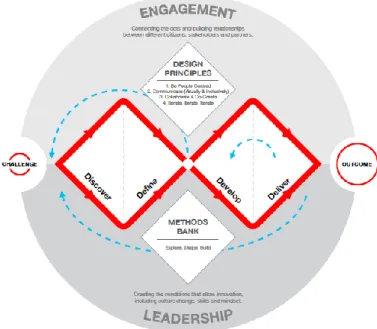
The British Council is an organisation focused on not only to foster both cultural and educational paramount on an international scale but also to provide support within their model for professionals that are either designers or non-designers. Toward the goal of tackling the whole aspect of complexity, which belongs to the social, economic and sustainable paramount, the Council developed the Double Diamond Design Thinking model (i.e., 4D is due to the four D letters of each phase). The model is fourfold in the phases of: (i) Discover; (ii) Define; (iii) Develop; and (iv) Deliver (British Design Council, 2020).
The first phase Discover, is to support a full understanding of what the problem is, as well as to generate synergy within the ones involved with the issue. The second phase Define, takes place once the problem was already organised into different insights at the first phase; therefore, a definition of it would be necessary to upfront the insights into different ways. In the third phase Develop, with a spark of inspiration from open-source methods to lift different ideas, and that adds up to further solutions, the team maps the problem and defines the working method to promote actions of moving further with a solution . In the fourth phase, Deliver, the action of prototyping the solution and taking decisions toward pivot or persevere appears, to further address the problem in question (British Design Council, 2020).
Differently from other DT models, the 4D model dynamic is broader concerning usability in adverse situations, which permits the design team to aim their focus on mapping the environment instead of diverging, rather than converging toward the design process of the model. For that instance, the model uses design principles, as to “Put people first”, which is the perception of whom would interact with the developed solution. The second principle, “Communicate visually and inclusively”, is the idea of sharing insights toward a problem. The third principle “Collaborate and co-create” holds the collaboration aspect to inspire the ones involved with the process. There is the “Iterate, iterate, iterate” as well, which is to act quickly to encounter issues to avoid unnecessary risks; therefore, confidence gains structure from the idea within the ones involved with the project (British Design Council, 2020).
Notwithstanding, the Design Council also has the method entitled as “Methods Bank” within the 4D Design Thinking model, which is a mix of structured methods in three areas to support the challenges and outcomes from the design process to identify, and question upon an addressed issue, such as: (i) Explore; (ii) Shape; and (iii) Build.
The Explore step regards the situation that needs an in-depth examination and investigation. The Shape step concerns the creation and generation of the prototype from the ideas generated, and the Build step is the knowledge toward the solution to face the problem (British Design Council, 2020).
Moreover, the Double Diamond model was designed as follow:
Figure 3. Double Diamond Phases (British Design Council, 2020).
2.1.2.4 NESTA Triple Diamond Model
The National Endowment for Science, Technology and the Arts (formerly NESTA) is an innovative foundation based in the UK. Their goal is to use Design Thinking to tackle social environments with toolkits (Mulgan, 2014). To expand the usability to enhance communication, and to gain insights with open innovation approaches, NESTA have developed their own DT model, namely the Triple
Diamonds model, based on the Double Diamond Design Thinking model from the British
Design Council, represented in the figure below. The model encounters six phases, divided into three diamonds (Casasbuenas, 2018).
Figure 4. NESTA Triple Diamond (Casasbuenas, 2018).
The first phase, Dialogue, focuses on communication with the team to issue insights upon policy challenges based on the location of each team member. The second phase Diagnose is to organise the ideas upon the challenges the team wants to address. Per the following phases of the model, its structure organisation manages to maximize both divergent and convergent ways of thinking the human-centred of design.
As an example toward the model, in terms of building and working with a Policy Accelerator approach for stakeholders, demonstrates how someone would fill up the model regarding when and how an engagement process tackles in (Casasbuenas, 2018):
2.1.2.5 Google 3E’s Model
Private firms have also designed their own DT models. Namely Google, one of the giants of technology and innovation, has created the 3Es for design thinking model. From the belief that ideas do not discriminate its source of incoming, which generates a creative outgoing, Pferdt (2019) stated by saying that “Ideas can come from anywhere, and everyone is creative”, which resulted in Google's aforementioned model. The company, as one of the most innovative and technological in the world, has easily connected its values amongst Design Thinking, in what concerns tackling complex problems with creativity and innovation. The model consists of three phases such as: (i)
Empathy; (ii) Expansive Thinking; and (iii) Experimentation.
The first phase of Empathy is the focus on inner aspects of the users, such as their feelings and beliefs, which gather the team in creating thorough solutions for their problems. The second phase Expansive Thinking is the brainstorm session, which allow the team to come up with a variety of ideas to develop either a solution for a problem or an improvement for the current idea, at this phase the team challenge each member with different ways of looking at the current situation. The third phase Experimentation is when the selected ideas from the previous phases are selected in order to build prototypes and to test its feasibility (Pferdt, 2019). The model is designed as follow:
2.1.2.6 Mindshake Evolution 6 Model
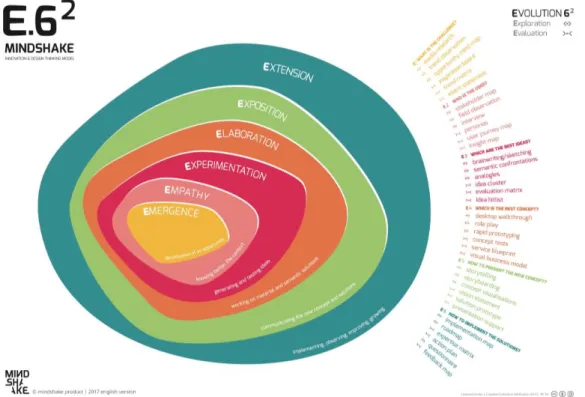
Katja Tschimmel developed Mindshake’s Design Thinking Model Evolution 62
between 2012 and 2015, the year in which the final version was registered and licensed under a Creative Commons attribution BY-SA. According to Tschimmel (2018), the model is called Evolution 62 for the following reasons: Evolution, because the creative
process is evolutionary and iterative, and the E62, because the model is divided into six
phases, all of which beginning with an E, such as: (i) Emergence; (ii) Empathy; (iii)
Experimentation; (iv) Elaboration; (v) Exposition; and (vi) Extension.
The 6, because in each phase of the process, moments of divergence (Exploration) and convergence (Evaluation) occur, making it symbolically six squared. In the verification of more divergent or convergent tools, this model differs from the others.
The model also encounters five principles, namely: (i) Human-centred approach; (ii)
Collaboration; (iii) Experimentation; (iv) Visualisation; and (v) Holistic perspective.
Regardless the relation toward the grounds of DT, this model permits the team to not only focus their actions onto processes that require creative thinking, and to design the new but also, and foremost, to take decisions to either pivot or persevere when the dynamic of the scenario is uncertain (Tschimmel, 2018).
2.2 Social Innovation
Social Innovation is related to not only methods for innovation, but also methods that promote innovative solutions for social needs. The idea of encountering with different tools, from the social innovation model, are to settle actions against the complexity of problems that permeates society. Not to mention to define sustainable solutions around environmental harms, safety concerns and economic equity.
In the Open Book of Social Innovation Murray et al. (2010) analysed innovation on social matters to discriminates that a model with an in-depth focus on innovative actions can transform processes and act against barriers to promote social change and generate social innovation.
In furtherance of what is innovation Phills, Deiglmeier and Miller (2008) stated the following: “innovation is both a process and a product”, that is divided in two criteria: the first explore the process in corporations and around society, which in this context the process around the solution is either abstract or concrete; and the second defines innovation as an outcome, which is the perception of how innovation appears in the process of developing a solution or as an outcome after it was implemented.
Some of the finest thinkers in the field of social entrepreneurship, social enterprise, and non-profit management use social to describe very different things: social motivations or intentions, the social sector as a legal category, social problems, and social impacts. An innovation is truly social only if the balance is tilted toward social value — benefits to the public or to society as a whole — rather than private value — gains for entrepreneurs, investors, and ordinary (not disadvantage) consumers (Phills et al., 2008, p. 38-39).
Moreover, there is the awareness of how to innovate on rigid and complex social systems, which stimulate an economy to generate value with new trends, such as with new technological solutions, and by putting people first, rather than systems with rough structures. The discussion toward this topic consider several elements of attention upon social, political, economic and environmental challenges, which have oppositely demanded improvements, innovation and new forms of insights for further actions on poverty issues, population ageing, migration, among others necessities (Social Innovation Academy, 2020).
To have innovation on the social structure, to underline a system, rather than a concept, the engagement from society should come with full support for an upcoming solution. For this instance, and based on both the novel Covid-19 pandemic and in The
Social Innovation Trends Report (2020), the key-points of attention gained a narrow spectrum
of enforcement, especially on the following trend of “Social Innovation in the era of social distancing”, which according to the report:
The Covid-19 (Coronavirus) has shown how vulnerable we are as species. Within weeks from discovery it has dominated the headlines, leaving question marks having over your daily routines and well-being, and highlighting our interdependence across communities, borders and continents (Social Innovation Academy, 2020, p. 25).
Social Innovation according to The Social Innovation Trends Report (2020) is a “multi-disciplinary, integrated with problem-solving approaches rather than single-department or single-profession solutions from the past” (Social Innovation Academy, 2020). Amidst this new kind of economic paramount based on services, rather than production and transformation of assets it reinforces the responsibility around transformative actions based on a human-centred and circular approaches.
Which, therefore, the environment opens their system with innovative approaches by using open innovation as a combined method to intensify knowledge-sharing, and create innovative and creative blends from multiple sources, which, somehow, unite ideas from a more distributive economy, instead of a more standard one. Even though Social Innovation appears as a model, it hardly distinguish as a unique method nor a concept designated related to disruptive innovation; it is a process that requires cooperation from the community, to enable empowerment, creativeness and innovation on citizens (Manzini, 2018).
Notwithstanding, SI also has a connection with DT. In 2001, IDEO re-designed its model to tackle the technical aspects and features based on society needs, which somehow, made the industry shape their actions toward creativeness and innovation to follow the same direction and, therefore, to act differently.
As a consequence of such a movement, the consulting firm has embraced the power of innovation, on taking decisions rapidly, which led into improvements around working methods to tackle wicked problems of society (Brown & Wyatt, 2010). In furtherance of such a movement, NESTA and The Young Foundation have developed a
SI model, which allows supporters from a circular network to address social challenges with innovation (Murray et al., 2010).
In furtherance of the impact that SI led into the economy, along with its potential to tackle societal issues, and its similarity across creativeness and innovation, the next chapter encounters a more in-depth review toward definitions and approaches, to discriminate Social Innovation, as well as its similarities upon the current challenges to familiarise a full dynamic of what is SI.
2.2.1 Definitions and Approaches
This chapter brings a more profound review with definitions and approaches in what concerns Social Innovation. In contrast, many contemporary types of research tackle the subject with a link to Design Thinking through a soft connection with societal states, and the actual means of society for innovative and transformative actions as an attempt to change a system, which is complex and bureaucratic, but with Social Innovation the processes enable a sustainable, and lean advancement toward systemic growth.
As stated by Wittmayer et al. (2019) that “many contemporary discourses understand social change as driven by process of innovation”, the challenges of having innovation for social change would only endure if the enhancements has quality, and the constraints of society exist through continuous discussions.
The context, though, regards to social issues, which governments struggle to manage. Additionally, there is the condition of society caring a status of ongoing transformations, even though there is the challenge of traditional paradigms to prevent change, notwithstanding the impact related to support structural reforms (Murray et al., 2010).
Alongside the aforementioned fact, Mulgan (2014) states that “innovation is a constant, an evolutionary process, which even the best ideas need to be adapted in the light of experience”, which means that, if on the one hand, by having a cutting edge insight toward a problem, there is the burden of living in a permanent situation, which, on the other hand, creates a sparkle of opportunity for innovative ideas. However, this aspect leads to a sense of sharing knowledge with more experienced ones through collaboration to be able to recognise missing gaps with innovation and expertise.
Hence, to distinct Social Innovation from not only the metrics and models should be accounted, but also consider how to measure abstract forms that gather innovation differently. Since that there is a lack of confidence related to innovation which leads to an uncertain idea of (Murray et al., 2010).
Social Innovation and collaborative networks must be fully used in order to boost participation by the public and civil society in general in designing and managing EU policies, employing distributed collective and bottom-up projects that strengthen more direct democracy (EESC, 2016, p. C13/104).
The perceived evolutionary process of SI changed its focus though, from structural and practical reforms to economic progress in the face of crisis happening around the world, which gathered collaboration with the market to work together and define setbacks with innovation. For this matter, it is essential to highlight the historical perspective of SI, as a lean definition of the process, with current discussions of the approaches in science, as well as the relationships among societal states throughout time, along with innovative actions afterwards (Leubolt, Moulaert, Mehmood, & MacCallum, 2017).
The rising interest among social innovation is unusually older than innovation itself, which once considering the latter as a hyper-connected movement with technological advancements on the works of innovation on economics (as cited in Leubolt et al., 2017), and as a systematic approach toward economic development (Lundvall, 1988; Edquist, 1997; Leubolt et al., 2017), and the historical aspect of SI that suffered a backlash in the 19th century (Leubolt et al., 2017).
The relation of social efforts to gather innovation on its process remained by the technological and business organisation interest, to develop urban and regional areas, which were when SI gained “intellectual support and practice manual for grassroots organisations, social economy and emancipation movements and as an ethical principle within the corporate social responsibility ambitions of large parts of the business world” (as cited in Leubolt et al., 2017).
Some 40 years later, SI is enjoying increasing popularity among policymakers and academics. This can be interpreted as a necessary corrective strategy to tackle the social problems emerging due to state retrenchment and austerity policies. SI would not only promote civil society engagement against the bureaucratised public sector and thereby
help to provide better services but also could assist in drafting austerity policies softening their negative social impact (Leubolt et al., 2017, p. 11).
Different events occurred in a systematic discourse, to gather SI significance throughout time, from historical and intellectual debates to emancipation, political and economic movements, the full institutionalisation of ideas, and organisational forms to upfront innovation around social problems. Notwithstanding, innovation itself, once perceived as an evolutionary process, due to not only when the term was used at first on religious contexts, but also by its absolute sense of empowerment in contemporary times, concerning socio-political, and ideological connotations in several debates of conflict, general scenarios and societal relations (Leubolt et al., 2017) to, therefore, renew the idea of innovation and society toward changing process for better.
Despite the aforementioned fact, SI in the field of social sciences claims to address wicked social issues and human needs, which is somehow, oriented by the principles of DT, as well as societal states. As reinforced by Leubolt et al. (2017) “SI is not reducible to a field of endeavour, not to a particular sector of the economy. It is a way of understanding a wide range of activities and practices”. Additionally, within the core of SI, there is the dynamical structure, as to correspond with the needs of a system, and to promote collaboration and structural reforms that aim at improving the needs of society, along with the opportunities to perceive the challenges more effectively (Leubolt et al., 2017).
Relatively to the process of SI, and to differentiate the general understanding of innovation, is to upfront new forms of participative collaboration focused on public and social matters, which according to NESTA, SI is a type of innovation that gather social needs from initiatives from the public sector, instead of the private players of the market, e.g., NGOs, instead of organised events promoted by the state, and private companies (Murray et al., 2010). Moreover, SI faces continuous changes from the economies, due to its power of being dynamic, as well as to be human-centric, and to foster a force that is, neither focused on capital growth, nor financial advancements (Moreira, Alves dos Santos, Palma, & Tschimmel, 2020).
Moreover, there are the SI definitions, which through a standard approach of a mix of aspects, both theoretical and practical ones, links the social environment with bright ideas that allow a flow of supplements toward an open set of innovation in which knowledge shares an empowering sense of ownership (Social Innovation Academy, 2020). Additionally, there is the open innovation method which aligns social innovation
to new processes (e.g., open-source projects) to not only draft social obligations with innovation but also to diffuse the idea of dependency and individualism.
Furthermore, to uplift the practical aspect of SI, the next chapter presents a SI model applied to a system that requires enhancements and innovative actions, as though to encounter within the goal of this research toward DT, SI and societal states with a model, which afterwards contributed to the creation of a programme.
2.2.2 The Social Innovation Model
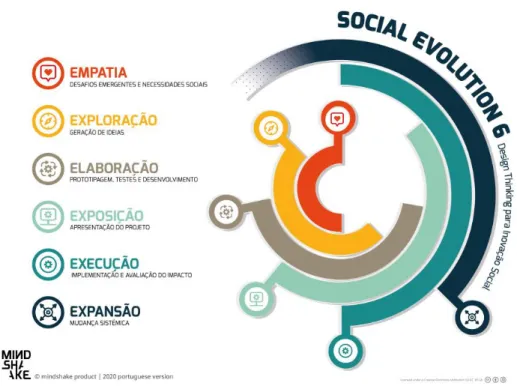
Amid Social Innovation perceived as a process, there is a model which holds social innovation on a system that is bureaucratic and dynamical by its means. For this instance, both NESTA and The Young Foundation developed a SI model, represented by a spiral of six streams, such as: (i) Prompts; (ii) Proposals; (iii) Prototypes; (iv) Sustaining; (v)
Scaling; and (vi) Systemic Change.
The model enables innovative actions toward social challenges through iteration around each phase. Due to the nature of the social environment, it works through a different set of loops, and from its additional features prevent the user from stuck against a step of a process (Moreira et al., 2020). Notwithstanding, the model is designed as follows:
The first part of the model Prompts, inspirations and diagnoses, regards to situations, which require innovation in a process. The Prompts are events or a cause, which demands further action to inspire innovative actions when circumstances such as a crisis, public processes, inefficiency and lack of performance, as well as poor management skills, happens. According to Murray et al. (2010), the Prompts are also triggers for actions, and it has an imperative format to deal with problems, even though the absence of specification and requirements. Despite that, it is essential to highlight the questioning aspects, to frame the proposal accordingly, since that “a good problem contains within it the seeds of the solution”, which the trick is on the details of the problem, e.g. if a city faces a problem with parking spots or housing in the city centre, the problem is in the details, which, therefore, means that neither parking nor housing is indeed the problem, but the lack of investment in public transport system.
The Inspirations are also capable of gathering creative insights through new pieces of ideas. It represents the call-to-action from the Prompt; as aforementioned, it demands creativity and research to fund a piece of evidence. The Inspirations regards to a set of situations, which demands actions and further mobilisations to recognise that, even though a problem is not accessible through collaboration as a trigger for inspiration, it can be solved (Murray et al., 2010). Also, it works as a tool to tackle severe problems, to identify the action, and to highlight it accurately, i.e., “to enlighten problem research is a key tool to frame a spotlight and be heard”, and, therefore, to trigger brighter and creative ideas. Notwithstanding, it requires mapping the situation, e.g., by using epidemiological methods, surveys, social indicators and social demographic datasets to provide support accordingly.
The Young Foundation’s Mapping Needs Project, and a parallel project in Portugal, have developed a comprehensive set of qualitative and qualitative methods. These aim to understand underlying causes, e.g., looking at ‘adaptive resilience’ to explain why some individuals, families and communities cope well with shoes while others do not (Murray et al., 2010, p. 17).
Additionally, by identifying the mix between the needs and its capacities, it is essential to perform segmentation toward market research and consumer categorisation, in regards to geo-demographic techniques for a process of social innovation mainly if the project aims to tackle health services (Murray et al., 2010).
Along with the Diagnoses step, the problem around the subject also requires mapping to have a full picture of the process. It consists of data collection to discover the problems and solutions around different methods and to encounter the situations in the city. Outstandingly, the PRA method, as well as the user-led and peer research method, fits not only within this occurrence but also to promote research within the community to gather the needs and to provide solutions (Murray et al., 2010).
User-led Research has specially developed amongst long term users of health and social care services. Service users are responsible for all stages of the research process — from design, recruitment, ethics and data collection to data analysis, writing up and dissemination (Murray et al., 2010, p. 18).
The PRA method is composed by a wide range of techniques, such as interviews, mapping, focus groups and events to visualise how the community perceives particular issues. Moreover, the aim of this method grounds on the engagement of local people in data collection, data analysis and creative ideas (Murray et al., 2010).
The second part of the model, Proposals and Ideas, is when an organised set of frames from different models supplement and support creativity and design for social innovation. Contemplates the methods related to it, to find the right question and to provide the best proposal with creativeness and innovation. Toward the field of design, it prompts collectiveness on the process of developing solutions with the public sector. For this matter, User-led design appears with an idea of a method, to get the users engaged with the design and, foremost, to promote a dynamical flow between different players, as both orchestrators and facilitators toward the process (Murray et al., 2010).
Additionally, re-designing services with users and developers is also related to this aspect, in which public services get involved with design consultancies, the outcome leads to several improvements. As an example of innovation in the health sector, IDEO worked with SPARC Centre at the Mayo Clinic (see-plan-act-refine-communicate), to turn an internal medicine wing into a laboratory designed to enhance the experiences of patient-provider (Murray et al., 2010).
The team turned an internal medicine wing into a four-zone journey through which patients proceed: starting with the Service Home Base, moving to the Visitor-Facing Hub which leads to the Preparation Service Area before finally reaching Innovation Central (Murray et al., 2010, p. 31).
The 'wings' are related to sections, where contributors from the health facility can work together to develop and prototype new processes, as well as to improve the delivery of such services (Murray et al., 2010).
For Proposals and Ideas, both design and creative methods draft processes that generate and manoeuvre insights in a stimulating exchange of ideas. On the top of that, to coordinate an improvement process that holds Ideation as a link with the step of Ideas from the SI model, the Six Thinking Hats and the Lateral Thinking tools take place performing continuous improvement activities that facilitate the understanding of how a process works, along with its variables (Murray et al., 2010). Additionally, there is the open innovation method, to harness both the distribution and collection of particular aspects from a crowd to generate empowerment and valuable lessons from actions of collaboration, adhocracy and flexibility which may affect innovation somehow (Palma & Matsuda, 2018).
The third step of the model, Prototyping and Pilots, regards to perform testing sessions toward the ideas generated beforehand. On this step, iteration appears in the process of decision making (e.g., to either pivot or persevere) to strengthen the solution and define a structured set of measurements against unresolved features. Plus, it grants faster outputs into the processes. Amidst the progression of an idea toward the stage of prototyping, challenges appear, which may affect the speed, costs, tangibility and loops of feedback. Therefore, to react rapidly while developing the solution, the delivery, management, economic factors and scalability are constraints to be aware of.
Despite tackling an action of prototyping and piloting a solution, there is the
Randomised Controlled Trials (RCT) method, which can randomly choose a sample of data
collection to test different procedures, which additionally, is a well-known method for standard solutions related to evaluation process as well, e.g., “In medicine, RCTs use ‘double-blind’ methods so that the researcher does not know which users are receiving the treatment and which are receiving the placebo” (Murray et al., 2010).
The fourth step, Sustaining regards the sustainability of processes from previous actions. To achieve sustainability from a process, it requires to shape and identify missing gaps, to refine an idea and moving further with possible enhancements, and to strengthen it with innovation, which in “the public sector this means identifying budgets, teams and other resources such as legislation” (Murray et al., 2010). Additionally, rather than an account from the public sector (i.e., feedback), but the details of which, are factors that highlight the aspect of sustainability for social innovation.
Public Feedback may be essential, but evaluation methods also have a vital role to play since there is always an element of judgment in determining what counts as success or failure. The ability to judge innovations, and screen out a high proportion, is critical to the success of an innovation system (Murray et al., 2010, p. 58).
Nonetheless, integration is also a key-point required to create a sustainable process. Albeit, the public sector, the private one, also has an active involvement toward this step, of which requires consideration from six models to hold collaboration and lift an open environment to achieve consistent innovation (Murray et al., 2010).
Each of the models presented strengthen the social venture toward an open and broader environment for collaboration for the ones involved with the process of sustaining social innovation projects, either the public sector or private ones, besides, to also achieve a financial structure (Murray et al., 2010).
The fifth step, Scaling and Diffusion, are strategies to leverage and grow a solution. To supplement a strategic action, not only economic data such as information from the market related to supply and demand but also politics are critical. By the fact that it supports further actions regarding decision-making, even though scaling is perceived as “a concept from the mass production age” around the social structure. Notwithstanding, there are plenty of different forms to achieve innovation, especially when the social economy demands inspiration, and emulation through knowledge-sharing and experience as a cornerstone to sustainable and lean growth. In the social economy Murray et al. (2010), state that “social ideas spread through emulation”, which means that, while not only effort and desire to excel on an endeavour but also organisational and other kinds of collaboration models must take place, an idea should advance to make diffusion happen.
Despite the advancements to innovate on the social economy, there are exceptions from both aspects of the economy, which bounces the market with diffusions. As a consequence of that, a process suffers adaptations, which affects its interaction and modifies its dynamics leading to a generative diffusion aspect. Moreover, the trends regarding the advancements of social innovation, scalability and diffusion, even though the interaction and modification complexity means to struggle toward breakthroughs in the social environment. According to Murray et al. (2010), "generative because the adoption of innovation will take different forms rather than replicate a given model", and "diffusion because it spreads, sometimes chaotically, along multiple paths".
Along with that, to have success while diffusing a process to achieve innovation, one would have to expect that both supply and demand process are managed effectively. As stated by Murray et al. (2010), both an adequate supply and sufficient demand are related to:
a) Effective Supply: refers to growth of evidence of how innovation really works b) Effective Demand: refers to willingness to pay
Amid effective supply and effective demand, there are some tools to support growth, innovation and financial aspects for an upcoming venture. Further efforts on evaluation and research improve effectiveness and valuation for an effective supply, as though as designing the structure of projects and marketing strategies to harvest the economy, which, therefore, these tools and methods ought to achieve effectiveness onto supply and demand (Murray et al., 2010).
The sixth step of the model Systemic Change is “the ultimate goal of social innovation” (Murray et al., 2010). It is when a wide range of elements, such as social movements, business models, laws and regulations, data and infrastructures and full involvement is required to achieve a systemic change.
Systemic innovation is very different from innovation in products or services. It involves changes to concepts and mindsets as well as to economic flows: systems only change when people think and see in new ways. It involves changes to power, replaying prior power holders with new ones. Moreover, it usually involves all four sectors — business, government, civil society, and the household (Murray et al., 2010, p. 107).
It is the initial step before achieving innovation, and along with the creation of new conditions, to turn a process viable and sustainable. It require a new set of inputs, as well as further actions aimed to break barriers with systematic approaches, despite the rareness toward the expected effort. These new ‘conditions’ are related to, either technological advancements or a new kind of institutional regulation, not to mention fiscal forms to achieve systemic innovation toward a process (Murray et al., 2010). An example of a systematic change regards to UK health service:
It is an extensive system by any standards with an annual turnover of £98 billion and employing some 1.5 million staff. It is already heavily involved in innovation through
investment in research and development on pharmaceuticals and medical instruments, and close links with top universities such as Imperial and UCL, as well as with big firms like GlaxoSmithKline and Pfizer. However, in recent years it has recognised that these traditional tools, while useful, do not go far enough. Some of the most significant impacts on health outcomes now come from service innovations, and some of the most exceptional creativity comes from outside the sphere of clinical leaders, business and government. Hence the drive to link many of the tools described earlier, from grants, loans and equity to commissioning, purchasing and whole system examples. All of these aim to ease the shift from a system primarily focused around hospitals and doctors to one in which patients share responsibility for care, supported by detailed feedback systems — in which whole environments are reshaped to support healthier living (Murray et al., 2010, p. 109).
Despite this fact, and due to the nature of how to change a system, as well as due to its complexity, awareness regarding the long-term results holds into the process of changing a system and, therefore, to achieve social innovation. Old models must be broken to permit new ones to arise. On a systemic level, and the requirements of such a system to be deployed, as well as the constraints of it, and the barriers involved, further results would only be perceived on a long-term basis (Murray et al., 2010).
There is also a further reference besides the aforementioned method from NESTA and The Young Foundation in Europe. The European Commission also has funded a broader line of frameworks to work on projects and foster SI. For this instance, there is the Social Innovation Community (i.e., SIC), which developed a method fourfold in the following streams to onboard the life-cycle of a project: (i) Prototyping; (ii)
Experimentation; (iii) Scaling; and (iv) Replicating.
Additionally, the Social Innovation Exchange (i.e., SIX), which through a partnership with NESTA, and with the support of the United Nations Development Programme, the Social Innovation Generation (SiG), the Australian Centre for Social Innovation (TACSI), and the J. W. Then, afterwards, the McConnell Family Foundation, the SIX Wayfinder, launched another incentive in three pillars, which outlines the knowledge, people and power (Social Innovation Academy, 2020). Nonetheless, another initiative gained the title of Digital Social Innovation for the European Union (DSI4EU), as to tackle usability factors of digital technologies for society, and environmental challenges in a wide range of fields, ranging from health-care, education and employment. Notwithstanding, the interest and relevance among SI increased, due to several studies
and different tools, that enhance creativity, and empowerment of actors that encourage facing new challenges (Cunha & Benneworth, 2014).
Positively, the impact of having continuous improvement from SI practices would only enhance a series of intended factors aimed at promoting inclusion, well-being and organisation at the place. Moreover, when external aspects from a system face SI, ought to effectively cause disruption and innovation so that when a framework collapses, the right methods and tools would easily support handling the situation if necessary (Cunha & Benneworth, 2014). Due to the characteristics toward DT and SI, as well as the unfortunate circumstances that took place in 2020 carried by the novel Covid-19 pandemic, the next chapter deals with societal states.
2.3 Societal States
The societal states highlighted in this research regards the threefold subjects to enrich the grounds of the concept and its specification. Also, to spotlight both positive and negative effects related to each psychological state.
To state the global aspect of the topic and its relation toward creativity and innovation it is necessary to dig into each societal state, as to discriminate its psychological contrast concerning both positive and negative effects. Additionally, in what concern studies that reported negative aspects toward psychological dysfunctions, while someone is in a state correlated with an action of being quarantined, it may as well suffer from post-traumatic stress disorders, confusion, and anger (Brooks et al., 2020). Notwithstanding, as within the threat of being imposed through a restriction of liberty, if only is a non-mandatory action, it would not harm as much of an imposed one though, which the effects might be smooth toward distress disorders and long-term complications (Brooks et al., 2020). One might wonder that there are plenty of societal states. However, the ones selected are intimately associated with the circumstances rolled out in 2020, within the novel Covid-19 pandemic, and the actions taken by the political force to avoid a more profound worldwide health catastrophe.
2.3.1 Social Distancing
Due to the novel Covid-19, in 2020, a few studies deployed on this concern, since that social distancing has been one of the intervention measures taken by governments to forbear this pandemic from spreading over. In furtherance of social distancing, in what concerns the 2020 Covid-19 pandemic, both Wilder-Smith and Freedman (2020) stated that: "Social distancing is designed to reduce interactions between people in a broader community […]", which means that, within this measure, the risk of infection would be easily controlled by health authorities. Although, Long (2020) stresses that: "social distancing encourages a calculative attitude toward others […] that threatens to strain many relationships and injure individuals' self-worth, especially in cases where contact that is 'essential' to one party may not be seen as such by the other". Moreover, what would paramount social distancing, on the one hand, enhance closeness on individuals toward collective good, but on the other hand ought to psychologically harm the ones that depend on companionship as a safeguard, to thrive and forbear on their issues of life (Long, 2020).
Additionally, once an individual faces social distancing triggered by an uncontrolled situation, other types of problems may also cause an outbreak, which ought to endure notably, as well as harder to tackle in (Gupta, 2020). If on a short-term, social distancing can affect relationships, on a long-term as well, it would also lead an individual to experience mental health problems, which include stress, emotional disorders, sleep deprivation, and other psychological disorders (Gupta, 2020). Thus Vieira, Franco, Restrepo, and Abel (2020) for that instance stated on their research that along with the short- and long-term problems that social distancing can, therefore, outbreak, other factors, besides the current pandemic, might also unfold rapidly and stringently, such as the 'misinformation' effect, which can act as an unfortunate complement toward the aforementioned disorders, as well as to harm individuals wellbeing.
A study was performed to hold 'misinformation' on 'social distancing' effects in China, while the users of their social network platform being socially distant from each other. The discovery took place toward the variations regarding the expression of emotions, which in contrast, the majority of posts reached discussions around depression and anxiety. Other posts expressing positive feelings also appeared, although with a lack of burden and quasi-non-existential link with the matter (Viera et al., 2020). Besides that, one raises the question of how an individual in a state of being socially distant would
affect its ability toward creativeness and innovation. To portray such a problem, not only the effects of social distancing is required but also the whole scenario that, therefore, holds societal states entirely.
2.3.2 Social Isolation
Once that social distancing is one of the effects that can twist a division on an individual, there are also the threats of social isolation at one's mental health, which ought to raise awareness toward the potential harms. It is quite unlikely that standard measures of each societal state are often treated without taking into consideration the term 'loneliness', which might have a similarity, it does not mean the same otherwise (No Isolation, 2020). Nonetheless, the correlation toward social isolation and loneliness endures, as it has been classified to be a significant health concern by health authorities worldwide (Kelly, Steiner, Mazzei, & Baker, 2019). Even though an individual may be seen as alone in a crowded place, it may not as well be socially isolated. In an article written by No Isolation in 2019 it highlights:
You can be lonely in a crowd, but you will not be socially isolated. Isolation has been defined as an objective [emphasis added] state whereby the number of contacts a person has can be counted, whereas loneliness is a subjective [emphasis added] experience. While the terms may have a slightly different meaning, both can be painful experiences and have a harmful impact on the individual (No Isolation, 2019, para. 01).
Moreover, social isolation is, therefore, an insufficient presence of social contact in a way, which an individual gets cut off from any social interaction for an unlimited time frame (No Isolation, 2019). Factors driven by an individual that is socially isolated is not just loneliness but also the isolation state by itself, which is the total deprivation toward interaction with society (No Isolation, 2019).
Notwithstanding, by the fact that an 'isolation' measure is defined as to be objective whilst 'loneliness', is, therefore, subjective, which means that the first can be observed and consequently safeguarded on facts. In contrast, the second is purely hypothetical. However, it may sound hardly optimal, 'loneliness' is a response toward 'isolation' side-effects and should not be left unattended otherwise (No Isolation, 2019). Moreover, social isolation causes are indeed relevant factors on health and wellbeing, as