
Performance and Improvements of the ATLAS Jet
Trigger System
P Conde Mu´ı˜no∗ on behalf of the ATLAS Collaboration
∗LIP, Lisbon, Portugal
E-mail: [email protected]
Abstract. In 2011-2012 the Large Hadron Collider (LHC) provided proton bunch crossings every 50 ns with up to 40 interactions every crossing. These unprecedented conditions posed stringent demands on the trigger system of the ATLAS experiment, which must provide a fast rejection of background events while maintaining a high efficiency for physics signals of interest. This note focuses on the jet trigger system in ATLAS. Jets are the most prevalent high-pT
objects produced at the LHC, and are an important component of a wide range of physics analyses. The challenges faced by the jet trigger system, and how its initial limitations were overcome, will be described. Performance results, including jet efficiency and resolution, will be presented.
1. Introduction
ATLAS [1] is a multipurpose detector designed for the LHC proton-proton collider. At the nominal LHC luminosity of 1034
cm−2s−1, the ATLAS bunch crossing rate will be 40 MHz, with about 23 interactions per bunch crossing (pile-up) and a 25 ns separation between successive proton bunches. These conditions impose stringent requirements on the trigger system, which must retain a high efficiency for physics signatures of interest while reducing the rate to about 400 Hz, limited by bandwidth and storage capacity. The actual running conditions of the LHC in 2011-12 were even more demanding than originally anticipated, with the peak number of interactions per bunch crossing reaching up to 60.
In order to have an unbiased and efficient event selection, the trigger identifies generic objects, like leptons, photons or jets with large transverse momentum (pT) or large missing transverse energy.
The ATLAS jet trigger [2] has been designed to select final states corresponding to a wide spectrum of physics processes, ranging from Standard Model signatures, such as high-pT jets, top quark production, and vector boson production, to searches for the Higgs boson and physics beyond the Standard Model, such as Supersymmetry (SUSY) or Extra Dimensions. The cross sections for these processes span many orders of magnitude, from O(100 nb) for jets to O(pb) for some SUSY models.
In order to fulfill the trigger requirements at the LHC, the ATLAS trigger system is divided into three levels. The first level trigger (L1) is based on custom hardware, and must form a decision with a 2.5 µs latency, reducing the input rate from 40 MHz to about 75 kHz. In order to achieve a fast processing time while identifying high pT objects, the L1 makes use of a coarse granularity in the ATLAS calorimeter and muon systems.
Table 1. LHC nominal and running conditions in 2011/12.
Nominal 2011 2012
Energy (√s) 14 TeV 7 TeV 8 TeV
Peak luminosity (cm−2s−1) 1034 3 × 1033 6 × 1033
Interactions per bunch crossing 23 11 up to 60
Bunch crossing rate 40 MHz 20 MHz 20 MHz
Offline storage rate 200 Hz 400 Hz 400 Hz
Bunch spacing 25 ns 50 ns 50 ns
The second level trigger (L2) is software based. It can use the full granularity of all detectors and it is based on the concept of Regions of Interest (RoIs). This means that it uses the geometrical position of the L1 triggered objects as seeds, performing reconstruction in a limited region around the L1 seed and thereby avoiding the need to read out the full detector. This scheme reduces the amount of detector data accessed to about 2%. The L2 uses simplified algorithms to take a decision in about 40 ms processing time, reducing the rate to 3 kHz.
The third level trigger, called the Event Filter (EF), uses offline-like algorithms that may operate in RoI-based reconstruction or with the full event readout (referred to as full scan), using the offline calibrations available at the time of data taking.
2. ATLAS Jet Trigger description
The L1 jet reconstruction algorithm consists of a sliding window of programmable size applied to calorimeter towers of 0.2×0.2 in pseudorapidity (η) and azimuthal angle (φ). Jets are identified when a local energy maximum above a given adjustable threshold is found. Although the same algorithm is used in the forward region (3.2 < |η| < 4.9), the L1 trigger tower granularity is larger, 0.4 × 0.4 in η × φ, and for jets, trigger towers are summed in η, thereby reducing the resolution.
In the original design, the L2 jet trigger algorithm requested the calorimeter data corresponding to a configurable RoI, centered around the L1 seed, be transferred from the detector readout drivers (RODs). It then converted this byte stream raw data into more refined objects such as calorimeter cells, for processing by jet algorithms. The early design executed a simplified cone-like jet algorithm with radius R=0.4 that determined the energy-weighted center of the RoI within 3 iterations. The outcome was a jet defined by its (η,φ) position and total energy. At this point, the calorimeter energy scale was set to be the electromagnetic (EM) energy scale determined at testbeams. Due to the non-compensating nature of the ATLAS calorimeters, the EM scale underestimates the hadronic component of jets, but for the results presented in this paper no additional hadronic energy corrections are applied.
The Event Filter can run any of the offline jet algorithm configurations, either RoI-based or with the full event reconstruction, as implemented for the first time in the trigger in 2011. By default the EF runs in full scan mode. In the first step it reconstructs three dimensional calorimeter clusters that are used as input to the jet reconstruction, performed using an anti-kt algorithm [3], with radius parameter R=0.4 or R=1.0.
The RoI-based approach described above suffered from reduced performance in the case of multi-jet events, due to the lower efficiency of the L1 sliding window algorithm to identify close-by jets. To overcome this a full calorimeter reconstruction was introduced in 2011 at the EF level, and in 2012 at L2, as indicated schematically in figure 1. The readout time of all calorimeter cells is considerably high [5] and the time spent running any jet algorithm using cells as constituents
Figure 1. Architecture of the ATLAS Jet Trigger System. [GeV] T Offline Jet E 40 50 60 70 80 90 E ff ic ie n c y 0 0.2 0.4 0.6 0.8 1 1.2 > 15 GeV T L1 Jet E
No pile-up noise suppression > 35 GeV T L2 Jet E > 40 GeV T EF Jet E
With pile-up noise suppression > 35 GeV T L2 Jet E > 40 GeV T EF Jet E ATLAS Preliminary Data 2011 R=0.4 T anti-k |<2.8 Jet η | [GeV] T Offline Jet E 40 50 60 70 80 90 100 E ff ic ie n c y 0 0.2 0.4 0.6 0.8 1 1.2 > 30 GeV T L1 Jet E
No pile-up noise suppression > 50 GeV T L2 Jet E > 55 GeV T EF Jet E
With pile-up noise suppression > 50 GeV T L2 Jet E > 55 GeV T EF Jet E ATLAS Preliminary Data 2011 R=0.4 T anti-k |<4.4 Jet η 3.6<|
Figure 2. The efficiency of the jet trigger for a single L1→L2→EF trigger chain as a function of the offline calibrated jet transverse energy (ET) for central (upper plot) and forward (lower plot) jets in two different data-taking scenarios: before (empty markers) and after (full markers) pile-up noise suppression was applied to both L2 and EF jets [4].
is too large for the available L2 processing time. Therefore, in the new implementation the L1 trigger towers are read out directly from the L1 calorimeter readout system, enabling access to the entire event at the L2 and enhancing the L2 input rate. This scheme has the advantage that it is possible to access either the trigger tower granularity available to the electron/photon triggers (0.1×0.1 in the central part of the detector) or to the L1 jets trigger (0.2×0.2). The L2 full event reconstruction using trigger towers is also called L1.5.
In addition, the FastJet [6] algorithm was introduced at L2 in 2012. FastJet is a package that can be configured easily to run different jet algorithms on a variety of inputs, allowing for the deployment of more sophisticated algorithms at L2. By default it uses the same configuration as the EF, anti-kt with R=0.4 or R=1.0, since this is the default in the ATLAS offline jet reconstruction.
The introduction of the full scan at L2 opens up a range of possibilities for configuring the ATLAS jet trigger system, since it can be used to seed L2 RoI-based algorithms or the EF directly. The result is a highly-configurable system that can be adapted to different LHC beam conditions and requirements for physics analysis.
jet η -3 -2 -1 0 1 2 3 Efficiency 0 0.2 0.4 0.6 0.8 1 1.2 >5 GeV EM T Level 1 Trigger Jet E
= 7 TeV s < 0.4 match R ∆ PYTHIA DATA ATLAS Preliminary <60GeV T jets R = 0.4, 40GeV<p T anti-K PYTHIA DATA [GeV] T Offline Jet E 10 20 30 40 50 60 E ff ic ie n c y 0 0.2 0.4 0.6 0.8 1 1.2 > 10 GeV T EF Jet E > 15 GeV T EF Jet E > 20 GeV T EF Jet E ATLAS Preliminary Data 2011 R=0.4 T anti-k |<2.8 Jet η |
Figure 3. Left: comparison of the L1 trigger efficiency as a function of the jet pseudorapidity in data (full circles) and in PYTHIA[7] simulated events (open circles) [5]. Right: efficiency of three EF jet triggers as a function of the offline calibrated jet ET for the case when the EF is run on L1 random-triggered events [4].
3. Performance
Detailed jet trigger efficiency studies have been performed for different data taking conditions, including increasing levels of up. The jet identification in the trigger is affected by pile-up, due to the overlap of energy depositions in the calorimeter, causing an increase in the reconstructed transverse energy (ET) of the jet. Since May 2011 onwards, a noise suppression tool has been implemented at both L2 and the EF. The noise suppression tool applies a symmetric, configurable energy threshold to cells, taking into account the measured noise from pile-up and calorimeter front-end electronics.
The efficiency of the jet trigger has been evaluated for offline jets reconstructed with the anti-kt algorithm with radius parameter R=0.4. The efficiency is defined as the fraction of offline reconstructed jets that match a trigger jet with ∆R = p
∆φ2+ ∆η2 <0.4 and which pass the corresponding trigger threshold. An example of the efficiencies obtained for central and forward jets is shown in figure 2, before and after the introduction of the pile-up noise suppression tool. Different thresholds are applied at each level of the trigger to increase rejection of low pT jets while maintaining a high efficiency for events satisfying the overall jet trigger. The overall 99% efficiency point improved by ∼ 5 GeV by suppressing the pile-up noise. The shift due to noise suppression is larger at L2 than at the EF, since the EF jets use three dimensional topological clusters as constituents, which already include some noise suppression. The efficiency curve for the L1 in the forward region has a slower turn-on due to the reduced granularity. The rejection is considerably improved at L2 and EF.
A comparison of the L1 trigger efficiency as a function of the offline jet η in data and Monte Carlo (MC) simulation is shown in figure 3 (left), as obtained with 2010 data. The agreement between data/MC is very good, within 2%, for the full range shown, except in the transition regions of the calorimeter near |η|=1.7, where the efficiency is lower in the data by about 10%. 3.1. Performance for full scan triggers
The introduction of the full event reconstruction mode in the EF in 2011 permitted the lowering of jet thresholds. As shown in figure 2, a 15 GeV threshold at L1 becomes 100% efficient for an offline jet of about 50 GeV. This is due to the higher noise thresholds at L1 and to the non-compensating nature of the ATLAS calorimeter, which is not corrected for at L1. To recover low ET jets, the EF full event reconstruction is run on random L1 triggers (called un-seeded EF
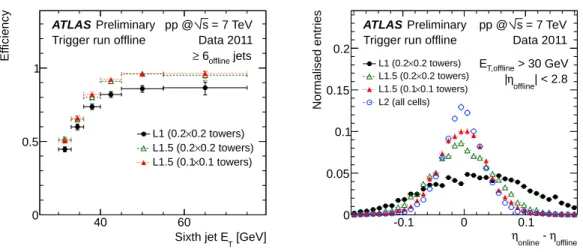
[GeV] T Sixth jet E 40 60 E ff ic ie n c y 0 0.5 1 0.2 towers) × L1 (0.2 0.2 towers) × L1.5 (0.2 0.1 towers) × L1.5 (0.1 = 7 TeV s pp @ Data 2011 jets offline 6 ≥ ATLAS Preliminary
Trigger run offline
offline η - online η -0.1 0 0.1 Normalised entries 0 0.05 0.1 0.15 0.2 0.2 towers) × L1 (0.2 0.2 towers) × L1.5 (0.2 0.1 towers) × L1.5 (0.1 L2 (all cells) = 7 TeV s pp @ Data 2011 > 30 GeV T,offline E | < 2.8 offline η | ATLAS Preliminary
Trigger run offline
Figure 4. Left: efficiency for L1 and L2 ( anti-ktR=0.4, full scan) jets to satisfy a six jet trigger (trigger run offline) as a function of the sixth offline jet ET. Right: the jet position resolution (in pseudorapidity) of the L1, L1.5 and L2 jet triggers in 2011 (trigger run offline) evaluated with respect to offline anti-kt R=0.4 jets [4].
reconstruction). An example of the EF efficiency curves for three different un-seeded triggers is shown in figure 3 (right). The plateau of the turn-on curve for the lowest threshold is reached at around 20 GeV, improving the acceptance for low ET jets.
The L1 sliding window algorithm has a low efficiency for close-by jets, as shown in figure 4 (left), where the efficiency for L1 jets to satisfy a six jet trigger is plotted as a function of the sixth offline jet ET. Here events are selected in which at least six anti-kt R=0.4 offline jets have been reconstructed offline within |η| < 2.8 and with ET >30 GeV. The events were pre-selected using a four jet trigger and the trigger was re-run offline for this study. The efficiency is improved by about 10% by the L2 full event reconstruction, thanks to the use of the anti-kt algorithm.
The spatial resolution for the L2 full scan jets, calculated with respect to the offline anti-kt R=0.4 jets, is shown in figure 4 (right) for the two possible granularities available at L2, in comparison to the L1 jets and the standard L2 cone jets. The L2 full scan improves considerably the L1 jet pseudorapidity resolution, for both cases in which either the lower or higher trigger tower granularity is used. The L2 cone jets based on cells have the best resolution, as expected, due to the better granularity.
3.2. Performance in Heavy Ion Collisions
The flexibility of the jet trigger configuration in the EF, in which any of the offline configurations can be used, allowed for the use of dedicated underlying event subtraction algorithms during the LHC Heavy Ion run in November 2011, with Pb-Pb collisions at a nucleon-nucleon centre-of mass energy of √sN N = 2.76 TeV.
Heavy ion collisions are characterized by a parameter called centrality, which describes the central, versus peripheral, nature of the impact between colliding nuclei. More central collisions involve a larger number of colliding nucleons, resulting in a larger number of particles created and a larger activity in the underlying event. In figure 5 the position resolution (left) and efficiency (right) for the main jet trigger in Heavy Ion collisions are shown for different values of centrality. The comparison is made to offline anti-kt jets with R=0.2. One observes the same performance over a range of centrality values.
Furthermore, the average readout time of the L1 trigger towers was measured in Pb-Pb collisions to be 7.5 ms for the smallest calorimeter granularity (0.1×0.1), with tails extending
η ∆ -0.4 -0.3 -0.2 -0.1 0 0.1 0.2 0.3 0.4 η∆ 1/N dN/d -1 10 1 10 2 10 Centrality 0-10% 10-20% 20-40% 40-60% 60-100% ATLAS Preliminary = 2.76 TeV NN s Pb+Pb R=0.2 T anti-k threshold T 20 GeV E [GeV] T Offline Jet E 0 20 40 60 80 100 120 140 Efficiency 0 0.2 0.4 0.6 0.8 1 1.2 Centrality 0-10% 10-20% 20-40% 40-60% 60-100% R=0.2 T anti-k threshold T 20 GeV E ATLAS Preliminary = 2.76 TeV NN s Pb+Pb
Figure 5. Jet position resolution in pseudorapidity (left) and efficiency (right) of the primary jet trigger used for the 2011 heavy ion run calculated with respect to offline anti-ktR=0.2 jets [4].
up to 20 ms. For the larger granularity of (0.2×0.2), the average readout time was 2.7 ms, with tails extending to 14 ms. Both of these times are well within the limits of the L2 trigger design. 4. Summary and conclusions
The ATLAS Trigger system was designed to cope with the challenging LHC conditions by dividing the trigger into three levels and using a Region of Interest based approach, in which the first level identifies high pT objects that are verified by the subsequent levels. For the jet triggers, the seeded mechanism introduced performance limitations for very low pT jets and multi-jet events. These were overcome by the introduction of a full event reconstruction at the EF in 2011 and at L2 in 2012. The L2 full event reconstruction is only possible using the L1 trigger towers, which are accessed directly from the L1 calorimeter readout. The result is a highly flexible system that can run many different algorithms and configurations, adapting to different requirements of physics analyses and changing data-taking conditions. The jet trigger has demonstrated an excellent performance since the first collisions of the LHC.
Acknowledgments
The author acknowledges the support by FCT co-financed by QREN/COMPETE of European Union ERDF fund, Portugal.
References
[1] ATLAS Collaboration 2008 JINST 3 08003
[2] ATLAS Collaboration 2008 CERN-OPEN-2008-020 [3] M Cacciari G S and Soyez G 2008 JHEP 04 063
[4] https://twiki.cern.ch/twiki/bin/view/AtlasPublic/JetTriggerPublicResults [5] ATLAS Collaboration 2011 ATLAS-CONF-2010-094
https://cdsweb.cern.ch/record/1299109
[6] M Cacciari G S and Soyez G 2011 CERN-PH-TH/2011-297 [7] T Sjostrand S Mrenna and P Z Skands 2006 JHEP 05 026

![Figure 1. Architecture of the ATLAS Jet Trigger System. [GeV]Offline Jet ET405060708090Efficiency00.20.40.60.811.2 > 15 GeVL1 Jet ET](https://thumb-eu.123doks.com/thumbv2/123dok_br/15846663.1085040/3.892.122.686.173.793/figure-architecture-atlas-jet-trigger-offline-efficiency-gevl.webp)
![Figure 3. Left: comparison of the L1 trigger efficiency as a function of the jet pseudorapidity in data (full circles) and in PYTHIA[7] simulated events (open circles) [5]](https://thumb-eu.123doks.com/thumbv2/123dok_br/15846663.1085040/4.892.113.699.175.409/figure-comparison-trigger-efficiency-function-pseudorapidity-circles-simulated.webp)
![Figure 5. Jet position resolution in pseudorapidity (left) and efficiency (right) of the primary jet trigger used for the 2011 heavy ion run calculated with respect to offline anti-k t R=0.2 jets [4].](https://thumb-eu.123doks.com/thumbv2/123dok_br/15846663.1085040/6.892.115.753.186.384/figure-position-resolution-pseudorapidity-efficiency-primary-trigger-calculated.webp)
