DOI 10.1140/epjc/s10052-014-2792-8
Special Article - Tools for Experiment and Theory
Boosted objects and jet substructure at the LHC. Report of
BOOST2012, held at IFIC Valencia, 23rd–27th of July 2012
A. Altheimer1, A. Arce2, L. Asquith3, J. Backus Mayes4, E. Bergeaas Kuutmann5,49, J. Berger6, D. Bjergaard2, L. Bryngemark7, A. Buckley8, J. Butterworth9, M. Cacciari10, M. Campanelli9, T. Carli11, M. Chala12,
B. Chapleau13, C. Chen14, J. P. Chou15, Th. Cornelissen16, D. Curtin17, M. Dasgupta18, A. Davison9, F. de Almeida Dias19, A. de Cosa20, A. de Roeck11, C. Debenedetti8, C. Doglioni21, S. D. Ellis22, F. Fassi23, J. Ferrando24, S. Fleischmann16, M. Freytsis25,47, M. L. Gonzalez Silva26, S. Gonzalez de la Hoz23, F. Guescini21, Z. Han27, A. Hook4, A. Hornig22, E. Izaguirre4, M. Jankowiak4, J. Juknevich28, M. Kaci23, D. Kar24, G. Kasieczka30, R. Kogler29, A. Larkoski4, P. Loch31, D. Lopez Mateos27, S. Marzani32, L. Masetti33, V. Mateu34, D. W. Miller35, K. Mishra36, P. Nef4, K. Nordstrom24, E. Oliver Garcia23, J. Penwell37, J. Pilot38, T. Plehn30, S. Rappoccio39,48, A. Rizzi40, G. Rodrigo23, A. Safonov41, G. P. Salam10,11, J. Salt23, S. Schaetzel30, M. Schioppa42, A. Schmidt29,30, J. Scholtz22, A. Schwartzman4, M. D. Schwartz27, M. Segala43, M. Son44, G. Soyez45, M. Spannowsky32, I. Stewart34, D. Strom46, M. Swiatlowski4, V. Sanchez Martinez23, M. Takeuchi30, J. Thaler34, E. N. Thompson1, N. V. Tran36, C. Vermilion25, M. Villaplana23, M. Vos23,a, J. Wacker4, J. Walsh47
1Nevis Laboratory, Columbia University, Irvington, NY 10533, USA 2Duke University, Durham, NC 27708, USA
3Argonne National Laboratory, Lemont, IL 60439, USA
4SLAC National Accelerator Laboratory, Menlo Park, CA 94025, USA 5Deutsches Elektronen-Synchrotron, DESY, 15738 Zeuthen, Germany 6Cornell University, Ithaca, NY 14853, USA
7Lund University, 22100 Lund, Sweden
8University of Edinburgh, Edinburgh EH9 3JZ, UK 9University College London, London WC1E 6BT, UK 10CERN, 1211 Geneva 23, Switzerland
11LPTHE, UPMC Univ. Paris 6 and CNRS UMR, 7589 Paris, France 12CAFPE and U. of Granada, 18071 Granada, Spain
13McGill University, Montreal, QC H3A 2T8, Canada 14Iowa State University, Ames, IA 50011, USA 15Rutgers University, Piscataway, NJ 08854, USA
16Bergische Universitaet Wuppertal, 42097 Wuppertal, Germany 17YITP, Stony Brook University, Stony Brook, NY 11794-3840, USA 18University of Manchester, Manchester M13 9PL, UK
19UNESP-Universidade Estadual Paulista, São Paulo 01140-070, Brazil 20INFN and University of Naples, 80216 Naples, Italy
21University of Geneva, 1211Geneva 4 , Switzerland 22University of Washington, Seattle, WA 98195, USA
23Instituto de Física Corpuscular, IFIC/CSIC-UVEG, 46071 Valencia, Spain 24University of Glasgow, Glasgow G12 8QQ, UK
25Lawrence Berkeley National Laboratory, University of California, Berkeley, CA 94720, USA 26Universidad de Buenos Aires, 1428 Buenos Aires, Argentina
27Harvard University, Cambridge, MA 02138, USA 28Weizmann Institute, 76100 Rehovot, Israel 29Universitaet Hamburg, 22761 Hamburg, Germany 30Universitaet Heidelberg, 69117 Heidelberg, Germany 31University of Arizona, Tucson, AZ 85719, USA 32IPPP, University of Durham, Durham DH1 3LE, UK 33Universitaet Mainz, 55099 Mainz, Germany 34MIT, Cambridge, MA 02139, USA
35University of Chicago, Chicago, IL 60637, USA
36Fermi National Accelerator Laboratory, Batavia, IL 60510, USA 37Indiana University, Bloomington, IN 47405, USA
40INFN and University of Pisa, 56127 Pisa, Italy
41Texas A & M University, College Station, TX 77843, USA 42INFN and University of Calabria, 87036 Rende, Italy 43Brown University, Richmond, RI 02912, USA 44Yale University, New Haven, CT 06511, USA 45CEA Saclay, 91191 Gif-sur-Yvette, France 46University of Illinois, Chicago, IL 60607, USA 47University of California, Berkeley, CA 94720, USA
48Present address:University at Buffalo, State University of New York, Buffalo, NY 14214, USA 49Present address:Humboldt University, 10099 Berlin, Germany
Received: 4 December 2013 / Accepted: 17 February 2014 / Published online: 21 March 2014 © The Author(s) 2014. This article is published with open access at Springerlink.com
Abstract This report of the BOOST2012 workshop presents the results of four working groups that studied key aspects of jet substructure. We discuss the potential of first-principle QCD calculations to yield a precise description of the substructure of jets and study the accuracy of state-of-the-art Monte Carlo tools. Limitations of the experiments’ ability to resolve substructure are evaluated, with a focus on the impact of additional (pile-up) proton proton collisions on jet substructure performance in future LHC operating sce-narios. A final section summarizes the lessons learnt from jet substructure analyses in searches for new physics in the production of boosted top quarks.
1 Introduction
With a centre-of-mass energy of 7 TeV in 2010 and 2011 and of 8 TeV in 2012 the LHC has pushed the energy frontier well into the TeV regime. Another leap in energy is expected with the start of the second phase of operation in 2014, when the centre-of-mass energy is to be increased to 13–14 TeV. For the first time experiments produce large samples ofW andZ bosons and top quarks with a transverse momentum pT that considerably exceeds their rest massm(pT ≫m).
The same is true also for the Higgs boson and, possibly, for as yet unknown particles with masses near the electroweak scale. In this new kinematic regime, well-known particles are observed in unfamiliar ways. Classicalreconstruction algorithms that rely on a one-to-one jet-to-parton assignment are often inadequate, in particular for hadronic decays of such boosted objects.
A suite of techniques has been developed to fully exploit the opportunities offered by boosted objects at the LHC. Jets are reconstructed with a much larger radius parameter to cap-ture the energy of the complete (hadronic) decay in a single jet. The internal structure of thesefatjets is a key signature to identify boosted objects among the abundant jet production
ae-mail: [email protected]
at the LHC. Many searches use a variety of recently proposed substructure observables. Jet grooming techniques1improve the resolution of jet substructure measurements, help to reject background, and increase the resilience to the impact of mul-tiple proton-proton interactions.
In July 2012 IFIC Valencia organized the 2012 edition [4] of the BOOST series of workshops, the main forum for the physics of boosted objects and jet substructure2. Working groups formed during the 2010 and 2011 workshops pre-pared reports [9,10] that provide an overview of the state of the field and an entry point to the now quite extensive liter-ature and present new material prepared by participants. In this paper we present the report of the working groups set up during BOOST2012. Each contribution addresses an impor-tant aspect of jet substructure analysis as a tool for the study of boosted objects at the LHC.
A good understanding of jet substructure is a prereq-uisite to further progress. Predictions of jet substructure based on first-principle, analytical calculations may provide a more precise description of jet substructure and allow deeper insight. However, resummation of the leading logarithms in this case is notoriously difficult and the predictions may be subject to considerable uncertainties. In fact, one might ask:
– Can jet substructure be predicted by first-principle QCD calculations and compared to data in a meaningful way?
The findings of the working group that was set up to evaluate the limitations and potential of the most popular approaches are presented in Sect.2.
While progress toward analytical predictions continues, searches for boosted objects that employ jet substructure rely
1 We refer to three related techniques as jet grooming: filtering [1], trimming [2] and pruning [3]. Unless stated otherwise, all studies in this paper of these techniques apply a common set of parameters that is widely used in the community.
on the predictions of mainstream Monte Carlo models. It is therefore vital to answer this question:
– How accurately is jet substructure described by state-of-the-art Monte Carlo tools?
The BOOST2010 report [9] provided a partial answer, based on pre-LHC tunes of several popular leading-order genera-tors. After the valuable experience gained in the first three years of operation of the LHC, it seems appropriate to revisit this question in Sect.3.
A further potential limitation to the performance of jet sub-structure analyses is the level to which the detector response can be understood and modelled. Again, the first years of LHC operation have provided valuable experience on how well different techniques work in a realistic experimental environment. In particular, the impact of multiple proton-proton interactions (pile-up) on substructure measurement has been evaluated exhaustively and mitigation schemes have been developed. Anticipating a sharp increase in the pile-up activity in future operating scenarios of the LHC, one might worry that in the future the detector performance might be degraded considerably for the sensitive substructure analy-ses. A third working group was therefore given the following charge:
– How does the impact of additional proton proton colli-sions limit the performance of jet substructure analysis at the LHC, now and in future operating scenarios?
Section4presents the contributions regarding jet reconstruc-tion performance under extreme contribureconstruc-tions, with up to 200 additional proton-proton collisions in each bunch cross-ing. We present the expectations for fake jet rates and the impact of pile-up on jet mass measurements under these conditions.
In the first years of operation of the LHC several groups in ATLAS and CMS have deployed techniques specifically developed for the study of boosted objects in several analy-ses. Jet substructure analysis has become an important tool in many searches for evidence for new physics. In Sect.5
we present the lessons learnt in several studies of boosted top quark production that have been the first to apply these techniques and answer the following question:
– How powerful a tool is jet substructure analysis in studies of boosted top production, and how can it be made even more powerful?
We hope that the answers to the above questions prepared by the working groups may shed some light on this rapidly evolving field.
2 Measurements and first-principle QCD predictions for jet substructure
Section prepared by the Working Group: ’Predictions and measurements of jet substructure observables’, A. Davison, A. Hornig,S. Marzani,D.W. Miller,G. Salam, M. Schwartz, I. Stewart, J. Thaler, N.V. Tran,C. Vermilion, J. Walsh
The internal structure of jets has traditionally been char-acterized in jet shape measurements. A detailed introduction to the current theoretical understanding and of the calcula-tions needed for observables that probe jet substructure is provided in last year’s BOOST report [10]. Here, rather than give a comprehensive review of the literature relevant to the myriad of developments, we focus on the progress made in the last year in calculations of jet substructure at hadron col-liders. Like the Tevatron experiments ATLAS and CMS have performed measurements of the energy flow within the jet [11,12]. Both collaborations have moreover performed ded-icated jet substructure measurements on jets reconstructed with a large radius parameter (R = 0.8−1.2, as opposed to the usual R=0.4−0.7). These experimental results are briefly reviewed before we introduce analytical calculations and summarize the status of the two main approaches.
2.1 Jet substructure measurements by ATLAS
The first measurement of jet mass for large-radius jets, with radii of 1.0 and 1.2, and several substructure observables was performed by ATLAS on data from the 2010 run of the LHC [13]. These early studies include also a first measurement of the jet mass distribution for filtered [1] Cambridge-Aachen jets. A number of further jet shapes were studied with the same data set in Reference [14]. These early studies were crucial to establish the ability of the experiment to resolve jet substructure and to validate the Monte Carlo description of jet substructure. They are moreover unique, as the impact of pile-up could be trivially avoided by selecting events with a single primary vertex. The results, fully corrected for detector effects, are available for comparison to calculations.
Since then, the ATLAS experiment has performed a direct and systematic comparison of the performance of several grooming algorithms on inclusive jet samples, purified sam-ples of high-pT W bosons and top quarks, and Monte Carlo
For a subset of the jet algorithms tested, dedicated jet energy scale and mass scale calibrations were derived and systematic uncertainties evaluated for a wide range of jet transverse momenta. Relative systematic uncertainties were obtained by comparing ratios of track-based quantities to calorimeter-based quantities in the data and MC simulation. In situ measurements of the mass of jets containing boosted hadronically decaying W bosons further constrain the jet mass scale uncertainties for this particular class of jets to approximately±1%.
2.2 Jet substructure measurements by CMS
The CMS experiment measured jet mass distributions with approximately 5 fb−1of data at a center-of-mass energy of
√
s = 7 TeV [16]. The measurements were performed in severalpT bins and for two processes, inclusive jet
produc-tion and vector boson producproduc-tion in associaproduc-tion with jets. For inclusive jet production, the measurement corresponds to the average jet mass of the highest two pT jets. In
vec-tor boson plus jet (V+jet) production the mass of the jet with the highestpT was measured. The measurements were
performed primarily for jets clustered with the anti-kt
algo-rithm with distance parameterR=0.7 (AK7). The mass of ungroomed, filtered, trimmed, and pruned jets are presented in bins of pt. Additional measurements were performed for anti-ktjets with smaller and larger radius parameter (R=0.5,
0.8), after applying pruning [3] and filtering [1] to the jet, and for Cambridge-Aachen jets withR =0.8 andR=1.2.
The jet mass distributions are corrected for detector effects and can be compared directly with theoretical calculations or simulation models. The dominant systematic uncertainties are jet energy resolution effects, pile-up, and parton shower modeling.
The study finds that, for the grooming parameters exam-ined, the pruning algorithm is the most aggressive grooming algorithm, leading to the largest average reduction of the jet mass with respect to the original jet mass. Due to this fact, CMS also finds that the pruning algorithm reduced the pile-up dependence of the jet mass the most of the grooming algorithms.
The jet mass distributions are compared against differ-ent simulation programs: Pythia 6 [17,18] (version 424,
tune Z2),Herwig++[19,20] (version 2.4.2, tune 23), and
Pythia 8 (version 145, tune 4C), in the case of inclusive
jet production. In general the agreement between simulation and data is reasonable althoughHerwig++appears to have the best agreement with the data for more aggressive groom-ing algorithms. TheV+jet channel appears to have better agreement overall than the inclusive jets production channel which indicates that quark jets are modeled better in simula-tion. The largest disagreement with data comes from the low
jet mass region, which is more affected by pile-up and soft QCD effects.
The jet energy scale and jet mass scale of these algo-rithms were validated individually. The jet energy scale was investigated in MC simulation, and was found to agree with the ungroomed energy scale within 3%, which is assigned as an additional systematic uncertainty. The jet mass scale was investigated in a sample of boosted W bosons in a semileptonic t t sample. The jet mass scale derived from the mass of the boosted W jet agrees with MC simula-tion within 1%, which is also assigned as a systematic uncertainty.
2.3 Analytical predictions for jet substructure
Next-to-leading order (NLO) calculations in the strong cou-pling constant have been performed for multi-jet produc-tion, even in association with an electro-weak boson. This means that substructure observables, such as the jet mass, can be computed to NLO accuracy using publicly available codes [21,22]. However, whenever multiple scales, e.g. a jet’s transverse momentum and its mass, are involved in a measurement, the prediction of the observables will con-tain logarithms of ratios of these scales at each order in perturbation theory. These logarithms are so important for jet shapes that they qualitatively change the shapes as com-pared to fixed order. Resummation yields a more efficient organization of the perturbative expansion than traditional fixed-order perturbation theory. Accurate calculations of jet shapes are impossible without resummation. In general one can moreover interpolate between, ormerge, the resummed and fixed-order result.
In resummation techniques the perturbative expansion of cross-sections for generic observables v is schematically organized in the form3
σ (v)=
v
0
dv′dσ dv′ =
partonic configurations δ
σ0(δ)g0(δ)(αs)eβ, (1)
β =Lg1(δ)(αsL)+g2(δ)(αsL)+αsg(δ)3 (αsL)+. . . (2)
whereσ0=σ0(δ)is the corresponding Born cross-section,
L =lnvis a logarithm of the observable in question and the
functionsgi(δ)resum the large logarithmic contributions to all orders in perturbation theory4.
The notation used in traditional fixed-order perturbation theory refers to the lowest-order calculation as leading order (LO) and higher-order calculations as NLO, next-to-next to leading order (NNLO), and so on (with NnLO referring to the
O(αsn)correction to the LO result). When organized instead in resummed perturbation theory as in Eq. (1), the lowest order, in which only the functiong1(δ)is retained, is referred to as leading-log (LL) approximation. Similarly, the inclusion of allgi(δ)with 1≤ i ≤ k+1 and ofg0 up to orderαsk−1
gives the nextk-to-leading log approximation to lnσ; this corresponds to the resummation of all the contributions of the formαnsLm with 2(n−k)+1 ≤ m ≤ 2n in the cross sectionσ. This can be extended to 2(n−k)≤m ≤ 2n by also including the orderαskcontribution tog(δ)0 .
Typical Monte Carlo event generators such asPythia, Herwig++ and Sherpa [23] are based on calculations to
Leading-Log precision. Next-to-Leading-Log (NLL) accu-racy has also been achieved for some specific observables, but it is difficult to say whether this can be generally obtained. Analytic calculations provide a way of obtaining precise cal-culations for jet substructure. Multiple observables have been resummed (most often at least to NLL but not uncommonly to NNLL and as high as NNNLL accuracy for a few cases) and others are actively being studied and calculated in the theory community.
Often for observables of experimental interest, non-global logarithms (NGLs) arise [24], in particular whenever a hard boundary in phase-space is present (such as a rapidity cut or a geometrical jet boundary). These effects enter at NLL level and therefore modify the structure of the functiong2(δ)in Eq. (1). Until very recently [25], the resummation of NGLs was confined to the limit of large number of colours NC
[24,26,27].
Moreover, we should stress that another class of contri-butions, usually referred to as clustering logarithms, affects theg2(δ)series of Eq. (1) if an algorithm other than anti-kt is
used to define the jets [28,29]. The analytic structure of these clustering effects has been recently explored in Ref. [30,31] for the case of Cambridge-Aachen andkt algorithms.
Furthermore, recent studies have shown that strict collinear factorization is violated if the observable considered is not sufficiently inclusive [32,33]. As a consequence, coherence-violating (or super-leading) logarithms appear, which further complicate the resummation of certain observables. These contributions affect not only non-global dijets observables, such as the fraction of dijets events with a central gap [34,35], but also some classes of global event shapes [36].
4In the following we concentrate on the case of jet masses with a cut on the jetpT. In this case L =lnm2J/p2T andσ (v)in Eq. (1) is the integrated (cumulative) distribution form2J < vp2T.
Of course, to fully compare to data one needs to incorpo-rate the effects of hadronization and multi-particle interac-tions (MPI). Progress on this front has also been made, both in purely analytical approaches (especially for hadronization effects [37]) and in interfacing analytical results with parton showers that incorporate these effects.
The two main active approaches to resummation are referred to as traditional perturbative QCD resummation (pQCD) and Soft Collinear Effective Theory (SCET). They describe the same physical effects, which are captured by the Eqs.1and2. However, the techniques employed in pQCD and SCET approaches often differ. Calculations in pQCD exploit factorization and exponentiation properties of QCD matrix elements and of the phase-space associated to the observable at hand, in the soft or collinear limits. The SCET approach is based on factorization at the operator level and exploits the renormalization group to resum the logarithms. The two approaches also adopt different philosophies for the treatment of NGLs. A more detailed description of these dif-ferences is given in the next Sections.
2.4 Resummation in pQCD
Jet mass was calculated in pQCD in [38]. A more extensive study can be found in Ref. [39] where the jet mass distribution forZ+jet and inclusive jet production, with jets defined with the anti-kt algorithm, were calculated at NLL accuracy and
matched to LO. In particular, for theZ+jet case, the jet mass distribution of the highestpT jet was calculated whereas for
inclusive jet production, essentially the average of jet mass distributions of the two highest pT jets was calculated. For
theZ+jet case, one has to consider soft-wide angle emissions from a three hard parton ensemble, consisting of the incom-ing partons and the outgoincom-ing hard parton. For three or fewer partons, the colour structure is trivial. Dijet production on the other hand involves an ensemble of four hard partons and the consequent soft wide-angle radiation has a non-trivial colour matrix structure. The rank of these matrices grows quickly with the number of hard partons, making the calculations for multi jet final states a formidable challenge5.
The jet mass is a non-global observable and NGLs of mJ/pT for jets with transverse momentum pT are induced.
Their effect was approximated using an analytic formula with coefficients fit to a Monte Carlo simulation valid in the large NClimit, obtained by means of a dipole evolution code [24].
It was found that in inclusive calculations6the effects of both
5 The colour structure of soft gluon resummation in a multi jet envi-ronment has been studied in [40,41] and resummed calculations for the case of five hard partons in the context of jet production with a central jet veto can be found in Refs. [34,35,42,43]
the soft wide-angle radiation and the NGLs, both of which affect theg2(δ)series in Eq. (1), play a relevant role even at relatively small values of jet radius such as R = 0.6 and hence in general cannot be neglected.
A restriction on the number of additional jets could be implemented, for instance, by vetoing additional jets with pT > pcutT . The presence of a jet veto modifies the
calcula-tion in several ways. First of all, it affects the argument of the non-global logarithms: lnn(m2J/p2T)→lnn(m2J/(pTpcutT )).
Thus pcutT could, in principle, be used to tame the effect of NGLs. However, if the veto scale is chosen such that pcutT ≪ pT, logarithms of this ratio must be also resummed.
Depending on the specific details of the definition of the observable, this further resummation can be affected by a new class of NGLs [44,45].
An obstacle to inclusive predictions in the number of jets is that the constant termg0(δ)in Eq.1receives contributions from topologies with higher jet multiplicities that are not related to any Born configurations. For instance, the jet mass in theZ+jet process would receive contributions fromZ+2jet configurations, which are clearly absent in the exclusive case. The full determination of the constant term toO(αs)and the
matching to NLO is ongoing.
2.5 Resummation in SCET
There have been several recent papers in SCET directly related to substructure in hadron collisions7. Reference [46] discusses the resummation of jet mass by expanding around the threshold limit, where (nearly) all of the energy goes into the final state jets. Expanding around the threshold limit has proven effective for other observables, see Ref. [47] and references in Ref. [46]. The large logarithms for jet mass are mainly due to collinear emission within the jet and soft emission from the recoiling jet and the beam. These same logarithms are present near threshold and the threshold limit automatically prevents additional jets from being relevant, simplifying the calculation. The study in Ref. [46] performs resummation at the NNLL level, but does not include NGLs. Instead, their effect is estimated and found to be subdominant in the peak region, where other effects, such as nonperturva-tive corrections, are comparable. Thus NGLs could be safely ignored where the calculation was most accurate.
An alternative approach using SCET is found in Ref. [48]. Beam functions are used to contain the collinear radi-ation from the beam remnants. The jet mass distribution in Higgs+1jet events is studied via the factorization formula for the 1-jettiness event shape [49], that is calculated to NNLL accuracy. Using 1-jettiness, the jet boundaries are defined by the distance measure used in 1-jettiness itself, instead of a
7We consider here only research made publicly available at the time of BOOST 2012 or soon after.
more commonly employed jet algorithm, although general-izations to arbitrary jet algorithms are possible.
For a single jet in hadron collisions, 1-jettiness can be used as a means to separate the in-jet and out-of-jet radiation (see for a review the BOOST2011 report [10]). The observable studied in Ref. [48] is separately differential in the jet mass and the beam thrust. The in-jet component is related to the jet mass, and can be converted directly, up to power corrections that become negligible for higher pT (up to about 3% for
pT = 300 GeV in the peak of the distribution of the
in-jet contribution to 1-in-jettiness which is smaller than NNLL uncertainties). The beam thrust8is a measure of the out-of-jet contributions, equivalent to a rapidity-weighted veto scale pcuton extra jets. The calculation can be made exclusive in
the number of jets by making the out-of-jet contributions small. Where Ref. [46] ensures a fixed number of jets by expanding around the threshold limit, Ref. [48] includes an explicit jet veto scale.
Exclusive calculations in the number of jets avoid some of the issues mentioned in Sect.2.4. An important property of 1-jettiness is that, when considering the sum of the in- and out-of-jet contributions, no NGLs are present, and when consid-ering these contributions separately, only the ratio pcut/mJ
of these two scales is non-global. A smart choice of the veto scale may then allow to minimize the NGL and make the resummation unnecessary. This corresponds to the NGLs dis-cussed in Sect.2.4that are induced in going from the inclu-sive to the excluinclu-sive case. These are the only NGLs present; the additional NGLs of the measured jet pT to their mass
discussed for the observable of Sect.2.4are absent in this case. By using an exclusive observable, with an explicit veto scale, NGLs are controlled. For comparison with inclusive jet mass measurements, such as those discussed in Sects.2.1
and2.2, the uncertainty associated with the veto scale can be estimated in a similar fashion as the NGL estimate in Ref. [46].
It was argued in Ref. [48] that the NGLs induced by impos-ing a veto on both the pT and jet mass are smaller than the
resummable logarithms of the measured jets over a range of veto scales. In contrast, in the inclusive case the corre-sponding pT value that appears in the NGLs is of the order
of the measured jet pT (since all values less than this are
allowed), making it a large scale and the NGLs as large as other logarithms. For a fixed veto cut, it was argued that the effect of these NGLs (at least of those that enter at the first non-trivial order,O(αs2)), can be considered small enough to justify avoiding resummation for a calculation up to NNLL accuracy for 1/√8<mcutJ /pcut<
√
8 (cf. Ref. [53]) in the peak region where a majority of events lie. It is also worth not-ing that the effect of normaliznot-ing the distribution by the total
rate up to a maximummcutJ andpcuthas several advantages
and in particular has a smaller perturbative uncertainty than the unnormalized distribution, in addition to having smaller experimental uncertainties.
We also note that while jet mass is now theoretically the best understood substructure observable, experiments often apply much more complex techniques in their analyses of the data. There has also been progress in understanding more complicated measurements using SCET, and in particular a calculation of the signal distribution in H → bb¯ was per-formed in Ref. [54]. While it is probably fair to say that our theoretical understanding (or at least the numerical accuracy) of such measurements are currently not at the same level as that of the jet mass, this is a nice demonstration that reason-ably accurate calculations of realistic substructure measure-ments can be performed with the current technologies and that it is not unreasonable to expect related studies in the near future.
2.6 Discussion and recommendations for further substructure measurements
We have presented a status report for the two main approaches to the resummation of jet substructure observables, with a focus on their potential to predict the jet invariant mass at hadron colliders. In both approaches recent work has shown important progress
We hope that providing predictions beyond the accuracy of parton showers may help both discovery and measure-ment. Beyond the scope of improving our understanding of QCD, gaining intuition for which treatments work best is an important step towards adopting such predictions as an alternative to parton showers. Non-perturbative corrections like hadronization are more complicated at the LHC due to the increased colour correlations. Entirely new perturbative and semi-perturbative effects such as multiple-particle inter-actions appear. Monte Carlo simulations suggest that these have a significant impact.
The treatments of non-perturbative corrections and NGLs are often different in pQCD and SCET9 and this leads to slight differences in which measurements are best suited for comparison to predictions. The first target for the next year should be a phenomenological study of the jet mass distri-bution inZ+jet, for which we encourage ATLAS and CMS measurements. Ideally, since the QCD and SCET literature have emphasized a difference in preference for inclusive or exclusive measurements (in the number of jets), both should be measured to help our understanding of the two techniques.
9We have focused on differences in our discussion, but typically both communities have the option to adopt the treatments commonly employed in the other community. That is, the treatments typically uti-lized are not features inherent to the approach.
The importance of boosted-object taggers in searches for new physics will increase strongly in the near future in view of the higher-energy and higher-luminosity LHC runs. How-ever, the theoretical understanding of these tools is in its infancy. Analytic calculations must be performed in order to understand the properties of the different taggers and estab-lish which theoretical approaches (MC, resummation or even fixed order) are needed to accurately compute these kind of observables10.
3 Monte Carlo generators for jet substructure observables
Section prepared by the Working Group: ’Monte Carlo pre-dictions for jet substructure’,A. Arce,D. Bjergaard, A. Buck-ley, M. Campanelli,D. Kar,K. Nordstrom.
In order to use boosted objects and substructure tech-niques for measurements and searches, it is important that Monte Carlo generators describe the jet substructure with reasonable precision, and that variations due to the choice of parton shower models and their parameters are char-acterized and understood. We study jet mass, before and after several jet grooming procedures, a number of popu-lar jet substructure observables, colour flow and jet charge. For each of these we compare the predictions of sev-eral parton shower and hadronisation codes, not only in signal-liketopologies, but also in background or calibration samples.
3.1 Monte Carlo samples and tools
Three processes in ppcollisions are considered at√s =7 TeV: semileptonict tdecays, boosted semileptonict tdecays, and(W±→µν)+jets. These processes provide massive jets coming from hadronic decays of a colour-neutral boson as well as jets from heavy and light quarks.
LikeZ+jets, the (W →µν)+jets process provides a well-understood source of quarks and gluons, and additionally allows an experimentally accessible identification (“away-side-tag”) of the charge of the leading jet. Assuming that the charge of this jet is opposite to the muon’s charge leads to the same charge assignment as a conventional parton matching scheme in approximately 70% of simulated events in leading order Monte Carlo simulation; in the remaining 30% of cases, the recoiling jet matches a (charge-neutral) gluon.
The selection of t, W±, and quark jet candidates for the distributions compared below include event topologies that can be realistically collected in the LHC experiments, with typical background rejection cuts, so that these stud-ies, based on simulation, could be reproduced using LHC data.
The most commonly used leading order Monte Carlo sim-ulation codes are thePythiaandHerwigfamilies. Here,
pre-dictions from the Perugia 2011 [58,59] tune with CTEQ5L [60] parton density function (PDF) and corresponding NOCR tunes ofpythia6[61,17] (version 6.426), tune 4C [62] with
CTEQ6L1 PDF [63] of the newerC++Pythia8generator
[18] (version 8.170), and the LHC-UE-EE-4 [64] tune of
Herwig++[20,65] (version 2.6.1) with CTEQ6L1 PDF are
compared. The default parameter tune of the next-to-leading order (NLO) parton shower model implemented inSherpa
[23] (version 1.4.2) with CT10 PDF [66] is also included in comparisons. ThePythia6generator with the Perugia2011
tune is taken as a reference in all comparisons. For each gen-erator, tune and process one million proton-proton events at
√s
=7 TeV are produced.
The analysis relies on the FastJet 3.0.3 package [67,68] and Rivet analysis framework [69]. All analysis routines are available on the conference web page [70]. In the boosted semileptonict tanalysis, large-radius jets were formed using the anti-ktalgorithm [71] with a radius parameter of 1.2 using
all stable particles within pseudorapidity|η| < 4. The jets are selected if they passed the following cuts: pjetT > 350 GeV, 140 GeV< mjet < 250 GeV. Only the leading and subleading jets were selected if more than two jets passed the cuts. The subjets were formed using the Cambridge-Aachen algorithm [72,73] with radius 0.3.
3.2 Jet mass
The jet mass distribution for the leading jet in the boosted semi-leptonict tsample is shown in Fig.1. The parton shower models inPythia6,Pythia8,Herwig++andSherpayield
significantly different predictions. Important differences are observed in the location and shape of the top quark mass peak. The largest deviations of the normalized cross section in a given jet mass bin amount to approximately 20%. Much better agreement is obtained for predictions with different tunes of a single generator.
The effect of different grooming techniques on jet mass is also shown in Fig.1. For filtering, three hardest subjets with Rsub = 0.3 are used. The trimming uses all subjets over 3% ofpTj et andRsub =0.3. For pruning,z=0.1 and D=mj et/pTj et is used. As expected, a much narrower top quark mass peak is obtained, with a particularly strong reduc-tion of the high-mass tail. The grooming procedure improves the agreement among the different Monte Carlo tools, as
expected from previous Monte Carlo studies with a more limited set of generators [9] and comparison with data [13].
3.3 Jet substructure observables
We investigate the spread among generators for a number of other substructure observables on the market:
– The Angular Correlation Function [74] measures the Rdistance scale of the radiation in the jet:
G(R)= 1
pT,ipT,jR2i,j
pT,ipT,jRi,2j
×(R−Ri,j)
where the sum runs over all pairs of particles in the jet, and (x)is the Heaviside step function. The Angular Structure Function is defined as the derivative:
G(R)=d logG(R)
d logR
A peak inG(R)at a givenRindicates that radiation in the jet separated byRcontributes significantly to the jet mass. Only prominent peaks, with prominenceh>4 are retained11. The variabler1∗studied here corresponds
to the location of the first peak in the angular structure function. Jets with a total number of prominent peaks npgreater than 1 are discarded.
– N-subjettiness [75,76] measures how much of a jet’s radiation is aligned along N subjet axes in the plane formed by the rapidityy and azimuthal angle φ. It is defined as:
τN =
1
k
pT,kRjetβ
k
pT,kmin(Rβ1,k, R2βk, ...)
where Rn,k is the distance fromk to the nth subjet
axis in they−φplane,Rjetis the radius used for
clus-tering the original jet, and β is an angular weighting exponent12.
11 The prominence of the highest peak is defined as its height and the prominence of any lower peak as the minimum vertical descent that is required in descending from that peak before ascending a higher, neighboring peak. In this analysis the derivatives are smoothed using a Gaussian in the numerator and an error function in the denominator, both withσ=0.06.
Fig. 1 Simulated jet invariant mass distribution for the leading jet in the boosted semileptonict tevent sample, before and after jet groom-ing. The ratio of the predictions of the different generators to that of the
pythia6code with the Perugia 2011 tune is shown in theinsets. The
yellow bandindicates the statistical error
– Angularity [77] introduces an adjustable parameter a that interpolates between the well-known event shapes thrust and jet broadening. Jet angularity is an IRC safe variable (fora <2) that can be used to separate multijet background from jets containing boosted objects [78]. It is defined as:
τa =
1 mj et
i∈j et s
ωisinaθi(1−cosθi)1−a
whereωi is the energy of a constituent of the jet.
– Eccentricity [79] of jets is defined by 1−vmax/vmin,
wherevmax andvmi n are the maximum and minimum
values of the variances of jet constituents along the prin-ciple and minor axes13.
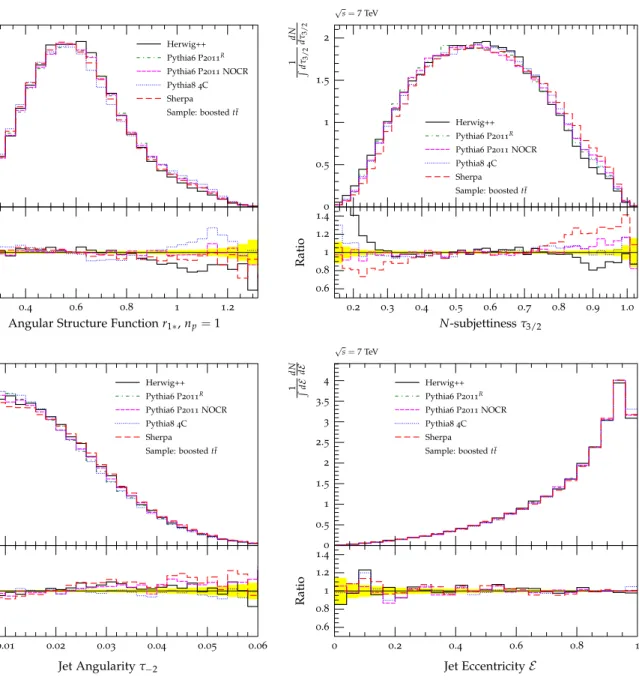
The comparison of the several Monte Carlo generators in Fig.2show that most models predict very similar behavior
Fig. 2 Simulated distribution of four different measures of jet sub-structure.Upper rowthe angular structure functionr1∗(left) and the ratio of 3-jettiness and 2-jettinessτ3/2(right).Lower rowthe jet angu-larityτ−2and the jet eccentryǫfor leading jet of a boosted semileptonic
top sample. The C-A algorithm is used in reclustering, as mentioned in the text. The ratio of the predictions of the different generators to that of thepythia6code with the Perugia 2011 tune is shown in theinsets. Theyellow bandindicates the statistical error
for angularity, eccentricity and theRscale of the peak in thenp=1 bin for the angular structure function. Deviations
are typically below 10% for these observables. The harder jet mass distribution inSHERPAand the softer spectrum in Pythia8are reflected in the edges of theτ3/2distribution.
3.4 Colour flow
Colour flow observables offer a complementary way to probe boosted event topologies. Pull [80] is apT-weighted vector
inη−φspace that is constructed so as to point from a given jet
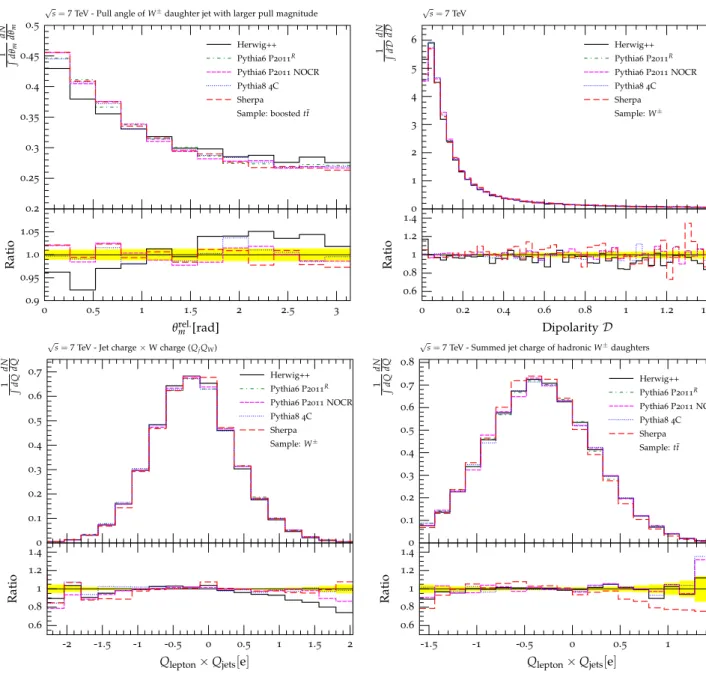
to its colour-connected partner(s). The pull is measured with respect to the otherW±daughter jet. TheW-boson is selected kinematically in 4-jet events with 2b-quarks, and flavors are labelled using the highestpT cone. In Fig.3, the top left plot
shows this variable for a background-like distribution. The comparisons demonstrate that Herwig produces a different colour flow structure.
Fig. 3 Upper rowComparison of simulations for colour-flow observ-ables: the pull angle of the leading jet attributed to the hadronic W decay int tevents, and the dipolarity of the leading jet produced in association with a leptonically decaying W.Lower rowComparison of simulated jet charge observables (κ=0.3): the jet charge for the leading jet pro-duced in association with a leptonically decaying W (left panel), and the
sum of jet charge observables for the two jets attributed to the hadronic W decay int tevents (right panel). The ratio of the predictions of the different generators to that of thepythia6code with the Perugia 2011 tune is shown in theinsets. Theyellow bandindicates the statistical error
3.5 Jet charge
Jet charge [82–84] is constructed in an attempt to associate a jet-based observable to the charge of the originating hard parton. ThepT-weighted jet charge
Qj =
1 pTκj
i∈T
qi×(piT)κ
is shown withκ =0.3 in Fig.3, using anti-kt 0.6 jets. The comparison displays the most relevant distributions for
typi-cal quark tagging and boson tagging analyses. Different MC models are seen to have very similar predictions for this observable too.
3.6 Summary
aspects of jet substructure are evaluated, from basic jet invari-ant mass to colour flow observables and jet charge.
We find that for jet mass large variations are observed between the various MC models. However, for groomed jets the deviations between different model predictions are smaller. The differences between several recent tunes of the
Pythiagenerator are much smaller. The MC model
predic-tions are similar forN-subjettiness, angularity and eccentric-ity. The colour flow model recently implemented in Her-wig++yields different predictions for colour flow
observ-ables than the models in other generators.
4 The impact of multiple proton-proton collisions on jet reconstruction
Section prepared by the Working Group: ’Jet substruc-ture performance at high luminosity’, P. Loch, D. Miller, K. Mishra, P. Nef,A. Schwartzman,G. Soyez.
The first LHC analyses exploring the experimental response to jet substructure demonstrated that the highly granular ATLAS and CMS detectors can yield excellent performance. They also confirmed the susceptibility of the invariant mass of large-radius jets, with a very large catchment area, to the energy flow from the additional proton-proton interactions that occur each bunch crossing. And, finally, they provided a first hint that jet grooming could be a powerful tool to mitigate the impact of pile-up. Since then, the LHC collab-orations have gained extensive experience in techniques to correct for the impact of pile-up on jets. In this Section these tools are deployed in an extreme pile-up environment. We simulate pile-up levels as high asµ =200, such as may be expected in a future high-luminosity phase of the LHC. We evaluate the impact on jet reconstruction, with a focus on the (substructure) performance.
4.1 Pile-up
Each LHC bunch crossing gives rise to a number of proton-proton collisions and typically the hard scattering (sig-nal) interaction is accompanied by several additional pile-up proton-proton collisions. The total proton-proton cross-section is aboutσtot =98 mb (inelasticσinel =72.9 mb) at
√s
=7TeV [85], and even slightly higher at√s=8TeV in 2012. With a peak instantaneous luminosity of about 7.7×1033 cm−2s−1 in 2012, the resulting average num-ber of pile-up collisions reachedµ = 20 at the highest intensities. The 2012 data set has a rather flatµdistribution extending fromµ = 5 toµ = 35. In future LHC running even higherµare expected.
Pile-up manifests itself mostly in additional hadronic transverse momentum flow, which is generated by over-laid and statistically independent, predominantly soft
proton-proton collisions that we refer to as “minimum bias” (MB). This diffuse transverse energy emission is superimposed onto the signal of hard scattering final state objects like particles and particle jets, and typically requires corrections, in partic-ular for particle jets. In addition, pile-up can generate particle jets (pile-up jets). We distinguish two types:QCD jets, where the particles in the jet stem from a single MB collision, and stochastic jetsthat combine particles from different vertices in the high density particle flow.
4.2 Monte Carlo event generation
We model the pile-up with MB collisions at√s=8TeV and a bunch spacing of 50 ns, generated with thePythiaMonte
Carlo (MC) generator [86,87], with its 4C tune [62]. All
inelastic, single diffractive, and double diffractive processes are included, with the default fractions as provided by Pyth-ia(tune 4C).
Overall 100×106 MB events are available for pile-up simulation. The corresponding data are generated in samples of 25000 MB collisions, with the largest possibly statisti-cal independence between samples, including new random seeds for each sample. To model pile-up for each signal inter-action, the stable particles14generated in a numberµof MB collisions, with µ being sampled from a Poisson distribu-tion around the chosenµ, are added to the final state stable particles from the signal. This is done dynamically by an event builder in the analysis software, and is thus not part of the signal or MB event production. All analysis is then performed on the merged list of stable particles to model one full collision event at the LHC.
The example signal chosen for the Monte Carlo simula-tion based studies presented in this Secsimula-tion is the decay of a possible heavy Z′boson with a chosen MZ′ = 1.5 TeV to a (boosted) top quark pair, at√s=8TeV. The top- and anti-top-quarks then decay fully hadronically (t → W b→ j j b-jet) or semi-leptonically (t → W b → ℓνb-jet). The
Pythiagenerator [86,87] is used to generate the signal
sam-ples. The soft physics modeling parameters in both cases are from the pre-LHC-data tune 4C [62]. The pile-up is simulated by overlaying generated minimum bias proton-proton inter-actions at√s=8TeV using Poisson distributions with aver-agesµ = {30,60,100,200}, respectively, thus focusing on the exploration of future high intensity scenarios at LHC. All analysis utilizes the tools available in theFastJet[67]
package for jet finding and jet sub-structure analysis. The larger jets used to analyze the final state are reconstructed with the anti−kT algorithm [71] with R = 1.0, to assure
that most of the final state top-quark decays can be collected into one jet. This corresponds to top-quarks generated with
pT 400 GeV. The configurations for jet grooming are
discussed in Sect.4.6.
4.3 Investigating jets from pile-up
Stable particles emerging from the simulated proton-proton collisions are clustered into anti−kT jets [71] with a radius
parameterR=0.4, using theFastJet[67] implementation:
Truth jetsare obtained by clustering all stable particles from a single MB interaction. For an event containing µpile-up interactions, jet finding is therefore executedµ times. The resulting truth jets are required to havepT≥5
GeV.
Pile-up jetsare obtained by clustering the stable particles from all MB interactions forming the pile-up event. They are subjected to the kinematic cuts described below.
Jets with rapidity|y|<2 are accepted.
The contribution of pile-up to jets can be corrected using the jet area based method in Ref. [88]. It employs the median transverse momentum densityρ, which here is determined usingkTjets with R =0.4 within|y| <2. To evaluate the
effect of this correction, the transverse momentum ratioRpT is introduced as
RpT =
pmat chT
pT−ρA =
pmat chT
pcorrT . (3)
HereAis the catchment area [68] of the pile-up jet, and pmat chT is the matching truth jet pT. The matching criterion
is similar to the one suggested in Ref. [89], where the truth jet matching uses the constituents shared between the truth jet and the pile-up jet. The jets are considered matched if the fraction of constituents of the truth jet that are also contained in the pile-up jet contribute to at least 50% of the truth jet pT. In the following, pile-up jets are only considered if their
corrected transverse momentum ispcorrT ≥20 GeV, and they are matched to at least one truth jet.
The contribution of particles from any vertex to a given pile-up jet can be measured using the jet vertex fraction (Fjvf). It is defined as
Fjvf(Vi)=
Npart(Vi)
k=1 pT,k
Ncoll
i=1
Npart(Vi)
k=0 pT,k = p1
T
Npart(Vi)
k=1
pT,k, (4)
whereNpart(Vi)is the number of particles from a given vertex
Vi, andNcollis the number of collision vertices contributing
particles to the jet.Fjvfis calculated for each of these vertices. Note that pT corresponds to the uncorrected jet transverse
momentum and consequently, the value of each component ofFjvf(Vi)depends onµ.
µ
0 50 100 150 200 250
> 0.8)
match T
efficiency( p /
0 0.5
1 - A<30 GeV T 20<p
A<40 GeV -T 30<p
A>40 GeV -T p Pythia 8, MB Anti-kt R=0.4, s = 8 TeV
corr T
p
√
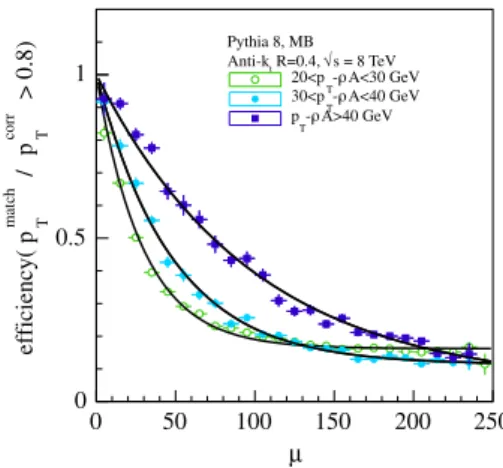
Fig. 4 The simulated fraction of pile-up jets withRpT >0.8
(QCD-like) in a 8 TeV operation of the LHC, as a function of the number of minimum-bias interactions and for different values ofpcorrT . A fit of the exponential form f =c0+c1exp(c2·NPV)is superposed where one degree of freedom is fixed via the constraintf(0)=1, i.e.c1=(1−c0)
4.4 Evaluation of the pile-up jet nature
It follows from the definition of RpT that pile-up jets with values ofRpT close to unity are matched to a truth jet with pT ≈ pcorrT of the pile-up jet itself. Consequently, there is
a single MB interaction which predominantly contributes to the jet. On the other hand, jets with a small value ofRpT are mostly stochastic, as no single minimum-bias collision con-tributes in a dominant way to the pile-up jet. We characterize jets as stochastic if RpT is smaller than 0.8. This threshold value is arbitrary and the fraction of QCD-like and stochastic jets depends on the exact choice. The conclusion of our study holds for a broad range of cut values.
The fractions of QCD-like and stochastic pile-up jets change as a function of pile-up jet pT and µ. This can
be seen in Fig.4, where QCD jet-like samples are defined by RpT > 0.8 for each pile−up level. The fraction of these jets at a given pcorrT decreases exponentially withµ. The exponential decrease is slower for larger pTcorr. At a pile −up activity of µ = 100, the fraction of pile-up jets that are QCD-like is about 40% (20%) for pcorrT >40 GeV(20 < pTcorr <30 GeV). At µ =150, these numbers decrease to about 25 and 15%, respectively.
4.5 Pile-up jet multiplicity
The mean number of pile-up jets per event, as a function of jet pcorrT and NPV, is indicative of the efficiency of the jet
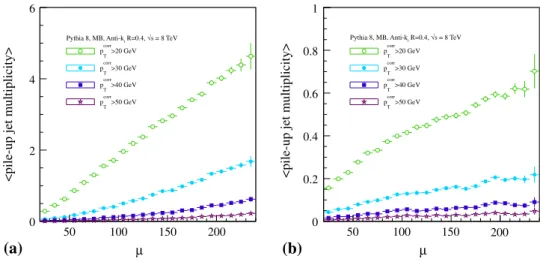
Fig. 5 Simulation results for mean number of pile-up jets per event in the 8 TeV LHC, inclusively (a) and for QCD-like pile-up jets withRpT >0.8 (b),
as a function ofµandpcorrT
µ
50 100 150 200
<pile-up jet multiplicity>
0 2 4 6
>20 GeV corr T p
>30 GeV corr T p
>40 GeV corr T p
>50 GeV corr T p
Pythia 8, MB, Anti-kt R=0.4, √s = 8 TeV
(a)
µ50 100 150 200
<pile-up jet multiplicity>
0 0.2 0.4 0.6 0.8 1
>20 GeV corr T p
>30 GeV corr T p
>40 GeV corr T p
>50 GeV corr T p Pythia 8, MB, Anti-k
t R=0.4, √s = 8 TeV
(b)
jet pT,∂N/∂µ is significantly smaller, and displays an
increase with increasingµ.
The sub-sample of QCD-like jets in the inclusive pile-up jet sample shows a different behavior, as indicated in the righmost panel of Fig. 5. In this case ∂N/∂µdecreases with increasingµin all considered bins of pcorrT . This con-tradicts the immediate expectation of an increase following the inclusive sample, but can be understood from the fact that with increasing µ the likelihood of QCD-like jets to overlap with (stochastic) jets increases as well. The resulting (merged) pile-up jets no longer display features consistent with QCD jets (e.g., loss of single energy core), and thus fail theRpT >0.8 selection.
The pile-up jet multiplicity shown in Fig.5is evaluated as a function of the pile-up corrected transverse momentum of the jet (pcorrT ). This means that after the correction approxi-mately two pile-up jets withpcorrT > pTmin=20 GeV can be expected forµ ≃100. This number decreases rapidly with increasing pTmin. The mean number of QCD jets is small, at about 0.4 atµ =100, forpminT =20 GeV.
4.6 Jet grooming configurations
Three jet grooming techniques are used by the LHC experi-ments:
Jet trimmingTrimming is described in detail in Ref. [2]. In this approach the constituents of the large anti−kTjet
formed with R =1.0 are re-clustered into smaller jets with Rtrim = 0.2, using the anti−kT algorithm again.
The resulting sub-jets are only accepted if their transverse momentum is larger than a fraction f (here f =0.03) of a hard scale, which was chosen to be the pT of the
large jet. The surviving sub-jets are recombined into a groomed jet.
Jet filteringFiltering was introduced in the context of a study to enhance the signal from the Higgs boson
decay-ing into two bottom-quarks, see Ref. [1]. In its simplified configuration without mass-drop criterion [90] applied in this study it works similar to trimming, except that in this case the sub-jets are found with the Cambridge-Aachen algorithm [73,91] withRfilt=0.3, and only the
three hardest sub-jets are retained. The groomed jet is then constructed from these three sub-jets.
Jet pruningPruning was introduced in Ref. [92]. Con-trary to filtering and trimming, it is applied during the formation of the jet, rather than based on the recombi-nation of sub-jets. It dynamically suppresses small and larger distance contributions to jet using two param-eters, Zcut for the momentum based suppression, and
Dcut=Dcut,fact×2m/pT(heremandpTare the
trans-verse momentum and mass of the original jet) for the distance based. Pruning vetoes recombinations between two objectsi and j for which the geometrical distance betweeni and j is more thanDcutand thepT of one of
the objects is less thanZcut×piT+j, where pTi+j is the
combined transverse momentum ofiand j. In this case, only the hardest of the two objects is kept. Typical values for the parameters are:Zcut=0.1 andDcut,fact=0.5.
In this study, trimming and filtering are applied to the orig-inal anti−kTjets with sizeR=1.0. We study the interplay
between jet grooming and area-based pile-up correction. The subtraction is applied directly on the 4-momentum of the jet using:
pjet,subµ = pjetµ−[ρAxjet, ρAyjet, (ρ+ρm)Azjet, (ρ+ρm)AjetE],
(5)
with
ρ=median
patches
p
t,patch
Apatch
, ρm =median
patches
m
δ,patch
Apatch
mδ,patch=i∈patch
m2i +pt2,i−pti , andAµis the active
area of the jet as defined in Ref. [68] and computed by Fast-Jet. Theρterm, mentioned above is the standard correction typically correcting the transverse momentum of the jet. The ρmterm corrects for contamination to the total jet mass due
to the pile-up particle. When applying this subtraction pro-cedure, we discard jets with negative transverse momentum or (squared) mass of the jet.
The estimation ofρ andρm is performed withFastJet
using15 kt jets with R = 0.4. Corrections for the rapidity
dependence of the pile-up densityρare applied using a rapid-ity rescaling.
When we apply this background subtraction together with trimming or filtering, the subtraction is performed directly on the subjets, before deciding which subjets should be kept, so as to limit the potential effects of pile-up on which subjets are to be kept.
4.7 Jet substructure reconstruction
The various methods and configurations discussed in the pre-vious section are applied to the jets reconstructed with the anti−kTalgorithm withR=1.0 in theZ′→t tfinal state in
the presence of pile-up. For the studies presented in this report we require jetpTbefore grooming and pile-up subtraction to
be greater than 100 GeV and consider the two hardestpT-jets
in the event. We further require that the rapidity difference between the two jets|y1−y2|is less than one. The immediate
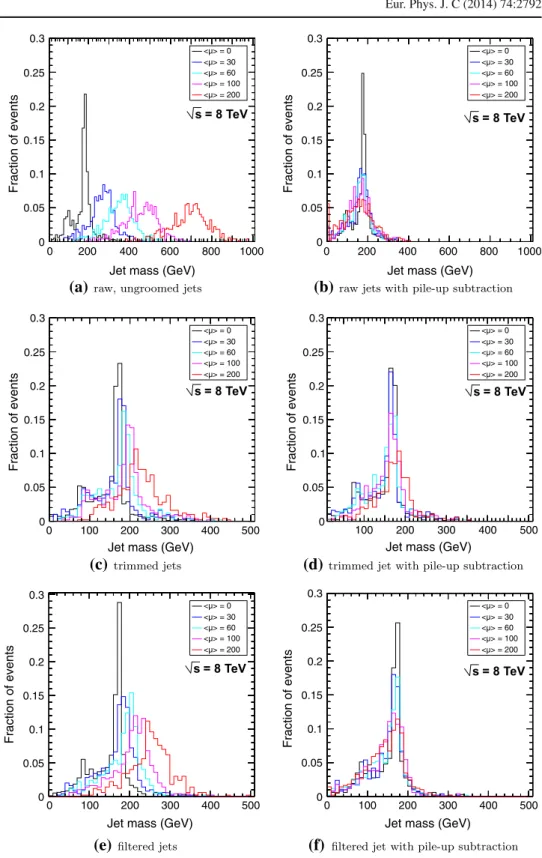
expectation for the reconstructed jet massmis the top mass, i.e.m≈175 GeV, and no residual dependence on the pile-up activity given byµ, after the pile-up subtraction. The two plots in the upper row of Fig.6show the distributions of the reconstructed jet masses without any grooming and with the pile-up subtraction discussed in Sect.4.6applied. The effect of pile-up on the mass scale and resolution is clearly visible. Applying only the pile-up subtraction, without changing the composition of the jets, already improves the mass recon-struction significantly. Allµdependence is removed from the jet mass spectrum, as shown in Fig.6. In particular, the position of the mass peak is recovered. With increasing pile-up, the mass peak gets more and more smeared, an effect due to the fact that the pile-up is not perfectly uniform. These point-to-point fluctuations in an event lead to a smearing
±σ√Ain (5). For very large pile-up, this smearing extends all the way tom=0 as seen in Fig.6.
The effect of the other grooming techniques on the recon-structed jet mass distributions is summarized in Fig.6, with and without the pile-up subtraction applied first. The spectra show that both trimming and filtering can improve the mass reconstruction. The application of the pile-up subtraction in
15Ghosts are placed up toy
max=3 and explicit ghosts are enabled.
addition to trimming or filtering further improves the mass reconstruction performance.
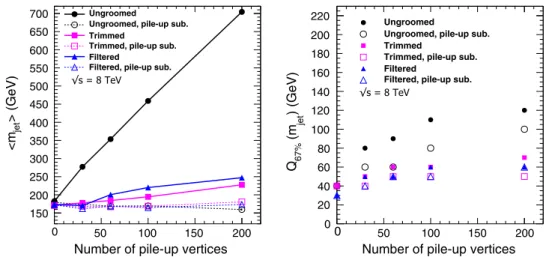
The findings from the spectra in Fig.6are quantitatively summarized in Fig.7for the mass scale and resolution. Here the resolution is measured in terms of the mass range in which 67% of all jet masses can be found (Q67%(mjet)quantile).
Maintaining the jet mass scale around the expectation value of 175 GeV works well for trimming and filtering with and without pile-up subtraction, see Fig.7. The same figure indi-cates that for very high pile-up (µ = 100−200), the jet mass after trimming and filtering without pile-up subtraction shows increasing sensitivity to the pile-up. The additional pile-up subtraction tends to restore the mass scale with bet-ter quality.
Both trimming and filtering improve the mass resolution to different degrees, but in any case better than pile-up sub-traction alone, as expected. Applying the additional pile-up subtraction to trimming yields the least sensitivity to the pile-up activity in terms of mass resolution and scale.
These effects can be explained as follows. As discussed earlier, pile-up has mainly two effects on the jet: a constant shift proportional toρAand a smearing effect proportional toσ√A, withσ a measure of the fluctuations of the pile-up within an event. In that language, the subtraction corrects for the shift leaving the smearing term untouched. Grooming, to the contrary, since it selects only part of the subjets, acts as if it was reducing the area of the jet16. This reduces both the shift and the dispersion. Combining grooming with subtraction thus allows to correct for the shift leftover by grooming and reduce the smearing effects at the same time. All these effects are observed in Fig.7.
4.8 Concluding remarks
The source of jets produced in minimum bias collisions in the presence of pile-up is analyzed using a technique relating the single collision contribution in the jet to its transverse momentum after pile-up correction in particle level Monte Carlo. The rate of pile-up jets surviving after application of the jet area based pile-up subtraction is about two with pcorrT > 20 GeV and within |y| < 2, at a pile-up activity ofµ =100. It rises about linearly with increasing pile-up for this particular selection. Higher pTjets occur at a much
reduced rate, but with a steeper than linear rise with increas-ingµ.
The rate of QCD-like jets is significantly smaller, and shows a less-than-linear increase with increasing µ even
Fig. 6 Simulation results for the impact of pile-up on the jet mass distribution.Top rowthe raw jet mass distribution for jets reconstructed with the anti−kT algorithm andR=1.0 in
Z′→t tfinal states withmZ′= 1.5 TeV, in the presence of pile-up withµ =30, 60, 100, and 200, before and after pile-up subtraction. The second and third row show the same result after trimming (middle row) and filtering (lower row)
Jet mass (GeV)
200 400 600 800 1000
Fraction of events
0 0.05 0.1 0.15 0.2 0.25 0.3
<µ> = 0 <µ> = 30 <µ> = 60 <µ> = 100 <µ> = 200
= 8 TeV s
Jet mass (GeV)
0 200 400 600 800 1000
Fraction of events
0 0.05 0.1 0.15 0.2 0.25 0.3
<µ> = 0 <µ> = 30 <µ> = 60 <µ> = 100 <µ> = 200
= 8 TeV s
Jet mass (GeV)
0 100 200 300 400 500
Fraction of events
0 0.05 0.1 0.15 0.2 0.25 0.3
<µ> = 0 <µ> = 30 <µ> = 60 <µ> = 100 <µ> = 200
= 8 TeV s
Jet mass (GeV)
100 200 300 400 500
Fraction of events
0 0.05 0.1 0.15 0.2 0.25 0.3
<µ> = 0 <µ> = 30 <µ> = 60 <µ> = 100 <µ> = 200
= 8 TeV s
Jet mass (GeV)
0 100 200 300 400 500
Fraction of events
0 0.05 0.1 0.15 0.2 0.25 0.3
<µ> = 0 <µ> = 30 <µ> = 60 <µ> = 100 <µ> = 200
= 8 TeV s
Jet mass (GeV)
0 100 200 300 400 500
Fraction of events
0 0.05 0.1 0.15 0.2 0.25 0.3
<µ> = 0 <µ> = 30 <µ> = 60 <µ> = 100 <µ> = 200
= 8 TeV s
(
a
)
(b)
(c)
(
d
)
(e)
(f)
0
for pminT = 20 GeV. This can be understood as a sign of increased merging between QCD-like jets and stochastic jets. The merged jets are less likely to display features character-istic for QCD-like jets, and therefore fail the selection.
The fraction of QCD-like jets with a core of energy arising from a single proton-proton interaction of at least 0.8pcorrT is found to decrease rapidly with increasingµ. Atµ=50 about
60% of the pile-up jets withpcorrT >50 GeV are found to be QCD-like, whereas atµ=200 this number is decreased to about 20%.
Fig. 7 Simulated average (leftmost figure) and RMS (rightmost figure) of the reconstructed jet mass distribution inZ′→t tfinal states, as a function of the pile-up activityµ, for various jet grooming techniques
Number of pile-up vertices
0 50 100 150 200
> (GeV)
jet
<m
150 200 250 300 350 400 450 500 550 600 650
700 Ungroomed
Ungroomed, pile-up sub. Trimmed
Trimmed, pile-up sub. Filtered
Filtered, pile-up sub.
Number of pile-up vertices
0 50 100 150 200
) (GeV)
jet
(m
67%
Q
0 20 40 60 80 100 120 140 160 180 200
220 Ungroomed
Ungroomed, pile-up sub. Trimmed
Trimmed, pile-up sub. Filtered
Filtered, pile-up sub.
using the four-vector area, to reconstruct the single jet mass and evaluate the stability of the mass scale and resolution at pile-up levels of 30, 60, 100, and 200 extra proton-proton collisions, in addition to the signal event. It is found that for this particular final state trimming and filtering work well for maintaining the mass scale and resolution, provided they are applied together with pile-up subtraction so as to benefit both from the average shift correction from subtraction and noise reduction from the grooming.
The studies presented here are performed with Monte Carlo simulated signal and pile-up (minimum bias) interac-tions. No considerations have been given to detector sensitiv-ities and other effects deteriorating the stable particle level kinematics and flows exploited here. With this respect the conclusions of this study are limited and can be considered optimistic until shown otherwise.
Note also that comparing the performance of filtering and trimming would require varying their parameters and that this goes beyond the scope of this study.
5 The potential of boosted top quarks
Section prepared by the Working Group: ’Prospects for boosted top quarks’, A. Altheimer, J. Ferrando, J. Pilot, S. Rappoccio, M. Villaplana,M. Vos.
Many applications of the strategies for boosted objects have been proposed (the bibliography of this paper and those included in Refs. [9,10] are a good starting point to navigate the extensive literature). Among these, the study of highly energetic top quarks forms the case that has been studied in greatest detail by the experiments. Several studies of the pro-duction of boosted top quarks have set limits on new physics scenarios. The first sample of boosted top quarks has also been used to understand the modelling of the parton shower and the detector response. In this section we present a sum-mary of achievements so far, discuss how existing analyses
could benefit from an improved understanding of jet sub-structure, and explore possible directions for future work.
5.1 Boosted top quark production
The top quark decay topology observed in the detector depends strongly on the kinematic regime. The decay prod-ucts of top quarks produced nearly at rest (pT <200 GeV/c)
are well-separated, leading to experimental signatures such as isolated leptons and a relatively large number of clearly resolved jets. With increasing transverse momentum, the decay products of the top quark will become collimated and possibly reconstructed in the same final state object. For inter-mediate boosts (200 < pT <400 GeV), the daughters of
theW boson from a fully-hadronic top decay will be close enough to be clustered into the same jet. At this point, the use of jet substructure techniques becomes important to effi-ciently identify these decay signatures. At even largerpTtop
quarks become truly boosted objects: all decay products of the top will be strongly collinear, with theR∼2mtop/pT.
Hadronic top quarks can be reconstructed in a single jet, and top quarks with leptonic decays generally contain non-isolated leptons due to the overlap with theb-quark jet.

![Table 1 The top pair production rate at past, present and future colliders, calculated with the MCFM code [93]](https://thumb-eu.123doks.com/thumbv2/123dok_br/15841328.139212/18.892.75.817.138.262/table-pair-production-present-future-colliders-calculated-mcfm.webp)