I N V I T E D C O M M E N T A R Y
Assessing water contamination risk from vegetation fires:
Challenges, opportunities and a framework for progress
Joao P. Nunes
1|
Stefan H. Doerr
2|
Gary Sheridan
3|
Jonay Neris
2|
Cristina Santín
2|
Monica B. Emelko
4|
Uldis Silins
5|
Peter R. Robichaud
6|
William J. Elliot
6|
Jacob Keizer
71
CE3C– Centre for Ecology, Evolution and Environmental Changes, Faculdade de Ciências, Universidade de Lisboa, Lisbon 1749‐016, Portugal
2
Swansea University, Swansea SA2 8PP, UK
3
University of Melbourne, Melbourne 3010VIC, Australia
4
University of Waterloo, Waterloo N2L 3G1ON, Canada
5
University of Alberta, Edmonton T6G 2R3AB, Canada
6
Rocky Mountain Research Station, US Forest Service, Moscow 20252ID, USA
7CESAM & Dept. Environment and Planning, University of Aveiro, Aveiro 3810‐193, Portugal
Correspondence
Stefan H. Doerr, Swansea University, Singleton Park, Swansea SA2 8PP, UK. Email: [email protected]
Funding information
Alberta Innovates, Grant/Award Number: 2096, 2343, 2385; European Commission, Grant/Award Number: 655993; Fundação para a Ciência e a Tecnologia, Grant/ Award Number: IF/01465/2015; Marie Skłodowska‐Curie, Grant/Award Number: 63830; European Union's Horizon 2020 research and innovation programme; Swansea University; Sêr Cymru Fellowship; Marie Skłodowska‐Curie Individual Fellowship, Grant/Award Number: 655993; LeverhulmeTrust Fellowship, Grant/Award Number: RF‐2016‐456\2; Victorian Department of Environment, Land, Water and Planning, and Melbourne Water; Fundação para a Ciência e a Tecnologia, Grant/ Award Number: IF/00586/2015
1
|T H E C H A L L E N G E
Water crises—defined as significant declines in water quality and
quantity—top the global risks list compiled by the World Economic
Forum (2015) that have the greatest potential impacts on society. Vegetation fires are amongst the most hydrologically significant landscape disturbances (Ebel & Mirus, 2014) and affect ~4% of the global vegetated land surface annually (Giglio, Randerson, & van der
Werf, 2013). Fire‐prone or fire‐managed ecosystems (forests, grass‐,
and peatlands) also provide ~60% of the water supply for the world's 100 largest cities (Martin, 2016). Accordingly, fire is increasingly acknowledged as a serious threat to water supply globally (Martin, 2016; Robinne et al., 2016). Whilst the global area burned declined by ~20% over the last two decades mainly due to agricultural expansion (Andela et al., 2017), many areas critical for water supply are exposed to increasing fire risk (Doerr & Santin, 2016; Sankey et al., 2017). This is due to increases in fire weather severity (Flannigan et al., 2013) and extended fire season in many regions (Westerling, Hidalgo, Cayan, & Swetnam, 2006), as well as fuel
build‐up due to fire suppression, afforestation, land abandonment,
and a trend towards more extensive fires (Doerr & Santin, 2016). A substantial body of hydrological research exists on fire impacts
on soil‐, hillslope‐ and, to a lesser extent, catchment‐scale processes
with a focus on infiltration, runoff, erosion, and water yield (Moody, Shakesby, Robichaud, Cannon, & Martin, 2013; Shakesby & Doerr, 2006; Shakesby, Moody, Martin, & Robichaud, 2016). However, despite the concerns highlighted above, research has only
recently focused on linkages between on‐site and downstream impacts
of fire on water quality (Abraham, Dowling, & Florentine, 2017; Bladon, Emelko, Silins, & Stone, 2014; Smith, Sheridan, Lane, Nyman, & Haydon, 2011) and treatability of contaminated water following fire (Emelko, Silins, Bladon, & Stone, 2011). Presence of highly erodible ash, combined with enhanced runoff and erosion responses following fire, can rapidly transfer sediment, nutrients, and contaminants of health concern, such as polycyclic aromatic hydrocarbons (PAHs) and heavy metals into stream networks (Bodí et al., 2014; Verkaik et al., 2013), impacting aquatic ecosystems (Silva et al., 2015) and drinking water supplies (Smith et al., 2011). These impacts can be exacerbated
-This is an open access article under the terms of the Creative Commons Attribution‐NonCommercial License, which permits use, distribution and reproduction in any medium, provided the original work is properly cited and is not used for commercial purposes.
©2018 The Authors. Hydrological Processes Published by John Wiley & Sons Ltd. DOI: 10.1002/hyp.11434
following drought due to reduced contaminant dilution at low water
levels. Such events have led to drinking‐water restrictions affecting
large cities (e.g., Denver, 1996, 2002; Canberra, 2003; Belfast, 2011) and substantial direct costs for restoring ecosystem services and man-aging drinking water treatment, e.g., $26 Mill. Denver and $38 Mill. Canberra (Denver Water, 2010; White et al., 2006). Climate change will likely increase risks of water contamination events through increases in droughts, fire frequency, intensity and extent, and inten-sity of rainfall events (IPCC, 2014; Sankey et al., 2017).
Despite their economic and environmental significance, it is still difficult to sufficiently predict the probability and magnitude of
post‐fire contaminant exports to enable (a) reliable water
contamina-tion risk assessments in fire‐prone catchments and (b) support
effective mitigation strategies (Shakesby, 2011; Shakesby et al., 2016; Verkaik et al., 2013). Research in this area has recently gained momentum, but the body of research is still relatively small with
enormous variability in the reported drivers of post‐fire
contamina-tion events (type of pollutants and mobilizacontamina-tion processes; Moody
et al., 2013) and location‐ or end user‐specific questions (e.g., White
et al., 2006; Emelko et al., 2011; Campos et al., 2012; Santín, Doerr, Otero, & Chafer, 2015; Santos, Sanches Fernandes, Pereira, Cortes, & Pacheco, 2015a, 2015b; Langhans et al., 2016). As a result, both the type and extent of knowledge are limited and regionally diverse.
The emerging field of post‐fire water contamination research has thus
not yet developed a coherent framework that supports addressing regional and universal knowledge gaps.
This commentary introduces such a framework within which we highlight (a) the dominant limitations to our capacity to evaluate
post‐fire water contamination risk and (b) recent advances towards
addressing them across a range of post‐fire environments. This
framework embodies the science required to broaden the scope and maximize the utility of such investigations, whilst enabling meaningful
comparison between studies and addressing site‐specific and end
user‐focused priorities.
2
|A F R A M E W O R K F O R P R E D I C T I N G P O S T
‐
F I R E W A T E R C O N T A M I N A T I O N R I S K S
Post‐fire water contamination risks are governed by the potential
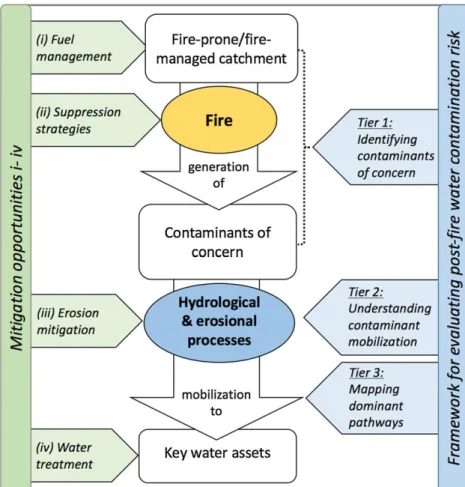
generation, mobilization, and accumulation of contaminants in aquatic environments. Whilst fire and fuel characteristics determine their generation (i.e., their availability after fire), hydrological processes (precipitation, infiltration, runoff, and erosion) drive their mobilization and delivery to water bodies. Mitigation opportunities exist at several stages (Figure 1): (a) effective fuel management can reduce risk before fires occur (Elliot, Miller, & Audin, 2010), (b) fire suppression might
limit the spread of fires into particularly sensitive zones, (c) post‐fire
emergency measures can mitigate the mobilization and transport of contaminants to water assets (Robichaud, Elliot, Pierson, Hall, & Moffet, 2007), and (d) treatment plants can be modified to meet specific decontamination needs. The hydrological research community therefore has a central role in water contamination risk assessment in
fire‐prone landscapes. To do this, a simple tiered framework for
evaluating post‐fire water contamination risk is proposed (Figure 1),
which includes
FIGURE 1 Visual representation of the proposed framework with three main tiers for
evaluating post‐fire water contamination risk.
Opportunities for mitigation at different stages before, during, and after fire events are highlighted
1. Identifying contaminants and water assets of concern;
2. Understanding the dominant processes that govern contaminant mobilization; and
3. Mapping the dominant pathways linking contaminants to areas of concern.
2.1
|Identifying contaminants and water assets of
concern
Post‐fire water erosion can mobilize a multitude of constituents with
contamination potential in dissolved and particulate forms or adsorbed to sediments (Smith et al., 2011). However, whether a constituent is deemed a contaminant depends on the ecosystem service evaluated (e.g., human consumption, industrial use, and aquatic ecosystem health; Calkin et al., 2007). Both the asset at risk (river, reservoir, or aquifer) and the contaminant of concern need to be clearly defined to focus research efforts. For example, Bladon et al. (2008) and Silins et al. (2014) reported elevated nutrient levels following snowmelt impacting stream ecosystems in burned catchments in Canada; White
et al. (2006) reported water treatment problems immediately post‐fire
driven by turbidity in the Australian Bendora reservoir and subsequent releases of dissolved metals from reservoir bottom sediments; Campos et al. (2012) found acute toxic effects in Portuguese river ecosystems
from PAHs dissolved in ash‐laden runoff; and major additional
treatment costs arose from changes in dissolved organic carbon (DOC) following the 2016 Fort McMurray wildfire, Canada (Thurton, 2017). These examples demonstrate that identification of the key contaminant(s) of concern for a particular water asset is critical and
linked to end‐user priorities. For each case, this process constrains
the possible approaches in subsequent post‐fire contamination
assessment; therefore, contaminants are best identified at the outset, or better still, identified by managers of sensitive watersheds in fire prone ecosystems before a fire occurs (Elliot, Miller, & Enstice, 2016).
2.2
|Understanding the dominant processes that
govern contaminant mobilization
Contaminants can be mobilized by wind and water erosion, debris flow, mass failure, and dissolution in water (Bodí et al., 2014; Smith et al., 2011). However, a specific process is often dominant in a particular landscape (Moody et al., 2013) and can be responsible for the majority of contaminant mobilization and delivery to water systems. For example, Jackson and Roering (2009) reported that debris flows in the Oregon Coast Range (USA) triggered by
saturation‐based mass failure were responsible for the majority of
post‐fire sediment production. In contrast, Nyman, Sheridan, Smith,
and Lane (2011) showed that runoff‐generated debris flows
dominated burned catchments in SE Australia; while in the Mediterranean, Shakesby (2011) noted the absence of both mass failure and debris flows, implying the dominance of interill processes (Prats, Wagenbrenner, Santos Martins, Malvar, & Keizer, 2016). The dominant processes that govern contaminant mobilization are often
controlled by higher‐order factors, for example, aridity controlling
debris flows occurrence in Australia (Sheridan et al., 2016) or mobilization being affected by land use patterns (Nunes et al., 2017). As highlighted above, transport by water erosion plays a dominant role for contaminant delivery to surface water bodies. Pollutants can
be mobilized by surface‐runoff or saturation‐based processes, which
are controlled by different system properties. For example, runoff‐
related processes such as inter‐rill and rill erosion and
runoff‐gener-ated debris flows require knowledge on local weather patterns, topog-raphy, fire severity, and soil hydrological and erosional characteristics.
Their occurrence is often driven by high‐intensity, short‐duration
rain-fall events (Kean, Staley, & Cannon, 2011). Saturation‐based processes,
such as post‐fire mass failure processes common in steep landscapes
of western North America, result from increased soil saturation and decreased soil bulk strength. They are therefore sensitive to tree
mor-tality, gradual root decay, and high‐volume rainfall events (Jackson &
Roering, 2009). These contrasting processes may also erode distinct parts of the landscape. For example, spatially widespread rill and
inter‐rill erosion processes can mobilize the ash that blankets soil after
fire (Moody et al., 2013), whereas channel erosion processes may
release colluvial, bank, or bed stores of clay‐sized or clay‐adsorbed
contaminants (Smith et al., 2011; Stone, Emelko, Droppo, & Silins, 2011). Both processes can also dominate at different times. For exam-ple, in northern temperate regions, channel erosion often governs mobilization during the snowmelt period, whereas rainfall dominates more widespread mobilization later in the season (Owens et al.,
2013; Silins, Stone, Emelko, & Bladon, 2009). Non‐erosional processes
include the subsurface mobilization of dissolved contaminants such as DOC, phosphorous, and nitrate in some regions, which is also governed by saturation processes (Elliot, Brooks, Traeumer, & Dobre, 2015; Mast & Clow, 2008; Olefeldt, Devito, & Turetsky, 2013).
Different mobilization processes are associated with characteristic
thresholds, and therefore, the dominant process in a given
environment can be considered as a first‐order control on the
magnitude and frequency of contamination events. Thus, research should focus on the contaminants to which water assets are most vulnerable and mobilization processes most relevant to them. For example, the mobilization of ash and other associated components has been recently assessed in depth (e.g., Bodí et al., 2014; Campos, Abrantes, Keizer, Vale, & Pereira, 2016). These works offer a wealth of information and strategies for describing mobilization processes in specific environments which, combined with emerging methods to determine ash loads and their movement across landscapes (Santín et al., 2015; Chafer, Santín, & Doerr, 2016; Neris, Elliot, Doerr, & Robichaud, 2017), represent a promising step towards simulation of ash mobilization in burnt areas.
2.3
|Mapping the dominant pathways linking
contaminants to areas of concern
This step is perhaps the most challenging element of the proposed framework, particularly when considering entire catchments. It will differ between transport pathways (connectivity on hillslopes, percola-tion to groundwater, transport in channel networks, and movement in water bodies) and is also related to the properties of the contaminants, including their potential transformation in the environment.
Hydrological contaminant transport can be partitioned into the parts where land surface properties dominate, and where properties of the water body dominate. For example, land surface properties including burn severity, surface roughness, slope, and topographic convergence control the connectivity of overland flow transport pro-cesses, which in turn affect contaminant delivery to receiving waters (Moody et al., 2013). In contrast, aquatic environment properties such as volume, flow regime, temperature, and stratification dominate pro-cesses including contaminant dilution, attenuation, transformation, and breakdown (Samuels, Amstutz, Bahadur, & Pickus, 2006; Smith et al., 2011). Groundwater contamination has also been observed in some areas (Mansilha, Carvalho, Guimarães, & Espinha, 2014; Olefeldt et al., 2013), but subsurface transport remains poorly studied.
Surface transport pathways can differ between mobilization pro-cesses. Their connectivity in the landscape for a given process is con-trolled by factors such as geomorphology, rainfall, or soil properties (Bracken et al., 2013; Bracken, Turnbull, Wainwright, & Bogaart, 2015). However, the impacts of fire on vegetation cover and soils change connectivity of transport pathways immediately after fire and throughout the recovery period, with controls including fire severity, burn patchiness, ash characteristics, soil water repellency, and vegeta-tion recovery (Moody et al., 2013; Jordán et al., 2015). Human factors,
such as forest tracks, terraces, and post‐fire management add further
complication (Shakesby, 2011; Wagenbrenner, MacDonald, Coats, Robichaud, & Brown, 2015). The spatial and temporal heterogeneities of these factors have complex impacts. For example, Ferreira, Coelho, Ritsema, Boulet, and Keizer (2008) showed runoff connectivity to be controlled by water repellency patterns in Portugal and disrupted by forestry operations, with stronger connectivity in the dry season (Nunes, Malvar, Benali, Rial Rivas, & Keizer, 2016). In contrast, Williams et al. (2016) highlighted the importance of prefire landscape degrada-tion in the western USA, with bare patches generating runoff and ero-sion enhanced by fires and heavy rainfall. Wagenbrenner and
Robichaud (2014) provided catchment‐scale and nested data,
quantify-ing declinquantify-ing sediment delivery with increasquantify-ing scale, and substantial advances have been made in modelling fire affected landscapes (Elliot, 2013; Flanagan, Frankenberger, Cochrane, Renschler, & Elliot, 2013; Miller, Elliot, Billmire, Robichaud, & Endsley, 2016; Robichaud et al., 2007); yet a major challenge still remains in quantifying contaminant amounts available for transport and delivery to receiving waters.
A diverse body of research concerns contaminant transport in aquatic environments, especially in streams, which often highlight
high‐magnitude but short duration contamination pulses following fire
(Smith et al., 2011). However, there is often a lack of connection
between contaminant delivery from the land surface and within‐
stream transport processes (Moody et al., 2013). The latter is compli-cated by remobilization of contaminants inside the stream network, which depends on particle size and streamflow properties, and can lead
to a lagged post‐fire response (Bladon et al., 2014; Elliot, 2013; Smith
et al., 2011). There are fewer studies focusing on lakes, where particle size and density, lake bathymetry, and stratification affect contaminant
attenuation and second‐order impacts such as nutrient‐induced
eutro-phication (Smith et al., 2011). As an example of links between hillslopes and water supply systems, White et al. (2006) reported high turbidity and metals in streams draining burnt Australian watersheds, depositing
at the bottom of a reservoir and resuspending periodically, leading to lasting water quality issues; while Santos et al. (2015b) discussed a sim-ilar problem in Portugal, caused by phosphorus exports adsorbed to sediment, enhancing eutrophication during the summer dry season. These latter linkages have been associated with biostabilization of
fire‐affected river bed sediments and have resulted in larger post‐fire
contaminant pulses with resuspension (Stone et al., 2011). They also
resulted in lasting legacy effects and downstream transport of post‐fire
contaminants in larger river basins (Emelko et al., 2016).
Given that quantifying transport processes at the land surface is already difficult, with complexity increasing with scale, the variability in contaminant transport and fate in channels and lakes and potential lags and remobilization on land and in water provide a major chal-lenge. However, linking contaminant transport from the land surface to streams, reservoirs, and aquifers is a critical step in assessing water contamination risks after fire. At the landscape level, recent advances in hydrological and sediment connectivity theory (Bracken et al., 2013, 2015; Nunes et al., 2017) allow the development of better models (Elliot, 2013; Flanagan et al., 2013; Miller et al., 2016) and
spatial indices to map risk areas and eventually facilitate post‐fire
interventions (Robichaud & Ashmun, 2013). Contaminant source trac-ing and apportionment techniques also provide valuable insights into
characterizing both upstream sources and downstream fate of fire‐
affected sediments and contaminants in larger river basins down-stream of fire (Stone, Collins, Silins, Emelko, & Zhang, 2014). Finally, there is a wealth of historical water quality data for streams and res-ervoirs which can be explored to study the relation between fires and contamination (Emelko et al., 2016; Rhoades, Entwistle, & Butler, 2011; Santos et al., 2015a).
3
|T H E F R A M E W O R K I N P R A C T I C E
The framework outlined above can be used to support a post‐fire
con-tamination vulnerability assessment (sensu Adger, 2006). For example, the sensitivity of a water asset, that is, the likelihood of it being affected by an important contamination event, can be evaluated by the probability of specific events occurring. This will depend on (a) the combined probability of occurrence of fires with relevant severity
that produce significant contaminant loads and of contamination‐
inducing storms during the window of disturbance period and (b)
land-scape‐ and water asset properties, such as their transport pathways,
residence time of contaminants, and the dilution capacity of water bodies. In cases of drinking water supply priorities, treatability risk assessment frameworks can be informed by vulnerability assessments conducted using this framework.
For each case, the choice of contaminant(s) of concern and potential
impacts constrain the possible approaches for post‐fire contamination
assessment, and therefore, they should be identified at the outset. Recent
studies have focused on determining the sensitivity to post‐fire
contami-nation and range from relatively simple spatial indices (e.g., Robinne et al., 2016 at the global scale) to more complex assessments based on the
probability of occurrence of both fire and the post‐fire contamination
events (Langhans et al., 2016; Santos et al., 2015a; Thompson et al.,
Robichaud et al., 2007) may serve to provide a foundation for more com-plex contamination models, but science advancements are still needed to support the development of these higher level predictive tools.
The following two examples illustrate limitations in existing approaches following fire and the potential benefit of applying the pro-posed framework to assess contamination risk:
As in 2017, extensive fires in 2003 and 2005 threatened the main water water supply reservoir of Lisbon (Portugal) with high
concentra-tions of fine sediments (Coelho, Almeida, & Mateus, 2011). This fire‐
prone region has seen substantial research on post‐fire erosion rates
at the plot to slope scale but much less on sediment transport at the catchment scale (Ferreira et al., 2008). Contaminant studies in the stream network in this region have focused on ecotoxic contaminants (Mansilha et al., 2017) and nutrients (Santos et al., 2015b) due to their potential environmental significance. Coelho et al. (2011) argued that
existing data were insufficient to connect post‐fire erosion risk with
larger‐scale stream contamination risk, with different yet supposedly
reasonable assumptions on transport processes in a water quality model leading to contamination estimates ranging from none to severe. This exemplifies a situation where a large research focus on sediment mobilization (Tier 2 of the framework presented here) was not com-bined with a similar focus on transport (Tier 3 of the framework). This has recently been addressed by developing models which can account for the seasonal dynamics of hydrological connectivity in burnt areas (Nunes et al., 2016, 2017; van Eck, Nunes, Vieira, Keesstra, & Keizer,
2016). These go some way in improving our ability to assess post‐fire
contamination risk; a major uncertainty in adapting the Lisbon water supply to a changing environment (Groot, Rovisco, & Lourenço, 2014). The severe 2016 wildfire around Fort McMurray, Alberta, Canada was catastrophic for the city and the most expensive disaster in Canadian history (Insurance Bureau of Canada, 2016). It burnt exten-sive upstream Boreal forest regions and raised many concerns, includ-ing the unknown threat to drinkinclud-ing water provision. While periods of source water quality deterioration, especially shifts in DOC, challenged treatment and led to the >$1 million (Can.) increases in associated costs in the first year after the fire (Thurton, 2017), potentially cata-strophic treatment failure was averted. While operational expertise and wise infrastructure investment largely enabled this success, rapid identification of water contamination and treatment risks was
informed by previous long‐term, post‐fire, catchment‐scale
hydrologi-cal research (Emelko et al., 2011, 2016; Silins et al., 2009) that was conducted in the different hydrologic, geologic, and physiographic
set-tings of Alberta's south‐eastern, steep‐sloped Rocky Mountains. This
example underscores the foundational nature of the first tier of the proposed framework in appropriately linking contamination risks and
end‐user priorities. For example, while heavy metals may pose
signifi-cant threats to ecosystem health, they can be effectively removed by most conventional and advanced drinking water treatment processes (see Emelko et al., 2011 for links of contaminants of concern to drink-ing water infrastructure typologies). Here, the identified need to focus on relatively subtle changes in DOC after wildfire both enabled
appro-priate—albeit costly—water treatment responsiveness (Tier 1 of the
framework) and identified key knowledge gaps related to contaminant mobilization in low relief northern landscapes with highly variable hydrologic connectivity (Tier 2 of the framework).
Predicting the risk of post‐fire water contamination is critical to
enabling effective mitigation strategies for safeguarding water quality and treatability, particularly given increased water scarcity and fire risk
in many regions. Current approaches to risk assessment are often site‐
specific because of differences in dominant mobilization and transport processes, as well as vulnerability of priority water assets. In the case of drinking water, while contaminants of concern are often known and have been broadly linked to infrastructure needs, operational capacity during challenge periods such as the hydrologic events
discussed herein remains largely undescribed—both factors must be
considered in treatment risk assessment. Further identification of con-taminants of concern for priorities such as ecosystem health is more difficult due to complex interactions between contaminants and effects on trophic chains (Silins et al., 2014). The lack of systematic frameworks for assessing risks has made it difficult to generalize research findings from specific studies and develop adaptation strate-gies in our changing environment. Risk is the probability that a hazard will result in adverse consequences; thus, the framework presented
herein prioritizes post‐fire water contamination hazard identification
(Tier 1) and evaluation of the probability of adverse consequence through predictive modelling of contaminant mobilization and trans-port (Tiers 2 and 3). While there is a clear need for more data collection and basic research to advance this framework, it can nonetheless help structure existing and future research, with the ultimate goal of con-tributing to the development of simplified, but effective tools, for
watershed asset management by predicting and mitigating post‐fire
contamination risks.
A C K N O W L E D G M E N T S
All authors contributed substantially to the drafting the manuscript. During manuscript preparation, J. P. N was supported by research grant from the Fundação para a Ciência e a Tecnologia (IF/00586/ 2015), G. S. by the Victorian Department of Environment, Land, Water and Planning, and Melbourne Water, S. H. D. by a Leverhulme Trust
Fellowship (RF‐2016‐456\2), J. N. by a Marie Skłodowska‐Curie
Individual Fellowship (655993), C. S. by a Sêr Cymru Fellowship co‐
funded by Swansea University and European Union's Horizon 2020
research and innovation programme (Marie Skłodowska‐Curie [Grant
63830]), U. S. and M. B. E. by Alberta Innovates grants (2096, 2343, 2385), and J. J. K. by a Fundação para a Ciência e a Tecnologia grant (IF/01465/2015).
O R C I D
Stefan H. Doerr http://orcid.org/0000-0002-8700-9002
R E F E R E N C E S
Abraham, J., Dowling, K., & Florentine, S. (2017). Risk of post‐fire metal
mobilization into surface water resources: A review. Science of the
Total Environment, 599–600, 1740–1755. https://doi.org/10.1016/j.
scitotenv.2017.05.096.
Adger, W. N. (2006). Vulnerability. Global Environmental Change, 16,
268–281.
Andela, N., Morton, D. C., Giglio, L., Chen, Y., van der Werf, G. R.,
Kasibhatla, P. S.,… Randerson, J. T. (2017). A human‐driven decline in
global burned area. Science, 356, 1356–1362. https://doi.org/
Bladon, K. D., Emelko, M. B., Silins, U., & Stone, M. (2014). Wildfire and the future of water supply. Environmental Science and Technology, 48,
8936–8943.
Bladon, K. D., Silins, U., Wagner, M. J., Stone, M., Emelko, M. B., Mendoza,
C. A.,… Boon, S. (2008). Wildfire impacts on nitrogen concentration
and production from headwater streams in southern Alberta's Rocky
Mountains. Canadian Journal of Forest Research, 38, 2359–2371.
Bodí, M. B., Martin, D. A., Balfour, V. N., Santín, C., Doerr, S. H., Pereira, P., … Mataix‐Solera, J. (2014). Wildland fire ash: Production, composition
and eco‐hydro‐geomorphic effects. Earth‐Science Reviews, 130, 103–
127. https://doi.org/10.1016/j.earscirev.2013.12.007.
Bracken, L. J., Turnbull, L., Wainwright, J., & Bogaart, P. (2015). Sediment connectivity: A framework for understanding sediment transfer at
mul-tiple scales. Earth Surface Processes and Landforms, 40, 177–188.
https://doi.org/10.1002/esp.3635.
Bracken, L. J., Wainwright, J., Ali, G. A., Tetzlaff, D., Smith, M. W., Reaney, S. M., & Roy, A. G. (2013). Concepts of hydrological connectivity: Research approaches, pathways and future agendas. Earth Science
Reviews, 119, 17–34. https://doi.org/10.1016/j.earscirev.2013.02.001.
Calkin, D. E., Hyde, K. D., Robichaud, P. R., Jones, J. G., Ashmun, L. E., &
Loeffler, D. (2007). General technical report RMRS‐GTR‐205. In
Assessing post‐fire values at risk with a new calculation tool (pp. 38). Fort Collins, CO, USA: Rocky Mountain Research Station.
Campos, I., Abrantes, N., Keizer, J. J., Vale, C., & Pereira, P. (2016). Major and trace elements in soils and ashes of eucalypt and pine forest plan-tations in Portugal following a wildfire. Science of the Total Environment,
572, 1363–1376. https://doi.org/10.1016/j.scitotenv.2016.01.190.
Campos, I., Abrantes, N., Vidal, T., Bastos, A. C., Gonçalves, F., & Keizer, J. J.
(2012). Assessment of the toxicity of ash‐loaded runoff from a recently
burnt eucalypt plantation. European Journal of Forest Research, 131(6),
1889–1903. https://doi.org/10.1007/s10342‐012‐0640‐7.
Chafer, C. J., Santín, C., & Doerr, S. H. (2016). Modelling and quantifying the
spatial distribution of post‐wildfire ash loads (2016). International
Journal of Wildland Fire, 25(2), 249–255. https://doi.org/10.1071/
WF15074.
Coelho, P. S., Almeida, M., & Mateus, N. (2011). Modelação Matemática da
Qualidade da Água em Albufeiras com Planos de Ordenamento– V – Efeito
de fogos florestais no regime de escoamento e na qualidade da água de rios e albufeiras. Lisbon: INAG.
Denver Water (2010). 2010 comprehensive annual financial report. Denver, USA: Denver Water.
Doerr, S. H., & Santin, C. (2016). Global trends in wildfire and its impacts: Perceptions versus realities in a changing world. Philosophical Transac-tions of the Royal Society, B: Biological Sciences, 371, 20150345. https://doi.org/10.1098/rstb.2015.0345.
Ebel, B. A., & Mirus, B. B. (2014). Disturbance hydrology: Challenges and
opportunities. Hydrological Processes, 28, 5140–5148. https://doi.org/
10.1002/hyp.10256.
van Eck, C. M., Nunes, J. P., Vieira, D. C. S., Keesstra, S., & Keizer, J. J.
(2016). Physically‐based modelling of the post‐fire runoff response of
a forest catchment in central Portugal: Using field vs. remote sensing based estimates of vegetation recovery. Land Degradation and
Development, 27(5), 1535–1544. https://doi.org/10.1002/ldr.2507.
Elliot, W. J. (2013). Erosion processes and prediction with WEPP technology in forests in the Northwestern U.S. Transactions of the
American Society of Agricultural and Biological Engineers, 56(2), 563–
579. https://doi.org/10.13031/2013.42680.
Elliot, W. J., Brooks, E., Traeumer, D. E., & Dobre, M. (2015). Extending WEPP technology to predict fine sediment and phosphorus delivery
from forested hillslopes. Presented at the interagency joint
sedimentation and hydrology conference. 20‐23 April. Reno, NV.
Elliot, J., Miller, I. S., & Audin, L. (Eds.) (2010). Cumulative watershed effects
of fuel management in the western United States ()Gen. Tech. Rep. RMRS‐
GTR‐231. ( pp. 299). Fort Collins, CO: U.S.: Department of Agriculture,
Forest Service, Rocky Mountain Research Station.
Elliot, W. J., Miller, M. E., & Enstice, N. (2016). Targeting forest manage-ment through fire and erosion modelling. International Journal of
Wildland Fire, 25, 876–887. https://doi.org/10.1071/WF15007.
Emelko, M. B., Silins, U., Bladon, K. D., & Stone, M. (2011). Implications of land disturbance on drinking water treatability in a changing climate: Demonstrating the need for "source water supply and protection"
strategies. Water Research, 4(2), 461–472. https://doi.org/10.1016/j.
watres.2010.08.051.
Emelko, M. B., Stone, M., Silins, U., Allin, D., Collins, A. L., Williams, C. H. S., … Bladon, K. D. (2016). Sediment‐phosphorus dynamics can shift aquatic ecology and cause downstream legacy effects after wildfire in
large river systems. Global Change Biology, 22, 1168–1184. https://
doi.org/10.1111/gcb.13073.
Ferreira, A. J. D., Coelho, C. O. A., Ritsema, C. J., Boulet, A. K., & Keizer, J. J. (2008). Soil and water degradation processes in burned areas: Lessons
learned from a nested approach. Catena, 74, 273–285. https://doi.
org/10.1016/j.catena.2008.05.007.
Flanagan, D. C., Frankenberger, J. R., Cochrane, T. A., Renschler, C. S., & Elliot, W. J. (2013). Geospatial applications of the water erosion predic-tion project (WEPP) model. Transacpredic-tions of the American Society of
Agricultural and Biological Engineers, 56(2), 591–601. https://doi.org/
10.13031/2013.42681.
Flannigan, M., Cantin, A. S., de Groot, W. J., Wotton, M., Newbery, A., & Gowman, L. M. (2013). Global wildland fire season severity in the
21st century. Forest Ecology and Management, 294, 54–61.
Giglio, L., Randerson, J. T., & van der Werf, G. R. (2013). Analysis of daily,
monthly, and annual burned area using the fourth‐generation global fire
emissions database (GFED4). Journal of Geophysical Research –
Biogeosciences, 118, 317–328.
Groot, A., Rovisco, A., & Lourenço, T. (2014). Chapter 4: Showcasing practitioners' experiences. In T. Lourenço, A. Rovisco, A. Groot, C.
Nilsson, H.‐M. Füssel, L. van Bree, & R. Street (Eds.), Adapting to an
uncertain climate. Lessons from practice (pp. 67–138). Heidelberg:
Springer. https://doi.org/10.1007/978‐3‐319‐04876‐5.
Insurance Bureau of Canada. (2016). “Northern Alberta wildfire costliest
insured natural disaster in Canadian history‐ Estimate of insured losses:
$3.58 billion”. July 7, 2016. http://www.ibc.ca/bc/resources/media‐
centre/media
‐releases/northern‐alberta‐wildfire‐costliest‐insured‐nat-ural‐disaster‐in‐canadian‐history (accessed 4 Dec. 2017).
IPCC. (2014): Climate Change 2014: Synthesis Report. Contribution of working groups I, II and III to the Fifth Assessment Report of the
Intergovernmental Panel on Climate Change. IPCC, Geneva,
Switzerland, 151 pp.
Jackson, M., & Roering, J. J. (2009). Post‐fire geomorphic response in steep, forested landscapes: Oregon Coast Range, USA. Quaternary Science
Reviews, 28, 1131–1146.
Jordán, A., Zavala, L. M., Granged, A. J. P., Gordillo‐Rivero, A. J., García‐Moreno,
J., Pereira, P.,… Alanís, N. (2015). Wettability of ash conditions splash
erosion and runoff rates in the post‐fire. Science of the Total Environment,
572, 1261–1268. https://doi.org/10.1016/j.scitotenv.2015.09.140.
Kean, J. W., Staley, D. M., & Cannon, S. H. (2011). In situ measurements of
post‐fire debris flows in southern California: Comparisons of the timing
and magnitude of 24 debris‐flow events with rainfall and soil moisture
conditions. Journal of Geophysical Research, 116, F04019. https://doi. org/10.1029/2011JF002005.
Langhans, C., Smith, H. G., Chong, D. M. O., Nyman, P., Lane, P. N. J., & Sheridan, G. J. (2016). A model for assessing water quality risk in
catch-ments prone to wildfire. Journal of Hydrology, 534, 407–426. https://
doi.org/10.1016/j.jhydrol.2015.12.048.
Mansilha, C., Carvalho, A., Guimarães, P., & Espinha, M. J. (2014). Water quality concerns due to forest fires: Polycyclic aromatic hydrocarbons (PAH) contamination of groundwater from mountain areas. Journal of
Toxicology and Environmental Health, Part A: Current Issues, 77(14–16),
806–815. https://doi.org/10.1080/15287394.2014.909301.
Mansilha, C., Duarte, C. G., Melo, A., Ribeiro, J., Flores, D., & Marques, J. E. (2017). Impact of wildfire on water quality in Caramulo Mountain ridge
(Central Portugal). Sustain. Water Resources Management (online early).
DOI: https://doi.org/10.1007/s40899‐017‐0171‐y.
Martin, D. A. (2016). At the nexus of fire, water and society. Philosophical
Transactions of the Royal Society, B: Biological Sciences, 371,
20150172. https://doi.org/10.1098/Rstb.2015.0172.
Mast, M. A., & Clow, D. W. (2008). Effects of 2003 wildfires on stream chemistry in glacier National Park, Montana. Hydrological Processes,
22(26), 5013–5023.
Miller, M. E., Elliot, W. J., Billmire, M., Robichaud, P. R., & Endsley, K. A.
(2016). Rapid‐response tools and datasets for post‐fire remediation:
Linking remote sensing and process‐based hydrological models.
Interna-tional Journal of Wildland Fire, 25, 1061–1073. https://doi.org/
10.1071/WF15162.
Moody, J. A., Shakesby, R. A., Robichaud, P. R., Cannon, S. H., & Martin, D.
A. (2013). Current research issues related to post‐wildfire runoff and
erosion processes. Earth‐Science Reviews, 122, 10–37. https://doi.org/
10.1016/j.earscirev.2013.03.004.
Neris, J., Elliot, W. J., Doerr, S. H., & Robichaud, P. R. (2017). Development
of a model to predict ash transport and water pollution risk in fire‐
affected environments. Geophysical Research Abstracts, 19, EGU2017–
EG18845.
Nunes, J. P., Malvar, M., Benali, A. A., Rial Rivas, M. E., & Keizer, J. J. (2016). A simple water balance model adapted for soil water repellency: Application on Portuguese burned and unburned eucalypt stands.
Hydrological Processes, 30, 463–478. https://doi.org/10.1002/
hyp.10629.
Nunes, J. P., Naranjo Quintanilla, P., Santos, J., Serpa, D., Carvalho‐Santos,
C., Rocha, J.,… Keesstra, S. D. (2017). Afforestation, subsequent forest
fires and provision of hydrological services: A model‐based analysis for
a Mediterranean mountainous catchment. Land Degradation and Development (online early).. https://doi.org/10.1002/ldr.2776. Nunes, J. P., Wainwright, J., Bielders, C., Darboux, F., Fiener, P., Finger, D., &
Turnbull, L. (2017). Better models are more effectively connected models. Earth Surface Processes and Landforms, Accepted for publica-tion. https://doi.org/10.1002/esp.4323.
Nyman, P., Sheridan, G. J., Smith, H. G., & Lane, P. N. J. (2011). Evidence of
debris flow occurrence after wildfire in upland catchments of south‐
east Australia. Geomorphology, 125(3), 383–401.
Olefeldt, D., Devito, K. J., & Turetsky, M. R. (2013). Sources and fate of terrestrial dissolved organic carbon in lakes of a Boreal Plains region
recently affected by wildfire. Biogeosciences, 10, 6247–6265. https://
doi.org/10.5194/bg‐10‐6247‐2013.
Owens, P., Giles, T. R., Petticrew, E. L., Leggat, M., Moore, R. D., & Eaton, B. C. (2013). Muted responses of streamflow and suspended sediment
flux in a wildfire‐affected watershed. Geomorphology, 202, 128–139.
https://doi.org/10.1016/j.geomorph.2013.01.001.
Prats, S. A., Wagenbrenner, J. W., Santos Martins, M. A., Malvar, M. C., &
Keizer, J. J. (2016). Mid‐term and scaling effects of forest residue
mulching on post‐fire runoff and soil erosion. Science of the Total
Envi-ronment, 573, 1242–1254. https://doi.org/10.1016/j.
scitotenv.2016.04.064.
Rhoades, C. C., Entwistle, D., & Butler, D. (2011). The influence of wildfire extent and severity on streamwater chemistry, sediment and tempera-ture following the Hayman fire, Colorado. International Journal of
Wildland Fire, 20, 430–442. https://doi.org/10.1071/WF09086.
Robichaud, P. R., & Ashmun, L. E. (2013). Tools to aid post‐wildfire
assess-ment and erosion‐mitigation treatment decisions. International Journal
of Wildland Fire, 22, 95–105. https://doi.org/10.1071/WF11162.
Robichaud, P. R., Elliot, W. J., Pierson, F. B., Hall, D. E., & Moffet, C. A. (2007). Predicting postfire erosion and mitigation effectiveness with a
web‐based probabilistic erosion model. Catena, 71, 229–241. https://
doi.org/10.1016/j.catena.2007.03.003.
Robinne, F. N., Miller, C., Parisien, M. A., Emelko, M. B., Bladon, K. D., Silins, U., & Flannigan, M. (2016). A global index for mapping the exposure of
water resources to wildfire. Forests, 7(1), 1–16. https://doi.org/
10.3390/f7010022.
Samuels, W. B., Amstutz, D. E., Bahadur, R., & Pickus, J. (2006). RiverSpill: A national application for drinking water protection. Journal of Hydraulic
Engineering, 132(4), 393–403. https://doi.org/10.1061/(ASCE)0733‐
9429(2006)132:4(393).
Sankey, J. B., Kreitler, J., Hawbaker, T. J., McVay, J. L., Miller, M. E., Mueller,
E. R.,… Sankey, T. T. (2017). Climate, wildfire, and erosion ensemble
foretells more sediment in western USA watersheds. Geophysical
Research Letters, 44, 8884–8892. https://doi.org/10.1002/
2017GL073979.
Santín, C., Doerr, S. H., Otero, X. L., & Chafer, C. J. (2015). Quantity, com-position and water contamination potential of ash produced under
different wildfire severities. Environmental Research, 142, 297–308.
https://doi.org/10.1016/j.envres.2015.06.041.
Santos, R. M. B., Sanches Fernandes, L. F., Pereira, M. G., Cortes, R. M. V., & Pacheco, F. A. L. (2015a). Water resources planning for a river basin
with recurrent wildfires. Science of the Total Environment, 526, 1–13.
https://doi.org/10.1016/j.scitotenv.2015.04.058.
Santos, R. M. B., Sanches Fernandes, L. F., Pereira, M. G., Cortes, R. M. V., & Pacheco, F. A. L. (2015b). A framework model for investigating the export of phosphorus to surface waters in forested watersheds:
Impli-cations to management. Science of the Total Environment, 536, 295–
305. https://doi.org/10.1016/j.scitotenv.2015.07.058.
Shakesby, R. A. (2011). Post‐wildfire soil erosion in the Mediterranean:
Review and future research directions. Earth‐Science Reviews, 105(3–
4), 71–100. https://doi.org/10.1016/j.earscirev.2011.01.001.
Shakesby, R. A., & Doerr, S. H. (2006). Wildfire as a hydrological and
geo-morphological agent. Earth‐Science Reviews, 74, 269–307. https://doi.
org/10.1016/j.earscirev.2005.10.006.
Shakesby, R. A., Moody, J. A., Martin, D. A., & Robichaud, P. R. (2016).
Syn-thesising empirical results to improve predictions of post‐wildfire
runoff and erosion response. International Journal of Wildland Fire,
25(3), 257–261. https://doi.org/10.1071/WF16021.
Sheridan, G. J., Nyman, P., Langhans, C., Cawson, J., Noske, P. J., Oono, A.,…
Lane, P. N. J. (2016). Is aridity a high‐order control on the
hydro‐geo-morphic response of burned landscapes? International Journal of
Wildland Fire, 25(3), 262–267. https://doi.org/10.1071/WF14079.
Silins, U., Bladon, K. D., Kelly, E. N., Esch, E., Spence, J. R., Stone, M.,…
Tichkowsky, I. (2014). Five‐year legacy of wildfire and salvage logging
impacts on nutrient runoff and aquatic plant, invertebrate, and fish
pro-ductivity. Ecohydrology, 7(6), 1508–1523. https://doi.org/10.1002/
eco.1474.
Silins, U., Stone, M., Emelko, M. B., & Bladon, K. D. (2009). Sediment
pro-duction following severe wildfire and post‐fire salvage logging in the
Rocky Mountain headwaters of the Oldman River basin, Alberta.
Catena, 79, 189–197. https://doi.org/10.1016/j.catena.2009.04.001.
Silva, V., Pereira, J. L., Campos, I., Keizer, J. J., Gonçalves, F., & Abrantes, A. (2015). Toxicity assessment of aqueous extracts of ash from
forest fires. Catena, 135, 401–408. https://doi.org/10.1016/j.
catena.2014.06.021.
Smith, H. G., Sheridan, G. J., Lane, P. N. J., Nyman, P., & Haydon, S. (2011). Wildfire effects on water quality in forest catchments: A review with
implications for water supply. Journal of Hydrology, 396(1–2), 170–
192. https://doi.org/10.1016/j.jhydrol.2010.10.043.
Stone, M., Collins, A. L., Silins, U., Emelko, M. B., & Zhang, Y. S. (2014). The use of fingerprints to quantify sediment sources in a wildfire affected
landscape, Alberta, Canada. Science of the Total Environment, 473‐474,
642–650. https://doi.org/10.1016/j.scitotenv.2013.12.052.
Stone, M., Emelko, M. B., Droppo, I. G., & Silins, U. (2011). Biostabilization
and erodibility of cohesive sediment deposits in wildfire‐affected
streams. Water Research, 45, 521–534. https://doi.org/10.1016/j.
watres.2010.09.016.
Thompson, M. P., Scott, J., Langowski, P. G., Gilbertson‐Day, J. W., Haas, J.
R., & Bowne, E. M. (2013). Assessing watershed‐wildfire risks on
National Forest System lands in the Rocky Mountain region of the
United States. Water, 5(3), 945–971. https://doi.org/10.3390/
Thurton, D. (2017).“Fort McMurray seeing big spike in water‐treatment
costs”. CBC News, http://www.cbc.ca/news/canada/edmonton/fort‐
mcmurray‐wildfire‐water‐treatment‐costs‐contaminants‐1.3973249;
accessed 4 Dec. 2017.
Verkaik, I., Rieradevall, M., Cooper, S. D., Melack, J. M., Dudley, T. L., & Prat, N. (2013). Fire as a disturbance in mediterranean climate streams.
Hydrobiologia, 719(1), 353–382. https://doi.org/10.1007/s10750‐
013‐1463‐3.
Wagenbrenner, J. W., MacDonald, L. H., Coats, R. N., Robichaud, P. R., &
Brown, R. E. (2015). Effects of post‐fire salvage logging and a skid trail
treatment on ground cover, soils, and sediment production in the interior western United States. Forest Ecology and Management, 335,
176–193. https://doi.org/10.1016/j.forco.2014.09.016.
Wagenbrenner, J. W., & Robichaud, P. R. (2014). Post‐fire bedload
sediment delivery across spatial scales in the interior western United
States. Earth Surface Processes and Landforms, 39, 865–876. https://
doi.org/10.102/esp.3488.
Westerling, A. L., Hidalgo, H. G., Cayan, D. R., & Swetnam, T. W. (2006). Warming and earlier spring increase western U.S. Forest wildfire
activity. Science, 313(5789), 940–943. https://doi.org/10.1126/
science.1128834.
White, I., Wade, A., Worthy, M., Mueller, N., Daniell, T., & Wasson, R. (2006). The vulnerability of water supply catchments to bushfires: Impacts of the January 2003 wildfires on the Australian Capital
Territory. Australasian Journal of Water Resources, 10(2), 179–194.
https://doi.org/10.1080/13241583.2006.11465291.
Williams, C. J., Pierson, F. B., Robichaud, P. R., Al‐Hamdan, O. Z., Boll, J., & Strand, E. K. (2016). Structural and functional connectivity as a driver of hillslope erosion following disturbance. International Journal of Wildland
Fire, 25, 306–321. https://doi.org/10.1071/WF14114.
World Economic Forum (2015). Global Risks 2015 (10th ed.). Geneva, Switzerland: World Economic Forum.
How to cite this article: Nunes JP, Doerr SH, Sheridan G, et al. Assessing water contamination risk from vegetation fires: Challenges, opportunities and a framework for progress.
Hydrological Processes. 2018;1–8. https://doi.org/10.1002/