
Teste de degrau de seis minutos no sobrepeso e obesidade: validação, confiabilidade e equação de predição
Six-minute step test for overweight and obese subjects:
concurrent validity, intrarater reliability and prediction
equation
Correspondência: Anna Myrna Jaguaribe de Lima, Universidade Federal Rural de Pernambuco, Rua Dom Manuel de Medeiros, s/n, Dois Irmãos, 52171-900 Recife - PE. [email protected]
Received on: July 24, 2020; Accepted on: September 8, 2020.
Thúlio Nilson do Nascimento Pereira¹ , Anna Myrna Jaguaribe de Lima1* , Jéssica do Carmo Anjos do
Monte2 , Leandro Augusto da Silva Araújo2 , Cinthia Rodrigues de Vasconcelos3 , Anísio Francisco
Soares1 . 1. Universidade Federal Rural de Pernambuco, Departamento de Morfologia e Fisiologia Animal, Recife, PE, Brasil.
2. Universidade Federal Rural de Pernambuco, Departamento de Educação Física, Recife, PE, Brasil. 3. Universidade Federal de Pernambuco, Departamento de Fisioterapia, Recife, PE, Brasil.
ABSTRACT
Objective: To evaluate the construct validation and intra-rater reproducibility of the 6-minute step test (6MST) and develop a prediction equation for the step test performance in overweight and obese indivi-duals.
Methods: A total of 35 individuals were analyzed and divided into two groups: obese/overweight and control group. The 6MST and the 6-minute walk test (6MWT) were performed on different days. An isoki-netic dynamometer was used to assess the lower limb muscle strength.
Results: A moderate positive correlation between the 6MST and 6MWT performances was found in the obese/overweight group (r = 0.501; p = 0.01). Reproducibility in the obese/overweight group was excellent for both performance and cardiovascular variables (intraclass correlation coefficient (ICC)>0.8; p<0.000), with the exception of the diastolic blood pressure (DBP) immediately after, which showed very good reproducibility (ICC) = 0.79; p<0.000). The following prediction equation was developed in the obese/ove-rweight group: number of steps climbed = 85.847 + 0.482 x (peak knee extension torque).
Conclusion: The 6MST is a valid, reproducible and viable alternative to assess functional exercise capacity in obese and overweight young people. The results showed that the lower limb muscle strength can pre-dict performance on the 6MST.
Key-words: Validation study, Reproducibility of results, Obesity, Exercise test, Muscle strength. RESUMO
Objetivo: Avaliar a validação do constructo e a reprodutibilidade intra-avaliador do teste de degrau de 6 minutos (TD6M) e desenvolver uma equação de predição para o desempenho no teste de degrau em indi-víduos com sobrepeso e obesidade.
Metodos: Foram analisados 35 indivíduos, divididos em dois grupos: obesidade/sobrepeso e grupo con-trole. O TD6M e o teste de caminhada de 6 minutos (TC6M) foram feitos em dias distintos. Para avaliar a força muscular de membros inferiores foi utilizado o dinamômetro isocinético.
Resultados: Uma correlação positiva moderada entre os desempenhos no TD6M e no TC6M foi encontrada no grupo obesidade/sobrepeso (r=0,501; p=0,01). A reprodutibilidade no grupo obesidade/sobrepeso foi excelente tanto para o desempenho quanto para as variáveis cardiovasculares (coeficiente de correlação intraclasse (CCI) > 0,8; p<0,000), com exceção da PAD imediatamente após, que apresentou reprodutibili-dade muito boa (CCI = 0,79; p < 0,000). No grupo obesireprodutibili-dade/sobrepeso foi desenvolvida a seguinte equação de predição: número de subidas no degrau = 85,847 + 0,482 x (pico de torque de extensão do joelho). Conclusão: O TD6M é válido, reprodutível e uma alternativa viável para avaliar a capacidade funcional de exercício em jovens obesos e com sobrepeso. Os resultados mostraram que a força muscular dos membros inferiores é capaz de prever o desempenho no TD6M.
Palavras-chave: Estudo de validação, Reprodutibilidade dos testes, Obesidade, Teste de esforço, Força muscular.
Original Article
Brazilian Journal of
Exercise Physiology
ISSN Online: 2675-1372 ISSN Printed 1677-8510RBFEx
Introduction
Obesity can promote respiratory muscle inefficiency and reduce respiratory muscle strength and endurance. These factors lead to inspiratory overload, increased respiratory work, oxygen consumption, energy cost in breathing and consequently reduced functional exercise capacity (FEC) in these individuals [1].
In addition to compromising the respiratory system, the low oxidative capa-city of obese skeletal muscle is also pointed to as being responsible for intolerance to physical exercise in obese patients. The large number of type II fast glycolytic muscle fibers and a low amount of type I oxidative muscle fibers in the obese cause peri-pheral muscle weakness and impair FEC [2,3]. The presence of associated comorbidi-ties such as cardiovascular disease, coronary disease, cerebral stroke, type 2 diabetes mellitus and hypertension can also contribute to exercise intolerance in obesity [4-6].
Although FEC is not routinely assessed in clinical practice, it is an important marker of cardiovascular health [7]. Regarding FEC assessment methods, field tests offer effective results, in addition to having a lower cost. The six-minute step test (6MST) is a submaximal intensity field test, is better tolerated by patients and has easy adaptation and portability [8]. Although the 6MST has already been validated in other populations [8-10], validation for obese and overweight individuals has not yet been studied.
Thus, the objective of this study was to evaluate the construct validation and intra-rater reproducibility of the 6MST to determine FEC in overweight and obese individuals, in addition to developing a prediction equation for performance in the 6MST.
Methods
Sample
This is an observational, prospective and cross-sectional study. The popula-tion consisted of 35 individuals divided into two groups: OWOG group (overweight and obese group) and CG (control group: composed of eutrophic individuals).
The study included individuals between 18 and 45 years old of both genders. The control group included subjects with a body mass index (BMI) between 18.5-24.9
kg/m2 and in the overweight/obese group BMI of the volunteers was between
25-39.9 kg/m2. Individuals with comorbidities such as uncontrolled hypertension and
diabetes, orthopedic and neurological changes, respiratory disorders such as COPD or asthma, or any cardiovascular or respiratory disease which prevented testing were excluded. The volunteers were informed about all procedures which would be perfor-med and signed the free and inforperfor-med consent form (ICF). The study was approved by the ethics and research committee of the Federal University of Pernambuco (no: 050244/2018).
Initial evaluation
The volunteers went through anamnesis, anthropometric assessment and answered the international physical activity questionnaire (IPAQ) - short version [11] to evaluate their physical activity level.
Isokinetic evaluation of muscle strength
An isokinetic evaluation of lower limb muscle strength was performed using a Humac Norm isokinetic dynamometer (HUMAC NORM 2009 System, Boston, USA). Peak torque of the quadriceps femoris and hamstrings in the concentric phase of each lower limb were measured as parameters to determine lower limb strength. The equipment was periodically calibrated according to the manufacturer’s recommen-dations. The participants sat in an upright position in a chair with the backrest at 90º, and their torso and thigh of the evaluated limb was stabilized by straps to minimize compensatory movements. The lateral femoral condyle was used as an anatomical point to align the rotation axis of the knee with the rotation axis of the dynamome-ter. The participants performed two sets of 5 knee extension and flexion repetitions with each limb at an angular speed of 60º/s, always starting with the dominant limb. The peak torque was calculated by the force multiplied by the perpendicular distance.
Assessment tests of functional exercise capacity
The tests were carried out on two different days with a minimum of two and a maximum of seven days between them. Individuals underwent a test-retest of the 6MST or the 6MWT on the first day of evaluation according to randomization (web-site randomization.com), and the other test-retest was performed on the second day. There was a minimum interval of 30 minutes between the test and the retest on both days.
The tests were performed in the presence of two evaluators. An evaluator mo-nitored heart rate (HR) using a frequency meter (Polar® RS800CX ProTrainer), blood pressure (BP) and lower limb fatigue symptoms (lower limbs) using the modified Borg scale [12]. The other evaluator monitored the distance walked (6MWT) or the number of steps climbed (6MST). Cardiovascular variables were analyzed at rest, im-mediately after the test and in the first and fifth minutes of recovery in both tests. According to the American Thoracic Society (ATS) Guidelines for the 6MWT [13], standard incentive phrases were used every minute during the test.
The 6-Minute Walk Test (6MWT): performed on a flat corridor 30 meters long and the ends were demarcated by signal cones. The volunteers were instructed to walk as far as possible without running and at a pace they could maintain during the six minutes recommended by the test and standard incentive phrases were used every minute, following the recommendations of the ATS Guidelines [13].
The 6-Minute Step Test (6MST): performed with a 20cm high, 80cm long and 40cm wide step made of wood with a non-slip surface. The volunteers were instruc-ted to go up and down the step maintaining a pace which would allow them to as-cend and desas-cend as many steps as possible for six minutes. The lower limbs could be intercalated in the ascents, and the upper limbs should remain stationary at their sides [8]. The same standard incentive phrases were used every minute, following the recommendations of the ATS Guidelines [13].
Data analysis
Statistical procedures were performed using the Statistical Package for the Social Sciences (SPSS) version 20.0 using descriptive and inferential statistical tech-niques. A significance level of 95% (p<0.05) was assigned in the statistical analysis of the results. Data normality was verified by the Kolmogorov-Smirnov test. The paired Student’s t-test was used to compare the test and the retest, and the unpaired Stu-dent’s t-test was used to assess the intergroup difference between the analyzed varia-bles. The data were expressed as means and standard deviations.
Construct validation was used to test hypotheses through the Pearson’s cor-relation coefficient to validate the 6MST. Construct validity is the degree to which evidence about a measure’s scores supports the inference that the construct has been adequately represented. The gold standard is not necessarily used in construct valida-tion; another test which has already been validated by the gold standard [14] which was used in the present study is the 6MWT.
The intraclass correlation coefficient (ICC) with the 95% confidence inter-val was used in einter-valuating intra-rater reproducibility, in which the classification of values according to interpretation criteria by Weir [15] was adopted as: poor reliabi-lity (ICC < 0.2), reasonable reliabireliabi-lity (ICC > 0.21 and < 0.4), good reliabireliabi-lity (ICC > 0.41 and < 0.6), very good reliability (ICC > 0.61 and < 0.8) and excellent reliability (ICC > 0.81). The Bland-Altman method was used to assess the agreement between the 6MST test and retest. Simple linear regression analysis was performed between the 6MST performance and peak knee extension torque to develop the prediction equation.
Results
The volunteer selection, allocation and follow-up protocol is shown in the flowchart below (Figure 1). A total of 35 adult individuals were analyzed with 14 men and 21 women, allocated as (n = 23, men = 11, women = 12) in the OWOG and (n = 12, men = 3, women = 9) in the CG.
The general characteristics of the sample are described in Table I. Table I - Characteristics of the sample.
Total (n = 35) CG (n = 12) OWOG (n = 23) Sex Male n (%) 14 (40%) 3 (25%) 11 (47.8%) Female n (%) 21 (60%) 9 (75%) 12 (52.2%) Age (years) 25.3 ± 5.6 24.4 ± 4.9 25.8 ± 6.0 Weight (kg) 78.3 ± 16.9 61.8 ± 9.1 86.8 ± 13.4 Height (m) 1.66 ± 0.08 1.64 ± 0.08 1.67 ± 0.07 BMI (kg/m2) 28.2 ± 5.2 22.7 ± 2.1 31.0 ± 3.9
Nutritional Status, n (%) Total (n=35) Total (n=12) Total (n=23)
Eutrophic 12 (34.3%) 12 (100%) 0 (0%)
Overweight 11 (31.4%) 0 (0%) 11 (47.8%)
Obese 12 (34.3%) 0 (0%) 12 (52.2%)
Fitness Level – n (%) Total (n= 35) Total (n=12) Total (n=23)
Very active 9 (25.7%) 3 (25%) 6 (26.1%)
Active 12 (34.3%) 5 (41.7%) 7 (30.4%)
Insufficiently active 11 (31.4%) 3 (25%) 8 (34.8%)
Sedentary 3 (8.6%) 1 (8.3%) 2 (8.7%)
Lower limbs muscle strength Total (n= 35) Total (n=12) Total (n=23)
PText. Knee (N.m) 175.0 ± 55.7 156.6 ± 56.0 184.5 ± 54.3 PTflex. Knee (N.m) 82.2 ± 27.7 71.8 ± 27.8 87.7 ± 26.7
Values expressed as mean ± standard deviation and percentage. Difference (* p <0.05); BMI: body mass index; PText. Joelho = peak knee extension torque; PTflex. Joelho = the peak knee flexion torque; * Unpaired t test.
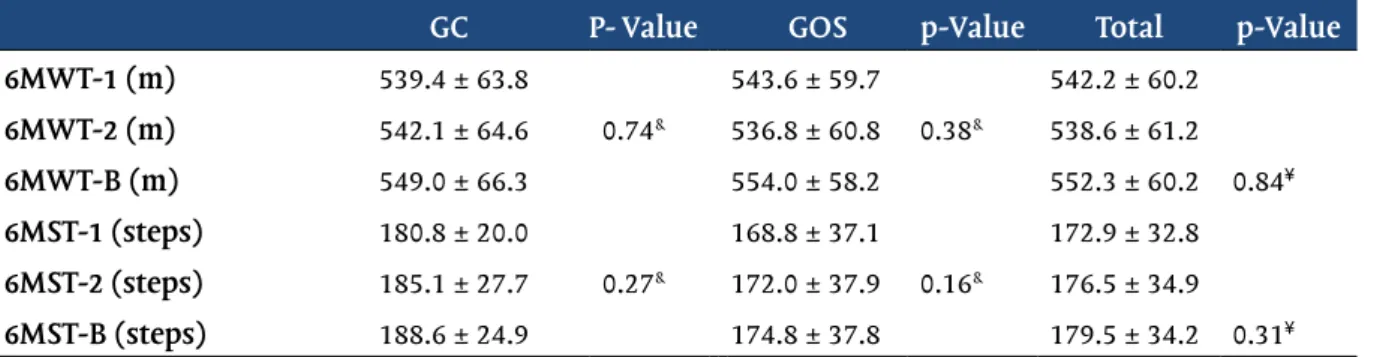
In the groups OWOG and CG, no difference was observed in the test-retest performance of the 6MWT (Table II, CG, p = 0.74; OWOG, p = 0.38) and of the 6MST (Table II, CG, p = 0.27; OWOG, p = 0.16). No difference in the comparison between the OWOG and CG groups regarding the performance of the 6MST (Table II, p = 0.84) or of the 6MWT (Table II, p = 0.31).
Table II - Performance in the 6MWT and 6MST test-retest.
GC P- Value GOS p-Value Total p-Value
6MWT-1 (m) 539.4 ± 63.8 543.6 ± 59.7 542.2 ± 60.2
6MWT-2 (m) 542.1 ± 64.6 0.74& 536.8 ± 60.8 0.38& 538.6 ± 61.2
6MWT-B (m) 549.0 ± 66.3 554.0 ± 58.2 552.3 ± 60.2 0.84¥
6MST-1 (steps) 180.8 ± 20.0 168.8 ± 37.1 172.9 ± 32.8
6MST-2 (steps) 185.1 ± 27.7 0.27& 172.0 ± 37.9 0.16& 176.5 ± 34.9
6MST-B (steps) 188.6 ± 24.9 174.8 ± 37.8 179.5 ± 34.2 0.31¥
CG = control group; OWOG = overweight/obese group; 6MWT-1 = first 6-minute walk test; 6MWT-2 = second 6-minute walk test; 6MWT-B = best 6-minute walk test; 6MWT-1 = first 6-minute walk test; 6MWT-2 = second 6-minute walk test; 6MWT-B = best 6-minute walk test. Values expressed as mean ± standard deviation. p <0.05); &paired t test: Test 1 vs Test 2. ¥ unpaired t test: CG vs OWOG; *p<0.05.
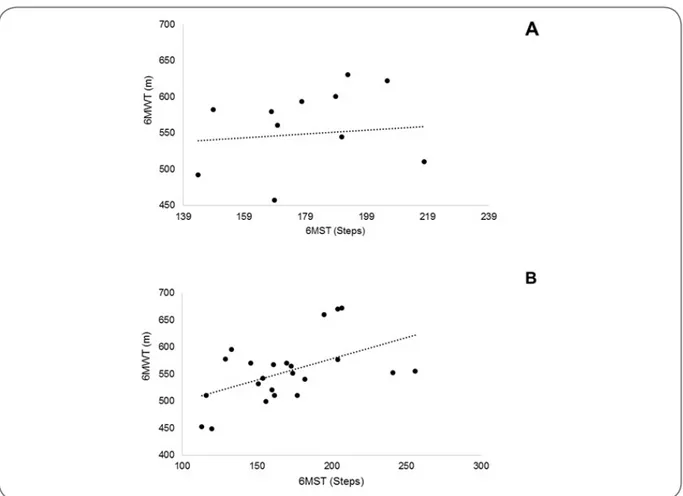
6MWT = 6-minute walk test; 6MST = 6-minute step test
Figure 2 - Pearson’s correlation coefficient for performance between the 6MWT and the TD6M for the
control group (Figure 2A: r= 0.088 p=0.7) and the obese/overweight group (Figure 2B: r= 0.501 p=0.01).
In the construct validation analysis, no correlation was identified between the 6MST or the 6MWT for the CG group (Figure 2A; r = 0.088; p = 0.78). A moderate positive correlation was observed between the 6MST and 6MWT performances in the OWOG group (Figure 2B; r = 0.501; p = 0.01).
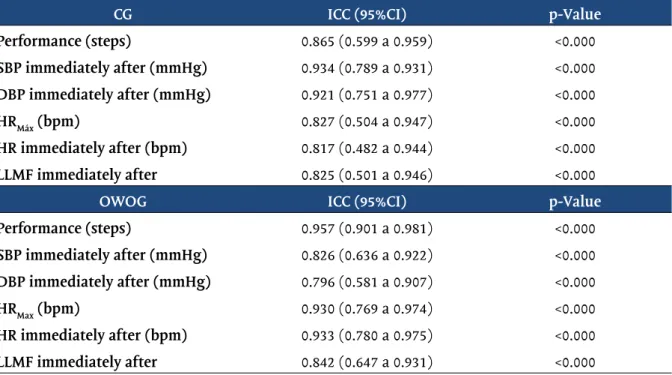
In Table III, the OWOG showed excellent reproducibility regarding perfor-mance on the 6MST (ICC = 0.95; CI = 95%; 0.90-0.98; p<0.000) and the behavior of the following cardiovascular variables: SBP immediately after (ICC = 0.82; CI = 95%; 0.63-0.92; p<0.000), HR immediately after (ICC = 0.93; CI = 95%; 0.78-0.97; p<0.000), HRmax (ICC = 0.93; CI = 95%; 0.76-0.97; p<0.000) and lower limb fatigue (ICC = 0.84; CI = 95%; 0.64-0.93; p < 0.000). DBP immediately afterwards showed very good reproducibility (ICC = 0.79; CI = 95%; 0.58-0.90; p<0.000).
All variables showed excellent reproducibility in the CG: performance on the 6MST (ICC = 0.86; CI = 95%; 0.59-0.95; p < 0.000), SBP immediately after (ICC = 0.93; CI = 95%; 0.78-0.93; p < 0.000), DBP immediately after (ICC = 0.92; CI = 95%; 0.75-0.97; p < 0.000), HRmax (ICC = 0.82; CI = 95%; 0.50-0.94; p<0.000), HR immediately after (ICC = 0.81; CI = 95%; 0.48-0.94; p < 0.000) and lower limb fatigue (CCI = 0.82; CI = 95%; 0.50-0.94; p < 0.000).
Table III - Reliability of the 6-minute step test in the control and overweight/obese groups.
CG ICC (95%CI) p-Value
Performance (steps) 0.865 (0.599 a 0.959) <0.000 SBP immediately after (mmHg) 0.934 (0.789 a 0.931) <0.000 DBP immediately after (mmHg) 0.921 (0.751 a 0.977) <0.000 HRMáx (bpm) 0.827 (0.504 a 0.947) <0.000 HR immediately after (bpm) 0.817 (0.482 a 0.944) <0.000 LLMF immediately after 0.825 (0.501 a 0.946) <0.000
OWOG ICC (95%CI) p-Value
Performance (steps) 0.957 (0.901 a 0.981) <0.000 SBP immediately after (mmHg) 0.826 (0.636 a 0.922) <0.000 DBP immediately after (mmHg) 0.796 (0.581 a 0.907) <0.000 HRMax (bpm) 0.930 (0.769 a 0.974) <0.000 HR immediately after (bpm) 0.933 (0.780 a 0.975) <0.000 LLMF immediately after 0.842 (0.647 a 0.931) <0.000
CG = control group; OWOG = overweight/obese group; ICC = intraclass correlation coefficient; 95%CI = 95% confidence interval.; SBP = systolic blood pressure; DBP = diastolic blood pressure; HRMax = ma-ximum heart rate; HR = heart rate; LLMF = lower limb muscle fatigue.
TD6M1 = performance in the first 6-minute step test; TD6M2 = performance on the second 6-minute step test.
Figure 3 - Bland-Altman graph. Concordance between the test and retest in the 6MST for the control
We observed good agreement on the 6MST test and retest for both the CG (Fi-gure 3A; mean error: -4.33) and for the OWOG (Fi(Fi-gure 3B; mean error: -3.22) through the Bland-Altman method.
In Table IV, the OWOG group demonstrated a moderate correlation between performance on the 6MST and HRmax (r = 0.705; p = 0.00), HR in the sixth minute of the test (r = 0.654; p = 0.00), peak knee extension torque (r = 0.692; p = 0.00), SBP imme-diately after the test (r = 0.617; p = 0.00) and DBP immeimme-diately after the test (r = 0.666; p = 0.00). A weak correlation was also identified between the 6MST performance and peak knee flexion torque (r = 0.417; p = 0.04) and systolic blood pressure recovery (r = 0.441; p = 0.03). The CG did not show a correlation between performance on the 6MST and the other variables.
Table IV - Correlation between the performance and the anthropometric and physiological variables
in the 6MST for control and overweight /obese group.
Performance (Steps) CG Performance (Steps) OWOG Variáveis r p-Value r p-Value
Age (years) 0.368 0.239 0.025 0.910 Sex -0.509 0.091 -0.217 0.320 BMI (kg/m2) -0.004 0.990 -0.124 0.574 HR in 6MST -0.011 0.972 0.654 0.001 HRMax (bpm) 0.036 0.912 0.705 0.000 PText. Knee (N.m) 0.540 0.070 0.692 0.000 PTflex. Knee (N.m) 0.527 0.078 0.417 0.048 SBP immediately after (mmHg) 0.439 0.154 0.617 0.000 SBP recovery (mmHg) 0.026 0.936 0.441 0.035 DBP immediately after (mmHg) -0.039 0.904 0.666 0.001 DBP recovery (mmHg) -0.253 0.427 0.321 0.135 LLMF immediately after -0.301 0.342 0.336 0.117 LLMF recovery -0.417 0.177 0.368 0.084
6MST: six-minute step test; BMI: body mass index; CG: control group; DBP: diastolic blood pressure; HR: heart rate; HRMax: maximum heart rate; LLMF: lower limb muscle fatigue; OWOG: overweight/ obese group; PText. Joelho: peak knee extension torque; PTflex. Joelho: the peak knee flexion torque; SBP: systolic blood pressure.
6MST = 6-minute step test.
Figure 4 - Linear regression between the peak knee extension torque and the performance on the 6MST
[F(1,21) = 19.278, p<0.001; R2 = 0.479].
Simple linear regression showed that the peak knee extension torque predicts
the number of steps climbed on the 6MST [F(1,21) = 19.278, p<0.001; R2 = 0.479] (Figure
4). The prediction equation is: performance on the 6MST [(number of steps comple-ted on the step) = 85.847 + 0.482 x (peak knee extension torque)].
Discussion
The 6MST proved to be valid and reproducible in the overweight and obese group. In addition, linear regression found that peak knee extension torque predicts performance on the six-minute step test in obese and overweight individuals.
No differences were identified regarding performance on the 6MWT and 6MST in either of the groups comparing the test and the retest, indicating that there was no learning effect. It is necessary to apply two tests when the learning effect is present; the first is for familiarization and the second to provide a clinically reliable result [13]. The American Thoracic Society (ATS) [13] suggests that the test should be carried out with verbal incentives to the patient, implying better results. Encou-raging words were standardized in performing the tests in the present study, which may have minimized the learning effect. Our results corroborate data from the stu-dies by Arcuri et al. [8], Davi et al. [16], Costa et al. [17], and Magalhães et al. [18], who also did not identify a learning effect in applying the 6MST.
The 6MST is a submaximal test which is easy to apply and capable of evalua-ting FEC in other populations [8-10,18]. Although the 6MWT also has submaximal in-tensity, the 6MST causes greater cardiovascular stress compared to the 6MWT, as wa-lking is a common daily activity which requires less oxygen consumption and effort. On the other hand, the 6MST requires greater body displacement against gravity, increasing the exercise difficulty. Submaximal stress tests are used in clinical practice and enable limitations related to maximum intensity tests to be overcome.
Submaxi-mal tests are also able to predict VO2max for one or more work rates by heart rate (HR)
response [19]. The high cost and complexity of performing Cardiopulmonary Exercise Testing (CPET) make it difficult to use in the clinical and academic environment [20].
The 6MST proved to be valid for assessing FEC in overweight and obese indivi-duals in the present study. We used the 6MWT as a parameter to assess the construct validity of the 6MST. The 6MWT is a test which has already been validated for obese individuals and has good correlation with the CPET [14,21]. Other studies have used the 6MWT to validate the construct in other populations [8-10,18]. Obese individuals generally have cardiovascular comorbidities, thus restricting their performance in CPET, as it is a maximum effort test which uses an external cadence imposing a rhy-thm on the individual. The 6MST validation for obese subjects is a submaximal free cadence test and therefore presents a safer option, as the individual can determine their own pace within their physiological limitations. The 6MST is a simple test and can be performed in any environment, as it only uses one step for its execution [22]. It is also easy to control and monitor the patient, proving to be highly effective to evaluate the FEC in this population.
Individuals in the overweight and obese group showed excellent reprodu-cibility regarding performance and most cardiovascular variables. Other studies evaluating the reproducibility of the 6MST have been carried out involving other populations: healthy individuals [8,16], patients with chronic obstructive pulmonary disease (COPD) [9,17], patients with COPD undergoing outpatient pulmonary reha-bilitation [10], and patients with obstructive sleep apnea treated with continuous positive pressure in the pathways (CPAP) [18]. The reproducibility of the 6MST in all these studies proved to be excellent or very good for performance and for physiolo-gical variables. Reliability in the present study was further enhanced by the Blan-d-Altman method, showing good agreement between the tests for the control and overweight and obese groups.
Simple linear regression analysis in the present study showed that peak knee extension torque predicts performance on the 6MST. An increase in body fat is asso-ciated with functional restrictions on muscle performance due to impaired mobility and muscle strength [21]. Obesity may also be related to sarcopenia, which not only refers to a reduction of fat-free mass, but also to a loss of muscle strength and func-tion. As a result, there is a decline in functional capacity and difficulties related to walking or the ability to ascend stairs. The decrease in muscle strength in the obese can be attributed to reduced mobility, neural adaptations and changes in muscle morphology [23].
Our study has some limitations. A larger number of participants would have enabled using multiple regression analysis and more predictor variables. In addition, CPET is the gold standard method for determining FEC, but was not used to validate the 6MST. However, this would characterize another type of validation, namely the validation of concurrent criteria. Thus, construct validation was chosen using the 6MWT as reference because it is a test which has good correlation with CPET.
Conclusion
The 6MST proved to be valid, reliable and highly reproducible for assessing functional exercise capacity in overweight and obese individuals. It was also iden-tified that lower limb muscle strength can predict performance on the 6MST in this population.
In addition, the 6MST is a submaximal test, which makes it more viable since weight gain is often associated with cardiovascular comorbidities, which can also limit maximum effort performance. The 6MST is also easy to apply, portable and has a low cost to determine FEC in overweight and obese individuals, thus facilitating its use on a large scale in clinical practice in both public and private healthcare services.
Potential conflict of interest
No conflicts of interest with potential potential for this article have been reported.
Financing source
There were no external sources of funding for this study.
Academic affiliation
This article is part of the thesis of master submitted by Thúlio Nilson do Nascimento Pereira, super-vised by Professor Doctor Anísio Francisco Soares and co-supersuper-vised by Professor Dr. Anna Myrna Jaguaribe de Lima at the Federal Rural University of Pernambuco in Recife-PE.
Authors’ contributions
Study conception and design: Pereira TNN, Lima AMJ. Acquisition of data: Pereira TNN, Monte JCA,
Araújo LAS. Analysis and interpretation of data: Pereira TNN, Lima AMJ. Statistical analysis: Pereira TNN. Obtaining funding for the study: Soares AF. Drafting of manuscript: Pereira TNN, Lima AMJ.
Critical revision of the manuscript for important intellectual content: Vasconcelos CR, Soares AF.
References
1. Sonehara E, Cruz MDSL, Fernandes PR, Policarpo F, Fernandes Filho J. Efeitos de um programa de reabilitação pulmonar sobre mecânica respiratória e qualidade de vida de mulheres obesas. Fisioter Mov 2017;24(1):13-21. https://doi.org/10.1590/s0103-51502011000100002
2. Tanner CJ, Barakat HA, Dohm GL, Pories WJ, MacDonald KG, Cunningham PR et al. Muscle fiber type is associated with obesity and weight loss. Am J Physiol-Endoc M 2002;282(6):E1191-E1196. ht-tps://doi.org/10.1152/ajpendo.00416.2001
3. Stegen S, Derave W, Calders P, Van Laethem C, Pattyn P. Physical fitness in morbidly obese pa-tients: effect of gastric bypass surgery and exercise training. Obes Surg 2011;21(1):61-70. https://doi. org/10.1007/s11695-009-0045-y
4. Andolfi C, Fisichella PM. Epidemiology of obesity and associated comorbidities. J Laparoendosc Adv Surg Tech A 2018;28(8):919-24. https://doi.org/10.1089/lap.2018.0380
5. Kim J, Kim MG, Kang S, Kim, BR, Baek MY, Park Y et al. Obesity and hypertension in association with diastolic dysfunction could reduce exercise capacity. Korean Circ J 2016;46(3):394-401. https:// doi.org/10.4070/kcj.2016.46.3.394
6. Tomlinson DJ, Erskine RM, Morse CI, Winwood K, Onambélé-Pearson G. The impact of obesity on skeletal muscle strength and structure through adolescence to old age. Biogerontology 2016;17(3):467-83. https://doi.org/10.1007/s10522-015-9626-4
7. Ross R, Blair SN, Arena R, Church, TS, Després JP, Franklin BA et al. Importance of assessing cardio-respiratory fitness in clinical practice: a case for fitness as a clinical vital sign: a scientific statement from the American Heart Association. Circulation 2016;134(24):e653-e699. https://doi.org/10.1161/ cir.0000000000000461
8. Arcuri, JF, Borghi-Silva A, Labadessa IG, Sentanin AC, Candolo C, Di Lorenzo VAP. Validity and reliability of the 6-minute step test in healthy individuals: a cross-sectional study. Clin J Sport Med 2016;26(1):69-75. https://doi.org/10.1097/jsm.0000000000000190
9. Pessoa BV, Arcuri JF, Labadessa IG, Costa JN, Sentanin AC, Di Lorenzo VAP. Validade do teste de de-grau de seis minutos de cadência livre em pacientes com doença pulmonar obstrutiva crônica. Braz J Phys Ther 2014;18(3):228-36. https://doi.org/10.1590/bjpt-rbf.2014.0041
10. Grosbois JM, Riquier C, Chehere B, Coquart J, Béhal H, Bart F, Chenivesse C. Six-minute stepper test: a valid clinical exercise tolerance test for COPD patients. Int J Chronic Obstr 2016;11:657. https://doi. org/10.2147/copd.s98635
11. Matsudo S, Araújo T, Matsudo V, Andrade D, Andrade E, Oliveira LC et al. Questionário internacio-nal de atividade física (IPAQ): estudo de validade e reprodutibilidade no Brasil. Rev Bras de Ativ Fís Saúde 2001;6(2):5-18. https://doi.org/10.12820/rbafs.v.6n2p5-18
12. Borg GA. Psychophysical bases of perceived exertion. J Med Sci Sports Exerc 1982;14:377-381. ht-tps://doi.org/10.1249/00005768-198205000-00012
Care 2002;166:111-17. https://doi.org/10.1164/ajrccm.166.1.at1102
14. Polit DF. Assessing measurement in health: Beyond reliability and validity. Int J Nurs Stud 2015;52(11):1746-53. https://doi.org/10.1016/j.ijnurstu.2015.07.002
15. Weir JP. Quantifying test-retest reliability using the intraclass correlation coefficient and the SEM. J Strength Cond Res 2005;19(1):231-240. https://doi.org/10.1519/15184.1
16. Davi SF, Arcuri, JF, Labadessa IG, Pessoa BV, Costa JNFD, Sentanin AC, Lorenzo VAPD. Reproduti-bilidade do teste de caminhada e do degrau de 6 minutos em adultos jovens saudáveis. Rev Bras Med Esporte 2014;20(3):214-8. https://doi.org/10.1590/1517-86922014200301714
17. Costa JN, Arcuri JF, Gonçalves IL, Davi SF, Pessoa BV, Jamami M et al. Reproducibility of cadence--free 6-minute step test in subjects with COPD. Respir Care 2014;59(4):538-42. https://doi.org/10.4187/ respcare.02743
18. Magalhães MGS, Teixeira JP, Santos AMB, Clímaco DCS, Silva TNS, Lima AMJD. Construct validity and reproducibility of the six-minute step test in subjects with obstructive sleep apnea treated with conti-nuous positive airway pressure. J Braz Pneumol 2020;46(3):e20180422. https://doi.org/10.36416/1806-3756/e20180422.
19. Travensolo, CDF, Goessler KF, Polito MD. Correlação entre o teste de caminhada de seis minu-tos e o teste de degrau em idosos. Rev Bras Geri Gero 2013;16(2):375-83. https://doi.org/10.1590/ s180998232013000 200017
20. Stickland MK, Butcher SJ, Marciniuk DD, Bhutani M. Assessing exercise limitation using cardiopul-monary exercise testing. Pulm Med 2012;824091. https://doi.org/10.1155/2012/824091
21. Perecin JC, Domingos-Benício NC, Gastaldi AC, Sousa TC, Cravo SD, Sologuren MJ. Teste de cami-nhada de seis minutos em adultos eutróficos e obesos. Braz J Phys Ther 2003;7(3):245-25.
22. Bennett H, Parfitt G, Davison K, Eston R. Validity of Submaximal Step Tests to Estimate Maximal Oxygen Uptake in Healthy Adults. Sports Med 2016;46(5):737-50. https://doi.org/10.1007/s40279-015-0445-1
23. Goodpaster BH, Chomentowski P, Ward BK, Rossi A, Glynn NW, Delmonico MJ et al. Effects of phy-sical activity on strength and skeletal muscle fat infiltration in older adults: a randomized controlled trial. J Appl Physiol 2008;105(5):1498-1503. https://doi.org/10.1152/japplphysiol.90425.2008


![Figure 4 - Linear regression between the peak knee extension torque and the performance on the 6MST [F(1,21) = 19.278, p<0.001; R 2 = 0.479].](https://thumb-eu.123doks.com/thumbv2/123dok_br/19227369.965567/9.892.106.791.106.448/figure-linear-regression-peak-knee-extension-torque-performance.webp)
