of tempeh during processing and refrigeration
Márcia Pires Ferreira(1), Maria Cristina Neves de Oliveira(2), José Marcos Gontijo Mandarino(2),
Josemeyre Bonifácio da Silva(1), Elza Iouko Ida(1) and Mercedes Concórdia Carrão‑Panizzi(3)
(1)Universidade Estadual de Londrina, Departamento de Ciência e Tecnologia de Alimentos, Campus Universitário, Caixa Postal 6.001, CEP 86051‑990 Londrina, PR, Brazil. E‑mail: [email protected], [email protected], [email protected] (2)Embrapa Soja, Rodovia Carlos João Strass, Acesso Orlando Amaral, Distrito Warta, Caixa Postal 231, CEP 86001‑970 Londrina, PR, Brazil. E‑mail: [email protected], [email protected] (3)Embrapa Trigo, Rodovia BR‑285, Km 294, Caixa Postal 451, CEP 99001‑970 Passo Fundo, RS, Brazil. E‑mail: [email protected]
Abstract – The objective of this work was to analyze changes in the isoflavone profile, determined by high performance liquid chromatography, at different processing stages and after refrigeration of tempeh. For tempeh production, clean soybean grains from cultivars BR 36 (low isoflavone content) and IAS 5 (high) were dehulled, and the separated cotyledons were hydrated and then cooked in boiling water for 30 min. Spores of the fungus Rhizopus microsporus var.oligosporus were inoculated in the cooked and cooled cotyledons, and incubated at 32ºC for 6, 12, 18, and 24 hours in perforated polypropylene bags, for fermentation. The resulting tempeh was stored at 4ºC for 6, 12, 18, and 24 hours. After 24‑hour fermentation, isoflavone glucosides were 50% reduced, and the aglycone forms in the tempeh from both cultivars was increased. The malonyl forms reduced 83% after cooking. Less than 24 hours of refrigeration did not affect the isoflavone profile of tempeh from either cultivar, which is a good indicator of its quality. The tempeh maintains the high and low isoflavone content of the cultivars, which indicates that cultivar differences in this trait should be considered when processing tempeh.
Index terms: Rhizopusmicrosporus var. oligosporus, aglycone, fermentation, functional food, high performance liquid chromatography, malonyl.
Mudanças no perfil de isoflavonas e na composição química de 'tempeh'
durante o processamento e a refrigeração
Resumo – O objetivo deste trabalho foi analisar mudanças no perfil de isoflavonas, determinado por meio de cromatografia líquida de alta eficiência, em diferentes estágios do processamento e após refrigeração de 'tempeh'. Para a produção do 'tempeh', grãos de soja limpos das cultivares BR 36 (baixo teor de isoflavonas) e IAS 5 (alto teor) foram descascados, e os cotilédones foram hidratados e, em seguida, cozidos por 30 min em água fervente. Em seguida, esporos do fungo Rhizopusmicrosporus var. oligosporus foram inoculados nos
cotilédones cozidos e resfriados, e incubados a 32ºC por 6, 12, 18 e 24 horas em sacos perfurados de polipropileno, para fermentação. O 'tempeh' resultante foi refrigerado por 6, 12, 18 e 24 horas. Após 24 horas de fermentação, os teores de glicosídeos de isoflavonas reduziram‑se em 50%, e os das formas agliconas aumentaram, em ambas as cultivares. Após o cozimento, as formas malonil reduziram‑se em 83%. A refrigeração por menos de 24 horas não afetou o perfil de isoflavonas no 'tempeh' das duas cultivares, o que é um bom indicador de sua qualidade. O 'tempeh' mantém os altos e baixos conteúdos de isoflavonas das cultivares, o que indica que as diferenças entre cultivares, para esta característica, devem ser consideradas durante o processamento de 'tempeh'.
Termos para indexação: Rhizopusmicrosporus var. oligosporus, aglicona, fermentação, alimento funcional,
cromatografia líquida de alta eficiência, malonil.
Introduction
The chemical composition of soybean cultivars varies depending on genetics and environmental conditions (Liu, 1997), but the average composition is generally 40% proteins, 21% lipids and 34% carbohydrates. Silva et al. (2009) worked with grain‑type and food‑type soybean cultivars, which ranged from 40.1 to 44.5% of protein, from 18.1 to 20% of lipids and from 30.6 to
Isoflavones are very important biologically active substances contained in soybeans. They are diphenolic compounds with antioxidant and antifungal activity (Liggins et al., 2000; Brouns, 2002), and recognized for their benefits to human health, reducing menopause symptoms and lowering the risk of chronic diseases, such as cardiovascular ones, osteoporosis, and breast, prostate and colon cancer (Setchell et al., 2001; Kris‑Etherton et al., 2002; Jefferson, 2003; Delmonte et al., 2006). Among the different forms of isoflavones, aglycones are especially important because they are readily bioavailable to humans.
To be converted into aglycone forms – daidzein, genistein and glycitein – the isoflavone glycosides require an initial hydrolysis by ß‑glycosidase enzymes produced by intestinal microflora of the human body (Liggins et al., 1998; Setchell et al., 2001). Fermentation is a processing technique in which the hydrolysis of glycosides can occur, as a result of microbial activities, forming aglycones (Nakajima et al., 2005; Haron et al., 2009).
Tempeh is a traditional fermented soybean food product from Indonesia. It is normally consumed fried, boiled, steamed or roasted. Processing soybeans into tempeh by fermenting with the fungus Rhizopus microsporus var. oligosporus (Saito) (Schipper &
Stalpers, 1984) improves the texture, flavor and aroma of the product. Tempeh has a soft texture due to breaking down, by the fungus, of the intercellular matrix between plant cells. A mild mushroom‑like aroma is evident in tempeh as a result of the action of the fungal mycelium on protein and lipids of the soybeans (Hermana & Karyadi, 2001). The fermentation process improves the nutritional value of tempeh by increasing the availability of isoflavone aglycones. These aglycones exist in smaller amounts in other nonfermented soy products such as tofu and soymilk (Wang & Murphy, 1994; Astuti & Dalais, 2000).
Carrão‑Panizzi et al. (1998) studied the influence of the environment on the growth of Brazilian soybean cultivars and concluded that differences in the isoflavone content, in different sowing locations, allows the selection of locations for the production of soybean with low or high isoflavone contents.
The objective of this work was to analyze changes in
the isoflavone profile, determined by high performance liquid chromatography, at different processing stages and after refrigeration of tempeh.
Materials and Methods
The soybean cultivars BR 36 and IAS 5 have low (53.7 mg per 100 g) and high (136.4 mg per 100 g) isoflavone contents, respectively (Carrão‑Panizzi et al., 1998). Grains of these cultivars were supplied by Embrapa Soja, located in Londrina, PR, Brazil. The chemical composition and the isoflavone profile analyses were performed on dehulled soybean grains (cotyledons) and on fresh tempeh from both cultivars.
The tempeh was prepared according to traditional methods (Wei, 1991). Clean soybean grains were dehulled, and the separated cotyledons were cooked in boiling water for 10 min. After that, the water was drained and the cotyledons were soaked in tap water for 17 hours at room temperature. The water was discarded, and the hydrated cotyledons were cooked in boiling water for 30 min. After cooking, the water was drained, and the cooked cotyledons were cooled at room temperature. Then, spores of the fungus Rhizopus microsporus var. oligosporus were inoculated in the
cooked and cooled cotyledons, which were packed in perforated polypropylene bags and incubated at 32ºC for 24 hours. The resulting tempeh was stored at 4°C for 24 hours.
Freeze‑dried Rhizopus microsporus var. oligosporus
inoculum was acquired from Intsoy (International Soybean Program, University of Illinois, USA). To multiply spores of R. microsporus, the inoculum was
suspended in a saline solution (0.85%), inoculated in Petri dishes containing potato dextrose agar (BDA), and incubated at 32°C for 48 hours. The resulting spores were inoculated in Petri dishes containing 60 g of raw ground rice, previously autoclaved for 15 min at 121°C, and 40 mL of distilled water, and incubated at 32°C for 72 hours. After the development of spores, the Petri dishes were opened and dried in a ventilated oven (50°C for 24 hours). After drying, the contents of the Petri dishes were ground in a DCG‑20 grinder (Cuisinart Coffee Grinder, East Windsor, NJ, USA) and stored in glass bottles.
The moisture, protein, lipid, ash and carbohydrate contents were determined as described by Normas Analíticas do Instituto Adolfo Lutz (2008), with three replicates, and the results were expressed in percentage of dry basis.
stages: after the 10‑min cooking, in the hydration phase; after the 30‑min cooking; after 6, 12, 18, and 24 hours of fermentation; and after 6, 12, 18, and 24 hours
of refrigeration.
A high performance liquid chromatography system (HPLC) model 2690 (Waters, Milford, MA, USA) was used to analyze the isoflavones (Kitamura et al., 1991; Kudou et al., 1991). The separation was carried out in an ODS C18 reverse column – YMC‑Pack ODS‑AM, S‑5 mm, 120 A, 250 mm long x 4.6 mm diameter (YMC America Inc., Allentown, PA, USA) –, and a photodiode array detector model 996 (Waters, Milford, MA, USA) was used to detect the isoflavones at a wavelength of 260 nm.
In order to extract the isoflavones, 100 mg of ground samples were transferred to test tubes with lids. Four milliliters of 70% ethanol containing 0.1% of acetic acid were added to each test tube. The tubes were agitated every 15 min during the 4‑hour extraction period. In an Eppendorf microcentrifuge, model 5417 R (Eppendorf, Hamburg, Germany), 1.5 mL of the obtained extract was centrifuged for 10 min at
20,000 g. Then, 80 µL of the supernatant was pipetted
into the tubes of the chromatograph’s automatic injector. These tubes were covered and sealed. For separation and quantification of the isoflavones, 10 µL aliquots were injected (with automatic injectors) into the chromatograph.
The separation was carried out in the before mentioned ODS C18 type reverse column, and the also mentioned photodiode array detector was used to detect the isoflavones at a 260 nm wavelength. A linear gradient system was used for separation. The mobile phase consisted of 0.1% acetic acid and acetonitrile. Initially, the system had 20% acetonitrile and 80% acetic solution. At the end of the first 20 min, the mobile phase composition in the system was 50% of acetonitrile and 50% of acetic acid, reaching 100% of acetonitrile shortly thereafter. This concentration was maintained for 5 min and reduced to the initial concentration (20% acetonitrile and 80% acetic acid) for the final 15 min. This completed the 40 min required for the separation of the isoflavones. The mobile phase flow was 1.0 mL per minute.
The standard solutions were a mixture of daidzin, genistin, daidzein and genistein prepared with a solution of 70% ethanol containing 0.1% acetic acid at different concentrations: 0.00625, 0.0125, 0.0250, 0.0500, and 0.1000 mg mL-1, for each component of
the mixture. The isoflavones were separated, quantified according to standard references, and expressed in mg per 100 g for each component, on a dry basis. The concentrations of malonyl‑glycosides and aglycones were calculated from the standard curves of their corresponding β‑glycosides, using the similarity of the molar extinction coefficients of malonyl‑isoflavones and their β‑glycosides (Coward et al., 1998). The values for isoflavones can be presented in aglycone equivalents (Góes‑Favoni et al., 2010) or as the sum of the different forms (Yue et al., 2010). In the present work, data are shown as the sum of each compound within each group of isoflavones (glycosides, malonyls and aglycones).
A randomized complete block experimental design was used with factorial arrangement between soybean cultivars (BR 36 and IAS 5) and processing treatments (cotyledons and tempeh), with seven replicates. The data were subjected to the analysis of variance (ANOVA). Following the evaluation, the assumptions of ANOVA were verified and the means compared by Tukey’s test, at 5% probability, using the SAS scientific package (SAS Institute, 2002).
Results and Discussion
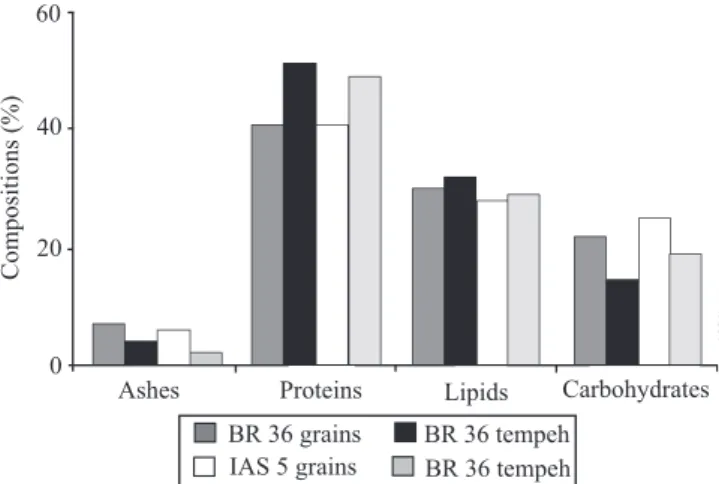
Soybean moisture content for both cultivars was 10.23% on average (Figure 1). In tempeh produced
Figure 1. Approximate chemical composition, on dry matter
from both cultivars, the moisture content was 64.61% on average. Both cultivars had 5% average ash content. In tempeh, however, a 50% decrease in ash content was observed due to the processing procedures. Tempeh had 21% higher protein content than the cotyledons. The soaking and cooking during the tempeh processing resulted in the loss of soluble substances, such as sugars and minerals, which may explain the higher protein and the lower ash contents.
Grains from cultivar BR 36 have high (39%) protein content (Mandarino et al., 1992). Tempeh maintained this characteristic and showed an even higher protein content in both products: cotyledons and tempeh. Lipid content was approximately the same for cotyledons of 'BR 36' and 'IAS 5' (29.18% average), while a small increase was observed in tempeh. The carbohydrate content in cotyledons ranged from 21.29% for 'BR 36' to 25.13% for 'IAS 5'. Carbohydrate content decreased 15.21% and 19.53%, respectively, for tempeh made from 'BR 36' and 'IAS 5'. This result was due to the solubilization of sugars during the tempeh processing. Vaidehi et al. (1985) found similar results for the chemical composition of soy tempeh in combination with other oilseeds.
The chemical composition of tempeh in this study was higher than that reported by Haron et al. (2009), who observed, for raw tempeh, 65% average moisture, 17.5% protein, 9.2% lipid, 7.6% carbohydrate and 0.6% ash. The USDA database (United States Department of Agriculture, 2010) reports 59.6% moisture, 18.5% protein, 10.8% lipid, 9.4% carbohydrate and 1.6% ash. Differences observed in the present study may be due to the different methods of analysis or to the expression of experimental data on a dry basis, which concentrates the components.
The total isoflavone content in the cotyledons of 'BR 36' and 'IAS 5' were, on average, 87.17 and 281.85 mg per 100 g, respectively (Table 1). 'BR 36' is a genetically low‑isoflavone content genotype, which was also observed in other studies (Carrão‑Panizzi et al., 1998). Isoflavone content in different soybean cultivars is affected by genetics, crop year and growth location (Wang & Murphy, 1994; Carrão‑Panizzi et al., 2009). The total glycoside forms (daidzin and genistin) in soybean cotyledons decreased in processed tempeh for both cultivars. Malonyl forms, which react unsteadily to heat treatments, were greatly reduced during the preparation of tempeh as a result of cooking.
Carrão‑Panizzi et al. (2004) showed that malonyl compounds were reduced at higher temperatures and in the processing of functional soybean foods. These authors also reported that hydrothermal treatments of soybean grains and high‑isoflavone content soybean cultivars can enhance the development of aglycone forms. The aglycone forms (daidzein and genistein) were found in very small amounts in cotyledons of 'IAS 5', and they were not even detected in 'BR 36'. In general, the aglycone forms are not present
Table 1. Total glycoside, malonyl and aglycone isoflavones
(mg per 100 g dry basis) during different steps of tempeh
processing(1).
Processing stage 'BR 36' 'IAS 5' Means
Glycoside isoflavones
Cotyledons 13.61±0.24 45.79±3.17 29.70±7.33AB
10 min cooking 13.87±0.69 54.03±4.16 33.95±9.17A
Soaking 8.34±0.45 44.23±7.41 26.28±8.68AB
30 min cooking 11.68±0.09 53.05±5.42 32.36±9.56A
6 hour fermentation 9.54±0.29 40.20±3.16 24.87±7.00AB
12 hour fermentation 7.20±0.32 30.21±5.99 18.71±5.80B
18 hour fermentation 4.65±0.15 12.93±0.57 8.79±1.87B
24 hour fermentation 3.65±0.29 14.79±1.50 9.22±2.58B
6 hour refrigeration 6.51±0.29 16.36±0.69 11.43±2.23A
12 hour refrigeration 7.33±0.26 18.5±0.80 12.93±2.53A
18 hour refrigeration 7.85±0.63 16.40±0.22 12.12±1.93A
24 hour refrigeration 7.42±0.36 17.43±0.83 12.43±2.27A
Malonyl isoflavones
Cotyledons 73.55±2.41bA 229.21±14.85aA 151.38±A
10 min cooking 53.92±1.22bB 162.37±9.08aB 108.14±B
Soaking 41.06±0.95bB 115.24±8.62aC 78.15±17.03C
30 min cooking 12.46±0.71 37.03±1.61 24.74±5.55AB
6 hour fermentation 9.81±0.10 30.06±1.87 19.94±4.60AB
12 hour fermentation 9.98±0.10 34.28±3.46 22.13±5.65AB
18 hour fermentation 10.51±0.18 33.96±1.87 22.23±5.31AB
24 hour fermentation 10.07±0.20 37.70±1.65 23.88±6.22AB
6 hour refrigeration 11.74±0.61 37.87±2.47 24.01±5.95AB
12 hour refrigeration 10.78±0.92 39.80±2.53 25.29±6.60A
18 hour refrigeration 12.25±0.58 37.26±1.93 24.75±5.66AB
24 hour refrigeration 11.78±0.13 38.45±0.73 25.11±5.97A
Aglycone isoflavones
Cotyledons 0.0±0.0 6.83±0.51 3.41±1.54B
10 min cooking 2.28±0.11 8.84±0.28 5.56±1.47A
Soaking 3.57±0.21bB 12.27±1.38aC 7.92±2.04C
30 min cooking 2.46±0.16 8.87±0.19 5.67±1.43A
6 hour fermentation 3.76±5.1 12.43±0.80aB 8.10±2.38A
12 hour fermentation 5.19±0.05bAB 24.19±3.61B 14.69±4.55B
18 hour fermentation 9.29±1.29bAB 30.75±1.89aAB 20.02±4.90AB
24 hour fermentation 11.52±0.81bAB 34.78±1.97AA 23.15±5.29A
6 hour refrigeration 12.71±0.55bA 35.35±2.38aA 24.03±5.18A
12 hour refrigeration 11.98±1.39BA 36.32±2.28aA 24.15±5.63A
18 hour refrigeration 13.16±0.38bA 36.77±2.90aA 24.96±5.44A
24 hour refrigeration 12.70±0.34bA 35.44±1.48aA 24.07±5.13A
(1)Means followed by equal letters, uppercase in the columns, and lowercase
in soybeans which were not exposed to hydrolysis or to fermentation. These processes are necessary to activate the ß‑glycosidase enzyme that hydrolyzes the glycosides to form the aglycones. In tempeh, the aglycone content increased from 0 to 11.52 mg per 100 g for 'BR 36', and from 6.83 to 34.78 mg per 100 g for 'IAS 5', as a result of the 24‑hour fermentation
process.
Aglycones are important compounds due to their
bioavailability, which is greater than that of other
isoflavone forms. Therefore, fermented tempeh can be a functional food with health benefits for humans. Nakajima et al. (2005) also reported that the amount of aglycones increased with fermentation time, and it effectively doubled after 24‑hour fermentation. Haron et al. (2009) reported higher values of aglycone forms in raw tempeh.
Isoflavone glucosides did not change markedly during the first stages of tempeh processing. Even after a 6‑hour fermentation, only a small reduction of these compounds was observed. Fermentation time, however, had a significant effect on these compounds, and, in the 12‑hour fermentation, there was a glucoside reduction of about 25%, which continued to decrease (50%) in the late stages of fermentation (18 and 24 hours). While refrigerated, the content of glucosides remained constant, and was not affected by different storage times.
Malonyl forms, which are heat labile, decreased continuously during each step of the tempeh processing, mainly due to cooking. Total malonyl in cotyledons of 'BR 36' were 73.55 mg per 100 g, and for 'IAS 5' 229.21 mg per 100 g. After 10‑min cooking, the malonyl forms in 'BR 36' were reduced by 73%, and in 'IAS 5' by 70%. An average reduction of 72% was observed after soaking. After 30 min of cooking, malonyl forms had decreased by 83% relatively to the amount in cotyledons. During the fermentation process, malonyl forms did not change and remained stable during refrigeration. Tempeh contains substantially reduced levels of malonyl isoflavones, in contrast to soybeans, of which malonyl is the main isoflavone compound (Kudou et al., 1991).
The aglycone forms, however, strongly changed as a result of the hydrolysis of the isoflavone glucoside by ß‑glycosidase enzyme during the fermentation process (Nakajima et al., 2005; Carrão‑Panizzi et al., 1999).
No aglycone was observed in the cotyledons of the BR 36 cultivar. In cultivar IAS 5, which has a high content of total isoflavones, a small amount of aglycone compounds was observed (6.83 mg per 100 g), which is normally the case in freshly harvested soybeans. To form aglycones, soybeans must be exposed to certain levels of moisture or fermentation, in order to activate the β‑glycosidase enzyme (Matsuura & Obata, 1993; Carrão‑Panizzi & Bordingnon, 2000; Carrão‑Panizzi et al., 2004).
During the cooking processes, no significant changes were observed in the level of aglycones. However, changes occurred during fermentation, confirming that special conditions are needed to form aglycones. The amount of aglycones increased significantly with fermentation time. During the first stage of fermentation (6 hours), aglycone content increased by 58% in comparison to cotyledons, and after 24‑hour fermentation, both cultivars contained more aglycones in tempeh than in cotyledons. Other authors also observed that aglycone increased with fermentation time, and that after 24‑hour fermentation, the amount of isoflavone aglycone doubles (Nakajima et al., 2005; Haron et al., 2009). Silva et al. (2011) reported that the autoclaved whole soybean flour fermented with
Aspergillus oryzae contained 36.25% of aglycones
in comparison to the autoclaved whole soybean flour (6.94%), after 24 hours. The amount of aglycones in tempeh of either cultivar did not change while refrigerated. Results indicate that tempeh refrigerated for 24 hours maintains its isoflavone composition, which is a good characteristic for tempeh.
concentration of aglycones in tempeh is high. However, this amount could be even higher if soybean cultivars with high isoflavone levels, like IAS 5, were used as raw material.
Conclusions
1. Tempeh prepared with soybean cultivars with high‑isoflavone content can be considered a functional food with positive effects on human health.
2. The fermentation process changes the isoflavone profile increasing the amount of aglycone forms.
3. Malonyl forms decrease continuously during tempeh processing, mainly due to cooking.
Acknowledgements
To Embrapa Soja, for providing the soybean cultivars.
References
ASTUTI, M.; DALAIS, F.S. Tempeh, a nutritious and health food from Indonesia. Asia Pacific Journal of Clinical Nutrition, v.9, p.322‑325, 2000.
BROUNS, F. Soya isoflavones: a new and promising ingredient for the health foods sector. Food Research International, v.35, p.187‑193, 2002.
CARRÃO‑PANIZZI, M.C.; BELÉIA, A. Del P.; KITAMURA, K.; OLIVEIRA, M.C.N. Effects of genetics and environment on isoflavone content of soybean from different regions of Brazil. Pesquisa Agropecuária Brasileira, v.34, p.1787‑1795, 1999. CARRÃO‑PANIZZI, M.C.; BERHOW, M.; MANDARINO, J.M.G.; OLIVEIRA, M.C.N. de. Environmental and genetic variation of isoflavone content of soybean seeds grown in Brazil. Pesquisa Agropecuária Brasileira, v.44, p.1444‑1451, 2009. CARRÃO‑PANIZZI, M.C.; BORDINGNON, J.R. Activity of beta‑glucosidase and levels of isoflavone glucosides in soybean cultivars affected by environment. Pesquisa Agropecuária Brasileira, v.35, p.873‑878, 2000.
CARRÃO‑PANIZZI, M.C.; GOÉS‑FAVONI, S.P. de; KIKUCHI, A. Hydrothermal treatments in the development of isoflavone aglycones in soybean (Glycine max (L.) Merrill) grains. Brazilian Archives of Biology and Technology, v.47, p.225‑232, 2004. CARRÃO‑PANIZZI, M.C.; KITAMURA, K.; BELÉIA, A.D.P.; OLIVEIRA, M.C.N. Influence of growth locations on isoflavone contents in Brazilian soybean cultivars. Breeding Science, v.48, p.409‑413, 1998.
COWARD, L.; SMITH, M.; KIRK, M.; BARNES, S. Chemical modification of isoflavones in soyfoods during cooking and processing. American Journal of Clinical Nutrition, v.68, p.1486S‑1491S, 1998.
DELMONTE, P.; PERRY, J.; RADER, J. Determination of isoflavones in dietary supplements containing soy, red clover and kudzu: extraction followed by basic or acid hydrolysis. Journal of
Chromatography A, v.1107, p.59‑69, 2006.
GÓES‑FAVONI, S.P.; CARRÃO‑PANIZZI, M.C.; BELEIA, A. Changes of isoflavone in soybean cotyledons soaked in different volumes of water. Food Chemistry, v.119, p.1605‑1612, 2010. HARON, H.; ISMAIL, A.; AZLAN, A.; SHAHAR, S.; PENG, L.S. Daidzein and genestein contents in tempeh and selected soy products. Food Chemistry, v.115, p.1350‑1356, 2009.
HERMANA, M.M.; KARYADI, D. Composition and nutritional value of tempeh: its role in the improvement of the nutritional value of food. In: AGRANOFF, J. (Ed.). The complete handbook of tempeh: the unique fermented soyfood of Indonesia. 2.ed. Singapore: American Soybean Association Southeast Asia Regional Office, 2001. p.27‑32.
JEFFERSON, A. Dietary phytoestrogens – a role in women’s health. Nutrition and Food Science, v.33, p.16‑22, 2003. KITAMURA, K.; IGITA, K.; KIKUCHI, A.; KUDOU, S.; OKUBO, K. Low isoflavone content in some early maturing cultivars, so‑called summer‑type soybeans (Glycine max (L.)
Merrill). Japanese Journal of Breeding, v.41, p.651‑654, 1991. KRIS‑ETHERTON, P.M.; HECKER, K.D.; BONANOME, A.; COVAL, S.M.; BINKOSKI, A.E.; HILPERT, K.F.; GRIEL, A.E.; ETHERTON, T.D. Bioactive compounds in foods: their role in the prevention of cardiovascular disease and cancer. The American
Journal of Medicine, v.113, p.71‑88, 2002.
KUDOU, S.; FLEURY, Y.; WELTI, D.; MAGNOLATO, D.; UCHIDA, T.; KITAMURA, K.; OKUBO, K. Malonyl isoflavone glycosides in soybean seeds (Glycine max Merrill). Agricultural and Biological Chemistry, v.55, p.2227‑2233, 1991.
LIGGINS, J.; BLUCK, L.J.C.; COWARD, W.A.; BINGHAM, S.A. Extraction and quantification of daidzein and genistein in food. Analytical Biochemistry, v.264, p.1‑7, 1998.
LIGGINS, J.; BLUCK, L.J.C.; RUNSWICK, S.; ATKINSON, C.; COWARD, W.A.; BINGHAM, S.A. Daidzein and genistein contents of vegetables. British Journal of Nutrition, v.84, p.717‑725, 2000.
LIU, K.S. Soybeans: chemistry, technology, and utilization. New York: Chapman and Hall, 532p. 1997.
MANDARINO, J.M.G.; CARRÃO‑PANIZZI, M.C.; OLIVEIRA, M.C.N. Chemical composition of soybean seeds from different production areas of Brazil. Brazilian Archives of Biology and Technology, v.35, p.647‑653, 1992.
MATSUURA, M.; OBATA, A. Beta‑glucosidases from soybeans hydrolyse daidzin and genistin. Journal of Food Science, v.58, p.144‑147, 1993.
MESSINA, M.; NAGATA, C.; WU, A.H.Estimated Asian adult soy protein and isoflavone intakes. Nutrition and Cancer: an International Journal, v.55, p.1‑12, 2006.
NAKAJIMA, N.; NOZAKI, N.; ISHIHARA, K.; ISHIKAWA, A.; TSUJI, H. Analysis of isoflavone content in tempeh, a fermented soybean, and preparation of a new isoflavone‑enriched tempeh. Journal of Bioscience and Bioengineering, v.100, p.685‑687, 2005. NORMAS analíticas do Instituto Adolfo Lutz: métodos químicos e físicos para análise de alimentos. 3.ed. São Paulo: Instituto Adolfo Lutz, 2008.
SAS INSTITUTE. SAS/STAT user’s: statistics. Version 9.2. Cary: SAS Institute, 2002.
SCHIPPER, M.A.A.; STALPERS, J.A. A revision of the genus
Rhizopus. 2. The Rhizopus Microsporus group. Studies in Mycology, v.25, p.20‑34, 1984.
SETCHELL, K.D.R.; BROWN, N.M.; DESAI, P.; ZIMMER‑NECHEMIAS, L.; WOLFE, B.E.; BRASHEAR, W.T.; KIRSCHNER, A.S.; CASSIDY, A.; HEUBI, J.E. Bioavailability of pure isoflavones in healthy humans and analysis of commercial soy isoflavone supplements. Journal of Nutrition, v.131, p.1362S‑1375S, 2001.
SILVA, J.B.; CARRÃO‑PANIZZI, M.C.C.; PRUDENCIO, S.H. Chemical and physical composition of grain‑type and food‑type soybean for food processing. Pesquisa Agropecuária Brasileira, v.44, p.777‑784, 2009.
SILVA, L.H. da; CELEGHINE, R.M.S.; CHANG, Y.K. Effect of the fermentation of whole soybean flour on the conversion of isoflavones from glycosides to aglycones. Food Chemistry, v.128, p.640-644, 2011.
UNITED STATES DEPARTMENT OF AGRICULTURE. National Nutrient Database for Standard References. Available at: <http://www.fns.usda.gov/tn/Resources/smi_appendices.pdf>. Accessed on: 21 Apr. 2010.
VAIDEHI, M.P.; ANNAPURNA, M.L.; VISHWANATH, N.R. Nutritional and sensory evaluation of tempeh products made with soybean, ground‑nut, and sunflower‑seed combinations. Food
Nutrition Bulletin, v.7, p.54‑57, 1985.
WANG, H.‑J.; MURPHY, P.A. Isoflavone content in commercial soybean foods. Journal of Agricultural and Food Chemistry, v.42, p.1666‑1673, 1994.
WEI, L.S. Domestic soybean consumption in Asia. In: TANTEERATARM, K. (Ed.). Soybean processing for food uses. Urbana‑Champaign: INTSOY: University of Illinois, 1991. p.162‑183.
YUE, X.; MOURSY, A.A.; XU, Z. Distribution of isoflavones and antioxidant activities of soybean cotyledon, coat and germ. Journal
of Food Processing and Preservation, v.34, p.795‑806, 2010.