405 Theme IV – Evaluation and Assessment
Diony Kypraiou
MPhil/PhD by Design Candidate; MArch(Dist)UCL, Dipl.Architect U.Patras Bartlett School of Architecture,UCL
SPEAKER
‘TRANSREAL’ TOPOGRAPHIES_ Manifesting the Unconscious
Abstract
Drawing largely upon a study of the ‘transreal’1 topographies of the late 19th century, with a focus on the Freudian topographic constructions through drawings and critical reviews of Freud’s own writings, this paper examines the role of the unconscious as a drive in the creative design process and its impact on the conception, perception and experience of space. In an attempt to examine the relation between the Freudian unconscious and the space, this paper presents a set of constructed topographies, including the actual psychoanalytical setting and, a recreation of Freud’s desk, as the manifested topography of his own unconscious. Operating as an analogical act of ‘unearthing’ that ‘brings to light’ a multiplicity of layers where unconscious appears analogous to physical space; this paper aims at a negotiation of ‘transreal’ topographies as extended projections of instincts, desires, fantasies and fears; a site of mutation that-‘as an expanse of ruins’-demands a disruption to reveal the depth of its spatiality.
Key words: topography, Freud, unconscious, transreal, archaeology, excavation
1
N 11 / 2014 AE... Revista Lusófona de Arquitectura e Educação Architecture & Education Journal
Fourth International Conference on Architectural Research by Design (ARbD’14) ‘ΤΟΠΟΓΡΑΦΙΑ’ AND THE FREUDIAN CONSTRUCTIONS.
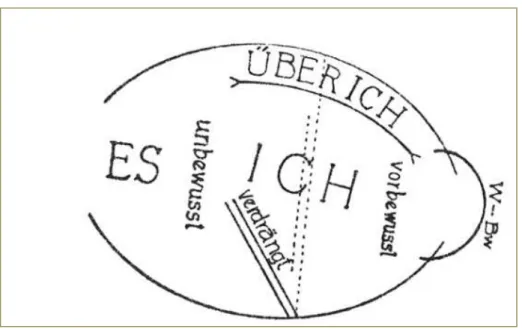
FIG 1. Basic Geography of the Mind by S.Freud,
For Sigmund Freud creativity wells up from the unconscious and its drives, for: ‘Unsatisfied wishes are the driving power behind fantasies; […] every fantasy contains the fulfilment of a wish, and improves an unsatisfactory reality’ (Freud, 1908).
In the late 19th century, Sigmund Freud developed his first concepts of psychical mechanics as informed by an ever augmented and multi-layered ‘unconscious’ as ‘the only true psychical reality’ (Freud, 1990), that later on, he would depict using spatial topographies of the mental landscape of ‘psyche’ translated into the form of abstract diagrams (Figure1).
During his attempt to better establish the protocols of the psychoanalytical process, a new set of discursive relationships based on analogical and spatial thinking methods were constructed and, the new vocabulary deployed was an appropriation of existing terms, mainly, informed by a diversity of other disciplines.
Even though ‘topos’ and its derivative ‘topography’ consisted terms being shared between anatomy and geography, they were not deployed by Freud to negotiate only aetiologies and localities, but to describe, as well, function and temporality, when his
Theme IV – Evaluation and Assessment
major analogies of terrain were driven by a personal interest in the discipline of archaeology.
The classical usage of the term ‘τοπογραφία
place’ a ‘topos’(τόπος); the act of describing the appearance of the land the first use of topography as a primal form of narrative.
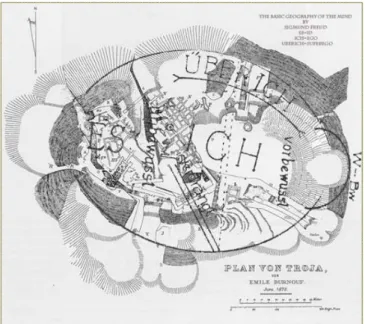
FIG 2. My overlap of the geography of the mind (S.Freud) with the topography of Troy (E.Burnouf).
The term ‘Topos’, as such, referred to a rather conceptual location, more than a geographical one, positioning it closer to Imannuel Kant’s construction of the ‘transcendental topic’ as ‘the place from which every concept begins; a location of understanding in which sensual experience is mediated through representation in such a way as to permit individual reflection
This transcendental turn, when extended to topography, appeared rather blurred, with overlaps of the physical and the metaphysical, and maps of that time were created as representations of real places of
imagination.
Freud’s modern topographical discourse was, mainly, constructed through analogical relationships, visual material and his advanced storytelling technique. His spatial 407 es of terrain were driven by a personal interest in the discipline of
ογραφία’ refers to the act of ‘writing about a describing the appearance of the land, setting, thus, the first use of topography as a primal form of narrative.
FIG 2. My overlap of the geography of the mind (S.Freud) with the topography of Troy
The term ‘Topos’, as such, referred to a rather conceptual location, more than a ne, positioning it closer to Imannuel Kant’s construction of the the place from which every concept begins; a location of understanding in which sensual experience is mediated through representation in such
(Hessbruggen-Walter,2004:146).
This transcendental turn, when extended to topography, appeared rather blurred, with overlaps of the physical and the metaphysical, and maps of that time were created as representations of real places of geography filled with considerable bits of Freud’s modern topographical discourse was, mainly, constructed through analogical relationships, visual material and his advanced storytelling technique. His spatial
N 11 / 2014 AE... Revista Lusófona de Arquitectura e Educação
Fourth International Conference on Architectural Research by Design (ARbD’14)
constructions ranged from the basic geography of the mind( Figure 1), to analogical writing about Schliemann’s Troy, and, even, included the topography of the female genital parts that became physical ground as part of his Introductory Lectures (1916 1917), when considering the importance of symbolism in dreams, he observed that ‘the complicated topography of the female genital parts makes one understand how it is that they are often represented as landscapes[original italics], with rocks, woods, and water’ (Freud, 1916). This latter deployment of topography refers to a visual representation of a location of sexuality and fantasy and as such, it reveals the topographic dynamic discourse of the Freudian spatial analogies as projected sites of an ‘unconscious’ both, existing and imaginary.
Freudian topographic construction of the unconscious reveals itself ancient drama is about to be performed once more’
pastiche of various places, which I will ,from now topographies.
‘TRANSREALITY’.
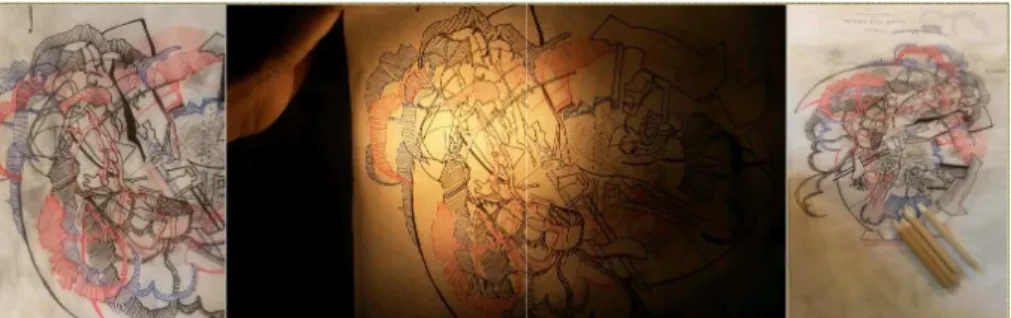
FIG 3. Drawing explorations of an augmented trans D.Kypraiou.
The deployment of the term ‘TransReal’ is drawn upon the way it was coined in a short essay entitled ‘A TranRealist Manifesto’ by Rudy Rucker (1983), in which transrealism is used as a literary mode that mixes the techniques of incorporating fantastic elements with the techniques of describing
naturalistic realism2. By deploying the boundaries of realism and imagination, it creates new metaphors for psychological change and incorporates the
higher reality in which life is embedded.
AE... Revista Lusófona de Arquitectura e Educação Architecture & Education Journal
Architectural Research by Design (ARbD’14)
sic geography of the mind( Figure 1), to analogical writing about Schliemann’s Troy, and, even, included the topography of the female genital parts that became physical ground as part of his Introductory Lectures
(1916-nce of symbolism in dreams, he observed that ‘the complicated topography of the female genital parts makes one understand how it is that they are often represented as landscapes[original italics], with rocks, woods, and ployment of topography refers to a visual representation of a location of sexuality and fantasy and as such, it reveals the topographic dynamic discourse of the Freudian spatial analogies as projected sites of an ‘unconscious’ both, existing and imaginary. At the close of the 19th century the Freudian topographic construction of the unconscious reveals itself as a site where ancient drama is about to be performed once more’ (O’donoghue, 2011, 116) forming a pastiche of various places, which I will ,from now on in this paper, term ‘transreal’
3. Drawing explorations of an augmented trans-real topography of Schliemann’s Troy, D.Kypraiou.
is drawn upon the way it was coined in a short essay entitled ‘A TranRealist Manifesto’ by Rudy Rucker (1983), in which a literary mode that mixes the techniques of incorporating fantastic elements with the techniques of describing immediate perceptions from By deploying the boundaries of realism and imagination, it creates new metaphors for psychological change and incorporates the perception of a
409 Theme IV – Evaluation and Assessment
A Trans-realist, therefore, writes about immediate perceptions in a fantastic way, using the tools of science fiction. Stating the belief that a consensus reality is a myth used for mass thought-control, the breaking down of this consensus reality and its turn into a Trans-reality becomes even more crucial now for, as argued by the transrealists, the modern society approaches a technological singularity.
THE MIGHTY TOPOGRAPHIC METAPHOR_ Beneath Antiquities and Schichts.
Everyone has found in the ancients whatever he needed or wished for; especially himself. (A.W.Schlegel,1798, Athenaums-Fragmente 15) In the mid-19th century, neurologists claimed that the topography of the human body was depicted onto the topography of the brain. For Freud having been arguing against that concept of mapping and, in his attempt to find an analogy for the effect of the additional elements regarding aphasia that were not depicted visually as such, he turned back to the topography in its archaeological senses.His earliest elaborated descriptions of land and antiquity would later become his psychoanalytical process as the unconscious evoking acts of excavation being proceeded ‘layer by layer’.
The archaeological site that Freud uses as an analogy to his process is actually a pastiche of various trans-real constructions of space, using topography as the visual representation of his location of fantasy, his ‘tale of Troy divine’, as a reference to the excavation of Troy by Heinrich Schliemann in 1873. Freud, often, deployed the latter as an analogy of the ultimate adult joy of a boy, referring to Schliemann, who proved to himself that his Never-land existed and opened it up to the real world.
Drawing largely upon the work of Richard H. Armstrong (2005) ‘A Compulsion for Antiquity. Freud and the Ancient World3’, I will seek to build a case for the importance of Freud’s compulsion for the archaeological metaphor in the incarnation of his new science of Psycho-Analysis, with a bifocal approach to the biographical details of his life, and the discursive effects of his writings.
To better comprehend the interaction between the situation and the discourse, the author suggests a model of ‘anatomizing’ Freud’s compulsion for antiquity, in three conceptual modes of analysis: the Personal, the Analogical, and, the Evidentiary,
3 More specifically this paper examines in detail the chapters 2 ‘Compulsive Anatomy’ (p.33-46), Chapter 6 ‘Conquest and Interpretation’ (p.102-125) and, Chapter 10 ‘Uncanny Understanding and a Grave Philosophy’ (p.201-216).
N 11 / 2014 AE... Revista Lusófona de Arquitectura e Educação
Fourth International Conference on Architectural Research by Design (ARbD’14) whose nature of regular interaction is the real source of their importance.
Far from the personal, as the concept of the private which is hidden from public view, the personal-as deployed by Freud -appears as a vital part of the public realm.
The author’s personal, as a mode of analysis, deploys the biographical and historical information of Freud’s life, and his personal trajectory such as: his schooling, his dreams, fantasies, interpretations and pretentions, his collection of antiquities extending into his working space, the disposition of the rooms in his house revealing his construction of privacy etc.
For Freud, the personal4 is, above all, a scientific concern in constant dynamic relation to the supra-personal, to one’s interests and ambitions. A concern from which, the very evidence for his new enterprise emerges, and becomes affirmed by the inter personal relations fostered in the analytic situation.
FIG 4. The Psychoanalytical Setting as a Stage in the Consulting (left) and Study (right) room, redrawn based on originals from the ‘Essay Berggasse 19: Inside Freud’s Office’, 1996.
Throughout the chronology of Freud’s work
analogical expression is consistent, as he suggested in the ‘
95): ’Let me give you an analogy; analogies is true, decide nothing but they
one feel at home” (New Introductory Lectures on Psycho
4 As underlined by the author, Freud was, as much, characterized by a tendency to speculate on different scales, ranging from the individual to the grand scale of the macro historical through the phylogenetic inheritance.
AE... Revista Lusófona de Arquitectura e Educação Architecture & Education Journal
Architectural Research by Design (ARbD’14) whose nature of regular interaction is the real source of their importance.
, as the concept of the private which is hidden from public view, appears as a vital part of the public realm. , as a mode of analysis, deploys the biographical and historical formation of Freud’s life, and his personal trajectory such as: his schooling, his dreams, fantasies, interpretations and pretentions, his collection of antiquities extending into his working space, the disposition of the rooms in his house revealing is, above all, a scientific concern in constant dynamic relation personal, to one’s interests and ambitions. A concern from which, the very evidence for his new enterprise emerges, and becomes affirmed by the
inter-in the analytic situation.
4. The Psychoanalytical Setting as a Stage in the Consulting (left) and Study (right) room, Essay Berggasse 19: Inside Freud’s Office’, 1996.
Throughout the chronology of Freud’s work, the analogical, or his compulsion for analogical expression is consistent, as he suggested in the ‘Studies of Hysteria’
(1893-is true, decide nothing but they can make Lectures on Psycho-Analysis, SE 22:72; my reud was, as much, characterized by a tendency to speculate on different scales, ranging from the individual to the grand scale of the macro historical through
411 Theme IV – Evaluation and Assessment
emphasis).
As one would, effortlessly, identify visiting his house in London-now the Freud Museum- , a feeling of home, for Freud, suggests to surround oneself with historical books and over two thousand artefacts ranging from statuary to mummy bandages (Figure 5), which justifies to a great extend his prominent deployment of a parallel and consistent discursive analogy between the archaeological excavating process and the clinical procedure of psychoanalysis for the extended period from 1893 to 1937. Freud’s first detailed description of an excavation took place in ‘Aetiology of Hysteria’ (1896), inviting the listeners to:
‘Imagine that an explorer [Forscher] arrives in a little known region where his interest is aroused by an expanse of ruins…[…] He may have brought picks, shovels and spades with him, and he may set the inhabitants to work with these implements. Together
with them he may start upon the ruins, clear away the rubbish, and, beginning from
the visible remains, uncover what is buried. If this work is crowned with success, the
discoveries are self-explanatory: the ruined walls are part of the ramparts of a palace
or a treasure-house; the fragments of columns can be filled out into a temple; the numerous inscriptions, which by good luck, may be bilingual, reveal an a alphabet and a language, and when they have been deciphered and translated, yield undreamed-of
information about the events of the remote past-, to commemorate which the
monuments were built. Saxa lonquuntur!5 (‘The stones talk’)’. (Freud 1896a, p192; my
emphasis).
One can find him/herself highly indulged by the great imagination that characterized Freud’s detailed descriptions of dreams and his narratives of physical spaces, such as the rooms of a house or an archaeological site, as analogies of spatial and psychic constructions of the mind he was wishing to reveal ‘layer by layer’. It was this story-telling approach of his that, even when the credibility of the facts can be questioned, makes his readers stand with great curiosity in front of the physical manifestation of his dream-world onto his desk, imagining all his fellow-travellers, gods of the underworld and wisdom, whispering all the stories untold and hidden that have been staged onto Freud’s escapist analytical setting.
In his statement to his friend and prolific Viennese writer Stefan Zweig, Freud admits his compulsion for collecting antiquities, “I have made many sacrifices for a collection
5 This phrase becomes the link between the narrative of unearthing and the process Freud was about to introduce as his method of examining hysteria.
N 11 / 2014 AE... Revista Lusófona de Arquitectura e Educação Architecture & Education Journal
Fourth International Conference on Architectural Research by Design (ARbD’14)
of Greek, Roman, and Egyptian antiquities, and have read more archaeology than psychology” (Stefan Zweig 1989[Freud 1931], 154-5), wishing to project himself as a rather complex and multi-layered personality, interested in fields extending from his own professional world.
FIG 5. Freud behind his study, photographed by E.Engelman, Vienna 1938
His spatial, psychic study and consulting room crowded by a vast collection of antiquities and artefacts, is a visual representation of the impact the ancient material world would have at the site of psychoanalysis. Freud’s great new enterprise and his passion for collecting would meld in a rather symbiotic relationship by informing and nourishing each other. His art collection was, for him, a retreat; a world by choice designed only for him; his ‘personal microcosm’ (Baudrillard, 1994, 7).
In his metaphor of archaeology, the analyst becomes the conscientious
psycho-excavator who unpacks the repressed fantasies, desires and phobias, so as to
reconstruct the physical sensation (SE 7:47-48). The narrative of excavation, thus, becomes a very detailed and multi-layered scenario, through which, regularly, Freud proceeds his readers. His excavation site operates as the pastiche of several locations
413 Theme IV – Evaluation and Assessment
interwoven into the same narrative, with the most frequent reference of which to be the excavation of Troy by the Homeric archaeologist Heinrich Schliemann (1822-1890). For it was the burgeoning development of archaeology in late 19th, early 20th century that reinforced Freud’s deployment of this metaphorical analogy for psychoanalysis. As a part of a comment Freud made to W.Fliess6 (1899) referring to a breakthrough with a patient during analysis, he said,
“Buried deep underneath all his fantasies, we found a science from his primal period which meets all the requirements and in which all the remaining puzzles converge. It is everything at the same time-sexual, innocent, natural, and the rest. It is as if
Schliemann had once more excavated Troy, which had hitherto been deemed a fable”
(Masson 1985, 391-392; my emphasis).
If we regard the two sites that are to be ‘anatomized’, in this essay, as being, the archaeological excavation, and the psychoanalytical procedure, it is apparent that, archaeology reveals an engagement with excavation as the rupture of a terrain that, already, exists, by revealing what lies beyond and beneath its multi-layered perceptive limits, as it brings to the light the unseen fragments of a buried past. Talking to his patient Russian aristocrat Pankejeff, known as the Wolf Man, Freud said that ‘the psychoanalyst, like the archaeologist, must uncover layer after layer of the patient’s psyche, before coming to the deepest, most valuable treasures’ (Panjekeff, 1972, 139).
By 1896, Freud formulated a definition anew for a term that would be shared by both archaeology and neuroscience: the ‘Schicht’ (‘layer’ or ‘stratum’). This analogy of the psychic Schicht becomes spatial when in his “Studies in Hysteria” (1895), he describes the work of the psychoanalyst as ‘clearing away the pathogenic psychical material
layer by layer, only to add “we liked to compare it with the technique of excavating a
buried city” (Breuer and Freud, 1895, p.139; my emphasis).
Thus, the unconscious psychoanalytical process is the means through which one can access the ‘mental underworld’, where repressed mental impulses are layered, and the access to this ‘underworld’ requires an uncanny, unconscious understanding, rather different and mystical compared to the ‘verstehen’ (‘understanding’) of the
6 Wilhelm Fliess, (1858 –1928) was a German Jewish otorynolarygologist who attended several conferences with Sigmund Freud, and the two soon formed a strong friendship. Through their extensive correspondence and the series of personal meetings, Fliess came to play an important part in the development of psychoanalysis.
N 11 / 2014 AE... Revista Lusófona de Arquitectura e Educação
Fourth International Conference on Architectural Research by Design (ARbD’14)
‘moral world7’. In this technical expression, “[the analyst] must turn his own unconscious like a receptive organ towards the transmitting unconscious of the patient” (SE 12:115). And then, only after systematic examination, could a found material be reconstructed into an informative document of its buried past.
It is this very reconstruction and interpretation that linked the two techniques of excavation and psychoanalysis. For archaeology provided Freud with three
paradigms: the material excavation, the recovery and, the decipherment. He, therefore, appears to deploy antiquity as an
relies, when his own theory does not coincide with the scientific establishment. The use of the archaeological metaphor reveals Freud’s need for a genealogy to legitimate his science, since the empirical moment of psychoan
isolation of the individual experience.
FIG 6. An Anecdotal Topography of Freud’s desk, drawing by D.Kypraiou Archaeology, as a paradigm of procedure and success , for it entails the ‘
evidentiary’, seeks to solve the inherit problem of the evidentiary in psychoanalysis,
where unlike the rest of the scientific methods
no public demonstration of findings; for the analytic encounter is kept strictly private
and cannot be observed by an audience.
7 Posited by Droysen as the second creation that can be accessed by the understanding. 8 For the image of the archaeologist is merged with that of the scientist and the explorer (Forscher).
AE... Revista Lusófona de Arquitectura e Educação Architecture & Education Journal
Architectural Research by Design (ARbD’14)
’. In this technical expression, “[the analyst] must turn his own ke a receptive organ towards the transmitting unconscious of the patient” (SE 12:115). And then, only after systematic examination, could a found material be reconstructed into an informative document of its buried past.
interpretation that linked the two techniques of excavation and psychoanalysis. For archaeology provided Freud with three evidentiary paradigms: the material excavation, the recovery and, the decipherment.
He, therefore, appears to deploy antiquity as an alternative tradition on which he relies, when his own theory does not coincide with the scientific establishment. The use of the archaeological metaphor reveals Freud’s need for a genealogy to legitimate his science, since the empirical moment of psychoanalysis points towards the
FIG 6. An Anecdotal Topography of Freud’s desk, drawing by D.Kypraiou
Archaeology, as a paradigm of procedure and success , for it entails the ‘self-inherit problem of the evidentiary in psychoanalysis, where unlike the rest of the scientific methods8, there is no public spectacle as such, ; for the analytic encounter is kept strictly private
Posited by Droysen as the second creation that can be accessed by the understanding. For the image of the archaeologist is merged with that of the scientist and the explorer
415 Theme IV – Evaluation and Assessment
Hence, in search for an unambiguous demonstration of his ‘findings’, Freud deployed the public spectacle of archaeology that incorporates the material excavation, decipherment and reconstruction, as his master-trope. Or, as Armstrong (2005) suggests, as his “means of distracting us from the fact that we are dealing with the assurance of things hoped for and the conviction of things not seen […] we are being indoctrinated into a faith” (cf Hebrews II.I,), something Freud seems to acknowledge when confessing to H.D9, “My discoveries are primarily not a heal-all. My discoveries are a basis for a very grave philosophy. There are very few who understand this, there
are very few who are capable of understanding this.” (H.D [1956] 1974, 18; original
emphasis)
‘TOPOGRAPHIE ANECDOTEE D’UN BUREAU or OF A MIND’
10During the attempt to examine the intersection of the metaphor of archaeology in psychoanalysis, one cannot fail to notice the complexity of associations which Freud deployed in order to describe his engagement with acts of unearthing.
While studying the Freudian unconscious through space, I began my design exercise, consisting of an architectural analysis of the actual psychoanalytic setting- the consulting room, and a design recreation of Freud’s desk, as the topography of his own unconscious. Combined with a critical review of his writings, this exercise acted as an analogical act of ‘unearthing’ that ‘brought to light’ a multiplicity of layers turning the unconscious into analogies of a physical site of mutation that-‘as an expanse of ruins’-demands a disruption to recover and reveal the depth of its spatiality.
Sigmund Freud’s vast collection of antiquities was instrumental in the formation of psychoanalysis. This collection of his has been the physical equivalent of his collection of patients’ case studies; stories of memories that have been repressed and become visualized and contextualised in classical mythology. Using the visual analysis of his collection as a lens, fragments of Freud’s personality are revealed in a different way, as he appears rather impulsive, a hedonistic spender, a tomb raider complicit in an often illegal trade of antiquities, a rather tough negotiator, and a tourist of numerous sensual Mediterranean journeys.
9
H.D. (born Hilda Doolittle, 1886 –1961) was an American poet, novelist and memoirist known for her association with the early 20th-century avant-garde Imagist group of poets that befriended Freud and became his patient in order to understand her bisexuality.
10 Title inspired by the Swiss artist Daniel Spoerri and his work entitled ‘Topographie Anécdotée
N 11 / 2014 AE... Revista Lusófona de Arquitectura e Educação Architecture & Education Journal
Fourth International Conference on Architectural Research by Design (ARbD’14)
Hence, through the art of collecting, Freud brought these fragmented mythologies and fictional narratives into his personal and working environment, as if they are the evidential but symbolic embodiment of his analytical success. It is documented that he started collecting the first artworks in 1896, following the death of his dad, Jacob, and his painful recovery is revealed through his exhilarating journey of self-analysis in ‘The Interpretation of dreams’ (1900). For art and mourning seem to have been aligned at this transitional period of Freud’s life as in his words art been “a source of exceptional renewal and comfort.”
Numerous pieces of his collection of antiquities appear to have a common symbolic duality, presenting a celebrating double-sided nature, such as the ‘Horus’ known as a representation of a half-man and half-bird figure. What is of more importance though, is the observation that he seems to have been interested in specific types of figures that are present twice or even more times, and of course, his way of displaying his artefacts on his desk, offers us hints of the hierarchy of importance that certain pieces had for Freud11. For him, collecting his desirable artworks seemed to work as a source of inspiration, noting that he often used the artworks in the analytic procedures, as a symbol of mourning, a replacement of loss through material possession, as an expression of his ‘need of something to love’, and of course, as an evidence of his numerous travels and his knowledge in fields beyond his professional one.
His patients, although really few of them appear to have written about his collection, describe the consulting room as a space recreating an atmosphere rather sacred and very quiet, establishing the perfect, distinct from reality and outer life, space for the analytic encounter to be revealed.
As far as we, as observers of the space, are concerned, the experience of the space where we are surrounding ourselves with his antiquities, offers us a rare insight into the foundations of psychoanalysis, as Freud's collection constitutes a museum of his own creation; a museum within a museum.
In 1934 Freud's patient H.D recorded him saying that his “little statues and images helped stabilize the evanescent idea, or keep it from escaping altogether.”
We can easily observe that Freud's figures utterly occupy his desk space and it is as if the row of figures resembles an audience gathered around Freud's writing paper,
11
For front row centre, Freud chose his most cherished talisman, a 4-inch-tall Roman figure of Athena, the goddess of wisdom and war11. The bronze goddess Isis suckling her infant son Horus embodies similar symbolism, Gamwell continued. Key to Egyptian religion, Isis was mar-ried to Osiris, god of the underworld, symbolizes the relation between conscious thought and feelings or memories repressed far below the surface.
417 Theme IV – Evaluation and Assessment
forming a unique relationship with the collector while gazing at him; a totality that represents his journey from inspiration to inscription.
FIG 7. Recreation of the atmosphere and the statues of the desk.
Freud, himself, never offered us enough information about his passion for collecting, although he counted it alongside smoking as one of his two addictive pleasures. John Forrester claimed in ‘The Cultures of Collecting’ (1994) that Freud's collection of an-tiquities works as a mirror of his collections of dreams, case histories, and anecdotes. Freud decided to die in his study, surrounded by his ancestors of choice, his most faithful companions, and the embodiments of his excavated truths of psychoanalysis; a rather revealing choice for a scholar whose interest was in our very psychological underworld.
CREATIVE TOPOGRAPHY_ Mapping the Unconscious.
In my design experimentations Freud’s desk operates as a trans-real topography that stages spatial material and immaterial, seen and unseen, real and imaginary performances of figures of history, culture and mythology, as the projected desires, recollections, obsessions and fetishes of a diversity of lands, empires, locations of the
N 11 / 2014 AE... Revista Lusófona de Arquitectura e Educação Architecture & Education Journal
Fourth International Conference on Architectural Research by Design (ARbD’14) past and the present, places open to debate and, lands inviting uncertainty.
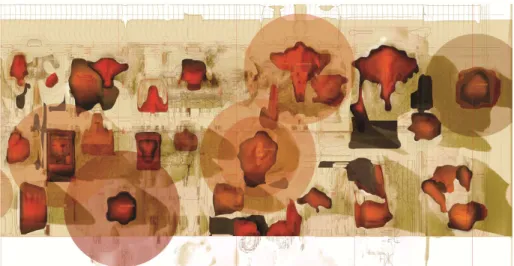
FIG 8. Creative Topographic Mapping of the desk, drawing by D.Kypraiou
FIG 9. Creative Topographic Mapping of the desk in a zoomed view. Drawing by D.Kypraiou. So thick is the net of links and relationship that bonds the collected pieces of Freud’s desk, that it is inevitably challenging to perform a type of interpretive archaeology as the technique to unravel the underlying psychic continuity of narratives, through the examination of the fragmented cultural pieces of its surface; to perform a dissection of the physical manifestation of Freud’s unconscious, using his statues as the very
Theme IV – Evaluation and Assessment dissecting knives.
For Freud believed that Animism, the idea that objects contain a communicable soul that invokes to the gods, has more influence on the human nature than science and eligion, the two other big pictures of the universe.
A FIELD TO EXCAVATE. Dissecting/Revealing the Unconscious
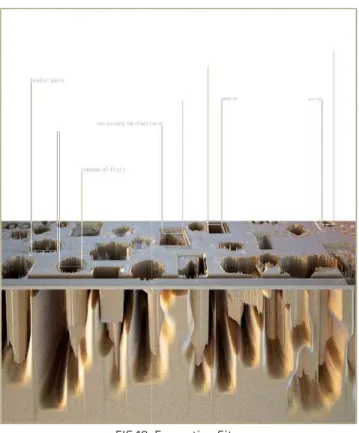
FIG 10. Excavating Site.
Through the development of a series of hybridized design strategies deploying art practices, mapping paradigms, textual reviews and observational descriptions, my drawings aim to form a synthesis of a multiplicity of psychic and physical
trans-real topographies of unconscious, less as a representation, and more as a blended site to perform an architecture driven by curiosity, free thought, design and material experimentation; As a negotiation of an archaeological, physical and,
419 For Freud believed that Animism, the idea that objects contain a communicable soul that invokes to the gods, has more influence on the human nature than science and eligion, the two other big pictures of the universe.
D TO EXCAVATE. Dissecting/Revealing the Unconscious
. Excavating Site.
Through the development of a series of hybridized design strategies deploying art practices, mapping paradigms, textual reviews and observational descriptions, my to form a synthesis of a multiplicity of psychic and physical Schichts of real topographies of unconscious, less as a representation, and more as a blended site to perform an architecture driven by curiosity, free thought, design and
N 11 / 2014 AE... Revista Lusófona de Arquitectura e Educação Architecture & Education Journal
Fourth International Conference on Architectural Research by Design (ARbD’14)
psychical topography of mutation operating not, as a visual manifestation of my own unconscious, but rather as an act to animate my curiosity of what an architectural space could be.
An extension of a topographic projection of instincts, desires and fears, forming an active psycho-geographic landscape of radical imagination and analogical thinking; an amalgam of constructed spatialities, as conceived in a spirit of discussion, experimental design and constant inquiry about the potential of an architecture reimagined, to suggest the importance of developing a higher awareness of the spatial sensory realm that embraces the pleasure of the process as an unconscious journey towards creation. A creative process as an active site of constant mutation, where architecture is being performed in ways that aspire to address the human spirit.
AN UNCONSIOUS ARCHITECTURE OF PROCESS and in progress.
FIG 11. Manifesting the site into a Transreality.
My design research is, thus, aiming at a negotiation of trans-real topographies of the unconscious, regarded as locations projecting a mixture of immediate spatial experiences that are imbued with imaginary elements, through a process analogical to ‘τοπογραφία’; a story telling device to investigate, map and, reveal the topography of the unconscious as an individual and collective portrait that is sculpted by thoughts, memories, desires.
I am focusing on the exploration of new design methodologies and readings of the experience of space, in the form of an intimate voyeuristic exploration into the private
421 Theme IV – Evaluation and Assessment
landscape of the unconscious to expose its significance in the creative process, and to set the process itself at the core of my research. I am interested in the notion of the creative process as a journey, whose destination is, at times, less important than the experience of the process itself and, thus, I am suggesting a design/making-driven research as an investigative tool to test, experiment and examine the potential of a design process driven by the unconscious as a step towards an architecture that is open to spontaneity, randomness and radical imagination, and is leaning towards a more personalised, authentic and unique approach to the creation of space.
N 11 / 2014 AE... Revista Lusófona de Arquitectura e Educação Architecture & Education Journal
Fourth International Conference on Architectural Research by Design (ARbD’14)
References
Armstrong, R.H.(2005) A Compulsion for Antiquity. Freud and the Ancient World, Unites States of America: Cornell University Press, pp.33-36 & 201-216.
Baudrillard, J.(1994) The System of Collecting, John Elsner & Roger Cardinal (ed.s), The Cultures of Collecting, London: Reaktion Books, pp.7.
Barker, S. (ed.) (1996) Excavations and Their Objects: Freud’s Collection of Antiquity. Albany, NY: State University of New York Press.
Coles, A. and Defert, A.(ed.s)(1998) The anxiety of Interdisciplinarity, London: BACKLess Books & Black Dog.
Engelman, E.(1976) Bergasse 19: Sigmund Freud’s Home and Offices, Vienna, 1938, New York: Basic Books.
Freud, S.(1916) Introductory Lectures on Psycho-Analysis, Standard Edition 15, p.p.156. Freud, S.(1917[1915]), Mourning and Melancholia, S.E. vol.XIV, p.p. 224-245.
Freud, S.(2010) The Interpretation of Dreams’, Standard Edition 5, p.p.536-549. Freud, S.(2003) The Uncanny, trans. McLintock, D., London: Penguin Books.
Freud, S.(1891) Zur Auffassung der Aphasien:eine kritische Studien, English Translation(1953): London:Imago.
Fuss, D. and Sanders J.(1996) Essay Berggasse 19: Inside Freud’s Office, STUD: Architectures of Masculinity, USA: Princeton Architectural Press, p.p. 122 & 127. Gamwell, L. and Wells, R.(ed.s)(1989) The Origins of Freud’s Antiquities Collection), Sigmund Freud and Art: His Personal Collection of Antiquities, State University of New York at Binghamton; London: Freud Museum, p.p.29 and 65
Gill, M.(1963) Topography and Systems in Psychoanalytic Theory, Vol.10, Psychological issues, New York: International University Press.
H.D. [Hilda Doolittle] (1956) Tribute to Freud: Writing on the Wall; Advent, foreword by Norman Holmes Pearson. Manchester: Carcanet, 1974.
Hessbruger-Walter, Stefan (2004) ’Topik, Reflexion und Vorurteilskritik:Kants Amphibolie der Reflexionsbegriffe“ im Kontext, Archive 86, no.2 (June):p.p.146-175. Lacan, J.(2004) Topologically Speaking,(ed.s) Ellie Ragland and Dragan Milovanovic,
423 Theme IV – Evaluation and Assessment
New York: Other Press.
Lahiji, N.(ed)(2011) The Political Unconscious of Architecture: re-opening Jameson’s narrative’, Farnham: Ashgate.
Liebrand, C.(2003) Gender-Topographien: Kulturwissenschaftliche Lekturen von Hollywoodfilmen der Jahrundertwende , Cologne: DuMOnt.
Lorens, H.(2010) Brunelleschi, Lacan, Le Corbusier: Architecture, space and the construction of subjectivit’, London: Routledge.
Martin, T.(2008) ‘From Cabinet to Couch: Freud’s Clinical Use of Sculpture’, British Journal of Psychotherapy, vol.24(2), Oxford: BAP and Blackwell Publishing Ltd, [online], [accessed 3 March 2014].
O’donoghue, D.(2011) ‘Mapping the Unconscious’, Visual Resources: An International Journal of Documentation, London: Routledge pub.,[online] p.p.656-657 [accessed 19 February 2014].
O’Donoghue, Diane (2004) ‘Negotiations of Surface: Archaeology within the Early Strata of Psychoanalysis’, Journal of the American Psychoanalytical Association, vol.52, no.3, p.p.653-671.
Panjekeff, S.(1972) ‘My Recollections of Sigmund Freud’, Muriel Gardiner (ed.), The Wolf-Man and Sigmund Freud, London :Hogarth Press and the Institute of Psyscho-analysis, p.p.139.
Rucker, R.(1983) ‘A Transrealist Manifesto’, The Bulletin of the Science Fiction Writers of America, vol.82, Winter, Reprinted in Rucker’s anthologies ‘Transreal’(WCS Books,1991).