Rui Miguel Neves Gonçalves Madeira
Mestre em Engenharia Informática
Model-driven Personalisation of
Human-Computer Interaction across Ubiquitous
Computing Applications
Dissertação para obtenção do Grau de Doutor em Informática
Orientador:
Prof. Doutor Nuno Manuel Robalo Correia,
Professor Catedrático, FCT/UNL
Co-orientador: Prof. Doutor Octavian Adrian Postolache,
Professor Auxiliar, ISCTE/IUL
Júri:
Presidente: Prof. Doutor Luís Manuel Marques da Costa Caires Arguentes: Prof. Doutora Carmen Santoro
Prof. Doutor Rui João Peixoto José Vogais: Prof. Doutora Ana Paula Pereira Afonso
Prof. Doutora Sofia Carmen Faria Maia Cavaco
Prof. Doutor Nuno Manuel Robalo Correia
Model-driven Personalisation of Human-Computer Interaction across Ubiquitous Compu-ting Applications
Copyright © Rui Miguel Neves Gonçalves Madeira, Faculdade de Ciências e Tecnologia, Universi-dade Nova de Lisboa.
Acknowledgements
First of all, I would like to express my sincerest gratitude to my supervisors. Once more, I had the honour of having Professor Nuno Correia as supervisor, continuing the friendship-based guidance and the transmission of knowledge that started more than ten years ago with the master’s work su-pervision. I also had the pleasure of having the supervision of Professor Octavian Postolache, who embraced this work with all the energy and availability, always bringing interesting insights, relevant expertise and great support.
My acknowledgements extend to the members of the thesis advisory committee, professors Ana Paula Afonso and Sofia Cavaco. Their feedback and expert comments were very important to direct this research work at some important stages along the way.
A special thank you goes to all my family for the love and unconditional support. Particularly, my parents, for everything and much more as I am what I am because of them, in all senses. My wife, for still “being here” after all this time, finding the needed patience to cope with my “moments of absence”. Tobias, my faithful companion, for putting a smile on my face and warming up my heart (and feet) every time I needed it. Moreover, Legolas, for brightening up my grey days of the last months of the dissertation’s writing. Love you all!
I would like to thank all of those that by some means contributed to the development of this work. Since I do not want to forget anyone, I will not refer any names, besides one, and I will thank everyone personally. Nonetheless, a special thank you goes to Pedro Albuquerque Santos since he is the one who worked more closely with me in this research work, always making me go a little further. Without him, this particular research work would not be possible.
Furthermore, I thank all my colleagues, students and friends for all the support, collaboration and friendship.
As a final point, it is also important to mention the different funding sources involved in this research work:
The development of this work was partially subsided by Fundação para a Ciência e Tecnologia (Portuguese Science and Technology Foundation) within the scholarship reference SFRH/PROTEC/50203/2009. This grant was set initially under the PROTEC program, an initiative to promote Ph.D. formation for the teaching staff of Polytechnic Institutes, in this case, Instituto Politécnico de Setúbal.
The research has also been enclosed by NOVA Laboratory for Computer Science and In-formatics, under the grant UID/CEC/04516/2013, former Center for Informatics and Infor-mation Technologies (CITI), which has also subsidised the work under the grant PEst-OE/EEI/UI0527/2011.
Abstract
Personalisation is essential to Ubiquitous Computing (Ubicomp), which focuses on a human-centred paradigm aiming to provide interaction with adaptive content, services, and interfaces towards each one of its users, according to the context of the applications’ scenarios. However, the provision of that appropriated personalised interaction is a true challenge due to different reasons, such as the user interests, heterogeneous environments and devices, dynamic user behaviour and data capture. This dissertation focuses on a model-driven personalisation solution that has the main goal of facili-tating the implementation of a personalised human-computer interaction across different Ubicomp scenarios and applications. The research reported here investigates how a generic and interoperable model for personalisation can be used, shared and processed by different applications, among diverse devices, and across different scenarios, studying how it can enrich human-computer interaction. The research started by the definition of a consistent user model with the integration of context to end in a pervasive model for the definition of personalisations across different applications.
Besides the model proposal, the other key contributions within the solution are the modelling frame-work, which encapsulates the model and integrates the user profiling module, and a cloud-based platform to pervasively support developers in the implementation of personalisation across different applications and scenarios. This platform provides tools to put end users in control of their data and to support developers through web services based operations implemented on top of a personalisa-tion API, which can also be used independently of the platform for testing purposes, for instance. Several Ubicomp applications prototypes were designed and used to evaluate, at different phases, both the solution as a whole and each one of its components. Some were specially created with the goal of evaluating specific research questions of this work. Others were being developed with a pur-pose other than for personalisation evaluation, but they ended up as personalised prototypes to better address their initial goals. The process of applying the personalisation model to the design of the latter should also work as a proof of concept on the developer side.
On the one hand, developers have been probed with the implementation of personalised applications using the proposed solution, or a part of it, to assess how it works and can help them. The usage of our solution by developers was also important to assess how the model and the platform respond to the developers’ needs. On the other hand, some prototypes that implement our model-driven per-sonalisation solution have been selected for end user evaluation. Usually, user testing was conducted at two different stages of the development, using: (1) a non-personalised version; (2) the final per-sonalised version. This procedure allowed us to assess if personalisation improved the human-com-puter interaction. The first stage was also important to know who were the end users and gather interaction data to come up with personalisation proposals for each prototype. Globally, the results of both developers and end users tests were very positive.
Finally, this dissertation proposes further work, which is already ongoing, related to the study of a methodology to the implementation and evaluation of personalised applications, supported by the development of three mobile health applications for rehabilitation.
Sumário
A personalização é essencial para a Computação Ubíqua (Ubicomp), que se foca num paradigma centrado no ser humano, com o objetivo de proporcionar uma interação adaptativa com conteúdo, serviços e interfaces apropriadas para cada um de seus utilizadores, de acordo com o contexto dos cenários das aplicações. No entanto, a disponibilização dessa interação personalizada é um verdadeiro desafio devido a diferentes razões, tais como, os interesses do utilizador, os ambientes e dispositivos heterogêneos, o comportamento dinâmico do utilizador e a captura de dados.
Esta dissertação centra-se numa solução de personalização guiada por um modelo que tem o objetivo principal de facilitar a implementação de uma interação pessoa-máquina personalizada transversal a diferentes cenários de aplicações Ubicomp. O trabalho aqui relatado investiga como um modelo ge-nérico e interoperável para personalização pode ser usado, partilhado e processado por diferentes aplicações, entre diversos dispositivos, e ao longo de diferentes cenários, estudando como pode en-riquecer a interação pessoa-máquina. A investigação começou pela definição de um modelo de utili-zador consistente, com integração do contexto, para culminar num modelo genérico para a definição de personalizações em diferentes aplicações.
Além do modelo, as outras contribuições-chave dentro da solução são a platforma de modelação, que encapsula o modelo e integra o módulo de aprendizagem automática, e uma plataforma baseada na nuvem para suportar os programadores na implementação da personalização em diferentes apli-cações e cenários. Esta plataforma fornece ferramentas que colocam os utilizadores finais no controlo dos seus dados e suportam os programadores através de serviços Web para personalização.
Foram utilizados diversos protótipos de aplicações Ubicomp para avaliar a solução como um todo e cada um dos seus componentes separadamente. Alguns foram criados com o objetivo de avaliar questões de investigação. Outros estavam sendo desenvolvidos com um outro propósito, terminando como protótipos personalizados para endereçar melhor os seus objetivos. O processo de aplicação do modelo de personalização no desenvolvimento destes também deve funcionar como prova de conceito no lado do programador.
Por um lado, envolveram-se programadores na implementação de aplicações personalizadas usando a solução proposta de modo a avaliar a mesma. O uso da solução pelos programadores também foi importante para avaliar como o modelo e a plataforma respondem às necessidades dos programado-res. Por outro lado, alguns protótipos foram selecionados para avaliação por utilizadores finais. Usu-almente, os testes com estes foram conduzidos em dois estágios diferentes de desenvolvimento, usando: (1) uma versão não personalizada; (2) a versão final personalizada. Este procedimento per-mitiu avaliar se a personalização poderá melhorar a interação pessoa-máquina. Globalmente, os re-sultados de ambos os tipos de testes foram muito positivos.
Por fim, esta dissertação propõe como trabalho futuro, já em curso, o estudo de uma metodologia para a implementação e avaliação de aplicações personalizadas, suportado pelo desenvolvimento de três aplicações móveis de saúde para reabilitação.
Contents
1. Introduction ... 1
1.1. Motivation ... 1
1.2. Research Problem ... 3
1.3. Research Goal and Questions ... 4
1.4. Research Plan ... 4
1.5. Contributions ... 5
1.6. Publications ... 6
1.7. Dissertation Outline ... 8
2. Related Research ... 9
2.1. The Personalisation Concept ... 9
2.2. Personalisation Modelling ... 10
2.2.1. Personas towards a User-Centred Design ... 10
2.2.2. User Modelling ... 13
2.2.3. Machine Learning and the User Modelling Techniques ... 15
2.2.4. Context Integration ... 16
2.3. Web Services and Cloud Computing ... 18
2.3.1. Web Services ... 18
2.3.2. Cloud Computing ... 20
2.4. Related Work ... 20
2.5. Summary ... 23
3. A Model-driven Personalisation Solution ... 25
3.1. Introduction ... 25
3.2. The Generic Personalisation Model ... 26
3.2.1. Model Overview ... 26
3.2.2. The XUPIL Language ... 30
3.3. The Modelling Framework ... 35
3.3.1. CAPE’s Architecture ... 35
3.3.2. The User Profiling Algorithm for Personalisation Option Requests ... 38
3.3.3. Personalisation API’s Methods ... 40
3.4. The Cloud-based Platform ... 40
3.4.1. Principles ... 40
3.4.3. The HTTP-based Personalisation API ... 44
3.4.4. The Web UI of P2MUCA ... 46
3.5. Evaluation Methodology - Studies Overview ... 48
3.6. Summary ... 49
4. Experimenting the Personalisation Solution (Developers-driven Evaluation) ... 51
4.1. Study D.1 – First Attempt of Applying the Personalisation Model ... 51
4.1.1. LEY: Persuasive Pervasive Gaming towards Domestic Energy Consumption-Awareness ... 52
4.1.2. Personalisation Design for LEY ... 55
4.1.3. User Study with Developers ... 59
4.1.4. Final Remarks ... 67
4.2. Study D.2 – Asking the Developers ... 68
4.2.1. Walker: People Counting in Indoor Spaces ... 68
4.2.2. Personalisation Design for Walker ... 72
4.2.3. User Study with Developers ... 76
4.2.4. Final Remarks ... 87
4.3. Summary ... 88
5. Studying the Personalisation Solution (End Users-driven Evaluation) ... 91
5.1. Study EU.1 – The Personalisation Platform in Action for the First Time ... 91
5.1.1. FCT4U: When Private Mobile Displays Meet Public Situated Displays ... 92
5.1.2. Personalisation Design for FCT4U ... 97
5.1.3. User Study with End Users ... 101
5.1.4. Final Remarks ... 110
5.2. Study EU.2 – The New Application already Knows the User ... 111
5.2.1. WeSync and WePlayTennis: Adaptation to TV Delays according to the Behaviour of the User ... 111
5.2.2. Using Personalisation in the Cheater-Detection Module ... 118
5.2.3. User Study with End Users ... 120
5.2.4. Final Remarks ... 132
5.3. Study EU.3 – Involving End Users in the Personalisation Design... 134
5.3.1. PhysioMate/just Physio Kidding: Pervasive Physical Rehabilitation based on NUI and Serious Gaming ... 135
5.3.2. Personalisation Design for “just Physio Kidding” ... 141
5.3.3. User Study with End Users ... 144
5.3.4. Final Remarks ... 156
6. Conclusions and Future Work ... 159
6.1. Synthesis ... 159
6.2. Achievements ... 162
6.3. Further Developments ... 163
References ... 167
A. Personalisations Design – XUPIL scripts ... 181
A.1. LEY (Study D.1) ... 181
A.2. FCT4U (Study EU.1) ... 184
A.3. WeSync (Study EU.2) ... 190
A.4. WePlayTennis (Study EU.2) ... 192
A.5. “just Physio kidding” (Study EU.3) ... 192
List of Figures
Figure 1.1 – Mobile is changing the world (HBR, 2012). ... 2
Figure 2.1 - Persona developed by the U.S. Department of Agriculture's (USDA) Economic Research Service (ERS) (usability.gov, 2013) ... 12
Figure 3.1 - A model-driven and cloud-based approach for personalisation. ... 26
Figure 3.2 - Personalisation sub-model’s core entities. ... 27
Figure 3.3 – The starting high-level taxonomy for the user model. ... 28
Figure 3.4 – A high-level taxonomy for the context model. ... 29
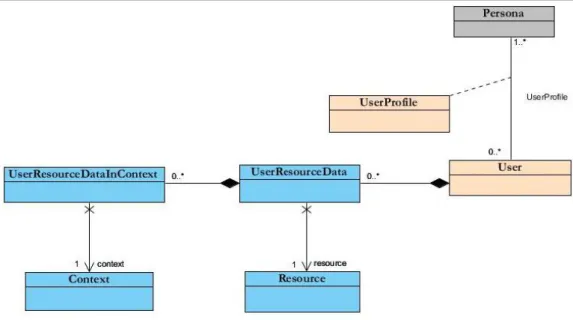
Figure 3.5 - User sub-model’s core entities with the connection to the central entity of Persona. ... 30
Figure 3.6 - X-Users overview “in a nutshell.” ... 30
Figure 3.7 – The root node of XUPIL language. ... 31
Figure 3.8 – Specification of the personalisation instances to be used in the personalisation. ... 32
Figure 3.9 - Defining context in a personalisation instantiation. ... 32
Figure 3.10 - Definition of a personalisation option. ... 33
Figure 3.11 - The parameters modelling. ... 34
Figure 3.12 – Resources definition. ... 34
Figure 3.13 – CAPE’s architecture. ... 36
Figure 3.14 – Part one of the personalisation request algorithm flow. ... 38
Figure 3.15 - Part two of the personalisation request algorithm flow. ... 39
Figure 3.16 - Architecture overview of P2MUCA. ... 43
Figure 3.17 – P2MUCA Website UI: initial interface. ... 47
Figure 3.18 – P2MUCA Website UI: user registration interface. ... 47
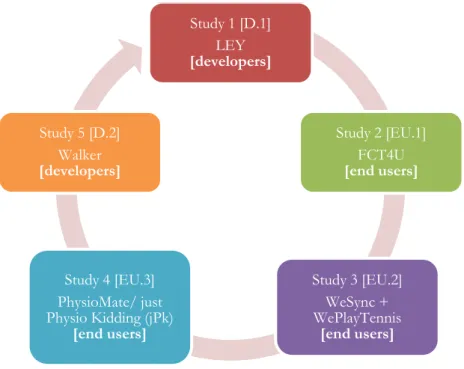
Figure 3.19 – Cycle of the evaluation process comprised of five studies. ... 49
Figure 3.20 – Solution for HCI personalisation built from the inside (the model) out (the platform). ... 50
Figure 4.1 – LEY: The system architecture. ... 53
Figure 4.2 - LEY UI: status view (level=C, score=4900 pts, avatar mood=green). ... 55
Figure 4.3 - LEY UI: status view (level=E, score=2000 pts, avatar mood=yellow). ... 55
Figure 4.4 - LEY UI: status view (level=E, score=2000 pts, avatar mood=red)... 55
Figure 4.5 – LEY UI: tournament screen showing the classification ordered by the avatar mood). 55 Figure 4.6 - LEY UI: a notification is received communicating that an abnormal high-consumption value has just been detected. ... 55
Figure 4.8 – Study D.1: Current areas of expertise of part 1’s participants. ... 61
Figure 4.9 – Study D.1: Years of experience of part 1’s participants in their current areas. ... 61
Figure 4.10 - Study D.1: Current areas of expertise of part 2’s participants. ... 61
Figure 4.11 – Study D.1: Years of experience of part 2’s participants in their current areas. ... 61
Figure 4.12 – Study D.1: Summary of part 1’s results for S1-S4. ... 63
Figure 4.13 – Study D.1: Summary of part 1’s results for S5-S8. ... 64
Figure 4.14 - Study D.1: Summary of part 2’s results for S1-S4. ... 66
Figure 4.15 - Study D.1: Summary of part 2’s results for S5-S8. ... 67
Figure 4.16 – Walker: the system architecture (Diogo and Banha, 2016). ... 70
Figure 4.17 – Walker: how it works (Diogo and Banha, 2016). ... 71
Figure 4.18 - Walker UI: login screen. ... 72
Figure 4.19 – Walker UI: locations/places screen. ... 72
Figure 4.20 - Walker UI: client user area. ... 72
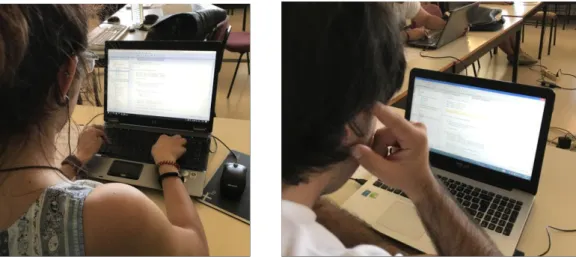
Figure 4.21 – Study D.2: One participant in the training session (left) and another in the testing session (right), with the tutorial to the left. ... 77
Figure 4.22 - Study D.2: Summary of part 1’s results for Likert-type scale statements S1-S4. ... 81
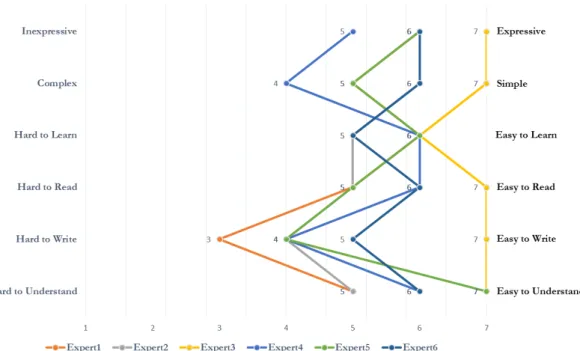
Figure 4.23 - Study D.2: Summary of part 1’s results for the SDS-based question “How do you evaluate XUPIL?”. ... 82
Figure 4.24 - Study D.2: Summary of part 1’s results for the SDS-based question “How do you evaluate personalising an application using P2MUCA?”. ... 83
Figure 4.25 - Study D.2: Summary of part 2’s results for Likert-type scale statements S1-S4. ... 84
Figure 4.26 - Study D.2: Summary of part 2’s results for the SDS-based question “How do you evaluate XUPIL?”. ... 85
Figure 4.27 - Study D.2: Summary of part 2’s results for the SDS-based question “How do you evaluate personalising an application using P2MUCA?”. ... 86
Figure 5.1 – FCT4U: architecture overview. ... 94
Figure 5.2 – FCT4U’s PD UI: screen shared by three users (each one getting personalised information)... 95
Figure 5.3 - FCT4U mobile UI: information sample. ... 97
Figure 5.4 – FCT4U: the direct interaction between a user’s device and the PD. ... 97
Figure 5.5 – FCT4U: the lab installation of the public display system. ... 102
Figure 5.6 - Study EU.1: Number of participants / public display installation type. ... 104
Figure 5.7 – Study EU.1: Summary of phase 1’s results (FCT4U without personalisation) for S2-S7. ... 106
Figure 5.10 - Study EU.1: Summary of phase 2’s results (FCT4U with personalisation) for S8-S11.
... 108
Figure 5.11 – Study EU.1: Summary of phase 1’s results (FCT4U w/out personalisation) for S12-S20. ... 109
Figure 5.12 - Study EU.1: Summary of phase 2’s results (FCT4U with personalisation) for S12-S20. ... 110
Figure 5.13 - Sync2FairPlay’s architecture (including the algorithm’s main actions). ... 113
Figure 5.14 – Instagram app blocks a user temporarily. ... 115
Figure 5.15 - Sync2FairPlay’s CPM applies a permanent penalisation to a user on WePlayTennis. 115 Figure 5.16 – WeSync/WePlayTennis’s CPM: summary flow when a user is detected as a cheater. ... 115
Figure 5.17 - WeSync UI: a key event that prompts users to predict a corner kick. ... 116
Figure 5.18 - WeSync UI: notification when the app is synchronised. ... 116
Figure 5.19 – WeSync’s SMUF: initial screen with the default at position “Great!”. ... 117
Figure 5.20 – WeSync’s SMUF: user setting a delay of 3s. ... 117
Figure 5.21 - WePlayTennis UI: A key event that prompts users to predict a point. ... 118
Figure 5.22 - WePlayTennis UI: The indication of the prediction’s result. ... 118
Figure 5.23 – Study EU.2: Two participants interacting with WeSync (scoreboard near the TV). 121 Figure 5.24 - Study EU.2: Summary of the phase 1’s questionnaire results regarding: the SMUF experience (S1-S3) and the cheating perception (S4-S6). ... 124
Figure 5.25 – Study EU.2: Summary of the phase 2’s questionnaire results regarding: the SMUF experience (S1-S3) and participants’ cheating perception (S4-S6). ... 127
Figure 5.26 - Study EU.2: Summary of phase 2’s questionnaire results regarding the CDM and CPM components (S7-S8.3). ... 128
Figure 5.27 - Study EU.2: Summary of phase 3’s questionnaire results regarding the SMUF experience (S1-S3) per group. ... 130
Figure 5.28 - Study EU.2: Summary of phase 3’s questionnaire results regarding participants’ cheating perception (S4-S6) per group. ... 130
Figure 5.29 - Study EU.2: Summary of phase 3’s questionnaire results regarding the CDM and CPM components (S7-S8.3). ... 132
Figure 5.30 - Study EU.2: the research plan comprised of three main phases. ... 133
Figure 5.31 - PhysioMate: The “Recycling Therapy” challenge game. ... 138
Figure 5.32 – “just Physio kidding”: JPKW’s interface for game customisation (configuration) where each personalisation instance can be controlled by the therapist. ... 139
Figure 5.33 - “just Physio kidding”: Analysis of a patient’s game movement in a JPKT’s interface. ... 139
Figure 5.34 - “just Physio kidding”: The challenge game “Eco, The Last Boy Scout”. ... 140
Figure 5.36 - Study EU.3: Overview of the study plan showing the main phases. ... 145 Figure 5.37 - Study EU.3: Coordinator of the experts’ team testing PhysioMate. ... 146 Figure 5.38 - Study EU.3: Participant M testing the first version of “just Physio kidding”. ... 146 Figure 5.39 – Study EU.3: phase 1’s part 2 of questionnaire results (SUS scores) for each
participant. ... 151 Figure 5.40 - Study EU.3: Summary of phase 2’s questionnaire results regarding PhysioMate/jPk’s usefulness and appropriateness (S1-S3). ... 152 Figure 5.41 - Study EU.3: Summary of phase 2’s questionnaire results regarding the NUI
application (games) for the patient (S4-S6). ... 152 Figure 5.42 – Study EU.3: Summary of phase 2’s questionnaire results regarding The application for the therapist (S7-S9). ... 153 Figure 5.43 – Study EU.3: “just Physio kidding” UI for the configuration of movements in a game. ... 153 Figure 5.44 - Study EU.3: “just Physio kidding” UI regarding the basic profile of a patient. ... 154 Figure 5.45 - Study EU.3: “just Physio kidding” UI that allows the therapist to control
List of Tables
Table 3.1 – HTTP Personalisation API calls: management operations. ... 44
Snippet 3.2 – JSON-encoded result for a validate call with a specific access_token. ... 45
Table 3.3 - HTTP Personalisation API calls: X-Users based operations. ... 45
Snippet 3.4 – JSON-encoded context map as an input param for an API call. ... 46
Table 3.5 - Prototypes and users involved in the studies and what was primarly evaluated in each one. ... 49
Table 4.1 – LEY: resources data on which personalisations are based. ... 56
Table 4.2 - LEY: six personalisation options for the “status view background”. ... 57
Table 4.3 - LEY: three personalisation options for the “house avatar”. ... 58
Table 4.4 - LEY: four personalisation options for the “alert level of notifications”. ... 58
Table 4.5 - LEY: three personalisation options for the “first screen”. ... 59
Table 4.6 – Study D.1: Questions and statements of the questionnaire. ... 62
Table 4.7 – Walker: resources data on which personalisations are based. ... 73
Table 4.8 - Walker: two personalisation options for the “crowded places information”. ... 74
Table 4.9 - Walker: three personalisation options for the “notifications level”. ... 75
Table 4.10 - Walker: four personalisation options for the “badges are bonus”. ... 76
Table 4.11 – Study D.2: Questions, statements and SDS in the questionnaire. ... 78
Table 4.12 - Study D.2: Results of experiment’s task one (writing three personalisation instances). 79 Table 5.1 – FCT4U’s resources (data on which personalisations are based on). ... 98
Table 5.2 - FCT4U: two personalisation options for the “map mode”... 98
Table 5.3 – FCT4U: four basic personalisation options for the “privacy mode”. ... 99
Table 5.4 – FCT4U: six personalisation options for the “greetings mode”. ... 100
Table 5.5 - Study EU.1: Questions and statements of the questionnaire. ... 103
Table 5.6 – FCT4U: Personalisation options obtained per user participating in the tests. ... 105
Table 5.7 – WeSync/WePlayTennis’ resources (interaction stream data used for personalisation). ... 119
Table 5.8 – WeSync/WePlayTennis: Combinations of the two parameters options result in four personalisation options. ... 119
Table 5.9 – Study EU.2: Statements of phase 1’s questionnaire. ... 121
Table 5.10 – Study EU.2: Additional statements in phase 2’s questionnaire. ... 122
Table 5.11 – Study EU.2: Characterisation of the phase 3’s participants. ... 122
Acronyms
AL after lunch
ACR Automatic Content Recognition API Application Programming Interface
BL before lunch
BLE Bluetooth Low Energy CDM Cheater-Detection Module
CP Cerebral Palsy
CPM Cheating-Penalisation Module DSL Domain-Specific Language EP Evolutionary Psychology
EU European Union
EUP End User Programming
GPL General-purpose Programming Languages GPS Global Positioning System
HCD Human-Centred Design HCI Human-Computer Interaction HTTP Hypertext Transfer Protocol IaaS Infrastructure as a Service
IDMS Inter-Destination Media Synchronisation IoT Internet of Things
IPM Interação Pessoa-Máquina
IS Information System
JPA Java Persistence API jPk just Physio Kidding JSON JavaScript Object Notation
LEY Less energy Empowers You MVC Model-view-controller
NIST National Institute of Standards and Technology NUI Natural User Interfaces
PaaS Platform as a Service
PD Public Display
PHP PHP: Hypertext Preprocessor PIR Passive Infrared (Sensor)
PJB PHP/Java Bridge
PUI Personalised User Interfaces PVR Personal Video Recorder PWS People Who Stutter
REST Representational State Transfer RFID Radio-Frequency IDentification RPC Remote Procedure Call
RS Recommender Systems
SaaS Software as a Service SDS Semantic Differential Scales
SMUF Synchronisation Mechanism through User Feedback SOAP Simple Object Access Protocol
TCP Transmission Control Protocol Ubicomp Ubiquitous Computing
UCD User-Centred Design UDD User-Driven Development
UI User Interface
UM User Modelling
URI Uniform Resource Identifier URL Uniform Resource Locator
W3C World Wide Web Consortium
WS Web Services
Introduction – Motivation
1.
Introduction
“A relaxed mind is a creative mind.”
(Yogi Teas, 2017)1
Nowadays, mobile and ubiquitous devices can be found everywhere around people. We are «living in a ubiquitous world» as we face widespread ubiquitous computing (Ubicomp) due to the billions of devices shaping the very fabric of an active world (Rodden, 2008).
The main goal of Weiser’s vision of Ubicomp, also called pervasive computing (Satyanarayanan, 2001), is the deployment of rich computational infrastructures to automatically and unobtrusively support and facilitate the everyday life of humans (Weiser, 1991). In the last decades, the development of viable Ubicomp solutions was realistically made possible due to some important technological advances, such as: wireless (data) communications infrastructures providing higher bandwidth, lower power consumption and commodity (readily available and secure); the small form factor of devices based on ever-shrinking electronics; novel interaction methods based on natural user interfaces (NUI); and enhanced displays. Automatic identification (e.g., RFID), sensing and actuation (e.g., bio-sensing) and context awareness are others factors that were important for achieving the Ubicomp’s goal.
Many researchers have been excited with the vision of a world augmented by interconnected computational devices that understand and respond to human activities and actions (Rodden, 2008). Abowd considers that the Ubicomp vision has succeeded in pervading the thoughts of a large community of researchers, becoming broader and broader which makes any attempt to maintain a well-scoped research on the topic increasingly difficult (Abowd, 2012). Therefore, Ubicomp had a profound impact becoming now indistinguishable from computing itself (Abowd, 2012). The world in which implicit and natural interactions between humans and computers occur in a natural way across multiple interfaces in diverse environments correspond now to the vision of Ubicomp (Salber et al., 1998; Weiser, 1991). Motion is an integral part of everyday life, so Ubicomp must support mobility or, otherwise, for instance, a person would be acutely aware of the technology by its absence when s/he moves (Satyanarayanan, 2001).
1.1.
Motivation
Ubicomp is nowadays especially supported by mobile and context-aware computing. Smartphones, tablets, and other devices are good examples of how technology has evolved mainly in the last decade. The number of increasingly faster and more efficient mobile and wearable devices is continuously increasing, which also explains the consolidation of Ubicomp. Mobile devices have the great potential to be used as the default physical interfaces of Ubicomp due to their advanced capabilities (Ballagas et al., 2006). These devices became common in everyday life of people in most countries, even in the developing ones. People are increasingly able to access the desired content since they are being used
Introduction – Motivation
almost anywhere on a day-to-day basis. Thus, they have changed the way people interact with information. Indeed, as Figure 1.1 illustrates, mobile is changing the world.
Figure 1.1 – Mobile is changing the world (HBR, 2012).
With Ubicomp, all the information becomes accessible from just about anywhere, at any time, and is delivered in a manner appropriate to our location and context (Greenfield, 2006). The paradigm aims to provide the right information and services in context to the end users of its environments and applications, according to their needs and preferences. It is desired that a (ubiquitous) computing environment proactively reacts to individuals who inhabit it. The vision of Weiser for Ubicomp was then human-centred (Dix et al., 2003; Yu et al., 2011; York and Pendharkar, 2004). Mobile devices present a very personal condition reinforcing this human-centred principle, in which the user is placed at the centre of a new way of understanding and designing computer systems (Chalmers et al., 2006). Due to their mobility, people can use the mobile devices anywhere and anytime, which makes them more personal than, for instance, a normal desktop workstation. While desktop computing presents a static nature, mobile computing is more prone to location variance and therefore, mostly used by moving users (Panayiotou et al., 2006). In 2001, Satyanarayanan stated that “the research agenda of pervasive computing subsumes that of mobile computing,” but he added four additional research thrusts into the agenda: (1) effective use of smart spaces; (2) invisibility; (3) localised scalability; and (4) techniques for masking uneven conditioning of environments (Satyanarayanan, 2001). The last one focuses on reducing the amount of variation regarding the smartness seen by a user across dif-ferent Ubicomp environments, proposing a user’s personal computing space to compensate for ‘‘dumb’’ environments (Satyanarayanan, 2001).
Introduction – Research Problem
Several empirical studies demonstrated in different application areas that well-designed adaptive user interfaces could give users considerable benefits (Kobsa, 2004). One of the main reasons for the increasing importance of personalisation, or adaptation, is that people interact with applications in different contexts of use, which are more and more varied because of the advent of those mobile technologies and smart environments (Paterno, 2014). Adaptation has been previously considered as a useful means of overcoming the limitations of the mobile devices (Al-bar and Wakeman, 2001), which are resource-constrained platforms. Increasingly, it becomes essential that applications adapt to the users, rather than forcing users to adapt to the several applications with which they interact simultaneously.
Moreover, these smart (ubiquitous) computing environments also lead to the information overload problem (Maes, 1994) since the quantity of available information rapidly grows and exceeds current processing capabilities (Berkovsky, 2005). This information overload issue can be overcome by the use of personalisation techniques that can filter irrelevant information reaching the user (Berkovsky, 2005). Therefore, this rapidly growing amount of information and services available to people demands proper user modelling and personalisation in Ubicomp environments (Berkovsky et al., 2010).
1.2.
Research Problem
The process of obtaining and choosing the appropriate content, interfaces, or services, for each user in many applications from diverse domains in Ubicomp scenarios is still a critical challenge (Gorgoglione et al., 2006). It requires more than wirelessly networked computers, displays, sensors and devices working together, as it relies implicitly on some recommendation mechanism to directly serve the individual. The offer of the right personalised experience is a challenge due to various issues, such as user interests, heterogeneous environments and devices, ubiquitous data capture, dynamic user behaviour and user privacy (Yu et al., 2011). Some of the more important specific challenges are (Berkovsky et al., 2010): inferring relevant information about a user from sensors; aggregating and integrating such information effectively into long-term user models, while achieving user model in-teroperability; and providing ubiquitous information access in a personalised manner.
Introduction – Research Goal and Questions
1.3.
Research Goal and Questions
The main goal of this research is the proposal of a generic, interoperable and pervasive model pro-vided by a cloud-based platform for personalisation across different Ubicomp applications.
Therefore, we envision a Ubicomp based world in which a personalisation model can and should be applied to different applications or systems, even if from different domains. The model should appear as the guiding basis of a cloud-based platform solution, which should provide the tools, services, and partners to help developers in the implementation of personalised solutions. On the other hand, users would be less bothered when starting to use a new system or application that needs “to know them”. Based on data from the generic global model, the new application already might know something about the users to automatically adapt itself to the users’ preferences and needs. A user’s interactions with a previous system or application might be useful to personalise the experience of the same user when interacting with a new one. This scenario should be possible due to the use of that pervasive model that promotes interoperability and should guide the developers in the implementation of both solutions.
The main research questions that appear from the work goal are the following:
[RQA] Is it possible to have a generic model to be followed in the personalisation of different applications, or systems,
across different domains in a Ubicomp based world?
[RQB] How can user modelling and context modelling be integrated into a generic pervasive personalisation model to
facilitate the implementation of personalised Ubicomp applications?
[RQC] Is the user interaction with an application useful to personalise the experience of the same user when interacting
with another application?
[RQD] Can a cloud-based solution be easy to use and be developer-friendly in the support of the rapid implementation
of generic personalisation across different Ubicomp applications?
After presenting the research questions, we can summarise the purpose of this thesis in the following research statement. “In order to provide developers with a set of easy to use and user-friendly guidelines and tools for applying personalisation to a wide spectrum of applications, we propose a model-driven and cloud-based platform targeted to the rapid development of personalised Ubicomp applications”. The platform should be simple to use while encapsulating the important mechanism of user modelling, allowing user interactions control and user preferences to be consistent and memorable across multiple Ubicomp applications.
1.4.
Research Plan
The work hereby described followed a plan that was decomposed into six main stages, each one of them including several tasks. A summary of each stage is presented next.
Stage 1 – Research.
This first stage was initiated at the beginning of this research work and was continuously updated considering new proposals and the directions followed by the work. Albeit this, the main research effort took place in the beginning, spanning the first two years with special focus on the model, the user profiling module and the platform for personalisation of Ubicomp applications.
Stage 2 – Experimentation.
Introduction – Contributions
mostly concluded by the end of the second year. However, some experimentation was done after that in order to finish the deployment of the last prototype.
Stage 3 – Prototypes implementation.
It was dedicated to the implementation of several proof-of-concept prototypes that tested most of the concepts presented in this work. It began in the first year with the analysis phase in order to evaluate which projects and applications would be viable options for this research. The second year was particularly devoted to the design phase and the development of the prototypes, whilst the im-plementation of the final working prototypes with personalisation applied was left for the third year. Some of this work was done in parallel with the final thesis writing.
Stage 4 – Validation.
The work has been continuously assessed and discussed, beginning in the second year with the first results of the research and getting special focus on the third year, and even in the final year, with the end user tests of the prototypes.
Stage 5 – Peer-reviewing.
The work has regularly been submitted to international conferences for peer-reviewing after each milestone of results gathering and discussion. The documentation of the work based on peer-review-ing papers has occurred regularly across the thesis, reflectpeer-review-ing the obtained results, even if preliminary. The submission to international journals was expected to happen at the end of the thesis, which is already planned.
Stage 6 – Final thesis writing.
The writing of the thesis has occupied most of the time of the final year.
1.5.
Contributions
The research presented here consists of the accumulated expertise summed up in the following con-tributions to the scientific community:
A study on how a generic model for personalisation can be defined, made available and distributed among devices, shared and instantiated by Ubicomp applications;
The personalisation model proposal, integrating ubiquitous user and context sub-models, with the main goal of facilitating the implementation of personalised Ubicomp applications;
An XML-based Domain-Specific Language (DSL) that is the standard format for the defini-tion of the rules specifying the instantiadefini-tion of a Ubicomp applicadefini-tion’s personalisadefini-tions;
A personalisation modelling framework in the form of personalisation API2s and
configura-tion modules;
A cloud-based platform to better support and help developers in the implementation of personalised Ubicomp systems;
The implementation of prototypes, based on the model and connected to the platform, which works as a proof of feasibility of the proposed solution;
2 In computer programming, an Application Programming Interface (API) can be a set of subroutine definitions, protocols, or
Introduction – Publications
Human factors studies in the design of personalised solutions for different domains.
1.6.
Publications
During this research work, the obtained results were materialised into the following publications, grouped into four subjects according to the topics addressed by them in the research:
Personalisation Solution
Building a Platform for Pervasive Personalisation in a Ubiquitous Computing World (Madeira, Santos and Correia, 2014), which presented and summarised the cloud-based platform.
Model-Based Solution for Personalisation of the User Interaction in Ubiquitous Computing (Madeira, Santos, Vieira, et al., 2014), which presented the full solution focusing a little more on the model. Developers’ tests with two prototypes were also presented, demonstrating how the solution was used in their personalisations.
Personalisation in Pervasive Spaces towards Smart Interactions Design (Madeira, 2012), where prelim-inary work on the research motivation, problem, goal, and plan, besides the initial studies, were presented for discussion at IEEE PerCom 2012’s Doctoral Consortium.
An Infrastructure for Real Objects Augmentation with Additional Personalised Information Services (Madeira and Correia, 2010), which focused on previous work that presented initial ideas for personalisation of the interaction integrated into an infrastructure for the augmentation of Ubicomp scenarios.
Prototypes Implementation
just Physio kidding - NUI and Gamification based Therapeutic Intervention for Children with Special Needs (Madeira et al., 2016), which introduced a new solution based on PhysioMate, but now directed to the rehabilitation of children with special needs. This version intensifies the per-sonalisation regarding gaming elements.
Synchronising Live Second Screen Applications with TV Broadcasts Through User Feedback (Centieiro, Romão, et al., 2015b) and A Synchronisation Mechanism based on User Feedback for Second Screen Applications (Centieiro, Romão, et al., 2015a), presented a mobile second screen app that uses a user feedback based synchronization mechanism.
PhysioMate - Pervasive Physical Rehabilitation based on NUI and Gamification (Madeira, Luís Costa and Postolache, 2014) presented the design of a pervasive computing solution mainly fo-cused on the rehabilitation of the upper-limb of stroke patients on wheelchairs.
Gaming for Therapy in a Healthcare Smart Ambient (Madeira, Postolache, et al., 2012) addressed the inclusion of gamification elements in the previous environment.
LEY! Persuasive Pervasive Gaming on Domestic Energy Consumption-Awareness (Madeira, Silva, et al., 2011), which introduced the first prototype used in the evaluation of the personalisation model by developers. LEY was developed for mobile devices and integrated a sensor plat-form for wireless home real-time energy monitoring.
Introduction – Publications
Personalisation of the Prototypes and Human Factors Studies
Serious…ly! Just Kidding in Personalized Therapy through Natural Interactions with Games (Madeira, Antunes, et al., 2017) is the full paper that presents the aforementioned just Physio kidding prototype in more detail, giving particular attention to the first study with experts (the healthcare professionals), in which the need for personalisation, at least in systems for health rehabilitation, became evident.
Mobile Apps to improve ThErapy - The Health Practitioner in your pocket knows you (Madeira, Macedo, et al., 2017), which is a paper presenting a project directed to the development and assessment of personalised mHealth applications that use the personalisation platform and follow the design guidelines taken from our studies.
Adaptation to TV Delays Based on the User Behaviour towards a Cheating-Free Second Screen Entertain-ment (Madeira et al., 2015) and In sync with fair play!: delivering a synchronized and cheat-preventing second screen gaming experience (Centieiro, Madeira, et al., 2015) present, respectively, an inter-mediate stage and the full solution of the WeSync prototype, already showing results ob-tained with the implementation of personalisation to deal with possible cheating behaviours.
FCT4U -- When Private Mobile Displays Meet Public Situated Displays to Enhance the User Experience (Santos et al., 2013) which presented a system designed as a mobile and ubiquitous distrib-uted system for the university campus. It also addressed the prototype’s personalisation, which was important as a demonstrator for the inclusion of context in the personalisation process.
Personalisation of an Energy Awareness Pervasive Game (Madeira, Vieira, et al., 2012), where the initial personalisation design of LEY was addressed.
Towards Personalised Pervasive Theragames in Smart Wheelchairs (Madeira and Correia, 2011), which addressed studies for the integration of personalised serious games in the environment of the PhysioMate prototype.
Designing Personalised Therapeutic Serious Games for a Pervasive Assistive Environment (Madeira, Correia, et al., 2011), which presented a more thorough study than the previous publication and already addressed the personalisation design of a gamification-based application for the wheelchair system.
Related Projects in which the Research Work was being Studied and Applied
Super-Fon: Mobile Entertainment to Combat Phonological Disorders in Children (Madeira, Patrícia Macedo, Reis, et al., 2014) and Phonological Disorders in Children? Design and user experience evalu-ation of a mobile serious game approach (Madeira, Mestre, et al., 2017), which presented a mobile healthcare prototype using gamification to address phonological disorders in children.
Mobile Integrated Assistance to Empower People Coping with Parkinson's Disease (Pereira et al., 2015) and ONParkinson – Innovative mHealth to support the triad: patient, carer and health professional (Pereira et al., 2016) presented the work conducted by an interdisciplinary team to create a mobile healthcare solution to help not only the patient, but mainly carers and healthcare professionals, to cope with the Parkinson's Disease.
Introduction – Dissertation Outline
1.7.
Dissertation Outline
This document contains five more chapters, structured as follows:
Chapter 2 (Research Context) presents the concept of personalisation and describes the main notions of the background in which this research work is inserted.
Chapter 3 (A Model-driven Personalisation Solution) focuses on the solution for per-sonalisation of ubiquitous computing based applications, introducing the X-Users model, the CAPE framework in which the model is integrated, and the cloud-based platform that provides the framework for all developers and end users of the applications.
Chapter 4 (Experimenting the Personalisation Solution) presents the conducted studies with developers to respond to the research questions raised previously. We have been involved in the development of different prototypes that worked as the basis for the study cases throughout the different phases of the evaluation process. This chapter presents the two studies that were used mainly to evaluate the personalisation solution by developers.
Chapter 5 (Studying the Personalisation Solution) presents the studies conducted with the involvement of end users to respond to research questions regarding the user experience side, mainly if the personalised prototypes deliver value to the end users. Once again, the involvement in the development of several prototypes allowed us to design different study cases throughout the whole evaluation process.
Related Research – The Personalisation Concept
2. Related Research
“When ego is lost, then universality exists.”
(Yogi Teas, 2017)
This chapter presents background and state of the art related to the main topics focused on this research work. It starts by introducing what means personalisation in the scope of this thesis (in section 2.1), presents the major topics to take into account in what we call the personalisation modelling process (in section 2.2), introduces the fundamentals of web services and cloud computing (in section 2.3) and, finally, describes a set of projects related to our research work (in section 2.4).
2.1.
The Personalisation Concept
Personalisation has enjoyed a revival since the year of 2000, having a rich history in computer science crossing fields like human-computer interaction, computer-supported collaborative work, operating systems, or the World Wide Web (Hilbert and Trevor, 2004). Therefore, personalisation is now in-creasingly expected, but so many people use the word in so many ways that we must first make sure we are using the right meaning in the context of the current research. Many times, people use the words personalisation and customisation interchangeably. However, for the area of our research, there is a subtle difference between the two, which has a great impact on the real purpose of devel-oping personalised computational systems. Customisation means that the user explicitly states inter-ests and preferences through direct configuration of human-computer interfaces, system’s options or screens. On the other hand, personalisation should be implicit and automatic, possibly resulting in a "Wow" moment when the user feels that things appear tailored to her/his needs and preferences. “Personalisation goes a step beyond customisation in that it does not just affect the way things look to users, it also is the way things feel to users” (Even, 2015). Customisation is considered user-led which results in an adaptable system, whereas personalisation is system-led resulting in an adaptive system (Oppermann et al., 1998).
Personalisation dynamically responds to users’ demands automatically adapting the items based on their preferences, their past use or even their location. Therefore, personalisation can be seen as a method that provides users with what they want, or need, without requiring them to ask for it explic-itly (Mulvenna et al., 2000). Personalisation is a special form of adaptation which generally focuses on making an application more receptive to the unique and individual needs of each user (Cingil et al., 2000). It is still about the adaptation of a system’s look and behaviour but focused on the personal profiles of the system’s users. An important and well-known definition for adaptive user interface is (Langley, 1999): “An adaptive user interface is a software artefact that improves its ability to interact with a user by constructing a user model based on partial experience with that user.”. Adaptive or personalised user interfaces (PUI) should use intelligent mechanisms to adapt the behaviour automatically and accordingly to the user characteristics, preferences, needs or abilities. Users are different and therefore they have different needs from an interactive system. The system should adapt to the user, instead of expecting the user to adapt to the system.
Related Research – Personalisation Modelling
1) Afferential - Observes and records user behaviour and system reactions;
2) Inferential - Analyses the gathered data to draw conclusions and decide how the system should adapt to the User Model;
3) Efferential - Adaptations lead to modifications of how the system behaves.
Moreover, according to (Brusilovsky and Maybury, 2002), a system acts at three stages during the process of personalisation in order to control:
1) the process of collecting data about the user,
2) the process of building up the user model (user modelling), 3) the final adaptation procedure.
The whole process of the personalisation cycle comprises these iterative stages, but it also should include measuring impacts on the users and adjusting all the previous stages based on the measured feedback (Mobasher and Tuzhilin, 2008). Regarding Ubicomp, according to (Satyanarayanan, 2001), adaptation is particularly necessary when there is a “significant mismatch between the supply and demand of a resource” (e.g., wireless network bandwidth, memory, user interfaces and content). The author identified three important strategies for adaptation:
1) the applications can be guided to change their behaviour to use less of a scarce resource; 2) the environment (Ubicomp space) can be asked by the clients’ applications to guarantee a
certain level of a resource;
3) the application can suggest corrective actions to the user so that the resource supply can become adequate to meet demand.
2.2.
Personalisation Modelling
This section addresses topics that are important to understanding better the modelling process of personalisation towards the solution we want to provide.
2.2.1.
Personas towards a User-Centred Design
Personalisation can be best viewed as an evolving set of tools (technologies and applications features) used in the design of the best possible end user experience (Kramer et al., 2000). Moreover, it is important to note that the use of personalisation might result in decreased value to the final user (Kramer et al., 2000). Software engineers and designers, who build a personalised application, are poised to make the classic error of putting technology before the needs of the end users and person-alisation can take a back seat to end-user value (Kramer et al., 2000). They need to understand the capabilities, limitations, and end-user costs of the tools used by them (Kramer et al., 2000). Many approaches for software systems design do not adequately capture the needs and values of end users since organizations fail to consider the user or consumer needs as the focal point of their design processes (Gulliksen et al., 2003). It is important to follow design approaches and methodologies that are appropriate for helping to gather relevant information about the end users in order to design the best possible personalised systems and applications.
Related Research – Personalisation Modelling
by the user’s requirements instead of the usual technical requirements. The design should depend on measures related to how well the product can be used by highlighting the user’s interaction and by using an iterative prototyping development process (Junior and Filgueiras, 2005).
However, the widespread acceptance of user-centred principles has not eliminated the frustration that often appears with the design and development of new solutions and products (Miaskiewicz and Kozar, 2011) and, along the years, many design processes had difficulties in reaching their target, the end users. In a UCD approach, in which the user is in the centre of the application design, the user modelling process must identify and analyse the end users. There are several modelling techniques (Junior and Filgueiras, 2005), such as, user roles, user profiles, user segments, marketing segments, extreme characters, personas, and non-user personas. Moreover, the three common representations of user data in forms that are useful to designers are personas, scenarios, and, more recently, user stories (Turner et al., 2013). From all the techniques and tools related to design process and user experience, only personas appear as a consistent common denominator (Churruca, 2013). Most of the designers agree that the secret of a great user experience strategy is supported by the use of personas; even so, the building process varies significantly.
Personas stand out with the potential to help address some of the issues with recent user-centred approaches, existing many benefits in incorporating them into UCD approaches (Miaskiewicz and Kozar, 2011). A consistent approach should be defined to obtain a product (e.g., a personalised application) that is user-oriented, meeting the user goals, so user personas have the potential to help achieve the adage fundamental to UCD: ‘Know thy user, for she is not you’ (Miaskiewicz and Kozar, 2011). The utilisation of personas was already booming more than a decade ago, being a popular way to customise, incorporate and share the research about users (Junior and Filgueiras, 2005).
The term “persona” comes from the Latin dramatis personae (the characters of the story). Alan Cooper popularised it as a means of clarifying the audience for a software application, helping a product’s developers team (especially engineers) understand they may not be the audience (Cooper, 1999). Per-sonas are described in a format that is meaningful and create user empathy among the development team’s members (Adlin and Pruitt, 2010), ensuring their users are always the focus of their efforts. The ultimate purpose of creating personas is to put all stakeholders involved in the project’s devel-opment into the user’s shoes. Thus, the creation of a common understanding of the final user is the most important reason to create personas. They act as a multipurpose tool used to drive many im-portant product development tasks, such as the creation of user scenarios, feature generation, and feature prioritisation (Flaherty and Laubheimer, 2017).
Initially, Cooper treated personas as stereotypes, which are a result of preconceived opinions, a stand-ardised image or idea that is usually oversimplified. Currently, the most followed definition is that “personas are archetypes built to identify our real users profile, needs, wants and expectations in order to design best possible experience for them” (Churruca, 2013). Persona is a representative technique with high impact in associating and representing real users, fulfilling the need of mapping and grouping a relevant number of users (Junior and Filgueiras, 2005). Persona modelling is the pro-cess of representing typical users and their goals, gathering realistic representative information about them, which can include additional fictitious data in order to reach a more accurate characterisation (Cooper, 1999; Cooper and Reimann, 2003). User personas are fictitious yet realistic representations of target users.
Related Research – Personalisation Modelling
a persona, but (Churruca, 2013) resumes some main elements that are common to the majority of the layouts, such as, a profile area, personality elements, expertise, must does/ must never, referents & influences, user type, archetype, among others. Personas should have names like real people and we can use pictures to represent them, adding realism (see Figure 2.1).
Figure 2.1 - Persona developed by the U.S. Department of Agriculture's (USDA) Economic Research Service (ERS) (usability.gov, 2013)
Related Research – Personalisation Modelling
persona definition should not be based on an isolated person. The definition of personas makes assumptions and knowledge about users explicit, creating a common language with which to talk about users meaningfully. It allows designers to focus on and design for a small set of specific users, helping to make better decisions (Adlin and Pruitt, 2010).
(Nielsen, 2013) presented a 10-step process covering the entire process for dealing with personas, from preliminary data collection, through active use, to continued development of personas. It contains four main parts: data collection and analysis of data (steps 1, 2), persona descriptions (steps 4, 5), scenarios for problem analysis and idea development (steps 6, 9), and acceptance from the organization and involvement of the design team (steps 3, 7, 8, 10). It would be the ideal process according to Nielsen, but it is not possible to include all the steps in all the projects that use personas. Summarising, there are a few common points across all user personas methods that are essential to understand this design tool (Churruca, 2013):
personas are ‘fictional’ characters, but they are created based on real data and research around a problem domain, or a focus target;
a product should have the minimum number of personas to have a more focused design in order to guarantee better success;
a personas approach must find the user needs, wants and limitations;
and is more important to be precise than accurate in user personas.
It is important to note that the use of personas for IT system development is mainly to explore interaction and navigation, not being so suited to describing what kind of information the system is to contain (Nielsen, 2013). Personas can be a first step towards personalisation. Jumping straight to the personalisation of an application might seem a step too far in the short term, so it is better to understand its user personas to offer a faster benefit and to serve as a first step to achieving person-alisation in the medium term. This way, using personas in the design process would help reveal what is personally meaningful to each targeted end user.
2.2.2.
User Modelling
User modelling is an essential mechanism for the support and enhancement of personalisation (Brusilovsky and Maybury, 2002). It is not a recent field of research as it can be traced back to 1979 (Kobsa, 2007), year in which we can find seminal works from Allen, Cohen, and Perrault (Allen, 1979; Cohen and Perrault, 1979), and the relevant work from Elaine Rich (Rich, 1979b; Rich, 1979a). However, its popularity increased with the appearance of the recommender systems. The user mod-elling process results in the user model, which attempts to gather, for instance, users’ characteristics, preferences or interactions patterns. The user model can be defined as an abstract representation containing explicit assumptions on all aspects of the user that may be relevant for the behaviour of the system (a particular perspective) (Zhang and Ghorbani, 2007). PUIs rely on a variety of models to improve their interaction with the user, of which the user model is the most important.
The result of the instantiation of a user model for a particular user is the user profile. The user may have one or several profiles, depending on the perspectives or views that are taken into account. Different profiles may be completely disjoint or may share some attributes. A particular profile cor-responds to a particular perspective, which is described as the domain of interest. The user profile is defined as a collection of information about a user, which can combine (Kobsa, 2004; Bouzeghoub and Kostadinov, 2007):
Related Research – Personalisation Modelling
usage/interactions data (e.g., functionalities executed, “skipping” of user interfaces (UI) or streaming media, time spent interacting with a UI);
information or assumptions about the user’s knowledge, skills, capabilities, interests, prefer-ences, goals, and plans;
environmental data, such as data about the user’s software and hardware environments, and data about the user’s current location and personalisation-relevant data of this location.
User data can be organised into two types, describing (1) individuals and (2) groups of users. Many times, obtaining the information about the users can be a hard task and several methods can be used to acquire it (Kobsa, 2004). It can be explicitly stated by the user or implicitly derived by the system. Usually, making an initial questionnaire is a simple way to ask users directly. However, the question-naire must be kept extremely short since people are generally reluctant to spend efforts on work that is not immediately related to their current tasks (Kobsa, 2004). An alternative is the use of smart cards (Kobsa, 2004), having basic information about users, which can be quickly used before the beginning of a computer session, or virtual representation of them on mobile devices that can even be read from a distance as users approach a reader terminal. Moreover, often people are not willing to provide the information because of privacy concerns (Kobsa, 2004).
Nonetheless, there are diverse methods that draw assumptions about the user based on her/his in-teraction behaviour (Kobsa, 2004). These methods include simple rules that predict user characteris-tics or assign the users to predetermined user groups with known characterischaracteris-tics when certain user actions are being observed (“stereotype approach”) (Kobsa, 2004). Usage information can be tracked from observing users' behaviours. Usually, it can be extracted from a Web server log, but, actually, it can be gathered from any application that stores interactions data logs. Anyway, a good approach to make user modelling simpler and more reliable is always the one that involves the user in the model-ling process, persuading and motivating the user to give additional information about her/him. User modelling is the whole process of incrementally building up a user model and creating, updating or deleting user profiles, maintaining the consistency of the model and supplying assumptions about the user. Therefore, the user model must represent the needed attributes of the user in the application context. A user model should be applied every time an individualised response from a system or application is expected (Koch, 2000). There are several techniques for user modelling and some of them have presented integrated ways to represent the user model. Actually, representation and rea-soning in user modelling are tightly coupled (Kay et al., 2012).
Related Research – Personalisation Modelling
modelling sharing between applications. It is a user modelling server, called UM-Server, which em-bodies a multi-criteria decision-making theory on the server side and provides services to any application that requests for it.
2.2.3.
Machine Learning and the User Modelling Techniques
Applications that provide large amounts of data regarding the users' interaction, such as usage data (e.g. number of clicks, time spent doing something), preferences or even context of usage, should use machine learning to reasoning about the users. It should be used to acquire models of individual users interacting with the information system and grouping them into communities or stereotypes with common interests. Machine learning algorithms can be organised into a taxonomy based on the out-come of the algorithm (Ayodele, 2010): supervised learning; unsupervised learning; semi-supervised learning; reinforcement learning; transduction; and learning to learn. There are several different ma-chine learning techniques for user modelling and to provide personalisation to applications. Usually, the most used techniques are based on clustering, classification and recommender systems (RS). Clustering algorithms are able to decide on their own which distinctions appear to be important (unsupervised learning algorithms) while classification algorithms learn to mimic examples of correct decisions (supervised learning), which implies the need to have labelled training data. Classification algorithms are also different from recommendation algorithms as they are intended to make a single decision with a limited set of possible outcomes, whereas recommendation algorithms select and rank the best of many possible alternatives and generally are item-oriented. They are commonly used in applications that are based on the notion of items, such as stores that sell products or applications that recommend services. This means that recommendation techniques can be useful for some ap-plications and practically useless (or impossible to implement) for other apap-plications that are designed with different ends.
Clustering or cluster analysis is the organisation of a collection of patterns (usually represented as a vector of measurements, or a point in a multidimensional space) into clusters based on similarity, i.e., dividing data into groups of similar objects. Intuitively, patterns within a cluster are more similar to each other than they are to a pattern that belongs to another cluster. Clustering a collection of items usually involves three entities: an algorithm, a notion of both similarity and dissimilarity and a stop-ping condition. The algorithm is basically the method that is used to group data into groups of similar objects. In order to organise data into patterns, the second entity is used since data must be compared between each other to predict a level of similarity or dissimilarity. Finally, the algorithm will have to stop eventually. That should happen when it is not possible to move objects around between clusters, i.e., when each cluster is already quite dissimilar with the others, which makes the usage of a stopping condition a requirement. The notion of distance between points is crucial to the success of the clus-tering operation, and that is why the most important issue in clusclus-tering is finding a function that quantifies the distance between any two data points as a number. It is not possible to identify the best distance measure because performance and effectiveness of each one strongly depend on the data that is used in each case.