Vol.54, n. 6: pp. 1069-1074, November-December 2011
ISSN 1516-8913 Printed in Brazil BRAZILIAN ARCHIVES OF
BIOLOGY AND TECHNOLOGY
A N I N T E R N A T I O N A L J O U R N A L
Formulated Products Containing a New Phytase from
Schyzophyllum
sp. Phytase for Application in Feed and Food
Processing
Denise Naomi Salmon, Luíza Cesca Piva, Renato Leal Binati, Luciana Porto de Souza
Vandenberghe, Vanete Thomaz Soccol, Carlos Ricardo Soccol and Michele Rigon Spier
*Programa de Pós-Graduação em Processos Biotecnológicos; Universidade Federal do Paraná;81531-990;Curitiba - PR - Brasil
ABSTRACT
A new formulated product containing high yield of phytase from Schizophyllum sp., an important mushroom used for medicinal studies, was developed for application in feed industries and for future use in food processing. The enzyme presented a high activity yield 55.5 U/mL and 6240 U/gds in liquid and solid formulated product, respectively. It showed a good shelf-life in concentrated product, retaining 67.8% of its activity after 60 days of storage at room temperature and 90% of the activity was maintained in the liquid formulation after the same period. Powder bioformulated product maintained 77% of its activity after two months of storage, without the addition of chemical additives, which was named as a new bioformulated product containing high quantities of phytase. After separation and concentration steps, enzyme stability was monitored in two forms: liquid and solid. The liquid product was stable with the presence of manitol and polyethylene glycol at 1% (w/v), while solid product was the most stable product without the presence of chemical additives.
Key words: phytase, Shizophyllum sp., downstream steps, stability, formulation
*Author for correspondence: [email protected]
INTRODUCTION
Mushrooms are potential sources of bioactives substances, such as vitamins, aminoacids, antioxidants, antitumorals, immunomodulators and enzymes. Phytases (myo-inositol hexakisphosphate 3-phosphohydrolase, EC 3.1.3.8) catalyze the hydrolysis of phytic acid to inositol phosphates, myo-inositol and inorganic phosphate. This enzyme is utilized as feed animal supplement to
focussed on improving the characteristics of the enzyme. Phytase must be thermotolerant to survive the high temperatures during animal feed pelleting and during the storage time. In addition, improvements in the enzyme stability may also increase its efficacy (Spier et al., 2010).
Acid phosphatases (phytases) are used in the feed formulations to hydrolyze the phosphates to decrease the phosphorus pollution. Research on the phytases from higher basidiomycetes has been ignored till date due to the lack of bioprocess design. Current results indicate that there is a great scope of research on developing phosphatase solubilizers in general and phytases in particular from basidiomycetes.
In this work, a new phytase from Schizophyllum sp. was produced and a new liquid concentrated and powder formulated product was developed.
MATERIALS AND METHODS
Microorganism and inoculum preparation
The mushroom was isolated in Brazil and morphologically identified as Schizophyllum sp. It has been deposited in the culture collection of the Bioprocess Engineering and Biotechnology Department, Federal University of Paraná (Brazil). The strain was cultivated on potato dextrose agar (PDA) at 30°C for eight days. This culture time was chosen according to complete mycelial formation. Then, the mycelial blocks of 5x5mm were inoculated in a 250 mL shake flask containing liquid Czapek medium consisted of (g L-1) 30.0 sucrose, 6.0 yeast extract, 1.0 KH2PO4,
0.5 MgSO4, and 0.01 FeSO4; pH 6.0. The
inoculum, for the solid-state culture was homogenized mycelia pellets of3-day-old shake flask culture.
Phytase production in SSF
Fermentation was carried out in 500 mL Erlenmeyer flasks containing 25% (w/v) of pre-treated wheat bran consisting of washing at 50ºC and thermal treatment at 80ºC for 4 h, followed by exposure to UV light for 15min instead of
autoclaving (Spier et al., 2008). The moisture level and the pH were adjusted to 50% and 7.0 respectively, with ultra pure water containing sucrose at 5% (w/v) according previously optimized bioprocess (unpublished data). The flasks were inoculated with 0.15% of filtered pellets mass (w/w). The content of flasks were thoroughly mixed, incubated at 30ºC for 72 h and the fermented matter was assayed for phytase activity. All the experiments were done in duplicate.
Solid-liquid extraction
Fermented matter was homogenized and macerated in deionized water adjusted to pH=7.0 in the proportion of 1:10 at 4ºC for 3 minutes. The extract was filtrated and centrifuged at 4500 x g for 15 min. The supernatant was used in a suitable dilution for phytase assay.
Phytase assay
Phytase activity was determined by Heinonen and Lahti (1981) method.
Dowstream steps
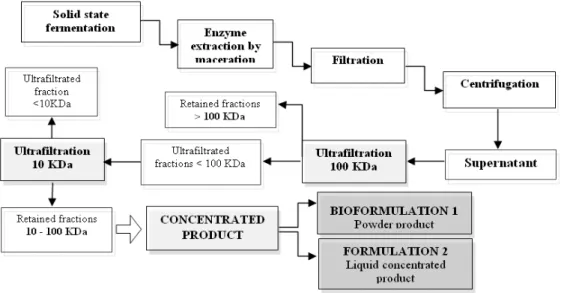
After solid-liquid extraction, filtration and centrifugation steps, the supernatant was submitted to ultrafiltration using different membranes as shown in Figure 1. After this, the phytase formulations were prepared using the fraction acquired among 10 and 100KDa ultra filtration steps, where 100 KDa filtrated fraction was ultra filtrated again in 10KDa membrane and the retained fraction was used in further formulation experiments to avoid enzyme losses.
Solid and liquid formulations
Figure 1 - Downstream steps for recovery phytase produced by S. commune.
RESULTS AND DISCUSSION
Since the molecular weight of the enzyme was estimated after ultrafiltration, using different pore membrane size from 10 to 100 KDa, it was possible to find out in which molecular weight range the produced phytase was in major proportion (Fig. 2). Results showed the molecular weight of the phytase from Schizophyllum sp. was higher than 30 KDa. Further studies would be needed to get purified phytase and to determine its molecular weight. It was in accordance with the phytases reported in the literature, which presented molecular mass between 60 and 110 KDa such as A. niger FS3 phytase with 108 KDa (Spier et al., 2010), A. niger FS3 SK-57 60 KDa (Nagashima etl al.; 1999), A. niger-307 39 KDa (Sariyska et al.; 2005); C, A. ficuum AS3.324 68.5 KDa (Zhang et al., 2005), Cladosporium sp. FP-1 32 KDa (Quan et al., 2004), A. niger commercial phytase (BASF) with 65.7 KDa (Yin et al 2007), and an. A. niger phytase with 100 KDa (Dvorakova et al., 1997). In some cases, glycosylation may increase the molecular weight of phytases (Han et al., 1999). Thus, it would be important to perform glycosylation tests after the purification studies using the produced enzyme to confirm if it could increase its molecular mass, (Han et al., 1999). The crude extract showed 8.26 U/mL phytase which represented 165 U/gds enzyme activity (units per gram of dried substrate) (first column in Fig. 2A). Higher phytase activities were in the range between 30 and 100 KDa. The 10 KDa
membrane resulted 3.67 times concentration, achieving enzymes titres of 30.35 U/mL, while in 30 KDa membrane, the phytase was concentrated 13.27 times (109.66 U/mL). Using a 50 KDa membrane, the concentration achieved was 11.46 times (94.69 U/mL).
As described above, the fractions among 10 and 100 KDa was used for further studies of phytase formulations. The enzyme showed a good stability during cooling and room temperature and lost less than 10% activity in 45 days of storage at 4°C (Fig. 2B), similar losses during the same period of storage at room temperature were observed. After 60 days, phytase still had 67% of its initial activity (Fig. 2B).
Solid formulation containing concentrated phytase retained 77.22% of its activity after 60 days of storage at room temperature. These results indicated that the phytase from Shizophyllum sp. was more stable in solid formulation containing high fiber levels than the concentrated liquid product at room temperature, both without any additives supplementation.
EDTA improved phytase stability during solid-liquid extraction. Thus, besides the addition of manitol and polyethylene glycol, EDTA could also
be another stabilizer agent to improve phytase stability during storage.
Figure 2 - A) Ultrafiltration experiments to concentrate and separate a Schizophyllum sp. phytase produced by solid state fermentation. B) Stability of liquid concentrated phytase during storage time at cooling (4ºC) and room temperature (22ºC).
Table 1 - Remained phytase activity after 15, 30, 45 and 60 days of storage at room temperature.
Liquid concentrated Liquid formulation Solid bioformulation Storage time
(days)
Remained activity (%)
Lost of activity (%)
Remained activity (%)
Lost of activity (%)
Remained activity (%)
Lost of activity (%)
0 100 ± 7.63 0 100 0 100 0
15 97.75 ± 4.72 2.25 99.68 0.32 94.0 6.0
30 96.08 ± 6.45 3.92 95.19 4.81 86.43 13.57
45 93.15 ± 9.13 6.85 94.47 5.53 78.55 21.45
60 67.81 ± 5.98 32.19 89.83 10.17 77.22 22.78
*Formulated contains 1% of manitol (w/v) and 1% polyethylene glycol (w/v); Solid bioformulation: stability of concentrated phytase on solid product containing high fiber levels (mainly pre-treated wheat bran).
S. commune phytase showed good stability in both conditions (room and cooling temperature), losing less than 10% activity in 45 days of storage (Fig. 2B). After this period, the activity decreased considerable. After 100 days, phytase incubated at 4°C retained 40% of its initial activity. At room temperature, phytase retained practically 20% activity after 140 days of storage (Fig. 2B). Nair et al. (2006) described an Aspergillus ficuum phytase
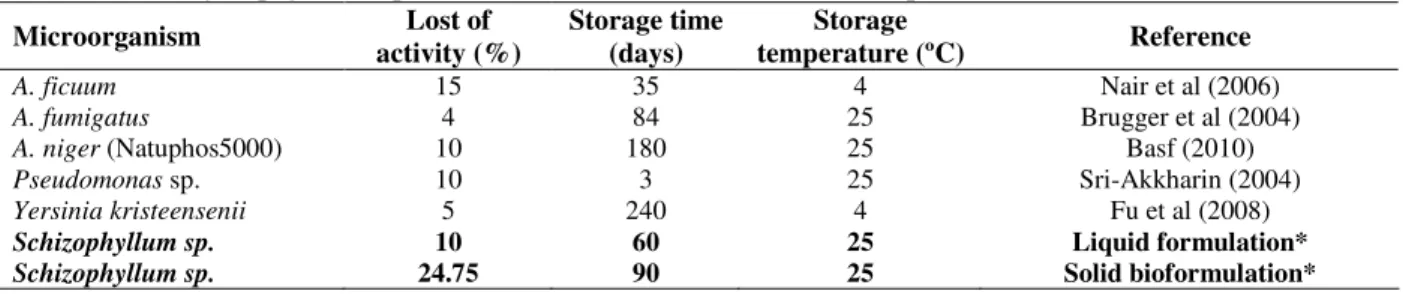
which lost only 15% of its activity in five weeks storage at 4°C. A. fumigatus phytase retained >96% of the initial activity after 12 weeks. Enzymatic product Natuphos® 5000 produced by Aspergillus niger was completely stable for 6 h at room temperature and for at least 12 months at 4ºC (European Commission Commission of Health & Consumer, 2000) (Table 2).
Table 2 - Stability of phytases reported in the literature and achieved in the present work.
* Achieved in this work.
Microorganism Lost of
activity (%)
Storage time (days)
Storage
temperature (ºC) Reference
A. ficuum 15 35 4 Nair et al (2006)
A. fumigatus 4 84 25 Brugger et al (2004)
A. niger (Natuphos5000) 10 180 25 Basf (2010)
Pseudomonas sp. 10 3 25 Sri-Akkharin (2004)
Yersinia kristeensenii 5 240 4 Fu et al (2008)
Schizophyllum sp. 10 60 25 Liquid formulation*
Liquid or dried enzyme was mixed with a natural dried carrier, which was previously incubated at 50°C for 2 h to remove the moisture. This method was also suitable and cost effective for application mainly in feed. Shah et al. (2009) mixed phytase with wheat bran or rice bran and dried at 50°C for 2 h to remove the moisture. The mixture was more suitable than commercial phytase, generally available in granular or powder form. For food applications, further studies would be necessary to verify the application of specific carriers to improve the stability of the enzyme during storage without use of any chemical additives. It would also needto enasure the product is contamination-free and also follows the regulation of the country. The bioformulated product containing high phytase activity could be a good supplement for feed industries. Some studies shows that some feed formulation, mainly for pigs requires high fibre content. Phytase from S. commune was stable in a fiber formulated product.
Schizophyllum sp. phytase produced by solid-state fermentation using wheat bran as substrate presented a high activity of 55.5 U/mL in liquid concentrated product and 6240 U/g of bioformulated powder product. The solid bioformulation had no chemical additives; hence, it was named as a new phytase bioformulation. The liquid formulation showed good shelf-life when stored at room temperature, maintaining 90% of its initial activity after 60 days of storage containing manitol and polyethylene glycol in the formulation.
ACKNOWLEDGEMENTS
The authors would like to thank CNPq (Brazil) for financial assistance.
REFERENCES
Basf (2011) http://www.natuphos.com/Product_List/ Product_List.aspx
Casey, A.; Walsh, G. (2003), Purification and characterization of extracellular phytase from
Aspergillus niger ATCC 9142. Bioresource Technol.,
86(2), 183–188.
Casey, A., Walsh, G. (2004), Identification and characterization of a phytaseof potential commercial interest. J. Biotechnol., 110, 313–322.
Dvorakova, J., Volfova, O., Kopecky, J. (1997), Characterization of phytase produced by Aspergillus niger. Folia Microbiol., 42, 349–352.
Eeeckout, I.M. (2000), Phytase quality suffers from steam pelleting and storage temperature. Feed Tech.,
4(2), 18–21.
Health & Consumer Protection Directorate-General (2010), Directorate B - Scientific Health Opinions, Unit B3 - Management of scientific committees II, Opinion of the use of enzymatic product Natuphos® 5000 (3-phytase; EC 3.1.3.8) as feed additive (adopted on 27 April 2000), Access in 20th Jun 2010. Heinonen, J.K., Lahti, R.J. (1981), A new and
convenient colorimetric determination of inorganic orthophosphate and its application to the assay of inorganic pyrophosphatase. Anal Biochem., 113, 313– 317.
Konietzny, U., Greiner, R. (2002), Molecular and catalytic properties of phytate-degrading enzymes (phytases). Int J Food Sci Technol., 37, 791–812. Pallauf J., Rimbach G. Nutritional significance of
phytic acid and phytase. Arch. Anim. Nutr., 50, 301– 319, 1997.
Quan C.S., et al (2004), Purification and properties of a low-molecular-weight phytase from Cladosporium
sp. FP-1. J. Biosci. Bioeng., 97, 260–266.
Nagashima, T. et al (1999), Dephosphorylation of phytate by using the Aspergillus niger phytase with a high affinity for phytate. Appl Environ Microbiol.,
65, 4682–4684.
Nair, V.C., Laflamme, J., Duvnjak, Z. (2006), Production of phytase by Aspergillus ficuum and reduction of phytic acid content in canola meal. J. Sci Food Agriculture, 54(3),355 – 365.
Rodríguez-Fernández; D.E.; et al (2010) Recovery of phytase produced by solid-state fermentation on citrus peel. Braz. Arch. Biol. Technol.,53 (6), 1487-1496
Sandberg, A.S; Andlid, T. (2002), Phytogenetic and microbial phytases in human nutrition. Int. J. Food Sci. Technol, 37, 823-833.
Sariyska, M.V. et al (2005), Aspergillus niger phytase: purification and characterization. Biotechnol Eq.
19/2005/3
Shah P., et al (2009), Strain improvement and up scaling of phytase production by Aspergillus niger
NCIM 563 under submerged fermentation conditions.
J. Ind Microbiol Biotechnol, 36, 373–380.
Spier, M.R.; et al. (2010), Phytase produced on citric byproducts: purification and characterization. World J. Microbiol. Biotechnol. DOI 10.1007/s11274-010-0455-y.
Sri-Akkharin, W. (2004), Production and characterization of extracellular phytase from Pseudomonas sp. Degree of master of Science Biotechnology Faculty of Graduate Studies of Mahidol University, 2004.
Zhang, L.; et al (2005), Properties of A. ficuum
AS3.324 phytase expressed in tobacco. Process Biochem., 40, 213–216.
Yin, Q.Q.; et al (2007), Biochemical characteristics of phytases from fungi and the transformed microorganism. Anim. Feed Sci. Technol., 132, 341– 350.