(Annals of the Brazilian Academy of Sciences) ISSN 0001-3765
www.scielo.br/aabc
Sedimentary changes on the Southeastern Brazilian upper slope
during the last 35,000 years
MICHEL M. MAHIQUES1, MARINA M. FUKUMOTO2, ILSON C.A. SILVEIRA1 RUBENS C.L. FIGUEIRA3, MARCIA C. BÍCEGO1, RAFAEL A. LOURENÇO2
and SILVIA H. MELLO-E-SOUSA1
1Instituto Oceanográfico da Universidade de São Paulo, Departamento de Oceanografia Física, Química e Geológica
Praça do Oceanográfico, 191, 05508-900 São Paulo, SP, Brasil
2Programa de Pós-graduação em Oceanografia Química e Geológica, Instituto Oceanográfico da Universidade de São Paulo
Praça do Oceanográfico, 191, 05508-900 São Paulo, SP, Brasil
3Universidade Cruzeiro do Sul, Av. Dr. Ussiel Cirilo, 225, 08060-070 São Paulo, SP, Brasil
Manuscript received on February 1, 2006; accepted for publication on April 24, 2006; presented byMÁRCIOM. PIMENTEL
ABSTRACT
A first evaluation of the sedimentary changes, including accumulation of inorganic and organic carbon on the upper slope off Southeastern Brazil under different climatic conditions, based on the analysis of a sedimentary core, is here presented. Results indicate that sedimentation rate as well sedimentary characteristics, including the nature of the organic carbon deposited during the LGM (Last Glacial Maximum), were different from the present deposition, indicating higher primary productivity during the LGM, to be accounted for by the higher values of marine organic carbon. Nevertheless, the higher values of Accumulation Rate of calcium carbonate and organic carbon can be credited to the higher values of the sedimentation rates. Conditions prevailing during Isotope Stage 3 may be considered intermediate as between the LGM and the present day. The conditions for a higher primary productivity associated with the deposition of finer terrigenous sediments may be explained as a response to the offshoreward displacement of the main flow of the Brazil Current.
Key words:sedimentation, accumulation rate, upper slope, Southeastern Brazil.
INTRODUCTION
Due to the lack of significant upwelling areas as well as to a relatively limited fluvial input the western South Atlantic tropical and subtropical margins have been much less intensively studied than its eastern counter-parts (Cohen and Tyson 1995, Ternois et al. 2000, de-Menocal et al. 2000, Sicre et al. 2001).
At the present time, the displacement of the warm waters of the Brazil Current leads to low levels of primary productivity, with consequent small amounts of sedimen-tary organic matter (Mahiques et al. 1999), exceptions being related to some few coastal upwelling areas and
Correspondence to: Michel Michaelovitch de Mahiques E-mail: [email protected]
river mouths (Mahiques et al. 2005). However, almost nothing is known about the paleoproductivity of the east-ern Brazilian margin under different paleoclimatic con-ditions.
As a function of its importance in CO2 dynamics
According to Mollenhauer et al. (2004), during the LGM the accumulation of organic carbon in deep basins of the tropical and subtropical South Atlantic was two to three times greater than during the Holocene. On the other hand, those authors observe that the accumulation of organic carbon during the LGM was not related to a corresponding increase in the paleoproductivity but was, rather, related to changes in the chemistry of the South Atlantic water masses as well as to the exposure of the continental shelves and, consequently, to the direct input of terrigenous organic matter to deeper areas.
A first evaluation of the sedimentary changes, in-cluding accumulation of inorganic and organic carbon on the upper slope off Southeastern Brazil, under differ-ent climatic conditions and based on the analysis of a sedimentary core, is here provided.
MORPHOLOGY AND OCEANOGRAPHY OF THE STUDY AREA
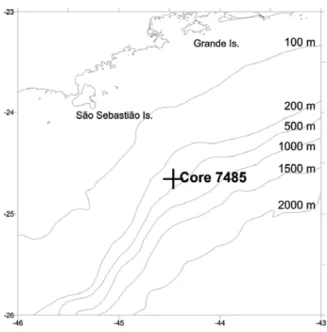
The study area corresponds to the upper slope off Southeastern Brazil (Figure 1), in the morphologic sec-tor of the Brazilian margin known as the São Paulo Bight. The São Paulo Bight is the arc-shaped part of the eastern Brazilian margin extending from 23◦S to 28◦S
(Zembruscki 1979).
The ocean floor of the São Paulo Bight shows a rather complex morphology involving channels, can-yons, and considerable variations in the slope morphol-ogy (Furtado et al. 1996). The shelf break is located at a depth of approximately 140 meters with the up-per slope showing an average gradient of approximately 1:55. In the eastern sector off São Sebastião island, close to the 600-m isobath (25◦S, 44◦30’W), the upper slope
changes into a fan-shaped feature at the end of the Búzios Channel.
On the middle and outer shelves as well as on the upper slope, sedimentary processes are influenced by the flow of the BC (Brazil Current) along the western At-lantic continental margin (Mahiques et al. 2002, 2004). The BC transports Tropical Water (TW, T = 25.0◦C,
S = 37.1) at upper levels and South Atlantic Central Wa-ter (SACW, T = 14.0◦C, S = 35.5) at pycnocline levels
(Miranda 1985, Silveira et al. 2001). The BC main flow is centered on the 1000 meter isobath (N. Garfield, un-published data).
Fig. 1 – Location of the core studied in this project.
According to Campos et al. (2000), the BC devel-ops a convoluted pattern of meanders in the vicinity of Cape Frio. The reason for this is the change in the lie of the Brazilian coastline, which contributes to the forma-tion of a clockwise meander of the BC in the latter’s at-tempt to conserve angular momentum. The consequence is a vortical structure with upwelling associated with its southernmost part and downwelling with its northern-most part. A counter-clockwise meander is often found downstream of the Cape Frio meander and a topographic Rossby wave pattern is observed inside the São Paulo Bight.
The distribution of surface sediments on the South-eastern Brazilian margin was extensively studied during the 70’s and is described in the papers of Rocha et al. (1975) and Kowsmann and Costa (1979). In general, the present sea-loor is covered by very fine siliciclas-tic sands and silts, with variable amounts of clay and calcium carbonate. Coarser sediments and carbonate gravel and boulder facies, found on the outer shelf, rep-resent less than 5% of the prep-resent bottom sediments and are generally related to relict sediments, deposited under lower sea-level conditions. More recently, Mahiques et al. (2002, 2004) have re-evaluated the sedimentary char-acteristics of the Southeastern Brazilian shelf and pro-posed hydrodynamic models for the sediment deposition in the area.
MATERIALS AND METHODS
A 203-cm long sediment core was collected during a 2003 cruise on board the R.V. “Prof. W. Besnard”. Geo-graphical coordinates were 24◦39.27′S and 044◦27.74′W
and water depth is 374 meters (Figure 1). Magnetic sus-ceptibility measurements were performed on board using a Bartington MS2C sensor.
After the core had been opened it was described and sampled continuously at 2 cm intervals. Sediment samples were frozen for later freeze-drying.
The age model for core 7485 was based on ten ac-celerator mass spectrometry (AMS) radiocarbon datings of foraminifera tests, as presented in Table I. All datings were performed at Beta Analytic Inc. (USA). The SW Atlantic Reservoir correction (R = 87, U = 46) was
ap-plied to the samples. Grain size was determined from decarbonated samples in a Malvern Mastersizer 2000 analyzer. Calcium carbonate content was determined via weight difference prior to and after the acidification of 1g of the sample with a 10% hydrochloric acid solution (Gross 1971). A comparison of this method with in-organic carbon determination in a LECO CNS2000 an-alyzer was performed for 10% of the samples and the results proved compatible.
Organic carbon and total nitrogen were determined in a LECO CNS2000 analyzer. Approximately 200 mg of dry sediment of each sample was treated with 1N HCl in order to remove calcium carbonate and then freeze-dried and analyzed. LECO soil standards and blanks
TABLE I
Radiocarbon ages of core 7485.
Depth (cm) BETA Number
Conventional Radiocarbon Age (yr B.P.)
1 189509 3020 ± 40
11 189510 7420 ± 40
21 189511 14230 ± 90
31 185176 17240 ± 90
51 185177 18070 ± 160
77 185178 18560 ± 140
127 185179 19700 ± 250
151 185180 21750 ± 160
171 185181 24860 ± 270
201 185182 34800 ± 400
were analyzed as controls for each set of 30 samples. Values ofδ13CPDBof the sedimentary organic
con-tent were obtained by mass spectrometry at the Coastal Science Laboratories (Austin, TX, USA). Carbon iso-tope analyses were performed by online combustion with a Fisons NA1500 Elemental Analyzer attached to a VG SIRA Model 10 mass spectrometer. Carbon isotope was calibrated using the NBS 22 oil standard (defined as
−29.60◦/◦◦ relative to PDB). Reproducibility for carbon
isotope was better than 0.2◦/ ◦◦ .
Mass accumulation rates of calcium carbonate (CaCO3 MAR) and organic carbon (orgC MAR), in
g.cm−2.kyr−1, were calculated in accordance with the
formula described in Grant and Dickens (2002):
CaCO3MAR (ororgC MAR)=
(%CaCO3(or %orgC))/100∗SR∗DBD∗1000
where SR is the sedimentation rate (cm.yr−1)obtained
from the age model and DBD is the dry bulk density (g.cm−3), calculated from:
DBD=(1−φ/100)∗ρs
whereφis the wet porosity andρsis the density of the
sediment particles, previously determined as 2.35g.cm–3.
The wet porosity(φ)was calculated using the
for-mula proposed by Clifton et al. (1995):
φ= ((W/100) ∗ρ
s) (((W/100)∗ρ
where W is the water content (in %),ρsthe density of
the sediment particles, i.e. 2.35 g.cm−3, andρ
wthe
den-sity of the pore water, assumed to be 1.0 g.cm−3.
RESULTS AND DISCUSSION
Results are presented in Figures 2 to 6.
CORE DESCRIPTION, AGE-MODEL AND SEDIMENTATION
RATES(FIGURE2)
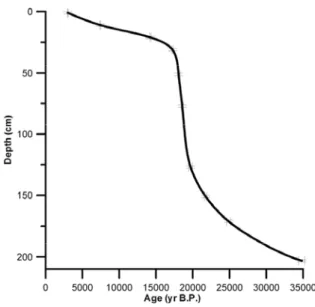
Fig. 2 – Age model for core 7485.
The whole core is composed of massive greenish-gray silty sediments, with a greater sandy contribution in the bottommost 40 cm as well as in the topmost 15 cm. Bioclasts are dispersed within the matrix and no other sedimentary structure can be observed along the core.
The establishment of a reliable model for depth-age relationships is a key question for all of the studies involving sediment accumulation and has been recently criticized by Telford et al. (2004). A basic assumption determined by these authors is that age-depth models are only meaningful and useful when established using cal-ibrated radiocarbon ages. Nevertheless, due to the time span limitation of radiocarbon calibration this assump-tion is frequently not taken into consideraassump-tion and age-depth models are used for much longer time intervals.
In order to evaluate the effect of the age-depth models on the values of sedimentation rates and, con-sequently, sediment accumulation, we tested several
in-terpolation procedures (polynomial, linear inin-terpolation between radiocarbon values, cubic spline and mixed ef-fect). Polynomial, linear interpolation and cubic spline models were calculated using the DepthAge software, developed by Louis Maher Jr. and available at the INQUA file boutique at http://www.geology.wisc.edu/
∼maher/ inqua.html (last accessed December 15, 2006).
The mixed-effect model was calculated by means of the Cagedepth and Cagenew functions as described by Hee-gard et al. (2005) and available at http://www.uib.no/ bot/qeprg/Age-depth.htm (last accessed December 15, 2005).
One particularity of the data here presented is the apparently extreme change in sedimentation rates as be-tween LGM and Holocene, as shown by the radiocar-bon data. This characteristic leads to the obtention of negative sedimentation rate values when using most of the polynomial approaches, despite their high statistical significance. This problem was also observed when the mixed-effect model was used. In this sense, the only age-depth models which could be assumed to be reliable were the cubic spline and linear interpolation between radiocarbon values. As stated by Grant and Dickens (2002), the linear interpolation leads to artificial sedi-mentation rate values and, consequently, the cubic spline approach was adopted as the age-depth model and used for the calculation of sedimentation rates and accumula-tion values.
The core covers an age range of 34,800 years. There was not any age inversion in the radiocarbon datings. Holocene sediments correspond only to the first 19 cm of the sedimentary column, revealing a sedimentation rate ranging from 0.0014 to 0.0026 cm.yr−1for the period.
Most of the sedimentary column (from cm 19 to cm 160, approximately) consists of Isotope Stage 2 sediments and higher sedimentation rates are found in this period, be-tween 18,800 to 18,700 years B.P. During Isotope Stage 3, sedimentation rates remained approximately constant (between 0.0300 and 0.0500 cm.yr−1).
Fig. 3 – Variations in magnetic susceptibility and grain-size in core 7485. Isotope stage limits based on Martinson et al. (1987).
off northern Norway. The same behavior was observed for an equivalent period on the shelf off NE Iceland (Andresen et al. 2005).
MAGNETICSUSCEPTIBILITY ANDGRAIN-SIZE(FIGURE3)
There is a conspicuous change in magnetic susceptibility as between Isotope Stage 2 and the younger sediments in the core. Values higher than 23.10−5S.I. are found
only in sediments older than 18,000 years B.P., revealing a considerable change in inorganic terrigenous input to the study area. From the LGM to the present time there is a gradual decrease in magnetic susceptibility values. Isotope 3 sediments show susceptibility values of the same magnitude as those of Stage 2. Magnetic suscepti-bility values indicate that, in comparison with the Holo-cene sediments, the samples from stages 3 and 2 present values that may be considered relatively high, suggest-ing that the input of terrigenous sediments dursuggest-ing these periods remained approximately constant.
The grain size, revealed by the graphs of time versus median size (inµm) and sand content (%) shows a
con-siderable fining upward, from Stage 3 sediments (50µm,
35% of sand) towards the LGM (20µm, less than 15% of
sand). There is a coarsening trend from this age towards the top of the core (45µm, more than 25% of sand).
An integrated analysis of magnetic susceptibility and grain-size indicates that, together with a more ef-ficient terrigenous input, probably as a consequence of the narrowing of the shelf during Isotope Stages 3 and 2, there is a clear change in hydrodynamic conditions when the shelf is totally or partially flooded (Isotope Stage 3 and Holocene). The prevalence of finer sed-iments during the LGM suggests a weakening and/or an offshoreward displacement of the main upper-slope hydrodynamic agent, i.e. the Brazil Current, leading to a diminishing capacity of sediment remobilization during the period. Prior to ca. 30,000 years B.P. the hydrody-namic conditions were more energetic than those of the Holocene.
CALCIUMCARBONATECONTENT ANDCARBONATEMASS
ACCUMULATIONRATE(FIGURE4)
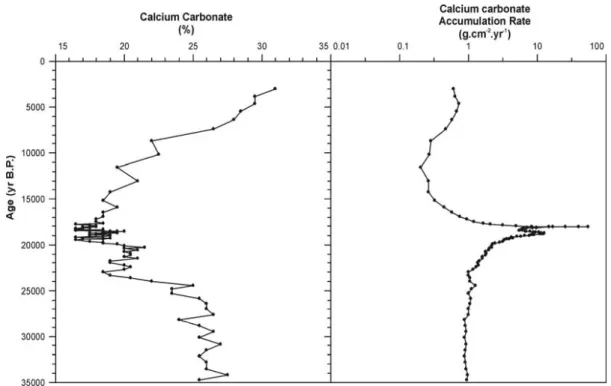
val-Fig. 4 – Variations in calcium carbonate content and carbonate Mass Accumulation Rate in core 7485. Isotope stage limits based on Martinson et al. (1987).
ues as low as 16%. There is a continuous increase in carbonate content from 15,000 years towards the top of the core where values are of around 30%.
On the other hand the Carbonate Mass Accumu-lation Rate (CaCO3MAR) has been greatly influenced
by the significant changes in sedimentation rates along the core. Values which represent two orders of mag-nitude higher than those of the Holocene samples are found around 18,000 to 19,000 years B.P., smaller vari-ations having been virtually obliterated. While Isotope Stage 3 sediments show accumulation rates of less than 1.0 g.cm−2.kyr−1 and those of the post-Last Glacial
Maximum exhibit values smaller than 0.8 g.cm−2.kyr−1,
the Isotope Stage 2 sediments show values as high as 55 g.cm−2.kyr−1, which can be clearly assumed to be
an overestimate, especially considering the percentages of calcium carbonate and its dilution due to the higher terrigenous input during the LGM.
Temporal variations in carbonate accumulation rates, associated with changes in sedimentation rates, have been established by Agnihotri et al. (2003) for the Arabian Sea.
ORGANIC CARBON, TOTAL NITROGEN, C/N RATIO AND
δ13CPDB(FIGURE5)
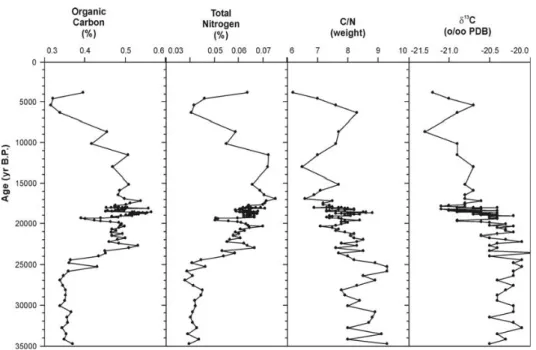
There is a slight increase in the organic matter content in the LGM samples, as revealed by the organic carbon and total nitrogen values. In general, samples from Stage 3 and the Holocene show organic carbon lower than 0.3% and total nitrogen lower than 0.05%; samples from the LGM showing values higher than 0.4% and 0.05%, re-spectively for carbon and nitrogen. There is an unex-pected continuous increase in C/N ratio values towards the base of the core. Since the organic character of the nitrogen may be guaranteed by the high correlation be-tween organic carbon and total nitrogen (R = 0.90), it seems that the higher C/N ratio values at the base of the core are much more closely related to the low nitrogen values than to a post-depositional effect.
The C/N ratio trend is also contradicted by the be-havior ofδ13CPDBvalues along the core. Higherδ13CPDB
values (around −20.4◦/◦◦) are present along the
Fig. 5 – Variations in organic carbon, total nitrogen, C/N ratio andδ13C in core 7485. Isotope stage limits based on Martinson et al. (1987).
post-LGM sediments maintain their tendency to lighter isotope values. The apparent contradiction between
δ13CPDBand C/N values may be related to partial
degra-dation of algal organic matter, leading to the decrease in the proteinaceous components and, hence, to that of the C/N ratio, also (Meyers 1997).
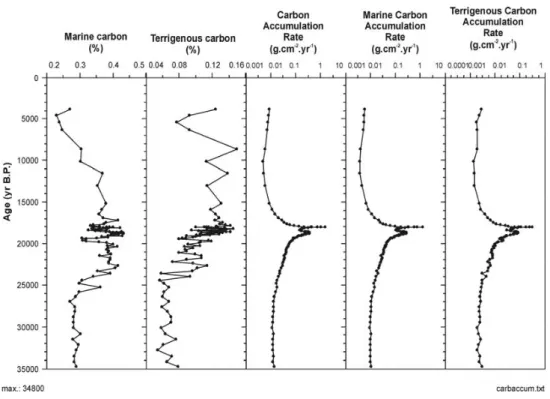
MARINE ANDTERRESTRIALORGANICCARBONCONTENT ANDACCUMULATIONRATES(FIGURE6)
According to McKay et al. (2004) it is necessary to estimate the relative abundance of marine and terrestrial organic matter when using organic carbon as a proxy for paleoproductivity. In our study this estimate has been made by using the following equation:
Terrigenous fraction= (δ 13C
PDBsample−δ13CPDBmar) (δ13CPDBterr−δ13CPDBmar)
where δ13CPDBmar and δ13CPDBterr correspond to the
marine and terrestrial end-members, respectively. This same procedure has been used successfully by Minoura et al. (1997), Fernandes and Sicre (2000) and McKay et al. (2004).
Mahiques et al. (1999) used the δ13CPDB values
of −19.0◦/◦◦ and −26.0◦/◦◦ for marine and terrestrial
end-members, respectively, on the Southeastern Brazil-ian shelf. Matsuura and Wada (1995) reportedδ13CPDB
values ranging from−20.5◦/◦◦ to−21.1◦/◦◦ for
plank-ton and−26.1◦/◦◦ for tree leaves from the coast off
Uba-tuba (SE Brazil); nevertheless care must be taken since these planktonδ13CPDBvalues represent not only
phyto-but, also, microzooplankton. In the Cananéia estuarine system (SE Brazil), Barcellos et al. (2005) determined averageδ13CPDBvalues of−25.6◦/◦◦ for mangrove trees
and−19.4◦/◦◦ for phytoplankton.
Due to the relatively small importance of the man-grove vegetation, in comparison with other tropical and subtropical rainforests of the Southeastern Brazilian coast, it may be assumed that the δ13CPDB values of −26.0◦/◦◦ and−19.0◦/◦◦ can be used as reliable
end-members for the determination of the amounts of ter-restrial and marine organic matter, respectively. The amounts of marine and terrestrial organic carbon as well as their accumulation rates have been calculated on the basis of this assumption. Higher values of marine organic carbon (>0.4% org Cmarine)are found between 24,000
and 18,000 years B.P.
Fig. 6 – Variations in marine and terrestrial organic carbon content and accumulation rates in core 7485. Isotope stage limits based on Martinson et al. (1987).
in the calcium carbonate accumulation rate. Total or-ganic carbon exhibits values ranging from 0.005 to 1.580 gC.cm−2.ky−1, higher values being found between
19,000 and 18,000 years B.P. Analogous behavior is to be observed in the marine and terrigenous organic car-bon accumulation rates. In all of these parameters, the values for Isotope Stage 3 and the Holocene remain ap-proximately constant, that for the latter being slightly smaller.
Very high differences in carbon accumulation rates under different paleoclimatic conditions have been ob-served in several areas. Agnihotri et al. (2003) identified a decoupling of carbon accumulation from productiv-ity; according to those authors, changes in sedimentation rates might be responsible for the better preservation of carbon during the LGM. Schlunz et al. (2000) also found a relationship between Total Organic Carbon Accumula-tion Rates and SedimentaAccumula-tion Rate and the eustatic curve, in the Barbados area. In the Arabian Sea, the organic carbon accumulation rate does not show any relationship with other paleoproductivity proxies (Pattan et al. 2003).
The changes in the sedimentary characteristics, as well as the occurrence of changes in inorganic and or-ganic carbon deposition and accumulation rates on the Southeastern Brazilian shelf during the LGM, may be ex-plained by a simple conceptual model involving changes in shelf width as well as the position of the Brazil Current under different climatic conditions (Figure 7). During the periods of higher sea-level, corresponding to Isotope Stage 3 and the Holocene, the displacement of the warm waters of the Brazil Current towards the coast prevents the increase in water productivity. Further, the scouring action of the Brazil Current on the sea-bed, as demon-strated by the bigger grain size values, prevents the de-position of mud and, consequently, of organic matter. Very low sedimentation rates are a consequence of a “floor-polisher” effect on the sea-bottom, described by Mahiques et al. (2004) for the study area.
ter-Fig. 7 – Schematic model for the position of the Brazil Current (BC) under different climatic conditions (a) Present and Isotope Stage 3 and (b) Last Glacial Maximum.
rigenous materials. Finer sediments are deposited as a consequence of changes in the competence of the main upper slope hydrodynamic agent.
The offshoreward displacement of the Brazil Cur-rent has also been reported by Viana et al. (1998) for the Campos continental margin, northward of this present study area. Nevertheless, in the Campos area this dis-placement was used to explain a trend of more highly energetic conditions on the upper slope during glacial lowstand stages. In fact, this might be acceptable for the areas which are presently within the transitional zone between the southward flow of the BC (Brazil Current), which transports the TW (Tropical Water) and the SACW (South Atlantic Central Water), and the northward flow of the IWBC (Intermediate Western Boundary Current), transporting AAIW Antarctic Intermediate Water) (Sil-veira et al. 2004). In this area, the inversion of flow is responsible for the low current speeds at depths between 400 and 500 meters.
CONCLUSIONS
The analysis of sedimentological constituents in a sediment core spanning a time interval of approxim-ately 35,000 years indicates the occurrence of signifi-cant changes in the sedimentation on the upper slope off Southeastern Brazil. Besides the changes in the amount of organic carbon deposited it has been established that during the LGM there was an increase in the marine pro-ductivity of the area, as revealed by the occurrence of higher levels of marine organic carbon.
Care must be taken with the extremely high values found for the accumulation rates of calcium carbonate and organic carbon during the LGM since they may have been influenced by the higher values of the sedimentation rates in that period.
A conceptual model, in which the offshoreward dis-placement of the main flow of the BC during periods of lower sea level, may be used to explain the differences between this period and Isotope Stage 3 and the Holo-cene. During the periods of higher sea-level the displace-ment of the warm waters of the BC towards the coast prevented any increase in water productivity as also of the deposition of organic matter. During periods of lower sea-level, the input of nutrients as well as of terrigenous materials favored the productivity and deposition of or-ganic carbon.
ACKNOWLEDGMENTS
The authors are indebted to the crew of the R.V. “Prof. W. Besnard” and to the researchers who joined the “Buzios project” cruise in September 2003. Financial support was provided by Fundação de Amparo à Pesquisa do Estado de São Paulo (FAPESP), by grants 01/13490-9 and 03/10740-0.
RESUMO
deposi-cionais atuais, indicando maior produtividade primária durante o UMG, como determinado pelos maiores valores de carbono orgânico marinho. Entretanto, os maiores valores de Taxa de Acumulação de carbonato de cálcio e carbono orgânico podem ser creditados aos valores mais altos de taxas de sedimentação. As condições prevalentes durante o Estágio Isotópico 3 podem ser consideradas intermediárias entre o UMG e as condições atuais. As condições para maior produtividade primária, asso-ciada à deposição de sedimentos mais finos, podem ser expli-cadas como uma resposta ao deslocamento, em direção ao mar aberto, do fluxo principal da Corrente do Brasil.
Palavras-chave: sedimentação, taxa de acumulação, talude
superior, Sudeste do Brasil.
REFERENCES
AGNIHOTRI RA, SARIN MM, SOMAYAJULUBLK, JULL
AJT AND BURR GS. 2003. Late-Quaternary biogenic
productivity and organic carbon deposition in the east-ern Arabian Sea. Palaeogeogr Palaeoclimatol Palaeoecol 197: 43–60.
ANDRESENCS, BONDG, KUIJPERS A, KNUTZPC AND
BJÖRN S. 2005. Holocene climate variability at multi-decadal time scales detected by sedimentological indi-cators in a shelf core NW off Iceland. Mar Geol 214: 323–338.
BARCELLOSRL, CAMARGOPB, BRIZZOTTIMANDFUR -TADOVV. 2005. Seasonal stable carbon isotope (δ13C) variations in sediments of the Cananéia-Iguape lagoonal estuarine system, São Paulo State, Southeastern Brazil. In: 10thINTERNATIONALSYMPOSIUM ON“THE INTERAC -TIONS BETWEEN SEDIMENTS AND WATER”. Abstracts. RMZ – Materials and Geoenvironment 52: 188. CAMPOS EJD, VELHOTE D AND SILVEIRA ICA. 2000.
Shelf break upwelling driven by Brazil Current cyclonic meanders. Geophys Res Letts 27: 751–754.
CASTROFILHOBM, MIRANDALBANDMIYAOSY. 1987.
Condições hidrográficas na plataforma continental ao lar-go de Ubatuba: variações sazonais e em média escala. B Inst Ocean São Paulo, SP, Brasil 35: 135–151.
CLIFTONRJ, WATSONPG, DAVEYJTANDFRICKERSPE. 1995. A study of processes affecting the uptake of con-taminants by intertidal sediments, using the radioactive tracers:7Be,137Cs and unsupported210Pb. Estuar coast Shelf Sci 41: 459–474.
COHENALANDTYSONPD. 1995. Sea-surface temperature-fluctuations during the Holocene off the south coast of
Africa – Implications for terrestrial climate and rainfall. Holocene 5: 304–312.
DEMENOCAL P, ORTIZ J, GUILDERSON T AND SARN
-THEINM. 2000. Coherent high- and low-latitude climate variability during the Holocene warm period. Science 288: 2198–2202.
FERNANDESMBANDSICRE MA. 2000. The importance
of terrestrial organic carbon inputs on Kara Sea shelves as revealed by n-alkanes, OC andδ13C values. Org Geochem 31: 363–374.
FURTADO VV, BONETTI FILHOJ ANDCONTILA. 1996. Paleo river morphology and sea level changes at south-eastern Brazilian continental shelf. An Acad Bras Cienc 68: 163–169.
GIRAUDEAUJ, MEYERSPAANDCHRISTENSENBA. 2002. Accumulation of organic and inorganic carbon in Pliocene-Pleistocene sediments along the SW African margin. Mar Geol 180: 49–69.
GRANTKMANDDICKENSGR. 2002. Coupled productivity
and carbon isotope records in the southwest Pacific Ocean during the late Miocene – early Pliocene biogenic bloom. Palaeogeogr Palaeoclimatol Palaeoecol 187: 61–82. GROSSMG. 1971. Carbon determination. In: CARVERRE
(Ed), Procedures in Sedimentary Petrology, New York: Wiley-Interscience, p. 573–596.
HEEGARDE, BIRKSHJB ANDTELFORDRJ. 2005.
Rela-tionships between calibrated ages and depth in stratigraph-ical sequences: an estimation procedure by mixed-effect regression. Holocene 15: 612–618.
KNIESJ. 2005. Climate-induced changes in sedimentary re-gimes for organic matter supply on the continental shelf off northern Norway. Geochim Cosmochim Acta 69: 4631– 4647.
KOWSMANN ROANDCOSTA MOA. 1979. Sedimentação
quaternária da margem continental brasileira e das áreas oceânicas adjacentes (relatório final). In: PROJETO RE-MAC. Petrobras, Rio de Janeiro, RJ, Brasil, p. 1–55. MAHIQUESMM, MISHIMAYANDRODRIGUESM. 1999.
Characteristics of the sedimentary organic matter on the inner and middle continental shelf between Guanabara Bay and São Francisco do Sul, eastern Brazilian margin. Continent Shelf Res 19: 775–798.
MAHIQUESMM, SILVEIRA ICA, SOUSA SHM ANDRO
-DRIGUESM. 2002. Post-LGM sedimentation on the outer shelf / upper slope of the northernmost part of the São Paulo Bight, eastern Brazil. Mar Geol 181: 387–400. MAHIQUES MM, TESSLER MG, CIOTTI AM, SILVEIRA
FURTADOVVANDPASSOSRF. 2004. Hydrodynamic-ally-driven patterns of recent sedimentation in the shelf and upper slope off southeast Brazil. Continent Shelf Res 24: 1685–1697.
MAHIQUES MM, BÍCEGO MC, SILVEIRA ICA, SOUSA
SHM, LOURENÇO RA AND FUKUMOTO MM. 2005.
Modern sedimentation in the Cabo Frio upwelling sys-tem, Southeastern Brazilian shelf. An Acad Bras Cienc 77: 535–548.
MARTINSON DG, PISIAS NG, HAYS JD, IMBRIE J, MOORE-JRTCANDSHACKLETONNJ. 1987. Age dat-ing and the orbital theory of the Ice Ages: Development of a high-resolution 0 to 300,000-year chronostratigraphy. Quatern Res 27: 1–29.
MATSUURAYANDWADAE. 1995. Carbon and nitrogen
sta-ble isotope ratios in marine organic matters of the coastal ecosystem in Ubatuba, southern Brazil. Cienc Cult 46: 141–146.
MCKAYJL, PEDERSENTF ANDKIENASTSS. 2004. Or-ganic carbon accumulation over the last 16kyr off Van-couver Island, Canada: evidence for increased marine productivity during the deglacial. Quatern Sci Revs 23: 261–281.
MEYERS PA. 1997. Organic geochemical proxies of
pa-leoceanographic, paleolimnologic and paleoclimatic pro-cesses. Org Geochem 27: 213–250.
MINOURAK, HOSHINOK, NAKAMURATANDWADAE. 1997. Late Pleistocene-Holocene paleoproductivity cir-culation in the Japan Sea: sea-level control onδ13C and δ15N records of sediment organic material. Palaeogeogr Palaeoclimatol Palaeoecol 135: 41–50.
MIRANDALB. 1985. Forma de correlação T-S de massa de
água das regiões costeira e oceânica entre o Cabo de São Tomé (RJ) e a Ilha de São Sebastião (SP), Brasil Bolm Inst Oceanogr S Paulo 33: 105–119.
MOLLENHAUERG, SCHNEIDERRR, JENNERJAHNT, MÜL
-LERPJANDWEFERG. 2004. Organic carbon accumu-lation in the South Atlantic Ocean: its modern, mid-Holo-cene and last glacial distribution. Glob Planet Change 40: 249–266.
PATTANJN, MASUZAWAT, NAIDUD, PARTHIBANGAND
YAMAMOTOPM. 2003. Productivity fluctuations in the southeastern Arabian Sea during the last 140 ka. Palaeo-geogr Palaeoclimatol Palaeoecol 193: 575–590. ROCHAJ, MILLIMANJD, SANTANACIANDVICALVIMA.
1975. Continental margin sedimentation off Brazil. Part 5: Southern Brazil. Contr Sedimentol 4: 117–150. SCHLUNZB, SCHNEIDERRR, MULLERPJANDWEFERG.
2000. Late Quaternary organic carbon accumulation south of Barbados: influence of the Orinoco and Amazon rivers? Deep-Sea Res I 47: 1101–1124.
SICRE MA, TERNOIS Y, PATERNEM, MARTINEZ PAND
BERTRANDP. 2001. Climatic changes in the upwelling region off Cap Blanc, NW Africa, over the last 70 kyear: a multi-biomarker approach. Org Geochem 32: 981–990. SILVEIRAICA, SCHMIDTACJ, CAMPOSEJD, GODOISS ANDIKEDAY. 2001. A Corrente do Brasil ao Largo do
Sudeste Brasileiro. Rev Bras Oceanogr 48: 171–183. SILVEIRA ICA, CALADO L, CASTRO BM, CIRANO M,
LIMA JAM AND MASCARENHAS AS. 2004. On the baroclinic structure of the Brazil Current – Intermediate Western Boundary Current system at 22◦–23◦S. Geophys Res Lett 31: LI4308.
TELFORDRJ, HEEGARDEANDBIRKSHJB. 2004. All age-depth models are wrong: but how badly? Quat Sci Rev 23: 1–5.
TERNOISY, SICREMAANDPATERNEM. 2000. Climatic
changes along the northwestern African continental mar-gin over the last 30 kyrs. Geophys Res Letts 27: 133–136. VIANAAR, FAUGERESJC, KOWSMANNRO, LIMAJAM, CADDAHLFGANDRIZZPJG. 1998. Hydrology, mor-phology and sedimentology of the Campos continental margin, offshore Brazil. Sedim Geol 115: 133–157. ZEMBRUSCKI SG. 1979 Geomorfologia da margem
conti-nental sul brasileira e das bacias oceânicas adjacentes. In: CHAVESHAF (Ed), Geomorfologia da margem