Rua do Lago, 562, 05508-080 São Paulo, SP, Brasil
3PETROBRAS – E&P EXP/GEO/GEAT, Av. República do Chile, 65, 20031-912 Rio de Janeiro, RJ, Brasil
Manuscript received on September 17, 2007; accepted for publication on March 25, 2008; presented byALCIDESN. SIAL
ABSTRACT
Structural analysis carried out on a segment of the Neoproterozoic Ribeira Belt, southeastern Brazil, show that it represents part of the transpressive dextral orogen related to the Central Mantiqueira Province. NNE-trending and steeply dipping regional mylonitic belts form anastomosed geometry, and describe a map-scale, S-C-like structure that is characterized by their deflection towards NE near the Além Paraíba Lineament. Lithological and structural control related to deformation partition were responsible for the formation of felsic mylonitic granulites with S-type granites lenses developed in ductile shear zones, alternated with less deformed intermediate to basic granulites associated with charnockites. The dextral shear sense indicators are consistent with transpressive deformation in the region and are common especially at the border of the main shear zones. The presence of S-type leucogranite may lead to variations of linear and planar relationships, which result in local extension zones. These elements are consistent with oblique continental collision considering the São Francisco Craton as a stable block.
Key words:Ribeira Belt, kinematics, transpression, syncontractional extension.
INTRODUCTION
Neoproterozoic transpression is well documented in the Ribeira Belt and is considered to be the main tec-tonic regime resulting from continental collision at this time (Machado and Endo 1993). The Brasiliano oro-genic event occurred between 1.0 and 0.5 Ga (Almeida et al. 1973, Brito Neves and Cordani 1991). The so-called Central Mantiqueira Province (sensuAlmeida and
Hasui 1984) comprises a long and sinusoidal north-eastern-trending array of shear zones developed at the southern border of the São Francisco Craton. The struc-ture of the Province is attributed to collision event(s) during western Gondwanaland agglutination (Heilbron
Correspondence to: Rômulo Machado E-mail: [email protected]
et al. 2004). In the Province, mylonitic rocks devel-oped under low to high-grade metamorphic conditions, and magmatic bodies of different compositions were in-truded during shear zone activity (Nummer et al. 2007). Because of their high silica or phyllosilicate contents, these shear zones form positive or negative features sig-natures in the relief that are recognizable in satellite or aero-geophysical images.
In the investigated segment the structural trend changes from NE to NNE close to parallel 21◦30′S (Fig. 1). This change is considered by some authors to define the limit between the Ribeira and Araçuaí belts (Pedrosa-Soares et al. 1992). Because of the lack of precise structural criteria to define this boundary, we prefer to consider this region as part of the central Mantiqueira Province. Furthermore, as a result of our observations, we believe that the segment of the Mantiqueira Province which ex-tends southwards at least from the centre of the State of Espírito Santo in the Rio Doce valley to the northern region of the State of Rio de Janeiro represents part of the same orogenic system.
The transpressive character of deformation in this region is shown by the coexistence of transcurrent and compressive structures (Dayan and Keller 1989, Trompette et al. 1993, Vauchez et al. 1994, Ebert and Hasui 1998, Dehler and Machado 2002). Scale-inde-pendent shear sense indicators (Dayan and Keller 1989, Campanha 1981, Egydio-Silva et al. 2002, Karniol and Machado 2004) point to a dextral regime of deforma-tion, although locally important sinistral displacements may also occur (Dehler et al. 2006).
A fan-like structure at the core of the orogen has been recognised since the 1960s, and consists of oppo-sitely dipping foliations to SE in its northwestern limb, and to NW in the southeastern limb (Ebert 1968). This geometry is considered either as late folding due to northwestward thrusting (Heilbron et al. 1991) or as a mega flower structure related to dextral transpressive deformation (Machado and Endo 1993).
Recently, many authors have pointed to the im-portance of orogen-parallel tectonic structures related to Neoproterozoic deformation (Dehler and Machado
and modern orogens, such as the Caledonides (Chauvet and Sérrane 1994, Lyberis and Mamby 1999), the Alps (Ratschbacher et al. 1991, Mancktelow 1992) or the Himalayas (Inger 1998). This process was modelled in two (Ratschbacher et al. 1991) and more recently in three dimensions (Seyferth and Henk 2004), and presents com-plex relationships of crustal behaviour in terms of time-dependent deformation mechanisms. Contributions to the characterization of this process in the Ribeira Belt have been made by Trompette et al. (1993), Vauchez et al. (1994), and Hackspacher and Godoy (1999).
We performed detailed geometric and kinematic analyses on a 40 km-long, SE-NW trending section be-tween the towns of Italva and Itaperuna in the State of Rio de Janeiro.
METHODS
Field work was carried out at fresh and weathered out-crops on the BR-252 road. Geometric analysis consisted of description and definition of groups of structures as proposed by Hobbs et al. (1976). Kinematic analysis involved measurements of stretching and mineral lin-eations, foliation planes and pairs of S-C-C’ foliations, as well as determination of shear sense based on the in-terpretation of asymmetric structures. A summary of the shear sense indicators used here can be found in many publications such as Platt and Vissers (1980), Simpson and Schmid (1983), Lister and Williams (1983), Hanmer and Passchier (1991), and Passchier and Trouw (1996). Oriented samples were collected for microtectonics, pet-rographical and geothermobarometric analyses.
Illustra-Fig. 1 – Geological map of northern region of the State of Rio de Janeiro with localization of the Italva-Itaperuna section (see Illustra-Fig. 2). Sketch at right shows the location of the studied area and the regional structural pattern of the Central Mantiqueira Province with Além Paraíba Lineament (a) and Guaçuí Shear Zone (b). 1 – Juiz de Fora Complex; 2 – Quirino Suite; 3 – Muriaé Suite; 4 – Leopoldina Charnockitic Suite; 5 – Paraíba do Sul Complex; 6 – Cachoeiro Tonalite and Galiléia Suite; 7 – Eugenópolis, Varre-Sai and Natividade Granites; 8 – Serra da Araras Granitic Suite; 9 – Divinésia Granite; 10 – Santa Angélica, Alto Chapéu, Morro do Coco Intrusive Suites; 11 – Muniz Freire Suite; 12 – Bela Joana Suite; 13 – Caparaó Suite; 14 – Angelim Suite; 15 – Piedade Complex; 16 – Dom Silvério Group; 17 – Desengano Suite; 18 – Rio Negro Complex; 19 – Barreiras Group; 20 – Other Quaternary Deposits; 21 – Shear Zones and 22 – Rivers.
tions used are photographs of the outcrops, and refer mostly to XZ sections of the finite strain ellipsoid.
GEOMETRY
The region investigated comprises medium to high-grade metamorphic rocks such as aluminous gneisses, granulites, leucogranites and charnockites, separated by steeply dipping shear zones. High-grade mylonites and mylonitic granulites commonly develop planar to planar-linear fabric. Besides these shear zones, poorly deformed green to greenish brown granulites, charnockites and leucogranites are present. They have heterogeneously
folded planar or sometimes sigmoid structures, where alternating centimetric to decimetric layers of felsic or mafic compositions characterize the main foliation.
Mylonitic to protomylonitic kinzigites are present in the eastern part of the profile. They contain an alu-minous mineral assemblage with sillimanite, muscovite, cordierite, and normally have up to 3 cm rounded garnet porphyroclasts which form up to 40 to 50 vol% of the rock compositions. These rocks belong to the Paraíba do Sul Complex, and contain lenses of calcitic and dolomitic marbles, which are quarried near Italva town.
Fig. 2 – Italva-Itaperuna geologic profile. Legend: 1 – Paraíba do Sul Complex; 2 – Paraíba do Sul Complex – carbonated series; 3 – Sense of shear in profile; 4 – Dextral shear zones; 5 – Foliation parallel to composicional layering; 6 – Mylonitic foliation.
below from east to west (Fig. 2), according to Turner and Weiss (1963) conceptions of homogeneous struc-tural domains.
EASTERNSTRUCTURALDOMAIN
This domain is located near Italva town (Fig. 2) and comprises metasedimentary rocks including kinzigites, type-S leucogranites, and diopside-bearing marbles of the Paraíba do Sul Complex.
Linear-planar fabrics prevail and the foliation is characterised by biotite or sometimes muscovite-rich planes. Compositional layering of felsic and biotite-granet rich bands may also form a planar fabric. A bio-tite-sillimanite or quartz-feldspathic lineation is some-times present.
Stereographic projection of planar structures for this domain indicates moderately to steeply, E-to-ESE-dipping foliation, as well as a secondary concentration steeply dipping to NW (Fig. 3A).
Folded planes fit a girdle whose axis plunges to NE, close to the measured fold axis (Figs. 3B e 3C). Mineral and stretching lineations are oriented close to the fold axis, and plunge shallowly or even moderately to E and NE (Fig. 3C). This parallelism suggests that simple shear caused the folding. Planar and linear data relationships are coherent with highly oblique dextral displacements in this domain.
CENTRALSTRUCTURALDOMAIN
This domain occurs near the RJ-182 road that leads to Bom Jesus do Itabapoana town in the northernmost part of Rio de Janeiro (Fig. 2), and displays a typical fan-like structure. It comprises mainly granulites of the Paraíba do Sul Complex with some S-type leucogranitic and charnockitic lenses. Some hundreds of meters wide shear zones show extreme deformation and present typical mylonitic fabrics.
Foliation comprises lenticular, centimetric to deci-metric compositional banding of quartz-feldspatic and pyroxene-anphibole-biotite layers that are well devel-oped at the shear zones. Stereographic projections of this structural data show mainly steeply to vertical SE and secondary NW dipping planes (Fig. 4A). Linear plots plunge shallowly to moderately to NE and shal-lowly to SW and refer to fine-grained quartz-felspar-biotite lineation and fold axis data (Fig. 4B) which are consistent with predominance of directional to gently oblique movements.
WESTERNSTRUCTURALDOMAIN
Near to or in Itaperuna town many outcrops occur along the BR-252 road. They are composed of granulites that may contain decimetric to decametric charnockitic and S-type leucogranitic lenses.
Fig. 3 – Structural data of Eastern Structural Domain. A – Poles to foliation (S), B – Poles to fold planes (SF) with statistically adjusted axis, C – Linear data (L): Lx – mineral and stretching lineation, Lb – fold axis. Equal area lower hemisphere Schmidt-Lambert stereographic projection. Number of data points (n) shown.
Fig. 4 – Structural data of Central Structural Domain. A – Poles to foliation (S), B – Linear data (L): Lx – mineral and stretching lineation, Lb – fold axis. Equal area lower hemisphere Schmidt-Lambert stereographic projection. Number of data points (n) shown.
where felsic mylonitic granulites and granites occur. In-ternally, heterogenous mafic charnockite lenses predom-inate. This structural/lithologic relationship is found at various scales, and represents one of the most important strain partitioning features in the region.
Stereographic projection of foliation shows a con-sistent, steeply ESE to E-dipping concentration (Fig. 5A). Fold planes are treated separately and define a gir-dle whose axis plunges shallowly to NE (Fig. 5B). This orientation is parallel to the principal lineation, and fold axis data show mainly gently NE and secondary SW dips (Fig. 5C), suggesting that rotation of fold axes
oc-curred during simple shear deformation. These elements allow us to locate the main focus of oblique movements in this sector.
KINEMATIC ANALYSIS
Fig. 5 – Structural data of Western Structural Domain. A – Poles to foliation (S), B – Poles to fold planes (SF) with statistically-adjusted axis, C – Linear data (L): Lx – mineral and stretching lineation, Lb – fold axis. Equal area lower hemisphere Schmidt-Lambert stereographic projection. Number of data (n) shown.
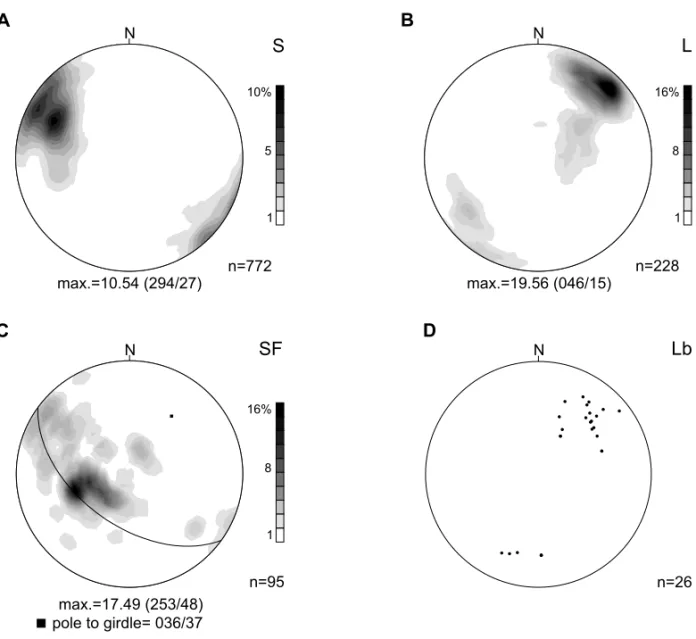
Global foliation data show mainly steeply SE and secondarily steeply to vertical NW dippings (Fig. 6A), a variation that may be attributed to the development of fan-like structures. The main lineation plunges gently to NE, but secondary shallowly SW and moderately E plunging lineations are observed (Fig. 6B). These data are consistent with oblique to directional tectonics.
Folded planes define a girdle which statistic axis plunges gently to NE, as well as measured fold axis (Figs. 6C and 6D). These data refer the tight to isoclinal folds under interference of decimetric to metric stretched anfibolitic and calcic-silicate enclaves (Fig. 7). The par-allelisms of fold axis and lineation (Fig. 6D) implie in simply shear participation during folding processes.
At outcrops with steeply-dipping foliation, norm-ally close to or in the shear zones of the eastern and cen-tral structural domains, mesoscale S-C and S-C’ folia-tion planes, asymmetrical porphyroclasts, sigmoid gran-itic lenses, fractured quartz veins, bookshelf structures, among other shear sense indicators, are consistent with a dextral shear sense (Figs. 8, 9 and 10).
At two outcrops east of the RJ-182 Road, folia-tion planes adopt S-C (Fig. 8A) to S-C’ geometry, where C’ and S-parallel centimetric sigmoidal mafic lenses are present (Figs. 8B and 8C), or fold interference figures are evident (Fig. 8D). This kinematic behaviour is also coherent with that shown in a quartz-feldspatic vein de-formed under a ductile-fragile regime (Fig. 8E).
Fig-ure 8F presents stereographic linear and planar data and suggests that directional movements are predominant.
In the western portion of the Central Domain at the BR-252 and RJ-182 crossroads, S-C foliation planes were observed at a weathered outcrop of an important high angle dextral shear zone (Figs. 9A and 9B).
West of this point, less deformed granulite also presents S-C foliation planes (Figs. 10A and 10B), which may be accompanied by S and C-parallel leucogranite bodies (Fig. 10C), and bookshelf structures in centimet-ric feldspatic porphyroclasts (Fig. 10D), all of them con-sistent with dextral dislocation. However, opposite sense S-C’ structures associated with sigmoid leucogranites are also present and probably represent antithetic dis-location along the shear zone (Fig. 10E).
Close to Itaperuna town, S-C foliation planes that correspond to predominantly dextral shear (Fig. 11A) accommodate stretched leucogranite lenses. Stereo-graphic plots of this outcrop show that these lenses are subparallel to foliation planes and that linear and planar relationship implies directional to gently top-down-to-the-SW extensional shear (Fig. 11B).
Fig. 6 – Global structural data. A – Poles to foliation (S), B – Mineral and stretching lineation (L), C – Poles to fold planes (SF) with statistically-adjusted axis and D – Fold axis (Lb). Equal area lower hemisphere Schmidt-Lambert stereographic projection. Number of data (n) shown.
Fig. 8 – Dextral kinematic indicators in high-angle granulitic mylonites near the road junction at Bom Jesus do Itabapoana/RJ. Section parallel to the XZ plane of the finite strain ellipsoid with its direction identified. A – S-C fabric of the foliations; B – Mafic lenses parallel to the C and C´ planes (above the pencil); C – Sigmoid basic lens; D – S-C-C´ foliation pairs with interference fold patterns in the left-hand part; E – Quartz-feldspathic vein cut by a fault with centimetric reject; F – Stereographic projection of foliation planes (S) and stretching and mineral lineations (Lx). Number of data points (n) given.
the section, ductile-ruptile foliation planes have steep WNW dips (Fig. 12C). Furthermore, difficult definition of slickenslide directions on fault planes does not allow a more precise evaluation of this structure.
DISCUSSION AND CONCLUSIONS
Geometrical and kinematic analyses on the studied cross-section allow us to discuss some aspects about the tec-tonic evolution of the Ribeira Belt. In this sector of the orogen, anfibolite to granulite facies rocks yield infor-mation on deep crustal behaviour in response to trans-pressive deformation. We consider this significant
be-cause in modern orogens, geologists can observe dir-ectly upper crustal levels, but the interpretation of deeper levels is mainly based on geophysical investigations.
The alternation of shear zones with felsic granulitic myonites and internal zones with heterogenous interme-diate to basic granulites, charnockites and S-type leuco-granites seems to have a major role in the deformation partitioning process. We observed that this relationship occurs at various scales, and probably represents a struc-tural control on the rock units.
Sections parallel to the XZ plane of the finite deformation ellipsoid, with its direction shown; B – Stereographic projection of foliation poles (S) and stretching and mineral lineations (Lx). Number of data points (n) shown.
Fig. 11 – Leucogranitic lenses (grey) controlled by S-C foliation planes (A) developed in outcrop close to Itaperuna town. Dextral movements contain top-down to SW component (B), where foliation planes (S), mineral and stretching lineation (Lx) and leucogranitic (Sg) are plotted. Equal area lower hemisphere Schmidt-Lambert stereographic projection. Number of data (n) shown.
Fig. 12 – S-C foliation fabric associated with top-to-W extensional tectonics seen at metric (A) and centimetric (B) scales. These structures are related to a late-stage deformation with development of low-angle fragile surfaces which are discordant of the main foliation in the granulites (C). Banded granulite outcrop in Itaperuna.
images. They consist of steeply dipping structures with oblique to directional lineation.
S-C and S-C’ foliation planes, asymmetrical por-phyroclasts, sigmoid granitic lenses, and fractured quartz-feldspatic dikes all indicate dextral shear in many outcrops of this section. We consider that they were formed under a regional transpressive regime related to the Neoproterozoic consolidation of western Gondwana, which is related to orogen-parallel flow towards SW,
considering the São Francisco Craton as a reference. The formation of granite lenses seen close to Itape-runa town may be due to local variations of planar and linear relationships during development of extensional shear. Top-down-to-west brittle-ductile structures have also been described in Itaperuna, and may be related to a more recent extensional event during the tectonic evo-lution of Ribeira Belt.
geo-de mapa estruturas do tipo S-C, que são geo-defletidas para di-reção NE nas proximidades do Lineamento de Além-Paraíba. O controle estrutural e litológico e a partição da deformação foram responsáveis pela formação de granulitos miloníticos félsicos com lentes de granitos tipo-S, desenvolvidos em zonas de cisalhamento dúcteis, alternados com granulitos básicos a intermediários menos deformados com charnockitos associa-dos. Na região, os indicadores cinemáticos do cisalhamento simples, destral, são consistentes com a deformação transpres-siva, que é particularmente comum nas bordas das zonas de cisalhamento mais importantes. A presença de leucogranitos tipo-S pode levar a variação das relações planares e lineares, as quais condicionam, localmente, zonas extensionais. Estes elementos são consistentes com uma colisão continental oblí-qua, considerando o Cráton do São Francisco como um bloco estável.
Palavras-chave: Cinturão Ribeira, cinemática, transpressão, extensão sincontracional.
REFERENCES
ALMEIDAFFMANDHASUIY. 1984. O Pré-Cambriano do
Brasil. São Paulo: Edgard Blücher, 378 p.
ALMEIDAFFM, AMARALG, CORDANIUGANDKAWA -SHITAK. 1973. The precambrian evolution of the south american cratonic margin south of Amazon river. In: NAIRN EMAND STEHLIFG (Eds). The ocean basins and margins. Plenun, New York, p. 411–446.
ALMEIDA FFM, HASUI Y AND CARNEIRO CDR. 1975. Lineamento de Além-Paraíba. An Acad Bras Cienc 47: 575.
BECKME. 1991. Coastwise transport reconsidered: lateral
displacements in oblique subduction zones, and tectonic consequences. Phys Earth Planet Int 68: 1–8.
ses superposées dans la précambrien du Brésil Sud-oriental (États de Rio de Janeiro et Minas Gerais). Rev Bras Geo-cienc 3: 1–22.
DAYANHANDKELLERJVA. 1989. A zona de cisalhamento do Rio Paraíba do Sul nas vizinhanças de Três Rios (RJ): uma análise da deformação dada por algumas feições es-truturais. Rev Bras Geocienc 19: 494–506.
DEHLERNMANDMACHADOR. 2002. Geometria e
cine-mática da aba sul da estrutura divergente do Rio Paraíba do Sul ao longo da seção Areal-Três Rios, Rio de Janeiro. Rev Bras Geocienc 32: 481–490.
DEHLERNM, MACHADORANDVASCONCELOSCS. 2000. Tectônica extensional oblíqua no sul do estado de São Paulo. Rev Bras Geocienc 30: 699–706.
DEHLERNM, MACHADOR, DEHLERH, MCREATHIAND
NUMMERA. 2006. Kynematics and geometry of
struc-tures in the southern limb of the Paraíba do Sul divergent structural fan, SE Brazil: a true transtensional shear. An Acad Bras Cienc 78: 1–17.
DEHLER NM, MACHADO R AND FASSBINDER E. 2007. Shear structures in the Serra do Azeite shear zone, southeastern Brazil: Transtensional deformation during regional transpression in the central Mantiqueira province (Ribeira belt). J South Am Earth Sci 23: 176–192. DIASRANDRIBEIROA. 1994. Constriction in a
transpres-sive regime: an example in the Iberian branch of the Ibero-Armorican arc. J Struc Geol 16: 1543–1554.
EBERT H. 1968. Ocorrências de fácies granulíticas no sul de Minas Gerais e em áreas adjacentes em dependência da estrutura orogênica: hipóteses sobre sua origem. An Acad Bras Cienc 40: 215–229.
Orogeny) in the Ribeira Belt, São Paulo State, Brazil. J Afric Earth Sci 29: 25–32.
HANMERSANDPASSCHIERCW. 1991. Shear Sense
Indi-cators: a review. Geol Sur Can Pap 90–17, 72 p. HARZEH, ANDRESENA, HODGESKVANDMARTINMW.
2001. Syncontractional extension and exhumation of deep crustal rocks in the east Greenland Caledonides. Tectonics 20: 58–77.
HEILBRONM, VALERIANOCM, ALMEIDAJCHANDTUPI
-NAMBÁM. 1991. A Megassinformal do Paraíba do Sul e sua implicação na compartimentação tectônica do setor central da Faixa Ribeira. In: SBG, Simp Geol Sud 2: 519–527.
HEILBRON M, PEDROSA-SOARES AC, CAMPOS NETO
MC, SILVALC, TROUW RAJANDJANASI VA. 2004.
Província Mantiqueira. In: MANTESSO-NETOVET AL. (Orgs) Geologia do Continente Sul-Americano: Evolu-ção da Obra de Fernando Flávio Marques de Almeida, p. 203–235.
HOBBSBE, MEANSBWDANDWILLIAMSPF. 1976. An outline of structural geology, New York: J Wiley & Sons, 379 p.
INGERS. 1998. Timing of an extensional detachment during
convergent orogeny: New Rb/Sr geochronological data from the Zanskar shear zone, northwestern Himalaya. Geology 26: 223–226.
JARRARDRD. 1986. Terrane motion by strike-slip faulting of forearc slivers. Geology 14: 780–783.
JONESRR, HOLDSWORTHREANDBAILEYW. 1997. Lat-eral extrusion in transpression zones: the importance of boundary conditions. J Struc Geol 19: 1201–1217. KARNIOLTRANDMACHADOR. 2004. Análise geométrica
e cinemática de um segmento na região do baixo Rio Doce entre Aimorés (MG) e Colatina (ES). Rev Bras Geocienc 34: 373–382.
e suas implicações tectônicas regionais. In: SBG, Simp Geol Sud, 3., Atas p. 208–213.
MANCKTELOWNS. 1992. Neogene lateral extension during convergence in the Central Alps: Evidence from inter-related faulting and backfolding around the Simplonpass (Switzerland). Tectonophysics 215: 295–317.
MARSHAKS, ALKMIMF, WHITTINGTON CANDPEDRO -SA-SOARESAC. 2006. Extensional collapse in the Neo-proterozoic Araçuaí orogen, eastern Brazil: a setting for reactivation of asymmetric crenulation cleavage. J Struc Geol 28: 129–147.
NUMMERA, MACHADORANDDEHLERNM. 2007. Pluton emplacement in a releasing bend in a transpressive regime: the Arrozal granite in the Paraíba do Sul shear belt, Rio de Janeiro. An Acad Bras Cienc 79 (2): 299–305.
PASSCHIERCWANDTROUW RAJ. 1996. Microtectonics,
Berlim: Springer-Verlag, 289 p.
PÊCHERA. 1991. The contact between the higher Himalaya crystallines and the Tibetan sedimentary series: Miocene large-scale dextral shearing. Tectonics 10: 587–598. PEDROSA-SOARESAC, NOCECM, VIDAL P, MONTEIRO
RLBPANDSALAZARE. 1992. Toward a new tectonic model for the Late Proterozoic Araçuai (SE Brazil) – West Congolian (SW Africa) belt. J S Am Earth Sci 6: 33–47. PERES GG, ALKMIM FF AND JORDT-EVANGELISTA H.
2004. The southern Araçaí belt and the Dom Silvério Group: geologic architecture and tectonic significance. An Acad Bras Cienc 76: 771–790.
PLATTJPANDVISSERSRLM. 1980. Extensional structures in anisotropic rocks: J Struct Geol 2: 397–410.
RATSCHBACHERL, FRISCHW, LINZERHANDMERLEO. 1991. Lateral extrusion in the eastern Alps, part II: Struc-tural Analysis. Tectonics 10: 257–271.