Forage characters of different Paspalum species in
Rio Grande do Sul: a meta-analysis
Caracteres forrageiros de diferentes espécies do gênero Paspalum no Rio Grande do Sul: uma meta-análise
Larissa Arnhold Graminho1* Miguel Dall’Agnol1 Luciana Pötter2 Rodrigo Ramos Lopes1 Carine Simioni1 Roberto Luís Weiler1
ISSNe 1678-4596
INTRODUCTION
Grasses of the genus Paspalum are the most important forage plants used in pastures in South America (NOVO et al., 2015). In particular, Rio Grande do Sul has soil and climate conditions that enable species of the genus Paspalum to adapt well ecologically, resulting in increased forage production.
Several studies have highlighted that species of the genus Paspalum, being native,
have advantages over exotic plants and high inter- and intraspecific variabilities in forage characteristics (REIS et al., 2010; PEREIRA et al., 2011; PEREIRA et al., 2012). As a result, there is great potential for exploiting these species in genetic improvement programs for using them as forage plants (REIS et al., 2010). Identifying the characteristics of species favorable to productive exploitation; will therefore, enable the selection of superior materials as cultivars.
1Departamento de Plantas Forrageiras e Agrometeorologia, Universidade Federal do Rio Grande do Sul (UFRGS), 90040-060, Porto Alegre,
RS, Brasil. E-mail:[email protected]. *Corresponding author.
2Departamento de Zootecnia, Centro de Ciências Rurais (CCR), Universidade Federal de Santa Maria (UFSM), Santa Maria, RS, Brasil.
ABSTRACT: The objective of this study was to evaluate, through meta-analysis, the forage characteristics of various species of the genus
Paspalum and to use them to select the best ecotypes that can be used in artificial hybridization as parents and hybrids for pasture production
and natural pasture recovery systems. Data were obtained from studies conducted by the Department of Forage Plants and Agrometeorology of the Universidade Federal do Rio Grande do Sul. Database comprised tests conducted with ecotypes and/or hybrids of Paspalum spp. in plots for evaluating total dry mass production, leaf dry mass production, and stem dry mass production by means of cuts. Total dry mass production, which included leaves and stems, differed between the ecotypes and hybrids. Hybrid H12 was the most divergent of all evaluated accessions. The greatest genetic divergence occurred due to dry mass production. Hybrids showed high total dry mass production, comprised mainly of
leaves. Hybrid H12 and the accession of Paspalum lepton 28E were identified as the most dissimilar based on the generalized Mahalanobis
distance using Tocher’s method. Total dry mass production is the characteristic that most contributed to the detection of genetic variability.
Key words: apomixis, hybridization, plant breeding, natural pasture, variability.
RESUMO: O objetivo deste trabalho foi avaliar, por meio de meta-análise, a variabilidade dos caracteres forrageiros de espécies do gênero
Paspalum e utilizá-los para selecionar os melhores ecótipos para serem utilizados em hibridações artificiais como genitores e híbridos para serem empregados em sistemas de produção a pasto e recuperação de pastagens naturais. Os dados foram obtidos a partir ensaios, do
Departamento de Plantas Forrageiras e Agrometeorologia da Universidade Federal do Rio Grande do Sul. A base de dados foi composta por
ensaios conduzidos com ecótipos e/ou híbridos do gênero Paspalum, em parcelas, avaliando por meio de cortes a produção de massa seca total, de folhas e colmos. Houve diferença entre ecótipos/híbridos para produção de matéria seca total, de folhas e colmos. O híbrido H12 foi o mais divergente dos acessos avaliados. A maior divergência genética ocorreu devido à produção de massa seca. Os híbridos apresentam elevada produção de massa seca total, sendo esta composta principalmente por folhas. O método de Tocher utilizando a distância generalizada de Mahalanobis identifica o híbrido H12 e o acesso de Paspalum lepton 28E como os mais dissimilares. A produção de massa seca total é o caractere que mais contribui para a detecção da variabilidade genética.
Palavras-chave: apomixia, hibridação, melhoramento genético, pastagem natural, variabilidade.
2
Apomixis is the predominant reproduction method in polyploid species of the genus Paspalum. However, it hinders genetic recombination as well impairs cultivar protection because of legal regulations (PEREIRA et al., 2012). However, hybridization, when one of the parents exhibits sexual reproduction, can result in variability and allows the selection of
progenies with immediate fixation of characteristics of
interest due to apoximis (ACUÑA et al., 2009).
Meta-analyses combined the results of several studies to create a reproducible and
quantifiable summary of data, thereby improving
the statistical power in studies on the effects of treatments and improving precision in the estimation and size of the effect (LOVATTO et al., 2007). An evaluation of variability in the expression of forage characteristics of interest and of the genetic diversity of ecotypes and hybrids of different species of the genus Paspalum by means of a meta-analysis enables the comparison of data from different trials, thus increasing the number of ecotypes, hybrids, and repetitions evaluated. It also provided information for the selection of superior plants as well as the formation of new elite recombinants. Therefore, the objective of this study was to evaluate, through a meta-analysis, the forage characteristics of species of the genus Paspalum and to use them to select
the best ecotypes for use in artificial hybridization
as parents and hybrids in pasture production and natural pasture recovery systems.
MATERIALS AND METHODS
Data were obtained from studies conducted between 2002 and 2014 by the Department of Forage Plants and Agrometeorology of the Universidade Federal do Rio Grande do Sul, in which the forage characteristics of ecotypes and hybrids of the genus
Paspalum were evaluated.
As criteria for inclusion in the database, the studies had to have been conducted in Rio Grande do Sul with ecotypes and/or hybrids of the genus
Paspalum in plots, free from animal grazing for two agricultural years and total dry mass production (TDMP), leaf dry mass production (LDMP), and stem dry mass production (SDMP) had to be determined by means of cuts and expressed as kg of DM per hectare per year (kg DM ha−1year−1). TDMP, LDMP, and SDMP were calculated by the sum of the cuts performed in each agricultural year. Different years and locations were treated as repetitions.
Because only a few trials reported the leaf:stem ratio (LSR) and harvest index (HI), we
calculated these variables using the following formulae: LSR = LDMP/SDMP (PEREIRA et al., 2012; PEREIRA et al., 2015; MOTTA et al., 2017) and HI = LDMP/ TDMP (PEREIRA et al., 2012), respectively.
Data from six studies were used in the database: SANTOS (2005), STEINER (2005), SAWASATO (2007), TOWNSEND (2008), PEREIRA et al. (2012), and MOTTA et al. (2017) The studies produced 135 observations on the following species:
Paspalum notatum, ecotypes André da Rocha and Bagual, and the commercial cultivar ‘Pensacola’; P. guenoarum, ecotypes Azulão, Baio, and the cultivar ‘Rojas’; P. urvillei: accessions collected in Rio Grande do Sul, in the municipalities of André da Rocha, Eldorado do Sul, and Bagé; P. lepton: accessions collected in Rio Grande do Sul, in the municipalities of Alegrete (26A and 26D) and Rosário do Sul (28B, 28C, and 28E); P. denticulatum and P. pauciciliatum. Two different species belonging to other genera,
Panicum maximum Jacq. cv. ‘Aruana’ and the species popularly known as giant missionary grass (Axonopus catharinensis Valls), were used as controls.
Genotypes and artificial hybrids
productivity data were also evaluated at the premises of the Instituto de Botánica del Nordeste (IBONE), which is based at the School of Agrarian Sciences in the province of Corrientes in Argentina. The P. guenoarum
ecotype ‘Rojas’ was used as the male parent, and the
P. plicatulum sexual genotype 4c-4x was used as the female parent. The chromosomal set of the sexual genotype was duplicated with colchicine (SARTOR et al., 2009) to enable cross-breeding between the different species and promote the production of fertile offspring. Hybrids evaluated (H12, H13, H20, and H22) were selected for their higher TDMP, as described by PEREIRA et al. (2015) and MOTTA et al. (2017).
After the normality test, the data were analyzed using a mixed model that considered
ecotypes/hybrids as fixed effects and experiments
and repetitions as random effects. Nine variance and covariance matrix models were tested as follows: variance component (VC), compound symmetry (CS),
unstructured (UN), first-order autoregression [AR(1)], heterogeneous first-order autoregression [ARH(1)], heterogeneous compound symmetry (CSH), first-order autoregression with moving averages [ARMA (1,1)], and first-order ante-dependence [ANTE(1)].
Multivariate analysis was performed with the GENES Program (CRUZ, 2007) using the generalized distance of Mahalanobis (D2) to estimate
the existing genetic dissimilarity between the ecotypes and hybrids. Tocher’s method was used as the technique for grouping the evaluated materials. Finally,
to define the total variability observed, the magnitude
of the relative contribution of the variables (Sj) was determined by Singh’s model (SINGH, 1981).
RESULTS AND DISCUSSION
There was a difference in TDMP between the ecotypes/hybrids (P = 0.0645; Table 1). The ‘Aruana’ (Panicum maximum) and ‘Rojas’ (P. guenoarum) cultivars had higher TDMP, with an average of 20467kg of DM ha−1year−1, which was 51% greater than that observed in ecotypes with lower TDMP, which averaged 9997kg of DM ha−1year−1 (Table 1). For P. guenoarum ecotypes Azulão and Baio and the P. lepton accessions, TDMP
was intermediate at 12463kg of DM ha−1year−1 (Table 1). The evaluated hybrids had an average TDMP of 19255kg of DM ha−1year−1, similar to the production observed in superior and intermediate materials (Table 1). These results demonstrate the high potential of the materials evaluated under the soil and climatic conditions of Rio Grande do Sul. Although some of these materials were commercial cultivars, the native genotypes never underwent any genetic improvement but had high forage yields.
Even though hybridization was performed with parents of different species, TDMP of the hybrids and of their male parent P. guenoarum Rojas was
similar, with no significant gains in productivity being confirmed. This may indicate genetic proximity between
the parents because according to PATERNIANI & CAMPOS (2005), hybrid vigor occurs when the genetic distance between parents is high.
TDMP of ‘Pensacola’ was lower than the averages observed in the hybrids (97%), P. guenoarum ecotypes (60%), P. lepton accessions
Table 1 - Total dry mass production (TDMP), leaf dry mass production (LDMP), and stern dry mass production (SDMP) in kg of DM per
hectare per year of ecotypes/hybrids of the genus Paspalum, Panicum maximum Jacq. cv. ‘Aruana’, and Axonopus catharinensis
evaluated in Rio Grande do Sul (2002-2014).
Ecotype TDMP LDMP SDMP
Panicum maximum Aruana 20364a 12459b 6887a
Axonopus catharinensis 10442c 6627cd 2624c
P. guenoarum Azulão 12651b 8339c 3202b
P. guenoarum Baio 12956b 8211c 3472b
P. guenoarum Rojas 20569a 15023a 4885ab
P. notatum André da Rocha 10080c 6392cd 3111b
P. notatum Bagual 10716c 6845cd 3103b
P. notatum Pensacola 9764c 6502cd 1819c
P. lepton 26A 12407b 8154c 2126c
P. lepton 26D 12279b 8404c 1933c
P. lepton 28B 13139b 8182c 2820b
P. lepton 28C 12185b 8284c 2062c
P. lepton 28E 11622b 7361c 2153c
P. urvillei (André da Rocha) 10430c 7169cd 2620c
P. urvillei (Bagé) 9806c 7323cd 2228c
P. urvillei (Eldorado do Sul) 9746c 7185cd 2022c
P. denticulatum 8010c 4868d 1154c
P. pauciciliatum 10977c 5626d 3261b
---Hybrids---H12 19424ab 15135a 3648b
H13 19700ab 14751ab 3595b
H20 19115ab 12821ab 3042b
H22 18782ab 14789ab 3107b
P 0.0645 0.0307 0.0864
4
(27%), P. notatum ecotypes (6.5%), and P. urvillei
accessions (2.3%). This comparison is important because the ‘Pensacola’ cultivar and P. atratum cv. ‘Pojuca’ are the only cultivars with seeds available in the Brazilian market.
Differences in LDMP were observed between the ecotypes/hybrids (P = 0.0307; Table 1). LDMP was higher in P. guenoarum cv. ‘Rojas’ and in hybrid H12, with an average of 15079kg of DM ha−1year−1 (Table 1). The other hybrids H13, H20, and H22 had LDMP similar to that of the two high-productivity materials and cultivar ‘Aruana’, which had intermediate leaf production (Table 1). The P. denticulatum and P. pauciciliatum ecotypes yielded lower LDMP, which was expected, as they also had lower TDMP (Table 1).
Leaf production is a very important characteristic because leaves are responsible for photosynthesis (RODRIGUES et al., 2008); they are the preferred structures consumed by animals and have the highest nutritional quality (BRATTI et al., 2009). According to PEREIRA et al. (2011), it is essential that selection for increased leaf production and reduced stem production be targeted in forage plant improvement, as showed by hybrid H12, which had LDMP of 132; 7.1%,. This value was higher than that of the commercial cultivar ‘Pensacola’ as well as the average leaf production of the hybrids.
Differences in SDMP were observed between the ecotypes/hybrids (P = 0.0463; Table 1). SDMP was higher for the cultivar ‘Aruana’, with 6887kg of DM ha−1 year−1, which was 30% higher than that observed for P. guenoarum ‘Rojas’. The cv. ‘Rojas’ was the second highest producer of stems and was also similar to the P. guenoarum ecotypes Azulão and Baio, P. notatum André da Rocha and Bagual, and P. lepton accession 28B (Table 1). We reported that 33%, 24%, and 17% of TDMP of ‘Aruana’, P. guenoarum, and the hybrids, respectively, were composed of stems, which indicated that the hybrids
brought benefits not only by increasing TDMP but
also by improving the structural characteristics of the plants, resulting in a lower proportion of components that are less important for livestock grazing.
There were no differences between the ecotypes/hybrids in either the LSR (P = 0.3580) or HI (P = 0.7108), with averages of 4.1 and 0.50, respectively, and these data were used to estimate the Mahalanobis distance, Tocher clustering, and relative contribution to variability.
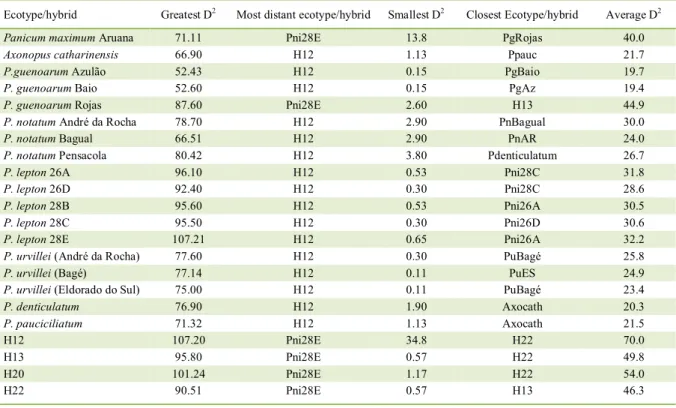
The measurements of genetic dissimilarity demonstrated a high magnitude (0.11-107.2), which indicated a broad range of genetic variability among
the ecotypes/hybrids (Table 2). Combinations of hybrids H12, H20, and H13 with P. lepton accession 28E and of hybrid H12 with P. lepton accession 26A had the highest divergence, with distances of 107.2, 101.2, 95.8, and 96.1, respectively.
In general, genotypes which present greater distance also have a greater genetic distance among them. Thus, the estimate of genetic dissimilarity becomes very important because when combined with knowledge about the performance of parents, it provides an alternative to cross-breeding by indicating genetic contributions with high combining capacities (VIEIRA et al., 2005)
In relation to the maximum distance obtained between all possible combinations of the ecotypes evaluated, we observed that most genotypes exhibited the maximum distance when combined with hybrid H12, which indicated that it was the most divergent of the materials evaluated. Thus, hybrid H12 can be used as a parent in future hybridization, because according to PEREIRA et al. (2015), genotypes that are genetically distant offer possibilities for new crosses targeting the formation of elite recombinants.
The smallest distances were observed between the P. urvillei accessions from Bagé and Eldorado do Sul (D2 = 0.11), between the P.
guenoarum ecotypes Azulão and Baio (D2 = 0.15),
and between the P. lepton accessions 26D and 28C (D2 = 0.30). Smaller distance between the ecotypes P.
guenoarum Azulão and Baio may be because they are of the same species and that the evaluated agronomic characteristics are similar. Although, cultivar ‘Rojas’ belongs to the same species, it had greater TDMP, LDMP, and SDMP, which may explain why its values of genetic dissimilarity were close to those of the Azulão and Baio ecotypes. For P. urvillei (Bagé and Eldorado do Sul) and P. lepton (26D and 28C), the smaller distances may have occurred because they are the same ecotypes, although they were harvested in different regions.
Cluster analysis using Tocher’s method resulted in the formation of three distinct groups (Table 3). There were 16 ecotypes in Group I, representing 72% of the materials evaluated, which indicated that crosses among these ecotypes, when viable, could reduce the possibility of obtaining superior genotypes. Groups II and III were composed of 5 and 1 ecotypes/hybrids, representing 23% and 5% of the evaluated materials, respectively (Table 3).
dissimilarity and the potential of parents. However, in addition to being dissimilar, parents should combine medium and high variability with regard to the characteristics being improved (ALMEIDA et al., 2011).
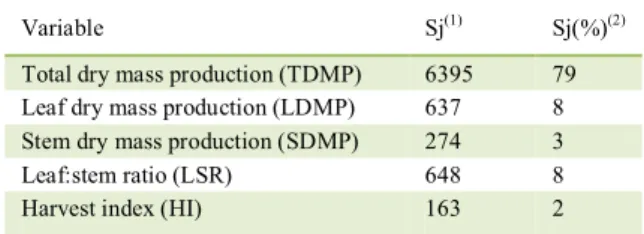
Analysis of the relative contribution to total variability showed that 78.8% of the genetic divergence occurred as a result of TDMP, whereas LSR, LDMP, SDMP, and HI had a contribution
of only 21.2% (Table 4). PEREIRA et al. (2015) analyzed the agronomic ecotypes and hybrids of the genus Paspalum (individual plants) and reported that the relative variability contribution of TDMP to genetic divergence was 46.2%, whereas the other seven evaluated variables accounted for 53.8% of the variability observed.
The fact that TDMP makes the greatest contribution to variability indicates that it was the
Table 2 - Estimates of the Mahalanobis distances (D2) based on five variables(1) in the ecotypes and hybrids of Paspalum, Panicum
maximum Jacq. cv ‘Aruana,’ and Axonopus catharinensis evaluated in Rio Grande do Sul (2002–2014).
Ecotype/hybrid Greatest D2 Most distant ecotype/hybrid Smallest D2 Closest Ecotype/hybrid Average D2
Panicum maximum Aruana 71.11 Pni28E 13.8 PgRojas 40.0
Axonopus catharinensis 66.90 H12 1.13 Ppauc 21.7
P.guenoarum Azulão 52.43 H12 0.15 PgBaio 19.7
P. guenoarum Baio 52.60 H12 0.15 PgAz 19.4
P. guenoarum Rojas 87.60 Pni28E 2.60 H13 44.9
P. notatum André da Rocha 78.70 H12 2.90 PnBagual 30.0
P. notatum Bagual 66.51 H12 2.90 PnAR 24.0
P. notatum Pensacola 80.42 H12 3.80 Pdenticulatum 26.7
P. lepton 26A 96.10 H12 0.53 Pni28C 31.8
P. lepton 26D 92.40 H12 0.30 Pni28C 28.6
P. lepton 28B 95.60 H12 0.53 Pni26A 30.5
P. lepton 28C 95.50 H12 0.30 Pni26D 30.6
P. lepton 28E 107.21 H12 0.65 Pni26A 32.2
P. urvillei (André da Rocha) 77.60 H12 0.30 PuBagé 25.8
P. urvillei (Bagé) 77.14 H12 0.11 PuES 24.9
P. urvillei (Eldorado do Sul) 75.00 H12 0.11 PuBagé 23.4
P. denticulatum 76.90 H12 1.90 Axocath 20.3
P. pauciciliatum 71.32 H12 1.13 Axocath 21.5
H12 107.20 Pni28E 34.8 H22 70.0
H13 95.80 Pni28E 0.57 H22 49.8
H20 101.24 Pni28E 1.17 H22 54.0
H22 90.51 Pni28E 0.57 H13 46.3
(1)Total dry mass production (TDMP); Leaf dry mass production (LDMP); Stem dry mass production (STDM); Leaf: stem ratio (LSR);
Harvest index (HI).
Table 3 - Breakdown of the genetic dissimilarity of ecotypes and hybrids of the genus Paspalum, Panicum maximum Jacq. cv ‘Aruana’, and
Axonopus catharinensis evaluated using Tocher’s cluster analysis (Rio Grande do Sul: 2002–2014).
Groups Clustering
I
P. urvillei (Bagé), P. urvillei (Eldorado do Sul), P. urvillei (André da Rocha), P. lepton 28B, P. pauciciliatum, P. lepton
28C, P. lepton 26D, P. lepton 26A, P. lepton 28E, P. denticulatum , Axonopus catharinensis, P. notatum Pensacola, P.
guenoarum Baio, P. guenoarum Azulão, P. notatum Bagual, P. notatum André da Rocha
II H13, H20, H22, P. guenoarum Rojas, Panicum maximum Jacq. cv Aruana
6
most effective variable for expressing the variability among genotypes and demonstrated its importance as a component in the selection of genotypes with superior forage characteristics. ALVES et al. (2003) reported the importance of determining the relative contribution of characteristics to reduce the number of evaluations necessary to determine genetic variability, given that only characteristics that effectively contributed to this variability can be measured. Smaller contribution to the genetic variability by botanical separation and structural components, when compared to TDMP, suggested that the measurements could be discontinued, because it required excessive labor and time in return for a relatively small contribution to variability.
CONCLUSION
The hybrids exhibited high TDMP, composed mostly of leaves, with a smaller proportion of stems than that observed in the ecotypes with similar or higher TDMP. The P. guenoarum genotypes Rojas, Baio, and Azulão stood out in terms of TDMP and could be used in future crosses. Tocher’s method using generalized Mahalanobis distance allowed us to identify hybrid H12 and P. lepton accession 28E as the most dissimilar and the P. urvillei accession from Bagé and Eldorado do Sul as the most similar. TDMP is the characteristic that contributes most to the detection of genetic variability.
ACKNOWLEDGEMENTS
We would like to thank Conselho Nacional de
Desenvolvimento Científico e Tecnológico (CNPq), Coordenação de Aperfeiçoamento de Pessoal de Nível Superior (CAPES), and SulPasto for the financial support and human resources.
REFERENCES
ACUÑA, C.A. et al. Bahiagrass tetraploid germplasm: reproductive and agronomic characterization of segregating progeny. Crop Science, v.49, p.581-588, 2009. Available from: <http://www.crops.org/publications/cs/articles/49/2/581?highli ght=&search-result=1>. Accessed: Oct. 24, 2016. doi: 10.2135/ cropsci2008.07.0402.
ALMEIDA, R.D. et al. Genetic divergence among soybean cultivars, under irrigated conditions, in south Tocantins State.
Revista Ciência Agronômica, v.42, p.108-115, 2011. Available from: <http://www.ccarevista.ufc.br/seer/index.php/ccarevista/ article/view/1143/515>. Accessed: Oct 24, 2016. doi: 10.1590/ S1806-669020110001000100014.
ALVES, R.M. et al. Selection of morpho-agronomic descriptors
for cupuaçuzeiro germplasm characterization. Pesquisa
Agropecuária Brasileira, v.38, p.807-818, 2003. Available from: <http://www.scielo.br/scielo.php?script=sci_arttext&pid=S0100-204X2003000700004>. Accessed: Oct. 24, 2016. doi: 10.1590/ S0100-204X2003000700004.
BRATTI, L.F.S. et al. Ingestive behavior of goats in ryegrass and black oat pastures in pure or mixture. Ciência Animal Brasileira, v.10, p.397-405, 2009. Available from: <https://www.revistas.ufg. br/vet/article/view/548/4830>. Accessed: Nov. 23, 2016.
CRUZ, C.D. Programa GENES: aplicativo computacional em
genética e estatística. Viçosa: UFV, 2007. 442p.
LOVATTO A.P. et al. Meta-analysis in scientific research: a
methodological approach. Revista Brasileira de Zootecnia, v.36, p.285-294, 2007. Available from: <http://www.scielo.br/ scielo.php?script=sci_arttext&pid=S151635982007001000026>. Accessed: Nov. 23, 2016. doi: 10.1590/S1516-35982007001000026.
MOTTA, E.A.M. et al. Forage value of superior interspecific
hybrids of Paspalum. Revista Ciência Agronômica, v.48, n.1, p.191-198, 2017. Available from: <http://www.ccarevista.ufc.br/ seer/index.php/ccarevista/article/view/4643>. Accessed: Nov. 11, 2016. doi: 10.5935/1806-6690.20170022.
NOVO, P.E. et al. Interspecific hybrids between Paspalum
plicatulum and P. oteroi: a key tool for forage breeding. Scientia Agricola, v.73, p.356-362, 2015. Available from: <http://www. scielo.br/pdf/sa/v73n4/0103-9016-sa-73-4-0356.pdf>. Accessed: Oct. 24, 2016. doi: 10.159010103-9016-2015-0218.
PATERNIANI, E.; CAMPOS, M.S. Melhoramento do milho. In: BORÉN, A. (Ed.). Melhoramento de espécies cultivadas. 2.ed.
Viçosa: UFV, 2005. p.491-533.
PEREIRA, E.A. et al. Agronomic production of a collection of
Paspalum lepton Parodi acess. Revista Brasileira de Zootecnia, v.40, p.498‑508, 2011. Available from: <http://www.scielo. br/scielo.php?pid=S1516-35982011000300006&script=sci_ arttext>. Accessed: Oct. 17, 2016. doi: 10.1590/S1516- 35982011000300006.
PEREIRA, E.A. et al. Genetic variability of forage traits Paspalum.
Pesquisa Agropecuária Brasileira, v.47, p.1533-1540, 2012. Available from: <http://www.scielo.br/scielo.php?script=sci_ arttext&pid=S0100-204X2012001000017>. Accessed: Oct 24, 2016. doi: 10.159/S0100-204x2012001000017.
Table 4 - Relative contribution to the variability of characteristics associated with the forage potential of ecotypes and hybrids of the genus
Paspalum, Panicum maximum Jacq. cv.
‘Aruana’, and Axonopus catharinensis based on
the generalized Mahalanobis distance (Rio Grande do Sul: 2002–2014).
Variable Sj(1) Sj(%)(2)
Total dry mass production (TDMP) 6395 79
Leaf dry mass production (LDMP) 637 8
Stem dry mass production (SDMP) 274 3
Leaf:stem ratio (LSR) 648 8
PEREIRA, E.A. et al. Agronomic performance and interspecific
hybrids selection of the genus Paspalum. Científica, v.43, p.388-395, 2015. Available from: <http://cientifica.org.br/index.php/
cientifica/article/view/753/450>. Accessed: Oct. 24, 2016. doi:
10.15361/198455292015v43n4.388-385.
RODRIGUES R.C. et al. Dry matter production, leaf/stem ratio and growth indexes of palisade grass (Brachiaria brizantha cv. ‘Xaraés’), cultivated with different rate combinations of nitrogen and potassium. Revista Brasileira de Zootecnia, v.37, p.394-400, 2008. Available from: <http://www.scielo.br/scielo. php?pid=S1516-35982008000300003&script=sci_arttext>. Accessed: Oct. 05, 2016. doi: 10.1590/S1516-35982008000300003.
REIS, C.A.O. et al. Morphological variation in Paspalum lepton
Parodi accessions, a promising forage. Scientia Agricola, v.67, p.143-150, 2010. Available from: <http://www.scielo.br/scielo. php?script=sci_arttext&pid=S0103-90162010000200003>. Accessed: Oct, 24, 2016. doi: 10.1590/S0103-9016201000020003.
SARTOR, M.E. et al. Mode of reproduction of colchicine‑induced Paspalum plicatulum tetraploids. Crop Science, v.49, p.1270-1276, 2009. Available from: <http:// www.crops.org/publications/cs/articles/49/4/1270?highlight =&search-result=1>. Accessed: Oct. 08, 2016. doi: 10.2135/ cropsci2008.05.0270.
SINGH, D. The relative importance of characters affecting genetic divergence. Indian Journal of Genetics and Plant Breeding, v.41, p.237-245, 1981. Available from: <http://www. indianjournals.com/ijor.aspx?target=ijor:ijgpb&volume=41&issue =2&article=010>. Accessed: Oct. 28, 2016