MESTRADO
E
CONOMIA E
G
ESTÃO DA
C
IÊNCIA
,
T
ECNOLOGIA E
I
NOVAÇÃO
TRABALHO FINAL DE MESTRADO
D
ISSERTAÇÃO
C
REATIVITY AS A BASIS FOR
E
NTREPRENEURSHIP
J
OÃO
M
ARIA
C
AVALLERI DE
J
ESUS
MESTRADO EM
E
CONOMIA E
G
ESTÃO DA
C
IÊNCIA
,
T
ECNOLOGIA E
I
NOVAÇÃO
TRABALHO FINAL DE MESTRADO
D
ISSERTAÇÃO
C
REATIVITY AS A BASIS FOR
E
NTREPRENEURSHIP
J
OÃO
M
ARIA
C
AVALLERI DE
J
ESUS
O
RIENTAÇÃO:
P
ROFESSORD
OUTORN
UNOJ
OELG
ASPARF
ERNANDESC
RESPONão tenho pressa. Pressa de quê? Não têm pressa o sol e a lua: estão certos. Ter pressa é crer que a gente passa adiante das pernas, Ou que, dando um pulo, salta por cima da sombra. Não; não sei ter pressa. Se estendo o braço, chego exactamente aonde o meu braço chega - Nem um centímetro mais longe. Toco só onde toco, não aonde penso. Só me posso sentar aonde estou. E isto faz rir como todas as verdades absolutamente verdadeiras, Mas o que faz rir a valer é que nós pensamos sempre noutra coisa, E vivemos vadios da nossa realidade. E estamos sempre fora dela porque estamos aqui
Alberto Caeiro
ii
Agradecimentos
Os resultados apenas são obtidos quando são empenhados esforço e dedicação. E isto aplica-se a quaisquer resultados que possamos querer alcançar na vida.
Este foi um trabalho que me ajudou a chegar a essa mesma conclusão. Exigiu esforço, dedicação e disciplina, e treinou-me de certa forma para possíveis desafios que o futuro trará. Certamente que com apoio e compreensão dos que me rodeiam, a motivação serviu de força motriz para seguir com o trabalho até ao fim.
Em primeiro lugar não posso deixar de agradecer à minha Mãe que sempre se chegou à frente para me ajudar em tudo, inclusivamente com este Mestrado. Se não fosse a sua ajuda e persistência, nunca teria chegado onde cheguei. Ao meu Pai que também insistiu para que desse sempre mais um passo para além daqueles que dei para trás, e à minha madrasta de igual forma.
Agradeço aos meus queridos amigos que nunca deixaram de acreditar no meu potencial e que sempre me apoiaram, especialmente à Joana Rodrigues por ter visto e revisto a componente de inglês deste trabalho, e ao Diogo Pelicano por ter sido tão presente.
Agradeço aos meus avós maternos que assistiram a todo este percurso do início ao fim e não me deixaram desistir.
Agradeço ao estabelecimento Villa Maçã por ter sido o meu escritório desde a primeira à última página que escrevi deste trabalho.
Ao Professor Nuno Crespo dirijo um enorme obrigado por ter dado a atenção que eu nunca daria a aspetos deste trabalho que poderão fazer toda a diferença.
Por último, agradeço ao meu avô paterno Hugo de Jesus por me ter conduzido por um caminho com curvas e contracurvas, cujo destino foi a Instituição onde lecionou até aos seus últimos dias: o ISEG.
iii
Abstract
The word “Entrepreneurship” has had its origin several years ago, appearing for the first time in the French dictionary back in the 18th century. The term itself was applied to individuals who were “adventurers” by creating business with no certain guarantee of success, and since then, its study has been carried out within distinct scopes due to its complexity. Numerous authors have studied entrepreneurship and have contributed to a greater understanding of this concept. Since the last past decades, entrepreneurship has been related to vast field of factors and some interesting results and conclusions have been achieved since then. However, although several aspects that influence entrepreneurship have already been identified, literature demands the need for a more concrete framework that studies a yet very undeveloped relation: the influence of creativity on entrepreneurship. By gathering frameworks of authors of psychology research, regarding to personality aspects and definitions of creativity, and authors of entrepreneurship research, regarding to different scenarios of conditions for entrepreneurship, and contemplating several theories and indicators of both creativity and entrepreneurship, this research goals to contribute for a better understanding of how creativity impacts on entrepreneurship and how far this influence is significant. Therefore, this study aims to accomplish some specific goals: to identify possible accurate indicators for creativity, and possible ways to construct them; to classify different scenarios for entrepreneurship according to the type of economy; to understand how creativity impacts in entrepreneurship regarding to realistic conditions, such as wealth and population of the countries. The analysis was elaborated over a “macro” perspective, regarding to countries and comparisons between countries. The hypotheses were tested through the combination of data from the Global Innovation Index and the Global Entrepreneurship Monitor, between the years of 2014 and 2017. The results provided empirical support for the relations between creativity and entrepreneurship which has been determined as negative. Moreover, the results suggested a negative dependence between creativity and necessity-driven entrepreneurship, and a positive dependence between creativity and opportunity-driven entrepreneurship. Intangible assets were found to be positively related to opportunity-driven entrepreneurship, and a negative relation between creative goods and services and entrepreneurship (as an overall) has also been determined. The present study attempts to provide a different and innovative view over entrepreneurship, highlighting the effect of creativity in its development.
iv
Resumo
A palavra “Empreendedorismo” teve a sua origem há bastantes anos, tendo aparecido pela primeira vez no dicionário da língua Francesa em meados do século XVIII. O termo, em si, era aplicado a indivíduos considerados “aventureiros” por criarem negócios sem garantias de sucesso. Desde então, o estudo de empreendedorismo tem vindo a ser elaborado em diferentes ramos dada a sua complexidade. Muitos autores contribuíram para uma melhor compreensão deste conceito. Ao longo das últimas décadas, o empreendedorismo tem vindo a ser relacionado com um vasto campo de fatores. Desde então, foram alcançados numerosos resultados e conclusões interessantes que contribuíram fortemente para o crescimento do conhecimento dentro deste assunto. No entanto, apesar de vários fatores que têm influência sobre o empreendedorismo já terem sido identificados, existe a necessidade de acrescentar à literatura o enquadramento de um dos aspetos menos estudados até aos dias de hoje: a influência da criatividade sobre o empreendedorismo. Ao relacionar conclusões de autores da área de psicologia, que dizem respeito a aspetos de personalidade e a definições de criatividade, e de autores da área do empreendedorismo, e ainda contemplando teorias e indicadores de criatividade e empreendedorismo, este estudo procura contribuir para uma melhor compreensão sobre como a criatividade impacta sobre o empreendedorismo e sobre o quão significativa é esta relação. Desta forma, este estudo procura alcançar os seguintes objetivos: identificar possíveis indicadores de criatividade; classificar diferentes cenários de empreendedorismo tendo em conta o tipo de economias; compreender a forma como a criatividade impacta sobre o empreendedorismo dentro de um enquadramento com condições realistas, tais como a riqueza e a população dos países. A análise foi elaborada através de uma perspetiva “macro”, analisando e comparando países. As hipóteses foram testadas através da combinação de dados provenientes do Global Innovation Index e do Global Entrepreneurship Monitor, entre os anos 2014 e 2017. Os resultados ofereceram suporte empírico para a relação entre a criatividade e o empreendedorismo, que foi determinada como negativa. Da mesma forma, os resultados sugeriram uma relação negativa entre a criatividade e o empreendedorismo por necessidade, e uma relação positiva entre a criatividade e o empreendedorismo por oportunidade. Por último, observou-se uma relação positiva entre ativos intangíveis e empreendedorismo por oportunidade, e também uma relação negativa entre bens e serviços criativos e empreendedorismo (como um só). Com o presente estudo, pretende-se gerar uma visão
v diferente e inovadora sobre o empreendedorismo, destacando o efeito da criatividade sobre o seu desenvolvimento.
vi
Table of Contents
1. Introduction ... 1
2. Literature Review ... 2
2.1 Creativity ... 2
2.2 Dimensions on the measure of creativity ... 3
2.2.1 Level... 3
2.2.2 Facet... 6
2.3 National creativity ... 8
2.3.1 The Global Creativity Index ... 9
2.3.2 Global Innovation Index ... 10
2.4 Entrepreneurship ... 15
2.4.1 The Global Entrepreneurship Monitor ... 15
2.4.2 The Entrepreneur ... 17
2.5 Creativity and Entrepreneurship ... 18
3. Framework and Hypothesis ... 20
3.2 Research Hypothesis and Development of the Model ... 20
4. Methodology ... 23
4.1 Dependent Variables ... 24
4.2 Independent Variables ... 24
4.3 Control Variables ... 24
4.4 Sample ... 25
4.4.1 Selection of the countries ... 25
4.4.2 Selection of the years ... 25
5. Results ... 25
5.1 Results Presentation ... 26
5.2 Discussion of findings ... 29
vii
6.1 Conclusions ... 33
6.2 Limitations and Further Research ... 35
7. References and Bibliography ... 37
8. Appendix ... 40
List of Tables
Table I: Different dimensions on the measurement of creativity ... 3Table II: Comparison between the 4P's of creativity and the 5A's of creativity . 7 Table III: Descriptive measures ... 26
Table IV: Correlation matrix ... 26
Table V: Structural model results for models 1, 2 amd 3 ... 28
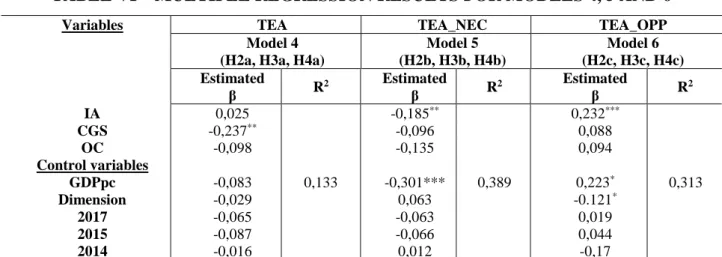
Table VI: Structural model results for models 4, 5 and 6 ... 29
Table VII:Results for the testet hypotheses ... 30
List of Figures
Figure 1: Relation between the % of population involved in early-staged entrepreneurial activity and GDP per capita ... 17Figure 2: Conceptual model ... 23
List of Abbreviations
TEA: Total Early-Stage Entrepreneurial Activity
TEA_NEC: Total Early-Stage Entrepreneurial Activity in a necessity scenario TEA_OPP: Total Early-Stage Entrepreneurial Activity in a opportunity scenario CO: Creative Output
IA: Intangible Assets
CGS: Creative Goods and Services OC: Online Creativity
1
1.
Introduction
It is not a novelty that entrepreneurship has been in constant growth since, at least, the last three decades (Shane & Venkataraman, 2007). Entrepreneurship drives economic development through innovation activities, which requires research and a mix of different knowledge fields (Bosma, Acs, Autio, Coduras, & Levie, 2008). Some of the major results driven from the creation of new businesses have reflected on structural changes in the economy, such as the forcing of older companies to shape up for keeping up on the competition (Bosma et al., 2008). Competition, itself, may be one of the strongest driving forces for development (Gilbert, 2006). If a new company enters a sector and brings innovation, then it has competitive advantages. This forces the older companies to compensate those advantages by innovating as well. These changes may be reflected in innovation, not only in the products, but also applied to the production and to the organizational and marketing strategies (Garcia, 2015). All together, these innovations make the sectors move forward. Through a microeconomic point of view, innovation is what makes companies stay in the market and reach profits. Through a macroeconomic point of view, innovation is what causes a country to develop, contributing for employment, economic growth, and social well-being (López, 2005).
However, in this context, it is important to understand which are the motifs that may be causing entrepreneurship to be rising so fast. According to Fossen and Fairlie (2017), entrepreneurship occurs for two main reasons: opportunity and necessity, being these two reasons related to the social stratum of the entrepreneurs.
Generally, the necessity scenario is commonly observed in poor and undeveloped countries, where the lack of employment and poverty are the main reasons driving people to start their own businesses. Though, in the opportunity scenario, entrepreneurs are generally people with no monetary issues, as they are well placed to start a new business. These entrepreneurs are mainly good observers, capable to understand the market demands and willing to respond to those demands by creating new businesses (Rosa, Kodithuwakku, & Balunywa, 2008).
However, in either case, there must be a number of abilities that make an entrepreneur. One of the main criteria should be creativity (Williams & McGuire, 2010). Creativity is the foundation of all the innovation process. The more the creativity, the higher the possibility to have new ideas, and therefore, the higher the possibility to innovate (Batey, 2012). However, studies about the relation between creativity and economic behavior
2 have been very few so far. In fact, the study of creativity has been taken among the roots of psychology, and the results have been mainly used for other purposes. Creativity remains as a topic that is practically untouched in the economic fields (Reisman, 2015). In a further analysis, the only questions that have been addressed in economic studies regarding to creativity have been limited to macroeconomic issues, such as industrial growth, national innovation systems and creative classes (Reisman, 2015). It would be interesting to find answers for unstudied matters, more concretely, about the relation between creativity and microeconomic aspects. In other words, it should be interesting to determine how much do creativity issues influence entrepreneurship and, therefore, innovation. For that, either psychological as sociological dimensions of creativity must be reviewed in order to classify and quantify the variables that may be or may be not explanatory of creativity.
2.
Literature Review
Several references were accessed in order to develop a basis for this dissertation. In a primary phase, the aim was to clarify the term “creativity” itself.
2.1 Creativity
There are no exact and unique definitions of creativity. In fact, numerous of different ways to define it may be found in literature, and all of them describe it through a very particular point of view (Runco & Jaeger, 2012). It has been verified that, among the years, the most significant topics that underpin the term are related to the relation between the western and eastern definitions (Batey, 2012). While the eastern perspective considers creativity “as the expression of personal truth or as self-growth” (Batey, 2012, p.56), the western perspective defines creativity as “the original product of and individual” (Batey, 2012, p.56). However, creativity research has adopted almost exclusively the western perspective (Batey, 2012). This way, creativity may be constructed over one basic assumption: it requires both originality and effectiveness (Runco & Jaeger, 2012). It is not exceedingly difficult to understand this statement. If some random creation appears for the first time, it is certainly a novelty. However, if it has absolutely no utility (practical, virtual or emotional), then it has no effectiveness, and therefore, it cannot be considered a product of creativity (Runco & Jaeger, 2012). Though, there are still visible, nowadays, a few differences in the definition of creativity, depending on the culture. For example,
3 Chinese individuals place more weight on the usefulness and less weight in the novelty, unlike American individuals who place more weight in novelty rather than in usefulness (Loewenstein & Mueller, 2016).
According to Plucker, Beghetto and Dow (2004, p.90), “creativity is the interaction among aptitude, process and environment by which an individual or group produces a perceptible product that is both novel and useful as defined within a social context”. Also, Rojas & Tyler (2018, p.29) have suggested that creativity may be defined as a “2-part process of buying low by investing in unusual ideas and then selling high by convincing others of the value or usefulness of these new ideas.” Though, new classifications may be created by merging and gathering previous definitions. In fact, for example, it may be possible to assume that originality and effectiveness are the basis of creativity, which can be described as the main condition for novel and useful products to be shaped by investing in unusual ideas and give them value by turning them useful to society.
2.2 Dimensions on the measure of creativity
The research in the field of creativity has been driven over two major dimensions: level and facet (Batey, 2012). The level is the study of creativity from the individual to the culture, while the facet is the study of the relation between internal and external factors with creativity. Lastly, there are some other aspects that have been considered relevant in the study of creativity over nations, which will be explained further. In the following table are expressed the considered dimensions to this study, such as the respective authors:
TABLE I: DIFFERENT DIMENSIONS ON THE MEASUREMENT OF CREATIVITY Measurement Author Level Batey (2012) Facet Batey (2012) Glǎveanu (2013)
2.2.1 Level
Creativity might be a complex and abstract research matter which has been studied towards different points of view. The level of assessment concerns the “who”, or in other words, the subject whose creativity is to be assessed. Its study may be undertaken over 4
4 different levels of focal points (Batey, 2012), and it connects the psychological study to the sociological study of creativity. Using a bottom-up analysis, it is possible to assess creativity in the following order:
• Individual: The study of the creativity of one individual;
• Team: The study of creativity as a junction of several individuals with different creativities;
• Organization: The study of creativity as a result of the interaction of several teams (e.g. a company);
• Culture: The study of creativity in a macro perspective, regarding to cultural values and the behavior of companies.
The primary focus of creativity research regards to the individual itself. According to Hughes et. al (2013), creativity is an important part of the human behavior which is now also known as the “process and ability” to generate new, useful and imaginative ideas and products (Loewenstein & Mueller, 2016). The last studies of creativity turned the relation between creativity and personality aspects very clear. There have been also carried out studies about the relationship between creativity and intelligence (Chamorro-Premuzic & Reichenbacher, 2008), even though they were not yet very conclusive. However, there has been a widely acceptance about some aspects that may be highly correlated to creativity (Hughes et al., 2013). For many years, creativity was considered a parcel of intelligence. Yet, Guilford (1956) identified a major difference between intelligence and creativity. The author notes that intelligence refers to the ability of an individual to identify the correct solution to a problem, unlike creativity, which refers to the ability of an individual to generate numerous answers to a problem. This way, intelligence may be assumed as the ability of an individual to think convergingly (Convergent Thinking), whilst creativity may be assumed as the ability of an individual to think divergently (Divergent Thinking) (Chamorro-Premuzic & Reichenbacher, 2008). Divergent Thinking may be called as a “proxy for creativity” (Chamorro-Premuzic & Reichenbacher, 2008). Several psychometric studies carried out over the years made it possible to create the Five Factor Model of Personality. This model was first created by Ernest Tupes and Raymond Christal in 1961 (Ed, 1961), although it was not deemed as relevant until the 80’s. It was improved by L.M Digman in 1990 (Goldberg, 1993). According to this model, there are
5 five main variables that may define personality: Openness, Extraversion, Neuroticism, Agreeableness and Consciousness.
As referred by Chamorro-Premuzic et. al (2006), the definitions of the five variables are as follows:
• Openness (short name for Openness to Experience) is seen in imaginative, artistically sensitive, and intellectually curious individuals.
• Extraversion is referred to sociable, cheerful and active individuals.
• Neuroticism relates to emotionally unstable, anxious and pessimistic individuals. • Agreeableness is associated to compassionate, trustworthy and empathic
individuals.
• Conscientiousness is related to responsible, organized and hard-working individuals.
These indicators are the key to determine the tendency of an individual for rather convergent or divergent thinking (Chamorro-Premuzic & Reichenbacher, 2008). It has also been included the study of the effects of pressure and stress in the measurement of Divergent Thinking (DT) and Convergent Thinking (CT), and the results were very consistent. It has been determined that Openness and Extraversion show the higher correlation results with DT in either stressful or calm conditions, whilst Neuroticism shows negative correlation results with DT and CT, especially in stressful conditions. Agreeableness and Conscientiousness show significant correlations with CT. In a brief analysis, it can be assumed that creativity is more likely to be higher in open and extraverted individuals, rather than in neurotic individuals.
A team, as a junction of several individuals, may be assessed concerning to creativity depending on the creativity of its members. The same is applicable to organizations, as they are aggregates of teams (Batey, 2012). Lastly, the study of creativity of a certain culture depends not only on individual factors, but also on sociological factors. It is hard to generalize creativity to a nationwide level, once individuals behave differently from each other, and, therefore, have different creativity skills. It is possible, however, to consider several cultural values as influences for the development of creativity. Individuals create teams, which create organizations, which create the business environment of a country. Individual aspects are as influencing as sociological aspects in what concerns to creativity (Batey, 2012). Therefore, the study of creativity should follow
6 a model where the combination of individual and social aspects is a strong explanatory variable for creativity itself.
2.2.2 Facet
Although some definitions may be very distinct, there is a concurrence among all the deems that have been attributed to creativity, suggested by Rhodes (1961/1987): creativity depends on the creator(s) as a person(s), the cognitive process involved in the formulation of ideas, the influence of the press or environment, and on the product that results from creative activity. In the words of the author, the answer to the question “What is creativity” is this: The word creativity is a noun naming the phenomenon in which a person communicates a new concept (which is the product). Mental activity (or mental process) is implicit in the definition, and of course no one could conceive of a person living or operating in a vacuum, so the term press is also implicit.” (Rhodes, 1961), p. 305). The author created this theory, called The Theory of the 4P’s, which defines the facet of creativity with the following parameters:
• Person: the trait of the creator(s); • Process: how creativity is produced;
• Press: the environment where creativity is generated; • Product: how creative is the product;
These aspects are crucial for the understanding of creativity. It is certain that creativity does not depend only on its creators. As a matter of fact, the “outside” of creativity is a major variable to explain how creativity evolves and develops in different countries. It would be insufficient only to consider the level, as the facet is undoubtedly important for an accurate approach. This indicates that creativity research may be built over the combination of psychological and sociological characteristics. In other words, the level is related to the “who”, that is, the person(s) who creates, and the facet is related to the “what”, “how” and “where”, that is, the external influences of creativity and creative process. However, some further studies have been considered and improvements have been made to this concept. Glǎveanu (2013) noticed that the Theory of the 4P’s focuses on the isolated study of the components rather than in their interaction. Besides, the author does also refer that this theory is time-fixed, and so ever, it does not consider time as an
7 important variable. This way, the author proposed the 5A’s of creativity as an improvement to the 4P’s of creativity (Glǎveanu, 2013, p. 71):
TABLE II: COMPARISON BETWEEN THE 4P'S OF CREATIVITY AND THE 5A'S OF CREATIVITY
The 4P’s of creativity The 5A’s of creativity Focus on: Focus on:
Internal attributes of the person Personal attributes in relation to a societal context
Primarily cognitive mechanisms
Coordinated psychological and behavioral manifestation
Features of products or consensus around them
Cultural context of artifact production and evaluation
The social as an external set of variables conditioning creativity
The interdependence between creators and social and material world
These 5 new variables suggested by the author define a new framework that considers aspects that are extremely important for the assessment of creativity. All the 5 new variables are time and culture related, which means that creativity depends on culture and that it is not time fixed (Glǎveanu, 2013). The notion of creativity may be much more accurate if these aspects are likely to be considered. The word “Actor” is used, considering actor as the person included in a roll of social relations and in a social context (Glǎveanu, 2013). The use of this term instead of “Person” suggests that the study should be built upon not only the trait of the creator, but also considering its personal attributes in a societal context. On the other hand, the same happens with the term “Action” instead of “Process”. According to Glǎveanu (2013), an action is a process embedded in a context, which means that the social context where the process happens to occur in crucial for its classification. The process, itself, requires the actors to have certain psychological characteristics such as ability to Divergent Thinking (Chamorro-Premuzic & Reichenbacher, 2008), whilst the action is the use of these psychological characteristics
Person → Actor Process → Action Product → Artifact Press Affordances Audience
8 within a sociocultural environment (Glǎveanu, 2013). This may also be applicable to the difference between “Product” and “Artifact”. If new creations outcome for the first time, they are novelties. However, if they have no utility (practical, virtual or emotional), they are not a outputs of creativity (Runco & Jaeger, 2012). According to Glǎveanu (2013), the term artifact should be applied to products that are meaningful within a sociocultural context. Nevertheless, “Audience” and “Affordances” are used instead of “Press”due to its double meaning. The audience refers to everybody who the artifact is shown to. It is the group of spectators who assist, judge, criticize and evaluate the result of creative work of the actors. It plays a very important role on creativity, once it constitutes and defines what is or is not creative in the society. On the other hand, the affordance is explained as the value applied to the artifact in order to the audience to find it affordable and worth it. (Glǎveanu, 2013). These two terms are used as more concrete aspects of “Press”, as they are very heavy variables in this indicator (Glǎveanu, 2013).
The consideration of social-related variables with creativity suggest that creativity and entrepreneurship may be related.
2.3 National creativity
National creativity can be a result of the combination of both level and facet in a macro view of assessment, applicable to every country. It has been argued in literature that different scores of creativity can be found in different cultures (Batey, 2012), which provides the chance of a possible influence of culture in creativity. Some authors believe that national creativity is an integrant part of the two-stage process of innovation (Williams & McGuire, 2010). According to Williams & McGuire (2010) national creativity should precede national innovation, which makes national innovation dependent of the national culture. In a worldwide scale, differences in innovation between the countries are expected to be found depending on the national cultures (Williams & McGuire, 2010).
There is not an exact model to measure creativity. A few authors have created multiple frameworks approaching measures of creativity, but depending on the level of the measurement, creativity must be assessed differently (Batey, 2012). However, for national measures, some frameworks have been studied and some interesting findings have made them the closest ways of assessment to reality.
9
2.3.1 The Global Creativity Index
An example of an accurate approach to reality for national creativity assessment is the Global Creativity Index. Florida et al. (2015) created the Global Creativity Index, which combines several variables in order to create a measurement of creativity in all the countries worldwide. It is an example of the combination between level (cultural) and facet (press, or audience and affordances). Unlike the other measurements, this methodology does not consider personal aspects such as personality or the actors. Quite in an opposite way, criteria decays more upon socioeconomic indicators, and its results can be very accurate. The creation of this index required the combination of three major indicators, called the 3T’s: Technology, Talent and Tolerance.
• Technology: One of the main roles in a knowledge-based economy regards to technology (Florida et al., 2015). Science and technology make economies rise and move forward, and according to Schumpeter (1934), technology is the major key to competitiveness, hence, efficiency and productivity. Global Technology was measured by relating the share of GDP devoted to R&D with the number of applied patents per capita, for each economy.
• Talent: In a knowledge-based economy, talent is also one of the most important driving forces for competitiveness. According to Florida et. al (2015, p.14), “talent is a driver of economic growth in today´s creative economy”, which means that new products and services require creativity to be created. Hence, talent is needed for creativity to move forward. This indicator was created regarding to the combination of two measurements: Creative Class (percentage of population who works in arts, culture, S&T and engineering, entertainment, media, business and management, healthcare and law) and Educational Attainment (share of population that participates in tertiary education).
• Tolerance: One of the most important factors to drive innovation is the mixture of knowledge, which comes from different cultures, places and people. Different perspectives and ways of thinks have the power to generate new ideas “outside the box”, and therefore, creativity and innovation (Anderson, Potočnik, & Zhou, 2014). Florida et. al (2015) consider the “openness” of countries to ethnic and sexual minorities the pillars of tolerance, which, according to the authors, is an explanatory variable for creativity. Tolerance is assessed by measuring Global racial and ethnic tolerance and Global gay and lesbian tolerance.
10 The Global Creativity Index is a composite of these 3T’s, which is the average value between the three major indicators. All the countries are classified, and according to the final result, are gathered and ranked according to their classification: the higher the value, the lowest the rank of the country. This criterion makes this report inappropriate for analytical studies, given that the values are ranks and not scores. However, qualitative comparisons can be carried out in order to confirm possible analytical results obtained in other studies.
2.3.2 Global Innovation Index
The Global Innovation Index comprehends the study of several innovation indicators all over the years for countries, and its importance has been significantly considered in literature. The referred indicators are created based on both objective and subjective data from sources such as the World Bank, which makes the scores as accurate as possible. Although each report from each year focuses in one particular subject, all the reports have a common assumption: innovation cannot be reduced to the most advanced economies, and its study should be carried out for all the different economies in order to detect different ways to make them rise (Dutta, Lanvin, & Wunsch-Vincent, 2017). For example, the 2017 report dedicates its research to the theme of innovation in agriculture and food systems, while the 2018 report directs its focus to the energy sector. However, both reports comprehend a vast list of countries and highlight innovation scores for all the nations.
The Global Innovation Index stands on several pillars that indicate how innovation behaves in the studied countries. For the 2018 report, the overall GII score is the simple average of the scores of the Innovation Input Index and the Innovation Output Sub-Index.
The Innovation Input Sub-Index comprises five input pillars that captures foundations of national economies. This Sub-Index has been built upon the following indicators:
• Institutions: political environment, regulatory environment and business environment;
• Human capital and Research: education, tertiary education and R&D; • Infrastructures: ICTs, General infrastructures and Ecological sustainability; • Market Sophistication: Credit, Investment and Trade, competition & market scale; • Business Sophistication: Knowledge workers, Innovation linkages and
11 The Innovation Output Sub-Index, on the other hand, comprehends elements that are the result of economic and innovative activities within the economies. These outputs are the following:
• Knowledge and Technology Outputs: knowledge creation, knowledge impact and knowledge diffusion:
• Creative Outputs: intangible assets, creative goods and services and online creativity.
The combination of both Input and Output Sub-Indexes generates the Innovation Efficiency Ratio, and its score makes the Global Innovation Index.
Although the central attention of the Global Innovation Index does not decay upon creativity, the few past reports consider creativity variables to explain innovation and score it for each nation. In these conditions, it is possible to study creativity all over the world and compare the scores for each country.
The Creative Outputs of the GII are referred to a macro view of creativity, instead of a micro view. In fact, as the name says, this indicator provides information about how economies behave and how they allow creativity to rise, which makes this analysis a combination between the last level of creativity (culture) and two last A’s of the 5A’s (Audience and Affordances). It is important to understand how these pillars are created and how the considered aspects are related to a real-world economy. The Creative Outputs are assessed based on three different dimensions, which are individually built over particular aspects. For each three dimensions, the considered aspects were as follows (GII, 2018; p.363):
1. Intangible assets:
a. Trademark application class count by origin: number of trademark
applications issued to residents at a given national or regional office (per billion PPP$ GDP) – “A ‘trademark’ is a sign used by the owner of certain products or provider of certain services to distinguish them from the products or services of other companies. A trademark can consist of words and or combinations of words, such as slogans, names, logos, figures and mages, letters, numbers, sounds and moving images, or a combination hereof. The procedures for registering trademarks are governed by the legislation and procedures of national and regional IP offices. Trademark
12 rights are limited to the jurisdiction of the IP office that registers the trademark. Trademarks can be registered by filing an application at the relevant national or regional office(s) or by filing an international application through the Madrid System. A resident trademark application is one that is filed with an IP office or an office acting on behalf of the state or jurisdiction in which the applicant has residence Industrial designs by origin: Number of designs contained in industrial design applications filed at a given national or regional office (per billion PPP$ GDP)”;
b. Industrial designs by origin: number of designs contained in industrial
design applications filed at a given national or regional office (per billion PPP$ GDP) – “This indicator refers to the number of designs contained in industrial design applications filed at a given national or regional office. Data refer to industrial design application counts—the number of designs contained in applications—and include designs contained in resident industrial design applications filed at both the national office and at the regional office, where applicable. ‘Resident design counts’ refers to the number of designs contained in applications filed with the IP office of or at an office acting on behalf of the state or jurisdiction in which the applicant has residence.”;
c. ICTs and business model creation: Average answer to the question “In
your country, to what extant do ICTs enable new business models? [1=not at all; 7=to a great extent]
d. ICTs and organizational model creation: Average answer to the
question “In your country, what extent do ICT’s enable new organizational models (e.g, virtual teams, remote working, telecommuting) within companies?” [1=not at all; 7=to a great extent];
2. Creative goods and services:
a. Cultural and creative services exports (% of total trade): This indicator
13 EBOPS 2010, a share of export of audiovisual transition of advertising, market research, public opinion and polling services and other personal cultural and recreational services as a percentage of total trade.
b. National feature films produced (per million population 15-69 years old): “A film with a running time of 60 minutes or longer. It includes
works of fiction, animation, and documentaries. It is intended for commercial exhibition in cinemas. Feature films produced exclusively for television broadcasting, as well as newsreels and advertising films, are excluded. Data are reported per million population 15–69 years old.”;
c. Global Entertainment and media market (per thousand population 15-69 years old): “The Global entertainment and media outlook (the
Outlook) provides a single comparable source of five-year forecast and five-year historic consumer and advertiser spending data and commentary for 17 entertainment and media segments, across 64 countries. The score and rankings for the Global Media Expenditures for the 64 countries considered in the Outlook report are based on advertising and consumer digital and non-digital data in US$ millions at average 2016 exchange rates for the year 2016. These results are reported normalized per thousand population, 15–69 years old.”;
d. Printing and publishing output (% of manufactures total output):
“
Printing, and reproduction of recorded media output as a percentage of total manufacturing output.”;e. Creative goods exports (% of total trade): “Total value of creative
goods exports, net of re-exports (current US$) over total trade. According to the sixth edition of the International Monetary Fund’s Balance of Payments Manual, the item ‘Goods’ covers general merchandise, net exports of goods under merchanting and nonmonetary gold. The ‘commercial services’ category is defined as being equal to ‘services’ minus ‘government goods and services not included elsewhere’;
14
3. Online creativity:
a. Generic top-level domains (per thousand population 15-69 years old):
“A generic top-level domain (gTLD) is one of the categories of top-level domains (TLDs) maintained by the Internet (.com, .info, .net, and .org). The original hard data were scaled by thousand population 15–69 years old. For confidentiality reasons, only normalized values are reported.”;
b. Country-code top-level domains (per thousand population 15-69 years old): “A country-code top-level domain (ccTLD) is one of the categories
of top-level domains (TLDs) maintained by the Internet Assigned Numbers Authority (IANA) for use in the Internet. Country-code TLDs are two-letter domains especially designated for a particular economy, country, or autonomous territory. Data are reported per thousand population 15–69 years old. For confidentiality reasons, only normalized values are reported.”;
c. Wikipedia yearly edits by country (per million population 15-69 years old): “Data extracted from Wikimedia Foundation’s internal data sources.
For every country with more than 100,000 edit counts in 2017, the data from 2017 are used; otherwise, for every country with more than 100,000 edit counts in 2016, the data from 2016 are used. For all other countries, the data from 2014 are used. The data exclude both contributions to the extent that is identifiable in the data sources. Data are reported per million population 15–69 years old.”;
d. Mobile app creation: global downloads of mobile apps (scaled by per million PPP$ GDP): “Global downloads of mobile apps, by origin of the
headquarters of the developer/firm, scaled by PPP$ GDP (billions). Global downloads are compiled by App Annie Intelligence, public data sources, and the company’s proprietary forecast model based on data from Google play store and iOS App store in each.. Since data for China are not available for Google play store and only for iOS App store, data from China are treated as missing and considered ‘n/a’.”;
15 The GII crosses information of several sources and ranks the nations according to the scores attributed for all the indicators. Creativity has been considered an important indicator for innovation, which supports the hypotheses found in literature.
2.4 Entrepreneurship
The term “Entrepreneurship” has been not only used, but also studied among the years. Although it seems a novelty, entrepreneurship is a concept with a long history and it has been seen an increase in its study in the past few years. However, one of the major difficulties in the creation of a conceptual framework of entrepreneurship has been its definition (Shane & Venkataraman, 2007). According to Venkataraman (1997), most researchers define entrepreneurship solely in terms of what the entrepreneur does and who is the entrepreneur. It is important to consider other relevant parts, such as lucrative opportunities, socioeconomic status, market, and enterprising individuals. This way, according to the author, it is important to understand the exploitation of opportunities as the main body of entrepreneurship (Shane & Venkataraman, 2007). In the very beginning of the study of entrepreneurship, Richard Cantillon (1734) (cited by Tarisco, 1985) defined entrepreneurship as the production of goods and services in an environment of uncertainty (Diana Aurélio, 2015). Schumpeter (1934) defined entrepreneurs as individuals who make new combinations, motivated by initiative and anticipation ability (Croitoru, 2015). On the other hand, Schulz’s work has made the definition of entrepreneurship even more complete. According to the author, entrepreneurship is “the ability to deal with disequilibria” (Schultz et al., 1975, p.830), by trying to reach an equilibrium with innovation.
Although, all these definitions claim something which may be visible and reducible to one only consideration: entrepreneurship depends on the individuals, as it depends on the what’s going on around them.
2.4.1 The Global Entrepreneurship Monitor
The Global Entrepreneurship Monitor (GEM) is a very accurate tool to understand the complexity of entrepreneurship and its implications in economic growth and innovation. GEM comprehends worldwide data in order to measure all forms of entrepreneurship for each year, which serves as the basis for research and publications in this field.
16 Every year some new conclusions are achieved and a better understanding about entrepreneurship is accomplished, which makes GEM one of the most highly regarded references of all entrepreneurship literature.
GEM classifies nations according to their type of economies (factor-driven, efficiency-driven and innovation-efficiency-driven economies), and several of interesting relations may be carried out by analyzing and comparing the indexes that are provided and scored. One of the most interesting set of indicators offered by GEM is called “entrepreneurial activity indicators”, which focuses on the study of the early-stage entrepreneurial activities. In this set, the most relevant indicator for the present study is the “total early-stage entrepreneurial activity” (TEA), which, according to the GEM definition, is the “percentage of the adult population aged 18-64 years who are in the process of starting a business (a nascent entrepreneur) or started a business less than 42 months old before the survey took place (owner-manager of a new business)” (GEM, 2018, p.21). This indicator quantifies the “new-entrepreneurship” rates for each nation, which makes it possible to compare and analyze different economies in order to achieve new conclusions.
One of the distinctions that GEM provides is the difference between the two main types of entrepreneurship. Entrepreneurship has been identified to be both related to a necessity and an opportunity scenario in an early stage (Fossen & Fairlie, 2017). These motivations are what makes entrepreneurship move forward, and each one of them has an aim on the creation of opportunities. Following the definitions of Fossen & Fairlie (2017), necessity entrepreneurs are individuals who are initially unemployed and have no other choice than creating their self-employment. On the other hand, opportunity entrepreneurs are individuals who have jobs, or are enrolled in school or college, or individuals who are no actively looking for a job in the moment they start undertaking their ideas. According to GEM (2018), entrepreneurial activity is more likely to be higher rather in less developed economies or in highly developed economies, unlike in medium-developed economies. In less developed economies, the demand for jobs is higher than the demand for employees, forcing individuals to create their own jobs as they have no other choice. It is a clear example of necessity entrepreneurship (GEM, 2018). In medium-developed economies, the rate between employment and employees is rather more stable. In this situation, there is no visible demand for the creation of own businesses, lowering the levels of entrepreneurship activities. Lastly, in wealthy societal levels, the growth in demand for sophistication is constantly more visible, allowing individuals to start own businesses based on their demands. In these scenarios, entrepreneurs have much more
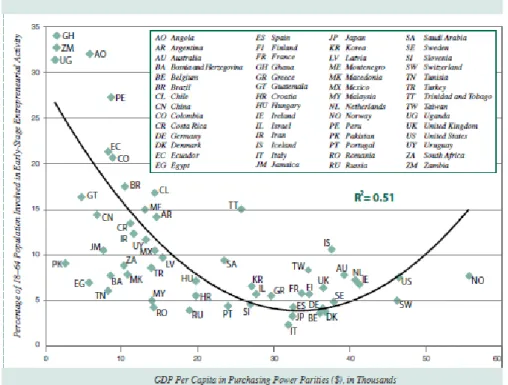
17 access to finance, R&D, knowledge and favorable conditions for entrepreneurship, leading these economies to give room for opportunity entrepreneurship. GEM has created a relation between the Percentage of 18-64 population Involved in Early-Stage Entrepreneurship and the GDP Per Capita for several economies and the result was a “U” shaped curve, suggesting a quadratic relation. The following figure represents the “U” shaped curve for the relation between GPD Per Capita and the percentage of population evolved in Earl-Stage Entrepreneurship (GEM, 2010):
FIGURE 1: RELATION BETWEEN THE % OF POPULATION INVOLVED IN EARLY-STAGED ENTREPRENEURIAL ACTIVITY
AND GDP PER CAPITA; SOURCE: GEM 2010
This figure supports the hypothesis of the distinction of early-staged entrepreneurship activities within different economies, which proves the existence of necessity and opportunity scenarios depending on the economies.
2.4.2 The Entrepreneur
It is certain that economic development is a driving force for entrepreneurship. Not only because it allows individuals to identify opportunities for businesses, but also because it opens space in the market for the generation of new and innovative ideas. Of course, the capability of an individual to be an entrepreneur is related to both social and psychological
18 dimensions. An entrepreneur is an individual who exploits and explores opportunities, accepting the risk and consequences of it. An entrepreneur is characterized by its leadership, and ability to create (Renko, El Tarabishy, Carsrud, & Brännback, 2015). According to GEM (2017), most entrepreneurs all over the world are opportunity-motivated, which means that the social context is a very strong variable to boost entrepreneurship in an early stage. The detection of opportunities, such as the individual’s beliefs about their entrepreneurial capabilities, are distributed worldwide depending on the conditions in their environment. The three major conditions are economic growth, culture and education, which are related to cultural factors, socio-economic factors and historical factors (GEM, 2010). Nonetheless, these variables are influent in the entrepreneurial attitude. One of the attitudes that makes an entrepreneur is the capability to perceive and recognize business opportunities. According to GEM (2010), this capability may be related to the type of economy in which individuals live. This relation has been studied along the years and the latest conclusions suggest that individuals have a higher perception for opportunities for entrepreneurship in factor-driven economies. It has also been detected a lower capability for perception for opportunities for entrepreneurship in efficiency-driven and innovation-driven economies (GEM, 2010). This may be relatable to the necessity-opportunity scenario, and it is not extendedly hard to understand this relation. In a factor-driven economy (where prevails the necessity scenario), most of the individuals have no other choice than start their own businesses. Therefore, the are “obliged” to have a perception for a business opportunity in order to create one. However, according the official OECD definition, an individual is an entrepreneur if he/she adds a novelty to the business. This way, although economies are a driving force for entrepreneurship, there is a very important parcel that should not be ignored: the entrepreneur. As a human being, an entrepreneur may or may not have the right skills to let him/her start a business. Understanding the characteristics of an entrepreneur, such as its mindset, may be a decisive step to a new comprehension of entrepreneurship. This ideology allows the creation of a hypothetical relation that certainly can be very interesting: the relation between creativity and entrepreneurship.
2.5 Creativity and Entrepreneurship
While the literature on entrepreneurship is very rich, the literature found on creativity and entrepreneurship is considerably less robust. However, some empirical investigations
19 have been carried out in order to determine how creativity may be related to entrepreneurship and its development. Blauth. et al. (2014) enhances the importance of creativity for product development. In other words, the author claims that in a company, creativity can be considered as the ability to perceive and exploit business opportunities, which should be regarded as a crucial key for employees to develop new products (Blauth, Mauer, & Brettel, 2014). In an increasingly competitive business environment, competitive advantage is gained by producing innovative products and services to generate distinction, which has caused research to extoll innovation as an important characteristic for companies (Blauth et al., 2014). On the other hand, Fillis & Renstschler (2010) assume innovation as the “tangibilisation of creativity” (Fillis, 2010, p.66), which emphases the importance of creativity behind the innovation process.
In what concerns to innovation research, creativity has been considered to play a dominant role in the early stage for the generation of the new ideas (Vissers & Dankbaar, 2002). In fact, as mentioned earlier, creativity is believed to be directly related to Divergent Thinking, which allows the individual to “think outside the box” and generate multiple answers for a problem (Chamorro-Premuzic & Reichenbacher, 2008) under uncertainty conditions. However, the creative output of an individual depends both on personal and contextual inputs (Amabile, 1996), which has taken companies to be advised to concern more about the conditions of work environment and also to stimulate employees’ creative skills (Blauth et al., 2014).
Hence, the conjugation of both creativity and entrepreneurship literatures leads to the possibility of a relation between both subjects.
The Global Creativity Index (GCI, 2015), has found a positive and strong relation between creativity and entrepreneurship. The data that has been correlated is the Global Entrepreneurship Index and the GCI, across 130 nations. According to the author, the correlation between the GCI and entrepreneurship is higher than the correlation between GCI and GDP per capita (Florida et al., 2015). Plus, a correlation between the 3T’s of creativity and the Global Entrepreneurship Index has been carried out and positive results have been determined for each of the 3T’s and entrepreneurship, which supports the hypothesis of a strong influence of technology, tolerance and talent in entrepreneurship. In this context, it should be expected to find a relation between entrepreneurship and creativity.
20
3.
Framework and Hypothesis
3.1 Research Hypothesis and Development of the Model
The aim of this research is to determine the possible association between creativity and entrepreneurship worldwide. For that, a relation has been created between indicators of creativity and indicators of entrepreneurship. All data was collected from known indexes, and the results are very interesting. In an early stage of the study, the elected variable for creativity was the Creative Output from Global Innovation Index (GII), and for the entrepreneurship, the elected variable was Total Early Stage Entrepreneurship (TEA) from Global Entrepreneurship Monitor (GEM). The relation goes across the years of 2014, 2015, 2016 and 2017. Several studies suggested this influence to be significant, and the results found in literature seem to be consistent. Blauth et. al (2014) have suggested that the use of entrepreneurial decision making has impact on creativity development. On the other hand, it has been also concluded that innovation cannot be achieved without creativity (Hong, Hou, Zhu, & Marinova, 2018). The model of the 3T’s of creativity provides light to a new perspective which makes it possible to comprehend the integration of creativity in the actual economy (Florida et al., 2015). Holistic approaches have been followed by some researchers, where the influence of creativity on entrepreneurship has been explored. According to Florida et al (2015), creativity is positively and strongly correlated with entrepreneurship and competitiveness (Florida et al., 2015). Blauth et. al. (2014) have determined that employee’s creativity will likely result in innovation and competitiveness. Van de Vliert & Murray (2018) also relates urbanization with creativity, which, according to the author, provides conditions to concentrate human capital and diverse perspectives. Also, the author claims that the national culture (“societal institutionalization, social inequality vs equality, collectivism vs individualism and other socio-behavior al covariates of affluence”) (Van de Vliert & Murray, 2018, p.21 ) is a very close variable to creative culture (Van de Vliert & Murray, 2018). Furthermore, Fillis, (2010) has also concluded that creativity is a key for the entrepreneur to act on business opportunities, which has increased over the years in the knowledge based economy. According to the author, “entrepreneurial creativity can be viewed as a process occurring in an individual who has been shaped, in art, by a range of social factors” (Fillis, 2010, p.20), where globalization and technology play serious roles for its development. By analyzing and combining all the definitions found on literature, it is possible to behold the relation between creativity and entrepreneurship, and all the factors that are involved
21 in its assessment. For instance, it has been suggested among the literature that opportunity-driven entrepreneurship tends to happen more frequently in innovation-driven economies. Therefore, considering the Creative Output as an indicator of innovation (GII, 2018), there may be a possible positive relation between creativity and entrepreneurship. In fact, the association between creativity and entrepreneurship has been shaped to the possibility of a stronger impact of creativity in the opportunity entrepreneurship scenario (Deli, 2011). On the other hand, the necessity scenario for entrepreneurship does not seem to be as dependent of creativity as the opportunity scenario, since entrepreneurs do not have other choice than open their own businesses for survival (Fossen & Fairlie, 2017). According to Zampetakis & Kanelakis (2010), opportunity entrepreneurs have higher ability to recognize business opportunities by identifying non-obvious associations new ideas, unlike the necessity entrepreneurs (Deli, 2011; Zampetakis & Kanelakis, 2010).
Also, one of the Creative Output pillars is referred to the intangible assets (such as trademark applications, design, ICTs and organizational and business models), which are direct measures for innovation (GII, 2018). Since innovation and entrepreneurship share a very strong bond (Williams & McGuire, 2010), there may be a positive relation between the intangible assets with entrepreneurship. Plus, it may be possible to observe a rise of intangible assets in the opportunity scenario of entrepreneurship, once it happens more frequently rather in innovation-driven economies than in efficiency and factor-driven economies (GEM, 2018). The same situation may be expected for the other two indicators of the Creative Output. Creative goods and services are, according to GII (2018), explained in terms of cultural and artistic activities (such as films production, entertainment, etc.) and, just like the intangible assets, are indicators for innovation. It is easy to understand why this relation exists. It is certain that the higher the innovation indexes, the higher is the wealth of the countries (GII, 2018). This measure is captured by analyzing, for example, the values of GDP per capita, and compare them with the innovation indexes. For example, in 2017, Switzerland was attributed with the highest score for the GII, and its GDP per capita is also one of the highest. According to the results, the higher the wealth of a country, the higher the availability to invest in creative goods and services. Hence, since creative goods and services are one of the pillars of the Creative Output (and therefore, innovation), it should be expected to observe a positive relation between creative goods and services and entrepreneurship. Nonetheless, it is also
22 expected to observe a stronger correlation in opportunity scenarios, unlike in necessity scenarios.
Lastly, online creativity follows the same pattern as the other two pillars of the Creative Output. Online activity depends on the access of a nation to technology, and according to Florida et al (2015), technology has a strong correlation with GDP per capita, which means the lower the wealth of a country, the lower the technology index. This way, it may be possible to expect a positive relation between online creativity and opportunity-driven entrepreneurship, unlike in the necessity-opportunity-driven entrepreneurship scenario. Considering all the information found on literature review and based on the arguments shown above, it has been possible to formulate the following hypotheses:
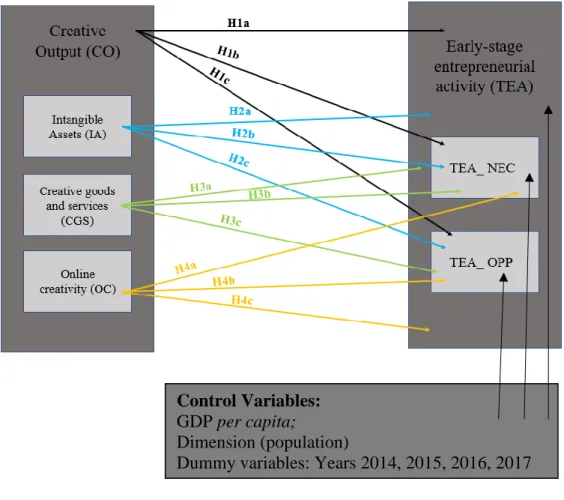
H1a: Creative Output (CO) is positively related to early-stage entrepreneurial activity (TEA);
H1b: Creative Output (CO) is negatively related to early-stage entrepreneurial
activity in a necessity scenario (TEA_NEC);
H1c: Creative Output (CO) is positively related to early-stage entrepreneurial
activity in an opportunity scenario (TEA_OPP);
H2a: Intangible Assets (IA) are positively related to early-stage entrepreneurial
activity (TEA);
H2b: Intangible Assets (IA) are negatively related to early-stage entrepreneurial
activity in a necessity scenario (TEA)_NEC;
H2c: Intangible Assets (IA) are positively related to early-stage entrepreneurial
activity in an opportunity scenario (TEA_OPP);
H3a: Creative Goods and Services (CGS) are positively related to early-stage
entrepreneurial activity (TEA);
H3b: Creative Goods and Services (CGS) are negatively related to early-stage
entrepreneurial activity in a necessity scenario (TEA_NEC);
H3c: Creative Goods and Services (CGS) are positively related to early-stage
entrepreneurial activity in an opportunity scenario (TEA_OPP);
H4a: Online Creativity (OC) is positively related to early-stage entrepreneurial
activity (TEA);
H4b: Online Creativity (OC) is negatively related to early-stage entrepreneurial
activity in a necessity scenario (TEA_NEC);
H4c: Online Creativity (OC) is positively related to early-stage entrepreneurial
23 To test the argued hypotheses, the following conceptual model has been created:
FIGURE 2: CONCEPTUAL MODEL
4. Methodology
In order to answer the fundamental research question of this study – does creativity have impact on entrepreneurial activity? – it is intended to determine in which conditions may or may not exist a cause-effect between the Creative Output (CO) and the Total Early-Stage Entrepreneurial Activity (TEA) for each country in the sample. Furthermore, it is also intended to understand which one of the pillars of CO presents more impact on TEA. Nevertheless, the scenarios of TEA where CO has a higher impact are likewise studied, such as the pillars of CO that influence those scenarios.
The mentioned relations have been analyzed using quantitative methods, such as correlational analysis and multiple linear regressions. By using these statistical techniques, the main objective is to determine in which way each one of the independent
Control Variables:
GDP per capita;
Dimension (population)
24 variables (related to creativity) may or may not justify the occurrence of the dependent variables (related to entrepreneurial activity).
4.1 Dependent Variables
The dependent variables used in this research were provided by the Global Entrepreneurship Monitor (GEM) and are the Total early-stage Entrepreneurial Activity (TEA), the Total early-stage Entrepreneurial Activity for the necessity scenario (TEA_NEC), and the Total early-stage Entrepreneurial Activity for the opportunity scenario (TEA_OPP).
GEM provides data of each one of these indicators from 2001 until 2017. However, the selected years for the present study were the years 2014 to 2017, as it will be justified further.
4.2 Independent Variables
As the literature about national creativity is not considerably robust, very few choices have been available for the selection of the independent variables. However, the Global Innovation Index (GII) provided information about creativity as an output of innovation, and the indicator that has been chosen was the Creative Output (CO) provided by the GII. Furthermore, the three sub-indexes of CO, which are Intangible Assets (IA), Creative Goods and Services (CGS) and Online Creativity (OC) were also elected to be independent variables in an attempt to justify more concretely the relation between creativity and entrepreneurship.
4.3 Control Variables
Since entrepreneurial activity is influenced by several other variables outside the selection for the present study, diverse control variables have been introduced in the analysis. These variables were as follows:
• Gross Domestic Product per capita (GDPpc): there are many studies that relate GDPpc with entrepreneurial activity, although some divergencies can be found in literature. For example, some authors suggested a negative correlation between GDPpc and entrepreneurial activity (Amoro, 2008). However, the latest results indicate that the most accurate relation between GDPpc and entrepreneurial activity is a “U” shaped curve, as indicates Figure 1 (M. A. Carree & Thurik, 2010). Given the already tested hypothesis of a relation between GDPpc and
25 entrepreneurial activity, it is certain that this variable is relevant for its inclusion in the control variables. The data was collected from the World Development Indicators from the World Bank.
• Dimension (population): dimension has also been considered relevant to be included as a control variable in this research. In the same way as for GDPpc, this data was collected from the World Development Indicators from the World Bank. • Years: this variable represents the set of elected years for the study. As it is the only dummy variable used in this context, the value 1 represents the information that is referent to a specific year, and the value 0 represents the information that is not referent to that specific year.
4.4 Sample
4.4.1 Selection of the countries
The sample is constituted by 59 countries. However, not all countries are scored for every year. Information of both GII and GEM has been matched for each year and for each variable. Some countries have been excluded since they were not been included in GEM for each year. This way, only the countries that presented values for all the variables in both reports were considered for the analysis. Also, the country New Zeeland was not included given the lack information found in GEM from 2006 until the present year.
4.4.2 Selection of the years
The values that concern to the indicators that analyze entrepreneurial activity, assigned by GEM, relate to the timeframe from 2014 until 2017. Before 2014 these indicators were scored differently, and due to this limitation, it was not possible to include information prior to 2014. On the other hand, the latest values for entrepreneurial activity, assigned by GEM, are referred to 2017. Overall, the total number of observations was 224.
5. Results
In this chapter, the aim is to exhibit the analysis of the relations between the variables introduced previously. The study was carried out by analyzing the correlation between the variables, and furthermore, the multiple linear regressions. The objective is to gauge if the previously argued hypotheses are supported. The data was introduced in Microsoft