This work is licensed under the Creative Commons Attribution-NonCommercial-ShareAlike 4.0 International License.
Effect of dual-task and visual manipulation on the
balance of older physical exercise practitioners and
sedentary older and young adults
Efeito da dupla-tarefa e da manipulação visual no equilíbrio de idosos praticantes de
exercícios físicos, idosos e adultos jovens não praticantes
AUTHOR’S Raquel de Melo Martins1
Bruno José Frederico Pimenta2
Marcelo Alves Costa3
Thiago Viana Camata4
Márcio Rogério de Oliveira2
Inara Marques1
1 Universidade Estadual de Londrina, Departamento de Educação Física, Londrina, Paraná, Brazil.
2 Universidade Norte do Paraná, Londrina, Paraná, Brazil.
3 Centro Universitário Filadélfia, Londrina, Paraná, Brazil.
4 University of Queensland, Brisbane, QLD, Australia. CORRESPONDING
Raquel de Melo Martins
Rodovia Celso Garcia Cid, Km 380, Caixa Postal: 6001. Londrina, Paraná, Brasil. CEP: 86051-990.
DOI
10.12820/rbafs.24e0107
ABSTRACT
The objective was to compare the effect of dual-task and visual manipulation on postural balance of older physical activity practitioners and older and young adult non-practitioners. Fifty-one subjects were divided into four groups: Older Practitioners of Karate (OPK), Older Practitioners of Func-tional Gymnastics (OPG), Non-practicing Older Adult Group (ONP), and Non-practicing Young Adult Group (YNP). The task was to remain in an upright, static position on a force platform, for 40 seconds, with and without a cognitive dual-task, by means of an arithmetic sum, and visual ma-nipulation, with and without a blindfold. The analyzed variables of the Center of Pressure (COP) were: area of oscillation and mean amplitude of oscillation, in the mediolateral and anteroposterior directions. The results showed similar performances among the physical exercise groups (OPK and OPG) and the young adults (YNP), while the ONP presented greater postural oscillation in all conditions. In the visual condition, blindfolded, in the condition with the dual-task, the OPK, OPG, and YNP groups oscillated less, when compared to the condition without dual-task. Thus, it can be inferred that the practice of physical exercises, regardless of the modality, is effective in improving the postural control of older adults, with similar performances to the group of young adults, even in conditions with dual-task and sensory manipulation of vision.
Keywords: Aging; Physical activity and health; Postural control; Dual-task. RESUMO
O objetivo do estudo foi comparar o efeito da dupla-tarefa e da manipulação visual no equilíbrio postural em idosos praticantes de diferentes modalidades de exercícios físicos, idosos e adultos jovens não praticantes. Participaram do estudo 51 indivíduos, subdivididos em quatro grupos: grupo de idosos praticantes de karatê (GPK), grupo de idosos praticantes de ginástica funcional (GPF), grupo de idosos não praticantes (GNP) e grupo de adultos jovens (GNP). A tarefa consistiu em permanecer, na posição ereta, sob plataforma de força, por 40 segundos, sem e com dupla-tarefa, por meio de soma aritmética e com manipulação visual, com e sem visão. As variáveis analisadas do Centro de Pressão (COP) foram: área de oscilação e amplitude média de oscilação, nos sentidos médio-lateral e ântero-posterior. Os resultados foram desempenhos semelhantes entre os grupos que praticavam exercícios físicos (OPK e OPG) e o de adultos jovens (YNP), enquanto o ONP apresentou maior oscilação postural, nas variáveis área e amplitude de oscilação. Na condição visual, com vi-são e com a dupla-tarefa, os grupos OPK, OPG e YNP oscilaram menos, quando comparados a condição sem dupla-tarefa. Dessa forma, pode-se inferir que a prática de exercícios físicos, independente da modalidade, é eficaz no equilíbrio postural de idosos, com desempenho semelhante no grupo de adultos jovens, mesmo em condições com dupla-tarefa e manipulação sensorial da visão.
Palavras-chave: Envelhecimento; Atividade física e saúde; Equilíbrio postural; Dupla-tarefa.
Introduction
Maintaining postural stability is a complex process1, re-quiring integration of the input signals between the vi-sual, vestibular, and somatosensory systems to produce adequate postural balance2, and correct adjustments to musculature for the individual to remain in an upright position3. However, the aging process causes functional
declines in some of these systems4.
Some studies have shown physiological declines in the visual, vestibular, and somatosensory systems3,5. These declines can lead older adults to be more suscep-tible to falls6, increased loss of autonomy7, greater fear of falling, and some walking disorders8. With regard to postural balance, this decline is also observed, being
more pronounced in the performance of dual-tasks8,9. Some reasons why older people are more suscepti-ble to postural imbalances are the need for more cog-nitive resources10 and the decline in physical capaci-ties11. In everyday tasks that involve the simultaneous performance of actions, such as reading, manipulating objects, visual monitoring, and walking, attention is divided, causing greater postural instability12. Some of these risk factors can be mitigated by physical exer-cise13,14. In this case, regular physical exercise can pre-vent falls in the older community in general, due to its effect on the mechanism of the postural control system, with improvements in cognitive and motor aspects14.
Studies comparing different modalities are wide-spread in adolescent and adult populations15, however, little explored among older adults16, especially in mo-dalities that include exercises which stimulate postural control, through greater instability during practice, in-cluding dynamic and unipodal movements, such as the martial art of karate and functional training, which can have beneficial effects on the postural balance of older adults. Some authors17,18 discuss the positive effects of karate training, as a practice that influences efficient motor action responses. On the other hand, function-al training is one of the most common modfunction-alities for older adults, the benefits of which involve motor coor-dination, agility, balance, and strengthening of lower and upper limbs17.
However, although there is a consensus that physical exercise practices have a positive impact on the aging process14,16, especially on gait and postural balance, it is not clear in the literature whether there are differences between the modalities practiced by older adults, espe-cially in the performance of postural balance together with a dual-task. In addition, situations with sensory manipulation, such as a visual condition, by blindfolding the eyes during posture maintenance, may increase the differences between groups of older practitioners and non-practitioners of physical exercises and young adults.
The hypotheses of the current study were that the groups of older people who practice physical exercises would present less postural oscillation compared to the group of non-practitioners in the condition with du-al-task. The two groups would be different from each other, with the group of Karate practitioners demon-strating less instability. The groups of older people who practice physical exercises would perform similarly to young adults and be more susceptible to instability in the condition without visual information.
Thus, the objective of the current study was to com-pare the effect of dual-task on postural balance in old-er practitionold-ers of diffold-erent types of physical exold-ercises, and older and young non-practitioners, in conditions with and without vision.
Methods
This study is characterized as cross-sectional, with a con-venience sample of older participants and young adults. The study included 51 volunteers, 30 women and 21 men.
Participants were subdivided into four groups: Old-er PractitionOld-ers of Karate (OPK), 11 oldOld-er adults (five men and six women); Older Practitioners of Func-tional Gymnastics (OPG), 16 older adults (seven men and nine women); Non-practicing Older Adult Group (ONP), 12 older adults (five men and seven women), Non-practicing Young Adult Group (YNP), 12 young adults (four men and eight women).
As inclusion criteria for the older groups (OPK, OPG, and ONP), participants were required to be be-tween 60 and 75 years of age, not have motor limita-tions that could influence the performance of experi-mental tasks, neurological diseases, or hearing loss, and know how to read and write. All of these aspects were self-reported by the participants through an anamne-sis. They were also required not to have cognitive im-pairments, assessed by the Mini-Mental State Exam (score> 22 in the MMSE), considering schooling19. The YNP were required to be between 20 and 35 years old, not have cognitive and physical limitations that compromise the task, and not have practiced physical exercise in the previous six months.
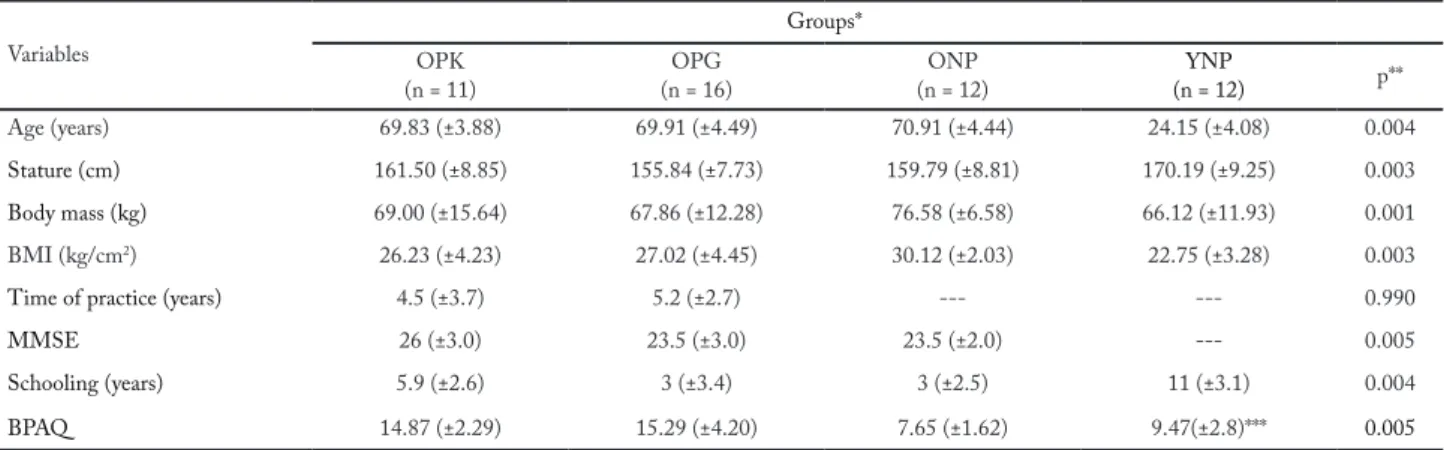
The Baecke questionnaire adapted for older adults20 and the Baecke questionnaire for the YNP were ap-plied to measure the practice of physical activity in the groups. Table 1 presents the characteristics of the participants. No differences were observed in the older groups between anthropometric measurements related to height and body mass.
There were differences between the groups with re-gard to height, body mass, and BMI (p < 0.05), with the YNP showing the lowest mean of the analyzed val-ues. When considering the educational level, the OPK presented more years of study when compared to the OPG and ONP (p < 0.05). This difference was also ob-served when analyzing the MMSE of the OPK, who presented higher scores when compared to the OPG and ONP. The YNP, on the other hand, presented a higher number of years of study when compared to the
older groups (OPK, OPG, and ONP). Regarding the level of physical activity, the ONP showed a significant difference compared to the OPK and OPG (p < 0.05).
A structured interview was carried out with par-ticipants through a questionnaire, referring to issues such as lifestyle, education, pre-existing diseases, drugs, history of falls, depression, fear of falling, and physical exercise practices in the previous six months.
The older adults were recruited in the places where they practiced their modalities of physical exercises and the ONP at an activity aimed at older adults, where bi-weekly meetings were held to address topics on aging, with crochet and computer workshops. For the OPK and OPG, participants were required to have partic-ipated in their practices continuously for the previous six months, with a minimum time in practice of one year (Functional Gymnastics and Karate). The OPK and OPG practiced their modality in three sessions a week, with each training session lasting one hour. The frequency of presence in classes was self-reported and reported by the teachers of the classes.
The evaluations took place at the Functional Evalua-tion and Human Motor Performance Laboratory of the State University of Londrina. The participants were in-dividually evaluated by the laboratory team, composed of the researcher and two other assistants, previously trained to perform the tasks. Participants in all groups were previously informed about the objectives and pro-cedures adopted in the study. After clarification, all par-ticipants signed the Free and Informed Consent Form. The procedures adopted in the study followed the crite-ria of ethics in research with human beings, according to Resolution no. 466/2012 and Resolution no. 510/2016
and approved by the Research Ethics Committee of the local University, under opinion no. 287/2011.
The postural balance test consisted of the partici-pants remaining in an upright, static position, for 40 seconds, on a force platform, with bare feet and arms extended at their sides. The support base adopted dur-ing the test was semi-tandem (ST). The participant chose the foot to place in front, after familiarization with the posture, and was required to perform all con-ditions with the same foot forward. The experimental conditions outlined for the study included: without dual-task and with vision (STCV); without dual-task and without vision (STSV); with dual-task and with vision (DTCV), and with dual-task and without vi-sion (DTSV). Three attempts were performed in each condition, with an interval of thirty seconds between attempts and sixty seconds between conditions. The or-der of conditions was randomized for all participants, by means of a draw.
In the condition with manipulation of the visual stimulus, with vision, the participants were asked to stare at a black visual mark (14.5 cm high x 14.5 cm wide x 4 cm thick), positioned on the wall, at the height of the eyes, a distance of two meters from the center of the platform. In the condition without vision, the participants were required to remain in the same position as the condition with vision, however, with a blindfold to occlude the visual information.
After the initial procedures, the participants were taken to the force platform for the familiarization session and then to perform the proposed experimental tasks. For the safety of the participants, during the experimen-tal conditions, the support team was always close to the
Table 1 – Characterization of participants: anthropometric and cognitive variables, time of practice, schooling, and level of physical activities (n = 51)
Variables OPK Groups*
(n = 11) (n = 16)OPG (n = 12)ONP (n = 12)YNP p**
Age (years) 69.83 (±3.88) 69.91 (±4.49) 70.91 (±4.44) 24.15 (±4.08) 0.004
Stature (cm) 161.50 (±8.85) 155.84 (±7.73) 159.79 (±8.81) 170.19 (±9.25) 0.003
Body mass (kg) 69.00 (±15.64) 67.86 (±12.28) 76.58 (±6.58) 66.12 (±11.93) 0.001
BMI (kg/cm2) 26.23 (±4.23) 27.02 (±4.45) 30.12 (±2.03) 22.75 (±3.28) 0.003
Time of practice (years) 4.5 (±3.7) 5.2 (±2.7) --- --- 0.990
MMSE 26 (±3.0) 23.5 (±3.0) 23.5 (±2.0) --- 0.005
Schooling (years) 5.9 (±2.6) 3 (±3.4) 3 (±2.5) 11 (±3.1) 0.004
BPAQ 14.87 (±2.29) 15.29 (±4.20) 7.65 (±1.62) 9.47(±2.8)*** 0.005
*One Way ANOVA = mean values with standard deviation; BMI = body mass index; MMSE = Mini-Mental State Examination; BPAQ = Phys-ical activity questionnaire adapted for the elderly (Baecke); **Tukey’s post hoc; ***Baecke questionnaire for young adults. OPK = older practitioners of Karate; OPG = older practitioners of Functional Gymnastics; ONP = older adult non-practitioners; YNP = young adult non-practitioners.
area of the force platform to assist if necessary.
The dual-task condition consisted of the perfor-mance of summing numbers previously recorded and presented by sound stimulus and multimedia ampli-fiers, positioned one meter behind the participants. The presentation interval between one number and the next was 3.33 seconds. All participants were previous-ly instructed to add 12 numbers mentalprevious-ly and without the aid of the hands or any other part of the body that could influence the postural condition.
The numbers used for the mathematical operation (sum) varied from one to three, with 12 predetermined combinations, being randomized in each condition, with the same final sum, with only the location of the numbers changing. Before starting the calculation, an auditory command indicated the beginning of the task and the participant was instructed to keep their eyes fixed on a black visual mark or blindfolded and, only after the end of the 40 seconds of the task, inform the evaluator of the result of the final sum.
To evaluate the postural balance, a force platform was used. Calculation of the Center of Pressure (COP) was derived from a sampling of 100 Hz. All the recorded strength signals were filtered with a low bandwidth filter of 35 Hz and of second order (Butterworth filter). For the acquisition and treatment of equilibrium parameters, the Bioanalysis software of the BIOMEC400 platform was used, which is compiled with MATLAB analysis routines (The Mathworks, Natick, MA). The main equi-librium parameters based on the COP were computed.
For the evaluation of postural balance, the follow-ing variables were obtained from the COP: area of dis-placement of the COP (cm2), calculated through the area of the ellipse that encompasses 95% of the total amplitude and mean amplitude of displacement of the COP, in the anteroposterior (AP) and mediolateral (ML) directions (cm).
After collecting the COP variables, the mean of the three attempts was used for the analyses. The validi-ty and reliabilivalidi-ty of the balance parameters calculated using this platform and software were evidenced by a previous study16.
For the categorization of the results of the du-al-task, the data were transformed into scores from 1 to 4, in which the highest score was four and the lowest one. The scoring was performed as follows: 1 - Error in the sum, far from the acceptable margin of error (sum greater than or less than five numbers from the correct sum); 2 - Error in the sum of four numbers above or
four numbers below the correct result (+4); 3 - Error in the sum of two numbers above or two numbers below the correct result (+2); 4 - Correct sum.
For the statistical analysis, the normality of the data was verified through the Shapiro Wilk test, the homoge-neity of the variances by the Levene test, and the sphe-ricity through the Mauchly test, for ANOVA Two Way, with repeated measures. To characterize the sample and compare the variables, ANOVA One Way was used.
The results of the evaluation of postural balance met the assumptions for statistical analysis using the ANOVA Two Way test with repeated measures. The ANOVA Three Way test was used to compare postural balance: four groups versus two task conditions (with and without dual-task) versus two visual conditions (with and without vision), with repeated measures on the last two factors. To identify the statistical differ-ences between groups, tasks, and visual condition, the Tukey test was used as a post hoc.
For the analysis of the dual-task score, the Kruskal Wallis non-parametric test was used for the groups and to identify the differences, the Mann Whitney U Test was used as a post hoc. The level of significance adopt-ed was 5%.
Results
For variables related to postural balance, the mean values of the COP sway area are shown in Figure 1. Regarding the comparisons between groups, effects were verified between groups [F (3; 47) = 13.07; p < 0.01], between tasks [F (3; 41.47) = 13.07; p < 0.01], and between visual conditions [F (1; 47) = 155.58; p < 0.01]. It was also possible to identify an interaction between groups and visual condition [F (3; 47) = 3.48; p < 0.05].
The effect between groups and visual condition was identified by the post hoc test, with differences between the groups in the STCV and DTCV conditions and also in the STSV and DTSV, with the ONP group demonstrating greater oscillation of the COP in the two conditions, differing from the other groups (OPK, OPG, YNP), with p <0.05.
For the intragroup analysis, in the STCV and STSV conditions, the OPK, OPG, and ONP groups showed differences, with a greater displacement area of the COP in the STSV condition (p < 0.05) and in the DTCV and DTSV conditions, the OPK, OPG, and ONP groups showed greater oscillation in the DTSV condition (p < 0.05).
In the DTCV and DTSV conditions, the OPK, OPG, and ONP groups showed greater oscillation in the DTSV condition (p <0.05). The condition of the visual task was disturbing for all groups, with an in-crease in the area of oscillation in the condition with-out vision.
Figure 1 – Values presented as mean and standard deviation of the groups, in the area of COP oscillation, in the different conditions of the tasks, with and without dual-task and with and without visual information.
a = significant difference between ONP and the OPK, OPG, and YNP groups, under STSV and DTSV conditions; b = significant intra-group difference, under STCV and STSV conditions; c = significant intra-group difference, under DTCV and DTSV con-ditions; STCV = without dual-task and with vision; DTCV = with dual-task and with vision; STSV = without dual-task and without vision; DTSV = with dual-task and without vision; OPK = older practitioners of karate; OPG = older practitioners of Functional Gymnastics; ONP = older adult non-practitioners; YNP = young adult non-practitioners.
For the variable mean amplitude of oscillation of the COP, in the AP direction (Figure 2), significant differences were observed. These differences were iden-tified with an effect for group [F (3; 47) = 14.503; p < 0.001], task condition [F (1; 47) = 5.8069; p < 0.001], and visual condition [F (1; 47) = 63.685; p < 0.001].
The OPK showed less oscillation with significant differences from the ONP under STSV and DTCV conditions (p < 0.05). The participants in the ONP group showed greater displacement of the COP in the condition without vision when compared to the condi-tion with vision (p < 0.01).
For the mean amplitude of oscillation of the COP, in the ML direction (Figure 3), there was greater oscil-lation between the groups, being more evident in the condition without vision. The analysis of variance iden-tified these differences, indicating an effect between groups: [F (3; 47) = 10.60; p < 0.001], task condition [F (1; 47) = 9.84; p < 0.001], and visual condition [F (1; 47) = 151.30; p < 0.001].
The post hoc test identified differences between the groups, with the ONP showing greater amplitude of COP oscillation in the ML direction, when compared to the other groups (p < 0.001).
For the effect of the visual condition and without dual-task, the OPK, OPG, and YNP groups showed greater oscillation in the STSV condition (p < 0.05). However, with respect to the effect of the visual con-dition with dual-task, it was evidenced that the ONP and YNP groups presented greater displacement of the COP in the DTSV condition when compared to the DTCV (p < 0.05).
In the dual-task condition, there was no significant difference for the other groups (p > 0.05). The OPK presented decreased amplitude of oscillation, showing the effect of the cognitive task on postural balance. This variable was even more evident in the comparison with and without vision, with the OPK oscillating less in the intra-group evaluation (p < 0.001).
Figure 2 – Values presented as mean and standard deviation, in the amplitude of oscillation of the COP, in the AP direction, in the different conditions of the tasks, with and without dual-task and with and without visual information.
a = significant difference between the OPK and ONP groups, under STCV/DTCVSTSV, and DTSV conditions; b = significant differ-ence from ONP, in STCV and DTCV conditions; STCV = without dual-task and with vision; DTCV = with dual-task and with vision; STSV = without dual-task and without vision; DTSV = with dual-task and without vision; OPK = older practitioners of karate; OPG = older practitioners of Functional Gymnastics; ONP = older adult non-practitioners; YNP = young adult non-practitioners.
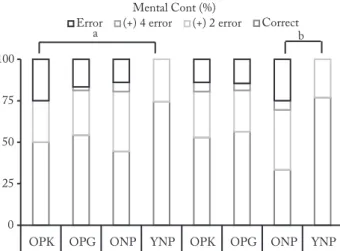
The dual-task data were analyzed by score (from 1 to 4) and presented as a percentage (Figure 4). The Kruskal Wallis test identified differences in the du-al-task between groups [H (3; 51) = 10.448; p = 0.015], with differences between the YNP and OPG in the DTSV condition, with better performance for the YNP (p < 0.05) and between the YNP and ONP in both conditions (p < 0.05).
Figure 3 – Values presented as mean and standard deviation of the groups, in the amplitude of oscillation of the COP, in the ML direction, in the different conditions of the tasks, with and without dual-task and with and without visual information.
a = significant difference between the ONP group and the other groups in the STCV and DTCV conditions; b = significant in-tra-group difference in STSV and STCV conditions; c = significant intra-group difference in DTSV and DTCV conditions.
Figure 4 – Relative values of dual-task, mental adding, in conditions with and without vision.
a = Significant intra-group difference in DTSV (OPK and YNP); b = Significant difference between the ONP and YNP groups, DTSV and DTCV conditions.
In Figure 4, it can be seen that the YNP performed better in the cognitive task, with a higher percentage of correct answers without any errors. The OPK group was consistent in their correct answers, presenting 50% correct answers, a performance similar to the OPG. However, in the condition with vision, the OPK ob-tained a greater number of errors (25%) compared to the other groups. The OPG was shown to be consist-ent in the successes and errors in both conditions. The ONP, in the DTCV condition, obtained 44.4% correct answers. In the absence of visual information, there was a drop in performance (33.3% correct answers), as well as an increase in the number of relative errors from 14% to 25%.
Discussion
The aim of the current study was to compare the effect of the dual-task on postural balance in older people who practice different types of physical exercises, and older and young adults who do not, in conditions with and without vision.
The study hypotheses established were: the groups of older people who practice physical exercises would present better postural balance when compared to non-practitioners, the groups would be different from each other, with the OPK showing better postural balance when compared to the group of functional gymnastics practitioners; the OPK and OPG would present similar performances to the YNP, in the condi-tions of postural balance with dual-task, and the older groups would present a detriment in the variables of postural control, in the condition without vision.
When analyzing the results of the study, the effect of the dual-task was observed on the postural balance of older people who practice physical exercises, non-prac-titioners, and young adults. The groups of older people who practiced physical exercises presented results simi-lar to those of the young adults, confirming the hypoth-esis that they would have better postural balance than non-practitioners, oscillate less in conditions with du-al-task, with and without vision. However, they did not differ between each other, refuting the study hypothesis that predicted better performance of the OPK.
Through the analysis variables related to balance, it was possible to verify the effect of the dual-task. In the mean amplitude of oscillation, in the AP direction, the effect of the cognitive task condition was more evident for the OPK, with a decrease in the oscillation of the COP.
For the mean amplitude, in the ML direction, due to the characteristic of the support base adopted, semi
tandem, the groups tend to oscillate more in this
direc-tion. Both with and without vision, an effect of cogni-tive task was observed, with the OPK, OPG, and YNP presenting decreased oscillation in the conditions with dual-task, The ONP oscillated more when compared to the other groups, showing a greater propensity to instability and postural imbalances.
Regarding the manipulation of visual information, the hypothesis was confirmed, with all groups demon-strating greater oscillations in conditions without vi-sion. This differentiation was also observed for the YNP. The decrease in postural oscillation in older adults has been addressed by different studies in tasks such as mental counting, verbal reaction time, and special
memorization, with the tasks being performed both in the upright posture and during gait21. Studies9,22 indi-cate that when the difficulty of the task increases, such as a decrease in the support base, instability of the plat-form, or a high degree of complexity in the task, for example, older people tend to allocate more attentional resources to postural control, leading to decreased per-formance in the cognitive task.
The results corroborate the findings of Bergamin et al.23 and Burcal et al.24 who observed an improvement in postural balance when adding an arithmetic calcula-tion as a secondary task. These results can be explained by the fact that the participants focus on the cognitive task and not only on the postural task, also optimizing postural balance. In addition, the authors stressed that a concurrent cognitive task can make postural muscles more tense, resulting in the adoption of compensatory strategies, thus reinforcing posture recovery25.
In the results of the cognitive task, it was possible to observe that the YNP performed better than the older adults with a greater number of correct answers, under the conditions analyzed. There is the possibili-ty of allocating primary attention to posture, placed as “posture first”26, being that it can be allocated to guar-antee postural stability, potentially affecting the results in the performance of the cognitive task. The results of the present study corroborate, in part, this primordi-al primordi-allocation model for posture, since the older adults demonstrated the ability to maintain performance of postural control, managing to decrease their oscillation and perform the cognitive task.
Some authors27 argue about the inverted U hypoth-esis between cognitive demand and postural oscillation. Low cognitive demand increases the level of excitation, with excellent regulation of postural oscillation, how-ever, when there is high cognitive demand, even higher levels of arousal occur, leading to a decrease in postural performance27.
Thus, it can be inferred that the older adults bene-fited from the dual-task (mental counting), with func-tional modulation of the upright posture and results similar to that of young adults. These results can be observed in the present study in the sensory condition, without the blindfold, through the possible visual cues used in the perception-action of the movement.
Some studies, such as those of Lamoth & Heuvel-len28 and Boisgontier et al.29 corroborate our results, demonstrating a decrease in postural oscillation with the cognitive task and with performance of the older
group similar to that of young adults. Some factors may have been responsible for these results. There may have been a better sensorimotor integration of the group of older people practicing physical exercises, as well as more efficient postural corrections.
Regarding the results of the OPK and OPG groups, there were no differences between them, refuting the study’s hypothesis. It can be inferred that this was due to the characteristics of the two practices analyzed, since both emphasize body awareness and balance, with training aimed at benefits for physical and functional capacities.
In this sense, Okubo et al.12 address the impor-tance of specifics in training. The authors explain about models of motor skill practices and training methods that use different neuropsychological and sensorimotor mechanisms, to present greater transfer possibility to the daily life of older adults and, thus, avoiding possible falls, with more efficient postural reactions11.
One factor that did not influence the relationship with the postural balance task and the dual-task was the level of schooling between the OPK and OPG groups. As observed in the characteristics of the groups, the OPK group participants had a higher score in the MMSE, with the possibility of this being related to a higher level of schooling and not just the regu-lar practice of activities related to the karate modality. Schooling level was one of the main influences on the cognitive performance of older adults30.
Regarding postural balance, those studies found no differences between groups who performed motor practices. Regarding the group of older people who did not practice physical exercises, studies indicate greater postural sway when there is an absence of sensory in-formation5, corroborating the data found.
The motor and cognitive performances of the OPK and OPG groups are emphasized, and it is possible to observe that, even in conditions characterized as more complex, such as the decrease in the support base, con-dition with vision, and dual-task, the results presented were similar to those of young adults.
These results corroborate studies13,14 that indicate the benefits of physical exercise practice, regardless of the modality, as a means for maintaining and im-proving the physical and functional capacities of older adults, more specifically postural balance.
Some limitations can be attributed to the study: the number of participants per group. The characteristic of the study is cross-sectional, with a cut off of a moment, in which controlling the important variables for
train-ing such as volume, intensity, and number of sessions, are more difficult to compare.
However, in general, it was possible to observe im-portant results for older practitioners of physical ex-ercises. Regardless of the modality, if performed cor-rectly, with supervision, intensity control, volume, and exercises that can stimulate physical, cognitive, and motor capacities, there may be better transfer to motor skills and everyday tasks.
Thus, the importance of the practice of well-struc-tured physical exercises and with various stimuli for older adults was demonstrated, reducing the effects and declines caused by aging and proving to be an ef-fective way to minimize the effects of aging on physical and functional capabilities.
Conflict of interest
The authors declare no conflict of interest.
Financing
This work was carried out with the aid of the Support for Scien-tific and Technological Development of the State of Paraná - Fundação Araucária and the National Council for Scientific and Technological Development – CNPq.
Authors’ contributions
Martins RM, participated in the conception of the manuscript, writing, and collecting, analyzing, and interpreting the data. Pi-menta BJF, participated in the analysis and interpretation of data, and critical review of the content. Costa MA, participated in the writing, and data collection. Camata TV, participated in the in-terpretation of data, and critical review of the content. Oliveira MR, participated in data collection and data interpretation. Mar-ques I, participated in the conception of the manuscript, writing, and critical review of the content.
Acknowledgements
The authors would like to thank the members of the Motor Lear-ning and Development Group (Gepedam) for their collaboration in data collection.
References
1. Horak FB, Diener HC, Nashner LM. Influence of
central set on human postural responses. J Neurophysiol. 1989;62(4):841–53.
2. Shumway-cook A, Horak FAYB. Assessing the Influence of
Sensory Interaction on Balance Suggestion from the Field. Phys Ther. 1986;66(10):1548–50.
3. Chiba R, Takakusaki K, Ota J, Yozu A, Haga N. Human
upright posture control models based on multisensory inputs; in fast and slow dynamics. Neurosci Res. 2016;(104):96–104.
4. Petersen N, König HH, Hajek A. The link between falls,
social isolation and loneliness: A systematic review. Arch Gerontol Geriatr. 2020;(88):1-11.
5. Goble DJ, Coxon JP, Wenderoth N, Van Impe A, Swinnen
SP. Proprioceptive sensibility in the elderly: Degeneration, functional consequences and plastic-adaptive processes. Neurosci Biobehav Rev. 2009;(33):271–8.
6. Horak FB. Postural orientation and equilibrium: What do
we need to know about neural control of balance to prevent falls? Age and Ageing. 2006;35(S2):ii7–ii11
7. Souza AQ, Pegorari MS, Nascimento JS, Oliveira PB,
Tavares DMS. Incidência e fatores preditivos de quedas em idosos na comunidade: Um estudo longitudinal. Cien Saude Colet. 2019;24(9):3507–16.
8. Raichlen DA, Bharadwaj PK, Nguyen LA, Franchetti MK,
Zigman EK, Solorio AR, et al. Effects of simultaneous cognitive and aerobic exercise training on dual-task walking performance in healthy older adults : results from a pilot randomized controlled trial. BMC Geriatr. 2020;20(1):83.
9. Freire Júnior RC, Porto JM, Marques NR, Magnani PE,
Abreu DCC. The effects of a simultaneous cognitive or motor task on the kinematics of walking in older fallers and non-fallers. Hum Mov Sci. 2017;(51):146–52.
10. Gaillardin F, Baudry S. Influence of working memory and
executive function on stair ascent and descent in young and older adults. Exp Gerontol. 2018;(106):74–9.
11. Streit IA, Mazo GZ, Virtuoso JF, Menezes EC, Gonçalves E.
Aptidão física e ocorrência de quedas em idosos praticantes de exercícios físicos. Rev Bras Ati Fis Saude. 2012;16(4):346–52.
12. Okubo Y, Schoene D, Lord SR. Step training improves
reaction time, gait and balance and reduces falls in older people: a systematic review and meta-analysis. Br J Sports Med. 2017;51(7):586-93.
13. Song Q, Li L, Zhang C, Sun W, Mao D. Long-term Tai
Chi practitioners have superior body stability under dual task condition during stair ascent. Gait Posture. 2018;(66):124–9.
14. Avelar BP, Costa JNA, Safons MP, Dutra MT, Bottaro M,
Gobbi S, et al. Balance Exercises Circuit improves muscle strength, balance, and functional performance in older women. Age. 2016;38(1):1–11.
15. Thalassinos M, Fotiadis G, Arabatzi F, Isableu B, Hatzitaki
V. Sport Skill–specific expertise biases sensory integration for spatial referencing and postural control. J Mot Behav. 2018;50(4):426–35.
16. Martins R, Camata T, Dascal J, Silva R, Marques I.
Comparação do equilíbrio postural de idosos sedentários, praticantes de diferentes modalidades de exercícios e adultos jovens. Rev Bras Educ Fís Esporte. 2018;32(2):289–97.
17. Witte K, Kropf S, Darius S, Emmermacher P, Böckelmann
I. Comparing the effectiveness of karate and fitness training on cognitive functioning in older adults — A randomized controlled trial. J Sport Heal Sci. 2016;5(4):484-90.
18. Pliske G, Emmermacher P, Weinbeer V, Witte K. Changes
in dual-task performance after 5 months of karate and fitness training for older adults to enhance fall prevention. Aging Clin Exp Res . 2016;28(6):1179–86.
19. Lourenço RA, Veras RP. Mini-Exame do Estado Mental:
características psicométricas em idosos ambulatoriais. Rev Saude Publica. 2006;40(4):712–9.
20. Voorrips LE, Ravelli AC, Dongelmans PC, Deurenberg P,
Van Staveren WA. A physical activity questionnaire for the elderly. Med Sci Sports Exerc. 1991;23(8):974–9.
Quote this article as:
Martins RM, Pimenta BJF, Costa MA, Camata TV, Oliveira MR, Marques I. Effect of dual-task and visual manipulation on the balance of older physical exercise practitioners and sedentary older and young adults. Rev Bras Ati Fis Saúde. 2019;24:e0107. DOI: 10.12820/rbafs.24e0107
21. Smith E, Cusack T, Blake C. The effect of a dual task on
gait speed in community dwelling older adults: A systematic review and meta-analysis. Gait Posture. 2016;(44):250–8.
22. Brustio PR, Rabaglietti E, Formica S, Liubicich ME.
Dual-task training in older adults: The effect of additional motor tasks on mobility performance. Arch Gerontol Geriatr. de 2018;(75):119–24.
23. Gobbo S, Bergamin M, Sieverdes JC, Ermolao A, Zaccaria
M. Effects of exercise on dual-task ability and balance in older adults: A systematic review. Arch Gerontol Geriatr. 2014;58(2):177–87.
24. Burcal CJ, Drabik EC, Wikstrom E a. The effect of
instructions on postural–suprapostural interactions in three working memory tasks. Gait Posture. 2014;40(2):310–4.
25. Bergamin M, Gobbo S, Zanotto T, Sieverdes JC, Alberton
CL, Zaccaria M, et al. Influence of age on postural sway during different dual-task conditions. Front Aging Neurosci. 2014;(6):1–7.
26. Li, KZH, Lindenberger U, Freund AM, Baltes PB.
Walking while memorizing: Age-Related Differences in Compensatory Behavior. Psychol Sci. 2001;12(3): 230-37.
27. Huxhold O, Li S, Schmiedek F, Lindenberger U.
Dual-tasking postural control : Aging and the effects of cognitive demand in conjunction with focus of attention. Brain Res Bull. 2006;(69):294–305.
28. Lamoth CJC, van Heuvelen MJG. Sports activities are
reflected in the local stability and regularity of body sway: Older ice-skaters have better postural control than inactive elderly. Gait Posture. 2012;35(3):489–93.
29. Boisgontier MP, Cheval B, van Ruitenbeek P, Levin O,
Renaud O, Chanal J, et al. Whole-brain grey matter density predicts balance stability irrespective of age and protects older adults from falling. Gait Posture. 2016;(45):143–50.
30. Dascal JB, Martins RDM, Marques I, Curti J, Teixeira D de
C. Comparação do estado mental de idosos com diferentes níveis educacionais inseridos em práticas de atividade física. Estud Interdiscip do Envelhec. 2013;18(2):441–54.
Received: 10/03/2020 Approved: 25/06/2020