ORIGINAL
RES
EAR
CH
Correspondence to: Rubens Alexandre da Silva Jr., Center of Health Science Research, LAFUP, UNOPAR – Avenida Paris, 675 – CEP: 86041-120 – Londrina (PR), Brazil – E-mail: [email protected].
Presentation: May 2013 – Accepted for publication: Apr. 2014 – Financing source: none – Conflict of interests: nothing to declare – Approval at the Ethics Committee No. PP0231/10.
ABSTRACT | This study aimed to compare the
pos-tural balance of professional tae kwon do athletes with a non-tae kwon do adult group. Nineteen participants (nine tae kwon do practitioners and ten non-tae kwon do practitioners) were tested. To measure the postural sway, a force platform was used and the equipment re-corded the main parameters: area of center of pressure; mean frequency, and velocity of center of pressure for both anteroposterior and mediolateral directions were measured for all participants. Before starting the as-sessment, the subjects received instructions and per-formed familiarization with the equipment and protocol. Participants were instructed to carry out three balance tests on a single-leg stance position with eyes opened. Values obtained in the postural assessment of profes-sional athletes with the force platform were lower for all parameters compared to non-practitioners, except the frequency of center of pressure in the mediolateral direction. However, a significant difference (p=0.021) be-tween the groups was found only in the center of pres-sure velocity parameter in the anteroposterior direction. These results have any implications on sport rehabilita-tion programs for balance assessments in athletes.
Keywords | Martial Arts; Postural Balance; Athletes.
Comparison of postural balance between
professional tae kwon do athletes and young adults
Comparação do equilíbrio postural entre atletas proissionais de tae kwon do
e adultos jovens
Comparación del equilibrio postural entre los atletas profesionales en tae kwon do
y adultos jóvenes
Lucas Maciel Rabello4, Christiane de Souza Guerino Macedo2, André Wilson Gil1, Marcio Rogério de Oliveira1,
Vinícius Arantes Coelho1, Gustavo Balthazzar Silva1, Rubens Alexandre da Silva Jr.3
Study developed at the Center for Health Sciences Research, Laboratory of Functional Evaluation and Human Motor Performance (LAFUP), Universidade Norte do Paraná (UNOPAR) – Londrina (PR), Brazil.
1Physiotherapists and MSc at the LAFUP, UNOPAR; Master’s and Doctoral Programs in Rehabilitation Sciences at Universidade Estadual
de Londrina (UEL), UNOPAR – Londrina (PR), Brazil.
2Professor at the Physical Therapy Program, Center for Health Sciences (CCS), UEL – Londrina (PR), Brazil.
3Titular Professor at the LAFUP, UNOPAR; Master’s and Doctoral Programs in Rehabilitation Sciences at UEL/UNOPAR; 4Coordinator of Physiotherapy, Faculty of Education and Environment, Ariquemes (RO), Brazil.
RESUMO | Este estudo teve como objetivo comparar o equi-líbrio postural de atletas profissionais de tae kwon do com um grupo de adultos não praticantes do esporte. Dezenove participantes (nove praticantes profissionais de tae kwon do e dez não praticantes) foram testados. Para avaliar a oscilação postural, uma plataforma de força foi utilizada e o equipamen-to registrou os principais parâmetros: área do centro de pres-são; frequência e velocidade do centro de pressão tanto para a direção anteroposterior, quanto para a médio-lateral. Essas medidas foram registradas para todos os participantes. Antes de iniciar a avaliação, os sujeitos receberam orientações e se familiarizaram com o equipamento e o protocolo. Também foram instruídos a realizar três testes de equilíbrio em apoio unipodal com os olhos abertos. Os valores obtidos na avalia-ção postural de atletas profissionais com o uso da plataforma de força foram inferiores para todos os parâmetros, quando comparados com aqueles dos não praticantes, com exceção da frequência do centro de pressão para a direção médio-la-teral. No entanto, encontrou-se uma diferença significativa (p=0,021) entre os grupos somente no parâmetro da veloci-dade anteroposterior do centro de pressão. Esses resultados apresentam implicações nos programas de reabilitação es-portiva para avaliação do equilíbrio postural em atletas.
INTRODUCTION
Tae kwon do (TKD), an oicial Olympic sport, is a popular martial art in Korea (country of origin), win-ning new practitioners over the years around the world. It is characterized by rapid movements of attack and defense, with greater emphasis on dynamic kicking
techniques from a mobile position1.To perform the
tasks required in this sport, physical abilities such as strength, speed, endurance, balance, lexibility, and
co-ordination are essential for the athletic performance2.
Among them, postural balance is essential to the prac-tice of TKD techniques since most of the movements are performed on one-leg support. he deicit of postur-al bpostur-alance may lead to system body instability, overload passive musculoskeletal structures and consequently to disorders, pain, and falls. In fact, approximately 3.9% of the neuromuscular and orthopedics disorders come
from neuromuscular balance deictis3. In a recent study,
which evaluated the incidence of muscular disorders in professional athletes of the Canadian TKD team, the authors observed that athletes experiencing some injury during a ight decreased their chances to reach a medal
(88.0% of cases on competitions)4.
For an eicient performance on TKD skills, athletes need to preserve and develop more postural balance. Techniques such as kicks, jumps and quick changes in any directions trainee the sensory and motor systems of these athletes for new adaptations of postural control. Biomechanically speaking, balance is deined as the ca-pacity of an individual to place his/her center of mass of the body, corresponding to the projection of his/her
center of gravity, within his/her support base5-7.
his process is complex and based on postural control from stimulus and responses derived of three systems:
visual, vestibular, and somatosensory8. he inluence of
TKD practice on postural balance is thus largely stud-ied in various nonprofessional individuals like children,
adolescents9, adults10, and aged people11. However, in
professional athletes, balance investigation frequently
pointed out in sports such as dance12, gymnastic13, and
judo14.New studies still need to assess postural balance
in TKD professional athletes.
he aim of this study was to compare postural bal-ance of TKD professional athletes with young healthy adults without TKD experience. he investigated hy-pothesis is that professional athletes would present a better balance when compared to untrained individuals.
METHODS
he sample consisted of 19 healthy participants aged between 19 and 31 years, from both sexes. he TKD Group (TKDG) included nine professional athletes (ive men and four women) with a mean age of 24 years (standard deviation – SD=4.28 years old). he Control Group (CG) was composed of ten young adults (six men and four women) with a mean age of 23 years (SD=4.11 years old). All participants were recruited voluntarily and by convenience. All the athletes of TKDG were members of the Brazilian TKD team in preparation to Pan-American Games (2011) and of the World TKD Federation (WTF).
he inclusion criteria to TKDG were as follows: performance of speciic training daily and participa-tion in naparticipa-tional and/or internaparticipa-tional competiparticipa-tions. For the CG, they were: non-participation in any speciic sports training and to be healthy. For both groups,
RESUMEN | Este estudio tuvo como objetivo comparar el
equi-librio postural de atletas de tae kwon do profesionales con un grupo de adultos que no practican esto deporte. Diecinueve participantes (nueve practicantes profesionales de tae kwon do y diez no practicantes) se pusieron a prueba. Para evaluar la os-cilación postural, se utilizó una plataforma de fuerza y el equipo registró los parámetros principales: el centro de la zona de pre-sión; la frecuencia y la velocidad del centro de la presión tanto para la dirección anteroposterior, y para la medio-lateral. Estas mediciones se registraron para todos los participantes. Antes de iniciar la evaluación, los sujetos recibieron instrucciones y se fami-liarizaron con el equipo y el protocolo. También fueron instruidos
para realizar tres pruebas de equilibrio en un solo pie con los ojos abiertos. Los valores obtenidos en la evaluación postural de los atletas profesionales utilizando la plataforma de fuerza eran más bajos para todos los parámetros en comparación con aquellos de los no profesionales, con la excepción de la frecuencia del centro de presión de la dirección medial-lateral. Sin embargo, se encontró una diferencia significativa (p=0,021) entre los grupos sólo con respecto a la velocidad anteroposterior del centro de presión. Esos resultados tienen implicaciones para los deportes de los programas de rehabilitación para la evaluación del equili-brio postural en los atletas.
general exclusion criteria were: history of systemic diseases and diseases that afect joint structures, es-pecially in the lower limbs; presence of any disability (orthopedic or neurological); and surgeries performed in the locomotor system.
he Laboratory of Functional Evaluation and Human Motor Performance from the Universidade Norte do Paraná (LAFUP-Unopar) was the location of the study. he participants were informed about the ex-perimental protocol and the potential risks of the study, and provided written consent before their participation. he protocol and the consent form had been previous-ly approved by the local Ethics Committee (protocol PP/0231/10).
One session of approximately one hour was required in the laboratory (LAFUP – Unopar). he same inves-tigator performed all procedures with the participants at the same place to ensure uniformity. Each subject was familiarized with the experimental protocol and the equipment.
Postural balance was assessed by a force platform (BIOMEC400, EMG System do Brasil, Ltda., São Paulo, Brazil). During all trials, the participants were instructed to stand on the leg of their preference under the following standardized condition. he athletes were barefoot placed standing on a force platform, at one-leg preference, looking to a mark at eye height, in front of the platform, trunk at erect position and upper limbs along the body, while the contralateral lower limb re-mained with hip at neutral position and knee at a 90º lexion. Participants performed three 30-second one-leg stance trials, with a rest period of approximately 30 seconds between each of them. he mean of three trials was used to increase the reliability of data as already
well reported by Pinsault and Vuillerme15.
For all balance tests, the vertical ground reaction force signals from the force platform were sampled at 100 Hz. hey were iltered with a 35-Hz low-pass sec-ond-order Butterworth ilter. he bio-analysis software of the BIOMEC400 platform itself, which is compiled with computer routines of stabilographic analyses in the MATLAB (he Mathworks, Natick, MA), was used for acquisition and treatment of the balance pa-rameters. he main balance parameters analyzed were: ellipse area (95%) of the center of pressure (COP) in
square centimeters (A-COP in cm2), mean velocity
in centimeters by second (VEL in cm/s), and mean fre-quency in Hertz (MF in Hz) of COP oscillations in both directions of the movement: anteroposterior (A/P)
and mediolateral (M/L). he validity and reliability of all these parameters computed with this typical force platform have been accepted for both young adults and elderly subjects, as reported by a recent study from our
research team16.
he anthropometric variables were tested for nor-mal distribution using Shapiro-Wilk’s test. After conirming the normal distribution of data, the com-parison between the groups for each dependent vari-able (A-COP, VEL and MF) was performed using
the Student’s t-test for independent samples. All
sta-tistical analyses were performed using the Stasta-tistical Package for Social Sciences – SPSS software (version 15, SPSS Inc., Chicago, IL), with an alpha of 0.05 for statistical signiicance.
RESULTS
he anthropometric characteristics of the participants are presented in Table 1. here is no signiicant difer-ence (p>0.05) between the TKDG and CG in variables for age, mass, height, and body mass index (BMI).
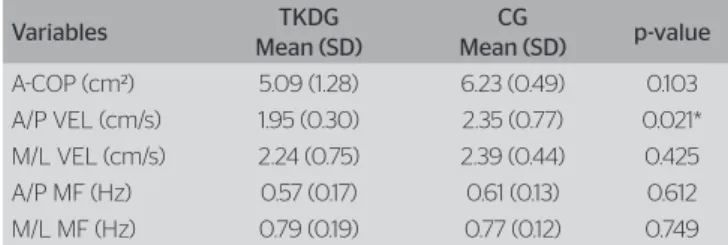
Signiicant diferences were found between the two groups for the postural balance (Table 2), which were then pointed out in the COP velocity parameter from A/P direction of movement (p=0.02). he TKDG pre-sented better balance than the CG (young adults), once the values of the latter were higher than for the TKDG.
Table 1. Characteristics of the subjects
Variables TKDG (n=9)
Mean (SD)
CG (n=10) Mean (SD)
Age (years) 24.89 (4.28) 23.30 (4.11) Mass (kg) 66.37 (11.61) 69.29 (14.42) Height (m) 1.74 (0.09) 1.71 (0.09) BMI (kg/m²) 21.94 (2.70) 23.28 (3.03)
SD: standard deviation; TKDG: Tae kwon do Group; CG: Control Group; BMI: body mass index
Table 2. Comparison between groups in postural balance results
Variables TKDG
Mean (SD)
CG
Mean (SD) p-value
A-COP (cm²) 5.09 (1.28) 6.23 (0.49) 0.103 A/P VEL (cm/s) 1.95 (0.30) 2.35 (0.77) 0.021* M/L VEL (cm/s) 2.24 (0.75) 2.39 (0.44) 0.425 A/P MF (Hz) 0.57 (0.17) 0.61 (0.13) 0.612 M/L MF (Hz) 0.79 (0.19) 0.77 (0.12) 0.749
DISCUSSION
he results of the present study supported that TKD professional athletes present better postural balance when compared to young adults without TKD prac-tice, when velocity of COP sway is of concern in the analysis. hese results were in agreement, at least, to our hypothesis.
Force platform had been considered the gold-standard instrument for postural balance analysis, since it reveals direct neuromuscular and
biomechan-ical mechanisms associated with postural control17.
he velocity measure represents the magnitude of COP displacement over time. he routines were com-piled from our system through a stabilographic anal-ysis. With the MATLAB (he Mathworks, Natick, MA), we extracted all of the COP parameters, with
regard to procedure of previous studies15-19 for
com-puting of the 95% conidence ellipse sway area and for velocity compute equation. In brief, the total area of COP sway was calculated using a 95% conidence ellipse, which represents an area that encloses 95% of
all COP positions data for a given trial19. his
pro-cedure helps to increase the precision of data from sway in both directions. he sway velocity was then represented by the total COP displacement divided
by time (cm/s)19. he evidences15-19 have supported
the use of COP ellipse area and/or mean COP ve-locity sway to better represent balance measurement with regard to good reliability and validity of data. In the present study, signiicant results were pointed out on of one these variables, COP velocity, which supports the relevance of our results for literature of issue. Furthermore, this measure is sensitive to detect small postural sway in a little area of space as
unipo-dal support in diferent populations16.
he results of present study are in agreement with
previous studies20 from other modalities and especially
with Leong et al.21, who observed that adults
practi-tioners of TKD (from one to three years of training) have better postural balance when compared to
seden-tary people. Fong et al.22 showed that short- and
long-term adolescents practitioners of TKD had signiicantly slower sway than the CG during one-single stance with eyes opened. Although there are diferences in the pop-ulation between the present study (adults) and those
from Leong et al. (adolescents)21, it is suggested that
TKD practitioners present better postural performance compared to untrained participants.
The one-leg stance task may have benefited the TKDG, once the repetition of specific movements
induces specific postural adaptations21-23. The
supe-rior upright unilateral stance stability in the TKD athletes may result from the repeated practice of
high kicks during training21. This would require high
level of balance, thus it would improve the postural
regulation in unilateral stance24.Similar results were
seen in judo players, who develop positive motor skills to improve their postural balance from
techni-cal movements in unipodal support23. Furthermore,
some authors suggested that athletes in combat sports such as karate (martial art similar to TKD) would maximize the changes in visual information
to maintain upright standing25-27. Thus, TKD
train-ing may improve the ability to use the visual system
to maintain balance26,27.
The results herein may be explained by the de-velopment of the vestibular system of TKD athletes. Such training involves acrobatic jump and spinning kicks, which would stimulate the vestibular system
and increase its sensitivity27. Fong et al.22 found
that TKD training speeds up the development of vestibular function. Therefore, adolescents who practiced TKD improved their vestibular function so that they could better stabilize in unilateral stance than their non-TKD counterparts. In our study, the athletes have been practicing TKD since their childhood. This can reduce their chances of injuries with falls during training. Furthermore, the somatosensory system also suffers alterations as a
result of sports training28. For example, judo
train-ing would improve proprioception in dynamic
situ-ations28 similar to gymnastics practice on knee and
ankle joint proprioception29.
Some limitations in this study need to be consid-ered when interpreting the indings. First, the number of included participants was small. Second, we must be careful to generalize our results to all TKD practi-tioners, as the population evaluated in this study was the high-performance athletes as compared to control. Future studies are still encouraged to assess the efects of TKD training on postural balance.
CONCLUSIONS
High-performance TKD professional athletes com-pared to healthy young adults presented lower COP velocity sway during single leg support, which indicates better postural balance than control. hese results have any implications on sport rehabilitation programs for balance assessments in athletes.
REFERENCES
1. Kukkiwon. Taekwondo textbook. 2 ed. Korea: O-Sung Publishing
Company, Seoul; 2006.
2. Lystad RP, Pollard H, Graham PL. Epidemiology of injuries in competition taekwondo: A meta-analysis of observational studies. J Sci Med Sport.2009;12(6):614-21.
3. Kazemi M, Chudolinski A, Turgeon M, Simon A, Ho E, Coombe L. Nine year longitudinal retrospective study of Taekwondo injuries. J Can Chiropr Assoc. 2009;53(4):272-81.
4. Kazemi M. Relationships between injury and success in elite Taekwondo athletes.J Sports Sci. 2012;30(3):277-83.
5. Horak FB. Postural orientation and equilibrium: what do we need to know about neural control of balance to prevent falls? Age Ageing. 2006;35 Suppl 2:ii7-ii11.
6. Winter DA, Patla AE. Ishac M, Gage WH. Motor mechanism of balance during quiet standing. J Electromyogr Kinesiol. 2003;13(1):49-56. 7. Lafond D, Corriveau H, Hébert R, Prince F. Intrasession reliability of
center of pressure measures of postural steadiness in healthy elderly people. Arch Phys Med Rehabil. 2004;85(6):896-901.
8. Nashner LM. Practical biomechanics and physiology of balance. In: Jacobson GP, Newman CW, Kartush JM, editors. Handbook of balance function testing. San Diego (CA): Singular Publishing Group; 1997. p. 261-79.
9. Tanguy S, Quarck G, Etard O, Gauthier A, Denise P. Vestibulo-ocular reflex and motion sickness in figure skaters. Eur J Appl Physiol. 2008;104(6):1031-7.
10. Suzana MA, Pieter W. Motor ability profile of junior and sênior Taekwondo club athletes. Br J Biomot. 2009;3(4):325-31.
11. Cromwell RL, Meyers PM, Meyers PE, Newton RA. Tae Kwon Do: an efective exercise for improving balance and walking ability in older adults. J Geront A Biol Sci Med Sci. 2007;62(6):641-6.
12. Gerbino PG, Grifin ED, Zurakowski D. Comparison of standing balance between female collegiate dancers and soccer players. Gait Posture. 2007;26(4):501-7.
13. Bressel E, Yonker JC, Kras J. Comparison of static and dynamic balance in female collegiate soccer, basketball, and gymnastics athletes. J Athl Train. 2007;42(1):42-6.
14. Perrin P, Deviterne D, Hugel F, Perrot C. Judo, better than dance, develops sensorimotor adaptabilities involved in balance control. Gait Posture. 2002;15:187-94.
15. Pinsault N, Vuillerme N. Test-retest reliability of centre of foot pressure measures to assess postural control during unperturbed stance. Med Eng Phys. 2009;31(2):276-86.
16. da Silva RA, Martin B, Parreira RB, Teixeira DC, Amorim CF. Age-related diferences in time-limit performance and force platform-based balance measures during one-leg stance. J Electromyogr Kinesiol. 2013;23(3):634-9.
17. Winter DA, Patla AE, Ishac M, Gage WH. Motor mechanism of balance during quiet standing. J Electromyogr Kinesiol. 2003;13(1):49-56. 18. Lin D, Seol H, Nussbaum MA, Madigan ML. Reliability COP-based
postural sway measures and age-related diferences.Gait Posture. 2008;28(2):337-42.
19. Prieto TE, Myklebust JB, Hofmann RG, Lovett EG, Myklebust BM. Measures of postural steadiness: diferences between healthy young and elderly adults. IEEE Trans Biomed Eng. 1996;43(9):956-66. 20. Asseman F. Caron O. Cremieux J. Are there specific conditions which
expertise in gymnastics could have an efect on postural control and performance? Gait Posture. 2008;27(1):76-81.
21. Leong HT, Fu SN, Ng GY, Tsang WW. Low-level Taekwondo practitioners have better somatosensory organization in standing balance than sedentary people. Eur J Appl Physiol. 2011;111(8):1787-93. 22. Fong SM1, Ng GY. Sensory integration and standing balance in
adoles-cent taekwondo practitioners. Pediatr Exerc Sci. 2012 Feb;24(1):142-51 23. Paillard T, Montoya R, Dupui P. Specific postural adaptations according
to the throwing techniques practiced in competition-level judoists. J Electromyogr Kinesiol. 2007;17(2):241-4.
24. Paillard T, Noé F, Rivière T, Marion V, Montoya R, Dupui P.Postural performance and strategy in the unipedal stance of soccer players at diferent levels of competition. J Athl Train.2006;41(2):172-6.
25. Del Percio C, Brancucci A, Bergami F, Marzano N, Fiore A, Di Ciolo E, et al. Cortical alpha rhythms are correlated with body sway during quite open-eyes standing in athletes: A high-resolution EEG study. Neuroimage. 2007;36(3):822-9.
26. Christelle R, Jacques C. Perception de l’orientation visuelle chez des experts en taekwondo. Staps.2004;65(3):79-96.
27. Tanguy S, Quarck G, Etard O, Gauthier A, Denise P. Vestibulo-ocular reflex and motion sickness in figure skaters. Eur J Appl Physiol. 2008;104(6):1031-7.
28. Perrot C, Deviterne D, Perrin PH. Influence of training on postural and motor control in a combative sport. J Hum Mov Stud. 1998;35(1):119-36. 29. Lephart SM, Giraldo JL, Borsa PA, Fu FH. Knee joint proprioception: a