Finding the contemporary in the traditional:
reassessing
the impact of indigenous Maya and modern western pedagogies
on identity and
self
Sheryl Ann Ludwigl Margaret Diane LeComptell
Abstract
This work contrasts what is taught and learned – other than what is intended – in different educative settings and two historical eras. In a comparison of ethnographic studies conducted in the US and in Guatemala, it compares the “hidden curriculum” (KOHLBERG, 1975) of formal western schooling – the norms, values and practices that are conveyed by the content knowledge taught, and the interaction patterns, assessment procedures and participation structures used (PHILLIPS, 1983) – with similar structures in an indigenous Maya community in Guatemala. It analyzes what children learn, the impact on their identities, and how those types of learning connect to future social and occupational destinations. Educational settings differ in the types of learning and teaching they support; they produce different kinds of learners with different identities and goals. It has been argued that modern schooling actually interferes with the values and practices of so-called traditional cultures, leading to the abandonment of traditional languages, practices and beliefs. Such an argument denies the flexibility of traditional cultures, relegating them to a static “present” not characteristic of the dynamic identities actually being constructed in the 21st century. Conversely, we argue that traditional pedagogies can protect enduring cultural identity (SPINDLER, G; SPINDLER, L, 2000) and lead to more successful accommodation to modernity (RUDOLPH, L; RUDOLPH, S, 1984). We connect this argument with research exploring myths about what schooling can and cannot do to achieve social mobility and improved societal conditions.
Keywords
Indigenous identity – Hidden curriculum – Schooling – Cultural reproduction – Sociology of education.
I- The Colorado Women’s College at Denver University, Denver, CO, EUA. Contact: [email protected] II- University of Colorado-Boulder, Boulder, CO, EUA.
Descobrindo o contemporâneo no tradicional:
reavaliação do impacto das pedagogias indígena maia e
ocidental moderna sobre a identidade e o
Self
Sheryl Ann Ludwigl Margaret Diane LeComptell
Resumo
Este trabalho compara o que é ensinado e aprendido – e não o que se pretende – em diferentes cenários educativos e dois momentos históricos. Considerando estudos etnográficos realizados nos Estados Unidos e na Guatemala, compara o “currículo oculto” (KOHLBERG, 1975) da escolarização ocidental formal – normas, valores e práticas transmitidos pelo conteúdo de conhecimento ensinado, e os padrões de interação, procedimentos de avaliação e estruturas de participação utilizados (PHILLIPS, 1983) - com estruturas similares em uma comunidade indígena maia da Guatemala. Analisa o que as crianças aprendem, o impacto sobre suas identidades e como esse aprendizado se conecta com os destinos sociais e ocupacionais futuros. Os cenários educacionais diferem quanto aos tipos de aprendizagem e de ensino que mantêm; produzem tipos diferentes de educandos com resultantes identidades e metas diversas. Tem sido afirmado que a escolarização moderna realmente interfere nos valores e práticas das assim chamadas culturas tradicionais, levando ao abandono das línguas, práticas e crenças tradicionais. Esse tipo de argumento ignora a flexibilidade das culturas tradicionais, relegando-as a um “presente” estático que não é característico das identidades dinâmicas que de fato se constroem no século XXI. Nós afirmamos o contrário: que as pedagogias tradicionais podem proteger a durabilidade da identidade cultural (SPINDLER, G; SPINDELER, L, 2000) e levar a uma acomodação mais bem-sucedida à modernidade (RUDOLPH, L; RUDOLPH, S, 1984). Ligamos esse argumento às pesquisas que estudam mitos a respeito do que a escolarização pode e não pode fazer para alcançar a mobilidade social e condições sociais melhores.
Palavras chave
Identidade indígena – Currículo oculto – Escolarização - Reprodução cultural – Sociologia da educação.
I- The Colorado Women’s College at Denver University, Denver, CO, EUA.Contato: sherylaludwig@ gmail.com
Introduction
This article had its inception in our respective dissertation research (LUDWIG, 2006; LECOMPTE, 1974), and is informed by career-long work in schools and communities, as educators, researchers, activists, parents, and community members. We use LeCompte’s study and also those of Jean Anyon (1980), Pierre Bourdieu (1977) and Basil Bernstein (1976) as a conceptual framework; we then update these findings and apply them to a non-Western society by using Ludwig’s study, augmented by other studies of learning and adaptation in immigrant and indigenous communities (DEYHLE; LECOMPTE,1994; SPINDLER, G; SPINDLER, L, 2000; PARADISE; ROGOFF, 2009; ROGOFF et al., 2005).
A leitmotif throughout both authors’ careers has been the exploration of how schools and educational processes affect individuals and groups in society. Do they actually enhance social mobility, equality, social justice and democracy? Or is their actual effect to reinforce existing asymmetries in society? Are they reproductive of the status quo, or can they be transformative? In what ways do they act to shape identity? Who benefits most from education, and why? One answer is that schooling – both public and private, and regardless of where it is located – is a necessary but insufficient condition for improvement in the socio-political and economic conditions of individuals and groups. As Ludwig’s research (2006) makes clear, both elites and the less fortunate desire literacy and numeracy for all groups in society – but their motivations and definitions of education may differ. Parents in impoverished countries make sacrifices to assure that their children get an education, regardless of how inferior it might be, and regardless of its poor chances of having an impact on their children’s vocational prospects. However, as it is made clear by the research of Anyon (1978), LeCompte (1978, 1981), and others, while education may be necessary for enhanced life
chances, it certainly is not sufficient. This is because the impact of schooling depends on which individuals and groups receive what kind
of schooling. This conclusion is supported by the authors’ more than 40 years of classroom research and experience in teaching; based on that background, we argue that, regardless of the reforms attempted, poor children frequently receive stratified and limited education that prepares them only for low-level jobs, if at all, and relegates most of them to lives in poverty or low-level employment. As Bourdieu (1977), Bernstein (1976) and others argued, schooling cannot impart what it isn’t designed to support. Similarly, Durkheim (2002) long ago described schools, especially public schools, as institutions designed to prepare children for citizenship in an existing society – to fit people into its existing societal niches in ways that the more particularistic socialization provided in families and apprenticeships is not prepared to do. Conflict theorists have described this as the
it. Even in such cases, a new system of relative
advantage and privilege often replaces the old one, leaving a society with similar social injustices and inequalities.
In the pages that follow, we draw both on our own research and on other authors’ to reflect on career-long preoccupations with the transmission and reproductive processes outlined above. We examine sites in the United States and Central America in order to support a contention that the best schooling for all students may, in fact, not only be that which is provided for professional and elite sectors in society, but also that which typifies indigenous ways of teaching and learning, despite the fact that the latter is often characterized as backward and primitive.
The informing studies
In this work, we examine schooling both historically and ethnographically, arguing that the most common kinds of public schooling are designed to perpetuate class stratification in societies across the world, and to institutionalize poor and marginalized populations at the bottom of the socio-economic ladder. In the 1970s, LeCompte studied four fourth grade classrooms in two schools in a medium-sized city in the US Southwest, one heavily populated by poor and working class Mexican Americans, and the other a low-to-middle class school in a predominantly white neighborhood. She noted that the schools serving working class and Hispanic students emphasized rote learning and conformity to authority, as well as the values of order, attending to tasks, and following directions. The original purpose of her 1974 research was to examine the hidden curriculum of “modern” Western style elementary schools in the USA; her findings contested a 1960s rhetoric that characterized education as a democratizing force. Going to school, according to this rhetoric, promoted social mobility, human progress, and creativity. However, LeCompte found that schooling experiences for
most children resembled authoritarian factory-like work conditions that teach children to sit down, shut up, and do what they were told – even in so-called “open classrooms.”
In the 1980s, she also studied two kindergarten classes in a very large metropolitan area in the South, documenting the values and attitudes transmitted by teachers and by the organization and content of instruction; students in these classes were predominantly white and middle to upper-class (1980). This research, which looked at what children thought the purposes of schooling were and what it required, followed children from pre-school through kindergarten. It demonstrated just how early in their lives children learn to be “civilized” in school; messages about learning, working, and what teaching is about are delivered even prior to attendance in regular schools, through day care programs that are structured like schools.
cooperativa resembled the autonomy, creativity and problem-solving skills that upper-class and elite parents seek for their children (BERNSTEIN, 1976; ANYON, 1980). Such pedagogies prepare children for professional occupations and work in a global economy.
Ludwig also learned how Guatemalan Maya women made use of both settings to preserve their own heritage while giving their children advantages in a contemporary globalizing and technology-rich society. Rather than remaining helpless in the onslaught of western culture, “traditional” Maya are active and adept in adopting and integrating western practices and making them their own. Ludwig’s work shows how traditional pedagogies and learning can promote hybrid identity and successful “third space” adaptation (BHABHA, 1990) without diminishing traditional cultures and identities.
We are particularly interested in how the “hidden curriculum” (FRIEDENBERG, 1970; KOHLBERG, 1975; LECOMPTE, 1974, 1978) of schooling – the norms, values and practices that are conveyed by the type of content knowledge taught, and the interaction patterns, assessment procedures and participation structures used (PHILLIPS, 1983) – differ according to the social status of the learners. Like Anyon (1980), we found that schools produce different types of learners that parallel different types of workers; each type of educational setting engages different kinds of learning and teaching, and as a consequence, produces different kinds of learners who have different identities and aspirations. These kinds of learning – and their consequences – differ widely for rich and poor students.
A key point is that even if there are educational settings that do foster active learning and positive identities for children, these are not always provided to children of the poor and marginalized. Further, while educators do know how to teach all children well, that knowledge is not put to use in the education
of the poor and marginalized. Often this is a consequence of stratified funding practices that provide fewer resources to the most needy schools and children. It also may be a function of teacher preparation and quality, in that the least well-prepared teachers often are assigned to the poorest and lowest achieving students.
we argue to the contrary. The questions to be explored, then, are “What do schools really teach?” “How does this contrast with more traditional forms of learning by observation and modelling?” and “What are the differential consequences of those teachings?” (LUDWIG, 2006; LECOMPTE, 1974).
The modernity of tradition1
In January 2011, Silvia, a Maya weaver, showed Ludwig the guipile (blouse) and tsute
(ceremonial garment) she was weaving. “Can you help me sell them in the United States?” she asked. “I want to enroll Emely in Hermano Pedro.” Emely is her six-year-old daughter. Hermano Pedro is a private school in her
Kaqchikel Maya village, an institution which is more respected than the public school that Silvia attended and Ludwig worked in. When Ludwig asked Silvia how she could show her weavings to potential buyers, Silvia said she would post photos on her Facebook page.
Silvia’s request demonstrates how Mayan women are making up a hybrid identity. They are not bricoleurs who assemble a mixed bag of unrelated items; Silvia’s use of a cell phone and a Facebook page were instrumental in helping her create markets so she could succeed as a traditional Mayan weaver. Mayan people have always been innovators and entrepreneurs who made use of new ideas and practices that served their own purposes and, in so doing, helped them to survive as a people. Making adaptations a part of their own tradition is, in fact, part of being Maya. For centuries, Maya people have employed the traditional value of kaxlan to adopt those practices from other cultures that have proved useful to them. Western schooling is no exception. Although attending the poor quality public schools in their village in no way guarantees future employment and success, Sylvia is taking no chances; she sends her own children to school to learn Spanish and acquire
1- Here, we borrow the title from Rudolph and Rudolph, 1984.
Western learning. She is also teaching Emely how to weave, ensuring that her daughter will preserve Maya culture by practicing traditional art as well as making money by selling her weavings. Furthermore, Sylvia is using her global linkages to find ways to market her own exquisite weavings to new potential buyers in the United States. No longer thinking of herself as just a woman weaver who peddles trinkets and tapetes (weavings made for sale to tourists) to survive, Sylvia now very tentatively defines herself as an artist, someone who could develop an international market. She is also working to ensure that her children will have broader arenas for defining themselves than she has had (LUDWIG, 2006).
The concept of kaxlan
sandals. We saw that sandals were good, and we now wear them. That doesn’t mean we are not Maya. What makes us Maya is more than what we wear or speak. It is the balance that we establish with nature and all that is within it. It is the way we choose to live our lives, the decisions we make about what is important in our lives.”
For millennia, Mayan women have preserved their culture by embedding in their weavings the symbols and colors of Mayan cosmology and culture. Their work allows them to wrap themselves and family members in weavings, clothing and ritual textiles imbued with the symbolism of Mayan culture. Traditional practices reinforce their identity and help to perpetuate indigenous cultural knowledge. Talking about and selling their weavings also allow them to participate more widely in a global economy.
Enduring, situated and
endangered selves: constructing
identity in the face of change
Spindler & Spindler (2000) describe a typology that we find useful in considering issues of cultural contact. The Spindlers feel that all people have an enduring self that is embedded in the highly valued norms and values of their natal culture. The enduring self is similar to Bourdieu’s notion of habitus and is the bedrock upon which identity rests. The Spindlers suggest that immigrants and others – like the Maya – whose traditional culture is confronted by the culture of a contrasting and more powerful community, are faced with a threat to their identity, or self. They can respond in several ways. At the point of contact, the traditional or enduring “self” becomes “situated” in a new set of given circumstances; it then can either assimilate it, endangering its core identity, or it can accommodate (GIBSON, 1988), maintaining the core values of the traditional culture – the “enduring self” – while adapting to the new environment. The Spindlers argue that
self-esteem and mental health are preserved by those whose enduring selves are supported and maintained while they are learning to survive in a different culture and environment. For the Maya, such support includes the weaving and wearing of traditional clothing.
Changing clothes, changing identity
When they arrived in Central America over 500 years ago, Europeans initiated a still-ongoing campaign to subjugate and exterminate the indigenous Maya people of the Guatemalan highlands and their culture. In fact, the distinctive hand woven garb worn by people from each village was imposed by the Spanish, who required each village to adopt clothing that differed in color and designs from all others – so that they would be able to identify more quickly where villagers came from and to control their movements.
Of particular interest is that centuries of intermarriage between the Maya and European-descent colonialists have rendered the Maya physically indistinguishable from ladinos or assimilated people. Maya people need only change their traditional clothes to jeans and t-shirts and speak Spanish to “become” ladino. They can only be identified as Maya if they both speak their Maya language and wear their traditional hand-made clothing, or traje
Weaving supports the enduring self of the Maya. Not only is wearing traje practical, but it serves to identify people clearly as Maya to others and to reinforce that identity to themselves. They are, in effect, wrapping themselves up in their culture. Weaving traje
also produces income that enable them to send their children to Western schools – where they can acquire the new skills and identities that facilitate their abilities to be successful in both their traditional culture and in the 21st century.
Sheryl Ludwig’s study
Sheryl Ludwig first went to Guatemala to learn Spanish as part of the requirements for her PhD degree. She became fascinated by the persistence of Maya culture, especially among women, and decided to focus on how they taught their children how to weave. For her dissertation research, Ludwig engaged in more than five years of fieldwork among Maya weavers in highland Guatemala, where she was able to contrast the practices, pedagogy and assigned tasks in the formal public elementary school in the village with similar practices, pedagogy and assigned tasks found in the home among master weavers teaching their children how to weave. The study began with a puzzling question: Why do Mayan women persist in wearing their hand-made traditional clothing (traje) when Western clothing is cheap and readily available, and when wearing traje
marks them, paradoxically, for invisibility, discrimination or even death?
In order to learn how teaching and learning occurred in traditional settings, Ludwig became an apprentice in a family cooperative of expert weavers, where she was taught how to weave on a backstrap loom. Because Ludwig’s doctoral committee, which included LeCompte, urged her to examine practices in the public schools as well, she also volunteered to teach English in the local village school. This gave her a daily opportunity to observe teaching and learning in that setting as well.
The principal research method in Ludwig’s study was participant observation in sites that included:
• The Moon Goddess cooperativa, located in the village of San Sebastian. It was created by Dona Beatriz, a master weaver, and held in her house. The cooperative was a small, informally organized group of women who wove together and gave performances of Kaqchikel courtship and marriage customs in their home to tourists and to students in local Spanish language schools, followed by a traditional Mayan lunch. They also could purchase weavings made by cooperative members. Dona Beatriz created the cooperativa
to provide a safe space for women to sell their weavings so that they could earn money to provide for their families and send their children to school. The alternative was selling in the local market, where, as Maya, they experienced racist harassment. Between 5 and 12 weavers were active in the cooperative over the period of the fieldwork; the children of the weavers and family members always were present in the patio, which served as the work site.
• The Escuela Primaria Nacional Mixta, the village school, was a successful public primary school in a “wealthy” indigenous village; it served grades 1-6 and had 2 classrooms for grades 1 through 4, and one fifth and one sixth grade classroom. The classes followed a state-mandated, Spanish-language, Westernized national curriculum and the school conducts an annual assessment test. For this study, the three teachers and 130 students of grades 4, 5, and 6 were included. In 2003, 83.72% of primary-aged children in San Sebastian attended school (the national average for attendance at that time was 32.4%).
• The local market and various artisan markets in San Sebastian and nearby Antigua.
Margaret LeCompte’s study
Margaret LeCompte’s (1974) research, also a dissertation study, was conducted in the United States. Her interest was the extent to which schools, in addition to knowledge and cognitive skills, also transmitted the values of “modernity” to children at early ages. Her research focused on the implicit messages conveyed in how the children were organized for learning. In her initial pilot study, she identified as crucial a series of behaviors that centered on attitudes toward work, time, order, achievement, authority and responsibility. In her subsequent year-long study of four fourth grade public school classrooms in the Southwestern United States, she examined how these attitudes were transmitted and the extent to which the locus of control remained with the teacher, or was centered on the children. Progressive educators had argued that the schools were instrumental in promoting democratic ideals and the values of social justice among students. LeCompte’s findings, however, were more congruent with the notion that schools actually socialized children to future careers that resembled those of the parents’ social class and status. LeCompte carefully coded teacher talk and the participation structures in the classrooms for instances that supported the development of progressive notions of autonomy, responsibility and creativity, as well as those that encouraged conformity to authority, following orders, and emitting rote responses to questions. Overwhelmingly, all four teachers promoted a hidden curriculum antithetical to the ideals of democracy, autonomy and creativity that LeCompte had expected to find. Instead, the predominantly middle and lower class students of minority status whom she studied were taught to follow orders, look busy and remain on task. They were not rewarded for creative thinking, an intrinsic approach to achievement, or for autonomy. Children were assigned topics to write about, and told what to read and draw. The underlying structure of
the classroom content and instruction inhibited even the efforts of an innovative teacher who had tried to make teaching and learning more “open” by bringing in a motorcycle engine for the children to dis-assemble, arranging children in collaborative work groups, and attempting to engage the students in activities designed to promote active learning.
Results
Ludwig’s results demonstrated the differences in structure between the teaching and learning practices in the indigenous Maya home and weaving cooperative and those in the public school. Table 1 contrasts teaching/learning organization, processes, role assignments and potential learner outcomes experienced in the cooperative and in the public school. It should be noted that the public school learning described in Table 1 also resembled what LeCompte found in the four US classrooms she studied, and in the kindergarten classrooms she studied several years later.
Learning in the village school
including minimal development of teachers’ knowledge and skill. Furthermore, Ludwig observed that the organization of learning, the pedagogy, the teacher and learner roles and the expected outcomes in the Escuela Mixta corresponded to Anyon’s (1980) and Bernstein’s (1976) description of schooling for lower class students: Learning was teacher-directed and involved the teachers telling, dictating, explaining, assigning, disciplining, and assessing children. In response, students’ tasks included listening, copying, following directions, answering simple direct questions, and performing as directed. While some group work was used in the classroom, the dialogue generated was more in the form of simple answers to direct questions, and was neither directed at more complex learning nor toward
personal development. Teachers taught from the teacher’s manual of the national Ladino curriculum in the national language, Spanish. Because an average of six students shared a single text, the children had limited access to curricular content. We should note that while few schools in the United States are as devoid of resources as the Escuela Mixta, it still is the case that poor communities in the United States cannot raise as much money to support innovative educational experiences, highly qualified teachers and adequate instructional materials as wealthy communities can. As a result, poor communities have poorer schools.
In the village school, Maya children learned to practice the language, knowledge, and routines of a culture outside their own, just as many immigrant and Native American Table 1- Comparison of teaching/learning in the cooperativa and the public school
In the cooperativa In the public school
∙ Voluntary responsibility for attendance and initiation of
instruction ∙ Legally imposed attendance and curriculum
∙ Learners participated in intergenerational groups ∙ Learners were organized into groups according to their age and years in school
∙ Modes of learning involved an apprenticeship of observation in authentic social and cultural contexts. Members engaged in reciprocal, respectful dialogue across levels of age and
competence
∙ Mode of learning involved top-down presentation of cognitive information that often was alien to learners’ social and cultural
context. Primary interaction patterns didactic and hierarchical (teacher to student)
∙ Teacher guided and assisted, modeled expert practice, and provided a vision of performance that was culturally valued
within Maya culture
∙ Teacher transmitted information, assigned tasks, and evaluated student learning on performance and tasks valued outside
Maya culture
∙ Personalized, attentive guidance based on ongoing,
formative assessment ∙
Group instruction plus periodic summative individual performance assessments
∙ Teaching by modeling and hands on experience with learning processes; practice encouraged transferable skills
and understanding
∙ Teaching by direct instruction and dictado; memorization of decontextualized facts; recitation of memorized content
∙ Pedagogy of caring: warm support that encouraged personal expression, initiative, and resourcefulness
∙ Pedagogy of authority: distanced and impersonal support that encouraged assimilation of chunked, fragmented, and
disconnected knowledge
∙ Learner initiated interest, took responsibility for learning, practiced what was observed as participated in authentic
cultural activity, and expressively created textiles that inscribed cultural centering (as reproduced ancient symbols)
∙ Learner received others’ knowledge, acquired content knowledge prescribed for them, learned to follow directives for
behavior and performance distanced from authentic cultural activity
∙ Rewards in the present, e.g., see results, practice one’s art, receive money from sale of one’s weavings ∙
children do in public schools in the United States. Implicit in their experiences was learning that their own culture was not valued and that it was not worth having more money spent on greater material resources for their education. While they became more skilled at practicing others’ cultural activities in the school, they also could not ignore the absence of content about Maya language, history and accomplishments from the national curriculum. Situations like this can lead to development of an endangered identity (SPINDLER, G; SPINDLER, L, 2000) and its attendant poorly integrated core identity.
Learning in the cooperativa
The weavers with whom Ludwig studied, all mothers of children who attended school, sacrificed much to send their children to school because they wanted their children to have a better life than they did. For Joy, that meant that her children would be able to have jobs that might guarantee them a secure and steady income. For Fabiola, that meant that her daughters would always have shoes to wear. Furthermore, being able to weave in their homes meant that their children played with the weaving tools, and were surrounded by the activity of weaving; children literally “grew up on the loom.” For all six of the weavers with whom Ludwig interacted each day as they wove, the education of their children was about human development and learning to become an adult member of the community. Children were engaged in what Paradise and Rogoff (2009) have called “observing and pitching in” with the everyday work of life in the home and village. The skills and knowledge they learned were those needed for full participation in the adult community, and as such, involved authentic and important life tasks whose mastery was crucial. They made sense to children eager to engage because doing so demonstrated that that they were, indeed, becoming grown-ups.
In contrast to the village school, the learning in the cooperativa consisted of a
constant interplay of modeling, guidance, and sharing of narratives across age and ability levels. These activities encouraged high levels of personal development and expression, as well as how to demonstrate initiative, responsibility, and autonomy. Like the rubber tappers in the Amazon rainforest whose schools were described by Heyck (2010), the Mayan women weavers considered education as an empowering process that contributes to a positive self-concept and improved quality of social interactions: This is what they hoped for their children. However, as the research continued, Ludwig began to wonder if these children were, in fact, getting an education from the village school that would lead to empowerment and mobility, or an education that reproduced social and political inequality. Given the dearth of viable employment in the village, and the difficulty of obtaining further education there, it became increasingly clear that the advancement the mothers desired for their children probably would mean they would have to leave the village (see ROGOFF et al., 2005).
Constructing Mayan identity
in the cooperativa: constructing
“modern” identity in the school
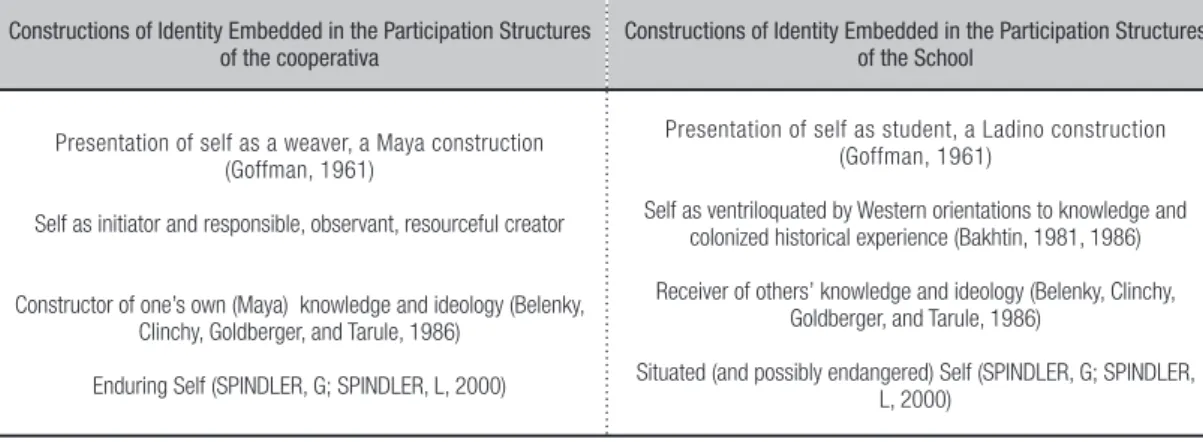
Differences in the impact of teaching/ learning interactions in the cooperativa and the school were reflected in the different identities supported for participants by the various settings of the cooperativa and the school. These are contrasted in Table 2.
We believe that participating in the
life, even though they attend the village school with its Western ways and goals. The village school represents the cosmopolitan world outside the home; it is, as Durkheim (2002) suggested, a means for preparing children for life and work in a larger community, perhaps even the world, however stratified and distant it might be. By contrast, family-based community learning includes learners as members of the community in which they participate, demonstrating active agency and initiative in their learning, and contributing to the community. These take place within a personal commitment to/grounding in a socially defined past and a physically defined context (PARADISE; ROGOFF, 2009). We argue that these differences in styles of and purposes for learning are factors in how, and in which sectors of life, Mayan people construct identity in conflicting times and amidst conflicting pressures regarding assimilation, hybridity, and globalization. They are grounded in a socially and culturally defined past that informs their enduring selves (PARADISE; ROGOFF, 2009), while constantly facing new situations and challenges – such as Western schooling – to which they must adapt (SPINDLER, G; SPINDLER, L, 2000; DEYHLE; LECOMPTE, 1994).
We can further link the differences in these two settings – the village school and the traditional weaving cooperative – to ways of being and knowing in the 21st century, and
to the class differences in the kinds of jobs for which students are being trained. The two schools that LeCompte studied served children who were middle and working class to poor. Many were Mexican-Americans whose first language was Spanish. Though LeCompte tried hard to find examples of behavior more in line with the democratizing and creative pedagogy that educational innovators claimed must be present, the organization of learning in three of those classrooms clearly conformed to the “public school” characteristics portrayed in Table 1. LeCompte noted the dominance of what she called a “management core” of activities that emphasized staying on task, being on time, doing work within time limits, keeping order and being accountable to the teacher. Children were never given opportunities for decision-making of their own, even in art; the teachers handed out drawings for children to color “within the lines” and gave them as their only choices a flower (for girls) and a bird (for boys). Learning was never treated as intrinsically enjoyable; rather, it was something accomplished to please the teacher. Even in the one classroom where the teacher was less conventional and worked at finding activities that students could relate to – like rebuilding the motorcycle engine that occupied the center of the classroom – the management core dominated teacher-student discourse.
Table 2 - Constructions of identity embedded in the participation structures of the cooperativa versus those embedded in the village school.
Constructions of Identity Embedded in the Participation Structures of the cooperativa
Constructions of Identity Embedded in the Participation Structures of the School
Presentation of self as a weaver, a Maya construction (Goffman, 1961)
Self as initiator and responsible, observant, resourceful creator
Constructor of one’s own (Maya) knowledge and ideology (Belenky, Clinchy, Goldberger, and Tarule, 1986)
Enduring Self (SPINDLER, G; SPINDLER, L, 2000)
Presentation of self as student, a Ladino construction (Goffman, 1961)
Self as ventriloquated by Western orientations to knowledge and colonized historical experience (Bakhtin, 1981, 1986) Receiver of others’ knowledge and ideology (Belenky, Clinchy,
Goldberger, and Tarule, 1986)
The work of Jean Anyon (1980) and Basil Bernstein (1977) confirms these emphases; they clearly spell out how schools serving lower income children differ from those available to the more affluent in the US and in England. Schooling, by design or default, is intended to preserve the existing system of social and political inequality, and the public schools in Guatemala are no exception. The kind of education provided for low income, minority and indigenous children in most countries – like that of the San Sebastian village school – isn’t designed to help them succeed economically or
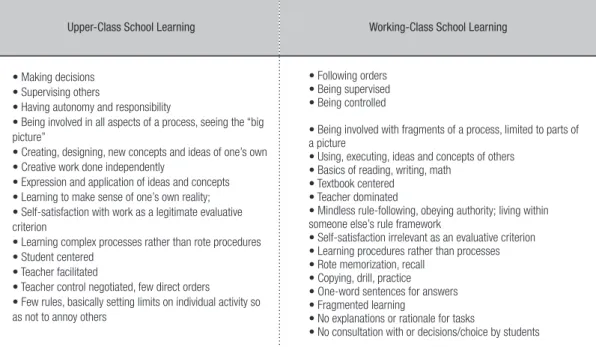
politically. More affluent Guatemalan parents send their children to private schools where the instruction is felt to be of higher quality. However, some of the learning goals and participation structures found in the Moon Goddess cooperativa, rather than holding students back, may be more characteristic of the kinds of educational opportunities provided in schools for the children of affluent professionals in Europe and the USA. These are depicted in Table 3, as “upper class school learning” and contrasted with “working-class school learning.”
Table 3- Upper class vs working-class school learning tasks and goals
Upper-Class School Learning Working-Class School Learning
•Makingdecisions •Supervisingothers
•Havingautonomyandresponsibility
•Beinginvolvedinallaspectsofaprocess,seeingthe“big
picture”
•Creating,designing,newconceptsandideasofone’sown •Creativeworkdoneindependently
•Expressionandapplicationofideasandconcepts •Learningtomakesenseofone’sownreality; •Self-satisfactionwithworkasalegitimateevaluative
criterion
•Learningcomplexprocessesratherthanroteprocedures •Studentcentered
•Teacherfacilitated
•Teachercontrolnegotiated,fewdirectorders
•Fewrules,basicallysettinglimitsonindividualactivityso
as not to annoy others
•Followingorders •Beingsupervised •Beingcontrolled
•Being involved with fragments of a process, limited to parts of a picture
•Using, executing, ideas and concepts of others
•Basics of reading, writing, math
•Textbook centered
•Teacher dominated
•Mindless rule-following, obeying authority; living within someone else’s rule framework
•Self-satisfaction irrelevant as an evaluative criterion
•Learning procedures rather than processes
•Rote memorization, recall
•Copying, drill, practice
•One-word sentences for answers
•Fragmentedlearning
•No explanations or rationale for tasks
•No consultation with or decisions/choice by students
Anyon argued that low-income and working class students were learning to follow orders and work with the ideas of others – the cultural capital and learning tasks corresponding to requisites for service level and manual labor jobs – while more affluent children were learning how to be supervisors, negotiators, collaborators, decision-makers, and knowledgeable workers. Another way of describing it is that how children are schooled is how they are “tooled” for the workforce.
Most important to our argument is that it is in the traditional learning of the cooperativa
theorists (BARNHARDT, 1987; OUICHI, 1981) argue are sought after by corporate head hunters and skilled managerial staff.
Bernstein also looked at class differences in schooling, suggesting that more than simply preparing students for their anticipated work roles, differences in schooling supported the acquisition of different kinds of knowledge and ways of knowing, even different ways of being learners, which articulate with a stratified, class-based political economy. Thus, children who attend what one could call “old school” schools are relegated to working-class jobs that require workers to follow orders and rely on the explanations of authoritative others.
These are schools such as the Escuela Mixta and the two schools that LeCompte studied, and in which both authors worked. By contrast, students who learn what Bernstein called the values and ways of thinking and working of the “new middle class” are destined to move into new occupational arenas – a “new economy” more dependent on collaborative working styles, interactive communication skills, and experiential learning. These are the ways of thinking and working that we believe are supported in the
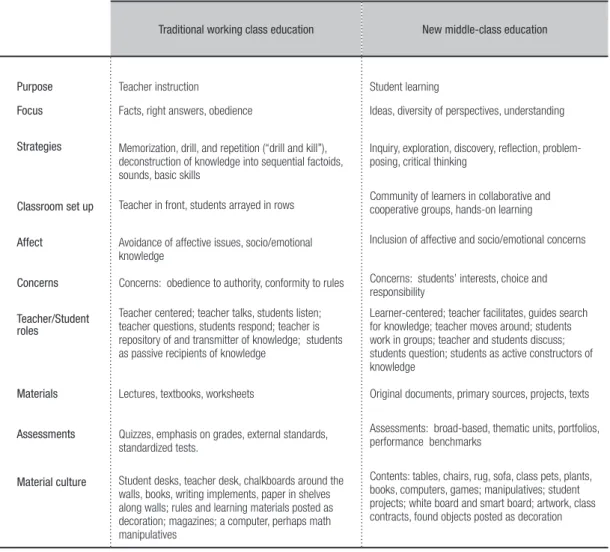
cooperativa. Table 4 displays the differences between traditional “old school” or working class education and education that is appropriate for new and emerging occupational categories.
Table 4- Bernstein’s traditional school versus new middle-class school characteristics
Traditional working class education New middle-class education
Purpose
Focus
Strategies
Classroom set up
Affect
Concerns
Teacher/Student roles
Materials
Assessments
Material culture
Teacher instruction
Facts,rightanswers,obedience
Memorization, drill, and repetition (“drill and kill”), deconstruction of knowledge into sequential factoids, sounds, basic skills
Teacher in front, students arrayed in rows
Avoidance of affective issues, socio/emotional knowledge
Concerns: obedience to authority, conformity to rules Teacher centered; teacher talks, students listen; teacher questions, students respond; teacher is repository of and transmitter of knowledge; students as passive recipients of knowledge
Lectures, textbooks, worksheets
Quizzes, emphasis on grades, external standards, standardized tests.
Student desks, teacher desk, chalkboards around the walls, books, writing implements, paper in shelves along walls; rules and learning materials posted as decoration; magazines; a computer, perhaps math manipulatives
Student learning
Ideas, diversity of perspectives, understanding
Inquiry, exploration, discovery, reflection, problem-posing, critical thinking
Community of learners in collaborative and cooperative groups, hands-on learning
Inclusion of affective and socio/emotional concerns
Concerns: students’ interests, choice and responsibility
Learner-centered; teacher facilitates, guides search for knowledge; teacher moves around; students work in groups; teacher and students discuss; students question; students as active constructors of knowledge
Original documents, primary sources, projects, texts Assessments: broad-based, thematic units, portfolios, performance benchmarks
Thus, many of the kinds of learning that took place in the cooperativa were more like the schooling that “new middle class” parents in Bernstein’s work sought out for their children. Such schooling assured the British families that Bernstein studied that their children would have a chance to move up in the social hierarchy, acquire advanced training, find professional and managerial jobs, and perhaps even avail themselves of global opportunities. Such opportunities, however, also require additional years of schooling, which was beyond what children in San Sebastian had available.
What do Mayan women want for their children?
By sending their children to the village school, Mayan women may be seeking the same sort of mobility for their children as Bernstein’s British parents. They understand that while western style education may not be sufficient to provide advantages for their children, it certainly is necessary. However, if Anyon and Bernstein are correct, Mayan women might well do better to focus at least as much on the social skills and learning patterns obtained in the
cooperativa—similar to those taught in Bernstein’s new middle class schools (see Table 4)-while learning to weave, as they do on the dominant culture, lower class skills and learning patterns fostered in the poorly equipped village school.
It is a fact that many Maya people have already realized this. Rather than needing to acquire a “voice” (BAKHTIN, 1981, 1986) in these matters, the Maya are already aware of the enduring value of their own culture. The women who taught Ludwig to weave in the
cooperativa spoke meaningfully and powerfully not only about the aesthetic pleasure they derived from designing, making and wearing their beautiful clothing, but they also said that it was practical – warm and comfortable – and most importantly, it marked them as who they were: talented weavers, artists, and Maya
References
ANYON, J. Social class and the hidden curriculum of work. Journal of Education, v. 162, n. 1, 1980.
BAKHTIN, M. M. The dialogic imagination. Austin: University of Texas Press, 1981.
BAKHTIN, M. M. Speech genres and other essays. Austin: University of Texas Press, 1986.
BARNHARDT, R. Theory Z + N: the role of Alaska natives in administration. 1987. Disponível em: <http://ankn.uaf.edu/Curriculum/ Articles/RayBarnhardt/Theory.html>. Acesso em: 2014.
BELNKY, M. et al. Women’s ways of knowing: the development of self, voice, and mind. New York: Basic Books, 1986.
BERNSTEIN, B. Class, codes, and control: towards a theory of educational transmission. London: Routledge, 1977.
CLIFFORD,J.;MARCUS,G.Writing culture: the politics and poetics of ethnography. Berkeley: University of California Press, 1986.
DEYHLE, D.; LECOMPTE, M. D. Conflict over child development: Navajo culture and the middle schools. Theory into Practice, v. 23, n. 3, p. 156-167, 1994.
DURKHEIM, E. Moral education: a study in the theory and application of the sociology of education. Mineola: Dover, 2002.
PublicadooriginalmenteporTheFreePressofGlencoe,em1961.
FRIEDENBERG,E.Z.Thecurriculumaseducationalprocess:themiddleclassagainstitself.In:OVERLY,N.V.(Ed.).The unstudied
curriculum: its impact on children.Washington, DC.: Association for Supervision and Curriculum Development, 1970.
GIBSON, M. A. Accommodation without assimilation: Sikh immigrants in an American high school. New York: Cornell University Press, 1988. The anthropology of contemporary issues.
GOFFMAN,E.Asylums: essay on the social situation of mental patients and other inmates. New York: Random House, 1961.
HEYCK, D. Schools in the forest: how grassroots education brought political empowerment to the Brazilian Amazon. Sterling: Kumarian Press, 2010.
JACKSON, P. Life in classrooms. New York: Holt, Rinehart and Winston, 1968.
KOHN, A. The schools our children deserve: moving beyond traditional classrooms and “tougher standards”. Boston: Houghton Mifflin, 1999.
KOHLBERG, L. The moral atmosphere of the school. In: OVERLY, N. V. (Ed.). The unstudied curriculum: its impact on children. Washington, DC.: Association for Supervision and Curriculum Development¸1970.
LECOMPTE, M. D. Learning to work: the hidden curriculum of the classroom. Anthropology and Education Quarterly, v. 9, p. 23-37, 1978.
LECOMPTE, M. D. Teacher styles and the development of student work norms, 1974. Unpublished doctoral dissertation, University of Chicago, Chicago, 1974.
LECOMPTE, M. D. The civilizing of children. Journal of Thought, v. 15, n. 3, p. 105-129, 1980.
LEVINE, C.; HEWER, A. Moral stages: a current formulation and a response to critics. Basel: Karger, 1983.
LUDWIG, S. A. Making fast the thread: cultural maintenance and transmission of Maya women who weave on back strap looms. 2006. Unpublished dissertation, University of Colorado Boulder, Colorado, 2006.
MARCUS,G.;FISCHER,M.M.J.Anthropology as cultural critique. Chicago: University of Chicago Press, 1986.
PARADISE,Ruth;ROGOFF,Barbara.Sidebyside:learningbyobservingandpitching.Ethos, v. 37, n. 1, p. 102-138, 2009.
PHILLIPS, S. U. Invisible culture: communication in classroom and community on the Warm Springs Indian reservation. Prospect Heights: Waveland Press, 1983.
ROGOFF, B.; CORREA-CHÁVEZ, M.; NAVICHOC COTUC, M.A Cultural-historical view of schooling in human development. In:
PILLEMER, D. B.; WHITE, S. H. (Eds.). Developmental psychology and social change: research, history, and policy. New York: Cambridge University Press, 2005. p. 225-63.
RUDOLPH, L.; RUDOLPH, S. The modernity of tradition: political development in India. Chicago: The University of Chicago Press, 1984.
SPINDLER, G.; SPINDLER, L. Fifty years of anthropology and education. Mahwah: Lawrence Erlbaum, 2000.
Received on January 1st, 2015
Approved on April 22th, 2015
Sheryl Ann Ludwig is adjunct professor at The Women’s College at Denver University, Denver CO.