Christine Ann Charles(a) James Anthony McGuire(b) Naresh Chandra Sharma(c) James Qaqish(c)
(a) Johnson & Johnson Consumer & Personal Healthcare Products Worldwide, Division of Johnson & Johnson Consumer Companies, Scientific and Professional Affairs, Research and Development, Morris Plains, NJ, United States of America.
(b) Johnson & Johnson Consumer & Personal Healthcare Products Worldwide, Division of Johnson & Johnson Consumer Companies, Biometric and Clinical Data Systems, Morris Plains, NJ, United States of America.
(c) BioSci Research Canada, Ltd., Mississauga, ON, Canada.
Corresponding author: Christine Ann Charles E-mail: [email protected]
Received for publication on Apr 19, 2011 Accepted for publication on Jun 22, 2011
Comparative efficacy of two daily use
mouthrinses: randomized clinical trial
using an experimental gingivitis model
Abstract: Two antimicrobial agents, a ixed combination of essential oils (EOs) and 0.07% cetylpyridinium chloride (CPC) are found in commer-cially available mouthrinses, Listerine Antiseptic and Crest Pro Health,
respectively. Both mouthrinses have been shown to control dental plaque and gingivitis in short and longer term studies. The aim of this study was to determine the comparative effectiveness of these two mouthrinses using a 2-week experimental gingivitis model. Qualiied subjects were randomly assigned to one of three mouthrinse groups: a ixed combination of EOs, 0.07% CPC, or negative control (C) rinse. Following baseline clinical as-sessments and a dental prophylaxis, subjects began a two-week period in which they rinsed twice daily with their assigned rinse and abstained from any mechanical oral hygiene procedures or other oral care products. Sub-jects were reassessed at the end of the two-week period. One hundred and forty-seven subjects were randomized and 142 completed this study. After two weeks use, the EOs rinse was superior (p ≤ 0.011) to the CPC rinse in inhibiting the development of gingivitis, plaque, and bleeding, with 9.4% and 6.6% reductions compared to CPC for gingivitis and plaque, respec-tively. Both rinses were superior to the negative control rinse (p < 0.001). This study demonstrates that the essential oil-containing mouthrinse has superior antiplaque/antigingivitis effectiveness compared to the 0.07% CPC-containing mouthrinse without mechanical oral hygiene inluence.
Descriptors: oils; cetylpyridinium; mouthwashes; dental plaque; gingivitis.
Introduction
Therapeutic antimicrobial mouthrinses have been shown to be valu-able adjuncts to mechanical oral hygiene procedures for the control of su-pragingival plaque and gingivitis.1 A mouthrinse containing a ixed
com-bination of essential oils (Listerine Antiseptic, Morris Plains, USA) has been shown in a number of six-month clinical trials2-8 to have signiicant
antiplaque and antigingivitis eficacy. Eficacy has been acknowledged through ADA acceptance9 and a Category I recommendation, i.e., safe
and effective, by a U.S. FDA advisory panel reviewing antiplaque prod-ucts for the control of gingivitis.10
The experimental gingivitis model11 in which antiplaque/antigingivitis
agents are tested in the absence of mechanical oral hygiene procedures has been used to demonstrate eficacy of the ixed combination of es-Declaration of Interests: The authors
sential oils12-14 and to demonstrate superiority to
0.05% CPC rinses.15 This experimental gingivitis
model is useful as a short-term model to determine eficacy of mouthrinse formulations and has been found to be consistent with six-month clinical tri-als results. The objective of this randomized clinical trial was to determine the comparative antiplaque/ antigingivitis effectiveness of an EOs and a 0.07% CPC mouthrinse formulation (Crest Pro Health, Procter & Gamble, Cincinnati, USA) using an ex-perimental gingivitis model.
Methodology
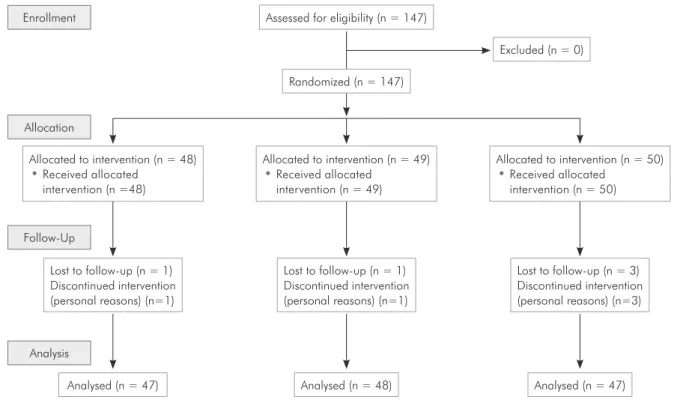
This was a randomized, controlled, examiner-blind, parallel-group clinical trial using the two-week experimental gingivitis model (Figure 1). This study was conducted in accordance with Interna-tional Conference on Harmonization Good Clini-cal practice guidelines.16 This international standard
for pharmaceutical clinical trials insures credible and accurate data and results management. Subjects aged 18 to 65, who met the following inclusion cri-teria were included in the study:
• a minimum of 20 sound, natural teeth; • a mean Modiied Gingival Index17 ≥ 1.95, and
• a mean Plaque Index18 ≥ 1.95.
Teeth that were grossly carious, fully crowned or extensively restored, orthodontically banded, abutments, or third molars were not included in the tooth count. Exclusion criteria included:
• a history of signiicant adverse events with use of oral hygiene products;
• signiicant oral soft tissue pathology, excluding gingivitis;
• moderate to advanced periodontitis;
• any condition requiring antibiotic prophylaxis prior to an invasive dental procedure;
• antibiotic, anti-inlammatory, or anticoagulant drug therapy during the month prior to the base-line examination;
• participation in a dental clinical trial within the previous 30 days; and
• regular use of chemotherapeutic antiplaque/anti-gingivitis products within the two weeks prior to the baseline examination.
Figure 1 - Study Flow Diagram. Left: control; center: EO; right: CPC. Randomized (n = 147)
Excluded (n = 0) Assessed for eligibility (n = 147)
Lost to follow-up (n = 3) Discontinued intervention (personal reasons) (n=3) Allocated to intervention (n = 49)
• Received allocated intervention (n = 49) Allocated to intervention (n = 48)
• Received allocated intervention (n =48)
Follow-Up
Lost to follow-up (n = 1) Discontinued intervention (personal reasons) (n=1)
Lost to follow-up (n = 1) Discontinued intervention (personal reasons) (n=1)
Analysis
Analysed (n = 47) Allocated to intervention (n = 50)
• Received allocated intervention (n = 50) Enrollment
Allocation
All subjects signed an informed consent form af-ter the nature of the study was fully explained to them. The protocol was reviewed by the Institution-al BCRL Review Board, Mississauga, Canada.
Prescreened subjects presented to the clinical site for baseline examinations having refrained from any oral hygiene procedures for at least 8 but not more than 18 hours. The baseline examinations consisted of a complete intraoral examination, assessment of gingivitis using the Modiied Gingival Index17
fol-lowed by sulcular bleeding,18 and Plaque Index
us-ing the Turesky modiication of the Quigley-Hein Plaque Index.19
Following the baseline examination, qualifying subjects received a complete dental prophylaxis to remove all stain, plaque, and calculus. They were then randomly assigned to one of three groups:
• a group using the essential oil-containing mouth-rinse (LISTERINE Antiseptic, Johnson & Johnson Consumer & Personal Products World-wide, Division of Johnson & Johnson Consumer Companies Inc., Morris Plains, USA);
• a 0.07% CPC-containing mouthrinse (Crest Pro-Health Procter & Gamble, Cincinnati, USA); or
• a negative control group using a 5% hydroalco-hol rinse.
Qualiied subjects were assigned product sequen-tially, in ascending numerical order, according to a block randomization with a ixed block size of 6. The randomization scheme was generated by a vali-dated SAS-based randomization application devel-oped by the sponsor. Neither the clinical examiner nor the recorder had access to the treatment code. Personnel dispensing study mouthrinses or supervis-ing their use did not have access to the treatment identiication and were not involved in examination of the subjects, in order to minimize potential bias.
All mouthrinses were used with the same dosing regimen, i.e., subjects rinsed with 20 ml for 30 sec twice daily. All the rinses were dispensed in over-wrapped marketed bottles that were individually la-beled with the number of the subject to whom that bottle had been assigned according to the random-ization scheme.
Twice-daily rinsing was started immediately fol-lowing the prophylaxis. The two daily rinses on weekdays were supervised and separated by at least four hours. Subjects were given an individually cod-ed bottle of mouthrinse and plastic dosage cups for unsupervised use on weekends and were provided a diary in which to document unsupervised rinse times. At the end of each weekend period, subjects returned their mouthrinse bottles to the study site and compliance was estimated by measuring the vol-ume of mouthrinse remaining. During the study pe-riod, subjects were instructed to discontinue all oral hygiene procedures, other than use of their assigned mouthrinse, and to follow their usual dietary habits.
Subjects used their assigned rinse for 14 days and returned to the clinical site for an oral soft and hard tissue examination and scoring of gingival, bleed-ing and plaque indices, at least 4 hours after the last use of the test products. All of the examinations and scoring were performed by a single trained and cali-brated examiner (N.S.) who did not know to which group the subjects had been assigned and did not have access to the case report forms until all the ex-aminations had been completed.
The repeatability of the examiner for gingival and plaque index scoring was determined prior to the start of the study. The examiner participated in an exercise in which subjects representing the entire scale of the gingival and plaque indices were scored and then rescored in random order after a period of time to avoid the possible recall of scores. The examiner’s repeatability of mean index scores was assessed using the intraclass correlation coeficient. The intraclass coeficients for the mean Modiied Gingival Index and mean Plaque Index were > 0.9.
Statistical methods
The primary outcome variables were gingivi-tis, (Modiied Gingival Index)17 and supragingival
plaque (Turesky modiication of the Quigley-Hein Plaque Index).18 The secondary outcome variable
was gingival bleeding, (Gingival Bleeding Index).19
Variable Negative Control (N = 47) EO (N = 48) CPC (N = 47)
Age (years)
• Mean (SD) 38.7 (10.38) 38.6 (9.30) 39.8 (9.23)
• Median 40 40 39
• Range 18-64 18-57 18-60
Gender (%)
• Male 11 (23.4) 12 (25.0) 10 (21.3)
• Female 36 (76.6) 36 (75.0) 37 (78.7)
Race (%)
• White 35 (74.5) 28 (58.3) 34 (72.3)
• Black 3 (6.4) 7 (14.6) 4 (8.5)
• Hispanic 2 (4.3) 1 2.1) 0
• Asian/PI 5 (10.6) 7 (14.6) 5 (10.6)
• AI/AN** 0 1 (2.1) 0
• Other 2 (4.3) 4 (8.3) 4 (8.5)
Smoker (%)
• Yes 11 (23.4) 10 (20.8) 11 (23.4)
• No 36 (76.6) 38 (79.2) 36 (76.6)
Gingival Index
• Mean (SD) 2.08 (0.057) 2.09 (0.060) 2.07 (0.048)
Plaque Index
• Mean (SD) 2.96 (0.246) 2.91 (0.222) 2.96 (0.251)
• Bleeding Index
• Mean (SD) 0.17 (0.058) 0.19 (0.074) 0.17 (0.068)
*For all subjects who had two-week efficacy data; **American Indian/Alaskan Native.
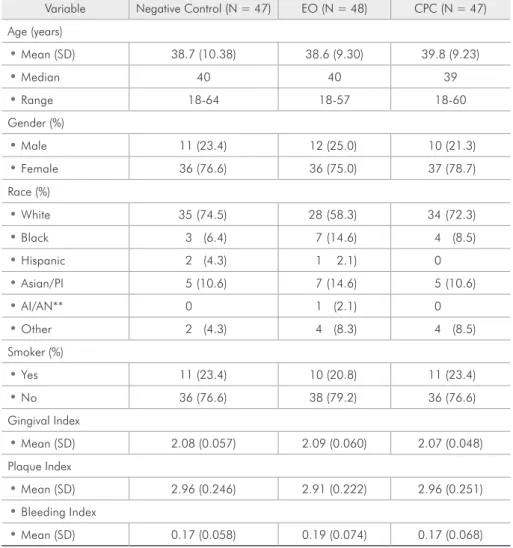
Table 1 - Baseline demographics and clinical means.*
variance model with treatment as a factor, with re-spect to gender and smoking status by means of a chi-square test, and with respect to race by means of Fishers Exact test.
A sample size of 135 (45 per treatment group) completed subjects was calculated to provide power of 0.90 for detecting a difference of 10% and 5% be-tween treatment groups in mean plaque and gingival index scores, respectively. For each of the outcome variables, between-group differences after two weeks of treatment were tested by means of a one-way analysis of covariance model with treatment as a fac-tor and the corresponding baseline value as a covari-ate. Comparisons were made between the essential oil and negative control rinse, between the CPC and negative control rinse, and between the EO and CPC mouthrinses. All tests were performed at the 0.05
level and two-sided. The essential oil-containing mouthrinse was to be considered better than Crest Pro-Health if the essential oil-containing mouth-rinse was statistically signiicantly better than both the 5% hydroalcohol control and Crest Pro-Health mouthrinses. Each comparison was performed at the 0.05 level of signiicance, two-sided.
Results
sig-niicant differences among the three groups with re-spect to gender, race, smoking status, or mean gingi-val, plaque, or bleeding indices. The majority of the subjects were female (76.8%), white (68.3%) and non-smokers (77.5%). The mean age was 39 years (18-64 range) with no statistically signiicant differ-ences among the three groups.
Primary outcome variables
The mean values at baseline and two-weeks for the Modiied Gingival Index and Plaque Index are presented in Tables 2 and 3, respectively. The com-parison of interest, that between the EOs and CPC mouthrinse, demonstrated superiority for the EOs rinse for both gingivitis and plaque, with 9.4% and 6.6% reductions versus CPC, respectively. Com-pared to the negative control at two-weeks, the es-sential oils (EOs) mouthrinse group had 16.8% and 31.6% reductions, respectively, in Modiied Gingival Index and Plaque Index (p < 0.001); while the CPC mouthrinse had reductions of 8.3% and 26.7%, respectively. All treatment differences were statistically signiicant.
Secondary outcome variable
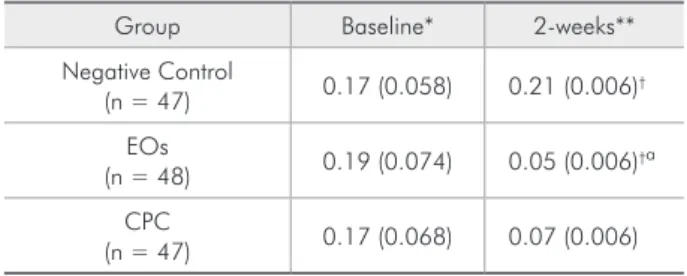
The mean values at baseline and two-weeks for the Bleeding Index are presented in Table 4. At two weeks, EOs mouthrinse was superior to the CPC mouthrinse and both produced statistically signii-cant differences (p = 0.003) compared to the nega-tive control.
Safety evaluations
No mucosal lesions developed during the course of the study. There were no product-related adverse events.
Group Baseline* 2-weeks** % Reduction vs.
Negative Control % Reduction vs. CPC
Negative Control
(n = 47) 2.08 (0.057) 2.09 (0.015) -
-EOs
(n = 48) 2.09 (0.060) 1.74 (0.015)
†ª 16.8 9.4
CPC
(n = 47) 2.07 (0.048) 1.92 (0.015) † 8.3
-*Mean (S.D.); **Adjusted mean (S.E.); †Significantly different from negative control, p < 0.001; ªSignificantly different from CPC, p < 0.001.
Table 2 - Modified Gingival Index Scores, Baseline and Two Weeks.
Group Baseline* 2-weeks** % Reduction vs.
Negative Control % Reduction vs. CPC
Negative Control
(n = 47) 2.96 (0.246) 3.28 (0.044) -
-EOs
(n = 48) 2.91 (0.222) 2.24 (0.043)†ª 31.6 6.6
CPC
(n = 47) 2.96 (0.251) 2.40 (0.044) 26.7
-*Mean (S.D.); **Adjusted mean (S.E.); †Significantly different from negative control, p < 0.001; ªSignificantly different from CPC, p = 0.011.
Table 3 - Plaque Index Scores, Baseline and Two Weeks.
Table 4 - Bleeding Index Scores, Baseline and Two Weeks.
Group Baseline* 2-weeks**
Negative Control
(n = 47) 0.17 (0.058) 0.21 (0.006)
†
EOs
(n = 48) 0.19 (0.074) 0.05 (0.006)†ª
CPC
(n = 47) 0.17 (0.068) 0.07 (0.006)
Compliance with treatment regimen
All completed subjects complied with the super-vised rinse schedule. Subject diaries and residual mouthrinse quantities at the completion of the two week period indicated compliance with weekend rinsing schedule as well.
Discussion
Previously this EOs mouthrinse has been shown to have antiplaque and antigingivitis eficacy superi-or to that of 0.05% CPC rinses in this same model15
as well as in longer-term studies incorporating me-chanical oral hygiene.20,21 This study was conducted
to determine the comparative eficacy to a higher level (0.07%) CPC rinse. This model has demon-strated the clinical superiority of the EOs mouth-rinse in reducing supragingival plaque and gingivi-tis, compared to that of the 0.07% CPC rinse in the absence of mechanical oral hygiene. In a 3-month randomized clinical trial, EOs + loss + manual brush and paste was shown to be superior to 0.07% CPC + loss + manual brush and paste.22 In 6-month
trials,23-24 this 0.07% CPC rinse has shown eficacy,
however, only the EOs rinse has met the clinical cri-teria, in 6-month randomized clinical trials, to qual-ify for ADA acceptance for products indicated for plaque and gingivitis.25
This ixed combination EOs mouthrinse contain-ing 0.064% thymol, 0.092% eucalyptol, 0.060% methyl salicylate, and 0.042% menthol has been previously shown to be an effective antiplaque/an-tigingivitis product in numerous six-month clinical trials.2-8,20-21 The experimental gingivitis model used
for this study, in which subjects abstain from all me-chanical oral hygiene procedures for the two-week study period,11 provides a rigorous test for
anti-plaque/antigingivitis products and enables a determi-nation to be made of relative chemotherapeutic ef-fectiveness against the dental plaque bioilm in situ.
There are several commercially available
mouth-washes with different features and proiles of clinical indication. Some of them are superior to others and thus can provide better results.26 The use of effective
mouthrinses on a daily basis is proven through sci-entiic data and is indicated to achieve or maintain a healthier mouth leading to a better overall systemic health.20 EOs containing mouthwashes present a
bet-ter26 and deeper27 bacterial reduction in laboratory
bioilm models when compared with several other mouthwashes indicated for daily use and therefore provides support for the clinical superiority in con-trolling the plaque bioilm. Furthermore, while the cationic properties of CPC help maintain its relatively high substantivity, CPC can interact with negatively charged particles found in other mouthrinses, denti-frices, serum, tissue luids, lipids, phospholipids, and proteins. This interaction may lower CPC’s biological activity, affecting its clinical eficacy.28 Unlike CPC,
all four essential oils are nonionic (i.e. uncharged). An additional beneit of essential oils is that, because of their nonionic state, they do not adversely interact with positively or negatively charged ions found in dentifrices and other oral hygiene products.29
The need for effective antiplaque/antigingivitis products to be used as adjuncts to mechanical oral hygiene procedures is evident from both population-based studies and from clinical anecdotal experi-ence indicating a high prevalexperi-ence of gingivitis.1 It is
important that consumers comply with the recom-mended dosage regimen in order for these products to have maximum impact.
Conclusion
An in vivo gingivitis model has demonstrated the superior eficacy of an essential oil-containing mouthrinse compared to a 0.07% CPC mouthrinse in reducing supragingival plaque and gingivitis. These results should provide the dental profession-al with a basis for recommending daily use of EOs mouthrinses to his or her patients.
References
1. Barnett ML. The role of therapeutic antimicrobial mouth-rinses in clinical practice. Control of supragingival plaque and gingivitis. J Am Dent Assoc. 2003 Jun;134(6):699-704.
3. Gordon JM, Lamster IB, Seiger MC. Efficacy of Listerine an-tiseptic in inhibiting the development of plaque and gingivitis. J Clin Periodontol. 1985 Sep;12(8):697-704.
4. DePaola LG, Overholser CD, Meiller TF, Minah GE, Nie-haus C. Chemotherapeutic inhibition of supragingival dental plaque and gingivitis development. J Clin Periodontol. 1989 May;16(5):311-5.
5. Overholser CD, Meiller TF, DePaola LG, Minah GE, Niehaus C. Comparative effects of 2 chemotherapeutic mouthrinses on the development of supragingival plaque and gingivitis. J Clin Periodontol. 1990 Sep;17(8):575-9.
6. Charles CH, Sharma NC, Galustians HJ, Qaqish J, McGuire JA, Vincent JW. Comparative efficacy of an antiseptic mouth-rinse and an antiplaque/antigingivitis dentifrice: a six-month clinical trial. J Am Dent Assoc. 2001 May;132(5):670-5. 7. Sharma N, Charles CH, Lynch, MC, Qaqish J, McGuire JA,
Galustians JG, et al. Adjunctive benefit of an essential oil-containing mouthrinse in reducing plaque and gingivitis in patients who brush and floss regularly. A six-month study. J Am Dent Assoc. 2004 Apr;135(4):496-504.
8. Charles CH, Bartels LL, Mostler KM, Mankodi SM. Compar-ative antiplaque and antigingivitis efficacies of a chlorhexidine and an essential oil mouthrinse: 6-month clinical trial. J Clin Periodontol. 2004 Oct;31(10):878-84.
9. Council of Dental Therapeutics. Council on dental therapeu-tics accepts Listerine. J Am Dent Assoc. 1988 Sep;117(3):515-6.
10. Wu CD, Savitt ED. Evaluation of the safety and efficacy of over-the-counter oral hygiene products for the reduc-tion and control of plaque and gingivitis. Periodontol 2000. 2002;28:91-105.
11. U.S. Food and Drug Administration. Oral health care drug products for over-the-counter human use; antigingivitis/an-tiplaque drug products; establishment of a monograph; pro-posed rules. Fed Regist. 2003 May 29;68(103):32241. 12. Fornell J, Sundin Y, Lindhe J. Effect of Listerineon dental
plaque and gingivitis. Scand J Dent Res. 1975 Jan;83(1):18-25. 13. Mankodi S, Ross NM, Mostler K. Clinical efficacy of Listerine
in inhibiting and reducing plaque and experimental gingivitis. J Clin Periodontol. 1987 May;14(5):185-8.
14. Ross NM, Mankodi SM, Mostler KL, Charles CH, Bartels LL. Effect of rinsing time on antiplaque-antigingivitis efficacy of listerine. J Clin Periodontol. 1993 Apr;20(4):279-81. 15. Amini P, Araujo MWB, Wu M-M, Charles CA, Sharma NC.
Comparative antiplaque and antigingivitis efficacy of three antiseptic mouthrinses: a two week randomized clinical trial. Braz Oral Res. 2009 Jul-Sep;23(3):319-25.
16. Department of Health and Human Services, Food and Drug Administration. International conference on harmonization:
good clinical practice-consolidated guideline availability. Fed Regist. 1997;62(90):25692-709.
17. Lobene RR, Weatherford T, Ross NM, Lamm R, Menaker L. A modified gingival index for use in clinical trials. Clin Prev Dent. 1986 Jan-Feb;8(1):3-6.
18. Saxton CA, van der Ouderaa FJ. The effect of a dentifrice containing zinc citrate and triclosan on developing gingivitis. J Periodont Res. 1989 Jan;24(1):75-80.
19. Turesky S, Gilmore ND, Glickman I. Reduced plaque forma-tion by the chloromethyl analogue of Victamine C. J Periodon-tol. 1970 Jan;41(1):41-3.
20. Cortelli SC, Cortelli JR, Aquino DR, Costa FO. Self-per-formed supragingival biofilm control: qualitative analysis, scientific basis and oral-health implications. Braz Oral Res. 2010;24(Spec Iss 1):43-54.
21. Sharma NC, Araujo MW, Wu MM, Qaqish J, Charles CH. Superiority of an essential oil mouthrinse when compared with a 0.05% cetylpyridinium chloride containing mouthrinse: a six month study. Int Dent J. 2010 Jun;60(3):175-80. 22. Lisante TA, Charles C, Qaqish J, Sharma N, Junker L.
Ef-ficacy of Brush, Floss, Rinse Regimens vs. Mechanical Oral Hygiene. J Dent Res. 2011;90(Spec Iss A). Abstract, 1320. 23. Albert-Kiszely A, Pjetursson BE, Salvi GE, Witt J. Hamilton
A, Persson GR, et al. Comparison on the effects of cetylpyri-dinium chloride with an essential oil mouthrinse on dental plaque an gingivitis - a six-month randomized controlled clini-cal trial. J Clin Periodontol. 2007 Aug;34(8):658-67. 24. Mankodi S, Bauroth K, Witt JJ, Bsoul S, He T, Gibb R,
Du-navent J, et al. A 6 month clinical trial to study the efficacy of a cetylpyridinium chloride mouthrinse on gingivitis and plaque. Am J Dent. 2005 Jul;18 Spec Iss:9A-14A.
25. Imrey PB, Chilton NW, Pihlstrom BL, Proskin HM, Kingman A, Listgarten MA, et al. Recommended revisions to American Dental Association guidelines for acceptance of chemothera-peutic products for gingivitis control. Report of the Task Force on Design and Analysis in Dental and Oral Research to the Council on Therapeutics of the American Dental Association. J Periodontal Res. 1994 Jul;29(4):299-304.
26. Pan PC, Harper S, Ricci-Nittel D, Lux R, Shi W. In-vitro
evidence for efficacy of antimicrobial mouthrinses. J Dent Res. 2010; 38(S2):S16-20.
27. Ciancio S. Essential oils in oral health management: a review. J Clin Periodontol. 2003;30(Suppl 5):1-24.
28. DePaola LG, Eshenaur-Spolarich A. Safety and efficacy of antimicrobial mouthrinses in clinical practice. J Dent Hyg. 2007;81(5):13-25.