*Correspondence: D. G. Rando. Laboratório de planejamento e síntese de quimioterápicos potencialmente ativos contra endemias tropicais - LAPEN, Departamento de Farmácia, Faculdade de Ciências Farmacêuticas - USP. Av. Prof. Lineu Prestes, 580 - Bloco 13 Superior - Cidade Universitária - 05508900 - São Paulo - SP, Brasil. E-mail: [email protected]
A
rti
Pharmaceutical Sciences vol. 46, n. 2, abr./jun., 2010
Chalcones and
N
-acylhydrazones: direct analogues? Exploratory
data analysis applied to potential novel antileishmanial agents
Daniela Gonçalves Rando
*, Jeanine Giarolla, Kerly Fernanda Mesquita Pasqualoto,
Elizabeth Igne Ferreira
Laboratory of design and synthesis of chemotherapeutical agents potentially active against tropical diseases – LAPEN, Department of Pharmacy, Faculty of Pharmaceutical Sciences, University of São Paulo
Leishmaniasis is an important health and social problem for which there is limited effective therapy. Chalcones and N-acylhydrazones have been studied as promising antileishmanial agents in enzymatic inhibition and in vitro assays. Since these chemical classes of compounds also resemble each other structurally, it would be useful to investigate whether they share direct analogy. Exploratory data analysis was applied to a library of chalcones and nitrated N-acylhydrazones assayed against Leishmania donovani
to investigate their similarity. Under the conditions applied in the present study, the two classes did not present functional or structural analogy.
Uniterms: Chalcones. N-acylhydrazones. Antileishmanial agents. Leishmaniasis. Chemometrics.
As leishmanioses são importantes problemas sociais e de saúde pública para os quais a terapia farmacológica atual é, ainda, limitada. Chalconas e N-acilidrazonas têm sido estudadas como promissores agentes leishmanicidas tanto em ensaios in vitro quanto em ensaios de inibição de cisteíno-proteases importantes para o parasito. Uma vez que estas classes de compostos apresentam similaridade bidimensional, seria interessante estudar se estes compostos guardariam relação de analogia direta entre si. Análise exploratória de dados foi aplicada, então, à biblioteca de chalconas e N-acilidrazonas nitradas ensaiadas contra Leishmania donovani para investigar suas relações de similaridade. Os resultados mostraram que, ao menos sob as condições consideradas neste estudo, as duas classes de compostos não apresentam analogia estrutural e funcional simultaneamente, embora elas apresentem alguma similaridade estrutural.
Unitermos: Chalconas. N-acilidrazonas. Agentes leishmanicidas. Leishmaniose. Quimiometria.
INTRODUCTION
Leishmaniasis is a neglected disease that affects millions of individuals worldwide causing signiicant mor-bidity and mortality, particularly in developing countries. Available drug therapy, however, is limited and frequently inappropriate (Chung et al., 2008). Of the 1393 new drugs marketed between 1975 and 1999, only 13 were targeted for tropical diseases (Trouiller et al., 2002). In fact, the effective drugs are toxic and often require parenteral administration for long treatment courses, increasing the
chances of failure due to emergence of resistance (Croft, 2005). This scenario emphasizes the importance of the search for completely new active compounds.
Studies comparing the inhibitory effect of N -acy-lhydrazones and chalcones on well-known parasitic cystei-ne proteases, such as cruzain, falcipain, and trypanopain, have been conducted (Li et al., 1995, 1996; Troeberg et al., 2000;). Both classes of compounds present IC50 values in a
micromolar range, suggesting that these compounds could be applied as prototypes in the development of new inhibi-tor agents. Since these chemical classes of compounds also resemble each other structurally, it would be interesting to verify whether they share direct analogy.
Direct analogues are deined as chemical entities which present, simultaneously, chemical and pharmaco-logical similarities (Wermuth, 2006).
Structural and functional analogy between chalcones and N-acylhydrazones would bring some advantages in the search for new antileishmanial agents. 3D and 4D-QSAR studies applied to both chemical classes could be able to provide ligand-receptor interaction information, and a common pharmacophore. Those indings could be useful for designing new and more potent compounds, which accumulate the significant molecular features of both chalcones and N-acylhydrazones.
Several chemometric methods have broadened the arsenal of tools that can be applied to QSAR studies. Ex-ploratory data analysis methods of Principal Component Analysis (PCA) and Hierarchical Cluster Analysis (HCA) (Beebe et al., 1998) number among these methods.
HCA is an important multivariate method whose primary purpose is to emphasize the clusters and patterns of the investigated data, displaying them as a dendrogram, which allows the visualization of the samples or variables in a 2D space. The distances between samples or variables are calculated and transformed into a similarity matrix whose elements correspond to the similarity indexes (Ferreira, 2002).
PCA however, is a data compression multivariate method based on correlation among variables. Its objective is to group correlated original independent variables or descriptors and replace them with a new set called prin-cipal components (PCs) onto which the data is projected. The PCs are completely uncorrelated and are built as a simple linear combination of original variables. Further-more, the PCs contain most of the variability in the data set within a much smaller dimensional space (Ferreira, 2002).
Thus, in this study, an exploratory data analysis using the above-mentioned methods was applied to a set of ninety-four chalcones and nitrated N-acylhydrazones to verify if they indeed share direct analogy. This is funda-mental to subsequent construction of 3D-QSAR models, to explaining their antileishmanial behavior and to inding a common pharmacophore, in order to design new parasitic
agents for this activity.
METHODOLOGY
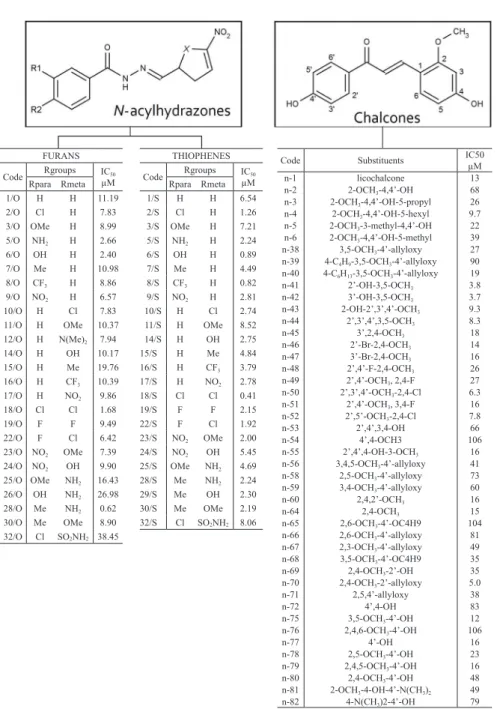
A complete series of ninety-four compounds were investigated and are listed in Figure 1. The set encom-passes forty-nine 5-nitroheterocyclic benzhydrazides, synthesized by Rando et al. (2008),and forty-ive chalcone derivatives, which were selected from the work of Nielsen
et al. (1998).
Biological activities were evaluated as the compoun-ds in vitro concentration capable of inhibiting 50 percent of Leishmania donovani promastigote proliferation (IC50, µM) (Figure 1). The IC50 values were expressed in
negative logarithmic units, pIC50 (-log IC50), and comprise
the set of dependent variables.
The three-dimensional structures of each of the ninety-four compounds or ligands, in their neutral forms, were constructed employing the HyperChem 7 software (HyperChem, 2002). The crystallized structures of nitrofu-razone and 2’-hydroxy-4’’-dimethylamino-chalcone were retrieved from the Brookhaven Protein Data Bank (PDB entry code 1yki, resolution at 1.70 Å; Race et al., 2005) and ile ob1067.cif (resolution at 1.01 Å; Liu et al., 2002), respectively, and were used as geometry references in the building up of all ligands. Crystallographic information of a nitrothiophene 2-carbaldehyde was retrieved from the file lh6379.cif (resolution at 1.18 Å; McBurney et al., 2005) and also used as a reference particularly in the construction of the nitrothiophene ring moiety.
The energy minimization was carried out employing the HyperChem 7 MM+ force ield without any restriction. The MOLSIM 3.2 program (Doherty, 1997) was also used for geometry optimization of each structure investigated. Partial atomic charges were calculated using the PM3 (Stewart, 1989) semi-empirical method, also implemented in the HyperChem program.
The structures modeled as described above were used as the initial structures in each molecular dynamics (MD) simulation (Van Gunsteren, Berendsen, 1990), whi-ch are employed to perform the conformational ensemble proile of each ligand (MOLSIM 3.2).
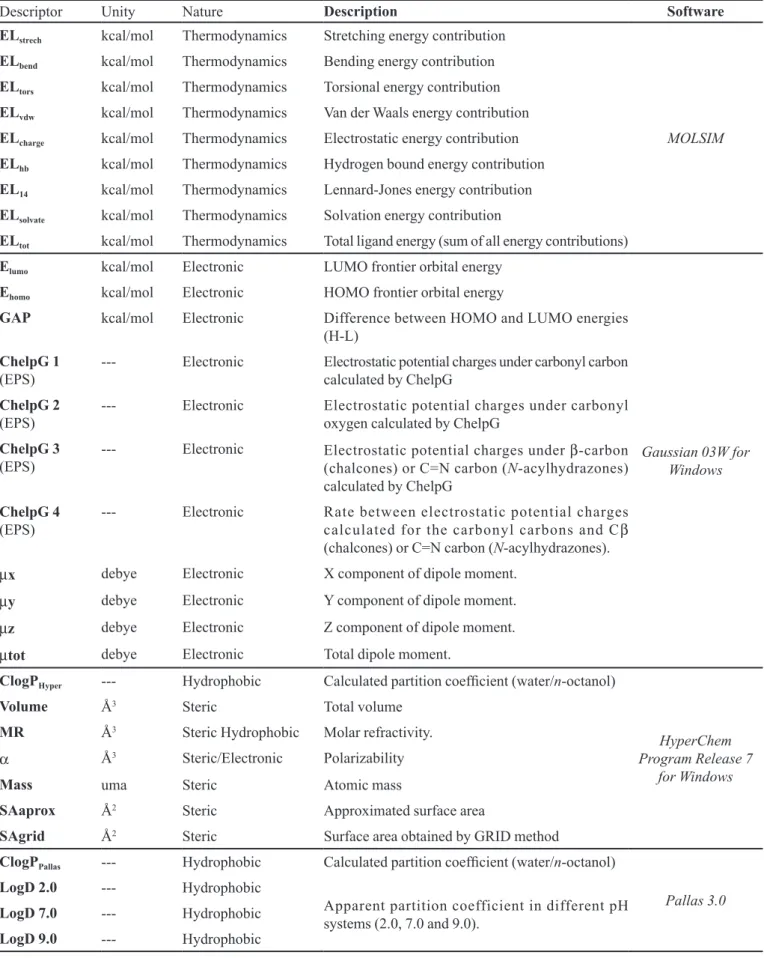
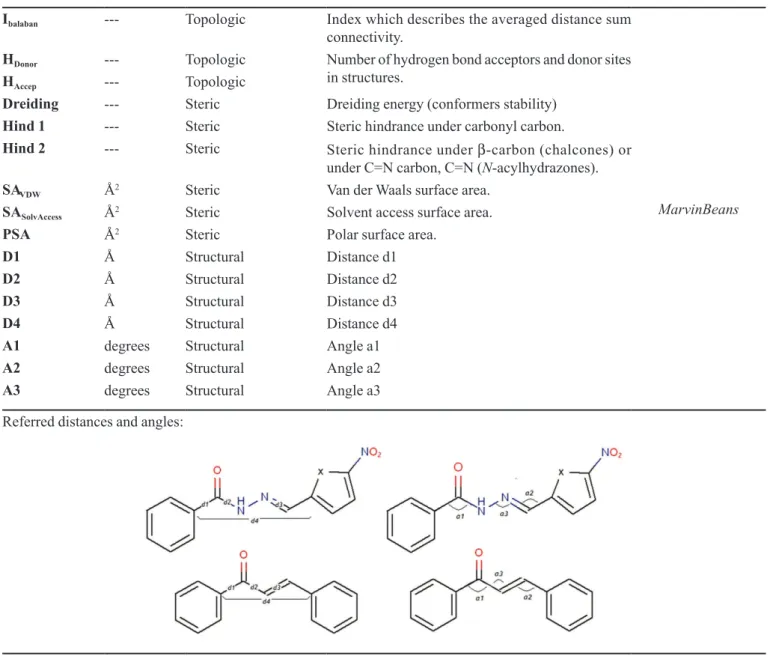
The independent variables or descriptors, related to thermodynamic, steric, electronic, hydrophobic and struc-tural contributions, were calculated employing speciic software such as MOLSIM 3.2 (Doherty, 1997), Marvin Beans (MarvinBeans, 2007),Gaussian 03W (Gaussian, 2003), Pallas 3.0 (Pallas, 1995), and HyperChem 7 (HyperChem, 2002). The total data matrix contains 94 rows (number of samples or compounds) and 48 columns, including biological activity. The samples were randomi-zed before performing the exploratory data analysis.
HCA and PCA (Beebe, 1998) were carried out using the Pirouette 3.11 program (Pirouette, 2003). The autos-caling procedure was applied as a preprocessing method,
meaning that each element of data matrix was subtracted by its mean column and divided by the standard deviation of its column before the analysis. After screening using different linkage methods, HCA studies were performed considering the centroid linkage method. The PCA forma-lism was run up to seven factors.
RESULTS AND DISCUSSION
Table I shows the complete list of independent va-riables calculated for the compounds together with their descriptions and other relevant information.
The thermodynamic descriptors found for the lowest
FIGURE 1 - Structures and actions of the investigated set of chalcones and nitrated N-acylhydrazones
FURANS
Code Rgroups IC50
µM Rpara Rmeta
1/O H H 11.19
2/O Cl H 7.83
3/O OMe H 8.99
5/O NH2 H 2.66
6/O OH H 2.40
7/O Me H 10.98
8/O CF3 H 8.86
9/O NO2 H 6.57
10/O H Cl 7.83
11/O H OMe 10.37
12/O H N(Me)2 7.94
14/O H OH 10.17
15/O H Me 19.76
16/O H CF3 10.39
17/O H NO2 9.86
18/O Cl Cl 1.68
19/O F F 9.49
22/O F Cl 6.42
23/O NO2 OMe 7.39
24/O NO2 OH 9.90
25/O OMe NH2 16.43
26/O OH NH2 26.98
28/O Me NH2 0.62
30/O Me OMe 8.90
32/O Cl SO2NH2 38.45
THIOPHENES
Code Rgroups IC50
µM Rpara Rmeta
1/S H H 6.54
2/S Cl H 1.26
3/S OMe H 7.21
5/S NH2 H 2.24
6/S OH H 0.89
7/S Me H 4.49
8/S CF3 H 0.82
9/S NO2 H 2.81
10/S H Cl 2.74
11/S H OMe 8.52
14/S H OH 2.75
15/S H Me 4.84
16/S H CF3 3.79
17/S H NO2 2.78
18/S Cl Cl 0.41
19/S F F 2.15
22/S F Cl 1.92
23/S NO2 OMe 2.00
24/S NO2 OH 5.45
25/S OMe NH2 4.69
28/S Me NH2 2.24
29/S Me OH 2.30
30/S Me OMe 2.19
32/S Cl SO2NH2 8.06
Code Substituents IC50µM
n-1 licochalcone 13
n-2 2-OCH3-4,4’-OH 68
n-3 2-OCH3-4,4’-OH-5-propyl 26
n-4 2-OCH3-4,4’-OH-5-hexyl 9.7
n-5 2-OCH3-3-methyl-4,4’-OH 22
n-6 2-OCH3-4,4’-OH-5-methyl 39
n-38 3,5-OCH3-4’-allyloxy 27
n-39 4-C4H9-3,5-OCH3-4’-allyloxy 90
n-40 4-C6H13-3,5-OCH3-4’-allyloxy 19
n-41 2’-OH-3,5-OCH3 3.8
n-42 3’-OH-3,5-OCH3 3.7
n-43 2-OH-2’,3’,4’-OCH3 9.3
n-44 2’,3’,4’,3,5-OCH3 8.3
n-45 3’,2,4-OCH3 18
n-46 2’-Br-2,4-OCH3 14
n-47 3’-Br-2,4-OCH3 16
n-48 2’,4’-F-2,4-OCH3 26
n-49 2’,4’-OCH3, 2,4-F 27
n-50 2’,3’,4’-OCH3-2,4-Cl 6.3
n-51 2’,4’-OCH3, 3,4-F 16
n-52 2’,5’-OCH3-2,4-Cl 7.8
n-53 2’,4’,3,4-OH 66
n-54 4’,4-OCH3 106
n-55 2’,4’,4-OH-3-OCH3 16
n-56 3,4,5-OCH3-4’-allyloxy 41
n-58 2,5-OCH3-4’-allyloxy 73
n-59 3,4-OCH3-4’-allyloxy 60
n-60 2,4,2’-OCH3 16
n-64 2,4-OCH3 15
n-65 2,6-OCH3-4’-OC4H9 104
n-66 2,6-OCH3-4’-allyloxy 81
n-67 2,3-OCH3-4’-allyloxy 49
n-68 3,5-OCH3-4’-OC4H9 35
n-69 2,4-OCH3-2’-OH 35
n-70 2,4-OCH3-2’-allyloxy 5.0
n-71 2,5,4’-allyloxy 38
n-72 4’,4-OH 83
n-75 3,5-OCH3-4’-OH 12
n-76 2,4,6-OCH3-4’-OH 106
n-77 4’-OH 16
n-78 2,5-OCH3-4’-OH 23
n-79 2,4,5-OCH3-4’-OH 16
n-80 2,4-OCH3-4’-OH 48
n-81 2-OCH3-4-OH-4’-N(CH3)2 49
TABLE I - Descriptors calculated for the set studied
Descriptor Unity Nature Description Software
ELstrech kcal/mol Thermodynamics Stretching energy contribution
MOLSIM
ELbend kcal/mol Thermodynamics Bending energy contribution
ELtors kcal/mol Thermodynamics Torsional energy contribution
ELvdw kcal/mol Thermodynamics Van der Waals energy contribution
ELcharge kcal/mol Thermodynamics Electrostatic energy contribution
ELhb kcal/mol Thermodynamics Hydrogen bound energy contribution
EL14 kcal/mol Thermodynamics Lennard-Jones energy contribution
ELsolvate kcal/mol Thermodynamics Solvation energy contribution
ELtot kcal/mol Thermodynamics Total ligand energy (sum of all energy contributions)
Elumo kcal/mol Electronic LUMO frontier orbital energy
Gaussian 03W for Windows
Ehomo kcal/mol Electronic HOMO frontier orbital energy
GAP kcal/mol Electronic Difference between HOMO and LUMO energies
(H-L)
ChelpG 1
(EPS) --- Electronic Electrostatic potential charges under carbonyl carbon calculated by ChelpG
ChelpG 2
(EPS) --- Electronic Electrostatic potential charges under carbonyl oxygen calculated by ChelpG
ChelpG 3
(EPS) --- Electronic Electrostatic potential charges under (chalcones) or C=N carbon (N-acylhydrazones) β-carbon calculated by ChelpG
ChelpG 4
(EPS) --- Electronic Rate between electrostatic potential charges calculated for the carbonyl carbons and Cβ
(chalcones) or C=N carbon (N-acylhydrazones).
µx debye Electronic X component of dipole moment.
µy debye Electronic Y component of dipole moment.
µz debye Electronic Z component of dipole moment.
µtot debye Electronic Total dipole moment.
ClogPHyper --- Hydrophobic Calculated partition coeficient (water/n-octanol)
HyperChem Program Release 7
for Windows
Volume Å3 Steric Total volume
MR Å3 Steric Hydrophobic Molar refractivity.
α Å3 Steric/Electronic Polarizability
Mass uma Steric Atomic mass
SAaprox Å2 Steric Approximated surface area
SAgrid Å2 Steric Surface area obtained by GRID method
ClogPPallas --- Hydrophobic Calculated partition coeficient (water/n-octanol)
Pallas 3.0
LogD 2.0 --- Hydrophobic
Apparent partition coefficient in different pH systems (2.0, 7.0 and 9.0).
LogD 7.0 --- Hydrophobic
Ibalaban --- Topologic Index which describes the averaged distance sum connectivity.
MarvinBeans
HDonor --- Topologic Number of hydrogen bond acceptors and donor sites
in structures.
HAccep --- Topologic
Dreiding --- Steric Dreiding energy (conformers stability)
Hind 1 --- Steric Steric hindrance under carbonyl carbon.
Hind 2 --- Steric Steric hindrance under β-carbon (chalcones) or
under C=N carbon, C=N (N-acylhydrazones).
SAVDW Å2 Steric Van der Waals surface area.
SASolvAccess Å2 Steric Solvent access surface area.
PSA Å2 Steric Polar surface area.
D1 Å Structural Distance d1
D2 Å Structural Distance d2
D3 Å Structural Distance d3
D4 Å Structural Distance d4
A1 degrees Structural Angle a1
A2 degrees Structural Angle a2
A3 degrees Structural Angle a3
Referred distances and angles:
TABLE I - Descriptors calculated for the set studied (cont.)
energy conformation from MD simulation of each ligand included the following energy contributions: stretching energy (ELstretch), bending energy (ELbend), torsional energy
(ELtors), Lennard-Jones or 1,4 interactions energy (EL1,4), electrostatic energy (ELel), van der Waals energy (ELvdW),
hydrogen bonding energy (ELHb), and solvation energy (ELsolv). The total energy of each ligand (ELtot) corresponds
to the summation of all these energy contributions. The correlation between the biological data (pIC50
values) and the calculated independent variables or des-criptors was visualized through the respective scatter plots. This is an important step in exploratory data analysis for acquiring reliable information about the dataset behavior. Correlation coeficients were not employed as a cutoff
factor because other types of correlation, besides the linear type, must also be considered in similarity studies.
The D4 parameter, for instance, describes the total
distance between the two aromatic rings in both subsets of compounds. The D4 range values found for the nitrated
N-acylhydrazones and chalcone derivatives were 4.80 to 4.90 Å and 4.90 to 5.20 Å, respectively. These distance ranges suggest that, although the intermediary chain of
N-acylhydrazones possesses four atoms, its 3D models are comparable to those of the chalcone derivatives, which have only three atoms in their intermediary chain.
Conversely, the scatter plot pIC50 versus D4 indicates
FIGURE 2 - Scatter plots of biological activity (pIC50) versus structural descriptors.
TABLE II - Topological and structural parameters calculated for
the investigated compounds
Descriptor Chalcones N-acylhydrazones
D1 1.40 – 1.48 1.36
D2 1.33-1.42 1.37
D3 1.32-1.40 1.26
D4 4.90-5.20 4.80-4.90
A1 118.9-144.5 119.9-120.1
A2 123.8-137.4 116.7-117.3
A3 118.7-131.7 118.5
TABLE III - Descriptor classiication regarding tendency on scatter plots versus pIC50 values
TENDENCY OF pIC50 X DESCRIPTOR
HIGH LOW MODERATE
ELbend
EL14
ELtot
ELtors
ELvdw
ELcharge
ChelpG 1 ChelpG 2 ChelpG 3 µx µz
µtot
Volume MR α Mass SAaprox
SAGRID
IBalaban
SAvdw
SAsolventacess
ELstrech
ELhb
Elumo
Ehomo
GAP ChelpG 4 ClogPHyper
D1 D2 D3
D4 A1 A2 A3 HDonor
Dreiding Hind 1 Hind 2 PSA
ELsolvat
ClogPPallas
LogD2,0
LogD7,0
LogD9,0
µy
HAccep Nitrated N-acylhydrazones presents a narrow range
of D4 values but a signiicant pIC50 value range. This
in-dicates that factors other than D4 are interfering with the
biological action of these compounds. Similar behavior was also veriied for the other distances and angles mea-sured, particularly the D2, A1 and A2 descriptors (Figure
2 and Table II).
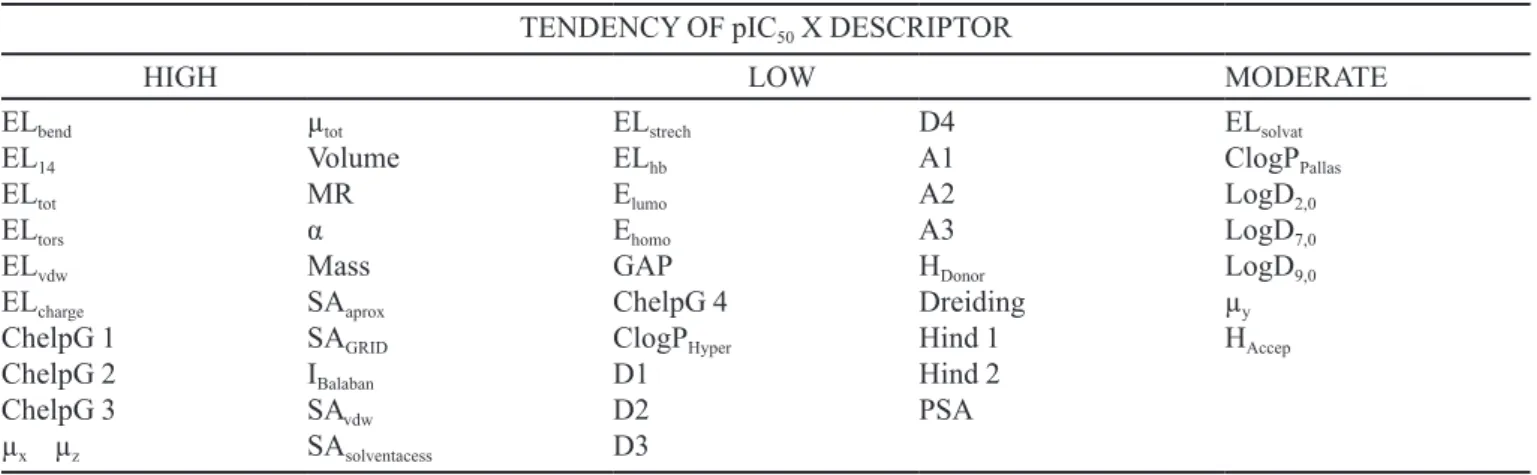
The visual inspection of the biological activity ver-sus calculated descriptor scatter plots was also applied as a ilter for selecting the independent variables that would be used to perform HCA and PCA. Concerning scatter plot behavior, the independent variables can be classiied as shown in Table III.
Among the forty-seven calculated descriptors, thirteen (Ehb, Ehomo, ChelpG 4, D1, D2, D3, A1, A2, A3, HDonor, Dreiding, Hind 1, Hind 2) were practically constant and did not present signiicant variability with the
pIC50 values. Moreover, six parameters (ELstrech, Elumo,
GAP, CLogPHyper, D4, PSA) were grouped in their scatter
twenty-eight descriptors, which presented good or mode-rate correlation with biological activity, were employed in the exploratory data analysis (Table III). Volume and atomic mass were excluded from the analysis because they were not considered very expressive.
Preliminary HCA displayed chalcones and N -acy-lhydrazones grouped in two different main sub-clusters: I, which comprises exclusively nitrated N-acylhydrazones, and II comprising only chalcones, as presented in Figure 3. The similarity index between the sub-clusters I and II is 0.617 (70 selected descendants), suggesting low similarity. Additionally, sub-cluster III is composed of chalcone de-rivatives that are signiicantly different from the chalcone derivatives grouped in sub-cluster II. Moreover, regarding the PCA 3D-diagram, N-acylhydrazones are mainly distri-buted in the PC2 and PC3 spaces whereas chalcones can be found in all factors (PC1, PC2 and PC3 space), indicating distinct behavior among the compounds of this subset.
The PCA scores plot (Figure 3) also reveals three chalcone derivatives (n-53, n-72 and n-77) that possibly di-ffer from the others. These three compounds could be acting as outliers interfering with the overall dataset behavior and leading to miscalculations. A 2D outlier diagnosis plot was therefore constructed to conirm this suspicion (Figure 4).
Considering the outlier diagram (sample residual versus Malahanobis distance), samples falling outside
one or both of the thresholds are potential outliers. The sample residual threshold is based on a 95% probability limit (Pirouette, 2006), thus 5% of normal samples would be expected to fall outside this cutoff. For this reason, sam-ples slightly exceeding only one threshold may be normal. However, samples lying either signiicantly beyond one threshold, or beyond both, are more likely to be outliers. Accordingly, only compound n-53 can be considered an outlier. In addition, another compound can also be identi-ied as a potential outlier, namely, 32/S.
FIGURE 3 - Preliminary PCA and HCA of the investigated set of compounds.
* Similarity indexes calculated for the seventy compounds grouped in the sub-clusters I (39 descendants) and II (31 descendants) (see Figure 3).
After the exclusion of compounds n-53 and 32/S individually and, later, at the same time, HCA procedures were carried out and the similarity indexes between the previous sub-clusters I and II were computed and evalu-ated*. When compound 32/S was individually eliminated, the similarity index obtained (0.618) was identical to that obtained before the exclusions (0.617). Nevertheless, when only compound n-53 was excluded, the similarity index diminished from 0.617 to 0.464, indicating that n-53 interferes signiicantly in the behavior of the chalcone derivatives. A similar result was found when both com-pounds n-53 and 32/S were excluded (0.460). This inding suggests that compound n-53 has greater impact on the overall set behavior than compound 32/S, and it should be considered as the only outlier.
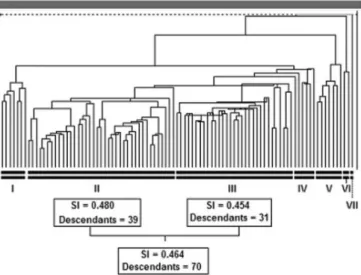
Optimization of the HCA and PCA procedures was performed by removing just compound n-53. The HCA results are shown in Figure 5. The new dendrogram reveals two major clusters. The irst is composed of the sub-clus-ters I, II, III, IV, V, and VI, whereas the second was called cluster VII and is distinct from the rest of the investigated data. Sub-cluster II corresponds to the N-acylhydrazones main group while sub-cluster III represents the chalcones main group. As previously mentioned, the similarity index between II and III was 0.464 as shown in Figure 5.
Sub-cluster I is consists of seven N-acylhydrazones, containing more than one nitro group in its molecular structures (9/O, 9/S, 17/S, 23/O, 23/S, 24/O, and 24/S). The sub-clusters IV and V comprise chalcone derivatives that differ substantially from the chalcones of sub-cluster
III. Finally, the dendrogram also revealed that compounds 32/O and 32/S did not share any kind of similarity neither
with chalcones nor with the other nitrated N -acylhydra-zones, being classified as a distinct sub-cluster (VI). These compounds possess a sulphonylamide group in their molecular structures. This chemical group can at-tribute completely different physicochemical features to the structures, such as higher hydrophilic and ionization potential properties, which could be responsible for the distinct behavior of these ligands compared to the other ligands of the investigated set.
It is noteworthy that cluster VII is composed of one single ligand, n-65, which does not share any kind of similarity with the investigated set of compounds. Considering the calculated parameters, this derivative di-ffers signiicantly from the others in terms of its torsional energy contribution (ELtors) (see Table A, Supplementary Material).
PCA methodology without the n-53 compound better elucidated the HCA results. The PCA procedure was run up to a maximum of seven PCs because when more than seven PCs were computed the total variance explained remained practically unchanged.
As shown in Table IV, the irst three PCs described 62% of the total variance explained. The relative impor-tance of each descriptor for the respective factor or PC (loadings) is also listed in this table.
The 3D scores plot conirmed the classiication of the investigated set into two main separate subsets: N -acylhydrazones and chalcones. This fact, which can be visualized in Figure 5, is much more evident after the outlier exclusion, corroborating the substantial impact of com-pound n-53 on the set behavior. Moreover, the partitioning of the investigated set also indicates that chalcones and
N-acylhydrazones do not share direct analogy or, in other words, do not show both structural and functional similarity, at least regarding the methodology applied in this study.
The clusters found with the HCA technique can also be observed in PCA results. For instance, sub-clusters I,
II, VI, and cluster VII (compound n-65) are clearly dis-cernible in view 1 of the 3D scores plot.
Parallel analysis considering the loading plot as well as the score (Table B, Supplementary Material) and loadings (Table IV), the tables revealed that the nitrated
N-acylhydrazones biological behavior depends chiely on thermodynamic and electronic descriptors, such as total energy (ELtot), bending energy (ELbend), total dipole mo-ment (µtot), and the number of acceptor hydrogen bonding
sites (HAccep).
It is important to consider that nitroderivatives can also exert their action by a nitro group reduction pathway (Orna, Mason, 1989), and this could be the mechanism highlighted in the methodologies applied here.
FIGURE 5 - Optimized dendrogram acquired after n-53
Non-nitrated N-acylhydrazones could be more suitable to demonstrate a common mechanism of action between the two classes of compounds investigated. However, as previously mentioned, a set of non-nitrated
N-acylhydrazones assayed under the same biological conditions as the classes evaluated in this study were not available in the literature.
Nonetheless, if a second mechanism of action takes place and is similar to that of chalcones, descriptors of any other nature should be common to both classes.
Chalcones, on the other hand, presented a broader distribution in PCs coordinates than did N-acylhydrazones (see View 2, Figure 6). The van der Waals energy (ELvdW) and electronic descriptors, such as dipole moment at the X coordinate (µx), and electrostatic potential partial atomic
charges at the carbonyl carbon (ChelpG 1) and oxygen (ChelpG 2), respectively, are related to chalcone biolo-gical behavior. These latter descriptors could indicate the importance of the carbonyl group to chalcone action and also support the cysteine protease inhibitory mechanism of action.
Interestingly, sub-cluster V of chalcones differs from the other chalcone derivatives by descriptors related to the molecular volume, such as van der Waals surface areas (SAVDW), polarizability (α), and molar refractivity (MR).
All compounds in this group presented bigger or more branched side chains (Figure 1). In fact, the Connolly sur-faces of these compounds can present volume differences compared to the other unsubstituted chalcone analogues (sub-cluster III) (Figure 7).
TABLE IV - Principal component analysis runs for 93 samples and 25 independent variables. The loadings of independent variables
are listed below
Factor 1 Factor 2 Factor 3 Factor 4 Factor 5 Factor 6 Factor 7
Variance % 36.49 15.04 10.56 9.46 5.22 3.82 3.64
Cumulative variance 36.49 51.54 62.10 71.55 76.77 80.60 84.24
ELbend -0.07 0.34 0.11 -0.32 -0.07 0.26 0.28
ELtors 0.04 0.33 -0.07 -0.01 -0.09 -0.26 -0.57
EL1,4 0.10 -0.18 0.47 -0.13 0.00 -0.09 -0.21
ELvdW 0.11 -0.09 0.00 0.22 0.25 0.68 -0.13
ELel -0.06 0.24 -0.41 0.09 0.12 0.16 0.33
ELsolv 0.26 -0.15 -0.15 -0.22 0.16 -0.08 -0.02
ELtot -0.09 0.22 0.41 -0.29 -0.02 0.04 0.02
ChelpG 1 0.05 0.18 -0.26 -0.39 0.17 0.12 -0.10
ChelpG 2 0.10 -0.06 0.14 0.50 0.06 -0.10 0.17
ChelpG 3 -0.01 0.28 -0.20 -0.10 0.24 -0.43 0.14
µx 0.06 -0.22 -0.06 -0.11 -0.48 -0.02 0.34
µy 0.02 0.29 0.06 0.29 0.22 -0.10 0.00
µz 0.01 -0.07 0.25 -0.18 0.57 0.11 -0.02
µtot -0.18 0.24 0.20 0.30 0.06 -0.09 0.04
MR 0.29 0.19 0.03 -0.01 -0.10 0.11 0.02
α 0.30 0.18 0.01 -0.05 -0.04 0.08 0.04
SAGrid 0.30 0.13 0.04 0.02 -0.15 0.07 -0.03
ClogPPallas 0.32 -0.02 0.02 0.01 0.13 -0.09 0.13
LogD 2.0 0.29 -0.01 0.00 0.11 0.16 -0.15 0.19
LogD 7.0 0.32 -0.03 0.03 -0.01 0.11 -0.10 0.14
LogD 9.0 0.29 -0.02 0.14 -0.07 0.07 -0.13 0.18
Ibalaban 0.18 0.02 -0.29 0.12 -0.07 0.11 -0.35
HAccep -0.22 0.31 0.16 0.10 -0.04 0.09 0.11
SAVDW 0.29 0.18 0.05 0.03 -0.17 0.08 -0.13
CONCLUSIONS
The visual examination of the correlation between biological activity and calculated descriptor scatter plots
as well as HCA and PCA formalisms used, indicated that chalcones and nitrated N-acylhydrazones do not present functional similarity under the conditions applied in the present study.
Given that the two investigated classes have been reported as potential cysteine protease inhibitors, the hy-pothesis that these compounds inhibit cysteine proteases enzymes at different sites should be considered. Studies regarding field descriptors are now investigating the same library of compounds to verify if they could share similarities from the energy-interaction point of view, and should be helpful to verify the hypotheses raised by our indings.
ACKNOWLEDGMENT
The authors would like to thank FAPESP (01/01192-3, 06/00116-5, 07/59416 and 07/5461-0) for the inancial support, and the Chem21 Group, Inc., for the MOLSIM 3.2 academic license.
REFERENCES
BEEBE, K. R.; PELL, R. J.; SEASHOLTZ, M. B. Chemometrics:
A practical guide. New York: Wiley, 1998. 360 p.
CHUNG, M. C.; FERREIRA, E. I.; SANTOS, J. L.; GIAROLLA, J.; RANDO, D. G.; ALMEIDA, A. E.; BOSQUESI, P. L.; MENEGON, R. N.; BLAU, L. Prodrugs for the treatment of neglected diseases. Molecules, v.13, p.616-677, 2008.
CROFT, S. L. Public-private partnership: From there to here.
Trans. R. Soc. Trop. Med. Hyg., v.99, p.9-14, 2005.
DOHERTY, D. MOLSIM: Molecular Mechanics and Dynamics Simulation Software - User’s Guide, version 3.2. Lake Forest: The Chem21 Group Inc., 1997. CD-Rom
FERREIRA, M. M. C. Multivariate QSAR.J. Braz. Chem. Soc., v.13, p.742-753, 2002.
GAUSSIAN 03Wfor Windows, version 6; Pittsburgh: Gaussian Inc., 1995-2003. CD-Rom
HYPERCHEM Program. Versão 7.0 for Windows, Gainesville: Hypercube, Inc., 2002. CD-Rom
KAYSER, O.; KIDERLEN, A. F.; CROFT, S. L. Natural products as antiparasitic drugs. Parasitol. Res., v.90, p.S55-S62, 2003.
FIGURE 7 - Electrostatic potential maps calculated on the
Connolly surfaces of the chalcone derivatives from sub-clusters III and V. Negative electrostatic potential regions are represented in red (high electronic density) while positive electrostatic potential areas are shown in dark blue (low electronic density).
FIGURE 6 - Scores and loadings on 3D plots found for the irst
LI, R.; CHEN, X.; GONG, B.; SEIZER, P. M.; LI, Z.; DAVIDSON, E.; KURZBAN, G.; MILLER, R. E.; NUZUM, E. O.; MCKERROW, J. H.; FLETTERICK, R. J.; GILLMOR, S. A.; CRAIK, C. S.; KUNTZ, I. D.; COHEN, F. E.; KENYON, G. L. Structure-based design of parasitic protease inhibitors. Bioorg. Med. Chem., v.4, p.1421-1427, 1996.
LI, R.; KENYON, G. L.; COHEN, F. E.; CHEN, X.; GONG, B.; DOMINGUEZ, J. N.; DAVIDSON, E.; KURZBAN, G.; MILLER, R. E.; NUZUM, E. O.; ROSENTHAL, P. J.; MCKERROW, J. H. In vitro antimalarial activity of Chalcones and their derivatives. J. Med. Chem., v.38, p.5031-5037, 1995.
LIU, M.; WILAIRAT, P.; GO, M. L. Antimalarial alkoxylated and hydroxylated chalcones: structure-activity relationship analysis. J. Med. Chem., v.44, p.4443- 4452, 2001.
LIU, Z.; FANG, Q.; YU, W.; XUE, G.; CAO, D.; JIANG, M. 2’-Hydroxy-4’’-dimethylamino-chalcone. Acta Crystallogr. C, v.C58, p.o445-o446, 2002.
MARVINBEANS, Version 4.1.8; Budapeste: ChemAxon Ldt, 1998-2007. CD-Rom
MCBURNEY, B.; CRUNDWELL, G.; UPDEGRAFF III, J. B.; ZELLERB, M.; HUNTERB, A. D. 5-Nitrothiophene-2-carbaldehyde. Acta Crystallogr. E, v.E61, p.o1221-o1222, 2005.
MCKERROW J. H.; ENGEL, J. C.; CAFFREY, C. R. Cysteine protease inhibitors as chemotherapy for parasitic infections.
Bioorg. Med. Chem., v.7, p.639-644, 1999.
MCKERROW, J. H. Development of cysteine protease inhibitors as chemotherapy for parasitic diseases: insights on safety, target validation, and mechanism of action. Int. J. Parasitol., v.29, p.833-837, 1999.
NIELSEN, S. F.; CHRISTENSEN, S. B.; CRUCIANI, G.; KHARAZMI, A.; LILJEFORS, T. Antileishmanial Chalcones: Statistical design, synthesis, and three-dimensional quantitative structure-activity relationship analysis. J. Med. Chem., v.41, p.4819-4832, 1998.
ORNA, M. V.; MASON, R. P. Correlation of kinetic parameters of nitroreductase enzymes with redox properties of nitroaromatic compounds. J. Biol. Chem., v.264, p.12379-12384, 1989.
PALLAS, version 3.0, Sedona: CompuDrug Chemistry Ltd, 1994-1995. CD-Rom
PIROUETTE, version 3.11, Woodinville: Infometrix Inc., 1990-2003. CD-Rom
RACE, P. R.; LOVERING, A. L.; GREEN, R. M.; OSSOR, A.; WHITE, S. A.; SEARLE, P. F.; WRIGHTON, C. J.; HYDE, E. I. Structural and mechanistic studies of Escherichia coli
nitroreductase with the antibiotic nitrofurazone: reversed binding orientations in different redox states of the enzyme.
J. Biol. Chem., v.280, p.13256-13264, 2005.
RANDO, D. G.; AVERY, M. A.; TEKWANI, B. L.; KHAN, S. I.; FERREIRA, E. I. Antileishmanial activity screening of 5-nitro-2-heterocyclic benzylidene hydrazides. Bioorg. Med. Chem., v.16, p.6724-6731, 2008.
STEWART, J. J. P. Optimization of parameters for semi-empirical methods I-method. J. Comput. Chem., v.10, p.209-220, 1989.
TROEBERG, L.; CHEN, X.; FLAHERTY, T. M.; MORTY, R. E.; CHENG, M.; HUA, H.; SPRINGER, C.; MCKERROW, J. H.; KENYON, G. L.; LONSDALE-ECCLES, J. D.; COETZER, T. H. T.; COHEN, F. E. Chalcone, acyl hydrazide, and related amides kill cultured Trypanosoma brucei brucei. Mol. Med., v.6, p.660-669, 2000.
TROUILLER, P.; OLLIARO, P.; TORREELE, E.; ORBINSKI, J.; LAING, R.; FORD, N. Drug development for neglected diseases: a deficient market and a public-health policy failure. Lancet, v.359, p.2188-2194, 2002.
VAN GUNSTEREN, W. F.; BERENDSEN, H. J. C. Computer simulation of molecular dynamics: methodology, applications, and perspectives in chemistry. Angew. Chem. Int. Ed., v.29, p.992-1023, 1990.
WERMUTH, C. G. Similarity in drugs: relections on analogue design. Drug Discov. Today, v.11, p.348-354, 2006.
Received for publication on 23rd July 2008