*Correspondence: D. Hansen. Centro de P&D de Sanidade Animal, Instituto Biológico. Av. Conselheiro Rodrigues Alves, 1252 - Vila Mariana - 04014-002 - São Paulo - SP, Brazil. E-mail: [email protected]
R
ev
Pharmaceutical Sciences vol. 46, n. 4, out./dez., 2010
Pharmaceutical properties of ‘sucupira’ (
Pterodon
spp.)
Daiane Hansen
1,2,*, Mitsue Haraguchi
2,
Antonio Alonso
11Institute of Physics, University Federal of Goiás, 2Center of Animal Health, Biological Institute of São Paulo
The plant of the genus Pterodon (Fabaceae, Leguminosae), commonly known as ‘sucupira’ or ‘faveira’, are disseminated throughout the central region of Brazil and has frequently been used in popular medicine for its anti-rheumatic, analgesic, and anti-inlammatory properties. In recent years, interest in these plants has increased considerably. The biological effects of different phytoextracts and pure metabolites have been investigated in several experimental models in vivo and in vitro. The literature describes lavonoids, triterpene and steroids, while one paper presented studies with proteins isolated from the genus. This review provides an overview of phytochemical and pharmacological research in Pterodon, showing the main chemical compounds studied to date, and focusing on the relationship between these molecules and their biological activity. Furthermore, this study paves the way for more in-depth investigation, isolation and characterization of the molecules of this plant genus.
Uniterms: Sucupira. Pterodon/phytochemistry. Pterodon/pharmacognosy. Diterpenes/biological activity. Isolavones/biological activity. Medicinal plants.
As plantas do gênero Pterodon (Fabaceae/Leguminosae), conhecidas popularmente como “sucupira branca” ou “faveira”, encontram-se distribuídas pela região central do Brasil e são frequentemente utilizadas na medicina popular por suas propriedades antirreumáticas, analgésicas e antiinlamatórias. Nos últimos anos, o interesse por estas plantas tem aumentado consideravelmente. Os efeitos biológicos dos diferentes itoextratos e metabólitos puros têm sido investigados em vários modelos experimentais in vivo
e in vitro. A literatura descreve lavonóides, triterpenos, esteróides e apenas um trabalho mostra estudos com proteínas isoladas do gênero. Esta revisão apresenta de maneira geral as investigações farmacológicas e itoquímicas de Pterodon, mostrando os principais compostos já estudados, sua composição química, focando na relação entre estas moléculas e sua atividade biológica. Mais ainda, nós abrimos as portas para maior investigação, isolamento e caracterização de moléculas deste gênero de plantas.
Unitermos: Sucupira. Pterodon/itoquímica. Pterodon/farmacognosia. Diterpenos/atividade biológica. Isolavonas/atividade biológica. Plantas medicinais.
INTRODUCTION
The broad biodiversity within Brazil’s territory places the country in a strategic position to develop ra-tional and sustained exploration of new metabolites with therapeutic value. Brazil’s landmass covers a wide range of climates, soil types, and altitudes, providing a unique set of selective pressures for the adaptation of plant life in these habitats. The plant chemical diversity is also driven by these forces, in an attempt to best adapt the plant to suit the particular abiotic stresses, fauna, and microbes that
coexist in the environment. Certain areas of vegetation, such as the Amazonian Forest, Atlantic Forest, Cerrado (Brazilian Savanna), and Caatinga, are rich in biodiversity and are therefore of great interest for the discovery of na-tural compounds with biological activity against diseases (Basso et al., 2005).
classiied as Pterodon pubescens by Bentham, but Vogel subsequently demonstrated that it was in fact the same plant species as that of Pterodon emarginatus. The species now bears the oficial name of Pterodon emarginatus Vo-gel. Unfortunately, it is commonly misidentiied as being two distinct species (Carvalho, 2004).
In general, these species are native aromatic trees reaching 5-10 m in height distributed throughout the central region of Brazil (Goiás, Minas Gerais and São Paulo) (Oliveira, Paiva, 2005; Dutra et al., 2008a). These trees frequently grow in the Brazilian Cerrado and in transitional areas approaching the Paraná River basin’s semi-deciduous forest. Despite their slow growth, these species are important in mixed reforestations designed to recover degraded areas (Oliveira, Paiva, 2005), due to their tolerance for direct sunlight and low soil fertility.
In mature seeds of some species, such as Pterodon emarginatus (Vogel), a distinguishing characteristic is the frequent presence of phenolic compounds in the integu-ments. Tests on these compounds have demonstrated their contribution to great hardness, low water permeability and high resistance to pathogen attack (Suárez, Engleman, 1980). Also, in mature seeds, the embryo show fleshy cotyledons, with accumulated lipid and protein reserves. Although the ‘sucupira’ seeds are commercially available at the medicinal lora market and are widely used in domestic medicine for their anti-rheumatic (Sabino et al., 1999b; Coelho et al., 2004), analgesic (Coelho et al., 2005) and anti-inlammatory (Carvalho et al., 1999; Dutra et al., 2009) properties, only a small number of papers have described the various lavonoids, amino-containing, triterpene, steroid, and others secondary compounds present in the Pterodon genus. In addition, to the best of
our knowledge, there is only one report available in the literature showing studies with proteins isolated from this genus, a 5 kDa α-amylase inhibitor reported by Silva et al. (2007). In this review, we have described the main chemi-cal compounds studied to date and focused on establishing a relationship between these molecules and their biological activity. The Tables I to V summarize the main molecules published in the literature.
Chemistry
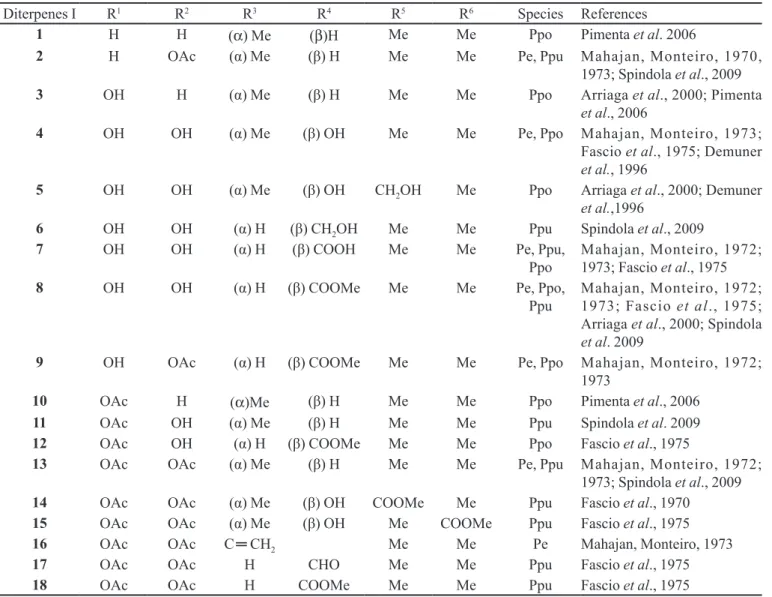
The interest in the Pterodon genus began in the six-ties, when Mors et al. (1967) isolated the geranylgeraniol 21 (Table IV) and 14,15-epoxigeranylgeraniol 23 (Table IV) by extraction of P. pubescens fruit essential oil with hexane, followed by chromatography on silica gel. In 1970, diterpenoids (2, 13) were obtained from the fruits of P. emarginatus by extraction with petroleum ether by Mahajan and Monteiro. (Table III). Two years later, the same authors presented a new compound from the same fruit (19). All these molecules present a vouacapane ske-leton in their structures. Yet in 1970, Fascio et al., isolated new terpenes from P.pubescens fruit oil (7,14) (Table III). In 1975, diterpenoid 20 was isolated from the same spe-cies. This compound shows high biological activity against S.mansoni cercariae and inhibits Crithidia fasciculate in culture (Fascio etal., 1975).
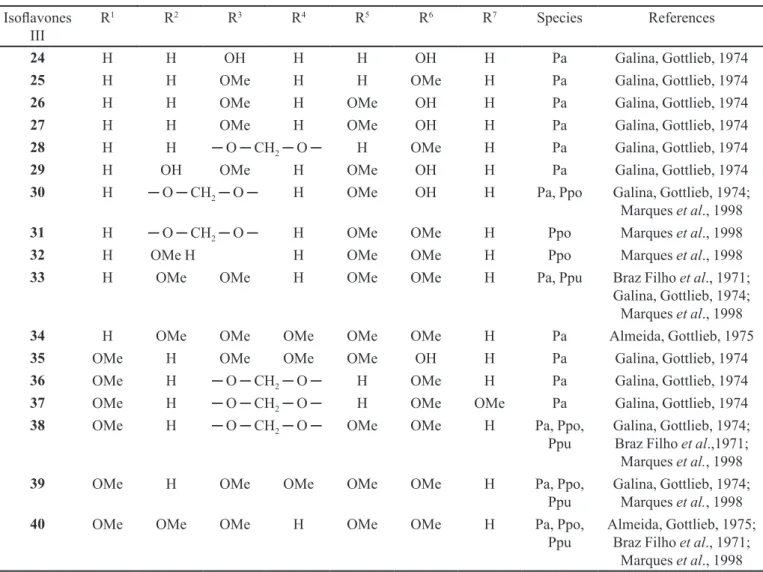
(38), the isomeric 2’,3’,4’,6,7-penta methoxyisolavo-ne and 2’,4’,5’,6,7-pentamethoxyisoflavomethoxyisolavo-ne (40), and 2’,4’,5’,6,7-pentamethoxyisolavone (39). All of these molecules are shown in Table V.
The seed of P. emarginatus was shown to contain sesquiterpenic essential oil such as trans-β-caryophyllene (35.9%), β-elemene (15.3%), germacrene D (9.8%), spa-thulenol (5.9%), α-humulene (6.8%) and, bicyclogerma-crene (5.5%) (Dutra et al. 2008a, 2009).
From the P. polygalaelorus Benth. species, four
fu-ran diterpenes (12, 15, 17, 18) were described by Fascio et al. (1975). The 6α-7β-dihydroxyvouacapan-17 β oate (8) was demonstrated to have important biological activities (Nunan et al., 1982; Duarte et al., 1996). In addition to the phytochemical study of the above-referenced species, the diterpenes 6α-hydroxyvoucapane (3), methyl 6α, 7β-dihydroxyvoucapan-17β-oate (8) and, vouacapane-6α, 7 β, 14 β, 19-tetraol (5) were also isolated from seeds by Arriaga et al., 2000. The same authors elucidated the structure of taxifolin (dihydroquercetin), the most
com-TABLE I - Biological activities in vivo of Pterodon spp. plant extracts/vouacapan derivative
Treatment Dose Activity References
P. pubescens / P. emarginatus
HAE 5 or 50 mg/kg anti-rheumatic/anti-arthritic Sabino et al., 1999b
HE 500 mg/kg anti-inlammatory;
determination of ED50 Carvalho et al., 1999
OEP 40 μg; 200 μg and 200 mg/kg
(OEP). anti-inlammatory Silva et al., 2004
Fractions PF1, PF2, PF3, PF4 2; 20 and 200 μg/kg anti-inlammatory Silva et al., 2004
Fractions PF1.1, PF1.2, PF1.3 0.1; 1.0 and 10 μg/kg anti-inlammatory Silva et al., 2004
OEP and fractions PF1, PF2,
PF3 and PF4 0.0013 – 130 mg/kg anti-nociceptive Coelho et al., 2004
EO, HE, BE and ME 100 – 500 mg/kg anti-nociceptive Dutra et al., 2008a
EO 100, 300 and 500 mg/kg ulcerogenic and
anti-inlammatory Dutra et al., 2009c
EE 0.1; 0.3 and 1 g/kg nociceptive and
anti-inlammatory Moraes et al., 2009
P. polygalaelorus
6α,7β-dihydroxyvouacapan-17
β-oate 200 μmol/kg anti-nociceptive Nunan et al., 1982
6α,7β-dihydroxyvouacapan-17
β-oate 125; 250 and 500 μmol/kg anti-nociceptive Duarte et al., 1992
6α,7β-dihydroxyvouacapan-17
β-oate 250; 375 and 500 μmol/kg anti-nociceptive Duarte et al., 1992
6α,7β-dihydroxyvouacapan-17
β-oate 250 and 500 μmol/kg anti-nociceptive Duarte et al., 1992
6α,7β-dihydroxyvouacapan-17
β-oate 125 and 500 μmol/kg anti-nociceptive Duarte et al., 1996
HAE 100, 200, 400 mg/kg nociceptive,
anti-inlammatory and bronchodilator
Leal et al., 2000
HE, ME, EO and
6α-acetoxyvouacapan 12.5 - 500 μg/mL larvicidal on Aedes aegypti Pimenta et al., 2006
EO 100 - 1300 μg/mL effects on contractions Evangelista etal., 2007
EO 100 - 300 μg/mL antispasmodic Leonhardt et al., 2010
mon member of the dihydrolavonol group (41). Details of these molecules are shown in Table III.
4-methoxybenzoic acid (p-anisic acid) and tri-terpenes (lupeol and betulin) were isolated from the heartwood of P. polygalaelorus (Marques et al., 1998). Sesquiterpenic essential oils were obtained from fruits and demonstrated to contain trans-β-caryophyllene (20.6%) followed by spathulenol (16.6%), α-capaene (10.4%), γ-muurolene (8.1%), β-elemene, α-humulene, alloaroma-dendrene, bicyclogermacrene, δ-cadinene, α-cubenene, γ-cadinene, β-gurjunene, aromadendrene, germacrene D, α-calacorene, δ-elemene, and α-gurjunene (Campos et al.,1994; Evangelista et al., 2007).
There are several papers referring to the isolation of alkaloid molecules of the Pterodon genus (Sabino et
al., 1999a; Coelho et al., 2005; Dutra et al., 2008a,b; Menna-Barreto et al., 2008; Vieira et al., 2008; Dutra et al., 2009b) but only one paper showed the structures of homoormosanine-type alkaloids from Bowdichia virgiloi-des, popularly called ‘black sucupira’ or ‘sucupira preta’ (Torrenegra et al., 1989).
Biological properties
The active metabolites were isolated at the same time that the medicinal properties were investigated. In folk medicine, wine infusions from Pterodon genus seeds are used in the treatment of rheumatoid arthritis, an auto-immune disease characterized by chronic inlamed joints and exacerbated functions of macrophages and T and B
TABLE II - Biological activities in vitro of Pterodon spp. plant extracts/vouacapan derivative
Treatment Dose Activity Reference
P. pubescens / P.emarginatus
OEP and
14,15-epoxigeranylgeraniol Pure or 5 % and 25 % diluted chemoprophylactic on schistosomiasis Mors et al., 1966; 1967
diterpenoid 8 µg/mL chemoprophylactic on
schistosomiasis and Crithidia
fasciculate in culture
Fascio et al., 1975
EO 10, 25, 50 mg antimicrobial Neto, 1976; Dutra et al., 2009a
OEP 100 ppm (soap) chemoprophylactic on
schistosomiasis Dos Santos Filho Katz et al., 1993et al., 1987;
OEP 30, 300, 3000 μg/mL antiplatelet Calixto et al., 2007
geranylgeraniol 1, 10, 100 nmol/mL antiplatelet Calixto et al., 2007
geranylgeraniol 15-20 μg/mL (trypomastigotes)
and 12.5-200 μg/mL (epimastigotes)
anti-Trypanosoma cruzi,
effect on proliferation of epi- and trypomastigotes
Menna-Barreto et al., 2008
subfraction A (HE derivative)
and furan diterpene 1 10-100 μg/mL antiproliferative on human melanoma cells Vieira et al., 2008
EO, BE, ME, EAE, HE 0.97-250 μg/mL antioxidant activity Dutra et al., 2008b
6α-acetoxi-7β-hydroxyvouacapan and four
diterpenes furans
0.25-250 μg/mL anticancer in prostate cell line Spindola et al., 2009
HE, BE, ME 6.25 – 100 μg/mL leishmanicidal Dutra et al., 2009a
P. polygalaelorus
furan diterpenes 100 e 1000 ppm effect on plant growth Demuner et al., 1996
furan diterpenes LC50 values of 50.08, 14.69,
and 21.76 μg/mL larvicidal against the aegypti Aedes De Omena et al., 2006
HE, ME, EO,
6-α-acetoxyvouacapane
12.5 - 500 μg/mL larvicidal against the Aedes
aegypti Pimenta et al., 2009
6α,7β-dihydroxyvouacapan-17β-oic acid and its derivatives 0.25 – 250 μg/mL antiproliferative on human cancer cells Euzébio et al., 2009
lymphocytes (Cardoso et al., 2008). Sabino et al. (1999b) and Coelho et al. (2004) have demonstrated the anti-arthritic effect of hydro-alcoholic extract of P. pubescens seeds using the collagen-induced arthritis model (Table I). Also, these researchers have presented studies in vitro and in vivo demonstrating that acute administration of even extremely high doses of the oil of P. pubescens seeds are
non-mutagenic, non-toxic, and non-cytotoxic to human peripheral blood mononuclear cells (PBMNCs)(Sabino et al., 1999a). In subsequent work, sub-acute toxic effects were not observed with hydro-alcoholic extract in studies of hematological, histopathological, clinical, and bioche-mical parameters in arthritic mice, according to studies of Coelho et al. (2001). Further analysis revealed the anti-in-lammatory (Silva et al., 2004) and anti-nociceptive effects of ethanolic extracts of P. pubescens seeds, conirming the rationale behind the use of this plant in popular medicine to treat pain disorders (Coelho et al., 2005) (Table I).
The investigations on the pharmacological proper-ties of ‘sucupira’ surpass those of its anti-inlammatory and anti-rheumatic activities. Dutra et al. (2008b) studied the total phenolic content and antioxidant activity of seeds of P. emarginatus (Table II). The phenolic constituents found
TABLE III - Structure of the diterpenes based on molecule I, identiied from the Pterodon genus
Diterpenes I R1 R2 R3 R4 R5 R6 Species References
1 H H (α) Me (β)H Me Me Ppo Pimenta et al. 2006
2 H OAc (α) Me (β) H Me Me Pe, Ppu Mahajan, Monteiro, 1970,
1973; Spindola et al., 2009
3 OH H (α) Me (β) H Me Me Ppo Arriaga et al., 2000; Pimenta
et al., 2006
4 OH OH (α) Me (β) OH Me Me Pe, Ppo Mahajan, Monteiro, 1973;
Fascio et al., 1975; Demuner
et al., 1996
5 OH OH (α) Me (β) OH CH2OH Me Ppo Arriaga et al., 2000; Demuner
et al.,1996
6 OH OH (α) H (β) CH2OH Me Me Ppu Spindola et al., 2009
7 OH OH (α) H (β) COOH Me Me Pe, Ppu,
Ppo Mahajan, Monteiro, 1972; 1973; Fascio et al., 1975
8 OH OH (α) H (β) COOMe Me Me Pe, Ppo,
Ppu Mahajan, Monteiro, 1972; 1973; Fascio et al., 1975;
Arriaga et al., 2000; Spindola
et al. 2009
9 OH OAc (α) H (β) COOMe Me Me Pe, Ppo Mahajan, Monteiro, 1972;
1973
10 OAc H (α)Me (β) H Me Me Ppo Pimenta et al., 2006
11 OAc OH (α) Me (β) H Me Me Ppu Spindola et al. 2009
12 OAc OH (α) H (β) COOMe Me Me Ppo Fascio et al., 1975
13 OAc OAc (α) Me (β) H Me Me Pe, Ppu Mahajan, Monteiro, 1972;
1973; Spindola et al., 2009
14 OAc OAc (α) Me (β) OH COOMe Me Ppu Fascio et al., 1970
15 OAc OAc (α) Me (β) OH Me COOMe Ppu Fascio et al., 1975
16 OAc OAc C ═ CH2 Me Me Pe Mahajan, Monteiro, 1973
17 OAc OAc H CHO Me Me Ppu Fascio et al., 1975
18 OAc OAc H COOMe Me Me Ppu Fascio et al., 1975
Ppo: Pterodon polygalaelorus; Pe: Pterodon emarginatus; Ppu: Pterodon pubescens
TABLE IV - Structure of the diterpenes based on molecule II,
identiied from the Pterodon genus
Diterpenes II R1 R2 References
21 H Mors et al., 1967
22 OH Mors et al., 1967
in vegetables have attracted considerable attention because of their antioxidant activity. The antioxidant activities of phenolics are mainly due to their redox properties, which allow them to act as reducing agents, hydrogen donors, and singlet oxygen quenchers. They have a metal chelation potential and play an important role in the adsorption or neutralization of free radicals. Buthanolic and methano-lic fractions of the P. emarginatus seeds demonstrated a marked scavenging effect on DPPH radical (2,2-diphenyl-2-picrylhydrazyl hydrate).
Other studies have demonstrated the potential trypanocidal effect of the oleaginous ethanolic extract of P. pubescens seeds and its fractions (Menna-Barreto et al., 2008) (Table II). Trypanosoma cruzi is the causative agent of Chagas’ disease, the parasitic infection that remains one of the leading causes of heart diseases in Latin America. Current treatment options for this disease involve two nitroheterocyclic compounds that present
low eficacy and severe side effects. It is hoped that an-tiparasitic therapeutic agents can be identiied from the plants through screening efforts aimed at discovering new molecules such as natural products, proteins and, peptides with recognized biological activity (Araújo et al., 2005; Hansen et al., 2007).
Also in the area of parasitic diseases, a group of Brazilian researchers demonstrated that the P. pubescens fruit essential oil inhibited the penetration of the cercaries of Schistosoma mansoni (Dos Santos-Filho et al., 1972, 1987; Katz et al., 1993). One of the compounds identiied as a component of this oil was the 14,15- epoxigeranyl-geraniol (3), a molecule isolated by Mors et al. (1967), and shown to be effective as a chemoprophyloactic agent in schistosomiasis. Mahajan and Monteiro (1973) also investigated the anti-cercaria action of P. pubescens while the other three species were studied by Fascio et al. (1975) (Table II).
TABLE V - Structure of the isolavones based on molecule III, identiied from the Pterodon genus
Isolavones
III R
1 R2 R3 R4 R5 R6 R7 Species References
24 H H OH H H OH H Pa Galina, Gottlieb, 1974
25 H H OMe H H OMe H Pa Galina, Gottlieb, 1974
26 H H OMe H OMe OH H Pa Galina, Gottlieb, 1974
27 H H OMe H OMe OH H Pa Galina, Gottlieb, 1974
28 H H ─ O ─ CH2 ─ O ─ H OMe H Pa Galina, Gottlieb, 1974
29 H OH OMe H OMe OH H Pa Galina, Gottlieb, 1974
30 H ─ O ─ CH2 ─ O ─ H OMe OH H Pa, Ppo Galina, Gottlieb, 1974;
Marques et al., 1998
31 H ─ O ─ CH2 ─ O ─ H OMe OMe H Ppo Marques et al., 1998
32 H OMe H H OMe OMe H Ppo Marques et al., 1998
33 H OMe OMe H OMe OMe H Pa, Ppu Braz Filho et al., 1971;
Galina, Gottlieb, 1974;
Marques et al., 1998
34 H OMe OMe OMe OMe OMe H Pa Almeida, Gottlieb, 1975
35 OMe H OMe OMe OMe OH H Pa Galina, Gottlieb, 1974
36 OMe H ─ O ─ CH2 ─ O ─ H OMe H Pa Galina, Gottlieb, 1974
37 OMe H ─ O ─ CH2 ─ O ─ H OMe OMe Pa Galina, Gottlieb, 1974
38 OMe H ─ O ─ CH2 ─ O ─ OMe OMe H Pa, Ppo,
Ppu Galina, Gottlieb, 1974; Braz Filho et al.,1971;
Marques et al., 1998
39 OMe H OMe OMe OMe OMe H Pa, Ppo,
Ppu Galina, Gottlieb, 1974; Marques et al., 1998
40 OMe OMe OMe H OMe OMe H Pa, Ppo,
Ppu Almeida, Gottlieb, 1975; Braz Filho et al., 1971;
Marques etal., 1998
Further biological activity data was presented by Neto (1973) during his doctoral research. He demonstrated that the oil obtained from P. pubescens seeds presented signiicant invitro antimicrobial activity (Table II).
From the P. polygalaelorus species, the diterpene 6α-7β-dihydroxyvouacapan-17β-oate was demonstrated to have an anti-inlammatory activity in the paw edema produced by carrageenin (Nunan et al., 1982) and, in subsequent studies, showed an important anti-nociceptive activity (Duarte et al., 1996) (Table I). The ethanolic extract from seeds showed signiicant larvicidal activity against the Aedes aegypti mosquito (De Omena et al., 2006) (Table II) and the hydro-alcoholic extract was the most active bronchodilator among those plants widely used in north-eastern Brazil for respiratory tract diseases (Leal et al., 2000) (Table I).
Toxicology
A paper written by Sabino et al. (1999a) presented a study in which the oil of P.pubescens seeds (PpSO) was tested for acute toxicity, mutagenic activity and cytotoxi-city against human peripheral blood mononuclear cells (PBMNC). The study provided data to classify PpSO as cytotoxic to PBMNC, mutagenic and, non-toxic after acute administration, since the PpSO doses tested were signiicantly higher than those used by the population.
Also, the clastogenicity of ‘sucupira oil’ extracted from P.pubescens was tested in vivo on wistar rat bone marrow cells. Metaphase analysis showed that the com-pound did not induce a signiicant increase in the frequen-cies of chromosomal aberrations (Dias et al., 1995).
CONCLUSION
The broad biodiversity in Brazil places the country in a strategic position in the development and rational exploitation of new metabolites with therapeutic value. Areas of vegetation such as the Central Cerrado are rich in species of value in the search for natural compounds with activity against many diseases. The chemical charac-terization of these compounds, the determination of their mechanism of action and, the study of biological activities in vitro and in vivo, have yielded important information about the natural compounds and their derivatives.
The aim of this review was to present the studies involving the genus Pterodon and its natural compoun-ds, with the goal of encouraging further investigation of these plants. The isolation and characterization of new molecules, and their correlation with new biological tests,
provides fertile ground for the development of drugs for a large number of diseases.
ACKNOWLEDGMENTS
The authors would like to thank Dr. Kelly Boatright Sexton from North Carolina State University for reviewing the manuscript and are grateful to Mr. Randolfo Carneiro Carvalho (Fazenda Eldorado, Urutaí, GO, Brazil) for incentive and popular information regarding the thera-peutical properties of ‘sucupira’ seeds. CAPES/PNPD and CNPq provided inancial support.
REFERENCES
ALMEIDA, M.E.L.; GOTTLIEB, O.R. Further isolavones. Pterodonapparicioi. Phytochemistry, v.14, n.12, p.2716, 1975.
ARAÚJO, A.P.U.; HANSEN, D.; VIEIRA, D.F.; OLIVEIRA, C.; SANTANA, L.A.; BELTRAMINI, L.M.; SAMPAIO, C.A.M.; SAMPAIO, M.U.; OLIVA, M.L.V. Kunitz type Bauhinia bauhinioides inhibitors devoid of disulfide bridges: isolation of the cDNAs, heterologous expression
and structural studies. Biol. Chem., v.386, n.6, p.561-568,
2005.
ARRIAGA, A.M.C.; CASTRO, M.A.B.; SILVEIRA, E.R.; BRAZ-FILHO, R. Further diterpenoids isolated from Pterodon polygalaelorus. J. Braz. Chem. Soc., v.11, n.2, p.187-190, 2000.
BASSO, L.A.; PEREIRA DA SILVA, L.H.; FETT-NETO, A.G.; AZEVEDO JR, W.F.; MOREIRA, I.S.; PALMA, M.S.; CALIXTO, J.B.; ASTOLFI FILHO, S.; DOS SANTOS, R.R.; SOARES, M.B.P.; SANTOS, D.S. The use of biodiversity as source of new chemical entities against deined molecular targets for treatment of malaria,
tuberculosis, and T-cell mediated diseases- a review. Mem.
Inst. Oswaldo Cruz, v.100, n.6, p.575-606, 2005.
BRAZ FILHO, R.; GOTTLIEB, O.R.; ASSUMPÇÃO, R.M.V. Chemistry of Brazilian Leguminosae. XXXIV Isolavones of Pterodon pubescens. Phytochemistry, v.10, n.11, p.2835-2836, 1971.
CALIXTO, N.O.; COSTA E SILVA, M.C.; GAYER, C.R.; COELHO, M.G.; PAES, M.C.; TODESCHINI, A.R. Antiplatelet activity of geranylgeraniol isolated from Pterodon pubescens fruit oil is mediated by inhibition of
CAMPOS, A.M.; SILVEIRA, E.R.; BRAZ-FILHO,
R.; TEIXEIRA, T.C. Diterpenoids from Pterodon
polygalaeflorus. Phytochemistry, v.36, n.2, p.403-406, 1994.
CARDOSO, C.C.; PINTO, A.C.; MARQUES, P.R.; GAYER, C.R.M.; AFEL, M.I.R.; COELHO, M.G.P.; SABINO,
K.C.C. Suppression of T and B cell responses by Pterodon
pubescens seeds ethanolic extract. Pak. J. Biol. Sci., v.11, n.19, p.2308-2313, 2008.
CARVALHO, J.C.T.; SERTIÉ, J.A.A.; BARBOSA, M.V.J.; PATRÍCIO, K.C.M.; CAPUTO, L.R.G.; SARTI, S.J.; FERREIRA, L.P.; BASTOS, J.K. Anti-inflammatory
activity of the crude extract from the fruits of Pterodon
emarginatus Vog. J. Ethnopharmacol., v.64, n.2, p.127-133, 1999.
CARVALHO, J.C.T. Sucupira, Pterodon emarginatus Vog.
In: CARVALHO, J.C.T. Fitoterápicos anti-inlamatórios
– aspectos químicos, farmacológicos e aplicações terapêuticas. Ribeirão Preto: Tecmedd, 2004. p.383.
COELHO, M.G.P.; MARQUES, P.R.; GAYER, C.R.M.; VAZ, L.C.A.; NETO, J.F.N.; SABINO, K.C.C. Subacute
toxicity evaluation of a hydroalcoholic extract of Pterodon
pubescens seeds in mice with collagen-induced arthritis. J. Ethnopharmacol., v.77, n.2-3, p.159-164, 2001.
COELHO, M.G.; SABINO, K.C.; DALMAU, S.R.
Immunomodulatory effects of sucupira (Pterodon
pubescens) seed infusion on collagen-induced arthritis. Clin. Exp. Rheumatol., v.22, n.2, p.213-218, 2004.
COELHO, L.P.; REIS, P.A.; CASTRO, F.L.; GAYER, C.R.M.; LOPES, C.S.; SILVA, M.C.C.; SABINO, K.C.C.; TODESCHINI, A.R.; COELHO, M.G.P. Anti-nociceptive
properties of ethanolic extract and fractions of Pterodon
pubescens Benth. seeds. J. Ethnopharmacol., v.98, n.1-2, p.109-116, 2005.
DE OMENA, M.C.; BENTO, E.S.; DE PAULA, J.E.;
SANT’ANA, A.E. Larvicidal diterpenes from Pterodon
polygalaeflorus. Vector Borne Zoonotic Dis., v.6, n.2, p.216-222, 2006.
DEMUNER, A.J.; BARBOSA, L.C.A.; VELOSO, D.P.; ALVES, D.L.F.; HOWARTH, O.W. Structure and plant
growth regulatory activity of new diterpenes from Pterodon
polygalaelorus.J.Nat.Prod., v.59, n.8, p.770-772, 1996.
DIAS, F. D.; TAKAHASHI, C.S.; SAKAMOTO-HOJO, E.; VICHNEWSKI, W.; SARTI, S.J. Genotoxicity of the natural cercaricides “sucupira” oil and eremanthine in mammalian
cells in vitro and in vivo. Environ. Mol. Mutagen., v.26, n.4,
p.338-344, 1995.
DOS SANTOS FILHO, D.; SARTI, S.J.; KATZ, N.; ARAÚJO, N.; ROCHA FILHO, P.A.; ABREU, J.E.; BORTOLIN, M.E. Chemoprophylactic activity of soaps containing essential
oil from the fruits of Pterodon pubescens in Schistosomiasis
mansoni. Mem. Inst. Oswaldo Cruz, v.82, suppl.4, p.343-345, 1987.
DOS SANTOS FILHO, D.; VICHNEWSKI, W.; BAKER, P.M.; GILBERT, B. Prophylaxis of Schistosomiaris. Diterpenes
from Pterodon pubescens. An. Acad. Bras. Ciênc., v.44,
n.1, p.45-49, 1972.
DUARTE, I.D.G.; NAKAMURA-CRAIG, M.; FERREIRA-ALVES, D.L. Possible participation of endogenous opioid peptides on the mechanism involved in analgesia induced
by vouacapan. Life Sci., v.50, p.891-897, 1992.
DUARTE, I.D.; FERREIRA-ALVES, D.L.; VELOSO, D.P.; NAKAMURA-CRAIG, M. Evidence of the involvement of biogenic amines in the anti-nociceptive effect of a
vouacapan extracted from Pterodon polygalaelorus Benth.
J. Ethnopharmacol., v.55, n.1, p.13-18, 1996.
DUTRA, R.C.; TREVIZANI, R.; PITTELLA, F.; BARBOSA, N.R. Anti-nociceptive activity of the essential oil and
fractions of Pterodon emarginatus Vogel seeds. Lat. Am. J.
Pharm., v.27, n.6, p.865-870, 2008a.
DUTRA, R.C.; LEITE, M.N.; BARBOSA, N.R. Quantiication of Phenolic Constituents and Antioxidant Activity of Pterodon emarginatus Vogel seeds. Int. J. Mol. Sci., v.9, n.4, p.606-614, 2008b.
DUTRA, R.C.; BRAGA, F.G.; COIMBRA, E.C.; SILVA, A.D.; BARBOSA, N.R. Antimicrobial and leishmanicidal
activities of seeds of Pterodon emarginatus. Braz. J.
Pharmacogn., v.19, n.2A, p.429-435, 2009a.
DUTRA, R.C.; FAVA, M.B.; ALVES, C.C.; FERREIRA, A.P.; BARBOSA, N.R. Antiulcerogenic and anti-inlammatory
activities of the essential oil from Pterodon emarginatus
DUTRA, R.C.; PITTELLA, F.; FERREIRA, A.S.; LARCHER, P.; FARIAS, R.E.; BARBOSA, N.R. Healing effect of Pterodon emarginatus seeds in experimental models of
cutaneous ulcers in rabbits. Lat. Am. J. Pharm., v.28, n.3,
p.375-382, 2009c.
EUZEBIO, F.P.G.; DOS SANTOS, F.J.L.; PILÓ-VELOSO, D.; RUIZ, A.L.T.G.; CARVALHO, J.E.; FERREIRA-ALVES, D.L.; DE FATIMA, A. Effect of 6α, 7β-dihydroxyvouacapan-17β-oic acid and its lactone derivatives on the growth of
human cancer cells. Bioorg. Chem., v.37, n.3, p.96-100,
2009.
EVANGELISTA, G.L.; COELHO-DE-SOUZA, A.N.; SANTOS, C.F.; LEAL-CARDOSO, J.H.; LOPES, E.A.B.; DOS SANTOS, M.V.; LAHLOU, S.; MAGALHÃES,
P.J.C. Essential oil of Pterodon polygalaelorus inhibits
electromechanical coupling on rat isolated trachea. J.
Ethnopharmacol., v.109, n.3, p.515-522, 2007.
FASCIO, M.; GILBERT, B.; MORS, W.B.; NISHIDA, T. Two
new diterpenes from Pterodon pubescens. An. Acad. Bras.
Ciênc., suppl.42, p.97-101, 1970.
FASCIO, M.; MORS, W.; GILBERT, B.; MAHAJAN, M.B.; MONTEIRO, M.B.; SANTOS FILHO, D.;
VICHNEWSKI, W. Diterpenoid furans from Pterodon
species. Phytochemistry, v.15, n.1, p.201-203, 1975.
GALINA, E.; GOTTLIEB, O.R. Chemistry of Brazilian
Leguminosae. XLVI Isolavones from Pterodon appariciori.
Phytochemistry, v.13, n.11, p.2593-2595, 1974.
HANSEN, D.; MACEDO-RIBEIRO, S.; VERÍSSIMO, P.; YOO-IM, S.; SAMPAIO, M.U.; OLIVA, M.L.V. Crystal structure of a novel cysteinless plant Kunitz-type protease
inhibitor. Biochem. Biophys. Res. Commun., v.360, n.4,
p.735-740, 2007.
KATZ, N.; DOS SANTOS FILHO, D.; SARTI, S.J.; MENDES, N.M.; ROCHA FILHO, P.A.; ARAÚJO, N.
Chemoprophylactic activity on Schistosomiasis mansoni
of soaps containing essential oil from the fruits of Pterodon
pubescens. Rev. Inst. Med. Trop., v.35, n.2, p.183-191,1993.
LEAL, L.K.; FERREIRA, A.A.; BEZERRA, G.A.; MATOS, F.J.; VIANA, G.S. Anti-nociceptive, anti-inflammatory and bronchodilator activities of Brazilian medicinal
plants containing coumarin: a comparative study. J.
Ethnopharmacol., v.70, n.2, p.151-159, 2000.
LEONHARDT, V.; LEAL-CARDOSO, J.H.; LAHLOU, S.; ALBUQUERQUE, A.A.C.; PORTO, R.S.; CELEDÔNIO, N.R.; OLIVEIRA, A.C.; PEREIRA, R.F.; SILVA, L.P.; GARCIA-TEÓFILO, T.M.N.; SILVA, A.P.F.S.; MAGALHÃES, P.J.C.; DUARTE, G.P.; COELHO-DE-SOUZA, A.N. Antispasmodic effects of essential oil of Pterodon polygalaeflorus and its main constituent
β-caryophyllene on rat isolated ileum. Fundam. Clin.
Pharmacol., v.24, n.6, p.749-758, 2010.
MAHAJAN, J.R.; MONTEIRO, M.B. New diterpenoids
from Pterodon emarginatus. An. Acad. Bras. Ciênc., v.42,
(Supplement), p.103-107, 1970.
MAHAJAN, J.R.; MONTEIRO, M.B. New diterpenoids from Pterodon emarginatus. An. Acad. Bras. Ciênc., v.44, n.1, p.51-53, 1972.
MAHAJAN, J.R.; MONTEIRO, M.B. New diterpenoids from Pterodon emarginatus. J. Chem. Soc. Perkin Trans.I, p.520-525, 1973.
MARQUES, D.D.; MACHADO, M.I.L.; CARVALHO, M.G.; MELEIRA, L.A. DA C.; BRAZ-FILHO, R. Isolavonoids
and triterpenoids isolated from Pterodon polygalaelorus.
J. Braz. Chem. Soc., v.9, n.3, p.295-301, 1998.
MENNA-BARRETO, R.F.S.; LARANJA, G.A.T.; SILVA, M.C.C.; COELHO, M.G.P.; PAES, M.C.; OLIVEIRA,
M.M.; CASTRO, S.L. Anti-Trypanosoma cruzi activity of
Pterodon pubescens seed oil: geranylgeraniol as the major
bioactive component. Parasitol. Res., v.103, n.1,
p.111-117, 2008.
MORAES, W.F.; MATOS, L.G.; NASCIMENTO, M.V.M.; PAULA, J.R.; BARA, M.T.F.; CUNHA, L.C.; VALADARES, M.C.; COSTA, E.A. Anti-inlammatory and
anti-nociceptive effects of Pterodon emarginatus stem bark
alcohol extract. Pharm. Biol., v.47, n.2, p.146-150, 2009.
MORS, W.B.; PELLEGRINO, J.; DOS SANTOS FILHO, M.F. Ação profilática do óleo dos frutos de
Sucupira-Branca, Pterodon pubescens Benth, contra a infecção pelo
Schistosoma mansoni. An. Acad. Bras. Ciênc., suppl.38, p.325-330, 1966.
MORS, W.B.; SANTOS, M.F.; MONTEIRO, H.B. Chemoprophyloactic agent in schistosomiasis:
14,15-epoxygeranylgeraniol. Science, v.157, n.3791,
NETO, J.J. Contribuição ao Estudo Farmacognóstico dos
frutos de Pterodon pubescens Bentham. Parte III-
Identiicação cromatográica em fase gasosa, química e ação
microbiológica do óleo do fruto. Rev. Fac. Farm. Odontol.,
Araraquara, v.10, n.2, p.317-327, 1976.
NUNAN, E.A.; CARVALHO, M.G.; PILÓ-VELOSO, D.; TURCHETTI-MAIA, R.M.M.; FERREIRA-ALVES, D.L. Furane diterpenes with anti- and pro-inlammatory activity. Rev. Bras. Pesq. Med. Biol., v.15, n.6, p.450-451, 1982.
OLIVEIRA, D.M.T.; PAIVA, E.A.S. (2005) Anatomy and
Ontogeny of Pterodonemarginatus (FABACEAE:
FABOIDEAE) Seed. Braz. J. Biol., v.65, n.3, p.483-494,
2005.
PIMENTA, A.T.A.; SANTIAGO, G.M.P.; ARRIAGA, A.M.C.; MENEZES, G.H.A.; BEZERRA, S.B. Estudo
itoquímico e avaliação da atividade larvicida de Pterodon
polygalaelorus Benth (Leguminosae) sobre Aedes aegypti. Rev. Bras. Farm., v.16, n.4, p.501-505, 2006.
SABINO, K.C.; GAYER, C.R.; VAZ, L.C.; SANTOS, L.R.; FELZENSZWALB, I.; COELHO, M.G. In vitro and in
vivo toxicological study of the Pterodon pubescens seed
oil. Toxicol. Lett., v.108, n.1, p.27-35, 1999a.
SABINO, K.C.; CASTRO, F.A.; OLIVEIRA, J.C.; DALMAU, S.R.; COELHO, M.G. Successful treatment of collagen-induced arthritis in mice with a hydroalcohol extract of
seeds of Pterodon pubescens. Phytother. Res., v.13, n.7,
p.613-615, 1999b.
SANTOS FILHO, D.; GILBERT, B. Prophylaxis of Schistosoma
by the fruit oil of Pterodon pubescens Benth. [Proilaxia de
esquistossomose pelo óleo de Pterodon pubescens Benth:
Dois novos diterpenos]. Bol. Fac. Farm. Odontol. Ribeirão
Preto, v.6, n.1, p.142-149, 1969.
SILVA, M.C.; GAYER, C.R.; LOPES, C.S.; CALIXTO, N.O.; REIS, P.A.; PASSAES, C.P.; PAES, M.C.; DALMAU, S.R.; SABINO, K.C.; TODESCHINI, A.R.; COELHO, M.G. Acute and topic anti-edematogenic fractions isolated from
the seeds of Pterodon pubescens. J. Pharm. Pharmacol.,
v.56, n.1, p.135-141, 2004.
SILVA,D.P.; CASADO-FILHO,E.L.; CORRÊA,A.S.R.;
FARIAS,L.R.; BLOCH, JR.,C.; GROSSI DE SÁ,M.F.;
MENDES,P.A.M.; QUIRINO,B.F.; NORONHA,E.F.;
FRANCO, O.L. Identiication of an α-Amylase Inhibitor
from Pterodon pubescens with Ability To Inhibit Cowpea
Weevil Digestive Enzymes. J. Agric. Food Chem., v.55,
n.11, p.4382-4387, 2007.
SPINDOLA, H.M.; CARVALHO, J.E.; RUIZ, A.L.T.G.; RODRIGUES, R.A.F.; DENNY, C.; SOUSA, I.M.O.; TAMASHIRO, J.Y.; FOGLIO, M.A. Furanoditerpenes from Pterodonpubescens Benth with selective in vitro anticancer
activity for prostate cell line. J.Braz.Chem. Soc., v.20, n.3.,
p.569-575, 2009.
SUÁREZ, G.R.; ENGLEMAN, E.M. Depósito de taninos
en la testa de Amaranthus hypochondriacus L. (alegria).
Agrociencia, v.42, p.35-50, 1980.
TORRENEGRA, R.; BAUEREIB, P.; ACHENBACH, H.
Homoormosanine-Type Alkaloids from Bowdichia
Virgiloides. Phytochemistry, v.28, n.8, p.2219-2221, 1989.
VIEIRA, C.R.; MARQUES, M.F.; SOARES, P.R.; MATUDA, L.; DE OLIVEIRA., C.M.A.; KATO, L.; DA SILVA, C.C.;
GUILLO, L.A. Antiproliferative activity of Pterodon
pubescens Benth. seed oil and its active principle on human
melanoma cells. Phytomedicine, v.15, n.6-7, p.528-532,
2008.
Received for publication on 06th Jan 2010.