INSOMNIA AND HYPNOTIC USE IN CAMPO GRANDE
GENERAL POPULATION, BRAZIL
José Carlos Souza
1, Luiz Alberto Magna
2, Rubens Reimão
3ABSTRACT – The insomnia prevalence in general population was determined by means of 408 home interviews of adults, in a representative sample of Campo Grande city, Brazil. The random sample was stratified by sex, age and economic social status. Insomnia subtypes evaluated were the disorders of sleep initiation (DSI), sleep maintenance (DSM) and early awakening (DEA). A structured questionnaire was used with the consent from the interviewed subjects. Statistics used chi-square, and Fisher tests; and inferences based on binomial distribution parameters; the significance level was 5% and confidence interval (CI) was 95%.The general prevalence of insomnia was 19.1% (sd=2.0%), mostly women (p=0.0015), and people of less years of schooling (p=0.0317), subtype DSI (14.2%, p=0.0043), and chronic (p=0.7022). Hypnotic drugs were used by 6.9%(sd=1.3%) in the last month. Use in the last 2 years, 70.3% mostly insomniacs (p<0.0001), women (p=0.0372) and people over 30 years of age (p=0.0536).
KEY WORDS: sleep, sleep disorders, insomnia, hypnotic use, general population.
Insônia e uso de hipnóticos na população geral de Campo Grande, MS
RESUMO – A prevalência de insônia foi determinada por meio de 408 entrevistas domiciliares de adultos, em amostra representativa da população geral da cidade de Campo Grande, MS. A amostragem aleatória foi estratificada por sexo, idade e classe social. Os subtipos de insônia avaliados foram os distúrbios de iniciar o sono (DIS), de manutenção do sono e de despertar final precoce. Foi utilizado questionário estruturado com consentimento dos entrevistados. Usaram-se os testes de qui-quadrado e Fisher e inferências com base nos parâmetros da distribuição binomial; nível de significância 5% e intervalo de confiança (IC) 95%. A prevalência geral de insônia foi 19,1%(sd=2,0%), principalmente mulheres (0,0015) e pessoas com menor nível educacional (p=0,0317), subtipo DSI (14,2%, p=0,0043) e crônica (p=0,7022). Drogas hipnóticas foram usadas em 6,9%(sd=1,3%) no último mês. O uso nos últimos 2 anos foi em 70,3%, principalmente insones (p<0,0001), mulheres (p=0,0372) e pessoas acima de 30 de idade (p=0,0536).
PALAVRAS-CHAVE: sono, distúrbios do sono, insônia, hipnótico, população geral.
From the Campinas State University, Campinas, Campinas SP, Brazil; and the Clinical Neurology Division, Hospital das Clinicas, University of Sao Paulo Medical School São Paulo SP, Brazil: 1Psychiatrist; Professor, Dom Bosco Catholic University, Campo Grande; Mental Health
Post-Graduate Course, Campinas State University. 2Head, Medical Genetics Department, Campinas State University. 3Assistant, M.D.,
Ph.D., Division of Clinical Neurology. This research was partially funded by Dom Bosco Catholic University, Campo Grande, MS, and Produtos Roche Químicos e Farmacêuticos S/A, Sao Paulo, SP.
Received 5 March 2002, received in final form 10 May 2002. Accepted 22 May 2002.
Dr. Rubens Reimão - Avenida Indianópolis 2784 - 04062-003 São Paulo SP - Brasil. FAX 11 5589 7422.
Insomnia and the use of hypnotic drugs are very common in general population1-6. In the last decade
there was an increase in population surveys in the urban and rural regions2,3,7-10. Insomnia is a symptom
that requires expensive specialized treatments, se-rious consequences to the public health, to the pro-ductivity, and to the quality of life1,5,6,11,12.
The objective of this study is to detect the general prevalence of insomnia in the Campo Grande city general population, to detect insomnia sub types, and the use of hypnotic drugs in general population, and to have the independent variables compared.
The present survey is part of a larger project we
are engaged to determine sleep habits and sleep di-sorders in this city.
METHOD
408 inhabitants of 18 years old or over were intervie-wed in the period from April 3rd to 8th, 2001 in 7 urban
regions in the city of Campo Grande, State of Mato Grosso do Sul, Brazil. The randomized sampling was obtained through the cluster method and was stratified with quotas of sex and age (according to Instituto Brasileiro de Geogra-fia eEstatística, 1996)13, and stratified by economic social
status based on Brazilian Market Research Association14 .
ade-quate staff of researchers to the instrument. For the field research, the cluster system was used, allotting succes-sive suburbs and blocks where the home personal inter-views were done. The 408 home personal interinter-views were carried out by a staff of field research properly trained by the authors, and a consistent application of the question-naire was obtained.
A standard individual questionnaire was used adapted from Giglio15 and the American Sleep Disorders Association
(ASDA)16, with the following independent variables: sex, age,
years of schooling, economic social status, marital status, and occupation of the interviewed. The years of schooling groups were: 0 to 4 years; 5 to 8 years; 9 to 12 years; college/ partial; college/complete.
For the definition of the insomnia the ASDA16 criteria
were applied according to the presence of the following: a) any complaint of insomnia in the last month; b) of any dif-ficulty of over thirty minutes to get to sleep or Disorders of Sleep Initiation (DSI) or initial insomnia; c) of waking up during the night for more than two times for 30 minutes or more, after have fallen asleep, or of Disorder of Sleep Main-tenance (DSM) or intermediary insomnia; d) of waking up earlier than wished or of Disorders of Early Arousing (DEA) or terminal insomnia; with a frequency of at least three times a week followed by any degree of uneasiness or early negative effects concerning the next day activities per-formance (slight, light insomnia, moderate insomnia, in-tense, severe insomnia). Insomnia is classified according to its duration as being acute up to one month or chronic when over one month.
The instrument evaluated DSI, DSM, DEA in the frequency of 3 or more times a week, in a month prior to the inter-view (acute insomnia) and over a month (chronic insomnia), with some degree of uneasiness and impairment concerning the activities the following day (slight, moderate, and intense). It also evaluated the use of hypnotic drugs in the prior month and throughout the life span, in the frequency of less than once a week, 1 – 2 and 3 or more times. Also included was who prescribed the hypnotic, from which me-dical area the physician was and whether or not the person has used one kind of alternative means to improve sleep.
This research was approved by the Research Ethics Com-mittee from Campinas State University. Informed, free and written consent was signed by all participants.
Descriptive methods were used as well as the tests of chi-square, Fisher exact, and inferences based on parameter of binomial distribution. The significance level adopted was 5% and the confidence interval (CI) of 95%.
RESULTS
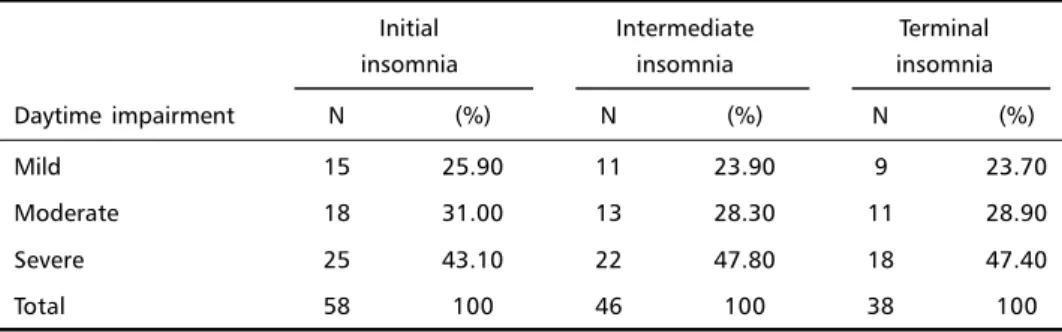
The general prevalence of insomnia was 19.1% (sd=2.0%; CI from 15.1% to 23.1%) in the city’s po-pulation, more in women (25.2%, chi-square=10.10, degree of freedom (DF)=1, p=0.0015) and people of less schooling years (28.6%, chi-square=10,58, DF=4, p=0.0317) (Tables 1, 2, 3). The most frequent was DSI (14.2%, chi-square=10.89, DF=2, p=0.0043). DSM (11.1%) was more frequent in men (84.6%, chi-square=10.60, DF=1, p=0.0011), ranging from 40 to 59 years old (81.3%, 40-49 years old and 75.0% 50-59 years old, chi-square=10.17, DF=5, p=0.075), in lower economic social status (77.1%, chi-squa-re=15.56, DF=3, p=0.0014); DEA (9.3%) affected mo-re the martially separated people and widows/wi-dowers (60% and 100%, chi-square=10.1, DF=3, p=0.0185). The distribution degree of uneasiness re-lated to DSI, DSM, and DEA was similar (chi-squa-re=2.58, DF=4. p=0.6315), as well as the degree of negative effects on activities the following day (chi-square=0.29, DF=4, p=0.9907).
In the three types of insomnia (DSI, DSM, DEA) the chronic mode was predominant (chi-square=0.71, DF=2, p=0.7022) and there were no significant cor-relation between the degree of negative effects on activities the following day and the social-demographic variables (chi-square=2.30, DF=2, p=0.3166).
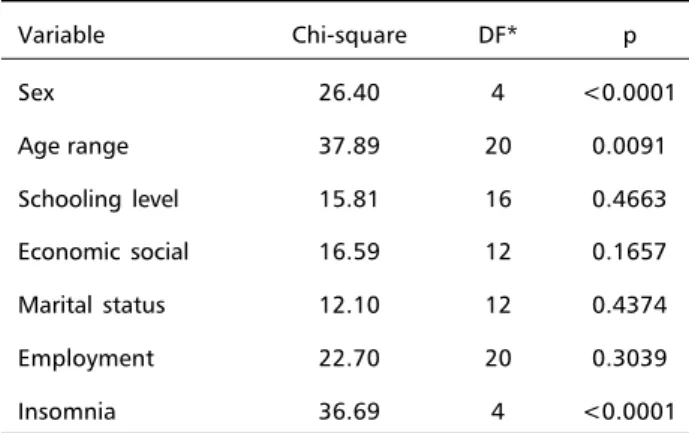
A total of 6.9% (sd=1.3%, CI between 4.3% and 8.5%) of the subjects used hypnotic drugs in the last month and 68.1 of these were over three times a week (Table 4). It was more frequent in insomniacs (15.4%, chi-square=29.8259, DF=3, p<0.0001), with no prevalence of any sub type (chi-square=2.95, p=0.2285 at DSI; chi-square=1.05, p=0.5909 at DSM; and chi-square=2.90, p=0.2342 at DEA). In all cases DF=2; not even in the acute or chronic sub types
Table 1. Frequency distribution and relative frequencies of insomnia in relation to the degree of next day impaiment.
Initial Intermediate Terminal
insomnia insomnia insomnia
Daytime impairment N (%) N (%) N (%)
Mild 15 25.90 11 23.90 9 23.70
Moderate 18 31.00 13 28.30 11 28.90
Severe 25 43.10 22 47.80 18 47.40
(p=0.2607 at DSI; p=0.3333 at DSM and p=1.000 at DEA). The major frequency was in women (chi-squa-re=8.47, DF=3, p=0.0372), and people over 30 years old (chi-square=24.74, FD=15, p=0.0536). Through their lives they have used hypnotic drugs 17.2% (sd=1.9%, CI between 13.4% and 21.0%) and 70.3% of these in the last 2 years, with the same predomi-nance of use in the last month. The other variables did not show any significant association with the time of use of the hypnotic drugs. 91.4% of the cases of hypnotic use were with a physician’s prescription, with
no significant predominance of any medical specialty (chi-square=8.20, DF=4, p=0.0844).
There was the use of alternative means to improve sleep in 36.8% of subjects (sd=2.4, IC between 32.0 and 41.6%), the most frequent being any type of beverage (53.3%) followed by a shower (31.3%). Sig-nificant association was shown between use of alter-native means to improve sleep and presence of in-somnia (chi-square=22.89, DF=1, p=0.0001).
DISCUSSION
The prevalence of insomnia in general population surveys varies from 12.0% to 76.3% depending on the type of criteria used3,5. It mostly affects women,
divorced people and widow/widowers, unemployed people, elderly people, and those of less schooling years and low economic social status1,5. Around 35%
of adult Americans have experienced insomnia in the course of a year. In the same survey, 7.1% had used hypnotic drugs (2.6% having been used under a phy-sician’s prescription and 4.5% without it)17. In a
re-trospective study in Texas, the authors concluded that there was excessive use of hypnotic sedative agents18.
The gender variable was evaluated according to long-term use and the dependence on psychotropic drugs, and it was found that men had a higher prevalence with or without a physician’s prescription.
Table 4. Chi-square values applied to the time of use of hypnotic drugs related to sex, age, schooling level, economic social status, marital status, employment, and the presence of insomnia.
Variable Chi-square DF* p
Sex 26.40 4 <0.0001
Age range 37.89 20 0.0091
Schooling level 15.81 16 0.4663 Economic social 16.59 12 0.1657
Marital status 12.10 12 0.4374
Employment 22.70 20 0.3039
Insomnia 36.69 4 <0.0001
*DF, degree of freedom.
Table 3. Frequency distribution and relative frequencies of chronic insomnia in relation to the use of hypnotic drugs.
Initial Intermediate Terminal
insomnia insomnia insomnia
Hypnotic drugs use N (%) N (%) N (%)
Never used 30 56.6 30 68.2 23 63.9
Use/used 23 43.4 14 31.8 13 36.1
Total 53 100 44 100 36 100
Table 2. Frequency distribution and relative frequencies of acute insomnia in relation to the use of hypnotic drugs.
Initial Intermediate Terminal
insomnia insomnia insomnia
Hypnotic drugs use N (%) N (%) N (%)
Never used 3 100 1 50.0
Use/used 1 100 1 50.0
In general, the results obtained with the adult population in Campo Grande, were not very different from other epidemiological national and world studies3,6,15,18. In this research, the prevalence of
in-somnia 19.1% was similar to other papers3,4,6,15,19.
The statistically significant associations occurred bet-ween insomnia and female sex and insomnia and low educational level. The prevalence of insomnia in general population epidemiological studies with questionnaire filled out in home interviews varied from 10% to 40%3,20. These studies showed that sleep
disorders are more common in elderly people3, those
with chronic medical diseases, and depressive and anxious disorders21. In a French study, the prevalence
of 17.7% insomniacs was detected in the general French population6. In a Japanese study with 3600
inhabitants, from 8 urban regions, the prevalence of insomnia was 11.2%; the authors correlated a higher risk of insomnia subjects who lived next to a road of intense traffic22. In a large North American
epidemiological general population survey (N=7954) on sleep disorders and psychiatric disturbance, 10.2% reported insomnia and 40% of these had a psychiatric disturbance2,23. In an epidemiological
study in the general population in Switzerland, with a stratified sampling of 600 adults, between 20 and 64 years of age, it was found that 20% had a disorder of insufficient sleep and 50% of these had also difficulties in sleeping19.
In the general population from Mannheim, Ger-many, the prevalence of 31%, three times a week for a period of one month24 was detected. The
sam-ple was sub divided in three groups: short term in-somnia (duration shorter than 1 year, N=60, 19%), medium term (duration from 1 to 5 years, N=110, 34%), and long-term duration (duration over 5 years, N=146, 46.2%). There were no significant diffe-rences in relation to age or sex24. In a study of inland
Brazil3 with an adult general population survey, an
insomnia prevalence 35.4% was found. About half of the complaints (48%) of the insomnia had dura-tion up to one year. There was a higher prevalence in women (47.0%) than in men (20.8%); which in-creased with age in women (from 35.4% 18 – 29 years old to 60.0% at 60 years old or over)3.
A comprehensive study on the prevalence of in-somnia in 12778 French subjects of 18 years old or over was done using a questionnaire sent by mail8.
The DSM-IV25 criteria were used for the definition of
insomnia and it had reached a prevalence of 29% in the frequency of three times a week, in one month, with daytime consequences. Severe insomnia
occur-red to 12% of women and 6.3% of men. There was no significant increase with age after 35 years old, but there was an increase between 25-34 years of age, independently of sex, while chronic insomnia had a significant increase with age in both sexes. Single people had the least index of insomnia, with being it more frequent in young women8.
In an epidemiological home interview based ge-neral population survey on the annual prevalence of insomnia in 2418 subjects in Singapore with age between 15 and 60 years an index was detected of 15.3%, comprised of 12.9% men and 17.5% wo-men25. There was no significant difference between
insomniac and non-insomniac groups related to the educational level. However, 26.8% of married women were insomniacs26. An epidemiological study on
insomnia was done with the French population using 5622 subjects of 15 years of age or older with tele-phone interviews. From the sampling, 20.1% were unsatisfied with their sleep, the majority being wo-men over 65 years old, separated, divorced or wido-wed and immigrants4. There was a wide comparative
study of insomnia prevalence in the general popula-tion from Portugal and Spain9. The study was done
with 1858 Portuguese people of 18 years of age or older, and 4065 Spanish people of 15 years of age or older, through a phone survey. Insomnia prevalence was 12.2% in general population, 15.8% being in Portugal and 10.6% in Spain, increasing with age. The prevalence of any diagnosis of insomnia of DSM-IV was greater in Portugal (8.7%) than in Spain (6.0%)9.
In Campo Grande, DSI was the most frequent with a significant association only with female sex. DSM was more frequent in men, and mostly in the age range of 40 and 59 years and in people of low eco-nomic social status, especially in the last one. DEA affected mainly separated or widowed people, the single ones being most infrequent. For the degree of subjective uneasiness, there was some similarity in the three sub types DSI, DSM, and DEA. It was different in another city of Brazil with a higher pre-valence of intermediary insomnia, followed by ini-tial and terminal insomnia (27.3%, 18.3%, and 14.3% respectively)3. More DSM (10.4%) was found in
Por-tugal than in Spain (6.8%)9. Also in a study of the
Japanese26 population with 3030 interviewed
peo-ple. There was no significant difference between the prevalence of DSI in young people (8.3%), middle-aged people4,10, and aged people (9.7%)
(chi-square=4.58, p<0.1)26. The higher prevalence of
in-somnia among Japanese women was related to DSI27.
Other researchers point out more DSM and DEA in the female sex4,28.
There was a predominant evolution to a chronic condition in Campo Grande’s population in all types of insomnia – initial, intermediary, and terminal. There was no significant difference in DSI, DSM, and DEA with a degree of negative effects on activities the next day. None of the independent variables sho-wed significant association with this phenomenon.
As to the use of hypnotic drugs, in the month prior to the interview of this study, there was a gene-ral prevalence of 6.9% , 68.1% of them being over 3 times a week. They were mostly insomniac women and people over the age of 30 (no significant diffe-rence in DSI, DSM, and DEA either chronic or acute). The fewest users were from the highest economic social status, and there was no significant association between the use and educational level, marital status, and occupation. Through the life span there was a prevalence of 17.2% of use, mostly in the last 2 years (70.3%), also more frequent in insomniac, women and people over 30 years old (no differences in DSI, DSM, and DEA either chronic or acute). There was no significant association between the total time of use of hypnotic drugs and other social-demogra-phic variables. In 91.4% of cases, there was a physi-cian’s prescription for the hypnotic drugs, with no significant predominance among the various medical specialties. In a French general population study5,
23.9% severe insomniacs used hypnotic drugs habi-tually with a physician’s prescription. Over half of those used them on a daily basis for 1 to 5 years or more. In Brazil7 the use of benzodiazepines (BDZ) as
daytime sedative or nighttime hypnotic, in 455 adults of 18 years old or more was estimated. The results of the BDZ use in life, for the last year and for the last month were 46.7%, 21.2%, and 13.1% respec-tively. Among women and widowers or separated people, the prevalence of BDZ use was significantly higher. In Switzerland29, 7% of use of hypnotic drugs
was found without a medical prescription in groups of chronic insomniac people with ages from 20 to 21 years old and 12% in the group from 27 to 28 years of age. A Brazilian general population survey3
detected 14.6% of hypnotic drug use in the last month, twice as much as in this paper. In Mexico30 it
was found that women used more hypnotic drugs
than men. In Singapore 26 it was found that 14% of
the studied sampling used more hypnotic drugs occa-sionally, and from the users, only 5% had them on a daily basis. Of the insomniac people in Singapore, 86% did not use hypnotic drugs; though in this study in Campo Grande, such index being 77.7%. In France4, it
was found that the use of hypnotic drugs during the life time in the 5622 subjects, of ages of 15 or over, was of 16%, being mostly women over 65 years old, and were immigrants, separated, widowed or divorced.
In Campo Grande, 36.8% of people sought alter-native means to get to improve sleep, almost the same result (31.1%) as in inland Brazil3. Most users
of alternative means were insomniac and 53.3% used some king of beverage, and 31.3% used to shower. In the present paper there was no significant correla-tion between age and the use of alternative means to improve sleep.
In conclusion, a better understanding of Brazilian prevalence of insomnia and hypnotic drugs use may help to identify patients with this important public health problem.
REFERENCES
1. Walsh J, Ustun B. Prevalence and health consequences of insomnia. Sleep 1999;22(Suppl 3):S427-S36.
2. Ohayon MM. Prevalence of DSM-IV diagnostic criteria of insomnia: distinguishing insomnia related to mental disorders from sleep disorders. J Psychiatr Res 1997;31:333-346.
3. Rocha F. Um estudo com base populacional de hábitos de sono, prevalência e fatores associados a insônia. Tese de Doutorado, Universidade de Brasília. Brasília, 2000.
4. Ohayon M. Epidemiological study on insomnia in the general population. Sleep 1996;19(Suppl 3):S57-S65.
5. Ohayon M, Claudet M, Guilleminault C. How a general population perceives its sleep and how this relates to complaint of insomnia. Sleep 1995;20:715-723.
6. Ohayon M, Claudet M, Lemoine P. Comorbidity of mental and insomnia disorders in thegeneral population. Compr Psychiatr 1998;39:185-197.
7. Wortmann MC, Grudtner M, Fialho AF, et al. Consumo de benzo-diazepínicos em Porto Alegre. Rev Assoc Med Bras 1994;40:265-270. 8. Leger D, Guilleminault C, Dreyfus JP, Delahaye C, Paillard M.
Prevalence of insomnia in a survey of 12778 adults in France. J Sleep Res 2000;9:35-42.
9. Ohayon M, Paiva T, Segales T. Comparison of insomnia prevalence in the general population of Portugal and Spain. Sleep 2001;24:A345. (Abstract). 10. Reimão R. Padrões e distúrbios do sono em adultos da comunidade negra rural e isoladade Furnas do Dionísio, MS. Tese de Livre-Docência, Faculdade de Medicina da Universidade de São Paulo. São Paulo. 2000. 11. Zammit GK, Weiner J, Damato N, Sillup GP, McMillan CA. Quality of
life in people with insomnia. Sleep 1999;22(Suppl 2):S379-S85. 12. Souza JCRP. Quality of life and insomnia in University Psychology
students. Human Psychopharmacol 1996;11:169-184.
13. Fundação Instituto Brasileiro de Geografia e Estatística (IBGE). Contagem populacional 1996. Rio de Janeiro: IBGE, 1996.
14. Associação Brasileira dos Institutos de Pesquisa de Mercado (ABIPEME). As características socioeconômicas da população brasileira. São Paulo: ABIPEME, 2000.
15. Giglio SB. Estudo da ocorrência de sonolência excessiva diurna e das relativas àsparassônias na população adulta da cidade de São Paulo. Tese de Doutorado, Escola Paulista de Medicina. São Paulo, 1988. 16. American Sleep Disorders Association. International classification of
17. Nishino S, Mignot E. Drug treatment of patients with insomnia and excessive daytime sleepiness: pharmacological considerations. Clin Pharmacokinet 1999;37:305-330.
18. Ohayon M, Caulet M, Priest RG, Guilleminault C. DSM-IV and ICSD-9 insom-niasymptoms and sleep dissatisfaction. Br J Psychiatry 1997;171:382-388. 19. Boman JE, Lundh LG, Hetta J. Insufficient sleep in the general
population.Neurophysiol Clin 1996;26:30-39.
20. Simon GE, Vonkorff M. Prevalence, burden, and the treatment of insomnia in primarycare. Am J Psychiatry 1997;154:1417-1423. 21. Ulstun T, Privett M, Lecrubier Y. Form, frequency, and burden of sleep
problems in general health care. Eur J Psychiatry 1996;11(Suppl 1):S5-S10. 22. Kageyama T, Kabuto M, Kurokawa Y, et al. A population study on risk factors for insomnia among adult Japanese women: a possible effect of road traffic volume. Sleep1997;20:963-971.
23. Buysse DJ, Reynolds CF, Hauri PJ, et al. Diagnostic concordance for DSM-IV sleep disorders: a report from the APA/NIMH DSM-IV field trial. Am J Psychiatry 1994;15:1351-1360.
24. Hohagen F, Kappler C, Schramm E, Riemann D, Weyerer S, Berger M.
Sleep onset insomnia, sleep maintaining insomnia and insomnia with early morning awakening: temporal stability of subtypes in a longitudinal study on general practice attenders. Sleep 1994;17:551-554. 25. American Psychiatric Association. Diagnostic and statistic manual of mental disorders.4.Ed. Washington, D. C.:American Psychiatric Association, 1993.
26. Yeo BKL, Pereira IS, Kok LP, Tsoi WF. Insomnia in the community. Singapore Med J 1996;37:282-284.
27. Kim K, Uchiyama M, Okawa M, Liu X, Ogihara K. An epidemiological study of insomnia among the Japanese general population. Sleep 2000;23:41-47. 28. Coren S. The prevalence of self-reported sleep disturbance in young
adults. Int J Neurosci 1994;79:67-73.
29. Chevalier H, Los F, Boichut D, et al. Evaluation of severe insomnia in the generalpopulation: results of a multinational survey. J Psycho-pharmacol 1999;13(Suppl 1):S21-S24.