Brief Communication
Audiol Commun Res. 2015;20(1):84-7 84
http://dx.doi.org/10.1590/S2317-64312015000100001465
Correlation between voice symptoms and
auditory-perceptual evaluation of voice in dysphonic individuals
Correlação entre sintomas e avaliação perceptivo-auditiva da voz
em indivíduos disfônicos
Dhayane Klodsinki1, Congeta Bruniere Xavier Fadel1, Francine Marson Costa2, Rosane Sampaio Santos1,
Marcelo de Oliveira Rosa3, Ana Paula Dassie-Leite2
ABSTRACT
Purpose: To determine the correlation between voice symptoms and auditory-perceptual evaluation of voice in dysphonic patients. Methods:
We analyzedmedicals records of 30 dysphonic patients with mean age 51.8±15.5 years, 22 of whom were woman and eight were man. The information collected included the results of the Voice Symptoms Scale (VoiSS) in the Limitation, Emotional and Physical domains and the total score and results of the auditory-perceptual evaluation according to the CAPE-V protocol. Both were evaluated by a speech pathologist on the first appointment. The data were statistically analyzed. Results: There were significant positive correlations between “VoiSS total score” and “overall severity of vocal deviance” and “VoiSS Limitation” and “overall severity of vocal deviance”. VoiSS Limitation and Total Scores showed correlation with roughness. In contrast, there was no correlation of bre-athiness and strain with voice symptoms. Conclusion: There is no direct correlation between voice symptoms and auditory-perceptual characte-ristics of voice.However, symptoms related to functionality, voice and communication limitations seem to have a greater correlation with cli-nical evaluation, specifically with the overall severity of voice deviance.
Keywords: Voice; Voice disorders; Dysphonia; Self-assessment; Voice quality
RESUMO
Objetivo: Correlacionar os sintomas vocais e os dados da avaliação perceptivo-auditiva da voz de indivíduos disfônicos. Métodos: Foram analisados os prontuários de 30 indivíduos com queixas vocais, aten-didos em um serviço de Fonoaudiologia, sendo 22 mulheres e oito homens, com média de idade de 51,8 anos (±15,5). Foram coletadas as seguintes informações: resultados da Escala de Sintomas Vocais (ESV) dos domínios Limitação, Emocional, Físico e Total; resultados da avaliação perceptivo-auditiva por meio do protocolo CAPE-V (grau geral do desvio vocal, rugosidade, soprosidade, tensão, pitch, loudness
e ressonância). Ambos os procedimentos foram realizados pela fonoau-dióloga responsável, na primeira consulta do paciente. Os dados foram analisados estatisticamente. Resultados: Houve correlações positivas consideradas boas apenas para os cruzamentos entre as variáveis “Esco-res totais da ESV” x “Grau geral do desvio vocal” e “Esco“Esco-res Limitação da ESV” x “Grau geral do desvio vocal”. Os escores dos domínios Limitação e Total da ESV tiveram correlação regular com o parâmetro rugosidade. Os demais parâmetros perceptivo-auditivos, de forma isola-da, principalmente soprosidade de tensão, não se correlacionaram com os sintomas vocais. Conclusão: A relação entre os sintomas vocais e as características perceptivo-auditivas da voz não é direta. No entanto, os sintomas relacionados à funcionalidade, ou seja, às limitações vocais e de comunicação, parecem ter maior correlação com a avaliação clínica, especificamente com o parâmetro “grau geral do desvio vocal”.
Descritores: Voz; Distúrbios da voz; Disfonia; Autoavaliação; Qualidade da voz
Study conducted at the Specialization Course on Voice, Universidade Tuiuti do Paraná – UTP – Irati (PR), Brazil. (1) Specialization Course on Voice, Universidade Tuiuti do Paraná – UTP – Irati (PR), Brazil.
(2) Department of Speech and Hearing, Universidade Estadual do Centro-Oeste – UNICENTRO – Irati (PR), Brazil. (3) Department of Electrical Engineering, Universidade Tecnológica Federal do Paraná – UTFPR – Curitiba (PR), Brazil.
Conflict of interests: No
Authors’ contribution: All authors participated in the study’s conception. DK, CBXF and FMC collected the data. RSS, MOR and APDL analyzed and interpreted the results. All authors wrote and revised the article.
Correspondence address: Dhayane Klodzinski. R. Manoel Eufrasio, 634/603, Curitiba (PR), Brazil, CEP: 80540-010. E-mail: [email protected]
Self-assessment and auditory-perceptual evaluation
Audiol Commun Res. 2015;20(1):84-7 85
INTRODUCTION
Voice self-assessment has become a widely used tool in speech therapy practice for evaluation and monitoring of dysphonic patients(1-5). Self-assessment is generally
conduc-ted with international protocols translaconduc-ted to and validaconduc-ted in Portuguese. During development, these protocols undergo a rigorous process of evaluation and are therefore sensitive and reliable for their purpose(2).
The Voice Symptom Scale (VoiSS) is the first protocol validated in Portuguese to assess voice symptoms reported by the patient, and the impact of dysphonia on the patient’s life(6).
Since the VoiSS was validated in Brazil in 2011, studies that use this instrument have only been published recently(7,8). With the
VoiSS protocol, the clinician can identify the exact complaints of the patient in an objective and standardized way. The VoiSS comprises 30 questions about symptoms related to voice limita-tion (Limitalimita-tion Domain), physical aspects related to dysphonia (Physical Domain) and psychological and emotional impact from a possible voice problem (Emotional Domain). With this instrument, it is also possible to calculate a general score that combines the three domains mentioned above.
As important as the patient’s self-assessment is the clinical evaluation of the voice. Regarding auditory-perceptual infor-mation, the CAPE-V protocol has been widely used in clinical practice and in voice studies(9,10) because it analyzes aspects
re-lated to glottal (like the GRBASI) and filter sources, in addition to involving several voice parameters. With this instrument, the sustained and running speech attribute are analyzed together and additional parameters may be marked, if the clinician deems it necessary. Each of the parameters is marked on a 100-mm visual analog scale (VAS) in which proximity to the maximum score reflects greater voice deviance(10).
Even though several studies have already associated the voice self-assessment with the clinical evaluation of the voice, these studies are mostly based on instruments which have been validated much earlier, such as the VRQOL, VHI and VAPP (11-13). In contrast, studies using the VoiSS are still scarce. In
addi-tion, we found no studies correlating the self-assessment with the auditory-perceptual analysis using the CAPE-V.
Given the above, the aim of this study was to correlate voice symptoms and auditory-perceptual findings in dysphonic individuals.
METHODS
This was an observational, analytic, cross-sectional and ret-rospective study approved by the Ethics Committee in Research of the Hospital de Clínicas (HC) at Universidade Federal do Paraná (UFPR) under the number 575.722. We reviewed 30 medical charts of all individuals referred to the speech and hearing therapy service associated with the Per Oral Endoscopy Service at HC/UFPR between the months of May and August
2013. The charts were associated with individuals with voice complaints, 22 of whom were women and eight were men, with an average age of 51.8 (±15.5) years, low socioeconomic status, literate, with several laryngeal pathologies and varying degrees of voice impairment.
We collected the following information from the medical charts:
- VoiSS scores obtained by the individual (Limitation, Physical, Emotional and Total domains). Maximum scores are 60 points in the Limitation domain, 32 points in the Physical domain and 28 points in the Emotional domain. The maximum total score assessed by VoiSS is 120 points, and the higher the score presented by the individual, the greater are the voice-related symptoms.
- VAS values obtained with the CAPE-V protocol for each of the predetermined parameters in the instrument (overall severity of voice deviance, roughness, breathiness, strain, pitch, loudness and resonance). The protocol had check marks logged by the appraiser ranging from 0 to 100 mm, with marks closest to 100 reflecting greater voice deviance. Since all variables in this study are continuous, we used the Pearson’s correlation test for statistical analysis. This test analyzes if an increase in one of the variables follows an increase (positive correlation) or decrease (negative cor-relation) in another variable. For both positive and negative correlations, we considered correlations with coefficients of 1.0 as perfectly linear, between 0.80 and 0.99 as strong, 0.60 to 0.79 as moderate, 0.40 to 0.59 as weak and less than 0.40 as negligible.
RESULTS
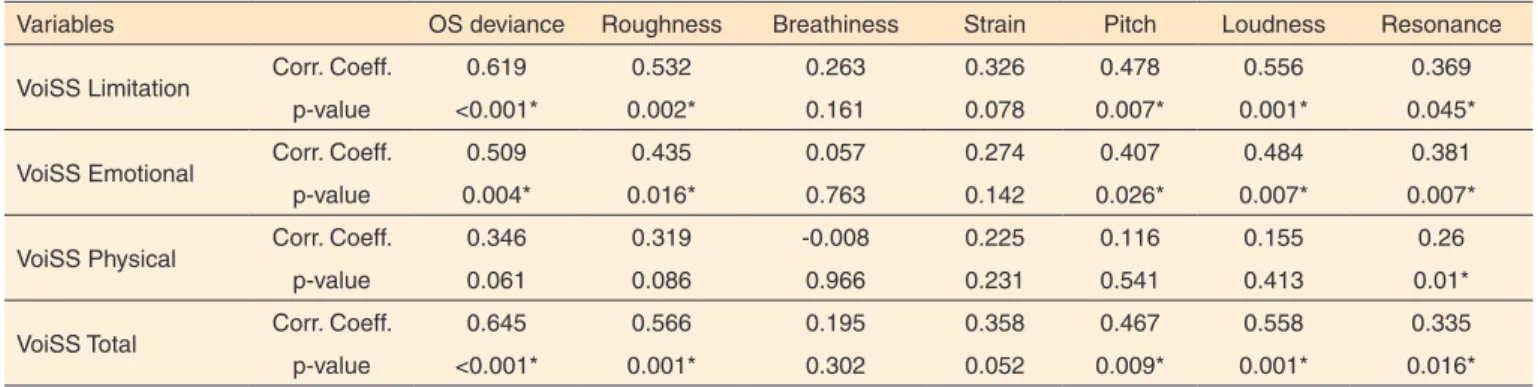
Correlation coefficients were obtained following analysis of the scores obtained with the VoiSS and the results of the auditory-perceptual evaluation by the CAPE-V. We only obser-ved good positive correlations for those analyses between the average VoiSS scores of the domain Limitation versus overall severity of voice deviance (correlation coefficient = 0.619) and average scores of the VoiSS total domain versus overall severity of voice deviance (correlation coefficient 0.645). The parameters breathiness and strain showed the worse correlations with the VoiSS scores (all were considered negligible) (Table 1).
DISCUSSION
Both the auditory-perceptual evaluation and the voice self-assessment currently have similar importance in voice clinics, since the analysis of both in combination allows the clinician to make good judgments regarding the patient’s therapy and prognosis(6). The identification of possible associations between
Klodsinki D, Fadel CBX, Costa FM, Santos RS, Rosa MO, Dassie-Leite AP
Audiol Commun Res. 2015;20(1):84-7 86
Good positive correlations were seen between two VoiSS domains (Limitation and Total) with the overall degree of dysphonia, which corresponds to a combination of other evaluated auditory-perceptual parameters. The domain con-cerning Limitation includes symptoms related to functional-ity, namely, voice and communication restrictions caused by dysphonia. This domain assesses symptoms such as hoarse-ness, voice loss, low/weak voice, voice failure and tiredness while talking(8). For this reason, we had expected it to show
a stronger correlation with parameters evaluated individu-ally (roughness, breathiness, loudness, etc.), which was not the case. However, the good correlation observed with the overall degree of dysphonia indicates that this is the domain that most associates with the auditory-perceptual assessment conducted by the clinician.
The results obtained here confirm recent international studies that aimed at correlating voice self-assessment with the instrument VHI and clinical evaluation of the voice(14). The
authors concluded that although there are some significant cor-relations between self-assessment and acoustic parameters, the information obtained by the self-assessment is different than that obtained by the auditory-perceptual evaluation.
In this study, the other VoiSS domains which evaluate emo-tional and physical limitations failed to show a good correlation with any of the auditory-perceptual parameters. The symptoms related to the emotional impact of the voice disorder depend on several socio-demographic and occupational factors and therefore, may not have a direct association with evaluations conducted by the clinician(3,14). In contrast, physical symptoms
in general (sore throat, feeling of swollen nodules in the neck, cough / throat clearing, among others) contemplate organic elements and have no direct association with voice production and, for this reason, were not expected to correlate directly with the auditory-perceptual evaluation.
It caught our attention that the auditory-perceptual param-eters breathiness and tension had a virtually negligible corre-lation with all VoiSS scores, even those related to the domain Limitation, which has a greater association with the clinical evaluation. We believe that other voice characteristics may have
overlapped with these parameters in the auditory-perceptual evaluation, since in cases of dysphonia the voice is commonly considered as being predominantly roughened, for example. In this sense, there may be a greater impact on the self-assessment of the individual (who in general is unable to identify exactly the type of hearing change that he or she observes in his or her own voice) than on the evaluation of the specialist (who evaluates each feature individually).
The parameters roughness, pitch and loudnesshad regular correlation with voice symptoms, probably because these characteristics are more easily observed / perceived by lay individuals. A new study with a greater number of subjects will allow a better inference about the correlation between these three parameters and VoiSS results. Under current conditions, we could be facing a statistical type II error, accepting the null hypothesis (H0 - that in this study would be the absence of
correlation between the variables), when in fact it is false and could be proven by sample modifications or other decisions made regarding methodological aspects.
CONCLUSION
The association between voice symptoms and the auditory--perceptual characteristics of the voice is not straightforward. However, the symptoms related to functionality, namely voice and communication limitations, appear to have a greater correlation with the clinical evaluation, specifically with the parameter overall severity of voice deviance.
REFERENCES
1. Putnoki D, Hara F, Oliveira G, Behlau M. Qualidade de vida e voz: o impacto de uma disfonia de acordo com sexo, idade e uso profissional. Rev Soc Bras Fonoaudiol. 2010;15(4):485-90. http:// dx.doi.org/10.1590/S1516-80342010000400003
2. Moreti F, Zambon F, Oliveira G, Behlau M. Equivalência cultural da versão brasileira da Voice symptom Scale: VoiSS. J Soc Bras Fonoaudiol. 2011;23(4):398-400. http://dx.doi.org/10.1590/S2179-64912011000400018
Table 1. Correlation between the scores obtained with the VoiSS and auditory-perceptual evaluation with the CAPE-V scale
Variables OS deviance Roughness Breathiness Strain Pitch Loudness Resonance
VoiSS Limitation Corr. Coeff. 0.619 0.532 0.263 0.326 0.478 0.556 0.369
p-value <0.001* 0.002* 0.161 0.078 0.007* 0.001* 0.045*
VoiSS Emotional Corr. Coeff. 0.509 0.435 0.057 0.274 0.407 0.484 0.381
p-value 0.004* 0.016* 0.763 0.142 0.026* 0.007* 0.007*
VoiSS Physical Corr. Coeff. 0.346 0.319 -0.008 0.225 0.116 0.155 0.26
p-value 0.061 0.086 0.966 0.231 0.541 0.413 0.01*
VoiSS Total Corr. Coeff. 0.645 0.566 0.195 0.358 0.467 0.558 0.335
p-value <0.001* 0.001* 0.302 0.052 0.009* 0.001* 0.016*
*Significant values (p<0.05) – Pearson’s correlation test
Self-assessment and auditory-perceptual evaluation
Audiol Commun Res. 2015;20(1):84-7 87
3. Ugolino AC, Oliveira G, Behlau M. Disfonia na percepção do clínico e do paciente. J Soc Bras Fonoaudiol. 2012;24(2):113-8. http:// dx.doi.org/10.1590/S2179-64912012000200004
4. Tutya AS, Zambon F, Oliveira G, Behlau M. Comparação dos escores dos protocolos QVV, IDV e PPAV em professores. Rev Soc Bras Fonoaudiol. 2011;16(3):273-81. http://dx.doi.org/10.1590/ S1516-80342011000300007
5. Morais EPG, Azevedo RR, Chiari BM. Correlação entre voz, autoavaliação vocal e qualidade de vida e voz de professoras. Rev CEFAC. 2012;14(5):892-900. http://dx.doi.org/10.1590/S1516-18462012005000032
6. Deary IJ, Wilson JA, Carding PN, MacKenzie K. VoiSS: a patient-derived Voice Symptom Scale. J Psychosom Res. 2003;54(5):483-9. http://dx.doi.org/10.1016/S0022-3999(02)00469-5
7. Moreti FTG. Validação da versão brasileira da Voice Symptom Scale – VoiSS [dissertação]. São Paulo: Universidade Federal de São Paulo; 2011.
8. Pernambuco LA, Costa EBM, Zimmermann TS, Silva ACS, Silva BC. Autoavaliação vocal, avaliação perceptivo-auditiva da voz e qualidade de vida em pacientes com suspeita de câncer tireoidiano: existe correlação? Rev Bras Cir Cabeça Pescoço. 2013;42(1):8-12.
9. Menezes MHM. Análise perceptivo-auditiva e acústica da voz relacionada ao tempo de execução do exercício de vibração sonorizada de língua em mulheres com nódulos vocais [tese]. São Paulo: Universidade de São Paulo, Faculdade de Medicina; 2010. 10. Consensus auditory-perceptual evaluation of voice (CAPE-V),
ASHA 2003. Rev Soc Bras Fonoaudiol. 2004;9(3):187-9.
11. Gasparini G, Behlau M. Quality of life: validation of the Brazilian version of the Voice-Related Quality of Life (V-RQOL) measure. J Voice. 2009;23(1):76-81. http://dx.doi.org/10.1016/j. jvoice.2007.04.005
12. Behlau M, Santos LMA, Oliveira G. Cross-cultural adaptation and validation of the voice handicap index into Brazilian Portuguese. J Voice. 2009;25(3):354-9. http://dx.doi.org/10.1016/j. jvoice.2009.09.007
13. Behlau M, Oliveira G, Santos LMA, Ricarte A. Validação no Brasil de protocolos de auto-avaliação do impacto de uma disfonia. Pró Fono. 2009;21(4):326-32. http://dx.doi.org/10.1590/S0104-56872009000400011