Article
0103 - 5053 $6.00+0.00*e-mail: [email protected]
Selective Cloud Point Extraction and Preconcentration of Trace Amounts of
Cadmium Prior to Flame Atomic Absorption Spectrometric Determination
Shayesteh Dadfarnia,* Ali Mohammad Haji Shabani and Ellahe Kamranzadeh
Department of Chemistry, Yazd University, Safaieh, 89195, Yazd, Iran
A extração por ponto nuvem (CPE) é proposta como um procedimento de separação e pré-concentração para a determinação de cádmio em amostras de água por espectrometria de absorção atômica com chama associada a sistema de injeção em luxo (FI-FAAS). O íon cádmio em solução aquosa foi convertido a [CdI4]
2− e sua carga foi neutralizada pela formação do par iônico com o
cátion metiltrioctilamônio na presença de TritonX-114 como surfactante não iônico. A separação de fases foi obtida pelo aquecimento da mistura a 80 °C por 10 min. A fase rica em surfactante foi diluída com 300 µL de etanol e 100 µL foram analisados por FI-FAAS. Os parâmetros que inluenciam a formação do par iônico e extração foram otimizados. Sob condições ótimas, a pré-concentração de 35 mL de amostra na presença de 0,04% (v/v)de Triton X-114 possibilitou um limite de detecção de 0,3 µg L-1 de Cd(II). A curva analítica de calibração foi linear até 250 µg L-1 de cádmio e o desvio padrão relativo foi inferior a 4% para uma solução contendo 100 µg L-1 de Cd. O procedimento gerou recuperações no intervalo de 95-102%. O procedimento foi aplicado com sucesso para a determinação de cádmio em água de torneira, água de mar e em material de referência certiicado de concentrado de cobre.
Cloud point extraction (CPE) is proposed as a separation and preconcentration procedure for determination of cadmium in water samples by low injection lame atomic absorption spectrometry (FI-FAAS). The cadmium ion in aqueous solution was converted to [CdI4]
2− and its charge was
neutralized through ion-pair formation with methyltrioctylammonium cation in the presence of Triton X-114 as a non ionic surfactant. Phase separation was achieved by heating the mixture to 80 °C for 10 min. The surfactant-rich phase was diluted with 300 µL of ethanol and 100 µL of it was analysed by FI-FAAS. The parameters affecting the ion-pair formation and extraction steps were optimized. Under optimum condition, preconcentration of 35 mL of sample in the presence of 0.04% (v/v)of Triton X- 114 led to a detection limit of 0.3 µg L-1 of Cd(II). Analytical calibration curve was linear up to 250 µg L-1 of cadmium and relative standard deviation was lower than 4% at 100 µg L-1 level. The procedure affords recoveries in the range of 95-102%. The procedure was successfully applied to the determination of Cd in tap water, sea water and certiiedreference copper concentrate.
Keywords: cloud point preconcentration, cadmium ion determination, FI-FAAS, Trion X-114,
water samples, ore
Introduction
Cadmium is highly toxic even at very low concentrations causing damages to organs such as kidneys, liver and lungs.1
The exposure is obviously dependent upon the emission of the element and might be particularly serious in some factories; 50% of inhaled cadmium for example, is absorbed and most of it is concentrated in the liver and kidney.2 The
deposition of cadmium which occurred during the 20th
century, leds to continuous increase of its concentration in
terrestrial and aquatic ecosystems, hence exposing human and wildlife to critical levels of this element. For humans, the main source of cadmium is water and food. Therefore, sensitive, reproducible and accurate analytical methods are required for the determination of trace amount of cadmium in such samples.
Graphite furnace atomic absorption spectrometry (GFAAS) and inductively coupled plasma mass spectrometry (ICP-MS) are the most sensitive techniques for the determination of trace level of metals.3,4 However, lame
of the instrumentation, the simplicity of procedures and the speed, precision and accuracy of the techniques . But, its limitation is low detectability, which may be improved by a preconcentration step.5-9 Several methods for the
separation and preconcentration of metals have been developed, enhancing the sensitivity and the versatility of the instrumental analytical techniques.
In the last decade, cloud point extraction (CPE) has attracted considerable attention mainly because it complies with the Green Chemistry principle.7,10-12
as the amount of organic solvent is lower than the conventional solvent extraction and the surfactant can be incinerated in the presence of waste acetone or ethanol. Since the irst application of this technique for metal extraction,12 numerous paper has reported the use of CPE
as preconcentration procedure for metal determination by several spectrometric techniques.10-20 The principle,
advantages and limitation of this technique, have been summarized in several reviews.10,11
Several ligands such as 1-(2-thiazolylazo)-2-naphtol (TAN),21-23 O,O-dietyldithiophosphate (DDTP)23,24 and
dithizone25 have been used in CPE and FAAS determination
of cadmium. In this study, the possibility of extraction of cadmium as ion-pair by CPE was considered. Cadmium in aqueous samples was converted to [CdI4]2- and was
extracted as ion pair with methyltrioctylammonium cation into surfactant rich phase and was determined by FI-FAAS. The optimized procedure was applied to water samples and copper lotation standard reference material.
Experimental
Instrumentation
A Buck scientiic atomic absorption spectrometer (Model 210 VGP, USA) was utilized, equipped with a deuterium background correction and an air-acetylene flame. A cadmium hollow-cathode lamp was used as radiation source, operated at 8.2 mA with a monochromator spectral resolution of 0.7 nm. For the cadmium detection, the wavelength was set at 228.8 nm resonance line. The single line low injection system consisting of peristaltic pump (Ismatec, MS-REGLO/8-100, Switzerland), and rotary injection valve (Rheodyne, CA, USA) with a loop of 100 µL capacity was used for effective control of the amount of sample and reproducibility of the measurement. The absorbance time response was monitored on x-t chart recorder (L-250) and quantitative analysis was based on measurement of the peak height of transient signals. The pH values were measured with a Metrohm pH-water (Model 691, Switzerland) supplied with a glass-combined electrode.
Reagents and solutions
The cadmium stock solution (1000 mg L-1) was prepared
by dissolving appropriate amount of Cd (NO3)2 (Merck, Darmstadt, Germany) in 1% (v/v) nitric acid solution. The working standard solutions were prepared by serial dilutions of the stock solution prior to analysis. All solutions were stored in pre-cleaned polypropylene (Nalgene, Lima, OH, USA) containers. Methyltrioctylammonium chloride was obtained from Merck and the solution of methyltrioctylammonium (0.2 mol L-1) was prepared by dissolving proper amount of it
in ethanol. Triton X-114 solution (2% v/v) was prepared by proper dilution of the commercially available product with water. All other chemicals were of highest purity available from Merck and were used as received and deionized water was used throughout the experiments. The tap water, well water and sea water samples were collected in PTFE containers, stored in a dark place at 4 °C, and were analyzed within 24 h of collection. The seawater was iltered through a membrane ilter (25 mm in diameter, porosity 0.45 µm, Dura pore TM, Millipore) prior to analysis. The reference ore sample was prepared by adding 5 mL of concentrated nitric acid to 0.105 g of reference ore material (CCU-1b) and heating the sample on a water bath for few minutes. The sample was then iltered through a Millipore ilter, 10 mL of 0.2 mol L-1 glycine was added, and the pH was adjusted and
was treated according to the given procedure.
Procedure
For CPE, 35 mL of sample or standard solution of cadmium was made 0.1 mol L-1 with respect to I− and its pH was adjusted to ca. 1.5 with hydrochloric acid. Then, 1.75 mL of methyltrioctylammonium chloride in ethanol (0.2 mol L-1)
and 0.70 mL Triton X- 114 (2%, v/v) were added to this solution. The mixture was heated in a thermostated water bath at 80 °C for 10 min. The solution becomes cloudy at this stage. To separate the phases the mixture was centrifuged for 10 min at 3500 rpm. Afterwards, the solution was cooled in ice-bath for 10 min, and the micellar phase was separated by simply inverting the tube to discard the aqueous phase. Finally, in order to reduce the viscosity and facilitate sample handling, the micellar phase was diluted to 0.5 mL with ethanol and 100 μL of the resultant solution was introduced into the FAAS for quantiication by using a single line FI system (Figure 1).
Results and Discussion
to be extracted into the small volume of surfactant-rich phase, thus obtaining the desired preconcentration.18 Cadmium
easily form negatively charged complex with iodide26
([CdI4]2− log β
4 = 5.35) which is hydrophilic; however, it
forms a lipophilic ion pair with methyltrioctylammonium chloride [MTOA] which is extractable into organic liquid such as 1-undecanol.27 In the preliminary study it was
established that ion pair of [CdI4]2− with MTOA can also be extracted into the surfactant rich media. The process can be summarized as:
[CdI4]2−
(aq) + 2CH3(n-C8H17)3N +
(aq)→
[CdI42−][2CH
3(n-C8H17)3N +]
2 (srp)
“srp” and “aq” represent the “surfactant rich phase” and “aqueous phase” respectively. Then, the parameters affecting the adduct formation and the extraction conditions such as concentration of iodide, pH, surfactant and MTOA concentration, temperature and incubation time were optimized using a univariate approach.
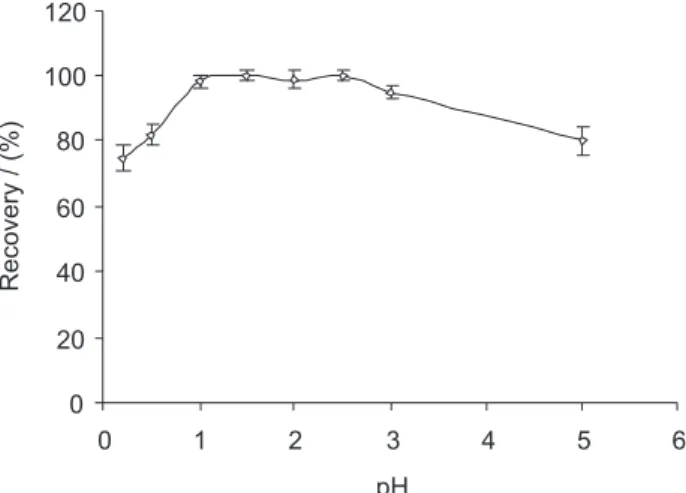
The pH plays a unique role on the metal-adduct formation and subsequent separation by CPE. So, the effect of pH on the CPE extraction of cadmium was studied in the pH range of 0.25-5 using hydrochloric acid or ammonium hydroxide. The results illustrated in Figure 2 shows that the recovery is nearly constant in the pH range of 1-2.5. Owing to this behavior the pH value of 1.5 was selected as the working value.
The effect of concentration of iodide on conversion of cadmium to [CdI4]2− and its recovery from aqueous phase was studied by extracting 5 µg of cadmium from 35 mL of a solution (pH ca. 1.5) containing MTOA (0.1mol L-1) and
Triton X-114 (0.04% v/v) plus various amount of potassium iodide. The results, presented in Figure 3, revealed that the recovery of cadmium was increased with an increase in iodide concentration up to 0.1 mol L-1 and was constant
up to 0.2 mol L-1. It should be mentioned that the slight
decrease in recovery in the presence of excess amount of iodide might be due to the extraction of excess amount of iodide as ion pair with MTOA into small volume of micelle phase, causing its saturation. In this study concentration of 0.1 mol L-1 of iodide was selected for subsequent
experiments.
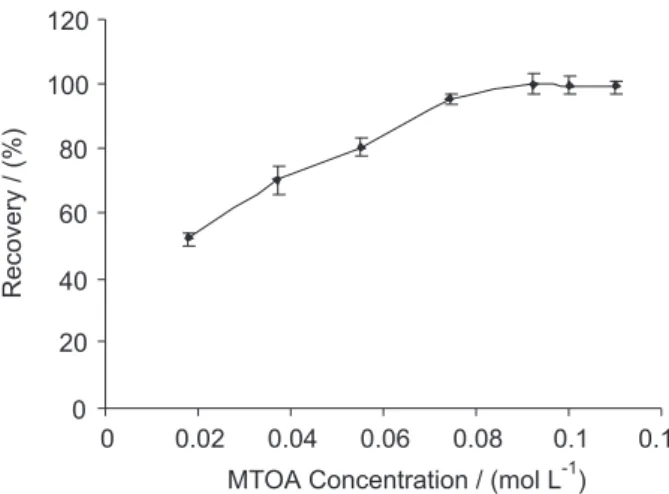
The effect of concentration of MTOA on extraction of cadmium was subsequently studied and the results are shown in Figure 4. The recovery increased with an increase in MTOA concentration up to 9.2×10⁻²mol L-1 which
was suficient for adduct formation. The extraction was independent of further increase in the amount of MTOA. Thus a concentration of 0.1 mol L-1 of MTOA was selected
as optimum.
An optimized equilibration temperature and incubation time is necessary for completion of reaction, achievement of phase separation and quantitative extraction and preconcentration. It is desirable to employ the shortest incubation time and the lowest possible equilibration temperature which fulfilled these requirements. The temperature at which the sample solution is heated was varied in the range of 25-90 °C, and was found that in the temperature range of 75-90 °C the reaction is completed
Figure 1. Schematic of low injection system coupled to lame atomic
absorption spectrometry.
Figure 2. Effect of pH on extraction of cadmium by CPE method.
Extraction conditions: sample volume, 35 mL; amount of metal ion, 7 µg; Triton X-114, 0.04% (v/v); iodide 0.1 mol L-1; methyltrioctylammonium
chloride 0.1 mol L-1.
Figure 3. Effect of iodide concentration on extraction of cadmium by CPE
and the phases are eficiently separated. An equilibration temperature of 80 °C was selected for further studies. The effect of incubation time on extraction was studied by varying the incubation time between 5 to 35 min. An incubation time of 10 min was found to be suficient for quantitative extraction.
A successful CPE should maximize the extraction efficiency by minimizing the phase volume ratio (vorg/vaq) thus improving its concentration ability. The non-ionic surfactant Triton X-114 was chosen due to its commercial availability in a high puriied homogenous form, low toxicological properties and cost, low cloud point temperature and high density of surfactant rich phase, which facilitates phase separation by centrifugation. Figure 5 shows the effect of surfactant concentration on the extraction eficiency. It was proved that Triton X-114 effectively extracts adduct of cadmium ions from liquid samples at concentration of 0.04% (v/v). Larger quantities of the surfactant can be used at the expense of detection limits, as higher concentration deteriorate atomic signal due to the increase in the surfactant volume. The decrease in extraction at low concentration of surfactant is probably due to its inadequacy of assemblies to entrap the hydrophobic complex quantitatively. The surfactant concentration of 0.04% (v/v) was selected for subsequent work and the recovery of analyte was quantitative in a single step process. The preconcentration capability of CPE system was further considered by studying the effect of aqueous volume on recovery of 5 µg of cadmium from different sample volume (5-40 mL). The results showed that the extraction was quantitative with the aqueous phase volume up to 35 mL, and then decreased with further increase in sample volume. Thus based on inal extract volume (0.5 mL) and the maximum sample volume that the extraction was quantitative (35 mL) a preconcentration factor of 70 was determined.
Interferences
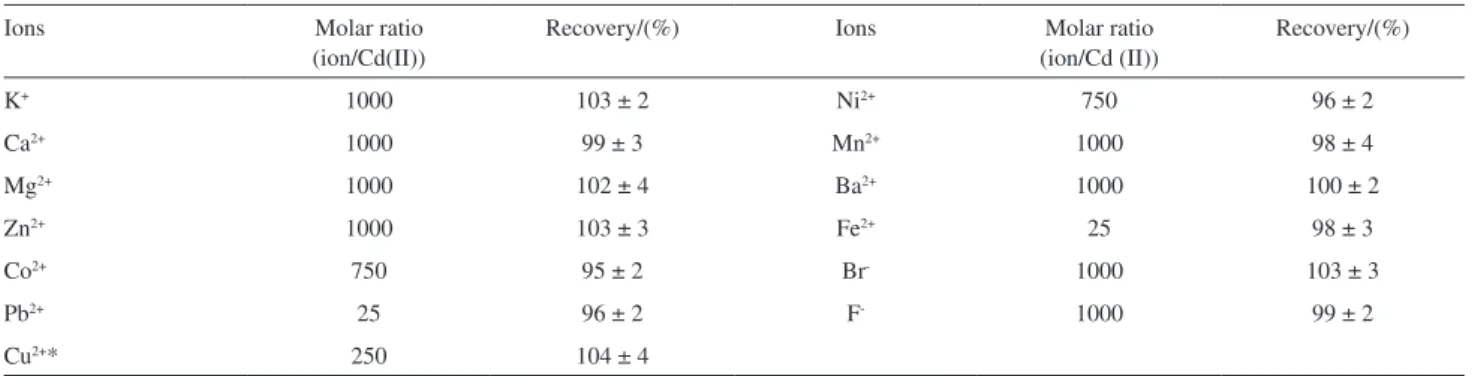
The efficiency of the method in extraction and preconcentration of cadmium ion in the presence of potential interference ions in natural waters was examined. For this purpose, the concentration of cadmium was set at 200 µg L-1, the concentration of Triton X-114 was set at
0.04% (v/v) and that of iodide and MTOA at 0.1 ml L-1.
The tolerance limit of coexist ions is deined as the largest amount making variation lower than 5% in the recovery of analyte. The results of this study are shown in Table 1, and prove that cadmium recovery is quantitative in the presence of excessive amount of the possible interfering ions.
Analytical performance
Calibration curve was obtained by processing 35 mL of standard solution of cadmium under the optimized experimental conditions. The calibration curve was linear up to 250 µg L-1 of cadmium with the equation of
H = 1.81 × 10⁻² C + 0.367 (where H is the peak height
absorbance, and C is the concentration of analyte) and correlation coeficient of 0.999. The equation of calibration curve without preconcentration was H = 2.96 × 10⁻⁴ C +
0.125, thus the enhancement factor, calculated as the ratio of slope of calibration curve obtained by preconcentration of sample to that obtained without preconcentration was found to be 63. The limits of detection and quantiication deined as 3Sb/m and 10Sb/m respectively (where Sb is the standard deviation of the blank and m is the slope of the calibration graph) was found to be 0.3 and 1.0 µg L-1. The
relative standard deviation (R.S.D.) for seven replicate measurements at 100 µg L-1 of Cd(II) was 4%. The
Figure 4. Effect of MTOA concentration on extraction of cadmium by CPE
method. Extraction conditions: water sample volume, 35 mL; amount of metal ion, 7 µg; pH ca. 1.5; Triton X-114, 0.04% (v/v); iodide 0.1 mol L-1.
Figure 5. Effect of Triton X-114 concentration on extraction of
cadmium by CPE method. Extraction conditions: water sample volume, 35 mL; amount of metal ion, 7 µg; pH ca. 1.5; iodide 0.1 mol L-1;
analytical characteristics of the developed procedure are summarized in Table 2.
Application
The proposed procedure was applied to the determination of cadmium in tap water, well water and seawater. Reliability was checked by spiking the sample with known amount of cadmium, and comparing the results with those obtained by GFAAS analysis. The results are given in Table 3, as it could be seen, the recoveries of the spiked sample are good (95-102%) and at 95% conidence level there is no signiicant difference between the results of developed procedure and GFAAS analysis. Furthermore, in order to verify the accuracy of the proposed procedure, it was used for determination of
cadmium in reference ore material (CCU-1b) the results of which is also given in Table 3. The concentration of cadmium in the sample was found to be 173 ± 4 µg g-1, which at 95%
conidence level, is in good agreement with the certiied value of 181 ± 5.0 µg g-1. Thus the procedure is reliable for
determination of cadmium in the sample types examined.
Conclusions
It was demonstrated that the ion pair of [CdI4][MTOA]2 can be quantitatively concentrated into surfactant rich phase in a single-step extraction. The proposed procedure provides a simple reliable and effective route for separation and preconcentration of cadmium and inal determination by FI-FAAS in several categories of natural waters. Furthermore, determination of cadmium by developed procedure was compared with other CPE-FAAS21,22,24,25
and the results are summarized in Table 4. As it is shown the proposed procedure has higher enrichment factor and consequently lower detection limit (with the exception of LOD of reference 20). Thus it provides an alternative procedure to techniques such as GFAAS and ICP-MS for determination of cadmium at µg L-1 level in water
samples. The main advantages of the procedure are: safety, simplicity, low cost, good extraction eficiency and enhancement of FAAS sensitivity.
Table 1. Effect of foreign ions on the recovery of cadmium (200 μg L-1)
Ions Molar ratio
(ion/Cd(II))
Recovery/(%) Ions Molar ratio
(ion/Cd (II))
Recovery/(%)
K+ 1000 103 ± 2 Ni2+ 750 96 ± 2
Ca2+ 1000 99 ± 3 Mn2+ 1000 98 ± 4
Mg2+ 1000 102 ± 4 Ba2+ 1000 100 ± 2
Zn2+ 1000 103 ± 3 Fe2+ 25 98 ± 3
Co2+ 750 95 ± 2 Br- 1000 103 ± 3
Pb2+ 25 96 ± 2 F- 1000 99 ± 2
Cu2+* 250 104 ± 4
*In the presence of glycine a molar ratio of 1000 was tolerated.
Table 2. Analytical characteristic of the method
Linear Dynamic Range 3-250 µg L-1
Correlation Coeficient/(R2) 0.999
Limit of detection 0.3 µg L-1
Limit of quantiication 1.0 µg L-1
RSD/(%) (n=7) 4.0 (at 100 µg L-1)
Preconcentration factor 70
Enhancement factor 63
Table 3. Determination of cadmium in real samples
Sample Added/(μg L-1) Founda/(μg L-1) Recovered/(%) GFAAS/(µg L-1)
Sea water
-14
1.8 ± 0.4 16.2 ± 0.2
-102.8
1.75 ± 0.21
-Well water
-14
1.2 ± 0.2 15.0 ± 0.8
-98.6
1.32 ± 0.12
-Tap water
-14
ND 13.7
-97.8
ND
-Standard ore (CCU-1b)b - 173 ± 4 (μg g-1) 95.6
aResults are mean and standard deviation of three independent measurements. bCopper lotation concentrate standard reference material with the composition
References
1. Silva, J. B. B. da; Borges, D. L. G.; Veiga, M. A. M. S. da; Curtius, A. J.; Welz, B.; Talanta2003, 60, 977.
2. Baird, C.;Environmental Chemistry,2nd ed., Freeman, W. H. and Company: New York, 1999.
3. Asadoulahi, T; Dadfarnia, S.; Haji Shabani, A. M.; J. Braz. Chem Soc.2007, 18, 1353.
4. Dadfarnia, S.; McLeod, W.; Appl. Spectrosc.1994, 48, 1331. 5. Bortoleto, G. G.; Macarovscha, G.T.; Cadore, S.; J. Braz. Chem.
Soc.2004, 15, 313.
6. Li, Z.; Zhou, L.; J. Braz. Chem. Soc.2008, 19, 1347. 7. Maranhão, T. de. A.; Martendal, E.; Borges, D. L. G.; Carasek,
E.; Welz, B.; Curtius, A. J.; Spectrochim.Acta, Part B2007, 62, 1019.
8. Ferreira, A. C.; Korn, M. G. A.; Ferreira, S. L. C.; Microchim. Acta2004, 146,271.
9. Baghban, N.; Haji Shabani, A. M.; Dadfarnia, S.; Jafari, A. A.; J. Braz. Chem. Soc.2009, 20, 832.
10. Bezerra, M. de. A.; Conceição, L. B. A.; Ferreira, S. L. C.; Microchim. Acta 2006, 154,149.
11. Silva, M. F.; Cerutti, E. S.; Martinez, L. D.; Microchim. Acta
2006, 155,349.
12. Bezerra, M. de A.; Arruda, M. A. Z.; Ferreira, S. L. C.; Appl. Spectrosc. Rev.2005, 40, 269.
13. Watanabe, H.; Tanaka, H.; Talanta1978, 25, 585.
14. Teo, K. C.; Chen J.; Analyst2001, 126, 534.
15. Doroschuk, V. O.; Lelyushok, S. O.; Ishchenko, V. B.; Talanta
2004, 64, 853.
16. Nascentes, C. C.; Arruda, M. A. Z.; Talanta2003, 61, 759. 17. Ferreira, H. S.; Bezerra, M. de. A.; Ferreira, S. L. C.; Microchim.
Acta2006, 154, 163.
18. Gaudarzi, N.; J. Braz. Chem. Soc.2007, 18, 1348.
19. Afkhami, A.; Madrakian, T.; Siampour, H.; J. Braz. Chem. Soc.
2006, 17, 797.
20. Afkhami, A.; Madrakian, T.; Siampour, H.; J. Hazard. Mater.
2006, 138, 269.
21. Chen, J.; Teo. K. C.; Anal. Chim.Acta 2001, 450, 215. 22. Silva, E. L.; Roldan, P. D. S.; J. Hazard. Mater. 2009, 161, 142. 23. Manzoori, J. L.; Bavili-Tabrizi, A.; Anal. Chim. Acta 2002, 470,
215.
24. Coelho, L. M.; Arruda, M. A. Z.; Spectrochim.Acta, Part B
2005, 60, 743.
25. Manzoori, J. L.; Karim-Nezhad, G.; Anal. Chim. Acta 2004, 521, 173.
26. Lurie J.; Handbook of Analytical Chemistry, English Translation, Mir Publisher: Moscow, 1975.
27. Dadfarnia, S. Haji Shabani, A. M. Kamranzadeh, E; Talanta
2009,79,1061.
Submitted: May 12, 2010
Published online: July 29, 2010
Table 4. Comparison of detection limit and enrichment factor of CPE-FAAS of cadmium
Ligand Sample LOD/(µg L-1) Enrichment factor Reference
TAN Water 0.099 57.7 21
TAN Water 0.75 20.3 22
DDTP Water and cigarette 0.9 - 24
Dithizone Water 0.31 52 25
Methyltrioctylammonium chloride Water and reference ore 0.3 63 Present work