
Identification of Isomers of Alkylaminophenylethanethiosulfuric
Acids by
13C-NMR Calculations Using a C-13 Chemical Shift User
Database and 2D NMR Techniques
Liliani Salum Alves Moreira
a, David Lee Nelson
b*, Ildefonso Binatti
b,
Lia de Mendonça Porto
b, and Dorila Piló-Veloso
aaDepartamento de Química, ICEx, UFMG, Belo Horizonte - MG, Brazil
bDepartamento de Alimentos, FAFAR, UFMG, Av. Olegário Maciel, 2360,
30.180-112 Belo Horizonte - MG, Brazil
Na obtenção de ácidos N-alquilaminoalcanotiossulfúricos, existe a possibilidade de formação de dois produtos na última etapa da síntese. No caso dos sete ácidos sintetizados neste laboratório a partir de óxido de estireno e aminas primárias alifáticas, os métodos comuns de espectroscopia não foram adequados para distinguir qual dos dois isômeros foi formado. Cálculos de deslocamentos químicos de carbono-13 empregando o programa ACD/CNMR ajudaram, mas não foram conclu-sivos para a identificação dos produtos. O uso de técnicas como HMQC, HMBC e TOCSY permitiu a identificação dos produtos como os ácidos 2-(N-alquilamino)-1-phenyl-1-etanotiossulfúricos.
In the synthesis of N-alkylaminoalkanethiosulfuric acids, there exists the possibility of forming two products in the last step of the synthesis. In the case of the seven acids synthesized in this laboratory from styrene oxide and primary aliphatic amines, the common spectroscopic methods were inadequate for distinguishing which of the two isomers was obtained. Carbon-13 chemical shift calculations employing the ACD/CNMR program were helpful, but not conclusive for identifying the products. The use of HMQC, HMBC and TOCSY techniques permitted the identification of the products as the 2-(N-alkylamino)-1-phenyl-1-ethanethiosulfuric acids.
Keywords:aminoalkanethiosulfates, 2D NMR techniques, empirical calculations
Introduction
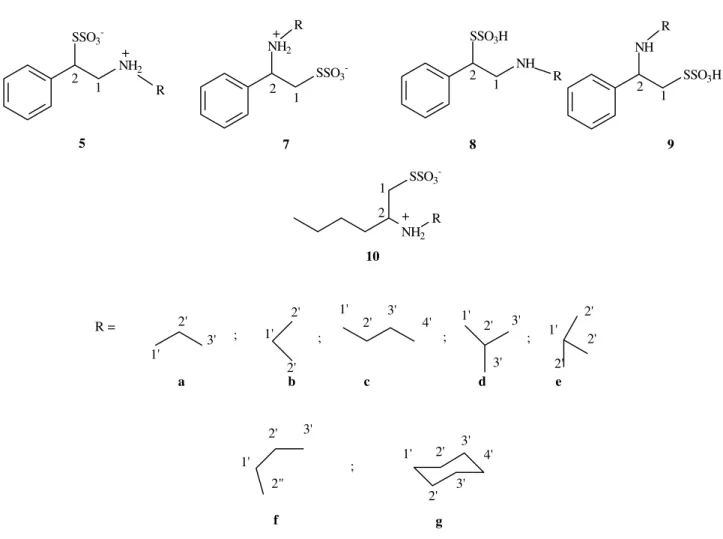
N-Alkylaminoalkanethiosulfuric acids have demon-strated significant activity against infection by Schistosoma mansoni in mice and hamsters1-4. One of the synthetic routes for producing these compounds involves the reaction of an epoxide with a primary aliphatic amine in a modifi-cation of the Beal method (Scheme 1)2,5,6. The aminoalco-hol is treated with hydrobromic acid, followed by phosphorous tribromide in a medium of low polarity to furnish the corresponding bromoalkanamine7,8. This inter-mediate is then converted to the N-alkylaminoalkanethio-sulfuric acid (5) by reaction with sodium thiosulfate9-12. In the last step of this synthesis, there is the possibility of rearrangement via the aziridine to furnish a second product (7). In the case of the corresponding aliphatic compounds, the rearranged product is the predominant product2.
The lack of data for thiosulfuric acids, especially ami-nothiosulfuric acids, in the consulted literature makes it
difficult to estimate the chemical shifts for the carbons bound to these groups. The problem is complicated by the fact that these molecules probably exist in the zwitterionic form and computer programs, such as the ACD/CNMR program, furnish results with large degrees of error for charged molecules. For the analogous aliphatic com-pounds, mass spectral analysis is normally sufficient to resolve any doubts as to the isomer formed in the last step of the synthesis. In the case of the aromatic acids, however, the mass spectra were ambiguous. Seven aromatic deriva-tives were synthesized with different R groups (Scheme 1) and analyzed spectroscopically in an effort to confirm the structure of the products.
Material and Methods
Seven alkylaminophenylethanethiosulfuric acids were synthesized from styrene oxide and seven primary amines (propylamine, isopropylamine, butylamine, isobutylamine,
tert-butylamine, sec-butylamine and cyclohexylamine), as described elsewhere13. The NMR spectra were recorded in DMSO-d6 at 100 MHz on a Bruker AVANCE DPX 400
spectrometer using TMS as the internal standard. Calcula-tions of carbon-13 chemical shifts were performed using the ACD/CNMR program (Version 1.0). Six alkylamino-hexanethiosulfuric acids (R = propyl, isopropyl, butyl, is-obutyl, sec-butyl and cyclohexyl) were synthesized by a similar procedure and their carbon-13 chemical shift values were used to form a user database for re-calculation of the chemical shift values for structures 5 and 7 (Scheme 1), as well as their uncharged forms (8 and 9). The syntheses and properties of these six compounds (10) will be published in the near future.
HMQC: r. t., DMSO-d6, Number of Scans (NS) = 32,
aquisition time (AQ) = 0.127 s, relaxation delay (d1) = 2 s,
evolution delay (d2) = 3.44 ms, 90° pulse, 11.3 µs for 1H,
12 µs for 13C hard pulses and 72 µs for 13C GARP decou-pling; 1024 data points in F2, 512 increments in F1; spectral
width 12 ppm in F2 and 158 ppm in F1; apodization with
sine-bell squared in F2 and sine-bell in F1 prior to double
Fourier transformation.
HMBC: r. t., DMSO-d6, NS = 16; AQ = 0.449 s; d1 = 2
s; d2 = 3.45 ms; delay for evolution of long range coupling
(d6) = 60 ms; 1024 data points in F2 and 382 increments in
F1; spectral width 11.4 ppm in F2 and 221.3 ppm in F1;
apodization with sine-bell squared in F2 and sine-bell in F1
prior to double Fourier transformation.
TOCSY: r. t., DMSO-d6, NS = 8; AQ = 0.246 s; d1 = 2
s; 90° pulse, 7.2 µs for 1H;3 dB attenuation of the 90o pulse and 15 dB attenuation of the spin lock pulse;TRIM pulse = 2.5 msec, mixing time = 30 ms; 60° pulse of 23.3 µs; spectral width of 11.24 ppm in both dimensions; 128 ex-periments in F1.
Results and Discussion
Initial ACD calculations of the expected carbon-13 chemical shift values resulted in large confidence limits for the methine and methylene carbons bound to the thiosulfate and ammonium groups for both isomers 5 and 7, thus preventing the assignment of the signals to these carbons
HO NHR
RHN+ +
2 3
4 5
6 7
HBr
PBr3/Bz 1)
2) MeOH
1
O
+ RNH2
S2O3-2
S2O3-2
S2O3-2 -Br
-+ NH2R Br -+
+
+
RNH2 SSO3
-Br NH2R Br
O3SS
NH2R
with confidence. There are four possible molecular forms which must be considered in the calculation of the theoreti-cal chemitheoreti-cal shift values: the two isomers in the zwitte-rionic (5 and 7) and undissociated (8 and 9) forms. Although the zwitterionic form would be expected to occur in aqueous medium, the undissociated form may predomi-nate in an organic solvent, as occurs with the common aminoacids. The results of the calculations for these four
forms are given in Table 1. The values for the aromatic carbons are not shown since there was not much variation in their values. The numbering of the carbons corresponds to the structures shown in Fig. 1.
The results of calculation of the 13C chemical shift values for 5 and 8 using the ACD/CNMR program are as follows. Those for the methylene carbon of the uncharged form varied from δ 57 to 60 (confidence limits = 1.8 to 5.1).
Table 1.13C-NMR chemical shifts for the charged (5 and 7) and uncharged (8 and 9) forms of the two possible isomers (5 and 7) of seven N-alkylaminophenylethanethiosulfuric acids calculated using the ACD/CNMR program without correction based on a user database (See Fig. 1 for assignment of the carbon atom number).
Compound C1 C2 C1’ C2’a C3’a C4’
δ δ δ δ δ δ
Structure 8
8a 60.22±2.0 54.27±3.6 51.97±0.7 23.89±1.1 12.89±0.5
8b 58.63±3.5 52.29±1.6 50.82±2.7 22.90±0.1
8c 60.40±1.8 50.83±0.1 49.14±1.9 32.94±1.7 20.90±0.5 14.20±0.5
8d 60.36±1.8 51.24±0.5 57.99±0.8 28.66±0.7 20.90±0.2
8e 57.07±5.1 53.24±2.5 51.81±6.7 29.28±1.6
8f 58.66±3.5 55.79±5.1 55.66±1.1 29.90±0.6 10.05±0.3 20.33±1.5b
8g 58.92±3.3 52.67±2.0 57.58±1.2 31.75±0.8 25.11±1.4 25.72±1.3
Structure 5
5a 58.10±11.3 50.12±14.0 50.07±5.8 20.22±5.2 11.70±0.8
5b 56.48±11.3 48.14±13.2 52.66±1.9 21.20±4.5
5c 58.24±11.4 46.68±15.5 48.27±5.4 28.72±5.3 20.30±0.1 14.20±0.5
5d 58.19±11.4 47.09±14.0 55.94±7.2 26.77±3.6 20.60±0.1
5e 54.58±11.3 49.09±13.4 57.61±0.3 26.00±7.3
5f 56.52±11.3 51.64±15.0 56.58±3.7 26.70±5.2 10.20±0.4 15.69±4.5b
5g 56.86±11.3 48.52±13.3 59.06±2.4 29.00±6.0 25.00±0.7 25.70±1.3
Structure 9
9a 47.43±3.5 54.51±9.9 49.07±0.8 23.46±2.3 11.93±1.3
9b 45.36±3.9 52.58±6.7 47.71±3.3 23.07±0.2
9c 45.37±3.9 57.51±8.1 46.86±0.5 33.80±1.2 20.30±0.4 14.20±0.5
9d 43.50±3.7 54.90±9.9 56.25±4.3 29.80±0.5 20.90±0.2
9e 45.51±3.9 51.14±7.9 53.61±3.3 29.46±1.6
9f 48.02±3.1 52.95±8.9 53.35±2.1 31.86±0.3 10.05±0.3 20.56±1.4b
9g 45.36±3.9 54.22±9.9 57.66±4.0 35.35± - 25.11±1.4 25.72±1.3
Structure 7
7a 45.10±5.8 50.27±29.8 47.01±6.3 22.18±6.1 11.70±0.8
7b 43.58±4.4 41.21±29.9 50.46±5.2 19.36±6.3
7c 43.59±4.4 51.77±27.5 44.06±7.0 29.28±7.6 20.30±0.1 14.20±0.5
7d 41.71±2.7 50.66±29.8 53.89±5.1 27.98±4.2 20.60±0.1
7e 43.35±5.1 40.15±29.5 60.97± - 26.56±7.0
7f 45.24±6.0 41.44±30.0 56.49±3.7 28.24±6.7 10.20±0.4 16.19±4.7b
7g 45.36±3.9 56.84±8.6 57.66±4.0 35.35± - 25.11±1.4 25.72±1.4
Those for the same carbon of the zwitterionic form were calculated to range from δ 55 to 58 (confidence limits = 11.3 to 11.4). The calculated values for the methine carbon bound to the undissociated thiosulfuric acid group varied from δ 51 to 56 (confidence limits = 0.5 to 5.1). Those for the thiosulfate varied from δ 47 to 52 (confidence limits = 13.3 to 15). Again, there is a small decrease in the values for the charged forms. However, because of the large in-crease in the confidence limits for the dissociated forms, this difference becomes insignificant. In this case, there is a large increase in the calculated values for both carbons.
The delta values calculated for 7 and 9 were as follows. The calculated values for the methylene carbon attached to the undissociated thiosulfuric acid group varied from δ 43 to 48 (confidence limits = 3.1 to 3.9) and for the methine carbon carrying the amino group varied from δ 51 to 58 (confidence limits = 6.7 to 9.9). The δ values calculated for the same methylene bound to the dissociated primary thio-sulfate group in 7 varied from δ 42 to 45 (confidence limits = 2.7 to 6.0) and for the methine carbon bound to the
ammonium group varied from δ 40 to 51 (confidence limits = 27.5 to 30). Thus, the calculated values for the methylene carbon in 7 were slightly lower than for 9, but of the same order of magnitude. The calculated chemical shift values for the methine carbons bound to the ammonium groups were generally smaller than those for the same carbons bound to the amino group. However, the confidence limits increased so much that any difference in calculated delta values became insignificant.
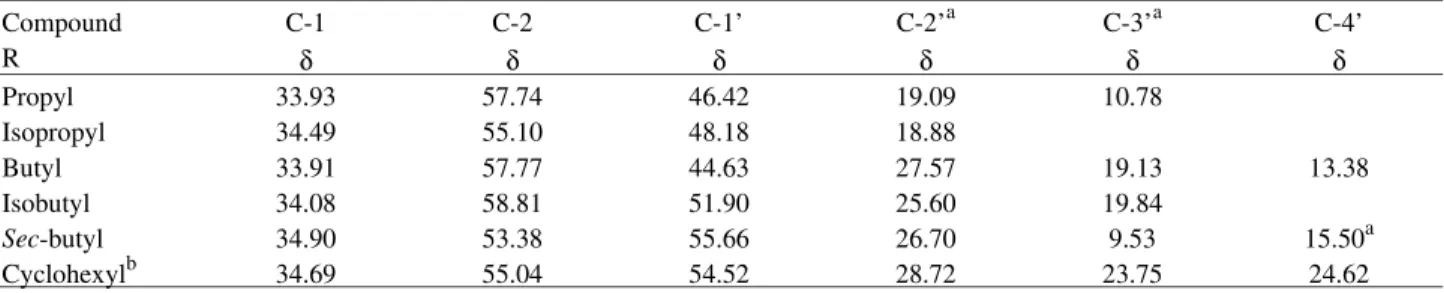
A user database with the known values obtained from the 13C-NMR spectra of six 2-(alkylamino)-1-hexanethio-sulfuric acids was created (Table 2). As a result, new chemical shift values could be calculated with greater pre-cision.
The 13C-NMR spectra of the N-alkylaminohexanethio-sulfuric acids were determined in the same solvent (DMSO-d6) as the N-alkylaminophenylethanethiosulfuric acids.
Thus, there should be no difference in the degree of disso-ciation of the two series of compounds. As a basis for calculating the corrected chemical shift values for the un-charged forms of the aromatic acids, the
aminohexanethio-5 7 8 9
10 1
2 NH2
R SSO3
-+
NH
SSO3H R
1 2 SSO3H
NH R 1
2 NH2
SSO3 -R +
1 2 SSO3
-NH2
R +
2 1
a b c d e
f g ; 4' 3' 3' 2' 2' 1' ; 3' 2' 1' 2' 2' 2' 1' 3' 2' 1' ; ; 2' 1' 2' 2' 1' ; 3' 3' R = 2" 4' 3' 2' 1'
Table 2. Observed experimental 13C-NMR chemical shift values for the carbons of six 2-(alkylamino)-1-hexanethiosulfuric acids (10) (See Fig. 1 for specification of the carbon atom number).
Compound C-1 C-2 C-1’ C-2’a C-3’a C-4’
R δ δ δ δ δ δ
Propyl 33.93 57.74 46.42 19.09 10.78
Isopropyl 34.49 55.10 48.18 18.88
Butyl 33.91 57.77 44.63 27.57 19.13 13.38
Isobutyl 34.08 58.81 51.90 25.60 19.84
Sec-butyl 34.90 53.38 55.66 26.70 9.53 15.50a
Cyclohexylb 34.69 55.04 54.52 28.72 23.75 24.62
aThe equivalent carbons on the cyclohexyl ring have identical chemical shifts. bThese values refer to carbon 2” in the N-alkyl group (Fig. 1).
Table 3.13C-NMR chemical shifts for the charged (5 and 7) and uncharged (8 and 9) forms of the two possible isomers (5 and 7) of seven N-alkylaminophenylethanethiosulfuric acids calculated using the ACD/CNMR program with a user database (See Fig. 1 for assignment of the carbon atom number)a.
Compound C-1 C-2 C-1’ C-2’b C-3’b C-4’
δ δ δ δ δ δ
Structure 8
8a 60.22±2.0 54.27±3.6 51.97±0.7 23.89±1.1 12.89±0.5
8b 58.63±3.5 52.29±1.6 50.82±2.7 22.90±0.1
8c 60.40±1.8 50.83±0.1 49.14±1.9 32.94±1.7 20.90±0.5 14.20±0.5
8d 60.36±1.8 51.24±0.5 53.81±0.3 25.10±0.3 19.84±
-8e 57.07±5.1 53.24±2.5 51.81±6.7 29.28±1.6
8f 58.66±3.5 55.79±5.1 57.79±2.3 24.79±1.3 9.53± - 15.14±1.1c
8g 58.92±3.3 52.67±2.0 56.65±2.3 26.61±1.3 23.75± - 24.62±
-Structure 5
5a 58.10±11.3 46.86±1.9 48.32±0.3 17.18±1.3 10.78±
-5b 56.48±11.3 44.88± -- 50.31±2.3 18.52±1.1
5c 58.24±11.4 43,42±1.5 46.54±0.3 25.66±1.3 19.13± - 13.38±
-5d 58.19±11.4 43.83±1.1 53.81±0.3 25.10±0.3 19.84±
-5e 54.55±11.4 45.82±0.9 54.58±1.2 26.39±0.6
5f 56.52±11.3 49.80±6.1 57.79±2.3 24.79±1.3 9.53± - 15.14±1.1c
5g 56.86±11.3 45.25±0.3 56.65±2.3 26.81±1.3 23.75± - 24.62±
-Structure 9
9a 38.27±1.4 56.02±1.7 46.28±0.3 18.68±0.3 10.78±
-9b 38.83±1.4 53.38±1.7 50.22±0.4 18.72±0.2
9c 38.84±1.7 56.05±1.7 44.49±0.3 27.16±0.3 19.13± - 13.38±
-9d 36.96±2.1 57.09±1.7 51.76±0.3 26.05±0.4 19.84±
-9e 38.97±1.5 52.32±2.0 55.85±5.5 26.60±0.7
9f 38.41±1.4 51.66±1.7 57.70±2.3 26.29±0.3 9.53± - 15.64±0.2c
9g 38.83±1.4 53.32±1.7 56.56±0.5 28.31±0.3 23.75± - 24.62±
-Structure 7
7a 38.27±1.4 56.02±1.7 46.28±0.3 18.68±0.3 10.78±
-7b 38.83±1.4 53.38±1.7 50.22±0.4 19.02±0.2
7c 38.84±1.7 56.05±1.7 44.49±0.3 27.16±0.3 19.13± - 13.38±
-7d 36.96±2.1 57.09±1.7 51.76±0.3 26.05±0.4 19.84±
-7e 38.97±1.5 52.32±2.0 55.85±5.5 26.90±0.7
7f 38.41±1.4 51.66±1.7 57.70±0.4 26.29±0.3 9.53± - 15.64±0.2c
7g 38.83±1.4 53.32±1.7 56.56±0.5 28.31±0.3 23.75± - 24.62±
-aNo values were provided by the program for the confidence limits with dashes. bThe equivalent carbons on the cyclohexyl ring have identical chemical
sulfuric acids were also considered to be in the undissoci-ated form, whereas, for the dissociundissoci-ated species of the aro-matic thiosulfuric acids, the aliphatic acids were considered to be in the corresponding zwitterionic form. The results of the calculations based on the C-13 chemical shift database are shown in Table 3.
In the calculations of the 13C chemical shift values for the uncharged structure 8 based on the user database which included the values for the aminohexanethiosulfuric acids, there were no significant changes in the values or in the confidence limits calculated for the methylene and methine carbons. For the charged structure 5, a decrease in the
chemical shift values for the methine carbon (C-2) was observed with a large decrease in the confidence limits. However, there were no changes in the chemical shift values for the methylene carbons (C-1) and no improve-ment in the corresponding confidence limits. This observa-tion may be due to the fact that these isomers bear the thiosulfate group on C-2 and the ammonium group on C-1, whereas, the user database was based on isomers in which these groups are inverted.
In the calculations of the 13C chemical shift values for the corresponding methylene carbons (C-1) of structures 7
and 9 after inclusion of the user database, the delta values
Table 4. The observed 13C-NMR chemical shift values for the product 5 with their proposed assignments (See Fig. 1 for specification of the carbon atom number).
Compound C o-C m-C p-C C-1 C-2 C-1’ C-2’a C-3’a C-4’
δ δ δ δ δ δ δ δ δ δ
Propyl 138.4 128.0 127.6 129.0 52.2 48.6 49.1 18.9 10.8
Isopropyl 138.3 128.9 127.9 128.4 50.5 46.6 48.8 18.5
Butyl 138.4 128.0 127.6 128.9 52.2 48.6 47.2 27.3 19.1 13.4
Isobutyl 138.6 128.0 127.5 130.0 53.2 48.6 54.5 25.3 19.8.
t-Butyl 138.2 129.0 127.7 128.1 47.0 49.5 57.1 25.1.
s-Butyl 138.4 128.1 127.6 129.0 49.9 49.0 55.7 25.2 9.5 15.3b
Cyclohexyl 138.4 128.9 127.6 28.0 49.6 49.0 56.8 28.5 24.7 23.8
aThe equivalent carbons on the cyclohexyl ring have identical chemical shifts. bThese values refer to carbon 2” in the N-alkyl group (Fig. 1).
Table 5.13C-NMR (100 MHz) data for the some of the N-alkylaminophenylethanethiosulfuric acids obtained via the HMQC [1J(C,H)], TOCSY and HMBC [nJ (C,H), n = 2 and 3] experiments.
HMQC HMBC TOCSY
δC δH 2J(C, H)(δ) 3J(C, H) 1H(δ) X 1H(δ) Propyl (5a)
C-1 52.2 3.75 H-2(4.65) H-1(3.54), H-2(4.63)
3.54 H-1(3.75), H-2(4.63)
C-2 48.6 4.63 H-1(3.54, 3.75) H-1 (3.45, 3.75)
C-1’ 49.1 2.88 H-2’(1.60) H-3’(0.88) H-2’(1.60), H-3(0.88)
C-2’ 18.9 1.60 H-3’(0.88) H-1’(2.88), H-3(0.88)
H-1’(2.88)
C-3’ 10.8 0.88 H-2’(1.60) H-1’(2.88) H-2’(1.60), H-3(0.88)
Ar-1 138.4 H-2(4.63) H-1(3.54, 3.75)
Ar-2 128.0 H-2(4.63)
Butyl (5c)
C-1 52.19 3.77 H-2(4.64)
3.56
C-2 48.53 4.64 H-1(3.56 3.77)
C-1’ 47.21 2.93 H-2’(1.55) H-3’(1.31)
C-2’ 27.28 1.55 H-4’(0.87)
C-3’ 19.10 1.31 H-4’(0.87)
C-4’ 13.39 0.87 H-3’(1.31) H-2’(1.55)
Ar-1 138.5 H-2(1.55)
obtained were much lower than those obtained without correction. There was also a significant decrease in the confidence limits. There was little change in the chemical shift values calculated for the methine carbon (C-2) bound to the thiosulfuric acid group in the uncharged form 9, although the confidence limits decreased significantly. For
the zwitterionic form, there was anincrease in the chemical shift values relative to those obtained without use of the user database and a large improvement in the confidence limits.
Based on these data and the results of the calculations shown in Table 3, structures 7 and 9 could be excluded as
Isobutyl (5d)
C-1 53.2 3.53 H-2(4.70)
C-2 48.6 4.70
C-1’ 54.5 2.82 H-2’(1.96) H-3’(0.96)
C-2’ 25.3 1.96 H-3’(0.96)
C-3’ 19.8 0.96 H-2’(1.96) H-3’(0.96)
Ar-1 138.6 H-2(1.96)
Ar-2 128.0 H-2(1.96)
t-Butyl (5e)
C-1 47.0 3.83 H-2(4.57) H-1(3.50), H-2(4.57)
3.50 H-1(3.83), H-2(4.57)
C-2 49.5 4.57 H-1(3.50, 3.83) H-1(3.50), H-1(3.83)
C-1’ 57.1 - H-2’(1.30) H-1(3.83weak)
C-2’ 25.1 1.30 H-2’(1.30)
Ar-1 138.2 H-2(4.57)
Ar-2 129.0 7.37 H-2(4.57)
sec-Butyl (5f)
C-1 49.9 3.78 H-2(4.63)
3.58
C-2 49.0 4.63 H-1(3.53, 3.78)
C-1 55.7 H-2’(1.47) H-3’(0.89)
H-2”(1.20)
C-2’ 25.2 1.74 H-3’(0.89) H-2’’(1.20)
1.47
C-2” 15.3 1.20 H-2’(1.47, 1.74)
C-3’ 9.5 0.89 H-2’(1.47, 1.74)
Ar-1 138.4 H-2(4.63) H-1(3.78)
Ar-2 128.1 H-2(4.63)
Cyclohexyl (5g)
C-1 49.6 3.80 H-2(4.62)
3.60
C-2 49.0 4.62 H-1(3.60, 3.80)
C-1’ 56.8 3.05 H-2’(1.73, 2.01) H-2(4.62 weak)
H-3’(1.27, 1.57)
C-2’ 28.5 2.01(eq) H-1’(3.05)
1.73(ax) H-3’(1.27, 1.57)
C-3’ 24.7 1.57(eq) H-2’(2.01, 1.73) H-1’(3.05)
1.27(ax)
C-4’ 23.8 1.13 H-3’(1.27 1.57)
Ar-1 138.4 H-2(49.0) H-1(49.6)
Ar-2 128.9 H-2(49.0)
probable structures for the products obtained in these syn-theses. The DEPT experiment could distinguish between methylene and methine carbons. The structure for which the calculated values most closely approached the observed values was 5. However, because of the proximity of the experimental values observed for carbons C-1, C-2 and C-1’ (Table 4) and the large confidence limits for the chemical shift values calculated for C-1 of structure 5
(Table 3), there was still doubt as to the assignments of the signals to these three carbons. Therefore, it was necessary to resort to 2D NMR techniques to assign these signals with confidence and to confirm the results of the calculations. The use of other spectral techniques was of no help in this case. Infrared spectroscopy, of course, would be of no assistance in distinguishing between isomers. In the case of the corresponding aliphatic compounds, mass spectral analysis easily permitted the differentiation of the isomers2. In the present case, however, the mass spectra were ambigu-ous and did not permit a firm assignment of the structures13. Therefore, the HMBC, HMQC and TOCSY experiments were performed to verify which groups were bound to the methylene and methine carbons. The results of these experi-ments are shown in Table 5. The values for 5b are not shown since, in this case, a mixture of products was ob-tained. The HMQC and HMBC experiments established the assignments of the signals to the respective carbons and the TOCSY experiment confirmed the results.
Conclusions
The results from the ACD/CNMR calculations using a user database were helpful, but were not conclusive because of the existence of charges on the molecules and the lack of data in the literature consulted for aminoalkanethiosulfuric acids. However, the use of HMQC, HMBC and TOCSY experiments established that, in this series of aromatic compounds, the principal product is that in which the thiosulfate group is bound to the benzilic carbon. In DMSO-d6 the zwitterionic form is preferred. In general, no
or very weak long-range coupling was observed through the ammonium group.
The ∆δ contribution for the thiosulfate group bound to the terminal methylene carbon was established as approxi-mately 16.5 ppm. From the results obtained in these experi-ments, the ∆δ for this group bound to the methine carbon could then be estimated as 9.4 ppm.
Acknowledgements
This work was supported by funds furnished by the Conselho Nacional de Desenvolvimento Científico - CNPq and the Fundação de Amparo a Pesquisa do Estado de Minas Gerais - FAPEMIG. Professors D. Piló-Veloso and D.L. Nelson were recipients of research fellowships from the CNPq. NMR spectra were determined at LAREMAR, Department of Chemistry, ICEx, Universidade Federal de Minas Gerais. We thank the Department of Chemistry of the Universidade Federal de São Carlos for the use of the ACD/CNMR program. This work constitutes part of the Doctoral Thesis of L. S.A. Moreira.
References
1. Nelson, D.L.; Pellegrino, J. Rev. Inst. Med. Trop. São Paulo1976, 365-70.
2. Penido, M.L.O.; Piló-Veloso, D.; Nelson, D.L. J.
Braz. Chem. Soc. 1990, 1, 35-39.
3. Penido, M.L.O.; Nelson, D.L.; Vieira, L.Q.; Coelho, P.M.Z. Mem. Inst. Oswaldo Cruz.1994, 89, 595-602. 4. Penido, M.L.O.; Nelson, D.L.; Vieira, L.Q.; Watson
D.G.; Kusel, J.R. Parasitol.1995, 111, 177-185. 5. Kraussuski, K.J. J. Pract Chem. 1907, 75, 238. In
Parker, R.E.; Isaacs, N.S. Chem. Rev.1959, 9, 737-99. 6. Biel, J.H. J. Am. Chem. Soc.1949, 71, 1306-1309. 7. Elderfield, R.C.; Craig, L.C.; Lauer, W.M.; Arnold,
R.T.; Gensler, W.J.; Head, J.D.; Bembry, T.H.; Mighton, H.R.; Tinkler, J.; Galbreath, J.; Holley, A.D.; Goldman, L.; Maynard, J.T.; Picus, N.; J. Am. Chem.Soc.1946, 68, 1518-1523.
8. Leffer, M.T.; Adams, R. J. Am. Chem. Soc. 1947, 59, 2252-2258.
9. Bunte, H. Chem. Ber. 1874, 7, 646-648.
10. Klayman, D.L.; Gilmore, W.F. J. Med. Chem. 1964,
7, 823-824.
11. Klayman, D.L.; Lown, J.W.; Sweeney, T.R. J. Org. Chem. 1965, 30, 2275-2278.
12. Klayman, D.L.; et al. J. Med. Chem. 1969, 12, 510-512.
13. Moreira, L.S.A.; Piló-Veloso, D.; Nelson, D.L.; Syn-thesis of 2-(Alkylamino)-1-Phenylethane-1-Thiosul-furic Acids, Potential Schistosomicides, Química Nova, In Press.
Received: March 29, 1999

![Table 5. 13 C-NMR (100 MHz) data for the some of the N-alkylaminophenylethanethiosulfuric acids obtained via the HMQC [ 1 J(C,H)], TOCSY and HMBC [ n J (C,H), n = 2 and 3] experiments](https://thumb-eu.123doks.com/thumbv2/123dok_br/18988397.459723/6.918.100.822.384.565/table-alkylaminophenylethanethiosulfuric-acids-obtained-hmqc-tocsy-hmbc-experiments.webp)
