MAY/JUNE REV. HOSP. CLÍN. FAC. MED. S.PAULO 54 (3): 85 - 90, 1999
RHEUMATIC FEVER: A MULTICENTER STUDY IN
THE STATE OF SÃO PAULO
Carlos Henrique Martins da Silva and Pediatric Committee - São Paulo Pediatric Rheumatology Society
SILVA, C. H. M. da et al. - Rheumatic fever: a multicenter study in the state of São Paulo. Rev. Hosp. Clín. Fac. Med. S. Paulo 54(3): 85 - 90,1999.
SUMMARY: Rheumatic fever is still the most commonly seen rheumatic disease in Brazilian pediatric rheumatology clinics. It remains a sig-nificant health problem since subsequent cardiac sequelae represent one of the most important causes of chronic heart disease in children. We revie-wed the clinical manifestations of rheumatic fever in 786 patients, follorevie-wed at seven pediatric rheumatology clinics in the state of São Paulo, Brazil. All patients were diagnosed according to revised Jones’ criteria. Regarding major criteria, 396 (50.4%) children exhibited carditis, 453 (57.6%) pol-yarthritis, 274 (34.8%) chorea, 13 (1.6%) erythema marginatum, and 12 (1.5%) subcutaneous nodules. Valvular lesions documented by echocardio-graphy in the absence of accompanying auscultatory findings were found in 144 (18.3%) patients. Migratory polyarthritis was observed in 290 (64.0%) patients with articular involvement. Documented previous streptococcal infection assessed by serum antistreptolysin (ASO) titers occurred in 531 (67.5%) patients. Even though prophylaxis with benzathine penicillin was recommended to all patients, recurrent attacks were observed in 147 (18.7%). We emphasize the high frequency of chorea, silent carditis and recurrences in our series as well as the variable clinical presentation of arth-ritis in rheumatic fever. Multicenter studies should be encouraged to improve our understanding of the clinical features of rheumatic diseases in chil-dren and adolescents.
DESCRIPTORS: Rheumatic fever. Epidemiology. Cardic disease. Department of Rheumatology. Pediatrics Society of São Paulo.
Rheumatic fever (RF) and rheu-matic heart disease represent an important health problem in several parts of the world. In developing countries, rheumatic heart disease is the most common cause of heart dis-ease in persons younger than 40 years and, at more advanced ages, it is exceeded only by arterial hyperten-sion and coronary disease9,22,24. The disease is associated with significant mortality and morbidity rates result-ing in major individual, family, and social consequences. According to
and 4500 cardiac surgeries, with a cost of R$19 million18. Thus, the socioeco-nomic cost of RF is high. Patients and their relatives suffer the physical and psychological consequences of this disease, and affected individuals are often unable to work during the most productive time of their lives. Furthermore, extensive financial resources are necessary for the med-ical and surgmed-ical treatment of these patients20.
Few studies have dealt with the
is known to be the most common con-nective tissue disease in the various pediatric rheumatology centers in Brazil15. Clinical-epidemiological dif-ferences between various geographic areas, even within the same country, fundamentally result from socioeco-nomic-cultural variations6,7,22.
The objective of the present study was to investigate the clinical charac-teristics of patients with RF seen at seven pediatric rheumatology centers in the State of São Paulo.
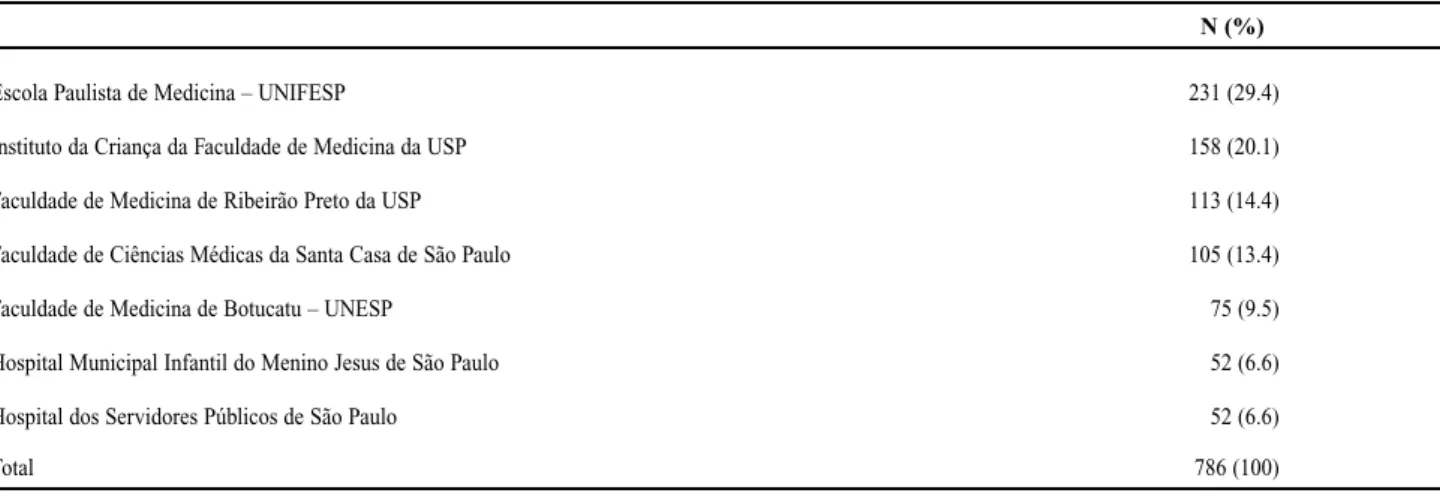
adolescents with a diagnosis of RF (modified Jones criteria21, and exclu-sion of other diseases with a similar clinical course) seen at seven Pediatric Rheumatology centers in the State of São Paulo from January 1989 to December 1994. Five of the centers are located in the capital city, and two are located in nearby cities--one in Ribeirão Preto and the other in Botucatu (Table 1). Children with incomplete hospital records or with insufficient information for diagnostic confirmation were excluded. A single protocol was est0ablished for use by the participating centers for the study of the following demographic, clinical, and laboratory characteristics: age, sex, ini-tial diagnosis prior to admission, fre-quency of major and minor Jones crite-ria, number of recurrences, evidence of previous streptococcal disease reflected by the presence of antistreptococcal antibodies (antistreptolysin O ASLO -at titers higher than 300 U/Todd), or a positive throat culture for Group A beta-hemolytic streptococcus.
The diagnosis of carditis was based on the presence of at least one of the following manifestations: a heart murmur compatible with valvu-lar disease, cardiomegaly, cardiac insufficiency, and pericarditis. The diagnosis of carditis was not made in the absence of clinical manifestations, even when echocardiography showed evidence of valvular disease.
RESULTS
A total of 786 patients fulfilled the proposed inclusion criteria: 404 boys (51.3%) and 382 girls (48.7%), with an average age of 9.4 years (range: 3 to 17 years).
Most of the patients (734, 93.3%) received an initial correct diagnosis of RF, whereas 52 patients (6.7%) first received other diagnoses such as reac-tive arthritis, juvenile rheumatoid arthritis, nonspecific muscle-skeletal pains, and septic arthritis.
Regarding the major criteria of
Jones, arthritis was present in 453 patients (57.6%), carditis in 396 (50.4%) and chorea in 274 (34.8%). Erythema marginatum and subcuta-neous nodules were observed in only 13 (1.6%) and 12 (1.5%) of the patients, respectively (Table 2).
Typically migratory polyarthritis occurred in 290 children (64.0%) with joint involvement.
One hundred and forty-four patients (18.3%) presented echocar-diographic changes suggestive of valvular disease, with no correlated clinical manifestations.
Of the 396 children with cardiac involvement, according to Jones crite-ria, 119 presented cardiac failure (30.0%), and 39 (9.8%) presented pericarditis. Electrocardiographic and radiological changes were observed in 225 (56.8%) and 88 (22.2%) patients, respectively. Considering the 540 chil-dren with a diagnosis of rheumatic carditis (396 children) or with only echocardiographic changes (144 chil-dren), the type of valvular damage
N (%)
Escola Paulista de Medicina – UNIFESP 231 (29.4)
Instituto da Criança da Faculdade de Medicina da USP 158 (20.1)
Faculdade de Medicina de Ribeirão Preto da USP 113 (14.4)
Faculdade de Ciências Médicas da Santa Casa de São Paulo 105 (13.4)
Faculdade de Medicina de Botucatu – UNESP 75 (9.5)
Hospital Municipal Infantil do Menino Jesus de São Paulo 52 (6.6)
Hospital dos Servidores Públicos de São Paulo 52 (6.6)
Total 786 (100)
most frequently observed was mitral insufficiency (409 patients, 75.7%), followed by aortic insufficiency (136 patients, 25.2%), tricuspid insuffi-ciency (49 patients, 9%), and aortic stenosis (6 patients, 0.1%). Pulmonary insufficiency and tricuspid stenosis occurred in only three and one patients, respectively.
With respect to the minor Jones criteria, 456 patients (58.0%) present-ed fever, 342 (43.5%) arthralgia, and 497 (63.2%) an increased blood sedi-mentation rate (ESR) (Table 2).
Elevated levels of antistreptococcal antibodies detected with antistrep-tolysin-O were observed in 499 (63.5%) of the patients.
One hundred and forty-eight patients (18.8%) presented at least one recurrence of RF. Two recurrences were observed in 20 patients, three in 12, and four in two.
half of the 1980 decade, it is in under-developed countries that this disease is associated with high morbidity and mortality22. A low socioeconomic-cul-tural level, precarious living condi-tions, inadequate primary health care services, and the delayed and inade-quate treatment of airway infections possibly represent the factors leading to this unfavorable picture26.
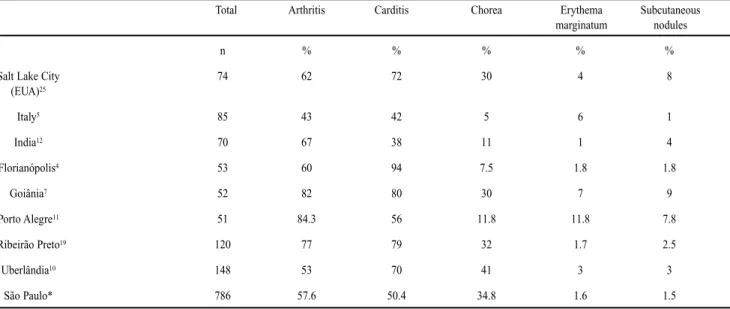
In general, the clinical and laborato-ry characteristics observed in the pre ent study are similar to those reported in the literature24, especially concerning Brazilian series (Table 3).
The present results indicate a worri-some epidemiological picture with respect to RF in the State of São Paulo. This series contains one of the largest number of children and adolescents with RF reported in the literature. Although the number of recurrences in this study was definitely underestimated, and the number of reported recurrences was very high (18.8%).
of streptococcal infections, i.e., through primary prophylaxis. Importantly, they recommend that these strategies should be easy to exe-cute and of low cost26.
The example of the program of RF prevention in Costa Rica is instructive. In that country, the indiscriminate treatment of all patients with tonsillitis with benzathine penicillin resulted in a reduction from 94 new RF cases in 1970 to 4 new RF cases in 19912.
Thus, it is urgently necessary to identify responsible local governmen-tal strategies for offering the popula-tion an immediate and effective treat-ment of streptococcal infections of the throat, in concert with programs sup-porting secondary RF prophylaxis3. In addition, it should be determined whether faulty secondary prophylaxis results from the ineffectiveness of cur-rent approaches and/or from lack of treatment compliance8.
In the present study, the initial RF
MAY/JUNE REV. HOSP. CLÍN. FAC. MED. S.PAULO 54(3): 85 - 90, 1999
Characteristic N (%)
Major Criteria
Carditis 396 50.4
Arthritis 453 57.6
Chorea 274 34.8
Erythema marginatum 13 1.6
Subcutaneous nodules 12 1.5
Minor Criteria
Fever 456 58.0
Arthralgia 342 43.5
ESR elevation 497 63.2
ASLO elevation 499 63.5
Table 2– Rheumatic fever patients exhibiting Jones21criteria symptoms (N
ties, especially when Jones criteria are used in a correct manner, although other diseases such as juvenile rheuma-toid arthritis, systemic lupus erythe-matosus, and acute lymphoblastic leukemia may satisfy the same criteria. Despite the importance of the Jones criteria for the diagnosis of RF, especially in the initial outbreaks, their interpretation is limited in med-ical practice in some specific clinmed-ical situations. For example, what is the meaning of the mitral regurgitation identified only by echocardiogram without the detection of a heart mur-mur upon auscultation during an acute RF episode? The frequency of carditis in the present study was similar to that reported by others (Table 3). However, if we consider isolated echocardiographic changes to be also carditis, especially mitral reflux without a corresponding heart mur-mur upon auscultation (silent mitral regurgitation), the frequency of car-diac involvement increases from 50.4% to 68.7%.
The American Cardiology As-sociation supports the use of the
crite-ria of carditis established by Jones about 50 years ago, considering the echocardiogram as a complementary method for the clinical diagnosis21. It does not seem to make sense to reject the findings of a sensitive and objec-tive technique for the characterization of valvular lesion. Indeed, some car-diologists that specialize in echocar-diography state that echocarechocar-diography can differentiate between physiologi-cal and pathologiphysiologi-cal mitral reflux17.
Chorea occurred in 34.8% of the cases studied. This frequency is rela-tively elevated compared to that observed in developed countries in the 1950’s and 1960’s, but seems similar to increased frequency of chorea observed in epidemics in the United States and especially observed recent-ly in countries like Australia22. Chorea can be easily recognized, and a neu-rologist or rheumatologist is immedi-ately contacted for medical care, since the embarrassing involuntary move-ments, the emotional lability, and the obsessive-compulsive disorders associ-ated with the condition cause a profound discomfort to the child and his
rela-tives23. However, it is probable that vari-ations in the frequency of chorea between regions of the same country or between different countries result from differences between streptococcal strains with a greater potential for involvement of the base nuclei.
Approximately one third of the patients with joint involvement report-ed here presentreport-ed polyarthritis with-out the classical migratory character-istics, but with the presence of addi-tive, symmetrical polyarthritis involv-ing small joints and the spine, a poor response to non-hormonal anti-inflammatory agents, and persistence of articular manifestations for more than six weeks. These “atypical” artic-ular manifestations have been fre-quently described and have been con-sidered by some as a specific clinical entity, i.e., post-streptococcal reac-tive arthritis13. However, it seems reasonable to include these mani-festations in the possible spectrum of articular involvement of RF14. The Pediatric Rheumatology Committee of the Pediatric Society of São Paulo does not consider
Total Arthritis Carditis Chorea Erythema Subcutaneous
marginatum nodules
n % % % % %
Salt Lake City 74 62 72 30 4 8
(EUA)25
Italy5 85 43 42 5 6 1
India12 70 67 38 11 1 4
Florianópolis4 53 60 94 7.5 1.8 1.8
Goiânia7 52 82 80 30 7 9
Porto Alegre11 51 84.3 56 11.8 11.8 7.8
Ribeirão Preto19 120 77 79 32 1.7 2.5
Uberlândia10 148 53 70 41 3 3
São Paulo* 786 57.6 50.4 34.8 1.6 1.5
* present study
post-streptococcal reactive arthritis to differ from RF and recommends the use of secondary prophylaxis in this situation.
The confirmation of previous streptococcal infection on the basis of the elevation of antistreptococcal antibodies (ASLO) was possible in 63.5% of the patients studied. It is known that levels of these antibodies increase during the early phase of the RF outbreak24. Thus, ASLO ele-vation is expected in polyarthritis and carditis. However, ASLO is not usually elevated in isolated chorea,
since this is a late manifestation of the disease. This fact may explain in part the relatively low frequency of ASLO elevation in the present study, since 34.8% of the patients studied presented chorea.
Few patients presented erythema marginatum (1.6%) and subcutaneous nodules (1.5%). The low frequency and lack of specificity of these mani-festations confirmed with several studies24suggest that, with respect to these signs, the major criteria for the diagnosis of RF (Jones criteria) should be revised.
CONCLUSION
In conclusion, the large number of outbreaks and recurrences of RF observed in the present study indi-cates an unfavorable situation for this disease in the State of São Paulo. Educational public health policies and effective programs aiming at primary and secondary prophylaxis of RF involving pediatricians, cardiologists, rheumatologists, and other health workers should be implemented with-in a short period of time.
MAY/JUNE REV. HOSP. CLÍN. FAC. MED. S.PAULO 54(3): 85 - 90, 1999
RESUMO
SILVA, C. H. M. da e col. - Febre reumática: Um estudo multicêntri-co no estado de São Paulo. Rev. Hosp. Clin. Fac. Med. S. Paulo 54(3): 85 - 90,1999.
A febre reumática é a doença do tecido conectivo mais comum no nosso meio e caracteriza-se, sobretu-do, pelo elevado custo social e econômico decorrente da cardiopatia reumática. Com o objetivo de analisar as características clínicas desta doença, foram estudados, retrospecti-vamente, os prontuários de 786 cri-anças diagnosticadas de acordo com os critérios de Jones e cadastradas em sete serviços de Reumatologia
Pediátrica do Estado de São Paulo. Com relação aos critérios maiores, 396 (50,4%) apresentaram cardite; 453 (57,6%), artrite; 274 (34,8%), coréia; 13 (1,6%), eritema marginado e 12 (1,5%), nódulos subcutâneos. Poliartrite migratória clássica ocorreu em 290 crianças (64,0%) com com-prometimento articular. Cento e quarenta e quatro (18,3%) dos pacientes apresentaram alterações ecocardiográficas sugestivas de valvopatia, sem manifestações clíni-cas associadas. A elevação dos títulos de antiestreptolisina-O foi evidencia-da em 531 pacientes (67,5%). Apesar da profilaxia secundária
recomenda-da, 147 (18,6%) crianças apresen-taram ao menos uma recorrência. As elevadas freqüências da coréia, de alterações cardíacas subclínicas detectadas pelo ecocardiograma e ainda de recorrências, bem como a grande variabilidade da apresentação clínica da artrite da febre reumática, merecem ser destacadas e ressaltam a importância dos estudos multicêntri-cos para determinar o comportamento das patologias de modo geral e, em particular da patologias reumáticas na infância.
DESCRITORES: Febre reumática. Epidemiologia. Cardite reumática.
RHCFAP/2968
1. ALVES MEIRA ZM, DE CASTILHO SR, LINS BARROS MV et al. - Prevalence of rheumatic fever in children from a public high school in Belo Horizonte. Arq Bras Cardiol,1995;65: 331-4.
5. CALVANI M - Acute rheumatic fever in the young, today. Minerva Pediatr,1991;43:481-92.
6. CARDONA PN, LÓPEZ R, LA LLAVE G et al. - Fiebre
9. DA SILVA NA & PEREIRA BAF - Acute rheumatic fever. Still a challenge. Rheum Clin North Am,1997; 23:545-68. 10. FERNANDES KP, MORAES AS, OLIVEIRA AP et al. - O
panora-ma epidemiológico da febre reumática na região de Uberlândia (1987 a 1996). Arq Bras Pediat,1997;4: S186.
11. GUS I, ZASLAVSKY C, SEGER JM et al. - Epidemiology of rheumatic fever. A local study. Arq Bras Cardiol,1995; 65:321-5. 12. GROVER A, DHAWAN A, IYENGAR SD et al. - Epidemiology of rheumatic fever and rheumatic heart disease in a rural commu-nity in northern India. Bull WHO,1993; 71:59-66.
13. KISS MHB - Comprometimento articular na febre reumática.
Rev Soc Cardiol Estado de São Paulo,1993; 3:25-31. 14. JANSEN TLTA, JANSSEN M & VAN RIEL PLCM - Acute
rheu-matic fever or post-streptococcal reactive arthritis: a clinical pro-blem revisited. Br J Rheumatol,1998; 37:335-40.
15. MACHADO CSM, CARVALHO J Jr., MARTIN JG et al. -Análise do atendimento ambulatorial em reumatologia pediátrica.
Rev Bras Reumatol,1995;35: S19.
16. MICHIELIN F, PRELLO AA, PRATAVIERA JC et al -Epidemiologia e prevenção da febre reumática no Rio Grande do Sul. Arq Bras Cardiol,1994;63:441-2.
17. MINICH LL, TANI LY, PAGOTTO LT et al. - Doppler echo-cardiography distinguishes between physiologic and patholo-gic “silent” mitral regurgitation in patients with rheumatic fever. Clin Cardiol,1997;20:924-6.
18. MINISTÉRIO DA SAÚDE. - Assessoria Técnico-Gerencial. Gabinete do Ministro. Fonte: DATASUS/FNS/MS, 1995-1996.
19. PILEGGI GCS - Aspectos clínicos da febre reumática em crianças atendidas no Hospital das Clínicas de Ribeirão Preto. Ribeirão Preto, 1997. ( Faculdade de Medicina de Ribeirão Preto da Universidade de São Paulo).
20. SNITCOWSKY R - Rheumatic fever prevention in industriali-zing countries: problems and approaches. Pediatrics,1996;
97:996-8.
21. SPECIAL WRITING GROUP OF THE COMMITTEE ON RHEUMATIC FEVER, Endocarditis, and Kawasaki disease of the council on cardiovascular disease in the young of the american heart association. Guidelines for the diagnosis of rheumatic fever: Jones criteria, 1992 update. JAMA,1992;
268:2069-73.
22. STOLLERMAN GH - Rheumatic fever. Lancet 1997;
49:9359.
23. SWEDO SE, LEONARD HL, SCHAPIRO MB et al. -Sydenham’s chorea: physical and psychological symptoms of St Vitus dance. Pediatrics,1993; 91:706-13.
24. TARANTA A & MARKOWITZ M - Rheumatic fever. Boston, Kluwer, 1989.
25. VEASY LG, WIEDMEIER SE, ORSMOND GS et al. - Resurgence of acute rheumatic fever in the intermountain area of the United States. N Engl J Med,1987; 316:421-7.
26. WHO/ISFC. - Strategy for controlling rheumatic fever/rheumatic heart disease, with emphasis on primary prevention: Memorandum from a Joint WHO/ISFC meeting. Bull WHO 1995;73:583-7.
Received for publication on the 05/04/99
APPENDIX: STUDY GROUP