BGD
10, 14815–14834, 2013
Methane release in glacier forefield soils
P. A. Nauer et al.
Title Page
Abstract Introduction
Conclusions References
Tables Figures
◭ ◮
◭ ◮
Back Close
Full Screen / Esc
Printer-friendly Version Interactive Discussion
Discussion
P
a
per
|
D
iscussion
P
a
per
|
Discussion
P
a
per
|
Discuss
ion
P
a
per
|
Biogeosciences Discuss., 10, 14815–14834, 2013 www.biogeosciences-discuss.net/10/14815/2013/ doi:10.5194/bgd-10-14815-2013
© Author(s) 2013. CC Attribution 3.0 License.
Open Access
Biogeosciences
Discussions
Geoscientiic Geoscientiic
Geoscientiic Geoscientiic
This discussion paper is/has been under review for the journal Biogeosciences (BG). Please refer to the corresponding final paper in BG if available.
Technical Note: Disturbance of soil
structure can lead to release of methane
entrapped in glacier forefield soils
P. A. Nauer, E. Chiri, J. Zeyer, and M. H. Schroth
Institute of Biogeochemistry and Pollutant Dynamics (IBP), ETH Zurich, Zurich, Switzerland Received: 2 August 2013 – Accepted: 26 August 2013 – Published: 6 September 2013 Correspondence to: M. H. Schroth ([email protected])
BGD
10, 14815–14834, 2013
Methane release in glacier forefield soils
P. A. Nauer et al.
Title Page
Abstract Introduction
Conclusions References
Tables Figures
◭ ◮
◭ ◮
Back Close
Full Screen / Esc
Printer-friendly Version Interactive Discussion
Discussion
P
a
per
|
D
iscussion
P
a
per
|
Discussion
P
a
per
|
Discuss
ion
P
a
per
|
Abstract
Investigations of sources and sinks of atmospheric CH4 are needed to understand
the global CH4 cycle and climate-change mitigation options. Glaciated environments
might play a critical role due to potential feedbacks with global glacial meltdown. In an emerging glacier forefield, an ecological shift occurs from an anoxic, potentially
5
methanogenic subglacial sediment to an oxic proglacial soil, in which soil-microbial consumption of atmospheric CH4 is initiated. The development of this change in CH4 turnover can be quantified by soil-gas profile analysis.
We found evidence for CH4 entrapped in glacier forefield soils when comparing two
methods for the collection of soil-gas samples: a modified steel rod (SR) designed for
10
one-time sampling and rapid screening (samples collected∼1 min after hammering the SR into the soil), and a novel multi-level sampler (MLS) for repetitive sampling through a previously installed access tube (samples collected weeks after access-tube instal-lation). In glacier forefields on siliceous bedrock, sub-atmospheric CH4concentrations
were observed with both methods. Conversely, elevated soil-CH4concentrations were
15
observed in calcareous glacier forefields, but only in samples collected with the SR, while MLS samples all showed sub-atmospheric CH4concentrations. Time-series SR
soil-gas sampling (additional samples collected 2, 3, 5, and 7 min after hammering) confirmed the transient nature of the elevated soil-CH4 concentrations, which were decreasing from∼100 µL L−1 towards background levels within minutes. This hints
to-20
wards the existence of entrapped CH4 in calcareous glacier forefield soil that can be
released when sampling soil-gas with the SR.
Laboratory experiments with miniature soil cores collected from two glacier fore-fields confirmed CH4 entrapment in these soils. Treatment by sonication and
acidifi-cation resulted in a massive release of CH4 from calcareous cores (on average 0.3–
25
1.8 µg CH4(g d.w.)−1); release from siliceous cores was 1–2 orders of magnitude lower (0.02–0.03 µg CH4(g d.w.)−1). Clearly, some form of CH
calcare-BGD
10, 14815–14834, 2013
Methane release in glacier forefield soils
P. A. Nauer et al.
Title Page
Abstract Introduction
Conclusions References
Tables Figures
◭ ◮
◭ ◮
Back Close
Full Screen / Esc
Printer-friendly Version Interactive Discussion
Discussion
P
a
per
|
D
iscussion
P
a
per
|
Discussion
P
a
per
|
Discuss
ion
P
a
per
|
ous glacier forefield soils, and to a much lesser extent in siliceous glacier forefield soils. Its nature and origin remain unclear and will be subject of future investigations.
1 Introduction
Methane in the atmosphere contributes significantly to global climate change (Forster et al., 2007). The total global CH4 budget is relatively well-constrained, but
uncertain-5
ties in estimates of individual source and sink contributions remain high (Bousquet et al., 2006; Bridgham et al., 2013). About 70 % of CH4 are from microbial sources (Conrad, 2009); other sources comprise fossil fuel extraction and mining (∼18 %) and biomass burning (∼7 %). There is still much debate about the contribution of plant-derived CH4 (Bruhn et al., 2012), and recently, geologic sources (natural CH4
emis-10
sions related to hydrocarbon reservoirs or geothermal areas) have also been proposed to contribute significantly to the global budget (Etiope and Klusman, 2002, 2010; Milkov et al., 2003). Only three sinks of atmospheric CH4 have been identified: photochem-ical oxidation by OH radphotochem-icals (>80 %), losses to the stratosphere, and oxidation by methane-oxidizing bacteria in unsaturated soils (Crutzen, 1991; Dutaur and Verchot,
15
2007).
In the wake of global change, glaciers and ice sheets have been subject to exten-sive investigations, resulting in the recognition of subglacial microbial life (Sharp et al., 1999; Skidmore et al., 2000; Skidmore et al., 2005). In this context, certain observa-tions fuelled speculaobserva-tions about widespread methanogenesis under ice, e.g. prevalent
20
anoxic conditions under glaciers (Wadham et al., 2004), elevated CH4concentrations in
ice-cores (Price and Sowers, 2004; Miteva et al., 2009), molecular evidence of the pres-ence of methanogenic archaea (Miteva et al., 2009) and long-term incubation experi-ments (Boyd et al., 2010; Stibal et al., 2012). Potential climate feedbacks are subject of an ongoing debate, as the produced CH4 might be released with glacial meltdown
25
BGD
10, 14815–14834, 2013
Methane release in glacier forefield soils
P. A. Nauer et al.
Title Page
Abstract Introduction
Conclusions References
Tables Figures
◭ ◮
◭ ◮
Back Close
Full Screen / Esc
Printer-friendly Version Interactive Discussion
Discussion
P
a
per
|
D
iscussion
P
a
per
|
Discussion
P
a
per
|
Discuss
ion
P
a
per
|
Areas in front of receding glaciers, termed glacier forefields, are the first ecosys-tems directly affected by glacial meltdown. With the ice melt causing a dramatic shift from a subglacial (anoxic, constantly cold, dark) to a proglacial habitat (oxic, temper-ature fluctuations, UV-light), organisms are forced to adapt. As exposure of subglacial sediments to the atmosphere occurs gradually, forming a well-defined soil
chronose-5
quence, glacier forefields are ideal environments to investigate soil development and microbial succession (Stevens and Walker, 1970; Sigler and Zeyer, 2002; Duc et al., 2009; Lazzaro et al., 2009, 2012). However, little is known on CH4 cycling in these
environments.
Recently, microbial oxidation of atmospheric CH4has been confirmed in glacier
fore-10
field soils in Greenland and Switzerland (Bárcena et al., 2010, 2011; Nauer et al., 2012). Methods employed to estimate soil-CH4oxidation in the field included flux
cham-bers and soil-CH4 profiles, respectively. Flux chambers should be inserted at least
5-10 cm into the soil to minimize lateral gas flux (Rochette and Bertrand, 2007; Ro-chette and Eriksen-Hamel, 2008). In the stony soil of a glacier forefield, finding
loca-15
tions where this is possible can be challenging and time-consuming. Hence, for the first survey on soil-CH4 oxidation in glacier forefields in the Swiss Alps (Nauer et al., 2012), the soil-CH4profile method was employed using a steel rod (SR) designed for
rapid soil-gas extraction in stony soils. Yet, repetitive sampling at the same location was not possible with this device. Consequently, a novel multi-level sampler (MLS) was
20
developed for repeated soil-gas sampling at multiple depths (Nauer et al., 2013). Re-markably, elevated CH4concentrations previously observed in SR samples from glacier
forefields on calcareous bedrock could not be detected in samples from the MLS during initial tests.
Hence, our objectives for this study were (i) to compare the two sampling
instru-25
ments (MLS and SR) side by side at three locations in a siliceous and a calcareous glacier forefield to confirm the disagreement with respect to elevated CH4
concentra-tions; (ii) to examine the possibility of temporary CH4 release during SR sampling by
BGD
10, 14815–14834, 2013
Methane release in glacier forefield soils
P. A. Nauer et al.
Title Page
Abstract Introduction
Conclusions References
Tables Figures
◭ ◮
◭ ◮
Back Close
Full Screen / Esc
Printer-friendly Version Interactive Discussion
Discussion
P
a
per
|
D
iscussion
P
a
per
|
Discussion
P
a
per
|
Discuss
ion
P
a
per
|
potentially entrapped CH4in glacier forefield soils by disturbing miniature soil cores in the laboratory using sonication and acidification.
2 Materials and methods 2.1 Field sites
Soil-gas samples and miniature soil cores were collected in two glacier forefields that
5
were part of the initial survey on CH4oxidation in the Swiss Alps (Nauer et al., 2012):
the Damma glacier forefield (DAM) on siliceous bedrock, and the Griessfirn glacier fore-field (GRF) on calcareous bedrock. Details on their soil-physical and -chemical proper-ties can be found in the literature (Lazzaro et al., 2009; Bernasconi et al., 2011; Nauer et al., 2012). In summary, soils in both glacier forefields ranged from barren glacial
10
till to poorly-developed Leptosols (IUSS Working Group WRB, 2006) with dominating sand and gravel fractions. Organic carbon and nutrient contents were low, but increas-ing with soil age. In each glacier forefield we sampled at three locations with increasincreas-ing distance to the glacier. Location A was ice-free for<20 yr, location B for∼40-50 yr, and location C for∼50–70 yr. Soils around location A at both sites and location B at GRF
15
were largely devoid of vegetation, with occasional pioneer species such asCerastium uniflorum at DAM, and Linaria alpina and Saxifraga aizoides at GRF. At location C at GRF we observed patchy ground cover of mainlySalix retusa and other creeping Salix spp. Location B and C at DAM came to lie in the “intermediate age section” as described in Bernasconi et al. (2011), and therefore exhibited similar vegetation cover
20
and soil properties.
2.2 Soil-gas sampling
Collection of soil-gas samples was accomplished using the SR (Nauer et al., 2012) and the MLS as part of a newly developed sampling system (Nauer et al., 2013). A graphical overview of both instruments is given in the supporting information. The SR
BGD
10, 14815–14834, 2013
Methane release in glacier forefield soils
P. A. Nauer et al.
Title Page
Abstract Introduction
Conclusions References
Tables Figures
◭ ◮
◭ ◮
Back Close
Full Screen / Esc
Printer-friendly Version Interactive Discussion
Discussion
P
a
per
|
D
iscussion
P
a
per
|
Discussion
P
a
per
|
Discuss
ion
P
a
per
|
is a 2-cm-diameter rod with an inner capillary to extract soil gas. It is hammered into the soil in user-defined increments, and from each depth one soil-gas sample is collected, typically within∼1 min after hammering ceased. Conversely, the MLS is designed as an insert for perforated access tubes installed at least 2 weeks prior to soil-gas sampling. With the MLS, up to 20 depths down to 1 m can be sampled through the access tubes’
5
wall, while an inflatable packer system seals the 5-cm interspace between the sampled depths.
The access tubes for the MLS were installed on 12 July 2012 at the GRF locations, and on 8 and 13 July 2012 at the DAM locations. Actual soil-gas sampling with the MLS took place on 25 July and 17 September 2012 at GRF, and on 31 July and 25
Septem-10
ber 2012 at DAM. On the sampling days in September we subsequently sampled soil gas with the SR within∼0.5 m distance from the installed access tubes at all locations (except for DAM C due to a sudden rain event). In addition to the typically-collected sin-gle sample from each depth, we left the SR in place and collected another four soil-gas samples in sequence attn=2, 3, 5 and 7 min, respectively, after hammering ceased.
15
Hence, a time-series of totaln=5 samples were collected at each of the 3-4 selected depths (up to 65 cm). The first samples from each depth att1(∼1 min after hammering ceased) were used for comparison with the MLS data, as they represented profiles equivalent to typically-performed one-time sampling with the SR.
The procedure of soil-gas sampling was identical for both instruments. At the
respec-20
tive valve of the instrument we collected 15 mL soil gas with a plastic syringe (after dis-carding the respective dead volume) and injected it into previously evacuated 10-mL glass vials. Air from 2 m above ground was sampled in similar fashion. Pressure was measured with a manometer (LEO 1, Keller AG, Winterthur, Switzerland) to account for dilution and altitude-related concentration differences. Methane from all soil-gas
sam-25
BGD
10, 14815–14834, 2013
Methane release in glacier forefield soils
P. A. Nauer et al.
Title Page
Abstract Introduction
Conclusions References
Tables Figures
◭ ◮
◭ ◮
Back Close
Full Screen / Esc
Printer-friendly Version Interactive Discussion
Discussion
P
a
per
|
D
iscussion
P
a
per
|
Discussion
P
a
per
|
Discuss
ion
P
a
per
|
2.3 Miniature-soil-core experiments
To test soils from both glacier forefields in the laboratory for potentially entrapped CH4,
we collected miniature soil cores on the day after respective sampling with the SR. At each of the SR sampling locations, a 60–70-cm deep and ∼50-cm wide soil profile was excavated. Soil cores were collected at 24–30 arbitrary spots along the profile
5
using a small steel tube of 10 mm i.d. and 80 mm length, which was horizontally driven 2–5 cm into the soil. We checked for compaction by comparing the insertion depth outside and core length inside the tube; compacted cores were discarded on the spot. Quasi-undisturbed cores were immediately transferred into a 20-mL autosampler glass vial and sealed by crimped butyl rubber stoppers. To prevent microbial oxidation of
10
potentially released CH4 we added 0.4 mL acetylene (C2H2) as inhibitor, resulting in
a C2H2gas concentration of approximately 2 vol %. After transfer to the laboratory, 4–
5 mL of N2 was added to each vial to create an overpressure, and the cores were stored at 8◦
C until further treatment.
To disturb the soil structure, cores in glass vials were subjected to two different
treat-15
ments (addition of water with sonication, and acidification). Pressure and CH4 con-centrations were measured before and immediately after each treatment to determine the mass difference of CH4 (∆CH4) in the vials’ headspace. The initial mass of CH4
after closure in the field (0-value field) was estimated using ambient pressure, temper-ature and CH4 concentrations in air on the day of sampling. The mass of CH4 in the
20
headspace determined before the first treatment was denoted as 0-value lab. Five mL of ultrapure H2O was then added to each vial, followed by vigorous shaking of the vial for 30 s to suspend the soil core and to dissolve any water-soluble soil structure. Prelim-inary experiments showed that this had only marginal effects on CH4 concentrations,
therefore, the∆CH4 was determined after the following sonication treatment. For this
25
BGD
10, 14815–14834, 2013
Methane release in glacier forefield soils
P. A. Nauer et al.
Title Page
Abstract Introduction
Conclusions References
Tables Figures
◭ ◮
◭ ◮
Back Close
Full Screen / Esc
Printer-friendly Version Interactive Discussion
Discussion
P
a
per
|
D
iscussion
P
a
per
|
Discussion
P
a
per
|
Discuss
ion
P
a
per
|
6 N HCl to each vial to dissolve carbonate minerals and potential carbonate precipi-tates. The cores from GRF immediately released CO2; however, the acid was largely
buffered within minutes. During the reaction, the headspace was connected to a 60-mL syringe, and the additionally produced gas volume was transferred to two empty and pre-evacuated 20-mL vials. Pressure and CH4 concentrations were determined
5
together with the original vials to calculate total mass of released CH4. Five vials each
of laboratory air and air with 2 vol % of C2H2 served as control and underwent the same treatments. Temperature was approximately 20◦
C during all laboratory experi-ments. Methane was determined as described above, but with additional runtime to allow for C2H2elution.
10
3 Results and discussion
3.1 Comparison of MLS and SR profiles
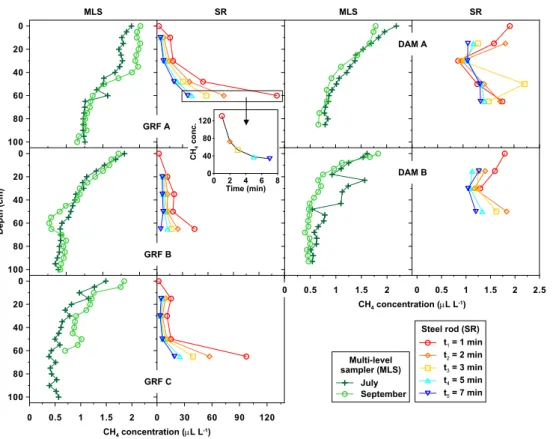
In both glacier forefields, all CH4 concentrations measured in samples from the MLS
were below atmospheric values (Fig. 1). The profiles from July and September gener-ally agreed well and displayed no major discrepancies. Concentrations of CH4showed
15
a gradual decrease with depth, typical for soils with a stable soil-CH4 sink and no
in-herent CH4 source. Lowest CH4 concentrations were around 1 µL L− 1
in young soils (A locations), and tended to decrease to 0.5 µL L−1 in older soil (B and C locations). In contrast, SR samples collected∼1 min after hammering ceased (t1; Fig. 1) showed
elevated CH4 concentrations up to 130 µL L−1 at all GRF locations. These samples
20
depict profiles comparable with one-time sampling with the SR (Nauer et al., 2012). Concentrations increased with depth, and highest values were reached at deepest sampling points. On the other hand, SR samples from DAM showed atmospheric or sub-atmospheric CH4 concentrations at all times (Fig. 1). In all SR samples O2
con-centrations were between 98–100 % of ambient air (not shown).
BGD
10, 14815–14834, 2013
Methane release in glacier forefield soils
P. A. Nauer et al.
Title Page
Abstract Introduction
Conclusions References
Tables Figures
◭ ◮
◭ ◮
Back Close
Full Screen / Esc
Printer-friendly Version Interactive Discussion
Discussion
P
a
per
|
D
iscussion
P
a
per
|
Discussion
P
a
per
|
Discuss
ion
P
a
per
|
Clearly, elevated CH4concentrations at GRF could not be explained by sample han-dling or analytical procedures, as for both sampling instruments the actual extraction of soil gas, storage and CH4measurement were identical. Sub-atmospheric CH4
con-centrations from siliceous sites showed that the SR did not “generate” CH4 by an un-known mechanism. Furthermore, we are confident that sampling with the MLS reflected
5
steady-state situations, as suggested by various tests with the instrument (Nauer et al., 2013). Using the MLS the soil is not disturbed during sampling through access tubes; disturbance occurs only once when the access tubes are installed (weeks earlier). Hence, the most probable explanation for the elevated CH4concentrations in GRF soil
is the momentary release of entrapped CH4when hammering the SR into the soil.
10
3.2 Time-series sampling with the SR
At all GRF locations, elevated CH4concentrations were decreasing exponentially within
minutes when sampling several times at the same depth before hammering the SR to the next sampling depth (Fig. 1). This is likely a consequence of the incremental dilution due to sampling, as well as diffusive gas transport away from the release source
15
(depicted in the insert of Fig. 1 with samples from GRF A at 60 cm depth). Possibly, concentrations immediately after hammering were even higher. This clearly shows that the elevated CH4 concentrations were transient and released by the act of sampling with the SR.
Time-series samples from DAM remained sub-atmospheric, with one exception at
20
DAM A,t3(Fig. 1). However, CH4concentrations tended to slightly increase with depth and decrease with time in the deepest samples. The variability of soil-CH4
concentra-tions between samples from the same depth was likely caused by soil heterogeneity and the increasing volume of soil gas extracted during repeated sampling. In GRF samples potential variability was likely masked by the released CH4. However, it
can-25
not be excluded that even in siliceous soils, small amounts of CH4 could be released
BGD
10, 14815–14834, 2013
Methane release in glacier forefield soils
P. A. Nauer et al.
Title Page
Abstract Introduction
Conclusions References
Tables Figures
◭ ◮
◭ ◮
Back Close
Full Screen / Esc
Printer-friendly Version Interactive Discussion
Discussion
P
a
per
|
D
iscussion
P
a
per
|
Discussion
P
a
per
|
Discuss
ion
P
a
per
|
With no additional information, the shape of the SR profilest1 from GRF might sug-gest a deep-soil CH4 source (Nauer et al., 2012), similar to what has been observed
in landfills or peat bogs (Fechner and Hemond, 1992; Urmann et al., 2007; Schroth et al., 2012). However, given the transient nature of the elevated CH4 concentrations in samples from the SR, a steady-state interpretation of such soil-gas profiles
involv-5
ing a continuous source has to be rejected. More likely, as suggested by results from the MLS, glacier forefield soils on both bedrock types appear to be stable sinks for atmospheric CH4. Nonetheless, the performed time-series sampling provided strong
indications that additional CH4 from sources other than the atmosphere are retained
in these fully oxic soils, whereby the amount present appears to be orders of
magni-10
tude larger in GRF compared with DAM soils. Considering the clear pattern reported in Nauer et al. (2012), where all SR samples from five calcareous glacier forefields showed elevated CH4concentrations (10–1000 µL L−
1
), the phenomenon of entrapped CH4might be more widespread in these environments.
3.3 Miniature-soil-core experiments
15
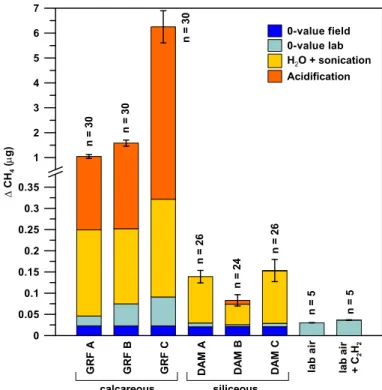
For a first quantitative assessment of entrapped CH4, miniature soil cores enclosed
in vials in the field were disturbed by different treatments in the laboratory, and the released CH4was measured (Fig. 2). The average amount of CH4released from cores of each location increased significantly during the course of the experiment, while in the control vials containing laboratory air or air+C2H2it remained constant and even
20
decreased marginally after acidification (decrease not visible in Fig. 2). Hence, cores from all locations contained some CH4that was released with either sonication or both
sonification and acidification.
However, the average amounts of CH4 released from calcareous soil cores were much higher than from siliceous cores (Fig. 2). Some of the GRF cores already
re-25
leased CH4during transport from the field to the laboratory. It is unlikely that
BGD
10, 14815–14834, 2013
Methane release in glacier forefield soils
P. A. Nauer et al.
Title Page
Abstract Introduction
Conclusions References
Tables Figures
◭ ◮
◭ ◮
Back Close
Full Screen / Esc
Printer-friendly Version Interactive Discussion
Discussion
P
a
per
|
D
iscussion
P
a
per
|
Discussion
P
a
per
|
Discuss
ion
P
a
per
|
addition of water itself had only a negligible effect (preliminary experiments, not shown), but sonication of the suspended cores released significant amounts of CH4from DAM
and GRF cores (2–5 times more from the latter; Fig. 2). This is a first indication that at least part of the CH4could be entrapped in soil colloids or cemented particles that can be suspended by ultrasound. Acidification almost exclusively affected calcareous
5
cores, for which the average amount of CH4 in the vials increased again by an order
of magnitude or more (Fig. 2). Similar CH4 concentrations in the headspace of the vial containing the core and in the vials containing the excess gas volume showed that CH4was released together with CO2during acidification only. As the acid affects
all calcareous minerals, it is unclear from which particle fraction this massive CH4
in-10
crease originated. Likely, the acid foremost affected the smaller particle fractions in suspension, and only the surface of larger particles, before it was completely buffered. Although calcareous gravel (2–5 mm fraction) from another glacier forefield (Griessen glacier; Nauer et al., 2012) and a quarry showed CH4release during acidification, total release was in the range of DAM cores (data not shown). This indicates that the bulk
15
mass of CH4in GRF samples may be entrapped in the finer soil fractions, e.g. in
ce-mented particles. Clarification of this issue will require further investigation, which was beyond the scope of this study.
On a mass basis, CH4 in the vials from GRF increased on average by a factor of
45–270 compared to the originally enclosed air. This is roughly the same order of
mag-20
nitude as the increase in soil-gas concentrations when sampling with the SR in the field. For DAM, the mass increase in the vials was in the range of 4–7, although no substantial increase in CH4concentrations was observed with the SR in the field. Rea-sons for this are unclear; it might be attributed to the 1-min delay between disturbance (hammering) and sampling with the SR, which could be sufficient to dilute potentially
25
released CH4 to ambient levels. However, it may also point towards a different nature of entrapment in siliceous versus calcareous soils.
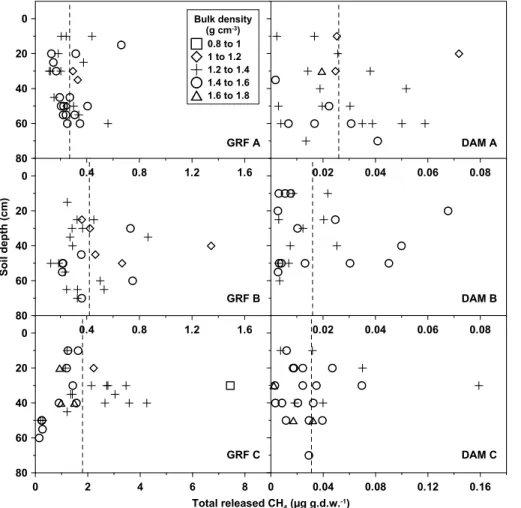
When considering individual cores, cumulative amounts of released CH4 showed
BGD
10, 14815–14834, 2013
Methane release in glacier forefield soils
P. A. Nauer et al.
Title Page
Abstract Introduction
Conclusions References
Tables Figures
◭ ◮
◭ ◮
Back Close
Full Screen / Esc
Printer-friendly Version Interactive Discussion
Discussion
P
a
per
|
D
iscussion
P
a
per
|
Discussion
P
a
per
|
Discuss
ion
P
a
per
|
7.5 µg CH4(g d.w.)− 1
, which was 1–2 orders of magnitude higher than the 0.002– 0.16 µg CH4(g d.w.)−
1
from DAM cores. For the latter, the increase of CH4 in some
vials was smaller than the estimated CH4originating from the enclosed air. In contrast, all GRF cores released substantial amounts of CH4, but some “hotspots” were
respon-sible for the most pronounced increase. However, we could not observe a clear pattern
5
of the released CH4with respect to the sampling depth of the cores, with the exception of GRF B and C, where highest amounts of CH4were released from samples collected
around 30–40 cm depth (Fig. 3). Furthermore, there was no obvious correspondence with bulk-density classes. However, it is remarkable that the only sample with an ex-ceptionally low bulk density released the highest amount of CH4from all cores (Fig. 3,
10
GRF C). At present, we lack a conclusive explanation for this observation.
3.4 Implications for further studies
In summary, we can state that there is CH4 entrapped in both the GRF and DAM soils, but the former retains orders of magnitude more CH4. In light of previous results
(Nauer et al., 2012) our findings suggest that CH4 entrapment might be a common
15
feature of glacier forefield soils, in particular on calcareous bedrock. At present, we can only speculate about the origin of released CH4 and the nature of entrapment.
The observation that the bulk mass of CH4 appears to be entrapped in the finer soil
fraction or aggregates could hint towards a potential role of secondary carbonate pre-cipitates of glacial origin (Ford et al., 1970; Fairchild et al., 1993; Lacelle, 2007). Water
20
films existing at the base of temperate glaciers can refreeze due to pressure changes while calcite precipitates and cements particles together (Fairchild et al., 1993; Carter et al., 2003). Methane produced by subglacial methanogenesis may get entrapped in closed-off pores or fissures. Such a mechanism would partially prevent or delay the outgassing of any subglacially-produced CH4 after glacial meltdown. Secondary
car-25
BGD
10, 14815–14834, 2013
Methane release in glacier forefield soils
P. A. Nauer et al.
Title Page
Abstract Introduction
Conclusions References
Tables Figures
◭ ◮
◭ ◮
Back Close
Full Screen / Esc
Printer-friendly Version Interactive Discussion
Discussion
P
a
per
|
D
iscussion
P
a
per
|
Discussion
P
a
per
|
Discuss
ion
P
a
per
|
would be preserved in the DAM soil with pH of 4–5 (Bernasconi et al., 2011). Here, other types of aggregates might be responsible for CH4 entrapment. In both glacier
forefields, CH4might also originate from recent methanogenesis in sealed microsites.
For calcareous glacier forefields we cannot exclude the possibility that the CH4 is entrapped in the bedrock itself. In this case the likely origin of the CH4 would be
ther-5
mogenic. Sampled calcareous glacier forefields in Nauer et al. (2012) lie on late juras-sic or early cretaceous limestones as part of the Helvetic nappes (Geological Atlas 1 : 500 000, Federal Office of Topography swisstopo, Wabern, Switzerland). The oc-currence of these limestones partially overlaps with a zone where fluid inclusions in quartz-filled fissures are dominated by thermogenic CH4 (Mullis et al., 1994;
Taran-10
tola et al., 2007). In some adjacent marls in the Helvetic nappes, CH4-dominated fluid inclusions in calcite-filled fissures have also been documented (Gautschi et al., 1990). Further insights in the nature of these CH4 entrapments require additional
experi-ments with fresh samples, including initial separation of grain-size classes, and com-plete dissolution of calcareous minerals to establish a total mass balance. Radiocarbon
15
age determination and auxiliary stable isotope measurements may shed light on the origin of entrapped CH4. Furthermore, given the relative ease of how entrapped CH4 was released, its potential bioavailability should be addressed. Particularly in glacier forefields, CH4 diffusing from such entrapments could represent an additional source
of carbon in an otherwise oligotrophic environment.
20
Supplementary material related to this article is available online at http://www.biogeosciences-discuss.net/10/14815/2013/
bgd-10-14815-2013-supplement.pdf.
Acknowledgements. Funding for this study by the Swiss National Science Foundation (grant no. 200021-137721) and by ETH Zurich (grant no. TH-20 06-3) is gratefully acknowledged.
25
Further-BGD
10, 14815–14834, 2013
Methane release in glacier forefield soils
P. A. Nauer et al.
Title Page
Abstract Introduction
Conclusions References
Tables Figures
◭ ◮
◭ ◮
Back Close
Full Screen / Esc
Printer-friendly Version Interactive Discussion
Discussion
P
a
per
|
D
iscussion
P
a
per
|
Discussion
P
a
per
|
Discuss
ion
P
a
per
|
more, we acknowledge the valuable inputs form Helmut Weissert, Dept. of Earth Sciences, ETH Zurich.
References
Bárcena, T., Finster, K., and Yde, J.: Spatial Patterns of Soil Development, Methane Oxida-tion, and Methanotrophic Diversity along a Receding Glacier Forefield, Southeast Greenland,
5
Arct. Antarct. Alp. Res., 43, 178–188, 2011.
Bárcena, T. G., Yde, J. C., and Finster, K. W.: Methane flux and high-affinity methanotrophic diversity along the chronosequence of a receding glacier in Greenland, Ann. Glaciol., 51, 23–31, 2010.
Bernasconi, S. M., Bauder, A., Bourdon, B., Brunner, I., Bünemann, E., Chris, I., Derungs, N.,
10
Edwards, P., Farinotti, D., Frey, B., Frossard, E., Furrer, G., Gierga, M., Göransson, H., Gül-land, K., Hagedorn, F., Hajdas, I., Hindshaw, R., Ivy-Ochs, S., Jansa, J., Jonas, T., Kiczka, M., Kretzschmar, R., Lemarchand, E., Luster, J., Magnusson, J., Mitchell, E. A. D., Venterink, H. O., Plötze, M., Reynolds, B., Smittenberg, R. H., Stähli, M., Tamburini, F., Tipper, E. T., Wacker, L., Welc, M., Wiederhold, J. G., Zeyer, J., Zimmermann, S., and Zumsteg, A.:
Chem-15
ical and Biological Gradients along the Damma Glacier Soil Chronosequence, Switzerland, Vadose Zone J., 10, 867–883, 2011.
Bousquet, P., Ciais, P., Miller, J. B., Dlugokencky, E. J., Hauglustaine, D. A., Prigent, C., Van der Werf, G. R., Peylin, P., Brunke, E. G., Carouge, C., Langenfelds, R. L., Lathiere, J., Papa, F., Ramonet, M., Schmidt, M., Steele, L. P., Tyler, S. C., and White, J.: Contribution
20
of anthropogenic and natural sources to atmospheric methane variability, Nature, 443, 439– 443, 2006.
Boyd, E. S., Skidmore, M., Mitchell, A. C., Bakermans, C., and Peters, J. W.: Methanogenesis in subglacial sediments, Environ. Microbiol. Reports, 2, 685–692, 2010.
Bridgham, S. D., Cadillo-Quiroz, H., Keller, J. K., and Zhuang, Q.: Methane emissions from
25
wetlands: biogeochemical, microbial, and modeling perspectives from local to global scales, Glob. Change Biol., 19, 1325–1346, 2013.
BGD
10, 14815–14834, 2013
Methane release in glacier forefield soils
P. A. Nauer et al.
Title Page
Abstract Introduction
Conclusions References
Tables Figures
◭ ◮
◭ ◮
Back Close
Full Screen / Esc
Printer-friendly Version Interactive Discussion
Discussion
P
a
per
|
D
iscussion
P
a
per
|
Discussion
P
a
per
|
Discuss
ion
P
a
per
|
Carter, C. L., Dethier, D. P., and Newton, R. L.: Subglacial environment inferred from bedrock-coating siltskins, Mendenhall Glacier, Alaska, U. S. A., J. Glaciol., 49, 568–576, 2003. Conrad, R.: The global methane cycle: recent advances in understanding the microbial
pro-cesses involved, Environ. Microbiol. Reports, 1, 285–292, 2009. Crutzen, P. J.: Methane’s sinks and sources, Nature, 350, 380–381, 1991.
5
Duc, L., Noll, M., Meier, B., Bürgmann, H., and Zeyer, J.: High Diversity of Diazotrophs in the Forefield of a Receding Alpine Glacier, Microb. Ecol., 57, 179–190, 2009.
Dutaur, L. and Verchot, L. V.: A global inventory of the soil CH4sink, Global Biogeochem. Cy., 21, GB4013, doi:10.1029/2006GB002734, 2007.
Etiope, G. and Klusman, R. W.: Geologic emissions of methane to the atmosphere,
Chemo-10
sphere, 49, 777–789, 2002.
Etiope, G. and Klusman, R. W.: Microseepage in drylands: Flux and implications in the global atmospheric source/sink budget of methane, Global Planet. Change, 72, 265–274, 2010. Fairchild, I. J., Bradby, L., and Spiro, B.: Carbonate diagenesis in ice, Geology, 21, 901–904,
1993.
15
Fechner, E. J. and Hemond, H. F.: Methane transport and oxidation in the unsaturated zone of a Sphagnum peatland, Global Biogeochem. Cy., 6, 33–44, 1992.
Ford, D. C., Fuller, P. G., and Drake, J. J.: Calcite Precipitates at the Soles of Temperate Glaciers, Nature, 226, 441–442, 1970.
Forster, P., Ramaswamy, V., Artaxo, P., Berntsen, T., Betts, R., Fahey, D. W., Haywood, J., Lean,
20
J., Lowe, D. C., Myhre, G., Nganga, J., Prinn, R., Raga, G., Schulz, M., and Van Dorland, R.: Changes in atmospheric constituents and in radiative forcing, in: Climate Change 2007: The Physical Science Basis. Contribution of Working Group I to the Fourth Assessment Report of the Intergovernmental Panel on Climate Change, edited by: Solomon, S., Qin, D., Manning, Z., Chen, Z., Marquis, M., Averyt, K. B., Tignor, M., and Miller, H. L., Cambridge University
25
Press, Cambridge, UK and New York, NY, USA, 2007.
Gautschi, A., Faber, E., Meyer, J., Mullis, J., Schenker, F., and Ballentine, C.: Hydrocarbon and noble gases in fluid inclusions of alpine calcite veins: implications for hydrocarbon explo-ration, Bulletin der Vereinigung Schweizerischer Petroleum-Geologen und-Ingenieure, 57, 13-36, 1990.
30
BGD
10, 14815–14834, 2013
Methane release in glacier forefield soils
P. A. Nauer et al.
Title Page
Abstract Introduction
Conclusions References
Tables Figures
◭ ◮
◭ ◮
Back Close
Full Screen / Esc
Printer-friendly Version Interactive Discussion
Discussion
P
a
per
|
D
iscussion
P
a
per
|
Discussion
P
a
per
|
Discuss
ion
P
a
per
|
Lacelle, D., Lauriol, B., and Clark, I. D.: Origin, age, and paleoenvironmental significance of carbonate precipitates from a granitic environment, Akshayuk Pass, southern Baffin Island, Canada, Can. J. Earth Sci., 44, 61–79, 2007.
Lazzaro, A., Abegg, C., and Zeyer, J.: Bacterial community structure of glacier forefields on siliceous and calcareous bedrock, Eur. J. Soil Sci., 60, 860–870, 2009.
5
Lazzaro, A., Brankatschk, R., and Zeyer, J.: Seasonal dynamics of nutrients and bacterial com-munities in unvegetated alpine glacier forefields, Appl. Soil Ecol., 53, 10–22, 2012.
Milkov, A. V., Sassen, R., Apanasovich, T. V., and Dadashev, F. G.: Global gas flux from mud volcanoes: A significant source of fossil methane in the atmosphere and the ocean, Geophys. Res. Lett., 30, 1037, doi:10.1029/2002GL016358 2003.
10
Miteva, V., Teacher, C., Sowers, T., and Brenchley, J.: Comparison of the microbial diversity at different depths of the GISP2 Greenland ice core in relationship to deposition climates, Environ. Microbiol., 11, 640–656, 2009.
Mullis, J., Dubessy, J., Poty, B., and O’Neil, J.: Fluid regimes during late stages of a continental collision: Physical, chemical, and stable isotope measurements of fluid inclusions in fissure
15
quartz from a geotraverse through the Central Alps, Switzerland, Geochim. Cosmochim. Ac., 58, 2239–2267, 1994.
Nauer, P. A. and Schroth, M. H.: In Situ Quantification of Atmospheric Methane Oxidation in Near-Surface Soils, Vadose Zone J., 9, 1052–1062, 2010.
Nauer, P. A., Dam, B., Liesack, W., Zeyer, J., and Schroth, M. H.: Activity and diversity of
20
methane-oxidizing bacteria in glacier forefields on siliceous and calcareous bedrock, Bio-geosciences, 9, 2259–2274, doi:10.5194/bg-9-2259-2012, 2012.
Nauer, P. A., Chiri, E., and Schroth, M. H.: Poly-use multi-level sampling system for soil-gas transport analysis in the vadose zone, Environ. Sci. Technol., in press, doi:10.1021/es401958u, 2013.
25
Price, P. B. and Sowers, T.: Temperature dependence of metabolic rates for microbial growth, maintenance, and survival, P. Natl. Acad. Sci. USA, 101, 4631–4636, 2004.
Rochette, P. and Bertrand, N.: Soil-Surface Gas Emissions, in: Soil Sampling and Methods of Analysis, 2nd Edn., CRC Press, 2007.
Rochette, P. and Eriksen-Hamel, N. S.: Chamber Measurements of Soil Nitrous Oxide Flux: Are
30
BGD
10, 14815–14834, 2013
Methane release in glacier forefield soils
P. A. Nauer et al.
Title Page
Abstract Introduction
Conclusions References
Tables Figures
◭ ◮
◭ ◮
Back Close
Full Screen / Esc
Printer-friendly Version Interactive Discussion
Discussion
P
a
per
|
D
iscussion
P
a
per
|
Discussion
P
a
per
|
Discuss
ion
P
a
per
|
Schroth, M. H., Eugster, W., Gómez, K. E., Gonzalez-Gil, G., Niklaus, P. A., and Oester, P.: Above- and below-ground methane fluxes and methanotrophic activity in a landfill-cover soil, Waste Manage., 32, 879–889, 2012.
Sharp, M., Parkes, J., Cragg, B., Fairchild, I. J., Lamb, H., and Tranter, M.: Widespread bacterial populations at glacier beds and their relationship to rock weathering and carbon cycling,
5
Geology, 27, 107–110, 1999.
Sigler, W. V. and Zeyer, J.: Microbial Diversity and Activity along the Forefields of Two Receding Glaciers, Microb. Ecol., 43, 397–407, 2002.
Skidmore, M., Anderson, S. P., Sharp, M., Foght, J., and Lanoil, B. D.: Comparison of Micro-bial Community Compositions of Two Subglacial Environments Reveals a Possible Role for
10
Microbes in Chemical Weathering Processes, Appl. Environ. Microb., 71, 6986–6997, 2005. Skidmore, M. L., Foght, J. M., and Sharp, M. J.: Microbial Life beneath a High Arctic Glacier,
Appl. Environ. Microbiol., 66, 3214–3220, 2000.
Stevens, P. R. and Walker, T. W.: The Chronosequence Concept and Soil Formation, Q. Rev. Biol., 45, 333–350, 1970.
15
Stibal, M., Wadham, J. L., Lis, G. P., Telling, J., Pancost, R. D., Dubnick, A., Sharp, M. J., Lawson, E. C., Butler, C. E. H., Hasan, F., Tranter, M., and Anesio, A. M.: Methanogenic potential of Arctic and Antarctic subglacial environments with contrasting organic carbon sources, Glob. Change Biol., 18, 3332–3345, 2012.
Tarantola, A., Mullis, J., Vennemann, T., Dubessy, J., and de Capitani, C.: Oxidation of methane
20
at the CH4/H2O–(CH4) transition zone in the external part of the Central Alps, Switzerland: Evidence from stable isotope investigations, Chem. Geol., 237, 329–357, 2007.
Urmann, K., Gonzalez-Gil, G., Schroth, M. H., and Zeyer, J.: Quantification of Microbial Methane Oxidation in an Alpine Peat Bog, Vadose Zone J., 6, 705–712, 2007.
Wadham, J. L., Bottrell, S., Tranter, M., and Raiswell, R.: Stable isotope evidence for microbial
25
sulphate reduction at the bed of a polythermal high Arctic glacier, Earth Planet. Sc. Lett., 219, 341–355, 2004.
Wadham, J. L., Tranter, M., Tulaczyk, S., and Sharp, M.: Subglacial methanogenesis: A poten-tial climatic amplifier?, Global Biogeochem. Cy., 22, GB2021, doi:10.1029/2007GB002951, 2008.
30
BGD
10, 14815–14834, 2013
Methane release in glacier forefield soils
P. A. Nauer et al.
Title Page
Abstract Introduction
Conclusions References
Tables Figures
◭ ◮
◭ ◮
Back Close
Full Screen / Esc
Printer-friendly Version Interactive Discussion
Discussion
P
a
per
|
D
iscussion
P
a
per
|
Discussion
P
a
per
|
Discuss
ion
P
a
per
|
100 80 60 40 20 0
MLS SR
100 80 60 40 20 0
D
e
p
th
(
c
m
)
100 80 60 40 20 0
0 0.5 1 1.5 2
CH4 concentration (mL L-1)
0 30 60 90 120
Steel rod (SR) t1 = 1 min
t2 = 2 min
t3 = 3 min
t4 = 5 min
t5 = 7 min
0 0.5 1 1.5 2
CH4 concentration (mL L-1) MLS
0 0.5 1 1.5 2 2.5 SR
0 2 4 6 8
Time (min) 0
40 80 120
C
H4
c
o
n
c
.
GRF A
GRF B
GRF C
DAM A
DAM B
Multi-level sampler (MLS)
July September
Fig. 1.Soil-CH4profiles obtained from the MLS and the SR time-series soil-gas samples. The
BGD
10, 14815–14834, 2013
Methane release in glacier forefield soils
P. A. Nauer et al.
Title Page Abstract Introduction Conclusions References Tables Figures ◭ ◮ ◭ ◮ Back Close
Full Screen / Esc
Printer-friendly Version Interactive Discussion Discussion P a per | D iscussion P a per | Discussion P a per | Discuss ion P a per | G R F A G R F B G R F C D A M A D A M B D A M C la b a ir 0 0.05 0.1 0.15 0.2 0.25 0.3 0.35 1 2 3 4 5 6 7 D C H4 ( m g ) 0-value field 0-value lab
H2O + sonication
Acidification n = 3 0 n = 3 0 n = 3 0 n = 2 6 n = 2 4 n = 2 6 n = 5 n = 5 la b a ir + C 2 H2 siliceous calcareous
Fig. 2.Cumulative, average amount of CH4released from miniature soil cores after treatments
BGD
10, 14815–14834, 2013
Methane release in glacier forefield soils
P. A. Nauer et al.
Title Page
Abstract Introduction
Conclusions References
Tables Figures
◭ ◮
◭ ◮
Back Close
Full Screen / Esc
Printer-friendly Version Interactive Discussion
Discussion
P
a
per
|
D
iscussion
P
a
per
|
Discussion
P
a
per
|
Discuss
ion
P
a
per
|
0.4 0.8 1.2 1.6
80 60 40 20
0 Bulk density
(g cm-3)
0.8 to 1 1 to 1.2 1.2 to 1.4 1.4 to 1.6 1.6 to 1.8
GRF A
0.4 0.8 1.2 1.6
80 60 40 20 0
S
o
il
d
e
p
th
(
c
m
)
GRF B
0 2 4 6 8
Total released CH4 (µg g.d.w.-1)
80 60 40 20 0
GRF C
0.02 0.04 0.06 0.08
DAM A
0.02 0.04 0.06 0.08
DAM B
0 0.04 0.08 0.12 0.16
DAM C
Fig. 3.Depth distribution and cumulative CH4released from individual miniature soil cores. The