ABUNDANCE AND DIVERSITY OF SOIL MITES OF FRAGMENTED HABITATS
IN A BIOSPHERE RESERVE IN SOUTHERN NIGERIA
1MOSADOLUWA ADETOLA BADEJO2 and BUNY AMIN OLA-ADAMS3
ABSTRACT - Soil samples were collected from the top 7.5 cm of soil in a Strict Natural Reserve (SNR), a surrounding buffer zone, a cassava farm and matured plantations of Gmelina, teak, and pine, so as to determine if plantation establishment and intensive cultivation affect the density and diversity of soil mites. Altogether, 41 taxonomic groups of mites were identified. The diversity and densities of mites in within the SNR, the buffer zone and the Gmelina were more than the diversity and densities in the cassava farm, teak and pine plantations. Each plantation had its own unique community structure which was different from the community structure in the SNR plot. The SNR plot and Gmelina were domi-nated by detritivorous cryptostigmatid mites unlike teak and pine which were domidomi-nated by predatory mesostigmatid and prostigmatid mites respectively. Low cryptostigmatid mite densities in the planta-tions and cassava farm were seen as a consequence of low fertility status of the soil, the evidence of which was revealed by soil pH and organic matter data.
Index terms: cassava, Gmelina, plantations, soil fauna, intensive farming.
ABUNDÂNCIA E DIVERSIDADE DE ÁCAROS DE HABITATS FRAGMENTADOS EM UMA RESERVA DE BIOSFERA NO SUL DA NIGÉRIA
RESUMO - Foram coletadas amostras de solo até a profundidade de 7,5 cm em uma reserva estritamente natural (SRN), em uma zona na vizinhança da SRN, e em plantações de mandioca, Gmelina, teca e pinheiros. O objetivo foi verificar se o estabelecimento de plantação e cultivo intensivo afetam a densidade e a diversidade de ácaros do solo. Ao todo, 41 grupos taxonômicos de ácaros foram identificados. A SNR, a zona vizinha da SNR e a plantação de Gmelina apresentavam maior densidade e diversidade de ácaros do que as plantações de mandioca, tecas e pinheiros. Cada plantação tinha sua própria estrutura de comunidade, diferente da estrutura existente na SNR. A SNR e a Gmelina eram dominadas por ácaros criptostigmatidas detritívoros, diferentemente das plantações de tecas e pinheiros, que eram dominadas por predadores mesostigmatidas e prostigmatidas, respectivamente. As baixas densidades de criptostigmatidas nas plantações de mandioca eram vistas como conseqüência da baixa fertilidade do solo, demonstrada pelos dados do pH baixo e pelos dados da matéria orgânica.
Termos para indexação: mandioca, Gmelina, plantações, fauna do solo, agricultura intensiva.
1Accepted for publication on September 15, 2000. 2Zoologist, Ph.D., Department of Zoology, Obafemi Awolowo
University, P.O. Box 1257, Ile-Ife, Nigeria. E-mail: [email protected]
3Forester, Dr., College of Environmental Resources Management, University of Agriculture, P.M.B. 2240 Abeokuta, Ogun, Nigeria. E-mail: [email protected]
INTRODUCTION
Habitat fragmentation is associated with
development, especially with the extension of various
agricultural and silvicultural practices (Sgardelis &
Soil tillage, application of biocides, reduction of
vegetation cover and the consequent changes in
microclimate have been reported to have negative
effects on survival and reproduction of soil
microarthropods in arable fields (Moore et al., 1984;
Badejo & Lasebikan, 1988; Badejo & Akinyemiju,
1989, 1993; Badejo, 1990; Badejo & Straalen, 1993;
Badejo & Olaifa, 1997; Badejo et al., 1997). When
cultivation is done on a continuous basis, the period
available for soil fauna to grow becomes shortened.
Cryptostigmatid mites (Oribatida) in particular suffer
deleterious effects because of their relatively long
life span and ontogenic development, low fecundity,
relatively poor dispersion ability and parental care
regarding oviposition microsites (Murphy & Jalil,
1964; Jalil, 1965; Weigmann, 1975; Webb, 1977;
Steinberger et al., 1990; Stamou & Asikids, 1992).
It is therefore expected that the structure of mite
communities in the fragmented Omo Biosphere
Re-serve will vary between compartments depending
on the degree of land use, type and extent of
vegetation cover and extent of isolation from
relatively undisturbed sites. Attention is being
focused on soil mites in southwestern Nigeria because
they account for about 50-60% of the soil
microarthropod fauna (Badejo, 1987).
The aim of this study therefore is to investigate
the diversity of soil mite populations in the
fragmented habitats in Omo Biosphere Reserve so
as to test the hypothesis that plantation
establishment as well as intensive cultivation affect
the density and diversity of soil mites.
MATERIAL AND METHODS
Site description
Omo Biosphere Reserve is one of the 31 Biosphere Reserves in 127 countries within the Afrotropical Realm. It is located between latitudes 6o 35' to 7o 5’N and 4o 19'
to 4o 10’E in the Ijebu area of Ogun State in southwestern
Nigeria. It is in the mixed moist, semi-evergreen rainforest zone in the Congolian sub-unit of the Guinea-Congolian Centre of Endemism or Phytochorion (Isichei, 1995). This reserve covers 130,500 ha of land about 20 km from the Atlantic coast 460 ha of land in the north central part of the reserve had been designated as a Strict Natural Reserve (SNR) since 1946. Plantations of local and exotic trees are present in the southernmost part of this Biosphere
Reser-ve about 10 km away from the SNR and they are separated by farmlands and/or hedgerows. Detailed description of the physiognomy of the vegetation in the SNR and the plantations have been provided by Dike (1992) and Isichei (1995).
Geologically, the Biosphere reserve lies on crystalline rocks of the undifferentiated basement complex which in the southern parts is overlain by Eocene deposits of sand, clay and gravel. The terrain is undulating and the maximum elevation of 150 m above sea level is towards the west where this study was carried out. The soil of the area is characterized by low pH, high percentage organic matter and low water table that is characteristic of highly drained sandy soils that have perennial vegetation cover (Okali & Ola-Adams, 1987; Isichei, 1995).
For the purpose of this study, the Biosphere Reserve was divided into four zones. These zones are, the SNR, the buffer zone, the cassava farm and the plantations. On March 29 and 30, 1996, a 10 x 10 m plot was selected for sampling in each of the SNR and buffer zones. On April 12 and 13, 1996, the Biosphere Reserve was visited again and soil samples were taken from 10 x 10 m plots in each of the plantations of Gmelina arborea {all plant names after Lowe & Soladoye (1990)}, Tectona grandis (teak) and Pinus caraba (pine) which were between 20 and 25 years old, and in a cassava farm on the fringe of the buffer zone. From oral evidence, the cassava farm had been under cultivation for the past 20 years. The farm was usually left to fallow after every three years of cultivation. At the time of this study, the cassava farm had been established for just one year after three years of fallowing. Altogether, a total of six plots were sampled during this investigation. Without removing the litter cover, a bucket auger of mouth diameter 8.75 cm was pressed down to the soil to collect samples from the top 7.5 cm of the soil in six randomly selected points within each plot (10 x 10 m). Each sample unit was carefully pushed with a peg from the auger into a polythene bag which was securely tied at the mouth to prevent desiccation and spilling of soil before reaching the laboratory. Soil samples were collected from the top 0-7.5 cm layer of the soil in this study because previous studies have revealed that about 90% of soil microarthropods live in this layer in forests and cultivated plots (Chiba et al., 1975; Badejo & Akinyemiju, 1993).
Extraction procedure
In the laboratory, the Bukard model of Berlese-Tullgren funnel extractor (Lasebikan, 1974) was used to extract soil microarthropods from soil samples. Description of a unit of this extractor as well as the extraction details have been provided by Badejo (1996). After extraction which lasted for seven days, the extracted microarthropods were poured into a petri-dish from where the mites were sorted from the rest of the microarthropods and counted under a dissecting microscope. Temporary mounts of specimens were made and examined thoroughly for fine taxonomic details under the compound microscope but a large majority of the specimens were preserved in Koenike’s fluid (Beirne, 1963). The mites were identified to family or generic levels using keys and illustrations provided in Baker & Wharton (1952), Evans et al. (1967), Norton (1990) and Woolley (1990) as well as comparing them with those already identified in the Laboratory for Systematics and Ecology of Microarthropods in Obafemi Awolowo University, Ile-Ife, Nigeria.
Statistical analysis
The Berger-Parker Dominance Index (D) (Southwood, 1978) was calculated to compare differences in the diversity and relative abundance of mites in all the plots.
RESULTS AND DISCUSSION
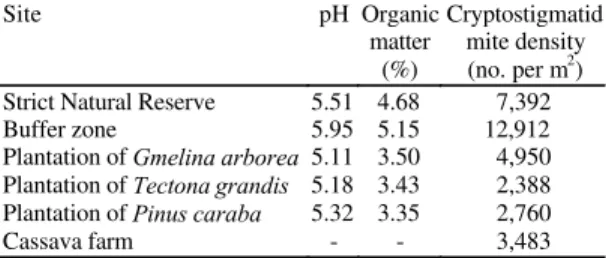
Data on soil pH, organic matter content and
densities of cryptostigmatid mites are presented in
Table 1. The soil of the area studied has a low pH but
there is a tendency for the pH to be lower in the
plantations than in the buffer and SNR. Low pH
suggests acidity and consequently poor nutrient
relations (Swift & Woomer, 1993). Although organic
matter is relatively high in all the plots when
compared with similar environments where organic
matter as low as 2.0% have been recorded (Badejo &
Akinyemiju, 1989), there is still an indication of lower
organic matter in the plantations than in the SNR
and buffer plots. Organic matter is a source and a
sink for nutrient elements in the soil. It has appreciable
influence on many soil properties, hence its
significance in maintenance of soil fertility (Swift &
Woomer, 1993). It can therefore be concluded that
there are indications, from pH and soil organic matter
TABLE 1. Soil pH, organic matter and cryptostigmatid mite densities in the experimental plots in the top 0-7.5 cm of soil (mean based on 6 samples).
Site pH Organic
matter (%)
Cryptostigmatid mite density (no. per m2
)
Strict Natural Reserve 5.51 4.68 7,392
Buffer zone 5.95 5.15 12,912
Plantation of Gmelina arborea 5.11 3.50 4,950
Plantation of Tectona grandis 5.18 3.43 2,388
Plantation of Pinus caraba 5.32 3.35 2,760
Cassava farm - - 3,483
data, that plantation establishment has reduced soil
fertility in the study area.
Only cryptostigmatid mite densities are presented
in Table 1 because unlike other groups (mesostigmata
and prostigmata) which contain predatory and
parasitic forms, this group comprises of exclusively
phytophagous and detritivorous feeders whose
direct influence on decomposition processes and
nutrient cycling in the soil has been documented
(Wallwork, 1976). Many cryptostigmatid species feed
directly on decomposing litter (saprophagous) while
many others feed on soil fungi (mycophages).
Cryptostigmatid mite densities in the SNR are three
times as many as the densities in teak and pine and
they are about twice as many as the numbers in
Gmelina
and cassava. The highest density was
mites than the
Gmelina
plot. These three plots
contained more cryptostigmatid mites than the
cas-sava, pine and teak plots.
The Berger-Parker Dominance Index for each
genus/family of soil mites extracted from the
experi-mental plots are presented in Table 2. This index is a
measure of the percentage contribution of a
taxonomic group to the total number of mites in each
plot. Genera/families that provided 10% or more of
the total density of mites in a plot are regarded as
dominant and they are between two and four in all
plots. The highest number of taxonomic groups was
recorded from the buffer zone while the least was
recorded from the cassava farm. The slight difference
in the number of taxonomic groups between the SNR
and buffer zone is probably due to the higher organic
matter in the buffer zone (Table 1) which may be a
consequence of more human activities other than
soil tillage in the buffer zone. Such activities have
been reported by Ola-Adams & Onyeachusim (1993)
and Isichei (1995) as exploitation of wildlife and
several non-timber forest products.
In the buffer and cassava plots, there was a large
percentage of
Eremulus
which was hardly present in
the SNR plot. Each of the plantations appears to have
a unique mite community structure that is different
from the community structures in the cassava farm,
buffer zone and SNR. In
Gmelina
,
Scheloribates
was
the most dominant. In teak,
Annectacarus
,
and a
mesostigmatid mite genus,
Rhodacarus
, were highly
dominant. In pine, an unidentified prostigmatid
species belonging to the family Caeculidae was the
most dominant. In the SNR and buffer plots, the
dominant groups are all cryptostigmatid mites. The
slight differences in the species composition of mites
in these two plots may therefore not have a serious
influence on the functioning of the mite segment of
the soil ecosystem. The dominant shift in favour of
Eremulus
in the cassava farm, coupled with low
diversity and density of mites suggests an effect of
intensive cultivation on the mite community in this
farm. In teak and pine, the dominance shift in favour
of predatory mites suggest an alteration in ecosystem
functioning. This dominance shift from
cryptostigmatid to prostigmatid mites has also been
observed during the transformation of a woodland
into arable field in a temperate environment by
Sgardelis & Usher (1994).
High diversity of mites in
Gmelina
coupled with
dominance shift in favour of
Scheloribates
, a
cryptostigmatid species, suggest that
Gmelina
is
more favourable to cryptostigmatid mite populations
than pine and teak. Conditions on the floor of
Gmelina
are similar to those on the floor of the SNR
plot as a result of the dense cover of undergrowth
and various other shrubs and tree species. This must
have provided adequate shade and litter cover which
has been reported to enhance the rapid growth of
soil mite populations (Lasebikan, 1988; Badejo et al.,
1995). The paucity of soil mites in pine despite the
heavy cover of undecayed pine twigs and
undergrowth might be due to the chemical
composition of the litter. Studies in the same
vegetation and climatic zone in Nigeria have revealed
that chemical composition of litter can influence the
abundance and diversity of soil microarthropods
(Badejo et al., 1995). The low diversity of soil mites
in teak might be due to the extensive erosion of the
top soil in many areas. It is however interesting to
note that
Annectacarus
accounts for 30% of the mites
extracted from this plantation. This genus which has
been found to recover quickly from herbicide
treatment (Badejo & Akinyemiju, 1993) must have
benefited from the conditions in the teak plantation.
It is certain from these results that habitat
fragmentation in the Biosphere Reserve has resulted
in clear changes in the population structure of the
soil-dwelling mites. The diversity data tend to agree
0,000 5,000 10,000 15,000
Buffer zone Strict Natural Reserve
Plantation of Gmelina arborea
Cassava farm
Plantation of Pinus caraba
Plantation of Tectona grandis
Mite number per m
2
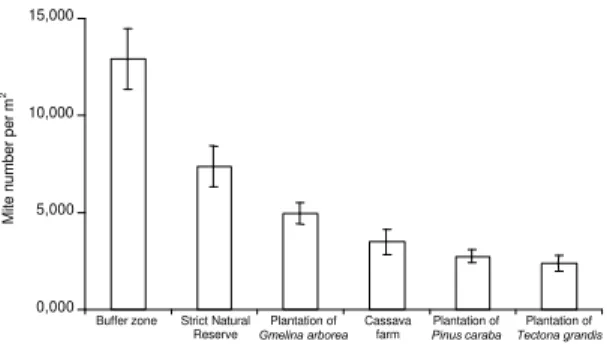
FIG. 1. The densities (no. per m2 ± std. error) of
TABLE 2. The dominance index (species/number ratio expressed in percentage) of soil mites in the study area.
Mite group Strict Natural
Reserve Buffer zone Cassavafarm Plantation
Gmelina arborea
Tectona grandis
Pinus caraba Oribatida (Cryptostigmata)
Annectacarus 0 1 0 2 30 0
Basilobelba 1 2 0 0 0 8
Belba 1 1 3 0 3 0
Carabodes sp.1 0 1 0 2 0 0
Carabodes sp.2 0 0 0 0 0 0
Dolicheremaeus 5.5 5 0 0 0 0
Epilohmannia 1 0 0 0 0 0
Eremulus 1 13 40 2 0 0
Galumna 3.5 2 0 0 0 0
Haplozetes 16 6 0 3 0 3
Hermannia 1 1 3 2 3 0
Indotritia 0 0 0 6 0 0
Machadobelba 0 3 3 5 3 18
Mesoplophora 0 0 0 0 0 0
Nothrus 0 0 0 0 12 12
Oppia 3 28 7 19 12 5
Oribates 9 0 3 5 3 3
Pilizetes 40 13 0 14 0 10
Platynothrus 1 0 7 2 1 0
Scheloribates 3 6 7 22 0 8
Tectocepheus 0 5 3 0 3 0
Teleioliodes 1 0 0 4 7 0
Cepheidae 0 0 10 0 0 0
Gamasida (Mesostigmata)
Macrocheles 0 0.5 0 0 0 0
Parasitus 0 0.5 10 0 0 0
Rhodacarus 0 0 0 0 18 0
Dermanyssidae 0 0 0 0 0 3
Polyaspididae sp.1 0 3 4 2 0 0
Polyaspididae sp.2 3 0 0 2 0 0
Protodinichidae 1 0.5 0 2 0 0
Uropodidae sp.1 6 4 0 2 1 0
Uropodidae sp.2 0 0 0 0 0 0
Uropodidae sp.3 1 0 0 2 0 0
Uropodidae sp.4 0 1 0 0 0 0
Actinedida (Prostigmata)
Bdellidae 0 3 0 0 0 3
Caeculidae 1 0 0 0 0 25
Cunaxidae 0 0.5 0 0 0 0
Rhagidiidae 0 0 0 2 4 0
Smaridiidae 0 0 0 0 0 0
Trombellidae sp.1 0 0 0 0 0 2
Trombellidae sp.2 1 0 0 0 0 0
No of taxonomic groups 20 22 12 19 13 13
No of dominant groups 2 3 3 3 4 4
with the trend seen in the densities (Fig. 1) in respect
of the magnitude of the effect of disturbances on
soil mite populations.
Previous studies on the ecology of soil
microarthropods in similar environments have
This study was carried out in March/April during
the early wet season when many mite species had
just started recruiting their populations through
reproduction. A more extensive sampling programme
will provide more information on the diversity as well
as absolute densities of mites in the fragmented
habitats.
CONCLUSIONS
1. Habitat fragmentation in the Biosphere
Reser-ve leads to fragmentation of the soil mite community
and alteration of their densities and diversity.
2. Plantation establishment brings about a
dominance shift to other mite species.
3. Type of vegetation cover and the resulting litter
as well as intensive agriculture affect mite population
densities and diversity in the soil.
4. Low soil cryptostigmatid mite densities signify
poor fertility in cultivated soils.
ACKNOWLEDGEMENTS
To the financial support of Unesco – MAB Paris
and German Federal Ministry of Economic
Co-operation and Development (BMZ), which made it
possible to carry out this investigation; to the
National Agricultural Research Project (NARP) in
Nigeria for providing logistic support that ensured
the completion of this work; to Professor A. O. Isichei
of the Department of Botany, Obafemi Awolowo
University, who linked me up with the research group
of Professor Ola-Adams; to Dr. Adriana Aquino of
Empresa Brasileira de Pesquisa Agropecuária
(Embrapa) in Brazil and two anonymous reviewers
for reading through the manuscript and offering
valuable suggestions.
REFERENCES
BADEJO, M.A. Acarine populations of forest and fallow plots in Ile-Ife, Nigeria. Pedobiologia, Jena, v.39, p.555-560, 1995.
BADEJO, M.A. Measuring the diversity of soil microflora and microfauna in an area of conservation of biodiversity. In: OLA-ADAMS, B.A.; OJO, L.O. (Ed.). Biosphere reserves for diversity
conservation and sustainable development in
Anglophone Africa (BRAAF):assessment and
monitoring techniques in Nigeria. Abeokuta : Nigerian National Committee for Man and Biosphere, 1996. p.83-100.
BADEJO, M.A. Seasonal abundance of soil mites (Acarina) in two contrasting environments. Biotropica,
Wa-shington, v.22, n.4, p.382-390, 1990.
BADEJO, M.A. Soil microarthropod fauna of three contrasting habitats in Obafemi Awolowo University campus, Ile-Ife, Nigeria. Ife Journal of Science, Ile-Ife, v.2, p.7-13, 1987.
BADEJO, M.A.; AKINYEMIJU, O.A. Influence of atrazine on soil microarthropod fauna and the performance of maize (Zea mays L.) in a humid tro-pical environment.Ife Journal of Agriculture, Ile-Ife, v.11, p.41-50, 1989.
BADEJO, M.A.; AKINYEMIJU, O.A. Response of soil mites to hexazinone application in Nigeria. Science
of the Total Environment, Amsterdam,
p.1156-1159, 1993. Supplement, part 2.
BADEJO, M.A.; LASEBIKAN, B.A. Comparative studies on the acarine populations of a secondary regrowth forest and a cassava plantation in Ile-Ife, Nigeria. Pedobiologia, Jena, v.32, p.111-116, 1988.
BADEJO, M.A.; OLAIFA, J.I. Effect of precultivation and weed control practices on epigeic Collembola of cowpea in Nigeria. Insect Science and Its
Application, Nairobi, v.17, n.2, p.192-198, 1997.
BADEJO, M.A.; OLAIFA, J.I.; STRAALEN, N.M. van. Effect of Galex on springtails in cowpea.
Pedobiologia, Jena, v.41, p.514-520, 1997.
BADEJO, M.A.; STRAALEN, N.M. van. Seasonal abundance of springtails in two contrasting environments. Biotropica, Washington, v.25,
p.222-228, 1993.
BADEJO, M.A.; TIAN, G.; BRUSSAARD, L. Effect of various mulches on soil microarthropods under a maize crop. Biology and Fertility of Soils, Berlin,
v.20, p.294-298, 1995.
BAKER, E.W.; WHARTON, G.W. An introduction to
BEIRNE, B.P. Collecting, preparing and preserving
insects. Ottawa : R. Duhamd, 1963. 127p.
CHIBA, S.; ABE, T.; AOKI, J.; IMADATE, G.; ISHIKAWA, K.; KONDOH, M.; SHIBA, M.; WATANABE, H. Seasonal changes in density of soil mesofauna: Acari, Collembola and others. Hirosaki
University Science Reports,v.22, p.87-124, 1975.
DIKE, M.C. Tree regeneration recruitment and
mortality in Nigerian tropical moist forests.
Ibadan : University of Ibadan, 1992. 192p. Ph.D. Thesis.
EVANS, G.O.; SHEALS, J.G.; MacFARLANE, D. The
terrestrial Acari of the British Isles: an
introduction to their morphology and classification. Dorking : Adlard and Son, Batholomeu, 1967. v.1.
INTERNATIONAL INSTITUTE OF TROPICAL AGRICULTURE (Ibadan, Nigeria). Selected
methods for soil and plant analysis. Ibadan, 1979.
70p. (IITA Manual Series, 1).
ISICHEI, A.O. Omo biosphere reserve:current status,
utilization of biological resources and sustainable management. Paris : UNESCO, 1995. 48p. (South Cooperation on Environmentally Sound Socio-Economic Development in the Humid Tropics. Working Paper, 11).
JALIL, M. The life cycle of Hermannia scabra (C.L. Koch 1879) (Acarina-Oribatei). Oikos, Copenhagen, v.16,
p.16-19, 1965.
LASEBIKAN, B.A. A preliminary communication on microarthropods from a tropical rainforest in Nigeria.
Pedobiologia, Jena, v.14, p.402-411, 1974.
LASEBIKAN, B.A. Studies in soil fauna in Africa: current status and prospects. Revue de Zoologie Africaine,
Wavre, v.102, n.3, p.302-311, 1988.
LOWE, J.; SOLADOYE, M.O. Some changes and corrections to the names of Nigerian plants since publication of “Flora of West Africa” 2nd edition and
“Nigerian Trees.” Nigerian Journal of Botany,
Ilorin, v.3, p.1-24, 1990.
MOORE, J.C.; SNIDER, R.J.; ROBERTSON, L.S. Effects of different management practices on Collembola and Acarina in corn production systems. I. The effects
of no-tillage and Atrazine. Pedobiologia, Jena, v.26,
p.143-152, 1984.
MURPHY, P.W.; JALIL, M. Some observations on the genus Tectocepheus. Acarologia, Montpellier, v.6,
p.187-197, 1964.
NORTON, R.A. Acarina: Oribatida. In: DINDAL, D.L. (Ed.). Soil biology guide. New York : J. Wiley, 1990. p.779-803.
OKALI, D.U.U.; OLA-ADAMS, B.A. Tree population changes in treated rain forest at Omo Forest Reser-ve, Nigeria. Journal of Tropical Ecology, Cambridge,
Great Britain, v.3, p.291-313, 1987.
OLA-ADAMS, B.A.; ONYEACHUSIM, H.D. Conservation and utilization of endangered adible wild plants in Nigeria. In: OKOGIE, J.A.; OKALI, D.U.U. (Ed.). Lost crops of Nigeria:implications
for food security. Abeokuta : University of Agriculture, 1993. p.44-70,
SGARDELIS, S.P.; USHER, M.B. Responses of soil Cryptostigmata across the boundary between a farm woodland and an arable field. Pedobiologia, Jena,
v.38, p.36-49, 1994.
SOUTHWOOD, T.R.E. Ecological methods. 2.ed. New
York : Chapman and Hall, 1978. 524p.
STAMOU, G.P.; ASIKIDIS, M.D. The effects of certain biotic factors on the demographic parameters of Scheloribates cf. latipes (Acari: Oribatida).
Pedobiologia, Jena, v.36, p.351-358, 1992.
STEINBERGER, Y.; WALLWORK, J.A.; HALIMI, M. Sex ratios and egg production of Zygoribatula spp. (Acari, Cryptostigmata) in the Negev desert of Southern Israel. Acaralogia, Montpellier, v.31, p.85-92, 1990.
SWIFT, M.J.; WOOMER, P. Organic matter and the sustainability of agricultural systems: definition and measurement. In: MULONGOY, K.; MERCKX, R. (Ed.). Soil organic matter dynamics and
sustainability of tropical agriculture. Leuven :
IITA/J. Wiley, 1993. p.3-18.
practices in the humid tropics. Pedobiologia, Jena,
42, p.33-42, 1998.
WALKLEY, A.; BLACK, I.A. An examination of the Degtjarf method for determination of soil organic matter and a proposed modification of the chromic acid titration method. Soil Science, Baltimore, v.37,
p.29-38, 1934.
WALLWORK, J.A. The distribution and diversity of
soil fauna. London : Academic, 1976. 355p.
WEBB, N.R. Observations on Steganacarus magnus ge-neral biology and life cycle. Acarologia, Montpellier,
v.19, p.686-696, 1977.
WEIGMANN, G. Labor-und Freilanduntersuchungen zur Generationsdauer von Oribatiden (Acari: Oribatei).
Pedobiologia, Jena, v.15, p.133-148, 1975.
WOOLLEY, T.A. Acarology:mites and human welfare.