LOW-COST MICROPROCESSED INSTRUMENT
FOR EVALUATING SOIL TEMPERATURE PROFILE
1PAULO ESTEVÃO CRUVINEL2
ABSTRACT - This paper describes a low-cost microprocessed instrument for in situ evaluating soil temperature profile ranging from -20.0°C to 99.9°C, and recording soil temperature data at eight depths from 2 to 128 cm. Of great importance in agriculture, soil temperature affects plant growth directly, and nutrient uptake as well as indirectly in soil water and gas flow, soil structure and nutrient availabil-ity. The developed instrument has potential applications in the soil science, whentemperature monitor-ing is required. Results show that the instrument with its individual sensors guarantees ±0.25°C accu-racy and 0.1°C resolution, making possible localized management changes within decision support systems. The instrument, based on complementary metal oxide semiconductor devices as well as ther-mocouples, operates in either automatic or non-automatic mode.
Index terms: soil management equipment, thermal properties, microprocessors, sensors.
INSTRUMENTO MICROPROCESSADO DE BAIXO CUSTO PARA AVALIAÇÃO DA TEMPERATURA EM PERFIL DE SOLO
RESUMO - Este artigo descreve um instrumento microprocessado de baixo custo para avaliação in situ da temperatura em perfil de solo na faixa de -20,0°C a 99,9°C com armazenagem de dados de até oito profundidades, de 2 a 128 centímetros. A temperatura do solo é de grande importância para o cresci-mento de plantas, absorção de nutrientes, fluxo de gases e estrutura. O instrucresci-mento desenvolvido en-contra várias aplicações na área da ciência do solo, onde o monitoramento de temperatura do solo é requerido. Resultados mostram que a caracterização do instrumento e seus sensores individuais garan-tem uma acurácia de ±0,25°C e uma resolução de 1,0°C. Também proporciona a produtores ou pesqui-sadores a oportunidade do manejo localizado para sistemas de tomada de decisão. O instrumento é baseado em dispositivos semicondutores com tecnologia de óxido metálico complementar e termopares. E pode operar tanto no modo manual quanto no modo automático.
Termos para indexação: equipamento para manejo do solo, propriedades térmicas, microprocessador, sensores.
regulating plant and animal environments required
manually adjusting curtains, tilt-out panels,
damp-ers, and spray nozzles. Although integrated circuits
(IC’s) have been available since the early 60’s, only
in recent years have these powerful building blocks
been used in designing analog devices such as
am-plifiers and filters, as well as digital logic circuits for
instrumentation, data logger, and measurement
sys-tems. Intel Corporation introduced the first
micro-processor, the Intel 4004 (Gupta & Toong, 1983) only
27 years ago. Its successors gave birth to today’s
growing personal computer industry and the
result-ing computer revolution. The subsequent prices drop
of microprocessor-based instrumentation measure
and control components made widely available to
1 Accepted for publication on July 19, 2000.
2 Engineer, Ph.D, Embrapa-Centro Nacional de Pesquisa e
Desenvolvimento de Instrumentação Agropecuária (CNPDIA), Caixa Postal 741, CEP 13560-970 São Carlos, SP, Brazil. E-mail: [email protected]
INTRODUCTION
engineers a versatile tool for systems design. By
us-ing microprocessors as central parts of a system, the
engineer can now simplify the task. First, one can
interfaces to the microprocessor all inputs, both
digi-tal and analog, by means of an analog to digidigi-tal
con-verter, and connects outputs using appropriate
cir-cuitry such as buffers, digital to analog converters,
amplifiers and so on. That done, by changing the
software, one can read inputs and control outputs as
desired. While personal computers have high public
visibility and extensive press coverage, a far greater
number of microprocessors are increasingly found
in industrial controllers, consumer products, research
instruments, and agricultural instrumentation for
in situ
use.
Of great importance in agriculture, soil
tempera-ture affects plant growth directly, e.g., in seed
germi-nation, root growth and nutrient uptake as well as
indirectly in soil water and gas flow, soil structure
and nutrient availability. Its influence on plants
de-velopment and seed germination has been reported
in the literature (Coffman, 1923; Gist & Mott, 1957;
Dubetz et al., 1962; Allmaras et al., 1964;
Smith, 1968).
In a further step, the Fourier analysis, reported as
describing temperature variation in soil with time
(Wijk, 1963; Nerpin & Chudnovskii, 1970), assumes
boundaries and isotropic soils as well as a linear
re-lationship between air and soil temperatures at a
2.54 cm depth. Even though mathematical models
ex-ist for predicting soil temperature and moex-isture
varia-tions using both soil properties and climatological
data, no simple prescriptions exist for convergence
(Rosena, 1975; Hasfurther & Burman, 1979;
Wierenga et al., 1982; Schieldge et al., 1982; Vieira
et al, 1983; Blackmore, 1999), therefore,
in situ
mea-surements are still quite useful and often required.
This paper describes a low-cost microprocessed
instrument for
in situ
evaluating soil temperature
pro-files, and also discusses the metrological,
method-ological and technmethod-ological fundamentals of the
pro-posed approach. The developed instrument has
po-tential applications in the soil science, when
tempera-ture monitoring is required. Its use extends to
irriga-tion operairriga-tions, where management is often triggered
by factors such as soil water content.
MATERIAL AND METHODS
System description
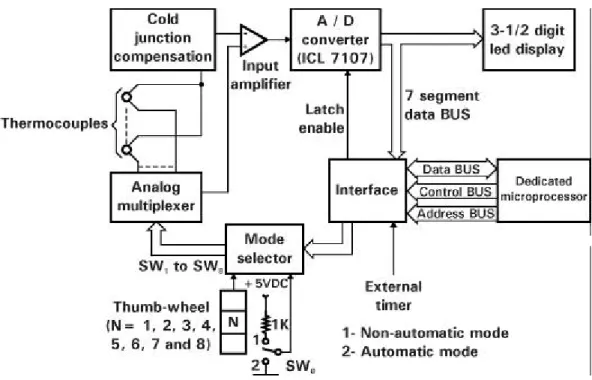
Fig. 1 shows the system configuration in a block dia-gram. The hardware is comprised of: a shaft (white-poly-ethylene pipe) 180 cm long and 2 cm in diameter and a set of eight stainless-steal needles 9.7 cm long and 0.3 cm ex-ternal diameter for sensor installation; a set of eight ther-mocouples (cooper-constantan) with a temperature coef-ficient of 25 µV/°C (Embrapa, 1989); an electronic sys-tem for cold junction compensation; an input amplifier; an A/D converter, a 3-1/2 digit LED display; an analog multiplexer; an electronic system for mode selection; and interface with a dedicated microprocessor architecture with two 3½” floppy disk units. This architecture, based on a Motorola 6502 microprocessor, makes it possible to con-nect a video display as well as a printer to access a chosen data file, or even to transmit to a host computer by means of a serial interface soil-temperature profile data.
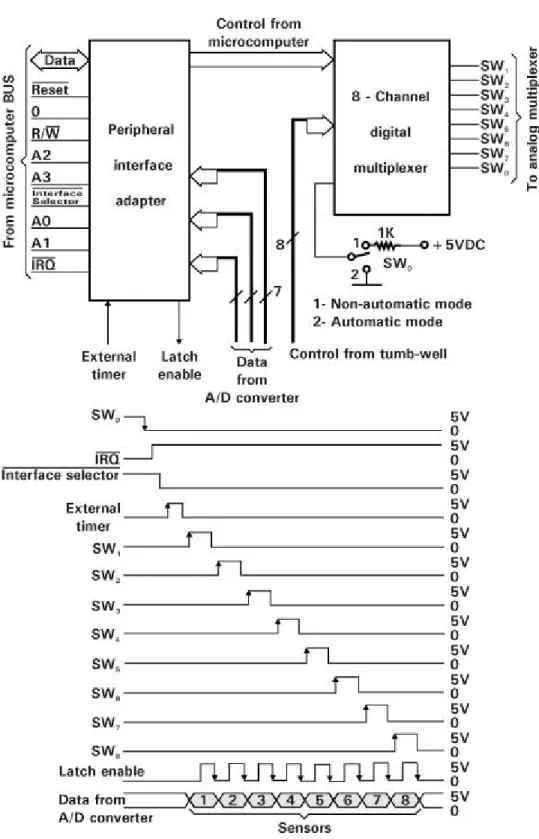
Using extension grade thermocouple wire the shaft with sensors is mobile within 100 m. Thermocouples were as-sembled inside of needles to minimize soil disturbance effects during sensor installation. To obtain soil tempera-tures at depths of 2, 4, 6, 8, 16, 32, 64 and 128 cm the needles with the thermocouples were distributed on the shaft, according to profile requirements. A commercially available LM725A was used to assemble the input ampli-fier due to its performance in applications requiring low noise, low drift and accurate closed-loop gain. A commercially available Intersil ICL 7107 integrated cir-cuit was used to convert analog signals from thermocouples to digital signals for the interface. After linearization and averaging, data appear on a 3-1/2 LED display. The inter-face circuit was designed using two Motorola 6821 pe-ripheral interface adapter integrated circuits. These I/O ports are used to interface with the dedicated micropro-cessor architecture the A/D converter, analog multiplexer, as well as external timer. Fig. 2 shows interface schematic diagram together with the mode selector operation circuit and the corresponding time sequence.
and data are stored in ASCII format. However, in non-automatic mode only the routines for average filtering, data linearization and read-out on a 3-1/2 LED display are used for a pre-selected sensor.
The low-cost microprocessed instrument for in situ evaluating soil temperature profile was developed at the Embrapa-Centro Nacional de Pesquisa e Desenvolvimento de Instrumentação Agropecuária, São Carlos, SP, Brazil.
System evaluation
A set of soil temperature measurements was made in order to evaluate instrument performance under field con-ditions. Each sensor was calibrated against an accurate thermometer with ±0.1% error in the -20.0°C to 100.0°C range. Conventional true temperature value was obtained using a reference-grade platinum RTD sensor. Thus, in-strument can provide measurements with less than ±1.5% error; a typical calibration curve for one of the sensors appears in Fig. 4.
To minimize noise during operation, each sensor was scanned eight times with filtering done by arithmetic av-eraging. The instrument was shielded to avoid stray
leak-age and humidity effects within ambient temperatures up to 65°C and relative humidity up to 85% (non-condensing).
The instrument was configured in automatic mode to simultaneously perform operations required for tempera-ture data collection for soil profile. For the first and fore-most task, measurements of the components of the tem-perature vector to the microprocessed system were housed in a weatherized small plastic box with environmental enclosure. The second task requires retrieving soil tem-perature profile data every 30 minutes and appending it to an existing file.
To avoid the constraints of using standard line power, the entire system is designed to operate on 12 volts DC, making it completely portable. The instrument including the entire soil temperature profile sensors system is pow-ered by nine deep-cycle 12 VDC batteries charged daily by solar panels (M75, Siemans, Inc.). The regulator is equipped with a low-voltage option that disconnects elec-tronic devices with greater power consumption when the battery voltage falls below 11.5 VDC.
Soil temperature data for instrument evaluation under field conditions were stored during 60 days with a 1-hour pre-selected acquisition-time interval. Both grass-covered and bare soils were studied.
Store value in memory
Are all sensors scanned? Scanning and read sensor from the measurement system
Read sensor through A/D converter
Error correction with averaging and linearization
(b)
NO
YES Temperature
sensor’s routine
NO
Start
End YES (a)
Initialize data file
Initialize instrument
Store soil temperature profile data in floppy disk
Plotting through recorder Are all measurements
complete?
80
-40 0 40 120
80
40
0
-40 120
r2 = 0.94
Apparatus
temperature (
o C)
Standard temperature (oC)
FIG. 3. (a) The algorithm used in automatic operation mode outlined in flowchart form; (b) tempera-ture sensor’s routine outlined in block diagram
form. FIG. 4. Typical calibration curve for one sensor.
RESULTS AND DISCUSSION
Under field conditions, offset was less than
2
µ
V. Therefore, the instrument operated under field
conditions, i.e., withstood environmental interference
like electromagnetic induction generated by lightning
and relative humidity effects on the electronic
cir-cuit board. A study of the instrument’s dynamic
per-formance showed settling time amounted to 18
µ
s,
almost independently of the temperature range.
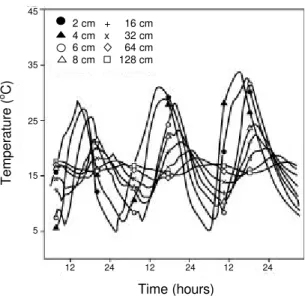
de-creased with depth and, markedly in grass-covered
soil, corroborating data presented in the literature.
Results also confirmed the value of features
allow-ing soil temperature acquisition at eight depths for
investigating a wide soil profile; minimization of soil
disturbance effects during sensor installation;
opera-tion range within temperature of at least -10.0°C up
to 50.0°C, that of soil temperature at several depths
year-round; and resolution (i.e., 1.0°C) making
pos-sible detection of temperature variation at a depth
128 cm, where amplitude versus time is smallest.
Besides, the instrument’s ability to make
automati-cally many measurements for a soil profile ranging
from 2 to 128 cm depth without moving the sensors
allows evaluation of both spatial and temporal
tem-perature pattern variability.
CONCLUSIONS
1. A compact, simple, reliable low-cost, highly
accurate instrument for
in situ
soil profile
tempera-ture measurements, with potential application in the
soil science area is described.
2. A simulation improves the temperature
detec-tion signal/noise ratio, making possible optimal
sen-sitivity selection.
3. By using small inner fast-response volume
sen-sors, the instrument minimizes soil disturbance
ef-fects during sensor installation, accelerating use of
automation in soil data monitoring and respecting
consumer demand for environmentally friendly
de-vices.
ACKNOWLEDGEMENTS
To CNPq, Embrapa-Centro Nacional de Pesquisa
e Desenvolvimento de Instrumentação Agropecuária,
and University of California, LAWR Department,
Davis, for financial and institutional support; to Mr.
Monzane and Mr. Souza, for the drawing work.
REFERENCES
ALLMARAS, R.R.; BURROWS, W.C.; LARSON, W.E. Early growth of corn as affected by soil tempera-ture.Soil Science Society of America. Proceedings,
Madison, v.28, p.271-274, 1964.
BLACKMORE, S. Developing the principles of precision farming. In: INTERNATIONAL CONFERENCE ON AGROPOLES AND AGRO-INDUSTRIAL TECHNOLOGICAL PARKS-AGROTECH’99, 1999, Barretos. Proceedings. Barretos : Associação Nacional de Entidades Promotoras de
Empreendi-2 cm + 16 cm 4 cm x 32 cm 6 cm 64 cm 8 cm 128 cm
Temperature (
oC)
Time (hours)
12 24
12 24 24
45
35
25
15
5
12
FIG. 5. Soil temperature variations at 2 to 128 cm depth during three days (with grass soil).
FIG. 6. Soil temperature variations at 2 to 128 cm depth during three days (with bare soil).
Temperature (
o C)
Time (hours)
2 cm + 16 cm 4 cm x 32 cm 6 cm 64 cm 8 cm 128 cm
12 24 12 24 12 24
45
35
25
15
mentos de Tecnologias Avançadas/Instituto Barretos de Tecnologia, 1999. p.75-77.
COFFMAN, F.A. The minimum temperature of germina-tion of seeds. AmericanSociety of Agronomy. Jour-nal,Madison, v.15, p.257-270, 1923.
DUBETZ, S.; RUSSELL, G.C.; ANDERSON, D.T. Effect of soil temperature on seedling emergence. Cana-dian Journal of Plant Science, Ottawa, v.42, p.481-487, 1962.
EMBRAPA(Brasília, DF), Paulo Estevão Cruvinel. Medidor digital multissensor de temperatura para solos. BR n. PI 8903105-9. 26 jun. 1989. Revista de Propriedade Industrial, Rio de Janeiro, n.983, p.51, ago. 1989.
GIST, G.R.; MOTT, G.O. Some effects of light intensity, temperature and soil moisture on the growth of al-falfa, red clover and birdsfoot trefoil seedlings.
Agronomy Journal, Madison, v.49, p.33-36, 1957.
GUPTA A.; TOONG, H.D. Microprocessors: the first twelve years. Proceeding of the IEEE, New York,
v.11, n.71, p.1236-1256, 1983.
HASFURTHER, V.R.; BURMAN, R.D. Soil temperature modeling using air temperature as a driving mecha-nism. Transactions of the ASAE, St. Joseph, v.17, p.78-81, 1979.
NERPIN, S.V.; CHUDNOVSKII, A.F. Physics of the soil:
Israel program for scientific translations. Jerusalem : Keter, 1970. 466p.
ROSENA, A. Amathematical model for simulation of the thermal behavior of bare soils based on heat and moisture transfer. Delft : Netherlands Center
for Remote Sensing, 1975. 88p. (Publication, 11).
SCHIELDGE, J.P.; KAHLE, A.B.; ALLEY, R.E. A numerical simulation of soil temperature and mois-ture variations for a bare field. Soil Science, Balti-more, v.133, p.197-207, 1982.
SMITH, O.Production storing processing. Westport : Avi, 1968. 232p.
VIEIRA, S.R.; HOFFIELD, J.L.; NIELSEN, D.R.; BIGGAR, J.W. Geostatistical theory and application to variability of some agronomical properties.
Hilgardia, Berkeley, v.51, n.3, p.75-82, 1983.
WIERENGA, P.J.; NIELSEN, D.R.; HORTON, R.; KIES, B. Tillage effects on soil temperature and thermal conductivity. In: SOIL SCIENCE SOCIETY OF AMERICA ANNUAL MEETING, 1980, Detroit.
Proceedings. Madison : Soil Science Society of America, 1982. p.69-90.