Addiction to work and factors relating to this:
a cross-sectional study on doctors in the state of Paraíba
Walter Fernandes Azevedo
I, Lígia Andrade da Silva Telles Mathias
IIFaculdade de Ciências Médicas da Santa Casa de São Paulo (FCMSCSP), São Paulo (SP), Brazil
ABSTRACT
CONTEXT AND OBJECTIVE: Addiction to work is one of the new behavioral phenomena present in orga-nizations and it is characterized by excess work and compulsion to work. This phenomenon may give rise to diferent sicknesses and may afect diferent professionals, including doctors. Thus, the aims of this study were to analyze the factorial validity and internal consistency of the Dutch Work Addiction Scale (DUWAS); to evaluate the prevalence of addiction to work among doctors in the state of Paraíba; and to investigate factors relating to addiction to work among these doctors.
DESIGN AND SETTING: This was an exploratory, descriptive cross-sectional study with a quantitative ap-proach conducted in municipalities in the state of Paraíba.
METHODS: Data were gathered between June and October 2015, by applying a questionnaire containing sociodemographic questions and the Work Addiction Scale.
RESULTS: The results showed that the Work Addiction Scale has internal consistency and factorial validity and that, in the population studied, only one factor was pointed out: addiction to work. Most of the doc-tors were not addicted to work; among the addicts, the addiction was not excessive; and the addiction had a positive correlation with the number of shifts done and a negative correlation with age.
CONCLUSION: Greater attention to this phenomenon is required and further research on this topic is needed in order to elucidate the harm caused by addiction to work in daily medical practice.
IMD, MSc. Doctoral Student, Faculdade de
Ciências Médicas da Santa Casa de São Paulo (FCMSCSP), São Paulo; Anesthesiologist, Hospital Universitário Lauro Wanderley (HULW); and Adjunct Professor, Medical School, Universidade Federal da Paraíba (UFPB), João Pessoa (PB), Brazil.
IIMD, MSc, PhD. Adjunct Professor, Medical School,
Faculdade de Ciências Médicas da Santa Casa de São Paulo (FCMSCSP), São Paulo (SP), Brazil.
KEY WORDS: Work.
Behavior, addictive. Risk factors. Medicine. Health.
INTRODUCTION
With a focus on greater agility and competitiveness, organizations have begun organizational policies and practices that place higher value on professionals who have dedicated more of their time to work.1 To meet capitalist market demands, professionals tend to work to exhaustion in
order to reach organizational targets and consequently obtain desirable professional success. hus, work tends to be the main reason to live and exist, which creates the new phenomenon of workaholism, i.e. addiction to work1 or working excessively.2-3
Addiction to work may be considered to be one of the most recent behavioral vices, although no addiction-inducing substance is present.3-4 It is a form of psychosocial damage
character-ized by working excessively, because of an irresistible need or wish to work more and more5.
hus, it involves compulsion to work.6
hese phenomena may be subjectively experienced as loss of control, in which the work addict continues working despite the known negative consequences, which are similar to those relating to psychological, physical and social disorders.7 he consequences of addiction to work
include cardiovascular and dermatological problems, cephalalgias, myalgias, sexual disorders,8
depression, high-level anxiety9 and poor satisfaction with life and with work performance.10
Because of the severe health complications that addiction to work causes, it has received great attention from researchers.11 However, research on this topic has been hindered by a lack
of consensus regarding the deinition of this term and how it is evaluated.1,7 Moreover, there is
poor knowledge about the number and kind of people afected by addiction to work and insuf-icient research with relevant samples.7
Regarding the characteristics that describe addiction to work, this problem can be correlated with medical practice. hus, it becomes relevant to evaluate the extent to which doctors may be vulnerable to addiction to work and the factors that might be related to this phenomenon.
In addition to academic relevance, the current study may pro-vide practical contributions through increasing the knowledge of addiction to work and its correlations in Brazil. Speciically, through knowing to what extent physicians are work addicts, strat-egies to help these professionals improve their health and quality of life may be deployed.
OBJECTIVES
he study aimed to analyze the factorial validity and internal con-sistency of the Dutch Work Addiction Scale (DUWAS); to eval-uate addiction to work among doctors in the state of Paraíba; and to investigate factors relating to addiction to work among these doctors.
METHODS
his was an exploratory analytical cross-sectional study with a quantitative approach. he population consisted of doctors in the state of Paraíba, Brazil, in the municipalities of João Pessoa, Pombal, Guarabira, Bayeux, Santa Rita, Cabedelo, Campina Grande, Sousa, Cajazeiras, Monteiro, Itaporanga, Piancó, Catolé do Rocha, Belém do Brejo dos Santos, São Bento and Patos. his study was approved by the Ethics Committee for Research on Human Beings of Lauro Wanderley University Hospital, Federal University of Paraíba. Data collection was performed only ater approval had been obtained from this committee, under the number CAAE 39156114.0.0000.5183.
he sample size was calculated based on the number of physi-cians registered at the Regional Medical Council of Paraíba (6,100) by using a simple random sampling plan, considering a margin of error of 3% and a conidence level of 95%. hus, the sample size was equal to 909. As it was possible to interview more physicians than the total of sample size calculated, the inal sample size was 1,110 physicians. Doctors from Sertão, Borborema, Agreste and Mata were selected to ensure the representativeness of the sample selection. It needs to be highlighted that in choosing these municipalities for inclusion, the number of doctors present at these locations was taken into consideration, because in some places there was either minimal presence of professionals or even none at all. hese phy-sicians met the following inclusion criteria: they were active dur-ing the data-gatherdur-ing period; they signed a free and informed consent statement; and they were interested in participating in the study and did so willingly.
Data were gathered between June and October 2015. Sociodemographic information (age, sex, race, marital status,
income, religion and number of shits) and data relating to the Work Addiction Scale were sought. Each work shit was consid-ered to consist of 12 working hours.
he main researcher was directly responsible for applying the questionnaire and coordinating the corresponding activities, counting on cooperation from other previously trained research-ers. he average time taken to gather data from each individual was 20 minutes.
he Dutch Work Addiction Scale (DUWAS) was originally created by Schaufeli et al.12-14 It is composed of 7 items (e.g. “I am
usually busy”; “I have many issues under my control”; and “I feel guilty when I am not doing anything else”). he questions are answered on a four-point scale, ranging from never (1) to every day (4). hese aim to show how the person feels at work, i.e. how much he experiences. heoretically, this measurement covers two main dimensions: compulsive work and excessive work.
he Brazilian version adapted by Carlotto and Miralles15 follows
the same instructions and response format. However, it contains 10 items: 5 for each dimension, which are answered using a four-point scale (on which 1 = never and 4 = every day). he results from this adaption have provided justiications for using this scale, includ-ing a goodness-of-it index = 0.95, comparative it index = 0.98, root mean square error of approximation = 0.04 and internal con-sistency in which the minimum Cronbach’s alpha exceeded the cutof point of 0.70.
Because we did not ind any data relating to measurement of addiction to work among doctors, we decided to take into con-sideration not only the Portuguese version of the scale but also exploratory analyses that aimed to identify the underlying (com-ponential) factorial structure.
he mean point on the scale (2.5) was used to consider whether addiction to work was present, chosen as the mean between the two cut-of values proposed by Schaufeli.12 hus, the doctors
whose mean score was greater than or equal to 2.5 were consid-ered to be addicted to work. hose whose mean scores were less than 2.5 were not considered to be addicted to work.
Variable Frequency Percentage Mean Median Standard deviation Sex
Male 591 53.3
Female 512 46.3
Not informed 5 0.4
Age (years)
44.42 43 13.89
From 21 to 30 200 18.17 From 31 to 40 301 27.07 From 41 to 50 200 18.08 From 51 to 60 226 20.32
Above 60 175 15.83
Not informed 6 0.53
Race
White 681 61.5
Black 22 2
Brown 397 35.8
Other 4 0.4
Not informed 4 0.4
Marital status
Single 254 22.9
Divorced 91 8.2
Married 713 64.4
Widow 22 2
Other 25 2.2
Gross monthly income 4 to 6
minimum wages 79 7.2
7 to 9
minimum wages 115 10.5
10 or more
minimum wages 910 81.9
Not informed 4 0.4
Religion
Catholic 823 74.3
Evangelical 132 12
Spiritist 56 5
Agnostic 39 3.5
Other 47 4.2
Not informed 11 1
Number of shifts worked
12.1 10 10.03
Up to 10 423 38.31
11 to 20 396 35.7
21 to 30 94 8.45
31 to 40 35 3.15
Above 40 11 0.99
Not informed 149 13.39
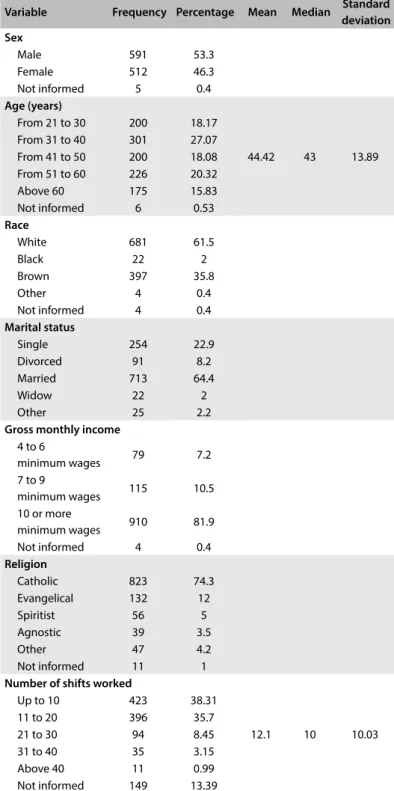
Table 1. Doctors’ distribution according to sex, age, race, marital status, income, religion and number of shifts worked. Paraíba (PB), 2016 (n = 1108)
and association tests (chi-square and Fisher). he signiicance level was taken to be 5% (P < 0.05).
RESULTS
Although 1,110 physicians were initially interviewed at hospitals, in their shits and healthcare centers, only 1,108 were included in the inal sample: 2 were excluded due to incomplete answering of the questionnaire, making it impossible to perform correlation analysis. he majority of the participants were male (53.30%). he largest proportion of the individuals (27.17%) aged between 31 and 40 years, followed by participants between 51 and 60 years (20.40%). A minority was over 60 years of age (15.79%). Most participants stated that their monthly salary was seven or more minimum wages (92.50%) (Table 1).
he largest proportion of the doctors performed 10 shits (each with 12 working hours) per month (38.18%), followed by those who did 11 to 20 shits (35.74%). he average was of 12.10 shits per month (standard deviation, SD = 10.03). A very small proportion (3.16%) stated that they did 31 shits or more.
Parameters for addiction to work
As a irst step, we decided to check the adequacy of the facto-rial analyses through an inter-item correlation matrix. he KMO (0.88) and Barlett sphericity test results [χ² (45) = 3831.36; P < 0.001] showed that these analyses were adequate for the data.
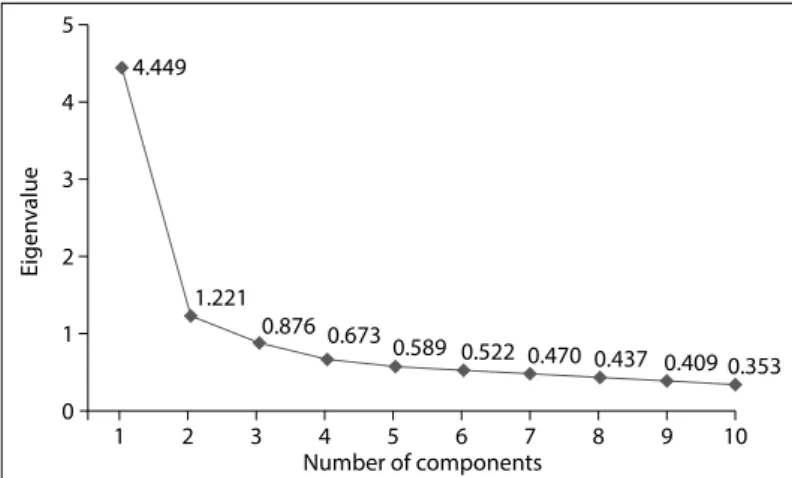
hus, we opted to perform principal component analysis (PCA). he analyses showed that there were two components with eigenvalues greater than one (4.45 and 1.22; Kaiser criterion) that together explained 56.7% of the total variance. Figure 1 shows the graphical distribution of the eigenvalues, which is a more consis-tent criterion for deining the number of factors to be taken out (Cattel criterion).
As can be seen from Figure 1, the irst component is evident, standing out from the others. However, regarding the other ponents, no relevant diference was observed; the second com-ponent is practically aligned with the others, thus suggesting that its presence may not be so clear. Because of these indings, it was considered that only one component existed, thus dein-ing its extraction.
It was found that the saturations (factorial charges) were sub-stantially consistent, ranging from 0.60 (item 10: “It is diicult to relax when I am not working”) to 0.70 (item 6: “I dedicate more time to work than to my friends, hobbies or pleasant activities”). hus, it seems plausible to accept that there was only one dimen-sion for addiction to work, which presented the eigenvalue of 4.45 and explained 44.5% of the total variance. he internal con-sistency (Cronbach’s alpha) of this group of items for measuring the same construct was 0.86, thus emphasizing its pertinence. Likewise, the homogeneity coeicient, i.e. the mean inter-item
correlation, was 0.38. his ranged from 0.23 (item 9 with items 1 and 4) to 0.61 (items 7 and 9).
these analyses thus showed that the general score from the Work Addiction Scale, obtained through summing its 10 items, could be considered to be the sole variable. his could then be analyzed.
Addiction to work among doctors
In the present analysis, most of the physicians were not addicted to work (610 in total). From the average scores for addiction to work in each group (addicts and non-addicts), it was seen that the non-addicts had an average score of 1.95 (SD = 0.32), and the addicts had a score of 2.50 (SD = 0.37). hus, it could be con-irmed that even in the group of addicts, the addiction was not strong, given that the addiction score was only 2.5.
Factors relating to addiction to work
Addiction to work was positively and weakly correlated with the number of shits worked (r = 0.20; P < 0.001); and it showed a negative, weak correlation with age (r = -0.20; P < 0.0001). Income did not show any signiicant correlation with addiction to work (r = -0.01; P > 0.05).
It was not possible to show any association between categorized addiction to work and the variables of sex, race, marital status and religion, with the conidence level taken to be 95%.
From these indings, it seems evident that addiction to work was inluenced by the number of shits worked and the doctors’ ages. On this basis, the younger the doctor was, the greater the chances were of being addicted.
DISCUSSION
he results from this study showed that the Work Addiction Scale has internal consistency and factorial validity, and that it evaluates a single general factor that can be named “addiction to work”, which is more precise than bi-dimensional evaluation. hese indings are contrary to the results found by Carlotto and Miralles,15 who found that bi-dimensional evaluation of
compul-sion to work and excessive work was coherent.
In an evaluation on the factorial validity and internal consis-tency of the Brazilian Work Addiction Scale, it was observed that compulsion to work and excessive work were related but indepen-dent dimensions.15 However, the group studied and the research
locality difered from those of the present study, which may have contributed towards the divergence of these results.
Nevertheless, the study in which the factorial structure of the 10-item version of the Dutch Work Addiction Scale (DUWAS) was investigated demonstrated that this measurement could be applied rapidly and had good factorial validity for all the profes-sions and nations measured. Moreover, it has showed that the DUWAS-10 subdimensions were highly correlated, thus mak-ing it possible to use them as a one-dimensional measurement for addiction to work.16
hat study16 also showed that the degree of addiction to work
can be assessed through four dimensions that are subdimensions of compulsion to work and excessive work: “working frantically” and “working long hours” to explain excessive work and “obses-sive work drive” and “unease if not working” to explain compul-sion to work.
In the light of these variabilities, further studies replicating the results obtained through using workers in a diversity of pro-fessional categories, in diferent regions of Brazil and in dissimi-lar organizational and sociocultural contexts, are recommended. hese would take into consideration the speciicity of each group.15
he current study showed that, although present, the addic-tion to work was not strong. he fact that most of the professionals evaluated only had up to 10 monthly shits may have inluenced the scores for addiction to work. he addicts dedicated many hours to their professional practice, but this was not a constant factor in the group studied.
In another study, doctors considered that their work was one of the most important things in their lives, and that it fulilled their economic and emotional needs and their pleasure and status, self-satisfaction and self-valorization. hese factors motivated them, were complementary and made life more attractive, and may have inluenced their non-addiction to work.17
A qualitative study involving eight doctors showed that they did not fulill the characteristics of workaholism, although the interviewees worked exhaustingly long hours and had diiculties regarding taking vacations, having leisure time, being with their families and disassociating their thoughts from their work. However, on certain occasions, some traces were observed, but they were not signiicant enough to airm that these doctors were workaholics.17
A case study using a quantitative approach analyzed a sam-ple of 25 collaborators within a medical healthcare cooperative, using a self-reporting questionnaire consisting of 24 questions. he results showed that there were many workers who might become workaholics, but that only four of them were consid-ered to be workaholics.1
Figure 1. Distribution of eigenvalues on the work addiction scale.
Eigen
v
alue
4.449
0 1
1 2 3 4 5 6 7 8 9 10
2 3 4 5
1.221
0.876 0.673
0.589 0.522 0.470 0.437 0.409 0.353
However, this does not mean that these professionals are also worklovers. A workloveris a person who is always satisied with
his work, and this is not a common occurrence among healthcare professionals, including physicians.17
An analysis on 2,115 resident Dutch physicians showed that unfavorable work conditions, work overload, conlicts, overwork, presentism and burnout syndrome were related to addiction to work. In addition, it showed that addicts recovered less easily, felt less fulilled, were unhappy and had a colder relationship with their patients. hus, the combination of compulsion to work and excessive work was detrimental both to doctors and to the insti-tution in which they work.18
A study carried out among doctors in the northeastern states of Brazil and published by the Federal Medicine Council showed that doctors in Paraíba mostly considered that their working condi-tions were fair or good, and that they were satisied with the work that they were doing. hey also believed that their working day and pay had improved in relation to previous years.19 hese factors
may contribute towards a lack of addiction to work.
In view of these favorable working conditions and reasonable salaries, plus low wear and tear relating to transportation within the doctors’ municipalities, i.e. without the hectic pace of larger centers (which means that they do not waste so much time on com-muting), a healthy routine encompassing work, home and family becomes established. his favors biopsychosocial and economic balance among physicians in Paraíba and frees them from being absorbed into addiction to work. Moreover, because they are close to the countryside, they can enjoy moments of leisure, when they have become established.
Addiction to work among doctors was correlated positively with the number of shits worked and negatively with age in the present study. hus, the more shits worked monthly and the younger the doctor was, the greater the addiction to work was. Workaholics tend to work compulsively and to work more than what is required within their work environment, for greater inancial return and professional status and because of the organizational culture.20
hese factors may inluence the relationship between the number of shits and work addiction.
his study showed also that intense dedication to work involved a great number of hours taken to conclude activities. If diferent demands are under these individuals’ control, more time is required and this means greater addiction to work.21
he fact that younger physicians need to achieve professional status and excel in the job market may make them work inten-sively, with longer working hours, thus dedicating more time to work and giving up leisure time. his increases their chances of developing addiction to work. However, it has been suggested that young workers who do not have a family are more likely to gain professional achievement and receive little social criticism
if they work excessively, in comparison with older workers who are married and have children. he latter attributes contribute towards decreasing addiction to work.22 A study conducted on
a Portuguese group showed that younger people seem to work less excessively than older ones.23 In that study, there was no
sig-niicant correlation between addiction to work and the income variable, or even any associations with the variables of sex, race, marital status and religion.
It is important to point out that, in many cases, low income threatens workers’ personal, family and social stability and, in searching for better work conditions, they dedicate more time to work, which may make them become workaholics. However, in comparing medical activities with other professions in Brazil, it needs to be highlighted that medical activity is well remuner-ated, and that this may inluence the lack of correlation between addiction and income.
he indings from the present study were similar to those from a previous study that showed that there was no relationship between the dimensions of addiction to work and the variables of income, sex and marital status, among others.24 A study conducted among
academic groups showed that addiction to work had a negative correlation with age, wages and marital status and a positive cor-relation with the kind and size of the family.25
Addiction involves behavioral vices without substance, and it is necessary to diferentiate this from real addiction to work, since this behavior may generate mental, physical, social and family conse-quences, besides afecting work performance.26 Diferent people
have considered work to be the most important factor in their lives, for diferent reasons such as: the need to survive, professional and personal fulilment or even inancial reasons. Consequently, some people have shown greater predisposition towards develop-ing addiction to work.1 So far, no treatment for addiction to work
has been proposed, and it is therefore necessary to conduct fur-ther studies in this area.27
Moreover, there is a need for additional studies in relation to considering work as one of the predictors of sickness, especially nowadays, when work is considered to be a privilege, and not a personal right. Only advances of science within this ield may pro-vide the credibility that is required for there to be any kind of inlu-ence on public policies for workers and any contribution towards international scientiic outcomes relating to addiction to work.15
his phenomenon requires closer attention. Further research that can elucidate the damage caused by addiction to work within daily medical practice and which can create strategies for diminish-ing addiction to work and its consequences needs to be developed to investigate the presence of addiction to work among doctors in other Brazilian regions and the factors that inluence it.
FINAL REMARKS
In keeping with the traditional characteristics of Northeasterners, of love for the land and contact with nature, the bucolic life of rural areas is an incentive for physicians, once they have become established, to acquire the hobby of spending weekends enjoying the countryside or farms near their homes and having moments of pleasure, which contribute towards increasing their wellbeing. he pleasure of being together with their relatives, and with the soil, animals and plants, relieves the tension of the day-to-day routine and is an excellent impediment to work addition.
As expected, the higher the number of shits worked was, the greater the addiction to work was, but the greater the age was, the less the addiction was. Since addiction is due to rep-etition, it is believed that when doctors take on more and more shits, they get into a vicious cycle and become liable to take up the repetitive act of working more and more. hey thus compro-mise their good sense of knowing how to impose limits and refuse additional job ofers, and consequently let themselves be swallowed up by the addiction.
Regarding the predominance of addiction in the younger age group, it is likely to be due to the natural impulses of youth, con-sisting of “I want everything”, “I can do everything” and “I crave everything”. It may even be due to a certain degree of ambition to quickly ascend socially and economically through the product of their work, i.e. the more they work, the more they earn and the richer they can become.
Another aspect of this might be due to the long duration of medical school. Because medical courses are full-time, they do not allow young people to enter proitable employment during the six years of the course, plus another four to six more years of medi-cal residency. When doctors inally become free to enter the job market, the will to “roll up the sleeves and get to work” manifests itself more intensely, and the long-held desire to “make money” is shown, sometimes even to an exaggerated extent.
CONCLUSION
he work addiction scale that best suited the population studied here considered excessive work and compulsion to work to be dependent variables. herefore, the scale is unifactorial.
Most of the physicians evaluated were not addicted to work, and, even in the group of addicts, the addiction was not strong, given that the addiction score was only 2.5. his may have been
because these physicians considered that their working condi-tions were favorable and because they were satisied with what they were doing.
REFERENCES
1. Stefaniczen J, Stefano SR, Machado RO. Workaholic: um novo modelo de comportamento nas organizações. In: Anais do XIII Seminários de Administração; 2010 09-10 set; São Paulo, Brasil. São Paulo: Programa de Pós-Graduação em Administração da FEA/USP; 2010. p. 1-5. Available from: http://www.sgc.goias.gov.br/upload/arquivos/2013-04/area- tematica--gestao-de-pessoas-workaholic-um-novo-modelo-de-comportamento-nas-organizacoes.pdf. Accessed in 2017 (Jun 2). 2. van den Broeck A, Schreurs B, De Witte H, et al. Understanding
workaholics’ motivations: a self-determination perspective. Applied Psychology. 2011;60(4):600-21. Available from: http://onlinelibrary. wiley.com/doi/10.1111/j.1464-0597.2011.00449.x/abstract. Accessed in 2017 (Jun 2).
3. Giannini M, Scabia A. Workaholism: an addiction or a quality to be appreciated? Journal of Addict Research & Therapy. 2014;5(3):1-9. Available from: https://www.omicsonline.org/open-access/workaholism-an-addiction-or-a-quality-to-be-appreciated-2155-6105-5-187. php?aid=30501. Accessed in 2017 (Jun 2).
4. Elowe J. [Workaholism: between illusion and addiction]. Encephale. 2010;36(4):285-93.
5. Salanova M, del Líbano M, Llorens S, Schaufeli WB. La adicción al trabajo. Notas Técnicas de Prevención, 759. Madrid : Instituto Nacional de Seguridad y Higiene en el Trabajo; 2007. Available from: http://www. insht.es/InshtWeb/Contenidos/Documentacion/FichasTecnicas/NTP/ Ficheros/752a783/759.pdf. Accessed in 2017 (Jun 2).
6. Aguilera EC, García JEGA. Perspectivas actuales de la adicción al trabajo. Psicología y Salud. 2011;21(1):131-9. Available from: https://www.uv.mx/ psicysalud/psicysalud-21-1/21-1/workaholism-Enrique-Casta%F1eda. pdf. Accessed in 2017 (Jun 2).
7. Andreassen CS, Griffiths MD, Hetland J, et al. The prevalence of workaholism: a survey study in a nationally representative sample of Norwegian employees. PLoS ONE. 2014;9(8):e102446.
8. Polo Vargas JD, Santiago Briñez V, Navarro Segura MC, Ali Nieto A. Creencias irracionales, síndrome de Burnout y adicción al trabajo en las organizaciones. Psicogente. 2016;19(35):148-60.
9. Bartczak M, Ogińska-Bulik N. Workaholism and mental health among Polish academic workers. Int J Occup Saf Ergon. 2012;18(1):3-13. 10. Shimazu A, Schaufeli WB, Kubota K, Kawakami N. Do workaholism and
work engagement predict employee well-being and performance in opposite directions? Ind Health. 2012;50(4):316-21.
12. Schaufeli WB, Taris TW. Dutch Work Addiction Scale (DUWAS); 2004. Available from: http://www.wilmarschaufeli.nl/publications/Schaufeli/ Tests/DUWAS_10_EN.pdf. Accessed in 2017 (Jun 2).
13. Schaufeli WB, Bakker AB, Salanova M. The measurement of work engagement with a short questionnaire: a cross-national study. Educational and Psychological Measurement. 2006;66(4):701-16. Available from: http://www.wilmarschaufeli.nl/publications/Schaufeli/251.pdf. Accessed in 2017 (Jun 2).
14. Schaufeli WB, Shimazu A, Taris TW. Being driven to work excessively hard: The evaluation of a two-factor measure of workaholism in the Netherlands and Japan. Cross-Cultural Research. 2009;43(4):320-48. Available from: http://www.wilmarschaufeli.nl/publications/Schaufeli/322a.pdf. Accessed in 2017 (Jun 2).
15. Carlotto MS, Miralles MDL. Tradução, adaptação e exploração de propriedades psicométricas da Escala de Adição ao Trabalho Dutch Work Addiction Scale (DUWAS) [Translation, adaptation and exploration of psychometric properties of “Dutch Work Addiction Scale” (DUWAS)]. Contextos Clínic. 2010;3(2):141-50.
16. Rantanen J, Feldt T, Hakanen JJ, et al. Cross-national and longitudinal investigation of a short measure of workaholism. Ind Health. 2015;53(2):113-23.
17. Müller MM. Worklovers: realidade ou mito? A experiência de médicos de um Hospital Universitário de Porto Alegre [thesis]. Porto Alegre: Universidade Federal do Rio Grande do Sul; 2007. Available from: http://www.lume.ufrgs.br/bitstream/handle/10183/10066/000594349. pdf?sequen. Accessed in 2017 (Jun 2).
18. Schaufeli WB, Bakker AB, van der Heijden FMMA, Prins JT. Workaholism among medical residents: it is the combination of working excessively and compulsively that counts. International Journal of Stress Management. 2009;16(4):249-72. Available from: https://lirias. kuleuven.be/bitstream/123456789/486749/1/14.pdf. Accessed in 2017 (Jun 2).
19. Andrade EO, Gouveia VV, Carneiro MB, Pinheiro AG. O médico e seu trabalho: resultados da região norte e seus estados. Brasília: Conselho Federal de Medicina; 2005. Available from: http://www.portalmedico. org.br/include/biblioteca_virtual/medico_e_seu_trabalho/regiao_ norte/NORTE.pdf. Accessed in 2017 (Jun 2).
20. Schaufeli WB, Taris TW, van Rhenen W. Workaholism, burnout, and work engagement: three of a kind or three diferent kinds of employee well-being? Applied Psychology: An International Review. 2008;57:(2):173-203. Available from: http://www.wilmarschaufeli.nl/publications/Schaufeli/288. pdf. Accessed in 2017 (Jun 2).
21. Gonçalves GDL. Adição ao trabalho e desempenho humano: estudo de caso em uma empresa júnior da Universidade de Brasília [monography]. Brasília: Universidade de Brasília, 2013. Available from: http://bdm.unb. br/bitstream/10483/5234/1/2013_GeorgedaneilLaportaGoncalves.pdf. Accessed in 2017 (Jun 2).
22. Sussman S. Workaholism: A Review. J Addict Res Ther. 2012;Suppl 6(1):pii 4120.
23. Pimenta ACA. Workaholism, work engagement e Burnout: distinção empírica e sua relação com os recursos e as exigências Laborais [thesis]. Évora: Universidade de Évora; 2014.
24. Carlotto MS. Adição ao trabalho e relação com fatores de risco sociodemográficos, laborais e psicossociais [Workaholism and relationship with sociodemographic, work and psychosocial risk factors]. Psico-USF. 2011;16(1):87-95.
25. Sharma J, Sharma P. Workaholism and its correlates: a study of academicians. International Journal of Management and Business Research. 2011;1(3):151-60. Available from: http://ijmbr.srbiau.ac.ir/ article_20_176349bc866bd978db78766c546babf9.pdf. Accessed in 2017 (Jun 2).
26. Scheen AJ. [Workaholism, another form of addiction]. Rev Med Liege. 2013;68(5-6):371-6.
27. Nené DCR. Preditores do workaholism e seus efeitos no bem-estar e burnout [thesis]. Algarve: Universidade do Algarve; 2015.
Conlict of interest: None
Sources of funding: None
Date of irst submission: November 23, 2016
Last received: April 17, 2017
Accepted: April 25, 2017
Address for correspondence:
Walter Fernandes Azevedo Av. Argemiro de Figueiredo, 1.716
Jardim Oceania — João Pessoa (PB) — Brasil CEP 58037-030
Cel. (+55 83) 99122-2035