Neighborhood contextual
characteristics and
leisure-time physical activity:
Pró-Saúde
Study
Departamento de Epidemiologia. Instituto de Medicina Social. Universidade do Estado do Rio de Janeiro. Rio de Janeiro, RJ, Brasil
Correspondence:
Karine de Lima Sírio Boclin
Sousa Lima, 257 apto. 902 Copacabana 22081-010 Rio de Janeiro, RJ, Brasil E-mail: [email protected] Received: 5/12/2013
Approved: 11/7/2013
Article available from: www.scielo.br/rsp
ABSTRACT
OBJECTIVE: To estimate the association between neighborhood contextual variables and leisure-time physical activity.
METHODS: Data were analyzed for 2,674 adults from Rio de Janeiro, RJ, Southeastern Brazil, participating in the longitudinal study in 1999. Leisure-time physical activity in the two preceding weeks was assessed dichotomously. Sex, age, income, education and marital status were analyzed as individual variables. Neighborhood contextual characteristics were the social development index, the Theil index and the proportion of the area occupied by parks, squares and gardens, categorized in quintiles.
The unadjusted and adjusted odds ratios and 95% conidence intervals were
estimated using multilevel logistic regression.
RESULTS: The prevalence of leisure-time physical activity was higher in residents in neighborhoods with higher indices of social development (between 32.3% and 53.1%) and a greater proportion of parks, squares and gardens (between 35.8% and 53.1%). Regarding the social development index, the adjusted odds ratios for physical activity were 1.22 (95%CI 0.93;1.61), 1.44 (95%CI 1.09;1.89), 1.75 (95%CI 1.31;2.34) and 2.25 (95%CI
1.70;3.00) for residents in neighborhoods in the second, third, fourth and ifth quintiles, respectively, compared with residents in neighborhoods in the irst
quintile. The odds ratios for the proportion of parks, squares and gardens were 0.90 (95%CI 0.69;1.19), 1.41 (95%CI 1.04;1.90), 1.63 (95%CI 1.24;2.14) and 1.05 (95%CI 0.80;1.38) for residents in neighborhoods in the second,
third, fourth and ifth quintiles. After adjusting for the other variables, only
the social development index continued to be associated with leisure-time physical activity, with odds ratios of 1.41 (95%CI 1.02;1.95); 1.54 (95%CI 1.12;2.12); 1.65 (95%CI 1.14;2.39) and 2.13 (95%CI 1.40;3.25) for residents
in neighborhoods in the second, third, fourth and ifth quintiles.
CONCLUSIONS: Leisure-time physical activity was more common in residents in neighborhoods with higher social development indices. No association was observed between access to leisure areas and income inequality.
DESCRIPTORS: Activities of Daily Living. Leisure Activities. Sedentary Lifestyle. Motor Activity. Green Areas. Environmental Health. Multilevel Analysis.
Karine de Lima Sírio Boclin Eduardo Faerstein
The beneicial effects of physical activity on health are well documented in scientiic literature.10 However,
a pattern of generally decreasing levels of physical activity in the population has been observed in recent decades, due to increased mechanization of work processes and daily activities. Thus, leisure-time physical activity has come to play an increased role in meeting daily needs for calorie expenditure.1,a
In addition to the inluence of individual factors such
as age, sex, schooling and others, characteristics of the
context in which individuals inds themselves, such
as the places in which they live and their
neighbor-hoods, can also inluence the practice of leisure-time
physical activities.14
Although there is no consensus on a working deinition,
approaches using neighborhoods as a unit of analysis are increasingly being used in epidemiological studies.3,23 In
general, neighborhoods are understood as geographi-cally demarcated spaces where, in addition to its phys-ical characteristics, residents share politphys-ical, cultural and economic circumstances.15,16 Florey et al (2007) deine
neighborhoods as any geographical aggregate which has this meaning for the local residents.7
Studies on the inluence of neighborhood characteris -tics on health outcomes show how individual health and life style related behavior is not randomly distributed among regions and populations, that there are dynamic and complex interactions between individuals and their contexts.2,9 Multilevel analyses, including multiple
hier-archical levels to evaluate outcomes at an individual level, are more appropriate for these types of studies,
as they provide a more reined estimate not only of the
contribution of variables related to the individual but also those of the context, as well as enabling unforeseen inferences due to better estimation of standard error of the parameters to be estimated.3,23
Despite the significant increase in health research including the neighborhood as a unit of analysis and using
a multilevel approach, there is little research on the inlu -ence of context factors on leisure-time physical activity.
The aim of this study was to estimate the association between contextual characteristics of the neighbor-hood and the practice of leisure-time physical activity.
METHODS
The Pró-Saúde study, with a longitudinal design, was conducted with university technical-administrative
INTRODUCTION
workers in Rio de Janeiro, RJ, Southeastern Brazil, and focused mainly on social determinants of health and health-related behavior.6 The eligible population was
4,459 workers, of whom 4,030 (90.4%) had
partici-pated in the irst phase of the study in 1999. Of these
participants, 3,141 resided in the municipality of Rio de Janeiro, RJ. In the analyses presented in this study, data relating to 2,674 residents in 144 neighborhoods are included, after excluding those participants for whom data were not provided (home address: 97; leisure-time physical activity: 307) and another 63 who, for health-related reasons, were unable to do some of their regular activities during the period.
Individual data were collected using questionnaires which the workers completed themselves at their work-place. Data and process quality were guaranteed using methods such as a pilot study, instrument reliability (test-retest) and independent double entry procedures.5
Leisure-time physical activity was evaluated dichoto-mously and self-reported by participants using the ques-tion: “In the last two weeks have you done some kind of physical activity to improve your health, physical
condi-tion or with aesthetic or leisure objectives?” Other indi -vidual variables considered were sex, age in years (< 30, 31-40, 41-50, > 50); per capita household income in minimum wages (MW), at the time: R$ 136 and US$ 77.71 (< 3 SM, 3 to 6 SM, > 6 SM); schooling (up to completed elementary education, completed high school, completed higher education or above) and marital status (single, in a stable relationship, separated/widowed).
Data from the Parks and Gardens Foundationb and the
2000 Demographic Census, conducted by the Brazilian Institute of Geography and Statistics (IBGE), were used to construct the contextual variables of the neighbor-hoods. The variables analyzed and categorized into quintiles were: social development index in 2000, Theil index in 2000, and proportion of the area occupied by parks, squares and gardens in 1999.
The social development index is an index conceptually similar to the Human Development Index (HDI). It is composed based on indicators covering four dimen-sions: access to basic sanitation, housing quality, head of household’s level of schooling and available income. The higher the index, the higher the social development
in the speciic area. The Theil index measures inequality
in per capita household income distribution. It is calculated based on the logarithm of the ratio between arithmetic and geometric means of individual income. The higher the value, the greater the concentration of
a Committee on Physical Activity, Health, Transportation and Land Use. Does the built environment influence physical activity? Examining the
evidence – special report. Washington (DC); 2005.
b Governo do Estado do Rio de Janeiro. Fundação Parques e Jardins - Diretoria de Planejamento, Julho de 1999, Tabela 1199. Rio de Janeiro;
income. The proportion of the area occupied by parks, squares and gardens was in indicator created for this study in order to estimate environmental conditions favoring doing leisure-time physical activity through the proportion (%) of each neighborhood occupied by urban parks, squares and gardens.
Interdependence between individuals residing in the same neighborhood was considered, hierarchical models were adopted with individuals nested in the neighborhoods. The adjusted and unadjusted Likelihood
ratios (LR) and their respective 95% conidence inter -vals were estimated for individual and contextual vari-ables using three groups of multilevel logistic regres-sion models with random intercept. In group 1 models, unadjusted LR were estimated; in group 2, each contex-tual variable was adjusted, separately, for the individual variables; and in model 3 they were mutually adjusted. The Restricted Iterative Generalized Least Squares algorithm and second order Penalized Quasi-likelihood method of estimation were used.
After adjusting the models, the variance partition coefi
-cients were calculated for the blank and the inal model
(model 3), according to the simulation method proposed by Goldstein et al.11 Fit was analyzed by diagnosing resi-dues at the two levels of analysis. All procedures were
carried out using the MLWin program, version 2.02.
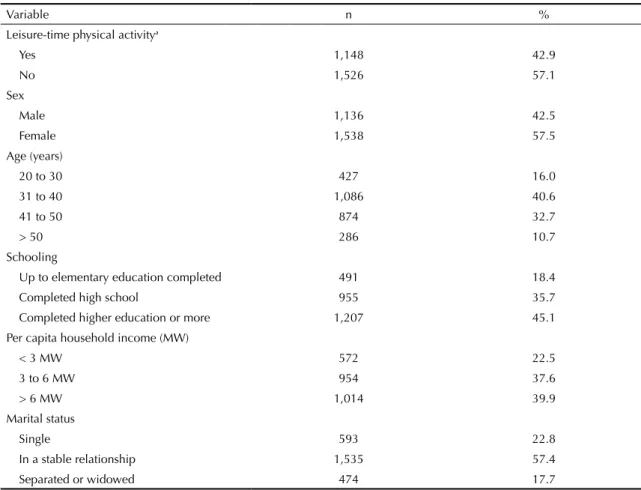
The number of individuals per neighborhood varied between 1 and 214, with a mean of 17.3 individuals. The population studied was predominantly made up of female workers, aged between 31 and 40, having
completed higher education, per capita household
income above six minimum wages and in stable rela-tionships (Table 1).
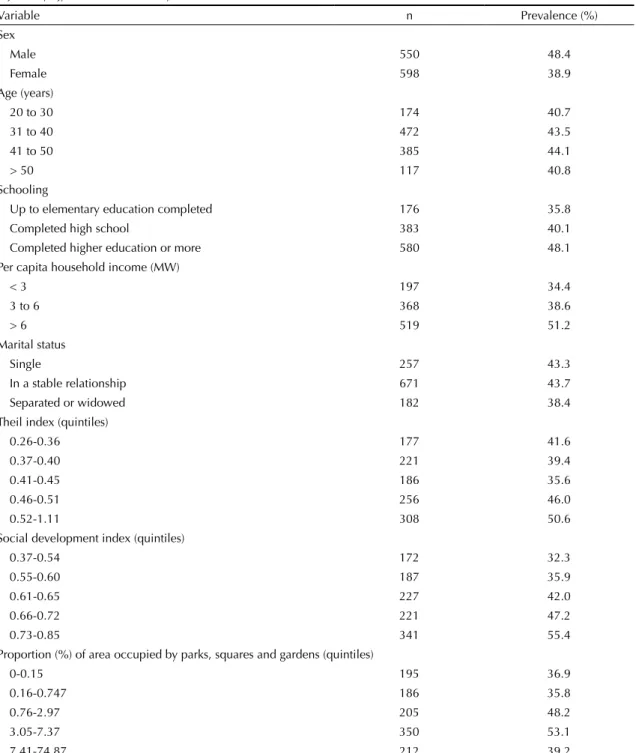
The prevalence of leisure-time physical activity was estimated at 42.9%, being higher among men, those having completed higher education and those with per capita household income above six minimum wages. Higher prevalence was also found in individ-uals residing in neighborhoods with higher Theil and social development indices and with greater propor-tions occupied by parks, squares and gardens (Table 2).
The research was approved by the Research Ethics Committee of the Hospital Universitário Pedro Ernesto
Table 1. Distribution of individual variables between participants in the Pró-Saúde study. Rio de Janeiro, RJ, Southeastern Brazil, 1999.
Variable n %
Leisure-time physical activitya
Yes 1,148 42.9
No 1,526 57.1
Sex
Male 1,136 42.5
Female 1,538 57.5
Age (years)
20 to 30 427 16.0
31 to 40 1,086 40.6
41 to 50 874 32.7
> 50 286 10.7
Schooling
Up to elementary education completed 491 18.4
Completed high school 955 35.7
Completed higher education or more 1,207 45.1
Per capita household income (MW)
< 3 MW 572 22.5
3 to 6 MW 954 37.6
> 6 MW 1,014 39.9
Marital status
Single 593 22.8
In a stable relationship 1,535 57.4
Separated or widowed 474 17.7
MW: minimum wage
(Record 224/1999). Participation was voluntary and all
information was conidential, as was explained to partic -ipants before they signed the informed consent form.
RESULTS
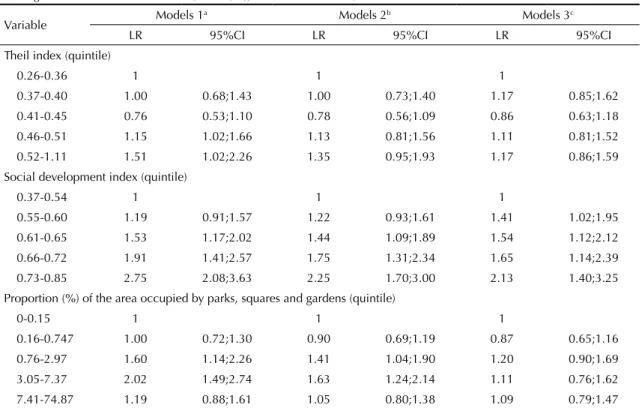
In the unadjusted models (group 1 models),
individ-uals in neighborhoods in the fourth and ifth quintiles
of the social development index, and in the third and
fourth quintiles of the proportion of area occupied by
parks, squares and gardens had a signiicantly higher
chance of doing leisure-time physical activity, compared
to those residing in neighborhoods in the irst quin -tile of these variables. When individual variables were included (group 2 models), associations between the social development index, proportion of area occupied by parks, squares and gardens and leisure-time physical
activity decreased, although they remained signiicant.
Table 2. Prevalence of leisure-time physical activity according to individual and contextual variables of the neighborhood. Rio de Janeiro, RJ, Southeastern Brazil, 1999.
Variable n Prevalence (%)
Sex
Male 550 48.4
Female 598 38.9
Age (years)
20 to 30 174 40.7
31 to 40 472 43.5
41 to 50 385 44.1
> 50 117 40.8
Schooling
Up to elementary education completed 176 35.8
Completed high school 383 40.1
Completed higher education or more 580 48.1 Per capita household income (MW)
< 3 197 34.4
3 to 6 368 38.6
> 6 519 51.2
Marital status
Single 257 43.3
In a stable relationship 671 43.7
Separated or widowed 182 38.4
Theil index (quintiles)
0.26-0.36 177 41.6
0.37-0.40 221 39.4
0.41-0.45 186 35.6
0.46-0.51 256 46.0
0.52-1.11 308 50.6
Social development index (quintiles)
0.37-0.54 172 32.3
0.55-0.60 187 35.9
0.61-0.65 227 42.0
0.66-0.72 221 47.2
0.73-0.85 341 55.4
Proportion (%) of area occupied by parks, squares and gardens (quintiles)
0-0.15 195 36.9
0.16-0.747 186 35.8
0.76-2.97 205 48.2
3.05-7.37 350 53.1
7.41-74.87 212 39.2
The association between the Theil index and leisure-time
physical activity lost statistical signiicance (Table 3).
In model 3, which included all of the individual and contextual variables, only the social development index remained associated with leisure-time physical activity, showing an increase in the likelihood ratio with increase in the quintile. Thus, residents in neighborhoods in the
ifth quintile of the social development index are twice
as likely (LR = 2.13; 95%CI 1.40;3.25) to do leisure-time physical activity as those residing in
neighbor-hoods in the irst quintile (Table 3).
The percentages of unexplained variance attributable to differences between neighborhoods were 3.6% in the blank model, and 0.03% for individuals in the reference categories of the variables included in model 3 (young, male, single, higher levels of income and of schooling; and residing in neighborhoods with lower Theil indices, higher social development indices and higher propor-tions of areas occupied by parks, squares and gardens).
Residue analysis, at both the irst and second levels,
showed normal distribution.
DISCUSSION
Great economic and social contrasts exist in Rio de Janeiro. Whereas some neighborhoods have high social
development indices, others have levels well below the
municipal mean. On the other hand, the city has plen -tiful seafront and many parks and squares, providing conditions favorable to doing leisure-time physical activity. However, the access of the population to such environmental conditions is not homogeneous.
In this study, doing leisure-time physical activity varied
signiicantly according to neighborhood. It was more
prevalent among residents in neighborhoods with better social conditions and access to public areas of leisure, regardless of individual attributes. However, after simultaneous adjustment, socio-environmental charac-teristics grouped in the social development index were shown to be more important than physical character-istics in determining the practice of leisure-time phys-ical activity. The Theil index, associated with physphys-ical activity in the unadjusted models, lost its statistical
signiicance after adjusting for individual variables,
suggesting that inequality in income distribution is not associated with doing leisure-time physical activity.
There is relatively little data on Brazilians’ leisure-time physical activity, although what there is agrees with the
indings presented in this study. Data from the 2011
Surveillance System for Chronic Disease Telephone Survey (VIGITEL) indicate a prevalence of 30.0% for leisure-time physical activity in the state capitals, with
Table 3. Adjusted and unadjusted likelihood ratios (LR) for individual sociodemographic variables and contextual variables of the neighborhood de chances. Rio de Janeiro, RJ, Southeastern Brazil, 1999.
Variable Models 1
a Models 2b Models 3c
LR 95%CI LR 95%CI LR 95%CI
Theil index (quintile)
0.26-0.36 1 1 1
0.37-0.40 1.00 0.68;1.43 1.00 0.73;1.40 1.17 0.85;1.62 0.41-0.45 0.76 0.53;1.10 0.78 0.56;1.09 0.86 0.63;1.18
0.46-0.51 1.15 1.02;1.66 1.13 0.81;1.56 1.11 0.81;1.52 0.52-1.11 1.51 1.02;2.26 1.35 0.95;1.93 1.17 0.86;1.59 Social development index (quintile)
0.37-0.54 1 1 1
0.55-0.60 1.19 0.91;1.57 1.22 0.93;1.61 1.41 1.02;1.95 0.61-0.65 1.53 1.17;2.02 1.44 1.09;1.89 1.54 1.12;2.12 0.66-0.72 1.91 1.41;2.57 1.75 1.31;2.34 1.65 1.14;2.39 0.73-0.85 2.75 2.08;3.63 2.25 1.70;3.00 2.13 1.40;3.25
Proportion (%) of the area occupied by parks, squares and gardens (quintile)
0-0.15 1 1 1
0.16-0.747 1.00 0.72;1.30 0.90 0.69;1.19 0.87 0.65;1.16 0.76-2.97 1.60 1.14;2.26 1.41 1.04;1.90 1.20 0.90;1.69 3.05-7.37 2.02 1.49;2.74 1.63 1.24;2.14 1.11 0.76;1.62
7.41-74.87 1.19 0.88;1.61 1.05 0.80;1.38 1.09 0.79;1.47
a Unadjusted LR.
b LR adjusted for sex, age, per capita household income, schooling and marital status.
this being higher among men (40.0%) compared with women (22.0%) and increasing as level of schooling increased, in both sexes.c
The highest levels of prevalence observed in this study (42.9%) may be explained by characteristics of the population studied (economically active and with higher levels of schooling). Moreover, individuals who reported having done leisure-time physical activity in the two weeks preceding the study were classed as active; in contrast, in surveys such as VIGITELc,
indi-viduals classed as active in leisure-time were those who did at least 30 minutes of mild or moderate activities
ive days a week or more and/or at least 20 minutes of
vigorous activities three days a week or more. Thus, individuals who practice leisure-time physical activity more sporadically and at lower intensities were
clas-siied as active, therefore producing higher levels of
prevalence of physical activity in leisure-time.
Traditionally, initiatives promoting health by encour-aging physical activity have been based on educational measures which emphasize changes in the behavior of the individual. This approach, however, focused exclusively on the individual, has been shown to
be insuficient to increase the population’s levels of
leisure-time physical activity. Increasing attention is now being paid to the role of profound changes in characteristics of physical, social and manmade environments – varying from spaces such as build-ings and parks to the infrastructure of neighborhoods and cities, such as water supply or energy grids – with
especially strong inluence on patterns of the popu -lation’s physical activity, it being recognized that increasing sedentarism is not restricted to the sphere of individual choices.1,19
From this broader perspective, international studies, especially those conducted in the United States,
Australia and European countries from 2000 onwards,
have shown that some contextual characteristics of the region in which the individual lives have been consistently associated with doing leisure-time phys-ical activity. Residents of neighborhoods with: access to places appropriate for doing leisure-time physical
activity, better trafic conditions, pavements, cycle
lanes and trails; security, illumination; transport facil-ities, trees and pleasant landscapes; parks, leisure areas, boardwalks and green areas in close proximity are more likely to be physical active.13,14,17,19,20 On the
other hand, residents in neighborhoods which priori-tize the accumulation of motorways and automobile use, which makes doing physical activity unsafe – due to the lack of pavements and pedestrian crossings or due to high rates of violence –, have a greater chance of being sedentary.18,19,21
Although they are scarce, in general, Brazilian studies
show associations between leisure-time physical activity and contextual characteristics of the neighbor-hood. Data on the adult population of the Brazilian capi-tals for 2006, collected by VIGITELc, show direct
asso-ciation between doing leisure-time physical activity and the proximity of the respondent’s residence to places propitiating leisure-time physical activity.8 Another
study,22 conducted with the elderly in Sao Paulo, SP,
Southeastern Brazil, showed that leisure-time physical activity was associated, among men, with the percep-tion of safety, the presence of courts and gyms and the proximity of banks or health centers. For women, living close to churches and the presence of squares and gyms in the area of the residence was associated with
increased leisure-time physical activity. On the other
hand, a study with the adult population in Sao Paulo who participated in VIGITELc did not ind an associa
-tion between the density of parks and public facilities/ equipment for doing physical activity in the area of residence and leisure-time physical activity.12
In a study conducted in 11 countries (Belgium, Brazil, Canada, Columbia, China, the United States, Japan, Lithuania, Norway, New Zealand and Sweden) using standardized methods for collecting information on physical activity and characteristics of the
neighbor-hood, ive of seven variables on the context were asso -ciated with physical activity in all of the countries, meaning that the results from economically advan-taged countries could be generalized for those with
mid or low income.21 The contextual variable most
strongly associated with doing leisure-time physical activity was the presence of pavements in the majority of streets in the nieghborhood.21 This result reinforces
the idea that simple, non-onerous strategies may stimulate diverse leisure activities such as walking, running, skating and cycling.18,20, 21
Regarding green areas and public parks in particular, when location, access and maintenance and security are convenient, studies show direct associations with leisure-time physical activity due to low (or no) cost. The presence of pleasant, natural spaces, sharing the space with other physical active individuals and greater social interaction and cohesion. Moreover, places where there are more trees and green areas are associated with lower levels of crime, assault and violence.1,24
The presence of parks in the neighborhood is linked to
beneits which go beyond physical and mental health.
It is also related to social (e.g., increasing social inter-action), economic (e.g., increased number of near-by restaurants and shops) and environmental (e.g., reduced
air pollution) beneits.1,24 On the other hand, access to
such spaces is not egalitarian: in the United States,
c Ministério da Saúde. Secretaria de Vigilância em Saúde. Vigitel Brasil 2011: vigilância de fatores de risco e proteção para doenças crônicas
racial minorities, the poor, elderly and women have less access to spaces which propitiate leisure-time phys-ical activity.1,17,19 Diez-Roux et al found an association
between access to leisure areas and doing leisure-time
physical activity among Afro-American and Latinos,
although there was no association found for Whites,4
showing the complexity of interactions between context and individual behavior. Inequalities in access may
explain indings related to racial/ethnic and socioeco -nomic inequality in this respect, e.g., obesity.19
Certain limitations may have inluenced the results of
this study. First, the choice of neighborhood by
physi-cally active people may have been inluenced by facility
of access to environments favorable to doing leisure-time physical activity. Second, although the propor-tion of the area occupied by parks, squares and gardens serves as a marker of access to leisure environments, other spaces related to leisure-time physical activity such as beaches and cycle lanes were not analyzed, as they were not included in the available databases, which may have weakened the association between this variable and leisure-time physical activity. Third,, as the neigh-borhoods in Rio de Janeiro are so heterogeneous, the capacity to distinguish “inter-neighborhood” differences was decreased, as indicated by the variance partition
coeficients in the blank model. However, choosing to use
smaller, and therefore more homogeneous, units of anal-ysis would mean a much reduced number of individuals within each unit. Finally, the period to which leisure-time physical activity referred – only the two weeks preceding
the study – does not guarantee that it was a consistent habit; moreover, the analysis did not incorporate analysis of type, frequency, intensity or duration of leisure-time
physical activity. On the other hand, the experience of a
population residing in a heterogeneous region and with economic, ethnic-racial and social contrasts provided a wider understanding of interaction existing between health-related behavior and environmental effects in determining leisure-time physical activity.
To sum up, the data suggest that increasing access to public leisure spaces is an important measure in promoting health at the collective level. However, better
social conditions can have a stronger inluence on an
individual’s possibility of doing leisure-time physical activity, irrespective of individual attributes and their potential access to leisure spaces. These results are in agreement with theories on the dynamic interaction between individuals and the context in which they live, which postulate that the majority of health-related behaviors and outcomes are not randomly distributed
among regions or populations.2
REFERENCES
1. Bedimo-Rung AL, Mowen AJ, Cohen DA. The significance of parks to physical activity and public health: a conceptual model.
Am J Prev Med. 2005;28(2Suppl2):159-68. DOI:10.1016/j.amepre.2004.10.024
2. Blakely T, Subramanian, SV. Multilevel studies. In: Oakes JM, Kaufman JS, editors. Methods in social epidemiology. San Francisco: Jossey-Bass; 2006. p. 316-40.
3. Diez-Roux AV. Multilevel analysis in public health research. Annu Rev Public Health. 2000;21:171-92. DOI:10.1146/annurev.publhealth.21.1.171
4. Diez-Roux AV, Evenson KR, McGinn AP, Brown DG, Moore L, Brines S, et al. Availability of recreational resources and physical activity in adults. Am J Public Health. 2007;97(3):493-9. DOI:10.2105/AJPH.2006.087734
5. Faerstein E, Lopes CS, Valente K, Plá MAS, Ferreira MB. Pré-testes e um questionário multidimensional autopreenchível: a experiência do Estudo Pró-Saúde UERJ. Physis. 1999;9(2):117-30. DOI:10.1590/S0103-73311999000200007
6. Faerstein E, Chor D, Lopes CS, Werneck GL. Estudo Pró-Saúde: características gerais e aspectos metodológicos Rev Bras Epidemiol. 2005;8(4):454-66. DOI:10.1590/S1415-790X2005000400014
7. Florey LS, Galea S, Wilson ML. Macrosocial Determinants of population health in the context of globalization. In: Galea S, editor. Macrosocial determinants of population health. New York: Springer; 2007. p. 15-51.
8. Florindo AA, Hallal PC, Moura EC, Malta DC. Prática de atividade física e fatores associados em adultos, Brasil, 2006. Rev Saude Publica. 2009;43(Suppl 2):65-73. DOI:10.1590/S0034-89102009000900009
9. Galea S. Integrative chapter: macrosocial determinants of population health. In: Galea S, editor. Macrosocial determinants of population health. New York: Springer; 2007. p. 295-7.
10. Garber CE, Blissmer B, Deschenes MR, Franklin BA, Lamonte MJ, Lee IM, et al. Quantity and quality of exercise for developing and maintaining cardiorespiratory, musculoskeletal, and neuromotor fitness in
apparently healthy adults: guidance for prescribing exercise. Med Sci Sports Exerc. 2011;43(7):1334-59. DOI:10.1249/MSS.0b013e318213fefb
11. Goldstein H, Browne WJ, Rasbash J. Partitioning variation in multilevel models. Underst Stat. 2002;1(4):223-31. DOI:10.1207/S15328031US0104_02
12. Jaime PC, Duran AC, Sarti FM, Lock K. Investigating environmental determinants of diet, physical activity,
and overweight among adults in São Paulo, Brazil. J Urban Health. 2011;88(3):567-81.
13. Kaczynski AT, Potwarka LR, Saelens BE. Association of park size, distance, and features with physical activity in neighborhood parks. Am J Public Health.
2008;98(8):1451-6. DOI:10.2105/AJPH.2007.129064
14. Lee ACK, Maheswaran R. The health benefits of urban green spaces: a review of the evidence. J Public Health.
2011;33(2):212-22. DOI:10.1093/pubmed/fdq068
15. Messes LC, Kaufman JS. Using Census Data to approximate neighborhood. In: Oakes JM, Kaufman JS, editors. Methods in social epidemiology. San Francisco: Jossey-Bass; 2006. p. 209-38.
16. O’ Campo P, Caughy MO. Measures of residential community contexts In: Oakes JM, Kaufman JS, editors. Methods in social epidemiology. San Francisco: Jossey-Bass; 2006. p. 193-208.
17. Popkin BM, Duffey K, Gordon-Larsen P. Environmental influences on food choice, physical activity and energy balance. Physiol Behav. 2005;86(5):603-13. DOI:10.1016/j.physbeh.2005.08.051
18. Sallis, JF, Cervero RB, Ascher W, Henderson KA, Kraft MH, Kerr J. An ecological approach to creating active living communities. Annu Rev Public Health. 2006;27:297-322. DOI:10.1146/annurev.publhealth.27.021405.102100
19. Sallis JF, Glanz K. Physical activity and food environments: solutions to the obesity epidemic. Milbank Q. 2009;87(1):123-54. DOI:10.1111/j.1468-0009.2009.00550.x
20. Sallis JF. Measuring physical activity environments a brief history. Am J Prev Med. 2009;36(4Suppl):86-92.
21. Sallis JF, Bowles RH, Bauman A, Ainsworth BE, Bull FC, Craig CL. Neighborhood environments and physical activity among adults in 11 countries. Am J Prev Med. 2009;36(6):484-90. DOI:10.1016/j.amepre.2009.01.031
22. Salvador EP, Florindo AA, Reis RS, Costa EF. Percepção do ambiente e prática de atividade física no lazer entre idosos. Rev Saude Publica. 2009;43(6):972-80. DOI:10.1590/S0034-89102009005000082
23. Santos SM, Chor D, Werneck GL, Coutinho ESF. Associação entre fatores contextuais e auto-avaliação de saúde: uma revisão sistemática de estudos multinível. Cad Saude Publica. 2007;23(11):2533-54. DOI:10.1590/S0102-311X2007001100002
24. Stanis, SAW, Schneider IE, Pereira MA. Parks and health: differences in constraints ad negotiation strategies for park-based leisure-time physical activity by stage of change. J Phys Act Health. 2010;7(2):273-84.