Seção de
Software
Virgílio José Martins Ferreira Filho
Departamento de Engenharia Industrial Universidade Federal do Rio de Janeiro (UFRJ) Rio de Janeiro – RJ [email protected]
ISYDS – INTEGRATED SYSTEM FOR DECISION SUPPORT (SIAD – SISTEMA INTEGRADO DE APOIO A DECISÃO):
A SOFTWARE PACKAGE FOR DATA ENVELOPMENT ANALYSIS MODEL
Lidia Angulo Meza
Material Science Department
Fluminense Federal University (UFF) Volta Redonda – RJ – Brazil
Luiz Biondi Neto
Electrical and Telecommunications Engineering Dept. Rio de Janeiro State University (UERJ)
Rio de Janeiro – RJ – Brazil [email protected]
João Carlos Correia Baptista Soares de Mello *
Production Engineering Department Fluminense Federal University (UFF) Niterói – RJ – Brazil
Eliane Gonçalves Gomes
Brazilian Agricultural Research Corporation (Embrapa) Brasília – DF – Brazil
1. Introduction
Data Envelopment Analysis (DEA) is an approach to evaluate efficiency and uses Linear Programming Problems (LPP) to assess the performance of Decision-Making Units (DMUs).
In recent years there has been an increasing interest for DEA and its corresponding LPPs. Several real case applications have led to a need for new developments in the classic models, the CCR (Charnes et al., 1978) and BCC (Banker et al., 1984) DEA models, in order to include new situations. Thus, several researchers have been aware to the results yielded by the models in terms of efficiency indexes, benchmarks and targets.
On the other hand, a LPP has to be solved for each DMU. So the task for efficiency evaluation can be hard and very time consuming without adequate specific software, particularly for a large number of DMUs. Several software packages were developed so to minimise those problems. However, in several situations, the results obtained from these softwares are either incomplete or inconsistent. In further sections, we will describe some of those and the problems related to them.
These problems motivated us to develop a DEA package that displays complete results (efficiency scores, targets, benchmarks, variable weights, shares, slacks) and that includes some advanced models usually not present in existent packages. This was the motivation for SIAD (which are the Portuguese initials for Integrated System for Decision Support) development.
Another motivation was the possibility of integrating in a single package other decision aid tools like multicriteria and game theory models. Those features are in still under development.
SIAD is design for Windows environment and was written in Delphi 7.0 due mainly to allow Object Pascal coding for writing the Simplex algorithm to solve LPPs and also to its capability to deal with graphics and windows interface. The user has no need of other additional software to run SIAD.
2. Data Envelopment Analysis
Data Envelopment Analysis (DEA) was developed by Charnes et al. (1978) and uses linear programming for the comparative evaluation of DMUs efficiencies.
DEA purpose is to compare a certain number of DMUs performing similar tasks and that distinguish themselves in the number of used inputs and produced outputs. There are basically two classic DEA models: the Constant Return Scale (CRS) model, also known as CCR (Charnes, Cooper & Rhodes, 1978), and the Variable Return Scale (VRS) model or BCC (Banker, Charnes & Cooper, 1984). The first model considers constant returns to scale; the second one assumes variable returns to scale and no proportionality among inputs and outputs.
Each kth DMU, k = 1, ..., n, is considered to be a production unit that uses r inputs xik, I = 1, …, r, to produce s outputs yjk, j = 1, …, s. The CCR model described by (1) maximises
DMU o, ho is its efficiency; xio and yjo are its inputs and outputs and vi and uj are the
calculated weights for the inputs and outputs.
1 1 1 1 max subject to
1, 1,...,
, 0 ,
s j jo j o r i io i s j jk j r i ik i j i u y h v x u y k n v x
u v i j = = = = = ≤ = ≥ ∀
∑
∑
∑
∑
(1)After some mathematical procedures, the model can be rewritten, yielding in a Linear Programming Problem (LPP) as shown in (2).
1 1 1 1 max subject to 1
0 , 1,...,
, 0 ,
s
o j jo
j
r
i io i
s r
j jk i ik
j i
j i
h u y
v x
u y v x k n
u v i j = = = = = = − ≤ = ≥ ∀
∑
∑
∑
∑
(2)As a LPP is solved for each DMU, if we have n DMUs n LPPs must be solved, with r + s
decision variables. The model just presented is the basis for all other DEA models.
Besides the efficiency index, DEA models yield, for each DMU, the variables weights, benchmarks and targets for the inefficient DMUs. The last two elements are determined from the values of the dual variables, i.e., by solving the dual LPPs or by the use of the complementary slack theorem. The set of all those results defines what we call in this paper “complete results”.
3. SIAD – Integrated System for Decision Support (ISYDS)
ISYDS uses Kuenzi et al. (1971) approach, which includes a subroutine to avoid degenerating problems. Degeneration is a common problem in DEA models, due to the typical structure of DEA LPPs. Those models present a large number of redundant constraints for the inefficient DMUs, and also a large number of variables and restrictions. The structure of DEA models often leads to multiple optimal solutions in the multipliers formulation and to degenerate problems when the envelopment approach is used. ISYDS uses the multipliers formulation, and, in the case of multiple optimal solutions, shows only the first one reached.
We use a unique method for solving the LPPs. The format of the LPPs is variable, in order to include different DEA models and orientation.
Internally, the input data must be in the proper format (in a matrix structure) depending on the used model. The data ordering process in the referred matrix is the most difficult part in the software implementation. But, of course, this is not a part of the user’s job.
3.1 Software description
SIAD (in Portuguese version and ISYDS in English) was implemented for Windows platform with Delphi 7.0. It is capable of dealing with 150 DMUs, 20 variables (inputs or outputs), and works with a six decimals accuracy. Figure 1 displays SIAD’s open window.
Although for other research areas 150 units might be insufficient, for DEA applications this number is able to deal with large-scale situations, once in the literature there are few applications dealing with more than 100 DMUs. As far as the number of variables is concerned, it should be pointed out that in most applications 10 variables are sufficient. In this package, we can choose between the classic models (CCR or BCC) and orientation (input or output). The user can choose only one model and one orientation at a time, and can also change data details, as values and variables names, with the editor toll, as shown in Figure 2. More operational details of the software can be found in Angulo-Meza et al. (2003 and 2004).
As one of the objectives of the ISYDS package is to allow new DEA models, advanced options are also included in this software. They may be chosen along with the model and its orientation. Thus, the user has also the possibility of using two types of weight restrictions: assurance regions and virtual weights (see Figure 3).
Figure 1 – SIAD’s open window.
Figure 3 – Weight restrictions window.
3.2 Implemented models
Basic DEA CCR and BCC models are already included in ISYDS. Both models include input or output orientation, producing complete results (efficiency scores, weights, benchmarks, targets, and slacks.).
Moreover, some advanced models were included, retrieving also complete results. These models were:
a) Inverted frontier, that is a way to measure the inefficiency of a DMU (Entani et al., 2002; Novaes, 2002), altogether with a composed efficiency, obtained from the common and inverted frontiers (Leta et al., 2005). This composed efficiency index is computed as shown in (3). As the common DEA frontier represents an optimist evaluation, and the inverted frontier a pessimistic one, the composed index considers both approaches. Normalised composed efficiency is obtained by dividing each DMU composed efficiency index by the major one along all DMUs. Even when not displayed, those indexes are always calculated as part of DEA results.
Classic efficiency Inverted efficiency 1 Composed efficiency index
2
− +
= (3)
b) Weight restrictions, using the assurance region (Allen et al., 1997), optional. c) Virtual weight restrictions, optional.
It’s important to point out that even using weight restrictions the results show the inverted frontier efficiency index. In using virtual weight restrictions, the results will not show the aforementioned index.
4. Comparing SIAD with Some Other DEA Packages
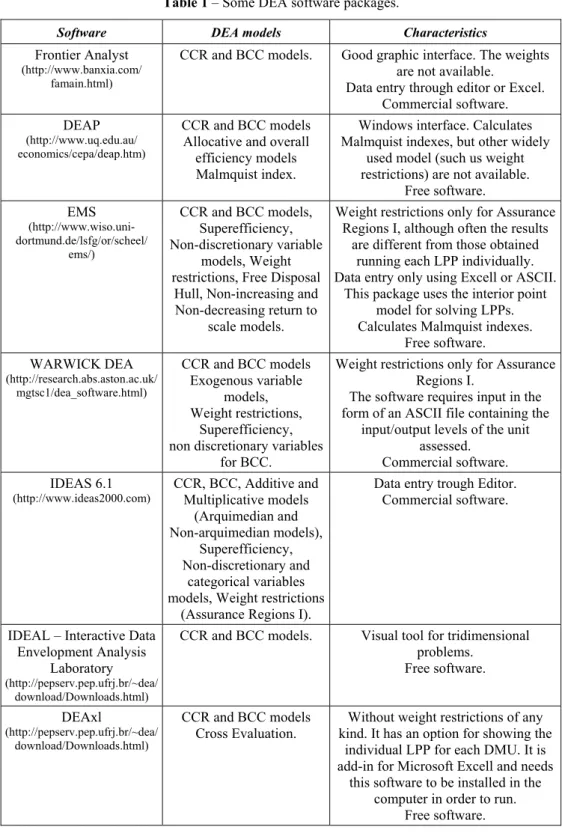
As mentioned earlier, in recent years, DEA software packages were developed due to the great interest and the large number of applications using the DEA approach. These softwares include mostly basic models and were mainly developed to avoid the effort of running separately LPPs for each DMU in order to get the final evaluation. Angulo-Meza & Estellita-Lins (2000) made a review of software packages used to perform DEA at that time, with special interest in Frontier Analyst (www.banxia.com). Table 1 shows some of the most popular DEA software packages, almost all run in Windows environment. This same table shows the advanced models include in each software package.
Although latest theoretical developments were introduced in DEA packages and there exist many options available, we can frequently observe that DEA results can be different from package to package. This happens even for the basic models. Besides, most software packages show only efficiency indexes, benchmarks, and targets, leaving out the actual values for variable weights, which may be useful in a thorough analysis of the DMUs and in later theoretical developments (Angulo-Meza & Estellita-Lins, 2000).
Table 1 – Some DEA software packages.
Software DEA models Characteristics
Frontier Analyst (http://www.banxia.com/
famain.html)
CCR and BCC models. Good graphic interface. The weights are not available.
Data entry through editor or Excel. Commercial software. DEAP
(http://www.uq.edu.au/ economics/cepa/deap.htm)
CCR and BCC models Allocative and overall
efficiency models Malmquist index.
Windows interface. Calculates Malmquist indexes, but other widely
used model (such us weight restrictions) are not available.
Free software.
EMS (http://www.wiso.uni-dortmund.de/lsfg/or/scheel/
ems/)
CCR and BCC models, Superefficiency, Non-discretionary variable
models, Weight restrictions, Free Disposal
Hull, Non-increasing and Non-decreasing return to
scale models.
Weight restrictions only for Assurance Regions I, although often the results
are different from those obtained running each LPP individually. Data entry only using Excell or ASCII.
This package uses the interior point model for solving LPPs. Calculates Malmquist indexes.
Free software. WARWICK DEA
(http://research.abs.aston.ac.uk/ mgtsc1/dea_software.html)
CCR and BCC models Exogenous variable
models, Weight restrictions,
Superefficiency, non discretionary variables
for BCC.
Weight restrictions only for Assurance Regions I.
The software requires input in the form of an ASCII file containing the
input/output levels of the unit assessed.
Commercial software.
IDEAS 6.1 (http://www.ideas2000.com)
CCR, BCC, Additive and Multiplicative models (Arquimedian and Non-arquimedian models), Superefficiency, Non-discretionary and categorical variables models, Weight restrictions
(Assurance Regions I).
Data entry trough Editor. Commercial software.
IDEAL – Interactive Data Envelopment Analysis
Laboratory (http://pepserv.pep.ufrj.br/~dea/
download/Downloads.html)
CCR and BCC models. Visual tool for tridimensional problems.
Free software.
DEAxl
(http://pepserv.pep.ufrj.br/~dea/ download/Downloads.html)
CCR and BCC models Cross Evaluation.
Without weight restrictions of any kind. It has an option for showing the
individual LPP for each DMU. It is add-in for Microsoft Excell and needs
this software to be installed in the computer in order to run.
DEAFrontier/DEA Excel Solver
(http://www.deafrontier.com/ software.html)
CCR and BCC models, Input and Output oriented.
Uses Excel Solver and does not set any limits on the number of DMUs,
inputs or outputs. Free software. OnFront
(http://www.emq.com/ software.html)
CCR and BCC models, Input and Output oriented,
Malmquist productivity indexes, Strong and weak
disposability.
Was developed by the originators of the Malmquist productivity index. Simulation capability and Malmquist productivity, including decomposition
into efficiency and technical change. Commercial software.
SIAD (http://www.uff.br/decisao)
CCR and BCC models, Input and Output oriented,
Inverted Frontier, Weight Restrictions.
Weight restrictions available for assurance regions (with or without previous normalization) and virtual
weights.
Data entry through editor or ASCII file. No graphics available. Cut, copy
and paste options are not available. Free software.
Other implementations for DEA models involved the algebraic modelling language AMPL (Green, 1996) and the SAS package for optimization (Emrouznejad, 2005) but they are not independent packages.
5. Conclusions
The recent years growing interest in DEA models and the theoretical developments due to real world applications have indicated the need of a reliable software package. This package must jointly have a friendly user interface, must yield reliable, consistent and complete results and should be capable of working with more advanced DEA models. There are available many DEA software packages, but the lack of complete and reliable results in those softwares led to the development of a software package that met our demands.
The ISYDS (SIAD) includes, besides the classic models, advanced models such as DEA models with weight restrictions and the use of a inverted frontier.
The complete results produced by this software are suitable for a deep analysis of the DMUs and are also useful for the development of new theoretical models.
The performance of the ISYDS in large-scale problems has been computationally satisfactory: the response time for problems involving 80 DMUs and 7 variables was less than one second.
The great motivation for the ISYDS development was the possibility of including other models in the package. This implementation has been very useful for DEA new developments and in testing new models. The latest beta version of the software can be downloaded from <http://www.uff.br/decisao>.
Finally, new models are under consideration in the ISYDS such as the DEA-GSZ model (Estellita-Lins et al., 2003; Gomes, 2003), models considering uncertainties using a fuzzy approach (Soares de Mello et al., 2005), and the smoothed DEA frontier model (Soares de Mello et al., 2004, 2002). A multicriteria module and a Game Theory one are also under development.
Acknowledgements
We acknowledge the financial support of CNPq (Brazilian Ministry of Science and Technology) processes 471014/2003-6 and 306924/2004-8.
References
(1) Allen, R.; Athanassopoulus, A.; Dyson, R.G. et al. (1997). Weights restrictions and Value judgements in Data Envelopment Analysis: Evolution, Development and Future Directions. Annals of Operations Research, 73, 13-34.
(2) Angulo-Meza, L. & Estellita Lins, M.P. (2000). Data Envelopment Analysis (DEA) using Frontier Analyst. Pesquisa Operacional, 19, 287-293. (In Portuguese)
(3) Angulo-Meza, L.; Biondi Neto, L.; Soares de Mello J.C.C.B.; Gomes, E.G. & Coelho, P.H.G (2004). FSDA – Free Software for Decision Analysis (SLAD – Software Livre de Apoio a Decisão): A Software Package for Data Envelopment Analysis Models. 12º Congreso Latino-Iberoamericano de Investigación Operativa y Sistemas, La Habana, Cuba.
(4) Angulo-Meza, L.A.; Biondi Neto, L.; Soares de Mello, J.C.C.B.; Gomes, E.G. & Coelho, P.H.G. (2003). SIAD – Integrated System for Decision Support: A Computational Implementation for Data Envelopment Analysis Models. Relatório de Pesquisa em Engenharia de Produção, vol. 3. (In Portuguese).
(5) Banker, R.D.; Charnes, A. & Cooper, W.W. (1984). Some Models for Estimating Technical and Scale Inefficiencies in Data Envelopment Analysis. Management Science, 30, 1078-1092.
(6) Charnes, A.; Cooper, W.W. & Rhodes, E. (1978). Measuring the Efficiency of Decision Making Units. European Journal Of Operational Research, 2, 429-444.
(7) Climaco, J.; Antunes, C.H. & Alves, M.J.G. (1996). Multicriteria Decision Aid. Faculdade de Economia da Universidade de Coimbra e INESC. (In Portuguese)
(8) Cooper, W.W.; Seiford, L.M. & Tone, K. (2000). Data Envelopment Analysis: A Comprehensive Text with Models, Applications, References and DEA-Solver Software. Kluwer Academic Publishers, USA.
(9) Dantzig, G.B. (1963). Linear Programming and Extensions. Princeton University Press, Princeton, N.J.
(10) Emrouznejad, A. (2005). Measurement efficiency and productivity in SAS/OR.
(11) Entani, T.; Maeda, Y. & Tanaka, H. (2002). Dual Models of Interval DEA and its extensions to interval data. European Journal of Operational Research, 136, 32-45. (12) Estellita Lins, M.P.; Gomes, E.G.; Soares de Mello, J.C.C.B. & Soares de Mello, A.J.R.
(2003). Olympic ranking based on a Zero Sum Gains DEA model. European Journal of Operational Research, 148, 312-322.
(13) Gomes, E.G. (2003). Zero Sum Gains Data Envelopment Analysis Models. Ph.D. Thesis in Production Engineering, COPPE, Rio de Janeiro Federal University. (In Portuguese)
(14) Green, R.H. (1996). DIY DEA: Implementing Data Envelopment Analysis in the Mathematical Programming Language AMPL. Omega, 24(4), 489-494.
(15) Kuenzi, H.P.; Tzschach, H.G. & Zehnder, C.A. (1971). Numerical Methods of Mathematical Optimization. Academic Press, New York.
(16) Leta, F.R.; Soares de Mello, J.C.C.B.; Gomes, E.G. & Angulo-Meza, L. (2005). Methods for Improving Ranking in DEA applied to Lathes Static Evaluation.
Investigação Operacional, 25. (In Portuguese, to appear)
(17) Novaes, L.F.L. (2002). Double Approach Envelopment for Real State Evaluation with Geographic Information System Environment. Ph.D. Thesis in Production Engineering, COPPE, Rio de Janeiro Federal University. (In Portuguese)
(18) Press, W.H.; Flannery, B.P.; Teukolsky, S.A. & Vetterling, W.T. (1989). Numerical Recipes in Pascal, The Art of Scientific Computing. Cambridge University Press. (19) Schell, H. (2000). EMS – Efficiency Measurement System: User’s Manual. Faculty
of Economic and Social Sciences, University of Dortmund. Available in: <www.wiso.uni-dortmund.de/lsfg/or/scheel/ems/>.
(20) Soares de Mello, J.C.C.B.; Gomes, E.G.; Angulo-Meza, L.; Biondi Neto, L. & Sant’Anna, A.P. (2005). Fuzzy DEA frontiers. Investigação Operacional, 25(1), 85-103.
(21) Soares de Mello, J.C.C.B.; Gomes, E.G.; Biondi Neto, L. & Estellita Lins, M.P. (2004). Smoothed DEA Frontier: The BCC Three-dimensional Case. Investigação Operacional, 24(1), 89-107. (In Portuguese)