Abstract
The legislation for the protection and conservation of caves is recent in Brazil. In 2008, the Decree 6.640 was enacted and in 2009, the Normative Instruction Nº 2 by the Brazilian Environment Ministry (MMA, Portuguese acronyms) was published. Mining operations cause a signiicant impact on the caves when they are present in or next to the mineral body. The impacts include the suppression of cavities and impacts on physical and bio-speleological stability of the caves. On the other hand, the actual legislation causes a signiicant impact on the mineable reserves when cavities are pres-ent. This article aims to assess the impact of the natural cavities on the feasibility of a mining project, based on the federal legislation, as well as to propose alternatives to combine mining activity with cave protection. For this research, three scenarios of open pit for a hypothetical ore body were considered for the assessments. This paper presents the results achieved for the three and comments on the necessity of researches to conciliate the conservation of the natural underground cavities with the mining activities.
keywords: mining feasibility, speleology, mine planning, natural underground cavity legislation.
Iure Borges de Moura Aquino
Mestre em Engenharia Mineral – PPGEM Universidade Federal de Ouro Preto - UFOP, Escola de Minas
Departamento de Engenharia de Minas Ouro Preto – Minas Gerais - Brazil [email protected]
Hernani Mota de Lima
Prof. Associado
-Universidade Federal de Ouro Preto - UFOP, Escola de Minas
-Departamento de Engenharia de Minas [email protected]
Analysis of the economic
feasibility of a mining project
due to the presence of natural
underground cavities
Mining
Mineração
http://dx.doi.org/10.1590/0370-44672014680094
1. Introduction
Natural underground cavities or caves, as popularly known are hollow spaces in a rock mass formed by a type of geologic process (POULSON and WHITE, 1969, FORD, 1988; BRA-SIL,1990). Activities such as mining, di-rectly interfere in the natural heritage and can also interfere in the cultural heritage, when they are destroyed and modify the ecosystem and archaeo-palaeontological sites. Caves along with the environment, are directly affected in these processes.
To promote sustainable develop-ment and mitigate the conlicts regard-ing the environment and the productive segment, many countries have deined
rules and have established standards for operations that have an impact on the environment. The legislation that regulates the use and conservation of natural cavities is recent. The last pub-lished acts are Decree 6.640/2008 and the Normative Instruction Number 02 of the Brazilian Environment Ministry (Ministério de Meio Ambiente - MMA). These acts regulate the classiication of the natural underground cavities in 4 degrees: Maximum, High, Medium, and Low Speleological Relevance, and deine their protection radius.
Depending on the number of highly relevant caves present in the mining area,
these cavities in some cases, can derail enterprises both in the initial installation phase and in the operating phase. Thus, the recent change in the Brazilian Spe-leological legislation, related to the lack of speciic works that conciliate mining activities and preserve natural under-ground cavities, justiies a study about the economic impact of the new legislation on the mineable reserve and on alternative mining projects that guarantee the pro-tection of cavities and enables the maxi-mization of the use of mineral resources. The objective of this study is to evaluate the feasibility of a mining project in the presence of natural underground cavities.
2. Methodology
For this study, a bibliographic review was necessary to contextualize environmental legislation about protec-tion of cavities and all of the diverse
mining operations that directly impact these cavities. To achieve the proposed objectives, a case study was adopted. In the choice of this case, adopted as
the viability for the mining and com-mercialization of the mineral good.
The karstic region of Arcos-Paíns-Doresópolis-Iguatema was chosen
because it met the established criteria (Figure 1).
Figure 1
Location of the area of study
A study region was selected that contained natural cavities in accordance with data from the Environmental Impact Assessment and Environmen-tal Impact Report (EIA and RIMA, Portuguese acronyms), available in the State Environment Foundation (FEAM,
Portuguese acronyms), and could be val-ued according to a level of relevance for each cavity. For this, Decree 6640/2008 and the IN 02/2009 of MMA were considered. A speleological zoning was established, dividing the areas into high, medium, or low speleological relevance
zones, which enabled the delimitation of inluential areas. Based on a typical stratigraphy column for the region and its topography, a hypothetical ore body was created. The mineable reserve or body estimated for this body is 65.4 Mt of limestone (Figure 2).
From this deposit, and applying the speleological zoning, three open pit mines were prepared considering three different scenarios (Table 1).
Thus, the proposed scenarios differ in the open pit dimensions and in the mineable reserve estimate. For each scenario, an Economic Exploitation
Plan was elaborated based on the estimated mineable reserve and its economic viability.
Figure 2
Scenarios Characteristics
Scenario 1
Maintaining the cavities’ protection radius of 250 m.
Suppression of the cavities of high, medium and low speleological relevance. Environment Compensation
No open pit limit restriction.
Scenario 2
Maintaining the cavities’ protection radius of 250 m. No suppression of cavities
No invasion of cavities’ area of influence. No environment compensation
Open pits limits restricted to low speleological potential areas.
Scenario 3
Adoption of a 100 m protection radium for cavities of médium speleological rel-evance
No suppression of cavities
No invasion of cavities’ area of influence. No environmental compensation
Open pit limits restricted to low speleological potential areas.
Implementation of monitoring cavities’ physical and biospeloelogical integrity program
To mount the database, to deine the areas for speleological zoning, and to analyze economic viability, different software was used. Among them were: ArcView 9.3 for digital mapping, GIS for
base editing, inal map layouts, integrated georeferenced information analysis, in-terpretation of regional images, area and distance calculations, DWG and DXF editing and treatment of pre-existent data,
AutoCad 2008 for topography confection, Google Earth for providing aerial images, and Micromine 11.01 for the activities of drawings of open pits and estimation of mineable ields.
2.1 Protection Legislation
The most recent legislative acts concerning the protection of the national speleological heritage collection are: De-cree 6.640 (2008) and the Environment Ministry Normative Instruction Number 2 (2009) (BRASIL, 2008 and 2009). The current law establishes the criteria for es-tablishing the valuation according to sev-eral factors that are decisive for whether to allow or not the realization of any irreversible interference in the cavity; in other words, the suppression of this cave. According to the legislation, the cavities are classiied in 4 degrees of speleological relevance (Maximum, High, Medium and
Low). For each relevance degree a measure of protection or compensation is adopted.
The natural cavities classified as maximum speleological relevance are the only cavities that aren’t inclined to be tar-geted by any impact. This is the only type of cavity that can completely derail a min-ing project dependmin-ing on some variables, such as the positioning of it within the ore body being considered. The cavities classi-ied as high speleological relevance can be suppressed if two cavities with the same characteristics are preserved, and if there aren’t two cavities around, the governmen-tal organ will be in charge of proposing
other compensatory measures. In the case of cavities classiied as medium speleologi-cal relevance, the responsible organ should provide a inancial compensation. For the cavities of low relevance, no compensatory measure is necessary.
The legislation also sets the inlu-ence radius (or a protection radius) for a cavity as being the horizontal projection of the outer contour of the cavity plus the minimum of 250 m. The protection radius helps to protect the cavity and its sur-rounding, as the external area has a direct inluence on the events and interactions that occur within the cave’s environment.
2.2 Cavities Used and Speleological Zoning
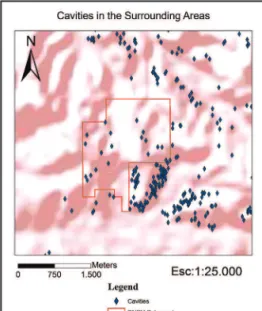
In the compilation of thespe-leological research completed in the region, around 200 cavities were
iden-tiied in the surrounding area of this study. These data are from surveys of primary data executed in the area, and
also of secondary data collected in the CECAV database (Figure 3).
Table 1 Definition of scenarios and their characteristics
The cavities present inside and around as far as 250 meters away from the polygon DNPM were valued ac-cording to the presence or absence of attributes regulated by the Normative Instruction 02/2009, of the Environ-ment Ministry, in accordance with ar-ticle 5 of Decree 99556/1990, amended by Decree 6640/2008. These studies
revealed the presence of 5 high relevance cavities, 14 medium relevance and 48 low relevance cavities.
After performing the valuation of the cavities, it was possible to deter-mine the speleological zoning that aims to deine areas of maximum, high, medium or low speleological relevance in function of the cavities’ areas of
inluence present there. The inluence area of a cavity was established by a radius of 250 meters from the outer contour of its horizontal projection, as deined in the IBAMA Ordinance Number 887/1990, CONAMA Reso-lution Number 347/2004 and reaf-irmed in Annex II of IN 02/2009 of MMA (Figure 4).
Figure 4
Speleological Zoning for the area of study
2.3 Mine Planning and Definition of Pit Boundaries
The mine planning, morepre-cisely the pit boundaries and other installations, should respect the environmental and geometrical re-strictions of the ield, and also the technical and operational constraints for full development of the mine.
En-vironmental restriction imposed by the cavities is an extremely important factor and should be evaluated with caution. The pit boundaries were es-tablished based on the inluence areas of the cavities present in the area. With the aid of Micromine software,
based on the speleological zoning and on the orebody geometry, an open pit was designed for each proposed sce-nario. With the pit projects designed, it was possible to estimate the mine-able reserve for each scenario and, consequently, evaluate its feasibility.
2.4 Scenario 1
2.5 Scenario 2
2.6 Scenario 3
The pit boundaries for Scenario 1 are restricted only to the polygon DNPM, and the geology of the body and all of the cavities present in the
area are subject to suppression. Thus, there are no restrictions regarding the pit boundaries due to the cavities. The total estimated mineable reserve
for Scenario 1 is 49.1 Mt of ore (75% of the total reserve), 34.2 Mt of waste and a stripping ratio of 0.7:1 (Figure 5, left).
The pit boundaries for Scenario 2 are restricted to only those zones that are away from the inluence of high and medium speleological relevance
cavities, and the restrictions due to the geographic limits of the polygon DNPM and ore body geometry. The total estimated mineable reserve for
Scenario 2 was 3.8 Mt of ore (06% of the total reserve), 8.4 Mt of waste and a stripping ratio of 2.3:1 (Figure 5, center).
The pit limits for Scenario 3 are included in new areas of low speleological potential, established in the speleological
zoning assuming a 100 m inluence radius for medium relevance cavities. The total mineable reserve for Scenario 3 was 27
Figure 5
Pit Boundaries for Scenario 1 (left), Scenario 2 (rigth) and
Scenario 3 (below).
3. Results
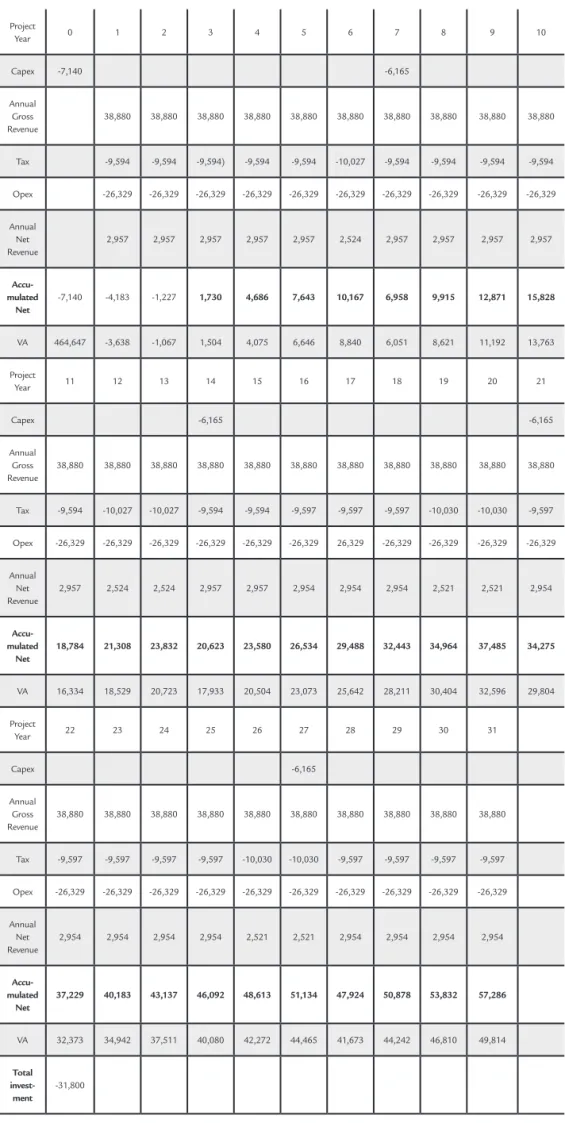
An economic exploiting plan was prepared for each proposed scenario based on the calculation of its mine-able reserve, on its given investment costs (CAPEX) and its operational costs (OPEX), which allowed a further economic viability analysis for each case, based on a development with a monthly output of 120,000 t, an esti-mated recovery of 90%, and the selling
price of the product equal to R$30.00/ ton. These igures were compiled from various Economic Exploitation Plan (PAE) private companies, according to HARTMAN, (1992 and 2002) and HUSTRULID and KUCHTA, (1979).
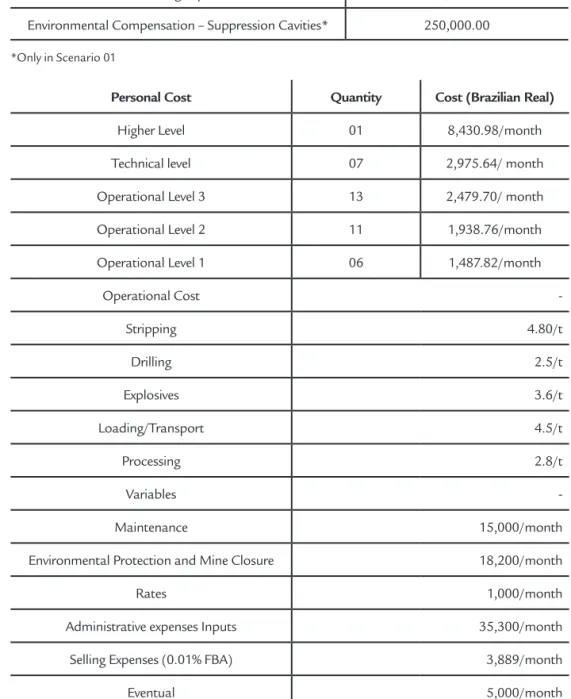
CAPEX involves all infrastructure investments, and improvements needed for the installation of the mining op-eration. For this study the investments
Table 3 CAPEX
Personal Cost Quantity Cost (Brazilian Real)
Higher Level 01 8,430.98/month
Technical level 07 2,975.64/ month
Operational Level 3 13 2,479.70/ month
Operational Level 2 11 1,938.76/month
Operational Level 1 06 1,487.82/month
Operational Cost
-Stripping 4.80/t
Drilling 2.5/t
Explosives 3.6/t
Loading/Transport 4.5/t
Processing 2.8/t
Variables
-Maintenance 15,000/month
Environmental Protection and Mine Closure 18,200/month
Rates 1,000/month
Administrative expenses Inputs 35,300/month
Selling Expenses (0.01% FBA) 3,889/month
Eventual 5,000/month
For a proper analysis of the eco-nomic feasibility of a project, in addition
to OPEX and CAPEX, some indicators are essential, such as the Internal Rate
of Return (IRR) and Net Present Value (NPV) by using the equation (1).
N
n = 0
C
n1 + r
n= 0
NPV =
Initial Investiment +
(1)
Where:
Cn
is the cash low int
;t
is the nth period in time in which the money will be invested in the project(starts in period 1, when there is effectively the irst cash low);
N
is the number of periods t;r
is the cost of equity/internal rate of return.A summary of these calculations is shown in cash lows for scenarios 1 and 3 (Tables 4, 5 and 6). The results obtained
in the feasibility analysis demonstrate that only Scenarios 1 and 3 are technically and economically viable. The operation
for Scenario 2 is not economically viable because the ore reserve available in this scenario is insuficient to pay the initial *Only in Scenario 01
Investment Type Cost (Brazilian Real)
Pre-operational investments 125,000.00
Buildings (shed, workshop, bathroom, cafeteria, ...) 100,000.00
Plant Processing 2,500,000.00
Equipment, Machinery and Vehicles 3,665,000.00
Working capital 500,000.00
Environmental Compensation – Suppression Cavities* 250,000.00 Table 2
investment needed and to cover the opera-tional costs. On the other hand, the results
obtained for scenarios 1 and 3 show to be promising, but with some differences.
Table 7 presents a comparison of values of the inancial data for both scenarios.
Project
Year 0 1 2 3 4 5 6 7 8 9 10
Capex -7,140 -6,165
Annual Gross Revenue
38,880 38,880 38,880 38,880 38,880 38,880 38,880 38,880 38,880 38,880
Tax -9,594 -9,594 -9,594) -9,594 -9,594 -10,027 -9,594 -9,594 -9,594 -9,594
Opex -26,329 -26,329 -26,329 -26,329 -26,329 -26,329 -26,329 -26,329 -26,329 -26,329
Annual Net Revenue
2,957 2,957 2,957 2,957 2,957 2,524 2,957 2,957 2,957 2,957
Accu-mulated
Net
-7,140 -4,183 -1,227 1,730 4,686 7,643 10,167 6,958 9,915 12,871 15,828
VA 464,647 -3,638 -1,067 1,504 4,075 6,646 8,840 6,051 8,621 11,192 13,763
Project
Year 11 12 13 14 15 16 17 18 19 20 21
Capex -6,165 -6,165
Annual Gross Revenue
38,880 38,880 38,880 38,880 38,880 38,880 38,880 38,880 38,880 38,880 38,880
Tax -9,594 -10,027 -10,027 -9,594 -9,594 -9,597 -9,597 -9,597 -10,030 -10,030 -9,597
Opex -26,329 -26,329 -26,329 -26,329 -26,329 -26,329 26,329 -26,329 -26,329 -26,329 -26,329
Annual Net Revenue
2,957 2,524 2,524 2,957 2,957 2,954 2,954 2,954 2,521 2,521 2,954
Accu-mulated
Net
18,784 21,308 23,832 20,623 23,580 26,534 29,488 32,443 34,964 37,485 34,275
VA 16,334 18,529 20,723 17,933 20,504 23,073 25,642 28,211 30,404 32,596 29,804
Project
Year 22 23 24 25 26 27 28 29 30 31
Capex -6,165
Annual Gross Revenue
38,880 38,880 38,880 38,880 38,880 38,880 38,880 38,880 38,880 38,880
Tax -9,597 -9,597 -9,597 -9,597 -10,030 -10,030 -9,597 -9,597 -9,597 -9,597
Opex -26,329 -26,329 -26,329 -26,329 -26,329 -26,329 -26,329 -26,329 -26,329 -26,329
Annual Net Revenue
2,954 2,954 2,954 2,954 2,521 2,521 2,954 2,954 2,954 2,954
Accu-mulated
Net
37,229 40,183 43,137 46,092 48,613 51,134 47,924 50,878 53,832 57,286
VA 32,373 34,942 37,511 40,080 42,272 44,465 41,673 44,242 46,810 49,814
Total invest-ment
-31,800 Table 4
Project Year 0 1 2
Capex -6,890
Annual Gross Revenue 38,880 38,880
Tax -8,417 -8,417
Opex -38,079 38,079
Annual Net Revenue -7,616 -7,616
Accumulated Net -6,890) -14,506 -22,122
VA -31,938 -12,700 -19,237
Total Investment -6,890 Table 5
Cash Flow for Scenario 2 (x R$ 1,000.00)
Project
Year 0 1 2 3 4 5 6 7 8 9 10
Capex -7,140 -6,165
Annual Gross Revenue
38,880 38,880 38,880 38,880 38,880 38,880 38,880 38,880 38,880 38,880
Tax -9,325 -9,325 -9,325 -9,325 -9,325 -9,758 -9,325 -9,325 -9,325) -9,325
Opex -27,020 -27,020 -27,020 -27,020 -27,020 -27,020 -27,020 -27,020 -27,020 -27,020
Annual Net Rev-enue
2,535 2,535 2,535 2,535 2,535 2,102 2,535 2,535 2,535 2,535
Accu-mulated
Net
-6,890 -4,355 -1,820 715 3,250 5,785 7,887 4,257 6,792 9,327 11,861
VA 146,763 -3,787 -1,583 622 2,826 5,030 6,858 3,701 5,906 8,110 10,314
Project
Year 11 12 13 14 15 16 17
Capex -6,165
Annual Gross Revenue
38,880 38,880 38,880 38,880 38,880 38,880 38,880
Tax -9,325 -9,758 -9,758 -9,325 -9,325 -9,327 -9,327
Opex -27,020 -27,020 -27,020 -27,020 -27,020 27,020 -27,020
Annual Net Rev-enue
2,535 2,102 2,102 2,535 2,535 2,533 2,533
Accu-mulated
Net
14,396 16,498 18,601 14,971 17,505 20,038 23,071
VA 12,519 14,347 16,174 13,018 15,222 17,424 20,061
Total invest-ment
-19,220
Table 6
Financial Data Comparison
Items 13t Scenario 3rd Scenario
Initial Investments R$ 7,090,000.00 R$ 6,890,000.00
Return Period (years) 2.8 3.3
Minimum Attractiveness Rate
(aa) 15.00% 15.00%
Internal Rate of Return 30.42% 21.75%
Real Net Income R$ 2,521,582.89 R$ 2,099,768.61
Current Value R$ 365,456,476.17 R$ 97,099,293.06
Present Net Value R$ 35,197,730.38 R$ 8,583,233.32
Simple Profitability 6.49% 5.40%
Total Investments R$ 31,800,000.00 R$ 19,220,000.00
IVA 11.46 5.05
Table 7 Comparasion between Scenarios 1 and 3
Both projects have an IRR above the minimum attractiveness rate, since these values ensure and prove the feasi-bility of the project. Based on the data, Scenario 1 seems to be more advanta-geous than Scenario 3, thanks to a real net income and a current value index greater than Scenario 3, in addition to having an inferior return period for the investments. Scenario 1 has a better i-nancial return for the investors in spite
of having a greater initial investment. In terms of decision-making, Scenario 1 seems to be the better choice for share-holders and for the local community, due to its high proitability and longevity of the operation, approximately 31 years.
The proposal for Scenario 3 should not be immediately dismissed. It can be used as an alternative plan, if in the worst case-scenario, the permission for the realization of suppression of
cavi-ties necessary for the mine development cannot be granted from the respon-sible environmental agency, or if the compensatory measures required have values higher than those expected for the project. In case of no permission is granted for the suppression of cavities, or in case the compensatory measures required imply a high implantation cost, Scenario 3 also becomes attractive and competes with Scenario 1.
4. Conclusions
Mining like any other branch of industry is required for the maintenance of society, since directly or indirectly it provides raw materials for several indus-trial sectors. But that doesn’t mean that environmental issues should be forgotten or put into the background.
Recent modiications in the protec-tion legislaprotec-tion for natural underground cavities divide the opinions of specialists. Taking the miners’ viewpoint, these alterations were positive for the sector, for the fact that it adopts well-deined criteria, a little subjective in a certain way, but effective in the determination of how much a cavity can represent a risk for the
enterprise development.
If during the environmental li-censing process, natural cavities are found that could affect negatively the development of a mining project, researches on the reduction of the protection radius, deined by law, will be paramount. Such studies should in-volve the physical stability of cavities, as well as biospeleological conditions. Conducting preliminary researches about the existence of cavities should be done using the database available on the Brazilian Speleological Society (SBE) and of National Cavities Conservation and Research Centre (CECAV) sites.
It is recommended, when possible, to conduct a recognition survey of the spe-leological potential of the chosen area. Studying the relationship of natural cavities with mining projects, it is especially important in the cur-rent context for carbonate rocks, and more recently, iron ore deposits due to environmental issues, the main-tenance of economic growth, and the increasing need for raw material from ore goods. Several factors must be analyzed to determine whether a project is possible or not, and one of these factors is the existence of cavities with important attributes.
5. References
AQUINO, B. M. I. Análise da viabilidade econômica de um projeto de lavra em
razão da proximidade com cavidades naturais subterrâneas. Ouro Preto: Escola
de Minas, Universidade Federal de Ouro Preto, 2014. (Dissertação de Mestrado em Engenharia Mineral).
BRASIL. Código Tributário Nacional. Lei nº 5.172, de 25/10/1966. Disponível em: <http://www.receita.fazenda.gov.br>. Acesso em 15/05/2011.
BRASIL. Instituto Brasileiro do Meio Ambiente e dos Recursos Naturais Renováveis,
espeleoló-gico nacional e delimita a área de inluência das cavidades naturais. Diário Oicial da União, nº 117, Seção I, Pág. 11844. de 20 jul 1990.
BRASIL. Ministério do Meio Ambiente. Resolução CONAMA n° 347, 10 setembro
2004, Dispõe sobre a proteção do patrimônio espeleológico. Diário Oicial da União, nº 176, Seção 1, páginas- 54-55 de 13 de set. de 2004.
BRASIL. Ministério do Meio Ambiente.Instrução Normativa IN n° 02, 20 agosto
2009, Dispõe sobre a proteção do patrimônio espeleológico.
BRASIL. Presidência da República, Casa Civil, Subcheia para Assuntos Jurídicos.
Decreto n° 6.640, 7 novembro 2008, Dá nova redação aos arts. 1º, 2º, 3º, 4º e 5º e
acrescenta os arts. 5-A e 5-B ao Decreto no 99.556, de 1º de outubro de 1990, que dispõe sobre a proteção das cavidades naturais subterrâneas existentes no território nacional.
CURI, A. Minas a céu aberto - planejamento e lavra. Ed. Oicina de Textos, 2014 FORD, D. Characteristics of dissolutional cave systems in carbonate rocks. In: James,
N. P., CHOQUETTE, P. W. (Eds.) Paleokarst. p. 25-57, 1988. (part 1).
HARTMAN, H. L. (Ed.).ditor in SME Mining Engineering Handbook. 2d Ed.
Little-ton, CO: Society for Mining, Metallurgy and Exploration, 1992.
HARTMAN, H. L., MUTMANSKY, J. M. Introductory Mining Engineering.
(2.ed.). Canada: Ins. Wiley – Interscience publication, 2002.
HUSTRULID, W., KUCHTA M. Open pit mine planning & design. (2. ed.). 1979 . p. 379 , (v.1 – Fundamentals).
POULSON, T. L.; WHITE, W. B. The Cave Environment. Science, p. 971-981,
Sep-tember 1969.