Effect of Rheological Properties of Zircon-Alumina Suspensions on
Density of Green Casts
L.B. Garrido*, E.F. Aglietti
CETMIC - Centro de Tecnología de Recursos Minerales y Cerámica, (CONICET-CIC-UNLP) Cno. Centenario y 506. C.C.49 (1897) M.B. Gonnet. Buenos Aires - Argentina
Received: March 6, 2001 Revised: September 10, 2001
Rheological properties of aqueous suspensions (48 vol%) of zircon-alumina mixtures containing different amounts of polyelectrolyte as dispersant were studied. Slip casting in a plaster mold and pressure filtration at 8 MPa experiments were performed to correlate the rheological properties of the suspensions with the relative density of green casts. Flow curves fitted satisfactorily to the Casson model. The Casson viscosity values remained nearly constant whereas Casson yield stress parameter decreased to a minimum and then increased with increasing the amount of dispersant added. The influence of particle size distribution (PSD) of the powder mixtures on Casson yield stress parameter and on the minimum viscosity was also examined. Green densities increased as yield stress Casson parameter decreased. The mixture of alumina and zircon as fine and coarse powders produced bimodal PSD which maximized the green density of the compacts. Some weakly flocculated suspensions having low apparent viscosity and small yield stress produced casts with relatively high densification. This is attributed to a slight higher viscosity at low shear rates of these suspensions in which settling of particles and /or segregation of components can not occur.
Keywords:zircon, alumina, rheology, slip casting, pressure filtration
1. Introduction
Reaction sintering of alumina and zircon is a common route to obtain a mullite-zirconia composite. Several stud-ies showed that materials composed of mullite and zirconia may be obtained using alumina and zircon powders by the traditional method that consisted in: premix milling, dry-pressing operations to produce the compacts and sintering. However, as the mean diameter of these powders was large, the achieved density was relatively low1. To improve sin-terability very fine powders must be chosen as densification must occur before mullitization2.
A high solid concentration of fine and colloidal parti-cles are needed for slip casting and pressure filtration processes, but currently these slips are difficult to cast.
Rheological behavior of concentrated suspensions is mainly dominated by hydrodynamic effects, Brownian mo-tion, electrostatic and steric repulsion and van der Waal’s attraction. With large particles (or hard-sphere systems) the colloidal interparticle forces may be ignored and the con-tribution of hydrodynamic effects to rheology depend on their volume concentration, shape, size, relative orientation and position3-5. The particle size distribution (PSD) is an important parameter for these concentrated suspensions, acting mainly on the maximum solid volume fraction. To enhance particle packing, small particles must fit the inter-stices between large ones. Theoretical models were
devel-oped to design an optimum PSD mainly based on Furnas’, and Andreasen’ s works which were described and further modified by Dinger and Funk6. Experimental results have confirmed that bimodal7-9 or a continuous broad particle size distribution10-12 can be used to achieve a high particle packing efficiency and to minimize the viscosity.
As the particle size decreases to the colloidal range, flow behavior is strongly influenced by interparticle colloi-dal interactions such as repulsion and van der Waal’s attraction, which control spatial arrangement (network structure) and dynamics of the suspended particles. Thus, an extra increase in viscosity and a complex rheological behavior are observed as a result of the formation of flocs due to relatively high van der Waal’s attraction as com-pared with the repulsion force. Certainly, flocculation has a considerable effect on size and shape of the flocs. By enclosing and thus immobilizing some liquid the flocs have the effect of increasing the effective solid volume and thus, the viscosity of the suspension increase3-5. Particle floccu-lation in the suspension leads to a low packing density because the flocs can not be close packed. On the other hand, well-dispersed particles in the suspension optimize the rheological properties and the packing density of the cast.
In this work, a polyacrylate based dispersant was used to control the degree of dispersion (to improve the rheol-ogy) of concentrated aqueous suspensions of
con mixtures. The effects of the amount of dispersant added and the PSD of the different powder compositions on the rheological properties and on the green density of com-pacts, which were obtained by slip casting and pressure filtration at 8 MPa, were examined.
2. Materials and Methods
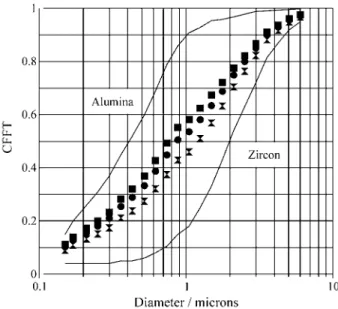
Starting powders used in this study were commercially availableα-Al2O3 and ZrSiO4. Cumulative fraction finer
than diameter CFFT vs. particle diameter D curves of alumina and zircon were determined using a Sedigraph 5000D. Figure 1 shows that the mean particle sizes were 0.4 and 2 µm, respectively. The specific surface area (BET) was 9.5 m2/g for α-Al2O3 and 4.1 m2/g for zircon.
Powder compositions of different alumina/ zircon (wt%) ratios in the mixtures ( 45.5/54.5, 51.7/48.3 and 35.1/64.9) were studied. These proportions correspond to: a) stoichiometric, b) with a 6 wt% excess of alumina and c) with a 10 wt% of zircon excess, respectively. The stoichiometric alumina to zircon weight ratio (45.5/54.5 wt%) corresponds to the stoichiometric α-Al2O3/ZrSiO4
mole ratio that forms mullite and zirconia after complete conversion at high temperature.
Aqueous 48 vol% suspensions were prepared by adding the powder to aqueous solutions with different polyacrylate content (Dolapix CE64, Zschimmers and Schwartz) at pH 9.1-9.2. After mixing, the suspensions were dispersed by ultrasonic process for 30 min.
Flow curves of the suspensions were obtained using a concentric cylinder viscometer Haake vt550 with NV sen-sor system at 25 °C.
The consolidation of suspensions by slip casting was carried out in a plaster mould to produce samples in a form of bars (12 x 12 x 60 mm3).
For pressure filtration a metallic sintered porous filter with a wet filter paper was employed. Uniaxial pressure (8 MPa) was applied from the top and the liquid moved through the porous filter. Pressure was maintained constant for 30 min. Cylindrical cast samples (25 mm diameter and 10-15 mm thick) were obtained.
Bars and cylindrical compacts were dried 24 h at room temperature and then at 110 °C up to a constant weight. Relative density (% of the theoretical) was measured by Hg immersion.
3. Results and Discusion
3.1. Effect of the amount of dispersant on the rheological properties of the 48 vol% suspensions
The isoelectric point (iep) of alumina used has been determined to be at pH near 9. Previous works on the casting behavior of a commercial zircon powder13,14 showed the electrophoretic mobility measurements as a function of the pH . They reported that the iep was at pH 5 and the zeta potential became strongly negative with fur-ther increase in pH. According to these results, the zircon particles had a high negative zeta potential in the basic pH range. Thus, at pH close to 9, an electrostatic attraction between the neutral alumina particle and the high nega-tively charged zircon particle can occur.
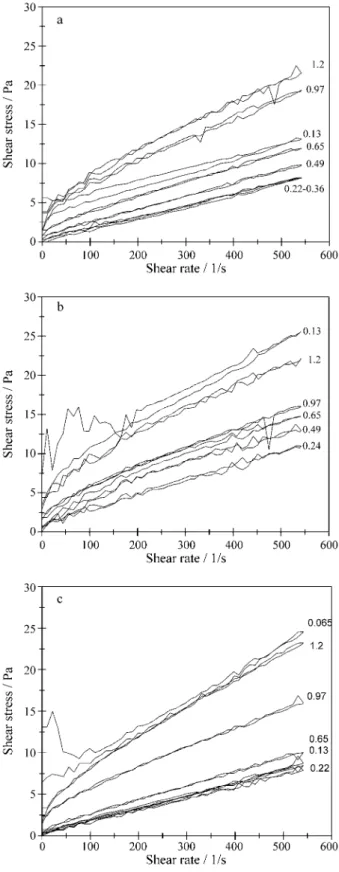
Figure 2 shows the flow curves of the aqueous 48 vol% suspensions of: stoichiometric composition, with a 6 wt% excess of alumina, and with a 10 wt% excess of zircon powder mixtures for different amounts of polyacrylate added.
Both shear stress and apparent viscosity, which is the shear stress to shear rate ratio at any shear rate, decreased to a minimum and then gradually increased with increasing the amount of dispersant added. For these suspensions, the maximum degree of dispersion of the particles is achieved when the suspension contained a 0.22-0.24 wt/wt % of dispersant that produced a minimum of viscosity. All the suspensions having a minimum viscosity showed a nearly Newtonian behavior ( well stabilized suspensions).
At pH 9 alumina and zircon exhibited opposite charges because of the differences in pHiep Adsorption of
polyacry-late on alumina was favored by electrostatic and specific mechanisms. Previous studies have shown that polyelec-trolytes on alumina can give electrostatic and steric stabi-lization. However, weak adsorption of polyacrylate on zircon particles was expected , in the basic pH range, due to an electrostatic repulsion between the polyacrylate anion in solution and the highly negative surface. Then, polyacry-late adsorption mainly on alumina surface generated high negative zeta potentials and therefore, electrostatic interac-tion between zircon and alumina particles changed to re-pulsive at pH 9. Then, a minimum in viscosity was obtained as both powders had highly negative surfaces at low elec-trolyte concentration (high zeta potential).
High apparent viscosities and non Newtonian flow be-havior were obtained at polyacrylate concentrations lower than 0.22-0.24 wt%. The flow behavior changed to shear
thinning or plastic depending on the powder composition. Flow curves exhibited a slight hysteresis loop indicating that the suspension was not fully deflocculated. This may be explained by an insufficient adsorption of polyacrylate anion (mainly on the alumina surface) due to low amount of available dispersant. Incomplete adsorption reduced the net negative charge of the mixed powders and consequently repulsion was low. Moreover, heterocoagulation between the uncoated alumina and zircon particles produced a sig-nificant increase in viscosity. With increasing shear rates, the breakdown of the flocs released some immobilized liquid that increased the volume of free liquid; therefore suspension viscosity decreased (shear thinning behavior).
For polyacrylate additions higher than 0.65 wt%, the apparent viscosity and the shear thinning behavior gradu-ally increased probably due to the presence of an excess of polyelectrolyte in solution. High amounts of non adsorbed polyelectrolyte in solution can promote flocculation by double layer compression (high ionic strength) and deple-tion mechanisms15.
The differences between the three compositions studied were examined. Suspensions of the three alumina-zircon mixtures at pH 9.1-9.2 containing 0.22-0.24 wt% of polyacrylate showed a minimum viscosity. The composi-tion with the zircon excess in the mixture had the lowest minimum viscosity . The viscosity of the suspension de-creased close to the minimum by addition of 0.13 wt% of dispersant due to low specific surface area of this mixture. The dispersant concentration required to obtain minimum viscosity was lower than that for the other compositions.
At low polyelectrolyte concentration, the suspension of the mixture that contained the highest amount of alumina showed higher viscosity values than the ones of the other compositions as fine alumina particles gave high specific surface area. Also, the higher is the content of alumina in the mixture, the lower is the zeta potential of the powders. As suspension pH was near pHiep of alumina, negative surface
charge of the uncoated alumina powder was lower than the one of the zircon. Therefore, electrostatic repulsion decreased. For polyacrylate concentrations higher than 0.65 wt%, the viscosity of all the alumina/zircon ratio mixtures in-creased to similar values.
Flow curves of Figs. 2 a, b, c were fitted with the Casson model:
τ1/2=τc1/2+ (ηc D)1/2
whereτ is the shear stress [Pa], D is the shear rate [s-1] and
τc and ηc are the Casson yield stress and viscosity
parameters, respectively. Except for the suspensions with 0.13 wt% of dispersant that showed a time dependency, the Casson model showed a good fit of the experimental data. Figure 3 shows the viscosity and yield stress Casson model parameters as a function of the dispersant content. Casson viscosity remained unchanged whereas yield stress Casson parameter decreased to a minimum and then in-creased with increasing the amount of dispersant added. Guoet al.15 related the τc parameter with the magnitude of
the attractive interparticle interactions. Thus high τc
pa-rameter is indicative of the formation of flocs due to rela-tively high van der Waals attraction as compared with the repulsion force.
The large variation in the yield stress Casson parameter τc
(Fig. 3b) with increasing amounts of polyacrylate added may be explained by significant differences in the strength of the network structure of the suspensions. Well dispersed suspen-sions gave a very low τcparameter. Low amount of dispersant
adsorbed as well as high amounts of non adsorbed polyelec-trolyte in solution caused flocculation, which increased the strength of the network resulting in a high τc.
At constant dispersant concentration, the magnitude of
τc is affected also by the PSD of the mixtures as is showed
in Fig. 3 b. Suspension with an excess of alumina exhibited
highτc values because of the small particle size and a high
content of fine sized particles. Based on the fine size fraction, this powder mixture had high number concentra-tion of particles, which determined more particle-particle bonds in a network structure. τc values decreased with
increasing the content of zircon in the mixture because of high amount of coarse particles. Previous results showed that extrapolated and measured yield stress vary inversely with particle size and , at constant solid concentration and particle size, yield stress decreases with increasing zeta potential.
3.2. Effect of PSD on the minimum viscosity of 48 vol% suspensions
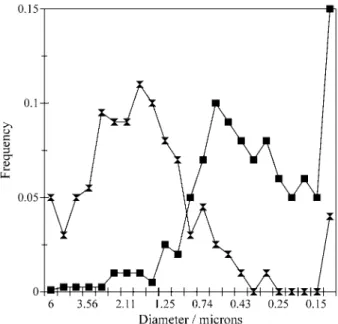
Figure 4 shows the frequency vs. particle diameter curves for alumina and zircon, which were obtained from cumulative curves given in Fig. 1. Alumina and zircon powders showed narrow distributions with a maximum in frequency at diameters of 0.6 and 1.8 µm, respectively.
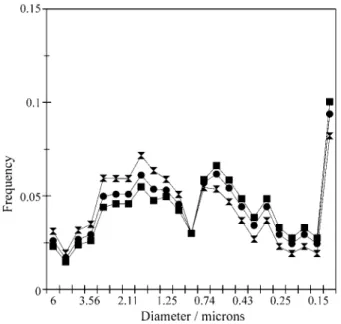
Contribution of the <0.15 µm fraction was important in the PSD of alumina. Figure 5 shows the corresponding curves for the mixtures, which were calculated by considering the individual distribution of alumina and zircon and the vol-ume fraction of each component. These curves exhibited broader distributions than those of Fig. 4. The presence of two maximum of frequency centered at 0.6 and 1.8 µm
indicated that the distributions were bimodal.
Suspensions containing the optimum amount of disper-sant showed a nearly Newtonian behavior, but the apparent viscosity slightly decreased with increasing shear rate reaching a plateau at high shear rates. The degree of shear thinning increased as the content of fine alumina in the mixture. Values of the Newtonian viscosity in the high shear rate region were 16, 14.5 and 19.7 mPas for
Figure 3. a: viscosity, b: yield stress Casson model parameters (best fit of flow curves of Fig. 1 a, b, and c as a function of the dispersant content for alumina-zircon suspensions of: • stoichiometric, with a 6 wt% excess of alumina and x with a 10 wt% excess of zircon powder mixtures.
Figure 4. Frequency vs. Particle diameter curves for: • alumina and x
stoichiometric, with an excess of zircon and with more alumina mixtures, respectively. The mixture with an excess of zircon exhibited the lowest viscosity. The volume frac-tion of each component in this mixture (0.383 for alumina and 0.616 for zircon as fine and coarse powders) was close to the optimum proportions for binary powder mixtures. As initially described by Furnas 6, particle packing of powders having bimodal distributions with an appropriate size ratio of components is optimized (apparent volume of the pack reaches a minimum) with a 0.29 volume fraction of fines. In this conditions apparent volume of fines just equals the pore volume between coarse particles. For the mixture with more alumina, the volume fraction of fines increased to 0.555 and consequently had an excess of fines with respect to the optimum proportion which produced high viscosity suspensions due to high specific surface area.
3.3. Effect of the rheological parameters on the density of green casts
Figures 3 a and b show that Casson yield stress parame-ter exhibited a dependence on the amount of dispersant added (i.e. on the interparticle colloidal forces) and on the PSD (particle size) stronger than that of the Casson viscos-ity. Therefore, τc can be used to study the influence of
rheological properties on green density of casts.
Figures 6 and 7 show the relative density of green compacts obtained from 48 vol% suspensions of the three compositions studied by slip casting and pressure filtration, respectively as a function of the yield stress Casson pa-rameter.
Density was nearly constant up to a certain τc value and
then decreased with increasing τc. Compacts resulting from
well dispersed Newtonian suspensions or with low τc
pa-rameter in which repulsion between particles was compara-tively large (at a constant Casson viscosity) gave compacts with the highest green density. Low density compacts could be prepared from suspensions characterized by a high τc
parameter indicating strongly attractive interparticle inter-actions which were related to low electrostatic repulsion due to insufficient adsorption of polyacrylate. This result agreed with that of previous studies on alumina16, which showed that the network structure resulting from a strongly attractive interactions resisted consolidation and, although
Figure 5. Frequency vs. Particle diameter curves calculated from data of Fig. 4 and volume fraction of each component for: • stoichiometric, with a 6 wt% excess of alumina and x with a 10 wt% excess of zircon powder mixtures.
Figure 6. Relative density of green compacts prepared from 48 vol% suspensions of: • stoichiometric, with a 6 wt% excess of alumina and
x with a 10 wt% excess of zircon powder mixtures by slip casting.
Figure 7. Relative density of green compacts prepared from 48 vol% suspensions of: • stoichiometric, with a 6 wt% excess of alumina and
it was compressible, a poor packing density was obtained. For suspensions with large excess of dispersant in solution, intermediateτc values were obtained. The influence of van
der Waal’s attraction became dominant due to reduced electrostatic repulsion between particles but density values were close to those from well dispersed suspensions. Den-sity only decreased 3% from the maximum value for sus-pensions containing 1.2 wt% of dispersant. These suspensions may be considered as weakly flocculated be-cause they exhibited higher viscosity than the minimum but smallerτc and lower shear thinning character than those
resulting from high attractive forces. Weakly flocculated suspensions showed a different packing behavior16. As the strength of these network structures are lower than that formed by highly attractive interactions a comparative higher density can be obtained16.
Relative density values of 70.4, 70.7, 71.2 and 69.9, 70.3, 70.2 % TD were found for green compacts prepared from the minimum viscosity suspensions ( very low τc ) by
slip casting and pressure filtration for mixtures with more alumina, stoichiometric, with an excess of zircon, respec-tively. However, Figs. 3 and 4 show that compacts prepared from the zircon excess composition achieved maximum density (72 and 71%TD) at a τc value somewhat higher than
that corresponding to the other compositions. Since this powder contained a high proportion of coarse and dense zircon particles, weak flocculation may be favorable. Slightly higher viscosity at low shear rates prevents settling of zircon particles and reduces segregation of components. An estimation of packing density of binary mixtures can be obtained using the idealized Furnas’ equation which as-sumes a dense random packing of the matrix and inclusion (spherical) particles17. Values of 76, 78 and 82% should be obtained for mixtures with more alumina, stoichiometric, with an excess of zircon, respectively. However, a further modifi-cation of this model was developed, which consider the combined effects of inclusion surfaces and inclusion con-tacts17. This model is expected to be valid to predict the packing density when the volume fraction of inclusions is less than 0.74 and when the inclusion particle size is larger than that of the matrix17. Although the predicted values for binary mixtures with more alumina, stoichiometric, with an excess of zircon reduced to 74, 75 and 78%, respectively they were somewhat higher than that of the experimental density values. As the colloidal size fraction of the mixtures was high (nearly 50% of the total weight was finer than 1 µm), the strong
influence of the colloidal interparticle forces at small interpar-ticle separations (high fine size content and high solid volume concentration) on the degree of dispersion can not be avoided.
4. Conclusions
Rheological properties of aqueous suspensions (48 vol%) of zircon-alumina mixtures were determined to study the effects of the amount of polyacrylate added and of the particle size distribution of the different powder compositions. Rheological properties were correlated with
green density of compacts obtained by slip casting and pressure filtration at 8 MPa.
Flow curves fitted satisfactorily to the Casson model. The Casson viscosity values remained nearly constant whereas the Casson yield stress parameter showed a strong dependence on the amount of dispersant employed (i.e. on the interparticle colloidal forces) and on the PSD (particle size). Therefore, Casson yield stress parameter was used to correlate rheology with the green density of compacts.
Suspensions characterized by low yield stress Casson parameter (at a constant Casson viscosity) in which repul-sion between particles was comparatively large gave com-pacts with the highest green density. Maximum relative density values of green compacts were 70.4, 70.7, 72.0 and 69.9, 70.3, 71.0 % for well deflocculated suspensions of mixtures with more alumina, stoichiometric and with an excess of zircon, by slip casting and pressure filtration, respectively. These values were obtained using 0.22 to 0.49 wt% of polyacrylate as dispersant at pH 9.1-9.2.
The lowest minimum viscosity for suspension of zircon excess composition may be attributed to a mixture with bimodal PSD and fine volume fraction near to 0.3 which maximized packing density of particles. Low yield stress Casson parameter was favorable for processing suspen-sions that contained high proportion of zircon particles. Probably, high viscosity at low shear rates prevented set-tling and reduced segregation of components.
References
1. Kapuri, N.; Ray, K.N.; Updhyaya, G.S. Interceram, v. 45, n. 6, p. 427, 1996.
2. Descamps,P.; Sakaguchi, S.; Pooterman, M.; Cambier, F. J. Am. Ceram. Soc., v. 74, n. 10, p. 2476, 1991.
3. Mewis, J. Rheology of suspensions In: Rheology, Astarita, G. et al. (eds.), Plenum, NY, v. 1, p. 149, 1980.
4. Barnes, H.A.; Hutton, J.F;. Walters, K. An introduction to rheology, Elsevier Sci. Publishers, Amsterdam, p. 116, 1989.
5. Bergström, L. Rheology of concentrated suspensions In: Surface and colloid chemistry in advanced ceramic processing, Pugh, R.J.; Bergström; L. (eds.), Marcel Dekker, NY, p. 193-244, 1994. 6. Dinger, D.R.; Funk, V.E. Interceram, v. 4, n. 5, p. 332-334, 1992. 7. Velamakanni, B.V.; Lange, F.F. J. Am. Ceram. Soc., v. 74, n. 1, p.
166-72, 1991.
8. Tari, G.; Ferreira, J.M.; Fonseca, A.T.; Lyckfeldt, O. J. Eur. Ceram. Soc., v. 18, p. 249-53, 1998.
9. Ferreira, J.M.; Diz, H.M. J. Am. Ceram. Soc., v. 82, n. 8, p. 1993-2000, 1999.
10. Smith, P.A.; Hearle, A.G. J. Am. Ceram. Soc., v. 78, n. 3, p. 809-12, 1995.
11. Smith, P.A.; Haber, R.A. J. Am. Ceram. Soc., v. 78, n. 7, p. 1737, 1995.
12. Ortega, F.S.; Pillegi, R.G.; Sepulveda, P.; Pandolfelli, V.C. Am. Ceram. Soc. Bull., v. 8, p. 106-111, 1999.
13. Moreno, R.; Moya, J.S.; Requena, J. In: Science of Ceramics, Taylor, D. (ed.), v. 14, The Institute of Ceramics, Stoke-on Trent, UK, p. 849-853, 1988.
14. Moreno, R.; Moya, J.S. Requena, J. Ceramics International, v. 17, n. 1, p. 37, 1991.
15. Guo, L.; Zhang, Y.; Uchida, N.; Uematsu, K. J. Am. Ceram. Soc., v. 81, n. 3, p. 549, 1998.
16. Bergström, L.; Schilling, Ch.H.; Aksay, I.A. J. Am. Ceram. Soc., v. 75, n. 12, p. 3305, 1992.
17. Zok, F.; Lange, F.F. J. Am. Ceram. Soc., v. 74, n. 8, p. 1880-5, 1991.