Preparation and Characterization of Hydrous Zirconium
Oxide Formed by Homogeneous Precipitation
G.L.J.P. da Silva*, M.L.C.P. da Silva, Tatiana Caetano
Department of Chemical Engineering, Faculty of Chemical Engineering of Lorena C. P. 116, 12600-000 Lorena - SP, Brazil
Received: May 25, 2001; Revised: February 4, 2002
This paper reports on the preparation, characterization and study of the ion exchange behavior of hydrous zirconium oxides formed by homogeneous precipitation from zirconium oxychloride. The precipitants used were obtained by thermal decomposition of urea, sodium nitrite or ammo-nium carbonate. Seven compounds were prepared and characterized by thermal analysis, X-ray diffractometry and by surface area measurements. Amorphous forms were obtained in each case, a result that agrees with those obtained by conventional gel precipitation methodology. All these materials present surface area values of >148 m2.g-1, determined after heat treatment at 50 °C. The
ion exchange behavior of each hydrous zirconium oxide prepared was studied using K+ as the
exchanged species and the results compared with those obtained for hydrous zirconium oxide originally precipitated by the sol gel method.
Keywords:homogeneous precipitation, ion exchange, cationic exchanger
1. Introduction
Synthetic and natural inorganic ion exchangers and adsorbents offer definite advantages over well-known and traditionally used organic resins insofar as their chemical properties, radiation and thermal stability, resistance to oxi-dation and selectivity to certain ions are concerned, as de-scribed in the literature1.
Hydrous oxides based on various polyvalent metal ions have been investigated due to their characteristics of selec-tivity and simplicity of preparation. They do, however, have a serious disadvantage: a comparison of different studies reveals that they produce inconsistent results owing to the difficulty of reproducing their preparations2,3.
Inoue and Yamazaki4 established a method to
synthe-size a hydrous zirconium oxide ion exchanger, studying its properties of ion exchange and thermal stability behavior. The exchanger was reproducibly synthesized by hydrolysis of a zirconium oxychloride solution at pH 9.3, by the addi-tion of an aqueous ammonia soluaddi-tion, in order to study the cationic exchange mechanism. The distribution coefficients of various cations were measured as functions of the pH and temperature.
Precipitation from a homogeneous solution is a
tech-nique in which a precipitating agent is generated in a solu-tion of the analyte by a slow chemical reacsolu-tion. Local rea-gent excesses do not occur because the precipitating area-gent appears gradually and homogeneously throughout the so-lution and reacts immediately with the analyte. As a result, relative supersaturation is kept low throughout the precipi-tation. Homogeneously formed precipitates, both colloidal and crystalline, are usually better suited for analysis than are solids formed by the direct addition of a precipitating reagent5.
Santos and coworkers6 studied a homogeneous
precipi-tation of aluminum hydroxide from aqueous aluminum sulfate, nitrate and chloride solutions by thermal decompo-sition of urea, sodium nitrite and ammonium acetate. They observed that the homogeneous precipitation from the aque-ous chloride and nitrites solutions were slower than from the sulfate ones. The particles of precipitate were spherical, while all the chloride particles were pseudo-boehmite fi-brils or needles; nitrate, urea and ammonium acetate pro-duced fibrils while sodium nitrite propro-duced very thin films. Nevertheless, pseudo-boehmite was formed in every case.
Silva and coworkers7 studied a homogeneous
precipita-tion of hydrous niobium oxide from the dissoluprecipita-tion of me-tallic niobium in HNO3/HF solution by thermal
sition of urea. This material presented a higher specific area and ion exchange capacity for Ba+2 ions than those observed
for hydrous niobium oxide prepared by the conventional gel precipitation method. This product was amorphous and also readily filtered.
In this study, hydrous zirconium oxide ion exchangers were prepared by homogeneous precipitation using an aque-ous zirconium oxychloride solution and different precipi-tating agents, i.e., urea, ammonium carbonate or sodium nitrite. The results were then compared with those obtained by the gel precipitation method. The ion exchange behavior was investigated and the ion exchange capacities of the syn-thesized products were determined.
2. Materials and Methods
Materials and reagents
All the reagents used here, such as alkaline chlorides, hydroxides and hydrochloric acids, were of analytical grade and were used without purification. The standard aqueous solutions were titrated by the usual procedures.
The ZrOCl2.8H2O used was prepared from an alkaline fusion of a Brazilian zirconite ore (ZrSiO4) and purified by recrystallization in the Department of Materials of our In-stitute.
Preparation of hydrous zirconium oxide by homogeneous precipitation
In the first step, 5.0000 g samples of ZrOCl2.8H2O dissol-ved in an aqueous hydrochloric acid solution (0.5 mol.L-1)
were added to and mixed with 15.0000 g of urea. The re-sulting solution was heated to 90 °C on an electrical plate to decompose the precipitating agent, leading to the forma-tion of the hydrous oxide. After precipitaforma-tion, the material was allowed to rest at 90°C for another hour. The white precipitate was filtered and washed repeatedly with deionized water with a pH of 4.5-5.0 for the removal of chloride traces, after which it was dried at room tempera-ture in a desiccator. (See preparation 2A in Table 1).
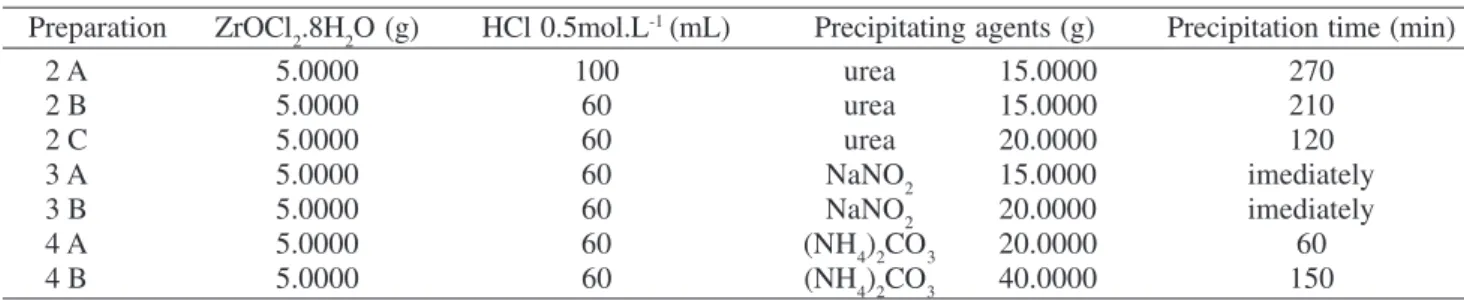
A total of seven batches of hydrous zirconium oxide were prepared by homogeneous precipitation, to which dif-ferent amounts of each precipitating agent were added (see preparations 2B, 2C, 3A, 3B, 4A and 4B in Table 1).
Preparation by conventional gel precipitation method
An aqueous solution of ammonia (1:3) was added drop by drop to an aqueous solution of zirconium oxychloride up to a final pH 8, under vigorous stirring. The precipitated gel was then aged in the mother liquor for 24 h. without stirring. After filtration, the gel was washed several times in distilled water for the complete removal of chloride ions (negative silver nitrate test). Finally, the product was dried at 25 °C for 18 h (see preparation 1 in Table 1).
Characterization of hydrous zirconium oxides prepared
The hydrous zirconium oxides surface areas, SBET, in m2.g-1, were determined by nitrogen adsorption using the
BET method. The samples were previously degassed in the cell at 50 °C for 3 h.
Thermal analyses were made using a model TGA-50 Shimadzu thermogravimetric instrument. Around 10.00 mg of material were heated to 600 °C at a rate of 20 °C.min-1
under a dry nitrogen flow.
X-ray diffractograms were obtained with a Rich Seifert, model Iso-Debyfex 100 diffractometer, using CuKα
radia-tion and varying 2θ values from 5 to 80°.
Ion exchange behavior
Reversibility of the exchange process
In the titration procedure, 0.0500 g of the hydrous zir-conium oxide sample was mixed with 50.00 mL of KCl 0.1000 eq.L-1 solution and titrated with [KCl 0.05000 + KOH
0.05000]eq.L-1 to pH 11.0. The reverse reaction –
regenera-tion of the ion exchanger material – was performed simi-larly, titrating the resulting solution with an aqueous solu-tion of [HCl 0.1000 + KCl 0.01000]eq.L-1 until the pH
re-turned to the initial value. The exchange and regeneration steps were repeated to confirm the reversibility of the proc-ess.
Capacity measurements
The samples exchange capacities were determined by pH x OH mEq concentration curves. The curves were obtained by mixing different volumes (different OH- concentrations)
of [KCl 0.05000 + KOH 0.05000]eq.L-1 and a sufficient
vol-Table 1. Experimental conditions and variables used in the preparation of ZrO2.n H2O by homogeneous precipitation.
Preparation ZrOCl2.8H2O (g) HCl 0.5mol.L-1 (mL) Precipitating agents (g) Precipitation time (min)
2 A 5.0000 100 urea 15.0000 270
2 B 5.0000 60 urea 15.0000 210
2 C 5.0000 60 urea 20.0000 120
3 A 5.0000 60 NaNO2 15.0000 imediately
3 B 5.0000 60 NaNO2 20.0000 imediately
4 A 5.0000 60 (NH4)2CO3 20.0000 60
ume of KCl 0.1000 eq.L-1 to complete 50.00 mL and 0.0500 g
of the exchanger. Thus, the pH changed but the total metallic ion concentration was the same in every sample.
3. Results and Discussion
Synthesis of hydrous zirconium oxides
In this work, the most favorable conditions for precipi-tation were found to involve precipiprecipi-tation from dilute solu-tions and gradual addition of the precipitating agent with constant stirring5
. This modus operandi ensures a low
de-gree of supersaturation. Despite these operations, however, an excess of local precipitating reagent is unavoidable when the reagent is added to the sample solution. A process of precipitation from a homogeneous solution should avoid such difficulties. In this technique, the precipitating reagent is generated in situ by a chemical reaction that occurs uni-formly throughout the solution. The generation of hydroxyl ions for the precipitation of hydrous zirconium oxide is an example of this technique. The precipitating agent may be generated by hydrolysis of urea in an initially acidic solu-tion:
(NH2)2 CO + 3 H2O Æ CO2 + 2 NH4+ + 2 OH
-This hydrolytic reaction takes place slowly and occurs at temperatures just below the boiling point of water.
Some hydrous zirconium oxides were prepared by gen-erating precipitant species in the solution, starting from an acid hydrochloric zirconium solution with an excess of gen-erator precipitating agents (urea, sodium nitrite or ammo-nium carbonate). Slow thermal decomposition of these pre-cipitating reagents generated hydroxyl ions, allowing for the precipitation of hydrous zirconium oxides with differ-ent characteristics. Hydrous zirconium oxide precipitates formed by the method of generating reagent in the analyte solution showed a smaller precipitate volume, with precipi-tates far more easily filtered than those produced using the
external addition of reagent.
Table 1 shows the results obtained from the different preparation runs (gel precipitation method for preparation 1; homogeneous precipitation method for preparations 2A, 2B, 2C, 3A, 3B, 4A and 4B). These results indicate that the rate of formation depends on the initial concentration and on the precipitating agent added.
Characterization of hydrous zirconium oxides
The above-described compounds were characterized by thermal analysis (TG-DTG) in a temperature range of 30 to 600°C and the experimental results used to determine their chemical composition (see Table 2).
The TG results of the decomposition of the materials prepared by the three different precipitating agents were quite similar, with only one less step, except for product 4A, which presented a two-step decomposition, as reported in Table 2.
Figure 1 shows the thermogravimetric curve obtained for sample 2A.Weight loss occurred in only one step in the
Table 2. Results of the thermal analysis (TG), composition, surface areas and ion exchange capacities (IEC) determined for the hydrous zirconium oxides prepared.
Preparation Temperature range Weight loss Composition Surface area IEC
(°C) (%) (m2.g-1) (meq OH.g-1)
1 30 - 350 27 ZrO2 . 2.2 H2O 231 0.70
2 A 30 - 350 30 ZrO2 . 2.5 H2O 210 0.34
2 B 30 - 350 28 ZrO2 . 2.3 H2O 249 0.25
2 C 30 - 350 34 ZrO2. 3.0 H2O 317 0.41
3 A 30 - 350 27 ZrO2 . 2.1 H2O 259 0.33
3 B 30 - 350 28 ZrO2 . 2.2 H2O 263 0.34
4 A 30 - 350 31 ZrO2. 3.1 H2O 148 0.43
350 - 450 4
4 B 30 - 350 30 ZrO2 . 2.4 H2O 154 0.32
Figure 2. TG curves of hydrous zirconium oxide prepared by ho-mogeneous precipitation of zirconium oxichloride with ammonium carbonate (preparation 4 A).
temperature interval of 30 to 350°C and was attributed to dehydration of the interstitial water8.Similar behavior was
observed for the other materials prepared, which were dubbed 2B, 2C, 3A, 3B and 4B. Sample 4A (Fig. 2) showed a 34% weight loss between 30 and 350°C, which was at-tributed to dehydration of the interstitial water, while the second weight loss of 4%, which occurred between 350 and 450°C, may be attributed to residual contamination prob-ably originating from residual carbonate present in the hy-drous zirconium oxide. In each case, the weight loss was completed at 600°C and ranged from 26 to 34% of the sam-ple’s initial weight.
The exchanger chemical compositions were established from the thermogravimetric curve results, which indicate the amount of water held in the solid by the following ex-pression:
18 n = X. (M + 18n) / 100
where X is the present mass loss in the respective ther-mal decomposition, n is the number of external mol of wa-ter and M the molar weight of dehydrated compound with-out the external water molecules.
Taking into account the water content of the different gels, their compositions are given in terms of ZrO2. n H2O (Table 2) , where n ranged from 2.1 to 3.1.
The specific surface area, whose calculation was based on the BET method, decreased from 317 to 148 m2.g-1 (see
Table 2). Based on an analysis of preparations 2B, 2C, 3A, 3B, 4A and 4B (see Tables 1 and 2), one can argue that:
(i) high specific areas were obtained using the same HCl concentration for the homogeneous preparations and even different precipitating agents;
(ii) higher specific areas were observed with higher
con-centrations of precipitating agent.
Gel preparation 4A presented a lower specific area, prob-ably due to the residual carbonate in the material’s micropores.
After drying, none of the gels prepared in this study pre-sented any degree of crystallinity, in accordance with the literature9.
Ion exchange behavior
The ion exchange behavior was studied by two differ-ent procedures.
In the first procedure, the reversibility of the exchanger was studied by repeating the exchange and regeneration steps; in the second, the ion exchange capacity was deter-mined for K+ ions with different stirring times.
Figures 3 and 4 show typical results obtained for po-tassium ions using the first and second procedures, re-spectively. Figure 3 clearly shows that this material is regenerable.
Table 2 lists the results of ion exchange capacities (IEC) obtained with potassium ions. As can be observed, the ion exchange capacities showed no significant changes for the exchangers prepared by homogeneous precipitation. The values were lower than those observed for hydrous zirco-nium oxide prepared by the gel precipitation method. The 2C material presented:
(i) the highest value of water molecules; (ii) the best specific area and
(iii) the highest value of ion exchange capacity for K+
ions, for the materials obtained from urea. The 3B material obtained from sodium nitrite presented:
(i) the highest value of water molecules; (ii) the highest specific area and
Figure 3. Reversibility study of ion exchange and regeneration curves obtained for K+ ion exchange with hydrous zirconium
(iii) the highest ion exchange capacity for K+ ions.
However, although it presented high water molecule and ion exchange capacity values, the synthesized 4A material showed only 47% of the value found for the specific area of material 2C. These anomalous values were probably due to carbonate ions that remained inside the particles of the ma-terial.
4. Conclusions
All the hydrous zirconium oxides proved to be regenerable under the conditions of this study, presenting amorphous forms, relatively high surface areas and similar water contents. These properties of hydrous oxides prepared Figure 4. pH x OH miliequivalent curves obtained.
by homogeneous solutions render them applicable in ion exchangers. These same products are readily filtered, in contrast to what was observed for hydrous zirconium oxide prepared by the sol gel precipitation method.
Acknowledgments
This work was supported by research grants from the Fundação de Amparo à Pesquisa do Estado de São Paulo (FAPESP).
References
1. Clearfield , A. “Inorganic ion exchange materials”, CRC Press, Boca Raton, 1982.
2. Egorov,Y.V.; Sukharev, Y.I.; Lyubimov, A.S.; Krylov, E.I.
Izv. Akad. Nauk. SSSR, Neorg. Mater., v. 3, n. 7, p. 1210-1215, 1967.
3. Inoue, Y.; Yamazaki, H.; Kimura, Y. Bull.Chem. Soc.Jpn,
v. 58, p. 2481-2486, 1985.
4. Inoue, Y.; Yamazaki, H. Bull. Chem. Soc. Jpn, v. 60, p. 891-897, 1987.
5. Christian, G.D. Analytical Chemistry, 5th edition, John Wiley & Sons, Inc. New York, 1994.
6. Santos, P.S.; Santos, H.S.; Kiyohara, P.K. Anais Assoc. Bras. Quim., v. 46, n. 1, p. 16-20, 1997.
7. Silva, Maria L.C.P.; Silva, Gilberto L.J.P.; Perez, E.A.C.; Tagliaferro, Gerônimo, V. Anais Assoc. Bras. Quim., v. 50, n. 2, p. 83-87, 2001.
8. Castro, H.F.; Silva, M.L.C.P.; Silva, G.L.J.P. Brazilian Jour-nal of Chem. Engineering, v. 17, n. 4-7, p. 849-857, 2000. 9. Tichit, D.; El Alami, D.; Figueiras, F., Applied Catalysis