ISSN 0104-6632 Printed in Brazil
Brazilian Journal
of Chemical
Engineering
Vol. 21, No. 02, pp. 211 - 218, April - June 2004
CATALYTIC WET-AIR OXIDATION OF LIGNIN IN
A THREE-PHASE REACTOR WITH AROMATIC
ALDEHYDE PRODUCTION
F.G. Sales
1*, C. A. M. Abreu
2and J. A. F. R. Pereira
3 1Departamento de Engenharia Química, Centro de Tecnologia, Universidade Federal do Ceará, Fortaleza - CE, 60455-760, Brazil. E-mail: [email protected]
2
Departamento de Engenharia Química, Centro de Tecnologia, Universidade Federal de Pernambuco, Recife - PE, 50740-520, Brazil. E-mail: [email protected]
3
Departamento de Engenharia de Sistemas Químicos e Informática, Faculdade de Engenharia Química, Universidade Estadual de Campinas, Campinas - SP,13083-970, Brazil.
E-mail: [email protected]
(Received: February 13, 2003 ; Accepted: December 13, 2003)
Abstract - In the present work a process of catalytic wet air oxidation of lignin obtained from sugar-cane bagasse is developed with the objective of producing vanillin, syringaldehyde and p-hydroxybenzaldehyde in a continuous regime. Palladium supported onJ-alumina was used as the catalyst. The reactions in the lignin degradation and aldehyde production were described by a kinetic model as a system of complex parallel and series reactions, in which pseudo-first-order steps are found. For the purpose of producing aromatic aldehydes in continuous regime, a three-phase fluidized reactor was built, and it was operated using atmospheric air as the oxidizer. The best yield in aromatic aldehydes was of 12%. The experimental results were compatible with those values obtained by the pseudo-heterogeneous axial dispersion model (PHADM) applied to the liquid phase.
Keywords: catalytic wet air-oxidation, lignin, vanillin, syringaldehyde p-hydroxybenzaldehyde, palladium catalyst, three-phase fluidized-bed reactor.
INTRODUCTION
Lignin is a ramified polymer made up of phenylpropane molecular units which occurs in an amorphous state mixed with holocellulose in the vegetable biomass as a layer covering the cellulose. Of those chemical processes that seek to valorize lignocellulosic materials, oxidation has been the most promising, since it produces a mixture of aromatic aldehydes which are of great industrial interest, vanillin, syringaldehyde and the p-ydroxybenzaldehyde. Reasonable yields can be obtained by catalytic oxidation in an alkaline medium, however limited to the use of homogeneous catalytic processes (Mathias, 1994) that have the
disadvantage of the additional cost of subsequent separation of the catalyst and by-products, making their application impractical.
and p-hydroxybenzaldehyde. Moderated oxygen partial pressures and short reaction times are used to avoid degradativ oxidation of the aldehydes produced with formation of acid mixtures (formic, latic, etc.). These aldehydes have many applications, from galvanization to the production of chemical intermediaries for pharmaceutical and agricultural production.
EXPERIMENTAL DEVELOPMENT
Catalyst Preparation
The catalyst was prepared from palladium chloride (Vetec) and J-alumina (Procatalyse) as catalytic support, with a superficial area of BET 3.65u105m2/kg and a particle porosity (Hp) of 0.5878.
The humid impregnation procedure was used to prepare the catalyst. After the impregnation step the material was dried at 393K for 12 hours and then reduced at 673K for 2 hours. The palladium content of 2.85% was quantified by atomic absorption. The presence of palladium in crystal shape was confirmed through X-ray diffraction (2T = 40.047, 46.609, 68.085 and 82.104).
Kinetic Evaluation
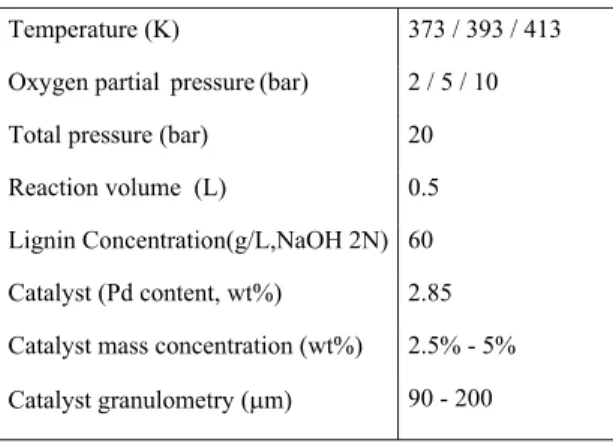
The kinetic experiments (Sales et al., 2001) were carried out in a high-pressure SS-316 Parr slurry reactor (Model 4843) equipped with a six-bladed turbine-type impeller mixer and with an effective volume of 500mL. A thermal sensor and an
external heating element together with an internal cooling coil provided temperature control in the reactor
with an accuracy of r 1K. The experimental
conditions are listed in Table 1. The liquid sample was collected with a metal filter, and after separation of the reagent, it was analyzed using a gas chromatographer (HP 5890 Series II) equipped with a capillary column (HP-1) and a flame ionization detector (FID).
Continuous Process Operation
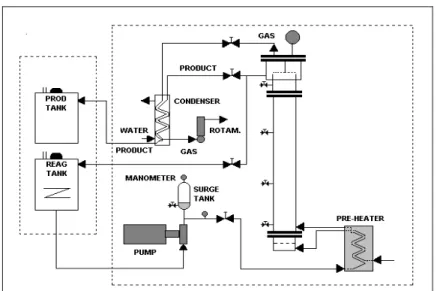
A schematic chart of the experimental setup is given in Figure 1. The experiments were carried out in a fluidized-bed operation in a 0.13m diameter tubular reactor with a total height of 1.40 m. The distributor plate has holes with diameter of 0.002 m, a triangular pass, with continuous free plate area (M) of 0.85%.
The gas-phase feed is through a two-stage compressor and the liquid-phase feed with a positive displacement pump with a surge tank to avoid line pulsation. Before entering the reactor, both fluid lines pass through a preheater.
The experimental procedure was divided into three steps: in the first the reactor operated at a liquid-phase flow rate of 5L/h and temperature of 373K during three hours; in the second step the same liquid-phase flow rate and temperature of 393K were maintained during the same period; and in the last the liquid-phase flow rate was changed to 10L/h and the temperature maintained at 393K during two hours. At the end of each step, reactor operation was verified to be in steady state (Sales, 2001).
Table 1: Experimental conditions for the kinetic study of catalytic wet-air lignin oxidation.
Temperature (K)
Oxygen partial pressure (bar) Total pressure (bar) Reaction volume (L)
Lignin Concentration(g/L,NaOH 2N) Catalyst (Pd content, wt%) Catalyst mass concentration (wt%)
Figure 1: Schematic diagram of the continuous three-phase fluidized reactor.
RESULTS AND DISCUSSION
The kinetics of catalytic wet-air lignin oxidation was studied to determine the influences of temperature, oxygen partial pressure, mass of catalyst fed into reactor and catalyst particle size, which were detailed in previous work (Sales, 2001).
The organic compound mechanism of the
catalytic wet-air oxidation is very complex, even for simple structures such as phenol (Hamoudi et alli., 1999; Zhang. at all, 1998). This is especially true in lignin oxidation with the reaction resulting in the formation of a large variety of intermediate products. Generally is assumed that the wet-air oxidation occurs in two or more steps, with small molecules such as CO2 and water formed in the first stage. In
the present work we did not observe the evolution of gases at the beginning of the reaction, probably due to the mild reaction conditions, although two reaction steps in lignin oxidation have been recognized for temperatures starting at 393K (Figure 2). For the proposed overall mechanism, we assumed that lignin, a macromolecule with a complex structure, is hydrolyzed forming fragments that produce aldehydes and other products of low molecular weight. The second step of the reaction was not studied because the concentration of lignin did not change significantly.
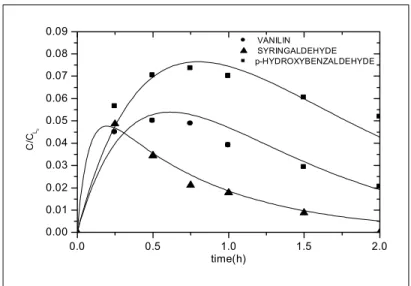
The kinetic profiles for aromatic aldehyde concentrations resulting from the lignin conversion are typical of reactions in series with their production and subsequent degradation in acids. Typical profiles are shown in Figure 3.
0.0 0.5 1.0 1.5 2.
0.0 0.2 0.4 0.6 0.8 1.0 1.2 1.4 1.6 1.8 2.0
0 373K(exp.)
393K(exp.) 413K(exp.)
-l
n
(C
L
/C
L0
)
time(h)
0.0 0.5 1.0 1.5 2.0 0.00
0.01 0.02 0.03 0.04 0.05 0.06 0.07 0.08 0.09
VANILIN SYRINGALDEHYDE p-HYDROXYBENZALDEHYDE
C/
CL
0
time(h)
Figure 3: Experimental (symbols) and theoretical (lines) concentration profiles, according to a pseudo-first-order model, for the reaction products. PO2= 5bar, PT= 20bar, T = 413K, 4wt% catalyst.
Figure 4: Schematic mechanism for catalytic wet-air lignin oxidation.
Process Kinetic Modeling
A schematic pathway of the reactions based on observations of its behavior, is proposed according to Figure 4. Considering all the process steps represented by first-order reactions, we have
1 2 3 4 LL
S
C k k k k dt
dC
m
V
V 5 L 1 V
S
C k C k dt dC m
V
S 7 P 6 L 2 V 5 R
S
C k C k C k C k dt dC
m V
P 6 L 3 P
S
C k C k dt dC m
V
S 7 L 4 S
S
C k C k dt dC
m
V
where V is the reaction volume and ms the
catalyst mass, while L represents the lignin, V the vanillin, S the syringaldeyde, P the p-hydroxybenzaldehyde and R the other products of low molecular weight. ki (i=1, 2, 3, 4, 5, 6, 7) represent the pseudo-first-order kinetic constants.
Estimation of Kinetics Parameters
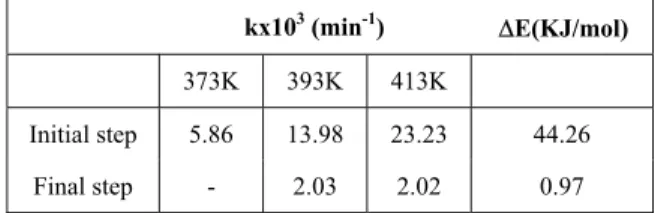
The data obtained were well fitted by a first-order kinetic law, even when they are applied separately in each step, as in the case of the reaction temperatures of 393K and 413K. The rate constants were obtained by the linear regression model and are listed in Table 2. The differential equations system, representing the kinetic model of the reaction, was numerically solved using a 4th order Runge-Kutta integration method. The calculated values of CL, CV, CS and CP were compared with the experimental results (Figure 3). The kinetic parameters were obtained through an optimization procedure using Box’s complex method (Box, 1965), minimizing an objective function, Fob
( ), constructed from the
experimental (C ) and the calculated values ( )
for the lignin and aldehyde concentrations. The results are presented in Table 3.
>
¦n
1 i
2 teo i exp i
ob C C
F
exp i
@
teo i
C
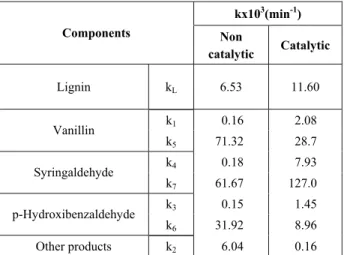
Catalyst activity and seletivity were evaluated by comparing the rate constants of the catalytic reactions with those of reactions without catalyst. Through a comparative analysis (Table 4) under these conditions, it was observed that the catalyst increased the lignin degradation rate approximately twofold. However, the rate of aldehyde formation was completely changed. The catalytic effect could also be outstanding compared to the rate constant k2, relative to the formation of other products. The catalyst reduced the formation of undesirable products approximately fortyfold, indicating a significative improvement in the selectivity for aldehydes associated with the catalytic process.
Table 2: Rate constants and activation energy of the catalytic wet-air lignin oxidation.
kx103 (min-1) 'E(KJ/mol)
373K 393K 413K
Initial step 5.86 13.98 23.23 44.26 Final step - 2.03 2.02 0.97
Table 3: Rate constants and activation energy for the catalytic reaction of the first-order kinetic model for the production of aromatic aldehydes with an oxygen partial pressure of 5bar.
Aromatic
Aldehydes kx10
3(min-1)
373K 393K 413K
'E KJ/mol
Lignin kL 5.39 11.60 23.50 43.76
k1 0.53 2.08 3.83 63.64
Vanillin
k5 23.28 28.73 31.93 10.18
k4 1.93 7.93 15.00 66.04
Syringal-dehyde
k7 70.30 127.0 216.7 35.97
k3 0.60 1.45 4.50 64.11
p-Hydroxy-benzald.
k6 4.67 8.96 18.33 43.62
Others
-Table 4. Rate constants and activation energy for the catalytic and non catalytic processes for the first-order kinetic model for production of aromatic
aldehydes, with an oxygen partial pressure of 5bar.
kx103(min-1)
Components Non
catalytic Catalytic
Lignin kL 6.53 11.60
k1 0.16 2.08
Vanillin
k5 71.32 28.7
k4 0.18 7.93
Syringaldehyde
k7 61.67 127.0
k3 0.15 1.45
p-Hydroxibenzaldehyde
k6 31.92 8.96
Other products k2 6.04 0.16
Continuous Three-phase Reactor Phenomenological Modeling
Having predicted the representation of the reaction process in the three-phase fluidized-bed reactor, the pseudo-heterogeneous axial dispersion model (PHADM) was applied with external mass transfer to the catalytic pellet, assuming dispersion in the liquid-phase. The conceptual basis for development of the model involves the following assumptions:
1) flow of the dispersed phase (gas) and the
continuous phase (slurry) is concurrent and
continuous;
2) gas-liquid and liquid-solid mass transfer
resistances are described by the two-films theory; 3) internal mass transfer resistance is described by the internal effectiveness factor, recognizing the model as pseudo-heterogeneous;
4) surface reaction with intrinsic kinetics is described according to a pseudo-first order model; 5) mass transport occurs in the axial direction by convection and axial dispersion;
6) catalytic load, component adsorption and oxygen concentration are taken into account as pseudo-constants;
7) the system is isothermal with no temperature gradients in the catalytic pellet or in the reactor; 8) continuous-phase (slurry) vapor pressure was much lower than the oxidizer (atmospheric air) pressure.
Writing the system equations in dimensionless form, and with the previous simplifications, we
limited quantification to the liquid phase component. For these components we have the following:
For the lignin,
C C 0St dz dC dz C d
Pe S,l L,l S,l
l , L 2 l , L 2 L L
H x x
x x
For aldehydes,
C C 0St dz dC dz C d
Pe S,A L,A S,A
A , L 2 A , L 2 L L
H x x x x
For the liquid-phase inside the catalyst pellet, we have the following:
For the lignin,
x x K xl l l , S l , L l ,
S C C R
St
For aldehydes,
x x K xA O A , S A , L v ,
S C C R
St
2
The boundary conditions of the system are as follows:
At the bed inlet, Z=0
x x x H E , l , L l , L l , L L
L C C
dz dC
x x x
H
E , A , L A , L A , L L L
C C dz dC
Pe (aldehydes)
At the bed outlet, Z=1
0 dz dCxL,l
(lignin)
0 dz dCxL,A
(aldehydes)
In previous equations the concentrations are in the dimensionless forms based on the bed-inlet lignin concentration. The subscripts L and S refer to the liquid and solid phase, respectively, while l and A refer to the lignin and aldehydes, respectively.
The axial dispersion model described by the previous equations is a boundary value problem for the group of second-order nonhomogeneous ordinary differential equations, except for the lignin concentration throughout the reactor. Solution of the equations system was obtained analytically through a computational program developed in the MAPLE software, version 6.
The simulation of the of catalytic wet-air lignin oxidation process, aiming at describing the lignin and the aromatic aldehyde concentration profiles for
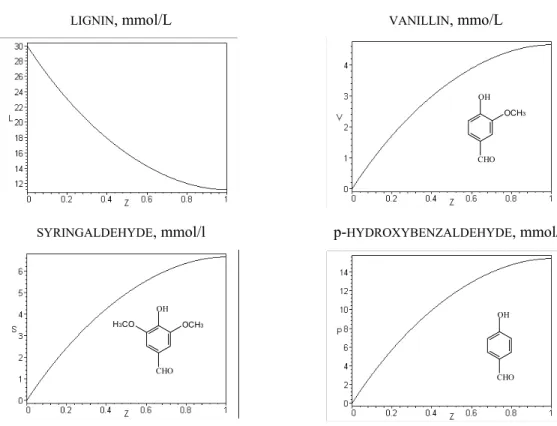
the three-phase reactor, used as the operational parameters a temperature of 393K, 4bar of pressure, a palladium catalyst (3 wt%) on J-alumina with a concentration of 4 wt%, a granulometry in the range of 400mm to 500mm and a lignin concentration in the liquid-phase of 30g/L in NaOH 2M solution. Atmospheric air was the oxidizer. The other parameters are given in Sales (2001). The model lignin and aldehyde concentration profiles for the reactor are presented in Figure 5.
The experimental results obtained at a sampling point located at 80% of the length of the reactor under the same conditions as those applied in the simulation were 4.3mmol/L for vanillin and
6.3mmol/L for syringaldehyde, both in good
agreement with the values predited by the axial dispersion model. The chromatographic analyses of the samples taken throughout the reactor found that sample points did not offer systematic results for the p-hydroxybenzaldehyde. In some samplings was detected, however, it was not possible to evaluate its evolution during the entire time of reactor operation. Verifying its physical constants, such as of a melting point of 319K, and the observation that it does not have a boiling point because it sublimes above this temperature, this behavior may indicate that this aldehyde was being arrested outside the reactor with the gas-phase during the experiment.
LIGNIN, mmol/L VANILLIN, mmo/L
OH
CHO OCH3
SYRINGALDEHYDE, mmol/l
OH
CHO OCH3
H3CO
p-HYDROXYBENZALDEHYDE, mmol/L
OH
CHO
Figure 5: Concentration profiles for the reactor according to the axial dispersion model for temperature of 393K, a liquid-phase flow rate of 5l/h, a gas-phase flow
CONCLUSIONS
Conversion of the process from discontinuous to continuous operation of catalytic wet-air lignin oxidation allowed validation of the kinetic model of series and parallel reactions with pseudo-first-order steps. The maximum operational yield with the reactor operating with an air-flow rate of 1000L/h, a liquid phase flow rate of 5L/h, a catalytic loading of 4 wt% and a pressure of 4bar, was of approximately 12% aldehydes in relation to the lignin feed concentration. The data obtained from the process simulation of the pseudo-heterogeneous axial dispersion model are compatible with those values experimentally obtained at the point located at 80% of the reactor length.
ACKNOWLEDGMENTS
The authors acknowledge the financial support received from CAPES for this work.
REFERENCES
Hamoudi, S., Belkacemi, K. and Larachi, F., Catalytic
Oxidation of Aqueous Phenolic Solutions Catalyst Deactivation and kinetics. Chemical Engineering Science, v 54, pp 3568-3576 (1999).
Harmsen, J.M.A., Jelemensjy, L. and van Andel-Scheffer, P.J.M., Kinetic Modeling for Wet Air Oxidation on Formic Acid on Carbon Supported Platinum Catalyst. Applied Catalysis A: General, v 165, pp 499-509 (1997).
Mathias, A.L. and Rodrigues, A.E., Production of Vanilin by Oxidation of Pine Kraft Lignins with Oxygen. Holzforscung (1994).
Sales, F.G., Pereira, J.A.F.R. and Abreu, C.A.M., Estudo Hidrodinâmico de um Reator de Leito de Lama Trifásico. XXVIII Congresso Brasileiro de Sistemas Particulados, Teresópolis, Brazil, (2000).
Sales, F.G., Oxidação Úmida Catalítica da Lignina em Reatores Trifásicos com Produção de Aldeídos Aromáticos. Ph.D.diss., Faculdade de Engenharia Química, Universidade Estadual de Campinas, Brazil,(2001).