Genetic Evidence of a Species Complex in
Anopheles pseudopunctipennis
sensu latol
Josh G.
ESTRADA-FRANCO,~ MICHAEL
C.MA,~,~
GREGORY
C.LANZARO,~ ROBERT GWADZ,~
CARMEN GALVAN-SANCHEZ,~
Jo&LUIS C~SPEDES,~
ROBERTO VARGAS-SAGARNAGA,~
& ROBERTO RODR~GUEZ~
444
This preliminary report provides information concerning genetic variation in the vector mosquifo Anopheles pseudopunctipennis sensu lato that could have malaria con&o1
implications. Because of inconsistencies in malaria transmission patterns within geographic zones inhabited by this vector, the possibility that it represents a species complex was investigated. Hybrid crossing studies, elecfrophoretic analysis of enzyme variafion, and DNA
restriction studies were carried out in mosquitoes captured in nine areas of Mexico, Bolivia, and Peru. The findings demonstrated the existence of a species complex believed to have resulted from allopatric speciation. This research points to a need for establishing the geo- graphic distribution of the newly recognized species because of their potential influence on malaria control.
M
alaria is on the rise throughout most of the Third World. In Latin Amer-ica, this trend has been encouraged by conditions resulting from the economic crisis and changes in patterns of devel- opment in most countries.
In particular, the public health problem of malaria on the American Continent has
‘This article was also published in Spanish in the BoIefin de la Oficina Sanitaria Panamericana, vol. 113, no. 4, 1992.
2Department of Entomology, University of Mary- land, College Park, Maryland 20742, USA. %Zenter for Agricultural Biotechnology, Maryland
Biotechnology Institute, University of Maryland, College Park, Maryland 20742, USA. All corre- spondence should be sent to Dr. Ma at the above address.
4Laboratory of Malaria Research, National Institutes of Allergy and Infectious Diseases, National Insti- tutes of Health, Bethesda, Maryland 20892, USA. ?5ecretaria de Salud y Bienestar Social, Cuemavaca,
Morelos, Mexico 63000.
Winisterio de Previsi6n Social y Salud Ptiblica, Di- recci6n National de Epidemiologia, La Paz, Bolivia.
26 Bulletin of PAHO 27fU, 1993
worsened since the beginning of the 1980s. The number of cases of malaria reported
to the Pan American Health Organization rose from 602 826 in 1980 to a record high of 1 045 808 in 1990 (1).
Among the fiSe principal vectors of en- demic malaria in the Americas is Anoph-
eles psetldopunctipennis sensu lafo (2). This mosquito has an extremely broad distri- bution and occupies a large variety of distinct ecologic niches. In addition, cer- tain inconsistencies stand out in the pat- tern of malaria transmission within this vector’s geographic range (2-7).
Working from the assumption that vec- tor capacity differs in different geo- graphic strains of An. pseudopunctipennis
sensu l&o, research was conducted to as- sess the possible degree of genetic di- vergence between different populations of the vector and to determine if distinct genetic forms represented a species complex.
pseudopunctipennis sensu lato were carried out in Mexico, Bolivia, and Peru. Speci- mens were collected during a 13-month period (JuIy 1990-August 1991) from nine clearly distinct geographic areas. Collec- tions were made in mountainous and coastal regions.in the states of Morelos, Mexico, and Guerrero in Mexico; in An- dean valleys of the provinces (depart- ment subdivisions) of Andres Ibanez and Arque in Bolivia; and in zones peripheral to urban Lima in Peru.
To evaluate the species complex hy- pothesis three specific technologies were used: (1) hybrid cross-breeding studies; (2) electrophoretic analysis of enzyme loci; and (3) DNA restriction anaIysis (RFLP). These procedures were conducted on both field-collected and colony-bred specimens.
Hybridization studies revealed unidi- rectional hybrid male and female sterility when Mexican females were bred with South American males. Sterility was con-
firmed by dissection of testes. The testes of F, hybrids showed varying grades of abnormality, ranging from the presence of a few partially formed spermatozoa to aspermia (Photos 1A and 1B). The testes were also smaller than normal, and the vas deferens were typically broader and shorter that those of controls (Photos 2A and 2B). Sterility of F, female hybrids was inferred by the presence of excessive asynapsis in the polytene chromosomes of the ovarian nurse cells, and also by collapse of the F, generation of hybrids, manifested by atrophy of the males’ re- productive apparatus.
Electrophoretic analysis provided fur- ther evidence of a species complex by showing fixed differences at two enzyme loci, Gcd (E.C. 1.1.1.72) and Pgm (E.C. 2.7.5.1) out of 16 loci sampled. These dif- ferences suggested an absence of gene flow between South American and Mex- ican populations, the two enzymes dis- tinguishing clearly between individuals from these two populations.
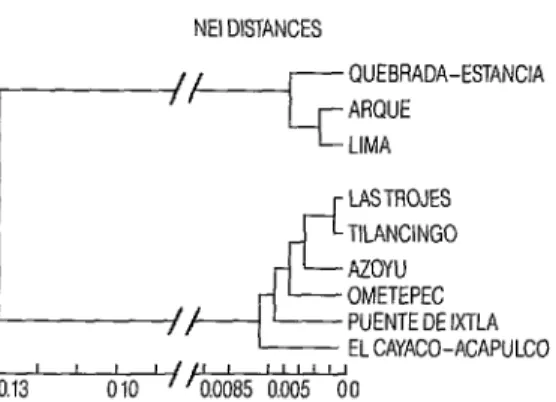
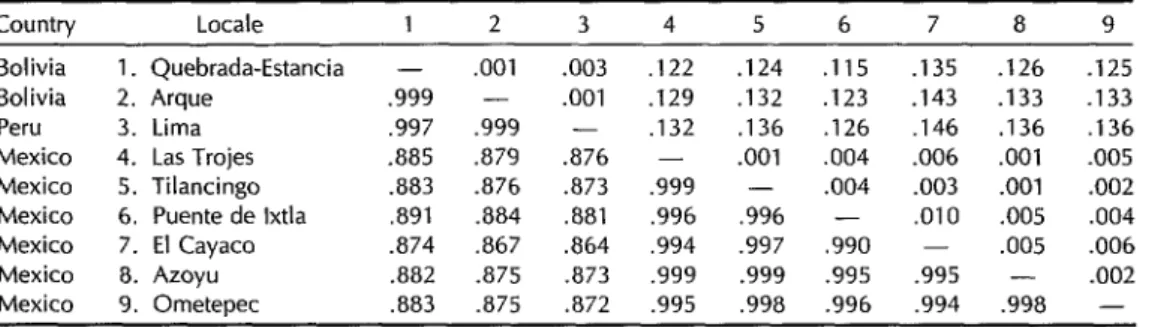
These studies were complemented by genetic distance @ or Nei distances) analysis (a), which yielded a distance value of 0.13, permitting two clusters to be dis- tinguished. One, from South America, was represented by three populations from Bolivia and Peru; while the other, from Mexico, was represented by six populations (see dendogram and matrix values, Figure 1 and Table 1). The “D” values are consistent with those found to clearly separate other cryptic anopheline species deemed to show allopatric spe- ciation.
Finally, DNA technoIogy invoking the use of ribosomal DNA probes from Anopheles gambiae S.S. revealed the pres- ence of a ribosomal DNA fragment in Mexican strains that was absent from South American ones. The heterologous probe was able to differentiate between Mexican maIe An. pseudopunctipennis sensu Zato and South American males. The Mex- ican species of An. pseudopunctipennis (species A) was identified by the pres- ence of a 3.4 kilobase fragment after digestion with the restriction enzyme
Figure 1. Dendogram of the presumed
relationship among isolated populations of An. pseudopunctipennis pseudopunctipennis 5.1. from Mexico, Bolivia, and Peru. The
dendogram was constructed using the UPGMA method of Sneath and Sokal (9).
NEI DISTANCES
QUEEIRADA-ESTANCIA
PUENTE DE IXTLA EL CAYACO-ACAPULCO
Photo
1A.Normal sperm of F-3 Bolivian colony An. pseudopunctipennis
mosquito.
Note the characteristic
long, slender shape and small head. (Picture
shown at 650
x.)
Photo
1B.Abnormal
sperm of hybrid from a cross between a Mexican colony
female and a Bolivian F-2 colony male. Note the truncated length and large
head of most of the sperm. Also note the presence of aberrant forms such as
sperm with two heads, sperm with partial development
of an extra head on the
tail, and spermatocytes
with no tails. (Picture shown at 650
x.)
Photo 2A. Normal mosquito testis showing evidence of normal coiled sperm
(dark areas). The vas deferens is slender and also clearly full of coiled sperm.
(Taken from a male of the Tilacingo,
Mexico colony.) (Picture shown at
160x .)
Photo 2B. Atrophied
mosquito testis resulting from a cross between a Mexican
colony female and a Bolivian wild colony male. Note the broad vas deferens,
small size, and absence of sperm contrasting
with the testis shown in Photo
2A. (Picture shown at 160
x.)
Table 1. Nei’s genetic distances and identity matrices among nine populations of An. pseudopunctipennis s.1. from Mexico, Bolivia, and Peru.
Country Locale 1 2 3 4 5 6 7 8 9 Bolivia 1. Quebrada-Estancia - ,001 .003 ,122 .124 ,115 .135 .126 .125 Bolivia 2. Arque ,999 - .OOl .129 .132 ,123 .143 .133 ,133 Peru 3. Lima ,997 .999 - ,132 .136 ,126 ,146 .136 ,136 Mexico 4. Las Trojes .885 .879 .876 - .OOl ,004 .006 .OOl .005 Mexico 5. Tilancingo .883 .876 .873 ,999 - .004 .003 .OOl .002 Mexico 6. Puente de lxtla ,891 .884 .881 ,996 ,996 - ,010 .005 .004 Mexico 7. El Cayaco ,874 ,867 .864 ,994 ,997 ,990 - ,005 .006 Mexico 8. Azoyu .882 .875 ,873 .999 .999 .995 .995 - .002 Mexico 9. Ometepec ,883 .875 .872 .995 ,998 .996 ,994 ,998 -
EcoRI. This fragment was absent from the South American species.
This body of evidence obtained through a multifaceted approach demonstrates the presence of a species complex in An. pseu- dopunctipennis sense late. The two forms identified through these studies have been provisionally named Anopheles pseudo- punctipennis species A, for the form found on the central plain and Pacific slope of Mexico, and Anopheles pseudopunctipennis
species B, for the form found among the Andean slopes and intermontane valleys of regions in Peru and Bolivia.
The findings presented here provide the first evidence that Anopheles pseudo- punctipennis sensu lato constitutes a spe- cies complex and suggest allopatric spe- ciation. It is thought that this mechanism of speciation is related to geographic bar- riers that isolated the populations in Mexico and South America, which in turn could have favored different adaptations by the two populations while preventing gene flow between them (IO).
These findings provide new informa- tion to help resolve pending questions about epidemiologic patterns of malaria transmission in neotropical America. In addition, they have some practical im- plications that need to be taken into ac- count because of their potential impact on An. pseudopunctipennis vector control in the Americas. Specifically, to under-
30 Bulletin of PAHO 27(l), 2993
stand malaria epidemiology and bring about effective vector control, it is nec- essary to establish the geographic distri- bution of the two recently recognized species and of any others that future studies may reveal. Such information is critically important for determining the geographic ranges of the different species in the complex, which could affect their relative contributions to malaria out- breaks as well as possible responses to control measures.
REFERENCES
1. 2. 3. 4. 5.Pan American Health Organization. Sfu-
fus of malaria programs in the Americas: XXXIX
report, XL111 Regional Commiffee Meeting.
Washington DC: 1991. (PAHO document CD35/Inf/2).
Fleming G. SioZogy and ecology of malaria vectors in fhe Americas. Washington, DC: Pan American Health Organization; 1986. (PNSP/86-72).
Vargas L, Casis G, Earle WC. Anopheles
pseudopuncfipennis Theobald: a vector of malaria in Mexico. Am J Trap Med. 1941; 21:779-788.
Cabaldon A. Malaria incidence in the West Indies and South America. In: Boyd F, ed.
Malariology (vol I). Philadelphia: WB. Saunders; 1949764-787.
Baker R, Ritzmiller JB, Chowdaiah B. The salivary gland chromosomes of Anopheles
6. Warren M, Collins W, Jeffery G, Richard- son B. AnopheZes pseudopuncfipennis: labo- ratory maintenance and malaria suscep- tibility of a strain from El Salvador. Am J Trap Med Hyg. 1980;29(4):503-506.
7. Molez JF, Desenfant P, Pajot F, Jacques JR, Duverseau Y, Saint-Jean Y. Le pal- udisme en Haiti: 2. presence d’AnopheZes (A) pseudopuncfipennis Theobald. Premiere mise en evidence sur l’ile d’Hispaniola.
Cah Orsfom, Ser Enf Med Parasifk 1901; 25(2):75-81.
8. Nei M. Estimation of average heterozy- gocity and genetic distance from a small number of individuals. Genetics. 1978; 89:583-590.
9. Sneath P, Sokal R. Numerical taxonomy. San Francisco: WH Freeman; 1973. 10. Mayr E. Animal species and evolution. Cam-
bridge: Harvard University Press; 1963.
444
Conference on Children and AIDS
An international conference entitled “Children and AIDS: Medical,
Ethical, and Legal Issues” will be held in Onate, Guiptizcoa, in north- ern Spain, from 13 to 19 June 1993. The conference will be hosted by the International Institute for the Sociology of Law, based in Onate, and is being organized by The American University (Washington, D.C., USA), with the collaboration of the Pan American HeaIth Organization.
The main goal of the meeting is to examine, analyze, and discuss the evolving medical, ethical, legal, and policy issues presented by pe- diatric AIDS. Particular attention will be given to actual solutions and interventions, so that discussion of pragmatic and applied topics is carefully balanced with presentation of theory, analysis, and pure re- search. A few of the many issues to be addressed are access to care, the natural history of HIV infection in children, living arrangements for HIV-infected children, peer counseling among adolescents, how to help schools and communities accept and support children with HIV infection, the legal rights of families caring for HIV-infected children, and the funding of prevention, research, and care.
The conference is meant to facilitate the sharing of information and the diffusion of proven or promising approaches among an interna- tional audience of practitioners, policy makers, and other profession- als. For more information, contact Prof. Emilio Viano, School of Public Affairs/DJLS, The American University, Washington, D.C. 20016-8043, USA; telephone (202) 885-2953; fax (202) 885-1292 or (202) 885-2353;
BITNET: EVIANO@AUVM; INTERNET: [email protected].