Microbial Population and Reduce Southern Blight of Soybean
Luiz E. B. Blum1 & Rodrigo Rodríguez-Kábana2
1Universidade de Brasília, Departamento de Fitopatologia, CEP 70910-900, Brasília, DF, Brazil, HPDLOOXL]EOXP#SHVTXLVDGRUFQSTEU2Auburn University, Plant Pathology Department, 209
Life Sciences Building, 36849Auburn AL, USA.
(Accepted for publication 20/10/2006)
Author for correspondence: Luiz Eduardo Bassay Blum
BLUM, L.E.B. & RODRÍGUEZ-KÁBANA, R. Dried powders of kudzu, velvetbean, and pine bark added to soil increase microbial population and reduce Southern blight of soybean. Fitopatologia Brasileira 31:551-556. 2006.
ABSTRACT
Southern blight (6FOHURWLXPUROIVLL) of soybean (*O\FLQHPD[) is an important disease throughout the world. Some soil amendments can reduce disease levels by improving soil microbial activity. The main goals of this study were to investigate the effects of soil amendments such as dried powders of kudzu (3XHUDULDOREDWD), velvetbean (0XFXQDGHHULQJLDQD), and pine bark (3LQXVWDHGD), on soil microbial population and disease caused by 6UROIVLL on soybean. Pine bark, velvetbean (mucuna) and kudzu (25 g kg-1DGGHGWRVRLOZHUHHIIHFWLYHLQUHGXFLQJGLVHDVHLQFLGHQFH>QRQDPHQGHG1$a amended (A) ~ 2 to 11%)]. %DFLOOXVPHJDWHULXP was the bacteria most frequently isolated in soils with velvetbean or kudzu (NA ~ log 5.7 CFU g-1RIGULHGVRLO$aORJ6RLOVZLWKYHOYHWEHDQDQGNXG]Xstimulated increase in population of (QWHUREDFWHU DHURJHQHV1$aORJ$aORJ3VHXGRPRQDVSXWLGD population was higher in A than in NA (NA ~ ORJ$aORJDQGZDVQHJDWLYHO\FRUUHODWHGU 3 WRGLVHDVHLQFLGHQFH6RLODPHQGHGZLWKNXG]XDQGSLQH bark stimulated increases in populations of 7ULFKRGHUPDNRQLQJLL1$aORJ$aORJDQG3HQLFLOOLXPFLWUHRQLJUXP 1$aORJ$aORJUHVSHFWLYHO\3HQLFLOOLXPKHUTXHL soil population increased with addition of kudzu (NA ~ log $aORJ7KHVHPLFURRUJDQLVPVDUHDQWDJRQLVWVRIVRLOERUQHSDWKRJHQV3RZGHUVRIYHOYHWEHDQNXG]XDQGSLQH bark can increase antagonistic population in soil and reduce disease.
Additional keywords:6FOHURWLXPUROIVLL, stem rot, soil amendments, 0XFXQD,7ULFKRGHUPD.
RESUMO
Pós-secos de kudzu, mucuna e casca de pinus adicionados ao solo aumentam a população microbiana e diminuem a murcha por esclerócio em soja.
A murcha (6FOHURWLXP UROIVLL) da soja (*O\FLQH PD[) é uma doença mundialmente importante. Alguns resíduos orgânicos quando adicionados ao solo podem reduzir a doença devido ao aumento da atividade microbiana. Neste estudo investigaram-se os efeitos de pós-secos de kudzu (3XHUDULDOREDWD), mucuna (0XFXQDGHHULQJLDQD) e casca de pinus (3LQXV WDHGD) adicionados ao solo, na população de microrganismos e na doença em soja. Casca de pinus (CP), mucuna e kudzu (25 g kg-1LQFRUSRUDGRVDRVRORUHGX]LUDPDLQFLGrQFLDGHGRHQoD>VHPDGLWLYRV6$aFRPDGLWLYRV&$aD 11%)]. %DFLOOXVPHJDWHULXP foi freqüentemente isolada em solo com mucuna ou kudzu (SA ~ log 5,7 UFC g-1GHVRORVHFR CA ~ log 6,2).Solos com mucuna e kudzu aumentaram a população de (QWHUREDFWHU DHURJHQHV6$aORJ&$aORJ 5,8). A população de 3VHXGRPRQDVSXWLGDIRLPDLRUHPVRORV&$GRTXHHPVRORV6$6$aORJ&$aORJ+RXYH FRUUHODomRQHJDWLYDU 3 HQWUHDTXDQWLGDGHGHGRHQoDHDSRSXODomRGH3SXWLGD. Solos com kudzu e CP aumentaram a população de 7ULFKRGHUPDNRQLQJLL6$aORJ&$aORJH3HQLFLOOLXPFLWUHRQLJUXP6$aORJ CA ~ log 2,6), respectivamente. A população de 3HQLFLOOLXPKHUTXHLDXPHQWRXGHYLGRDDGLomRGHNXG]X6$aORJ&$ ~ log 2,5). Estes microrganismos são antagonistas de patógenos no solo. A adição ao solo de mucuna, kudzu e CP aumentou a população de microrganismos antagonistas e reduziu a doença.
Palavras-chave adicionais:6FOHURWLXPUROIVLL, podridão, resíduo orgânico, mucuna, 7ULFKRGHUPD.
INTRODUCTION
6FOHURWLXP UROIVLL Sacc. [teleomorph $WKHOLD UROIVLL
(Curzi) C.C. Tu & Kimbr.] is responsible for crop yield losses in many important plants around the world. This pathogen can cause stem or foot rot on soybean (*O\FLQHPD[ L.) and 500 other species of plants. Recommendations have been made for use of fungicides, microbial antagonists, crop
rotation, soil organic or inorganic amendments, solarization, and resistant cultivars (Punja, 1988).
If correctly applied, soil amendments can reduce populations of soil-borne pathogens by stimulating increases in populations of some naturally occurring antagonists. The activities and populations of some microorganisms in soil are altered when amendments are added (Blum & Rodriguez-Kábana, 2004). Studies under greenhouse conditions with benzaldehyde and pine (3LQXV L.) bark powder (Kokalis-Burelle & Rodríguez-Kábana, 1994) showed that some selected microorganisms had their populations increased.
7KLVLQFUHDVHLQSRSXODWLRQVRIEHQH¿FLDORUJDQLVPVFDQEH
associated with decreases in populations of some soil-borne fungi.
Blum & Rodriguez-Kábana (2004) reported a positive correlation between rates of amendments and activities of soil enzymes, indicating an increase on soil microbial activity, which could be associated to disease reduction. In addition, the availability of kudzu [3XHUDULDOREDWD (Willd.) Ohwi], velvetbean [0XFXQD GHHULQJLDQD (Bort) Merr.], and pine bark in the southeast U.S. and the possibility for management of 6UROIVLL with these amendments, led us to study the effect of kudzu, velvetbean (mucuna), and pine bark powder on soil microbial population and Southern blight (6UROIVLL) on soybean.
MATERIAL AND METHODS
6FOHURWLXPUROIVLL inoculi from PDA (Potato dextrose
agar, Difco Co.) cultures were prepared using oat kernels (Beute & Rodríguez-Kábana, 1979). After growth, these colonized seeds were dried (22oC). A sandy-loam soil was
sieved and mixed with siliceous sand (50:50w/w). The elemental composition and other characteristics of the soil used for the greenhouse experiments were: Source area
$XEXUQ $/ 86$ 3UHYLRXV FURS 3HDQXW $UDFKLV
K\SRJDHD/6RLOW\SHVDQG\ORDP&(&FPRONJ
-1S+3PJNJ-1.PJNJ-10JPJNJ-1&D
300 mg kg-1&1
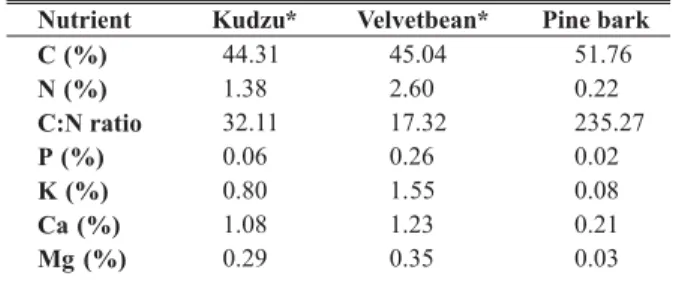
The amendments used in the experiments were dried and ground fresh pine bark, kudzu and velvetbean (Three-month-old plants - leaves and stem) as described by Blum & Rodriguez-Kábana (2004). The Soil Testing Laboratory at Auburn University, Auburn, AL, determined the elemental composition of the powdered materials. The results of the analyses of powdered amendments are presented on Table 1.
Two experiments were performed in greenhouse (25 ± 5 oC) with soil infested with 6UROIVLL (5 g colonized oat
seeds kg-1 of soil). For both tests soil treatments were as
presented on Figure 1 [control (without amendment), kudzu, velvetbean, and pine bark powder (25 g kg-1), controls
with autoclave sterilized (with and without 6 UROIVLL) and non-sterilized (without 6 UROIVLL) soil were also applied, but were not used for statistical analyses]. Each treatment was replicated six times. An experimental unit in the experiments was a 1 liter pot (1 L capacity cylinder shape PVC pot) with 1 kg of soil (1kg of soil and 1.0 g of 10-10-10 N-P-K). Infestation of soil with pathogen was made 2
days prior to application of the amendments. Sowing with ‘Davis’ soybean (10 seeds per pot) was done 30 days after application of the amendments [Plantings in amended soil prior to 30 days after application of the amendments are not recommended due to possible phytotoxic effects on soybean seedlings induced by the organic residues (Blum & Rodríguez-Kábana, 2004)]. Evaluation of disease incidence was done 30 days after sowing. Irrigation of plots was by pouring 100 mL of water per pot when necessary.
Soil samples from each pot were collected 60 days after application of the amendments, and were used for microbial isolations and evaluation of soil moisture content. Ten grams of freshly collected soil from each plot were thoroughly mixed for 5 minutes (tray shaker) with 90 mL of sterile water, and then diluted 10 fold to 10-6. For fungi,
dilutions 10-2-10-3were used and for bacteria 10-5-10-6. The
resulting suspensions were then spiral plated (Spiral System) in the appropriate culture media. The selective medium used to isolate fungi from soil was MEA (Malt extract agar, Difco Co., amended with 100 mg L-1WHWUDF\FOLQHK\GURFKORULGH
50 mg L-1rose Bengal). Isolations of bacteria were done in
5% TSA (Tryptic soy agar Difco Co., amended with 50 mg L-1 benomyl). Number of colonies per plate was determined
GLUHFWO\WZRDQG¿YHGD\VDIWHULQRFXODWLRQIRUEDFWHULDDQG
fungi, respectively.
Twenty bacterial isolates from each replication were randomly picked with sterile tooth picks, grown in TSA, and maintained in small tubes (1.2 mL) with 1.0 mL of
VWHULOHZDWHU,GHQWL¿FDWLRQRIEDFWHULDOLVRODWHVZDVEDVHG RQ DQDO\VLV RI IDWW\ DFLG PHWK\OHVWHUV SUR¿OHV 6WHDG
1988). Bacterial samples were prepared as described by Kloepper HW DO (1992), analyzed with a Hewlett-Packard
*DV&KURPDWRJUDSK\,,DQGLGHQWL¿HGDFFRUGLQJWR 6KHUORFN0LFURELDO,GHQWL¿FDWLRQ6\VWHPVRIWZDUH7ZHQW\
fungal isolates from each replication were randomly picked
DQGPDLQWDLQHGLQWXEHVZLWK0($,GHQWL¿FDWLRQRIIXQJL
was based on morphology and growth on MEA, PDA and Czapek Dox Agar (Difco Co.), and consulting appropriate literature (Domsch HWDO., 1980).
Treatments in the experiments were arranged in a randomized complete block design, and data were analyzed by ANOVA. Differences among means were evaluated for
VLJQL¿FDQFHE\7XNH\¶VWHVW
TABLE 1 – Elemental composition of amendments (kudzu, velvetbean and pine bark) used in the experiments
FIG. 1 - Effects of soil amendments (kudzu, velvetbean, and pine bark) on: A. fungal population (CFU = Colony forming unit g-1 of dried VRLOB. bacterial population (CFU g-1RIGULHGVRLOC-H.VHOHFWHGSUHGRPLQDQWSRWHQWLDODQWDJRQLVWVI. soybean disease (6FOHURWLXPUROIVLL) LQFLGHQFHDQGJ. regression between disease incidence and 3VHXGRPRQDVSXWLGDSRSXODWLRQFRHI¿FLHQWRIUHJUHVVLRQVLJQL¿FDQWDW3 (YDOXDWLRQPDGHGD\VDIWHUVRLOWUHDWPHQWGD\VDIWHUVR\EHDQVRZLQJ%DUVIROORZHGE\VDPHOHWWHUVDUHVLJQL¿FDQWO\HTXDO (Tukey, P < 5%). (Data represent an average of two experiments).
Fungal population
Trichoderma koningii
Penicillium citreonigrum
Penicillium herquei
Bacterial population
Bacillus megaterium
Enterobacter aerogenes
Pseudomonas putida
Pseudomonas putida
3,5
3,4
3,3
3,2 2,9 2,6 2,3 2
1,7 1,4 1,1
3,2
2,7
2,2
1,7
1,2
0,7
0,2
2,6
2,1
1,6
1,1
50
40 30
20
10
0
6,9
6,7
6,5
6,3
6,1
5,9
6,5
6,3 6,1 5,9 5,7
5,5 5,3
5,9
4,9
3,9
2,9
5,8
5,3
4,8
4,3
3,8
50
40
30 20
10 0
3 4 5 6 7
Control Kudzu Velvetb. P.bark
Control Kudzu Velvetb. P.bark
Control Kudzu Velvetb. P.bark
Control Kudzu Velvetb. P.bark
Control Kudzu Velvetb. P.bark
Control Kudzu Velvetb. P.bark
Control Kudzu Velvetb. P.bark
Control Kudzu Velvetb. P.bark A
C
E
G
I
B
D
F
H
J
a a a a b a a b
b a b b bc a ab c
b a c a c b a c
b a b b b a a a
a b b b
Control Kudzu Velvetb. P.bark
amendment (25g kg-1) Pseudonomas putida [log (CFU g-1)]
y= 11.55x2 - 128.24x + 363.91
r2= 0.69**
log CFU g
-1
soil
log CFU g
-1
soil
log CFU g
-1
soil
log CFU g
-1
soil
Incidence %
log CFU g
-1
soil
log CFU g
-1
soil
log CFU g
-1
soil
log CFU g
-1
soil
RESULTS AND DISCUSSION
In this study was shown that certain types of amendments stimulate the increase on populations of some naturally occurring antagonists and, consequently, decrease the amount of disease. Furthermore, this work adds new information and complements data presented by Blum & Rodriguez-Kábana (2004) concerning the effects of organic amendments on 6UROIVLL sclerotial germination and mycelial growth.
Total fungal population averages (~ log 3.3-3.5 CFU g-1 of dried soil) did not differ among treatments (Fig. 1A).
+RZHYHU WRWDO EDFWHULDO SRSXODWLRQV ZHUH VLJQL¿FDQWO\
higher in soil treated with velvetbean (~ log 6.7 CFU g-1) or
kudzu (~ log 6.8 CFU g-1) in comparison to the non-amended
(~ log 6.1 CFU g-1) soil (Fig. 1B). Previously, evaluations of
microbial populations were made from 0 to 70 days after soil amendment, therefore, was determined that the population of microorganisms in amended soil was higher around 60 days after soil amendment under greenhouse conditions (data not shown). Independently of the soil treatment, a
WRWDORIVSHFLHVRIEDFWHULDZDVLGHQWL¿HGDQGWKHPRVW
frequent ones were %DFLOOXV PHJDWHULXP de Bary and
&RPDPRQDVDFLGRYRUDQV (den Doren) Tamaoka HWDO. (Data
not shown). %DFLOOXV PHJDWHULXP was the most common (~ log 6.4 CFU g-1) bacteria in soils amended with kudzu
(Fig. 1D). Velvetbean amended soils frequently contained
%PHJDWHULXP (~ log 6.3 CFU g-1),(QWHUREDFWHU DHURJHQHV
Hormaech & Edwards (~ log 5.9 CFU g-1), and 3VHXGRPRQDV
SXWLGD (Trevisan) Migula (~ log 5.5 CFU g-1) (Fig. 1D, F, H).
Pine bark treated soil had large numbers of 3SXWLGD (~ log 5.4 CFU g-1).3HQLFLOOLXPFLWUHRQLJUXP Dierckx, 3KHUTXHUL
Bainier & Sartory, and 7ULFKRGHUPDNRQLQJLL Oudem. were the most common fungi isolated from soil amended with kudzu (Fig. 1C, E, G). Soils amended (~ log 2.5 CFU g-1)
with pine bark had more 3FLWUHRQLJUXP (Fig. 1E) than the non-amended (~ log 1.3 CFU g-1) control.
Disease incidence was reduced from ~ 39% (non-amended control) to ~ 11%, ~ 12%, and ~ 2% in soils amended with kudzu, velvetbean and pine bark, respectively (Fig. 1I). Previous work has shown that amendments may reduce pathogen populations and diseases (Beute & Kábana, 1979). Kokalis-Burelle & Rodríguez-Kábana (1994) reported that pine bark powder was effective in reducing mycelial growth of 6UROIVLL, as well as in improving lentil (/HQV FXOLQDULV Medik.) stands in greenhouse experiments. Pine bark can suppress )XVDULXP
R[\VSRUXP f.sp. FKU\VDQWKHPLLitrell, G.M. Armst. & J.K.
Armstr., )R[\VSRUXP f.sp. lini W.C. Snyder & H.N. Hansen,
and 3K\WRSKWKRUD FLQQDPRPL Rands (Kokalis-Burelle
5RGUtJXH].iEDQD +DUG\ 6LYDVLWKDPSDUDP
1991). Velvetbean (mucuna) is a useful rotation crop with many important crops for reduction of soil borne pathogens of many crops (Rodríguez-Kábana HW DO., 1992). Blum & Rodriguez-Kábana (2004) reported an increase of occurrence
of7ULFKRGHUPD Pers. spp. parasitizing sclerotia of 6UROIVLL
in soil amended with kudzu and pine-bark. These authors also reported that there was a negative correlation between the number of viable sclerotia of 6UROIVLL and amount of velvetbean and pine bark.
Antagonistic microorganisms might be involved in disease suppression when soil amendments are used. Bacteria with potential for biocontrol of soil-borne pathogens increased in some amended soils. Velvetbean treated soils favored increase in populations (Non-amended soil, ~ log 3 CFU g-1DPHQGHGVRLOaORJ&)8J-1) of (DHURJHQHV
(Fig. 1F). Kudzu amended soil enhanced (Non-amended soil, ~ log 5.7 CFU g-1DPHQGHGVRLOaORJ&)8J-1)%
PHJDWHULXP (Fig. 1D), and pine bark was favorable
(Non-amended soil, ~ log 4.1 CFU g-1DPHQGHGVRLOaORJ&)8
g-1) to 3SXWLGD (Fig. 1H). All these bacteria are recognized
for their potential as antagonists of pathogens such as
3K\WRSKWKRUD de Bary, 3\WKLXP Pringsh., 5KL]RFWRQLD DC.,
and6FOHURWLXP Tode (Marchi & Utkhede, 1994).
3VHXGRPRQDV SXWLGD population was negatively
correlated (r = -0.83, P < 1%) to incidence of disease
LQ VR\EHDQ )LJ - 1R VWDWLFDOO\ VLJQL¿FDQW 3
correlation was shown between disease incidence and population of other microorganisms (%DFLOOXVPHJDWHULXP,
(QWHUREDFWHU DHURJHQHV,7ULFKRGHUPDNRQLQJLL,3HQLFLOOLXP
FLWUHRQLJUXP, and 3KHUTXHL). The lowest levels of disease
incidence (~ 5-15%) were reached with populations of
3SXWLGD around log ~ 5.5-6.1 CFU g-1. In soils amended
with kudzu, velvetbean, and pine bark the population of 3
SXWLGD was around, log ~ 5.4 CFU g-1, log ~ 5.6 CFU g-1,
and log ~ 5.5 CFU g-1, respectively. Earlier study reported
that3SXWLGD reduced vascular wilt in cotton caused by F.
R[\SRUXP f.sp. YDVLQIHFWXP W.C. Snyder & H.N. Hansen
(ChenHWDO., 1995). 3VHXGRPRQDVÀXRUHVFHQV Migula and 3
SXWLGD have been implicated (Sivasithamparam HWDO., 1979)
in suppression of *DHXPDQQRP\FHVJUDPLQLV var. WULWLFL J. Walker in wheat (7ULWLFXPDHVWLYXP L.) take-all disease.
The mechanisms involved in pathogen control may vary, depending on bacterial species. Parasitism, antibiosis, siderophore production, plant growth, induced resistance, and competition (nutrients and sites of colonization) might be involved in suppression of pathogen populations and in disease incidence or severity (Kloepper & Schroth, 1981). Marchi & Utkhede (1994) showed that E.DHURJHQHV acted by antibiosis against 3K\WRSKWKRUDFDFWRUXP (Lebert & Cohn) J. Schröt. on apple trees (0DOXVGRPHVWLFD Borkh.). %DFLOOXV
PHJDWHULXP LV DQ HI¿FDFLRXV FRPSHWLWRU DQG H[WUDFHOOXODU
enzyme producer that inhibit soil-borne plant pathogens, such as 5KL]RFWRQLD VRODQL J.G. Kühn (Bertagnolli HW DO, 1996). Competition or antibiosis might be biological control mechanisms used by 3 SXWLGD against several soil-borne
SDWKRJHQV6FKHU %DNHU:HOOHU &RRN
Kudzu amended soil stimulated increases in populations (Non-amended soil, ~ log 1.3 CFU g-1DPHQGHG
soil, ~ log 2.5 CFU g-1) of 3KHUTXHL (Fig. 1G). This fungus
The incorporation of crop residues into soil is a strategy to control soil-borne plant pathogens by promoting selectively enhanced activity of antagonists or to immobilize essential elements for successful infection by a plant pathogen (Pankurst & Lynch, 1995). Bourbos & Skoudridakis (1987) reported that some antagonists, such as 3 KHUTXHL and T.
YLULGH Pers. ex Gray, were found in greater numbers in the
rhizosphere of resistant tomatoes (/\FRSHUVLFRQHVFXOHQWXP Mill.) to vascular diseases caused by ) R[\VSRUXP f.sp.
O\FRSHUVLFL W.C. Snyder & H.N. Hansen and 9HUWLFLOOLXP
DOERDWUXP Reinke & Berthold. 3 KHUTXHL produces an
alkaloid (herquline) with antimicrobial activities (Omura
HWDO., 1979). This information indicates the potential of 3
KHUTXHL as a biological control agent against 6UROIVLL.
0HWKRGV IRU LQFUHDVLQJ SRSXODWLRQV RI EHQH¿FLDO
microorganisms by soil amendments have the advantage that no improved methodology is needed to facilitate microbial growth and survival. Indigenous microorganisms, in general, have higher competence for survival in their own habitat than introduced antagonists. Other cultural methods, such as mulching and crop rotation, also induce microbial increases in soil (Rodríguez-Kábana HWDO., 1992).
Adding organic amendments to soil such as velvetbean (C:N ~ 32) and kudzu (C:N ~ 17) limits disease intensity, possibly due to release of toxic compounds (ammonium derived compounds and others) or to increases in levels of resident antagonistic soil microorganisms (Punja, 1985). Mian & Rodríguez-Kábana (1982) reported that the relative
HI¿FDF\ RI WKH DPHQGPHQW RQ VXSSUHVVLQJ SDWKRJHQV
depends on their nitrogen content and C:N ratio. These authors, also reported that materials with narrow C:N ratio (high N content) were more effective than those with broad C:N ratios. Materials with C:N ratios of 15-20 are optimal to
VWLPXODWHVRLOPLFURÀRUDZKHQDSSOLHGDWDURXQGUDWH
(Mian & Rodríguez-Kábana, 1982). Punja & Grogan (1982) published that nitrogen derived compounds were toxic to
6UROIVLL, inhibiting sclerotial germination. Nogueira HWDO.
(1996) reported that an aliphatic alcohol (1-triacontanol) and an ester (triacontyl tetracosnate) extracted from leaves and stems of 0XFXQDDWHUULPD Merr. had nematicidal effects
on 0HORLGRJ\QH LQFRJQLWD (Kofoid & White) Chitwood.
These compounds could be released during velvetbean decomposition in soil and then inhibit 6UROIVLL.
Probably a group of factors like soil pH, secondary metabolites from decomposition of amendments, microorganisms (%PHJDWHULXP,E.DHURJHQHV,3SXWLGD,T.
NRQLQJLL,3FLWUHRQLJUXP, and 3KHUTXHL), small animals, type
of pathogen inoculum (Blum & Rodriguez-Kábana, 2004) is involved in the control of 6UROIVLL by amendments to soil. Single factors might have a major role, but are not alone responsible for the suppression of soil-borne diseases.
ACKNOWLEDGEMENTS
7KH ¿UVW DXWKRU JUDWHIXOO\ DFNQRZOHGJHV WKH
fellowship provided by CNPq.
REFERENCES
BEUTE, M.K. & RODRÍGUEZ-KÁBANA, R. Effect of volatile compounds from remoistened plant tissues on growth and germination of sclerotia of 6FOHURWLXP UROIVLL. Phytopathology 69:802-805. 1979.
BERTAGNOLLI, B.L., DALSOGLIO, F.K. & SINCLAIR, J.B. ([WUDFHOOXODUHQ]\PHSUR¿OHVRIWKHIXQJDOSDWKRJHQ5KL]RFWRQLD VRODQL isolate 2B-12 and of two antagonists, %DFLOOXVPHJDWHULXP strain B153-2-2 and 7ULFKRGHUPD KDU]LDQXP isolate Th008. I. Possible correlations with inhibition of growth and biocontrol. Physiologycal Molecular Plant Pathology 48:145-160. 1996.
BLUM, L.E.B. & RODRÍGUEZ-KÁBANA, R. Effect of organic amendments on sclerotial germination, mycelial growth, and 6FOHURWLXPUROIVLL-induced diseases. Fitopatologia Brasileira 29:66-74. 2004.
BOURBOS, V.A. & SKOUDRIDAKIS, M.T. Das VerhaltenDas Verhalten einiger pilzlicher Antagonisten in der Rhizosphäre resistenter und anfälliger Gewächshaustomaten. Journal of Phytopathology,. Journal of Phytopathology, 120:193-198. 1987.
CHEN, C., BAUSKE, E.M., MUSSON, G., RODRÍGUEZ-KÁBANA, R. & KLOEPPER, J.W. Biological control of fusarium wilt on cotton by use of endophytic bacteria. Biological Control 5:83-91. 1995.
DOMSCH, K.H., GAMS, W. & ANDERSON, T.H. Compendium of soil fungi. Vol. 1. Academic Press, London, England. 859 p. 1980.
HARDY, G.E.ST.J. & SIVASITHAPARAM, K. Effects of sterile and non-sterile leachates extracted from composted eucalyptus bark and pine-bark container media on 3K\WRSKWKRUD spp. Soil Biology & Biochemistry 23:25-30. 1991.
KLOEPPER, J.W., RODRÍGUEZ-KÁBANA, R., MCINROY, J.A. & YOUNG, R.W. Rhizosphere bacteria antagonistic to soybean cyst (+HWHURGHUDJO\FLQHV) and root-knot (0HORLGRJ\QHLQFRJQLWD) QHPDWRGHVLGHQWL¿FDWLRQE\IDWW\DFLGDQDO\VLVDQGIUHTXHQF\RI biological control activity. Plant & Soil 139:75-84. 1992.
KLOEPPER, J.W. & SCHROTH, M.N. Relationship of in vitro antibiosis of plant growth-promoting rhizobacteria to plant growth DQG GLVSODFHPHQW RI URRW PLFURÀRUD 3K\WRSDWKRORJ\ 1024. 1981.
KOKALIS-BURELLE, N. & RODRÍGUEZ-KÁBANA, R. Effects of pine bark extracts and pine bark powder on fungal pathogens, soil enzyme activity, and microbial populations. Biological Control 4:269-276. 1994.
MARCHI, A. & UTKHEDE, R.S. Effect of (QWHUREDFWHU DHURJHQHVRQWKHUKL]RVSKHUHPLFURÀRUDRIDSSOHWUHHV-RXUQDO Phytopathology 141:127-132. 1994.
MIAN, I. H. & RODRÍGUEZ-KÁBANA, R. Survey of the nematicidal properties of some organic materials available in Alabama as amendments to soil for control of 0HORLGRJ\QH DUHQDULD. Nematropica 12:235-246. 1982.Nematropica 12:235-246. 1982.
NOGUEIRA, M.A., OLIVEIRA, J.S. & FERRAZ, S. Nematicidal hydrocarbons from 0XFXQDDWHUULPD. Phytochemistry 42:997-998.Phytochemistry 42:997-998. 1996.
PANKHURST, C.E. & LYNCH, J.M. The role of soil microbiology in sustainable intensive agriculture. Advances in Plant Pathology 11:229-247. 1995.
PUNJA, Z.K. The biology, ecology and control of 6FOHURWLXP
rolfsii. Annual Review of Phytopathology 23:97-127. 1985.
PUNJA, Z.K. 6FOHURWLXP ($WKHOLD)rolfsii, a pathogen of many plant species. Advances in plant pathology. 6:523-535. 1988.
PUNJA, Z.K. & GROGAN, R.G. Effects of inorganic salts, carbonate-bicarbonate anions, ammonia, and the modifying LQÀXHQFH RI S+ RQ VFOHURWLDO JHUPLQDWLRQ RI6FOHURWLXP UROIVLL. Phytopathology 72:635-639. 1982.
RODRÍGUEZ-KÁBANA, R., PINOCHET, J., ROBERTSON, D.G. & WELLS, L. Crop rotation studies with velvetbean (0XFXQDGHHULQJLDQD) for the management of 0HORLGRJ\QH spp.
Journal of Nematology (Supplement) 24(4s):662-668. 1992.
SHER, F.M. & BAKER, R. 1982. Effect of 3VHXGRPRQDVSXWLGD and a synthetic iron chelator on induction of soil suppressive to Fusarium wilt pathogens. Phytopathology 72:1567-1573. 1982.
SIVASITHAMPARAM, K., PARKER, C.A. & EDWARDS, &6 %DFWHULDO DQWDJRQLVWV WR WKH WDNHDOO IXQJXV DQG ÀXRUHVFHQW pseudomonads in the rhizosphere of wheat. Soil Biology & Biochemistry. 11:161-165. 1979.
67($''(,GHQWL¿FDWLRQRIEDFWHULDE\FRPSXWHUDVVLVWHGIDWW\ DFLGSUR¿OLQJ$FWD+RUWLFXOWXUDH
WELLER, D.M. & COOK, R.J. Suppression of take-all of wheat E\VHHGWUHDWPHQWZLWKÀXRUHVFHQWSVHXGRPRQDGV3K\WRSDWKRORJ\ 73:463-469. 1983.