Development of RFLP-PCR method for the identification of medically important
Aspergillus
species using single restriction enzyme
Mwo
I
K. Diba
1, H. Mirhendi
2, P. Kordbacheh
3, S. Rezaie
4 1Cellular and Molecular Research Center, School of Medicine, Urmia University of Medical Sciences, Urmia, West Azarbayejan, Iran.
2
Department of Parasitology and Mycology, School of Public Health and Institute of Public Health Research, Tehran University of Medical Sciences, Tehran, Iran.
3
Department of Parasitology and Mycology, School of Public Health and Institute of Public Health Research, Tehran University of medical sciences, Tehran, Iran.
4
Department of Parasitology and Mycology, School of Public Health and Institute of Public Health Research, Tehran University of medical sciences, Tehran, Iran.
Submitted: September 18, 2012; Approved: March 14, 2014.
Abstract
In this study we attempted to modify the PCR-RFLP method using restriction enzymeMwoI for the identification of medically important Aspergillus species. Our subjects included nine standard
Aspergillusspecies and 205Aspergillusisolates of approved hospital acquired infections and hospi-tal indoor sources. First of all,Aspergillusisolates were identified in the level of species by using morphologic method. A twenty four hours culture was performed for each isolates to harvest
Aspergillus mycelia and then genomic DNA was extracted using Phenol-Chloroform method. PCR-RFLP using single restriction enzymeMwoI was performed in ITS regions of rDNA gene. The electrophoresis data were analyzed and compared with those of morphologic identifications. Total of 205Aspergillusisolates included 153 (75%) environmental and 52 (25%) clinical isolates.A. flavus
was the most frequently isolate in our study (55%), followed byA. niger65(31.7%),A. fumigatus
18(8.7%),A. nidulansandA. parasiticus2(1% each).MwoI enabled us to discriminate eight medi-cally importantAspergillusspecies including A. fumigatus, A. niger, A. flavus as the most common isolated species. PCR-RFLP method using the restriction enzymeMwoI is a rapid and reliable test for identification of at least the most medically importantAspergillusspecies.
Key words:Aspergillus, identification, MwoI.
Introduction
Invasive filamentous fungal infections have emerged as important human diseases in recent years, particularly in the patients who receiving aggressive chemotherapy regi-mens and immunosuppressive agents (Walsh and Fran-cesconi, 1995).Aspergillusspecies are most abundant and widely distributed in soil, water, air, seeds and foods (Anaissie and McGinnis, 2003). These molds are associ-ated with allergic bronchopulmonary disease, mycotic keratitis, otomycosis, nasal sinusitis and invasive infection.
Aspergillus fumigatusremains the most frequent cause of
invasive aspergillosis (IA), although at least 30 other spe-cies, primarilyA. flavus, A. terreus, A. niger, A. nidulans, A. ustusandA. versicolorhave been associated with human disease (De Aguirreet al., 2004). In some institutions,A. terreusis becoming more common and is of concern be-cause it is less susceptible to antifungal drugs such as amphotericine-B thanA. fumigatus. SimilarlyAspergillus nidulans has also been reported as less susceptible to amphotericine-B thanA. fumigatusand although it rarely causes invasive disease,A.ustusis less susceptible thanA. fumigatusto antifungal medications such as voriconazole (Zhao and Kong, 2001). Therefore, accurate and timely
Send correspondence to K. Diba. Cellular and Molecular Research Center, School of Medicine, Urmia University of Medical Sciences, Urmia, Iran. E-mail: [email protected].
species identification is important to manage IA as well as for surveillance and epidemiological purposes.
Identification ofAspergillusspecies has traditionally relied on macroscopic colony characteristics and micro-scopic morphology (Dibaet al., 2007). Recently, compara-tively simpler and more efficient molecular techniques have been adapted to detect and identify pathogenic fungi includingAspergillusspecies. In particular, because of its speed, reproducibility, high sensitivity and specificity, Polymerase Chain Reaction (PCR)-based tests have in-creasingly been used in laboratories to identify numerous fungal species (Canbeet al., 2002). Several methods have been reported for DNA-based identification ofAspergillus
spp. including PCR-sequencing of the ITS region (Moody and Tyler, 1990) repetitive-sequence based PCR (Healy and Kontoianis, 2004) , PCR-Enzyme Immune Assay (EIA) (De Aguirre and Choi, 2004), nested PCR targeting rDNA ITS regions (Zhao and Kong, 2001) and PCR-res-triction fragment length polymorphism (PCR-RFLP) for identification ofAspergillusat the generic level (Mirhendi and Diba, 2007), as well as direct PCR/sequence (d-PCRs) (Moody and Tyler, 1990). In a study, we also introduced the molecular, PCR based method of single strand confor-mational polymorphism (SSCP) for the identification of medically importantAspergillus species(Diba and Mirhen-di, 2008). In this study we attempted to modify the PCR-RFLP method by using restriction enzyme MwoI for the identification of most common hospital isolated
Aspergillusspecies .
Materials and Methods
Microorganisms
Referenced cultures ofAspergillusspecies were ob-tained from the Japanese Collection of Microorganisms (JCM) including:A. flavus(JCM 2061),A. fumigatus(JCM 10253),A. niger(JCM 10254),A. nidulans(JCM 10227) andA. tereus(JCM 02728). Test samples were collected from clinical specimens including; sputum, sinus dis-charge, broncho alveolar lavage, nail scrapings; the envi-ronmental samples were included aerosols precipitated on Sabouraud medium (Difco) and surface swabs of indoor and outdoor environments , in a University hospital, Urmia, Iran.
Culture preparation and morphological study
Morphologic identification of all standard and hospi-tal isolatedAspergillusspp. was performed by using four enrichment media: Czapek dox agar, Czapek yeast extract agar, Czapek yeast 20% sucrose agar and malt extract agar (Diba and Mirhendi, 2007). For the molecular study,
Aspergillusmycelia were harvested from sabouraud glu-cose broth (Difco) cultures after 24-48 h at 30 °C on a shak-ing platform. The mycelia were recovered on a 0.45mm pore size filter and washed with TRIS- EDTA buffer and
sterile deionised water. Aliquots of the fungal hypha were stored frozen at -20 °C until use.
DNA extraction
Aspergillusfreeze mycelia were ground using a Mi-cro-Multimixer (IEDA Trading Corporation, Japan) or shaking with same volume of 0.3 to 0.4 mm (d) glass beads. DNA isolation ofAspergillus cells was performed using phenol-chloroform method (Mirhendiet al., 2007; Dibaet al., 2008).
PCR amplification
PCR was performed using 5mL of the DNA template to the PCR master mix including PCR buffer (20 mM Tris-HCL at pH 8.0), 50 mM MgCl2, 0.1 mM each of forward (ITS: 5-TCC GTA GGT GAA CCT GCG G-3) and reverse (ITS-4 5-TCC TCC GCT TAT TGA TAT GC-3) primers (the universal primers synthesized by the UNMC, Eppley molecular biology lab), and 1.5 U of Taq DNA polymerase. Thermal protocol was use as our last studies on Aspergilli (8, 6). After amplification the products were stored at 4 °C until used.
Restriction Enzyme Digestion
Studying the literature and using molecular analyzer software (DNASIS Japan), we selectedMwoI which was a desirable restriction enzyme with differential cutting pat-terns for the identification of medically important
Aspergillusspecies. For restriction digestion, 13mL of each PCR product was directly digested with by 5 U (0.5mL) of the restriction enzymeMwoI, 1.5mL of the related buffer, and incubated at 37 °C for 180 min (Diba and Mirhendi , 2008). Digested PCR products were subjected to electro-phoresis in a 2% agarose gel and visualized by gel doc UV system.
Results
Studying a lot of well known restriction enzymes with various digestion patterns, we choseMwoI, as appro-priate restriction enzyme with a differential power for nine of the 18 most medically important Aspergillus species tested in the present study. Amplification of rDNA in ITS1-5.8-ITS2 region for standard strains ofAspergillus
species including A. fumigatus, A. flavus, A. niger, A. nidulans and A. terreus resulted PCR bands ranging 570-598 bp. Against PCR produced bands, digestion with
swabs, as well as 153 environmental specimens including indoor surfaces swabs.
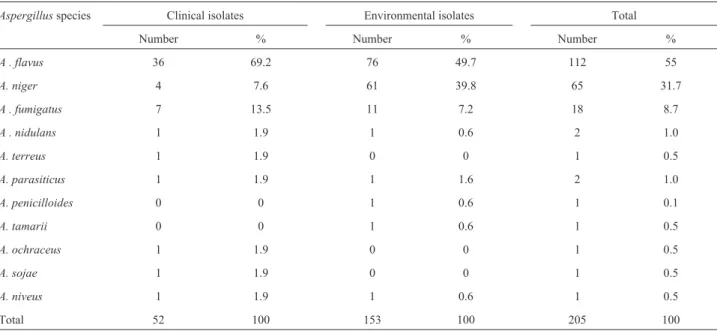
During 18 month of our study, totally 205 isolates in-cluding 11Aspergillus species were identified (Table 2).
Aspergillusisolates included 153 (75%) environmental and 52 (25%) clinical isolates. Among all,A. flavus was the most common species (55.0%) isolated from both clinical specimens followed by A. niger (31.7%), A. fumigatus
(8.7%),A. nidulans (1.0%) andA. tereus (0.5%). Among environmental Aspergillus isolates, also A. flavus was found as the most frequent species followed byA. niger, A. fumigatusand the other Aspergillus species listed in Ta-ble 2.
Discussion
Use of molecular methods is preferred for the identifi-cation of medically importantAspergillusspecies compar-ing morphological tests which have some disadvantages including, delayed production or lack of characteristic morphologic features on culture media, lack of the sexual reproduction cycle in some Aspergillus species which makes difficult the identifications and similarity of micro-scopic or macromicro-scopic characteristics in the species level and being risky for the health of laboratory personnel (Pryce and Palladino , 2006). The rDNA contains several regions of highly conserved sequence useful for obtaining proper sequence alignments. Most previous publications on PCR-based detection or identification systems were rele-vant to the sequencing rDNA 18S or 28S regions as target Figure 1- Agarose gel electrophoresis of ITS1-ITS2 PCR products of
standardAspergillusspecies after digestion with the restriction enzyme
MwoI Lanes 1-9:A. fumigatus, A. flavus, A. niger, A. terreus, A. nidulans, A. clavatus, A. ochraceus,A. amstelodami and A. fischeri.Lane 10:N. quadricincta(Digestion pattern is similar toA. fumigatus). Lane M 100 bp ladder.
Table 1- The fragment size of ITS1-ITS2 PCR products after digestion with restriction enzymeMwoI for some medically importantAspergillus
species.
Species Cutting size
A fumigatus 207, 125, 108, 29, 21, 9
A. flavus 325, 98, 65, 40, 20
A. niger 192, 175, 120, 108, 30, 21, 9
A. terreus 220, 109, 106, 96, 29, 9
A. nidulans 162, 135, 104, 31, 29, 9
A. clavatus 210, 125, 106
A. ochraceus 420, 90, 39, 9
A. amstelodami 286, 106, 100, 29, 9
N. ficheri * 200, 140, 120
*:Neosrtorya ficheri.
Table 2- Frequency ofAspergillusspecies isolated from clinical and environmental sources.
Aspergillusspecies Clinical isolates Environmental isolates Total
Number % Number % Number %
A . flavus 36 69.2 76 49.7 112 55
A. niger 4 7.6 61 39.8 65 31.7
A . fumigatus 7 13.5 11 7.2 18 8.7
A . nidulans 1 1.9 1 0.6 2 1.0
A. terreus 1 1.9 0 0 1 0.5
A. parasiticus 1 1.9 1 1.6 2 1.0
A. penicilloides 0 0 1 0.6 1 0.1
A. tamarii 0 0 1 0.6 1 0.5
A. ochraceus 1 1.9 0 0 1 0.5
A. sojae 1 1.9 0 0 1 0.5
A. niveus 1 1.9 1 0.6 1 0.5
DNA, however, the sequences in these regions looks con-served across a wide range of fungi. It is therefore difficult to design truly species-specific primers to make differentia-tions by PCR amplificadifferentia-tions. Several studies have shown that ITS-2 length polymorphism and/or RFLP patterns ob-tained after treatment of the PCR product with restriction endonuclease might be useful for the identification of fun-gal pathogens (Moody and Tyler, 1990).
Determination of ribosomal DNA sequences in ITS regions for discriminatingAspergillusspecies is so expen-sive that makes difficult using it as a routine diagnostic method in hospital medical labs or reference laboratories. Therefore, it has been often restricted to use for research aims (Yuan and Chen, 1995). Random amplified polymor-phic DNA (RAPD) has proved useful for sub-typing and discriminating between Aspergillus strains (Walsh and Francesconi, 1995) however, the results are usually too complicated to interpret and also it is not sufficiently reli-able for identification of clinically isolated fungi. There is sufficient sequence variability in rDNA region that can serve as an identification target forAspergillusisolates by PCR-RFLP and ITS1 - ITS2 sub regions have been re-vealed as markers for discrimination among the species if using species-specific restriction enzyme analysis. De Aguirre developed a PCR-Enzyme Immuno Assay method using ITS1 and ITS2 region oligonucleotid probes to detect seven important Aspergillus species, but the method re-quires DNA sequencing followed by analysis on an auto-mated capillary DNA sequencer which is time consuming and relatively expensive (De Aguirre and Hurst, 2004). Identification of the pathogenic Aspergillus species by nested-PCR using a mixture of specific primer to the DNA topoisomerase II gene was studied by Canbe so thatA. fumigatus, A. flavus, A. nidulansandA. terreuswere identi-fied using the primer mix (PsIV) by nested PCR as a rapid (Canbe and Kikuchi , 2002). Simple and available method using primer sets designed for amplification of conserved genes from filamentous ascomycetes to identify them to the generic level (Yuan and Chen, 1995). In the present study, amplification of the 570-598 bp fragment (ITS1-5.8 S-ITS2) of Aspergillus species rDNA gene followed by
MwoI restriction in RFLP analysis allowed us to identify the most medically importantAspergillusspecies. Few in-vestigators have reported use of RFLP with single restric-tion enzyme to identify Aspergilli to the level of species. De Aguirre (De Aguirre and Hurst, 2004) used the restriction enzymeStyI to show an identical pattern for Aspergillus
species in the diagnosis ofAspergillus isolates at the ge-neric level. An analysis of PCR-RFLP was used to identify five species of filamentous ascomycetes (Yuan and Chen, 1995). Dentis used RFLP to identify fiveAspergillus spe-cies (Dentis, 2003). In this study we succeeded to differen-tiate at least 9 medically important Aspergillus species. Using this method, all tested standard strains were identi-fied successfully exceptN. fischeri andA. amsteloidami.
The similarity between electrophoretic band patterns of
Neosartoria fischeriandA. amsteloidamiwas exception as shown in the figure. Our findings of PCR-RFLP analysis on the clinical and environmental isolates were comparable with those of morphologic examinations. We recommend this method using restriction enzymeMwoI as simple and reliable to identify ofAspergillus species isolated from some sources in a short time (5-6 h after a 24 h growth) in a clinical laboratory.
Acknowledgments
The authors thank Professor K. Makimura (Institute of Medical Mycology, Teikyo University, Tokyo, Japan) for the standardAspergillusspecies and thank N. Jalalizand (Molecular Biologylogy lab, Institute of Health Re-searches, Esfehan, Iran), Dr. A. Namaki (Arefian General Hospital, Urmia, Iran) for their assistance. We also thank Dr. J. Smith (University of Adelaide, Australia) for her partly English edition of this paper. We thank deputy of Re-searches and Technology, Urmia University of Medical Sciences, Urmia, Iran and also Institute of Public Health, Tehran University of Medical Sciences, Tehran, Iran, for supporting some parts of this project.
References
Anaissie EJ, McGinnis MR (2003) Clinical Mycology. Churchill Livingstone Press, USA.
Canbe T, Yamaki K, Kikuchi A (2002) Identification of patho-genicAspergillusspecies by Nested PCR using a mixture of species primers to DNA topoisomerase Pgene. J Microb Immunol 46:846-848.
De Aguirre L, Hurst SF, Choi JS (2004) Rapid differentiation of Aspergillusspecies from other medically important opportu-nistic molds and yeasts by PCR-Enzyme Immunoassay. J Clin Microbiol 42:3495-3504.
Dentis N (2003) PCR -RFLP detection identification of species identification of fungal pathogens in patients with Febrile Neutrogena J Clin Mirobiol Infect 9:1991-2002.
Diba K, Kordbacheh P, Mirhendi H (2007). Identification of Aspergillus species using morphological characteristics. Pak J Med Scien 23:867-872.
Diba K, Mirhendi SH, Kordbacheh P, Jalalizand N (2008) Single Strand Conformation Polymorphism analysis of PCR-am-plified rDNA to differentiate medically important AspergillusSpecies. Ir J Publ Health 37:52-59.
Healy M, Reece K, Walton D, Kontoianis DP (2004) Identifica-tion to the species level and differentiaIdentifica-tion between strains of Aspergillus clinical isolates by Automated Repiti-tive-Sequence-Based PCR. J Clin Microbiol 42:4016-4024. Mirhendi SH, Diba K, Kordbacheh P (2007) Identification of
pathogenisAspergilluspecies by a PCR-restriction enzyme method J Med Microbiol 56:1568-1570.
Moody SF, Tyler BM (1990) Restriction Enzyme Analysis of mi-tochondrial DNA of theAspergillus flavusgroup;A. flavus, A. parasiticus and A. nomius. J Appl Environ Microbiol 56:2441-2452.
Pryce TM, Palladino S, Price DM, Gardam DJ, Murray RJ (2006) Rapid identification of fungal pathogens in BacT/Alert, BacTec and BBL MGIT media using polymerase chain re-action and DNA sequencing of the internal transcribed spacer regions. J Diag Microbiol Infec 54:289-297.
Travis H, Iwen PC, Hinrichs SH (2000) Identification of Aspergillusspecies using Internal Transcribed Spacer Re-gions 1 and 2. J Clin Microbiol 38:1510-51.
Walsh Tm, Francesconi A, Kasai M (1995) PCR and single strand conformational polymorphism for recognition of medically important opportunistic fungi. J clin Microbial 2:3216-20.
Yuan GF, Liu CS, Chen CC (1995) Differentiation ofAspergillus parasiticusfromAspergillus sojaeby random amplification of polymorphic DNA. J Appl Environ Microbiol 61:2384-2387.
Zhao J, Kong F, Li R, Wang D (2001) Identification of Aspergillus fumigatusand isolated species and related spe-cies by Nested PCR targeting ribosomal DNA Internal Tran-scribed Spacer Region. J Clin Microbiol 39:2281-2286.