Biological Motion Primes the Animate/
Inanimate Distinction in Infancy
Diane Poulin-Dubois*‡, Cristina Crivello‡, Kristyn Wright‡
Department of Psychology, Centre for Research in Human Development, Concordia University, Montréal, Québec, Canada
‡These authors contributed equally to this work. *[email protected]
Abstract
Given that biological motion is both detected and preferred early in life, we tested the hy-pothesis that biological motion might be instrumental to infants’differentiation of animate and inanimate categories. Infants were primed with either point-light displays of realistic bio-logical motion, random motion, or schematic biobio-logical motion of an unfamiliar shape. After being habituated to these displays, 12-month-old infants categorized animals and vehicles as well as furniture and vehicles with the sequential touching task. The findings indicated that infants primed with point-light displays of realistic biological motion showed better cate-gorization of animates than those exposed to random or schematic biological motion. These results suggest that human biological motion might be one of the motion cues that provide the building blocks for infants’concept of animacy.
Introduction
Evidence from various lines of research supports the assertion that infants form categories in a top-down manner, from most to least inclusive [1–5]. Infants are first able to form global or su-perordinate-level categories (e.g., animals vs. furniture) before being able to categorize nar-rower, less inclusive categories such as basic-level categories (e.g., cats vs. dogs; chairs vs. tables). In a seminal paper on the development of object categories in infancy, Mandler and Bauer [6] reported basic-level categorization in infants as young as 16 months of age using a se-quential touching task, when the basic-level categories came from differing superordinate cate-gories (e.g., dogs vs. cars are from theanimalandvehiclecategory) but not when the contrasts were from the same superordinate category (e.g., cars vs. trucks are both from thevehicle cate-gory). Using the same sequential touching task, the authors found that 18-month-old infants were able to differentiate superordinate-level categories (animals vs. vehicles) but not basic-level categories of low contrast (e.g., dogs vs. horses) or moderate contrast (e.g., cars vs. motor-cycles). By 30 months of age, infants were capable of discriminating low and moderate degrees of contrast at the basic-level [2]. In a more recent study, Bornstein and Arterberry [1] systemat-ically examined categorization at four different levels of inclusiveness in 12- to 30-month-old infants. While categorization at a more inclusive level (e.g., superordinate-level‘animals’such
OPEN ACCESS
Citation:Poulin-Dubois D, Crivello C, Wright K (2015) Biological Motion Primes the Animate/ Inanimate Distinction in Infancy. PLoS ONE 10(2): e0116910. doi:10.1371/journal.pone.0116910
Academic Editor:Alexander N. Sokolov, Eberhard Karls University of Tuebingen Medical School, GERMANY
Received:June 4, 2014
Accepted:December 16, 2014
Published:February 6, 2015
Copyright:© 2015 Poulin-Dubois et al. This is an open access article distributed under the terms of the
Creative Commons Attribution License, which permits unrestricted use, distribution, and reproduction in any medium, provided the original author and source are credited.
Data Availability Statement:All relevant data are within the paper.
Funding:This study was funded by the Natural Sci-ences and Engineering Research Council of Canada (grant # 2003-2013) to Diane Poulin-Dubois. The funders had no role in study design, data collection and analysis, decision to publish, or preparation of the manuscript.
Competing Interests:The authors have declared
as ducks, lions, pigs, and porpoises) was found to be above chance by 18 months of age, 12-month-old infants only showed a trend to categorize at the most inclusive level. This con-flicts with evidence for the precocity of the animate-inanimate distinction when other tasks are used, such as the object examination procedure [7,8]. Both 9- and 11-month-old infants cate-gorize superordinate-level categories of animals and vehicles, while 7-month-old infants dem-onstrate a slightly lower level of performance. Recently, a study using event-related potentials with an oddball paradigm showed that 7-month-olds show a stronger novelty response to an oddball stimulus from a different superordinate level category (e.g., animal vs. furniture) than from the same category [9]. The main goal of the current study was to determine if 12-month-old infants are able to categorize animate and inanimate objects in the sequential touching task when provided with a priming stimulus common to animals, that is, biological motion.
While there is mounting evidence for the precocious acquisition of the animacy concept, much less is known about the perceptual cues infants use to acquire such an“abstract”concept. There are two broad classes of perceptual cues that could contribute to the identification of enti-ties as animate or inanimate: featural cues (e.g., face, wheels) and dynamic cues (e.g., self-propulsion, movement upon contact). It has been hypothesized that infants form conceptual cat-egories by extracting both static morphological and dynamic features of objects and use this in-formation to determine an object’s category membership [10–12]. While it may be possible to categorize perceptually dissimilar objects using morphology alone (e.g. differentiation of animals and vehicles using object parts or general shape), the differentiation of perceptually similar items (e.g., birds and airplanes) likely requires more sophisticated knowledge of dynamic attributes [7]. Mandler [10,13,14] has hypothesized that it is the perception of motion characteristics that pro-vides infants with conceptual knowledge about the“kinds of things”objects are. Specifically, she proposed that infants’animate-inanimate conceptual categories are formed on the basis of con-ceptual primitives, which involve the movement of objects in space. These concon-ceptual primitives may include whether objects start moving by themselves, whether they interact with other ob-jects, and the kind of path they take. Similarly, Rakison and Poulin-Dubois [12] proposed that the foundation of the animate-inanimate distinction in infancy relies on the following five mo-tion cues: a)onset of motion(self-propelled vs. caused motion), b)type of causal role(agent vs. re-cipient), c)form of causal action(action at a distance vs. action from contact), d)pattern of interaction(contingent vs. non-contingent), and e)line of trajectory(irregular vs. smooth).
It has been suggested that the presentation of biological motion using point-light display confounds motion and form perception. That is, although no explicit shape information is pro-vided, the body shape is implicit in the display and could be used when processing this type of stimulus [26]. Another stimulus that generates the perception of animacy is the schematic, non-rigid“caterpillar”motion [27]. Schematic presentations of biological motion, such as the Michotte“caterpillar,”depict a rectangular-shaped stimulus that moves by elongating from one side, then contracting on the opposite side. This stimulus has been shown to elicit the per-ception of goal-directedness in infants as young as 6 months of age [28] and is judged as
‘animal-like’in children as young as 3 years of age [29]. Such judgments must be based on mo-tion alone, as the rectangular shape of the stimulus is not animate in its morphology.
Given that biological motion is detected and preferred early in life, biological motion might be instrumental to infants’differentiation of animate and inanimate concepts. One way to test whether this type of animate motion is a dynamic cue that infants use to facilitate the animate-inanimate distinction is by priming infants and observing improvement in their categorization performance. Priming involves the facilitation or activation of a concept by way of providing other conceptually related information [30]. In previous research, priming has been successful-ly used to increase social affiliation in very young children and to influence which level of inclu-siveness infants focus on when categorizing objects [31,32].
The overall objective of this study was to determine whether priming 12-month-old infants with biological motion improves their ability to categorize animate and inanimate objects when assessed with the sequential touching task. We investigated whether a point-light display of a human primes categorization of animals in 12-month-old infants. Previous research has shown that about 50% of 12-month-old infants categorize at the global level with a mean run length just at trend level [1]. Given that the human point-light display has been shown to also contain morphological cues [33], we view this prime as investigating the combined influence of motion and morphology. We also presented infants with a schematic biological motion prime, the Michotte stimulus, to provide a more stringent test of the potential effect of biological mo-tion per se. We hypothesized that infants who were primed with human biological momo-tion or schematic biological motion would categorize animals and vehicles better than infants who viewed random motion. In contrast, infants’categorization of inanimate furniture-vehicle con-trasts was not expected to be facilitated by these priming stimuli.
Method
Participants
A total of 106 infants were tested. Infants had no reported birth complications, as well as no visual or auditory impairment. Seventy-nine infants were included in the final analysis (M age= 12.36 months,SD=.42, age range: 11.69 to 13.40 months; 42 males) as the remaining 27 participants were excluded due to fussiness (n= 17), throwing toys (n= 8), and parental in-terference (n= 2). The experimental procedures were approved by the Human Research Ethics Committee of Concordia University, and all the parents involved were informed and consented (in written form) to let their child participate prior to data collection. All participants were free to withdraw from the experiment at any time.
Materials
body. These markers convey important information about both the structure of the body (where the various joints and bones are located) and the dynamic movements of each part (e.g., the velocity of the arm swing vs. the stability of the trunk) [33]. The final video consisted of one 15-second trial, containing 30 complete gait cycles (0.5 seconds/cycle).
Schematic Motion Prime.The stimulus presented in this video was adapted from Michotte’s [27] schematic, non-rigid, caterpillar motion. A blue square (1.5 cm x 1.5 cm) ex-panded towards the right, while the left side remained still, forming the shape of a rectangle (1.5 cm x 3.5 cm). Next, the rectangle contracted wherein the right side remained still and the left side moved until the shape returned to its original form. The overall motion pattern of the schematic form was a rightward horizontal translation. This expansion-contraction motion was repeated six times for a trial duration of 15 seconds. At the beginning of each new trial, the square reappeared on the left side of the screen and moved rightward.
Random Motion Control Prime.The random motion control video used the same 11 point-light dots as the human biological motion display. Each dot was given a smooth line of trajectory and a fixed speed using VPixx© software [34]. None of the dots contained animate cues, such as the ability to change direction, change speed, or move contingently with other dots. The direction of the point-light dots was also controlled by having the same amount of dots moving to the right, left, up, or down.
Procedure
Infants were randomly assigned to the human biological motion prime condition (n= 25), the schematic motion condition (n = 28), or the random motion control condition (n= 26). Infants viewed the video prime on a 61 cm x 36 cm screen placed at eye level, approximately 100 cm from the infant. Infants’gaze was filmed and displayed on a computer monitor. Looking times were coded live using Habit 2000 software [35]. At the beginning of each trial, an attention get-ter (e.g., moving shape with sound) was used to orient infants’gaze to the screen. This same stimulus also appeared when the infant looked away for more than two seconds. Each trial was 15 seconds in duration and infants were given a maximum of 14 trials to habituate. Infants were considered habituated once they reached the criterion, defined as three successive trials where the infants’looking time was less than half of their looking time on the first three trials [36].
Sequential Touching Task.The sequential touching task is an implicit measure of infants’
ability to differentiate categories by measuring infants’sequence of touches toward an array of toys from contrasting categories. Categorization is typically inferred if the infant touches objects from the same category in sequence before touching objects from the other category [37]. This procedure is considered appropriate for children between the ages of 13 and 30 months [38]. In-fants were given a tray of eight toys containing four exemplars from two contrasting categories. The experimenter instructed infants by saying,“Look at all these toys. These toys are for you!”
as a sweeping motion was made over the toys. Infants were given the opportunity to explore the toys without constraint for two minutes [39]. If infants dropped a toy on the ground, the experi-menter simply placed the toy back on the tray.
toys (e.g., pointing or labeling). After the participants viewed the priming videos, the sequential touching task was administered.
Coding and Reliability.The sequences of touches to objects on both trays were coded for each participant. Thus, infants received separate scores for the animal-vehicle and furniture-ve-hicle trays. A touch was considered only if the infant coordinated touching using his/her hand, finger, or another object with eye gaze toward the object. Therefore, the following behaviors were not counted as a touch: if the infant accidentally touched an object without coordinated gaze or if the infant touched an object immediately after it was placed back on the tray (if dropped). Furthermore, to ensure that the infant was actively associating the objects touched in sequence, a delay between touches of 10 seconds or more was coded as a break in the run. Si-multaneous touching of two objects from the same category was considered a single touch, while simultaneous touches of objects from different categories did not constitute a touch. Ad-ditionally, infants had to touch at minimum of one toy from each category, and throw fewer than three toys per categorization tray in order to be included.
A mean run length (MRL) for each tray of objects was calculated by dividing the total num-ber of touches across categories by the total numnum-ber of runs (i.e. touches to objects of the same category). The MRL for both trays was compared against chance (1.75). Chance is calculated using a formula that takes into account the total number of categories (2) and objects used (n) in the procedure [37]. A MRL of 1.75 or lower indicates that the infant touched the objects in a random order or in alternation; however, a MRL statistically above 1.75 is interpreted to indi-cate that infants performed successive touching. It has been argued that successive touching (above chance) reflects infants’processing of within-category similarity. In contrast, alternating touching (below chance) reflects attention to between-category differences. Successive touch-ing is considered a more advanced form of categorization that emerges later in infancy [40]. Since we predicted that priming would facilitate a mature form of categorization consisting of above chance performance (i.e. statistically greater than 1.75), one-tailed t-tests were used. An independent observer blind to the priming condition coded 25% of the sample to assess inter-rater reliability. A Pearson correlation was computed asr= 0.93 for the human biological mo-tion condimo-tion,r=.88 for the schematic motion condition, andr=.93 for the random motion condition.
Although MRL analyses are informative to assess the categorical abilities of groups of indi-viduals, this type of analysis tells us little about an individual child’s knowledge of categories, nor of the type of touching that took place. Therefore, an additional approach for analyzing children’s sequential touching was employed. This was to ascertain whether a child’s touches were primarily aimed toward either category or equally toward both categories. As outlined by Dixon, Price, Watkins, and Brink [41], children’s sequential touching was coded for“special”
The percentage of participants in each category was then calculated using the results of the Monte Carlo analyses.
Results
The infants assigned to the three conditions did not differ in terms of demographic characteris-tics such as age or sex (age:F(2, 76) = 1.39,p= .26, partialη2= .04; sex:χ2(2) = .98,p= .61, f= .11). Skew and kurtosis values were examined for all dependent variables to ensure that the data were normally distributed. According to Kline [42], a skew of less than 3 and a kurtosis of less than 10 are acceptable, and thus the present data did not violate the assumption of normal-ity. To test whether infants habituated to the priming videos, mean looking times during the first and last three trials of the habituation phase were compared. These two scores were en-tered into a 2 x 3 (Trial Block X Condition) mixed-design ANOVA. The analysis only revealed a significant main effect of Trial Block,F(1,76) = 374.66,p<.001, partialη2= .83, wherein
in-fants looked longer during the first block of trials (M= 9.22,SD= 2.63) than during the second block (M= 4.31,SD= 1.80). Thus, infants habituated to the video primes in all three
conditions.
To investigate whether priming infants with biological motion had an effect on categoriza-tion, a 2 (Category [animal-vehicle, furniture-vehicle]) x 3 (Condition [human biological mo-tion, schematic momo-tion, random motion]) mixed-design ANOVA was computed on mean run lengths. No main effect but a statistically significant Category x Condition interaction was found,F(2, 76) = 4.31,p= .02, partialη2= .10. Pairwise comparisons (with Bonferroni
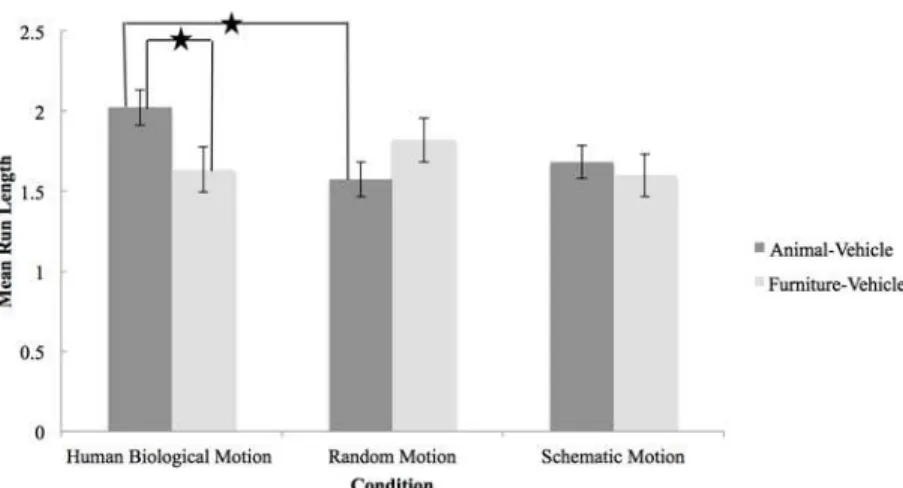
correc-tions) revealed significant differences between categorization trials (animal-vehicle vs. furni-ture-vehicle) for the human biological motion condition,M difference=.39,p= .01. In contrast, mean differences in MRLs were not significant in the schematic motion condition (M difference= .09,p= .56) or in the random motion condition (M difference= -.25,p= .11). When comparing groups on categorization of furniture and vehicles, infants in the human bio-logical motion condition (M= 1.63,SD= .49) had a MRL equivalent to infants in the schematic motion condition (M= 1.60,SD= .47;M difference= .035,p= 1.00) and in the random motion condition (M= 1.82,SD= 1.01;M difference= -.19,p= 1.00). In contrast, infants primed with human biological motion had a higher mean MRL for the animal-vehicle categorization (M= 2.02,SD= .75) than infants primed with the schematic motion (M= 1.68,SD= .48;M dif-ference= .39,p= .09) and the random motion (M= 1.57,SD= .35;M difference= .45,p= .01) (seeFig. 1).
To compare the MRL of each category and condition to chance (MRL = 1.75) a one-sample t-test was used. Infants in the human biological motion condition performed above chance when categorizing animals and vehicles,t(24) = 1.87,p=.04, but not when categorizing furniture and vehicles,t(24) = -1.25,p=.22. The proportion of runs (23%) that included the dolphin was in line with the expected proportion based on four animals (25%). This indicates that biological motion primed the concept of animals, and not simply a body part such as legs. Infants in the schematic motion condition performed at chance when categorizing animals and vehicles, t(27) =-.73,p=.22, but below chance when categorizing furniture and vehicles,t(27) = -1.71, p=.05. Infants in the random motion condition performed below chance when categorizing ani-mals and vehicles,t(25) = -2.54,p=.01, while the MRL for the furniture-vehicle trial did not dif-fer from chance,t(25) =.42,p=.34.
In terms of category pairs, about one-half of children categorized the animals vs. vehicles after being primed with the human point-light walker (48%). In contrast, much fewer children cate-gorized animals vs. vehicles following exposure to schematic motion (28%) or random motion (11%). As expected, categorization of artifacts was not facilitated by human point-light biologi-cal motion (28%), schematic biologibiologi-cal motion (27%), or random motion (14%) priming.
Discussion
The purpose of this experiment was to investigate if exposure to biological motion primes in-fants’categorization of animals and vehicles using a sequential touching task. The results pro-vide support for the hypothesis that a human biological motion point-light display primes infants’ability to categorize animals and vehicles. Further, this effect was not observed when infants were primed with schematic biological motion, or random motion. Importantly, the priming effect was specific to the animal-vehicle categorization task and did not influence in-fants’performance on the task requiring infants to differentiate two inanimate categories (e.g., furniture and vehicles). Additional support for our hypothesis is demonstrated by the fact that infants in the human biological motion condition categorized above chance (MRL>1.75) on the animal-vehicle task, but not on the furniture-vehicle task. None of the mean run lengths in the other two conditions was above chance. This is an extraordinary finding for two reasons: 1) in a point-light display, the movement of the body is reduced to the motion of dots that rep-resent the key joints, and 2) the movement of ahumanbody facilitated the categorization of animals, including mammals and birds. These results can be interpreted as support for a Figure 1. Mean Run Length as a Function of Priming Condition and Category.The Mean Run Length (MRL) was calculated for the Human Biological Motion, the Random Motion, and the Schematic Motion conditions across categorization of animal-vehicles and furniture-vehicles. A MRL of 1.75 refers to categorizing at chance level. In the present study, the human biological motion point-light display primed infants’ability to categorize animals and vehicles, but not inanimate categories (e.g., furniture and vehicles). This priming effect was not found in the two other conditions.
doi:10.1371/journal.pone.0116910.g001
Table 1. Mean percentage of categorizers across condition and type of category.
Priming Condition
Category trial Human Biological Motion Random Motion Schematic Motion
Animal-vehicle 48% 11.5% 28.6%
Furniture-vehicle 28% 26.90% 14.3%
precocious association of biological motion with animacy by 12 months of age, as long as the structure of the human body is implicit in the point-light display.
In contrast to previous research on categorization of animals vs. artifacts without priming, 12-month-old infants performed at a level above chance when tested with a sequential touch-ing task [1]. The current results also demonstrated that biological motion alone is not sufficient to improve infants’animal–vehicle categorization abilities. Infants in the schematic biological motion condition (‘Michotte’stimulus) did not perform significantly better on the sequential touching task than those exposed to random motion. However, the schematic motion differed from the biological motion prime in many ways, including the absence of human locomotion. Future studies contrasting intact biological motion with other motion stimuli (e,g., scrambled motion) will be needed in order to clarify whether animate motion needs to contain form cues to prime the concept of animacy in a categorization task. Nonetheless, this finding contrasts with recent research showing that infants as young as 6 months of age attribute goals to sche-matic animal motion, like the moving square that we used [28], and that schematic biological motion cues might signal agency before animacy. However, associating goal-directedness to schematic biological motion does not entail, as the authors suggest, that the moving shape is perceived as animate. Similarly, goal attribution has been linked to a self-propelled box in 5-month-olds [44]. These findings do not provide information about whether infants perceive these objects as animate, only that they are able to associate motion cues considered to be con-ceptual primitives for the development of the animacy concept [14]. Furthermore, the absence of a priming effect for the schematic motion condition suggests that this type of motion is not identified as animal-like by infants, as it is by preschoolers and adults [29].
The research presented here contributes to understanding early conceptual development in many ways. First, because infants were primed with human biological motion and were tested on their ability to differentiate non-human animals (mammals and fish) from vehicles, these re-sults provide evidence for the notion that infants as young as 12 months of age possess an im-plicit concept of animates, which includes both humans and animals. To date, only a handful of studies have addressed this issue. Poulin-Dubois, Frenkiel-Fishman, Nayer, and Johnson [45] reported that infants as young as 16 months of age extend motion and sensory properties mod-eled on people to animal exemplars (i.e., within the animate category). More recently, Rostad et al. [4] reported that even 14-month-olds can group animals and people together with a se-quential touching procedure. We provide evidence that realistic point-light biological motion is recognized as animate by infants as young as 12 months. To date, research using point-light dis-plays with infants have reported sensitivity to biological motion and recognition of the solidity of the human body [46]. Our data suggest that such displays also activate stored knowledge about animate beings broadly defined.
animals and vehicles. The findings of the present study support the hypothesis that biological motion is an important building block in the acquisition of the concept of animacy. Since even newborns preferentially attend to biological motion, it is likely the case that this ability facili-tates categorization and not the reverse as some form of global categorization has been docu-mented only a few months later with the familiarization-novelty procedure. Unlike self-propulsion, which appears to apply equally to animals and vehicles without knowledge about human agency in vehicle motion, biological motion might be uniquely associated with animacy from birth.
The priming paradigm developed here to assess whether infants associate biological motion with animals offers new ways to study the foundations for the development of early categoriza-tion. First, it could be easily adapted to test younger infants by pairing it with categorization tasks appropriate for infants younger than 12 months, such as the object examination proce-dure. Second, rigid, mechanical motion could be substituted for biological motion as the prim-ing stimulus in order to determine if inanimates are associated with this manner of motion. One would expect that categorization of vehicles would be facilitated by exposure to, for exam-ple, a car rolling. Future research may also investigate whether priming with schematic biologi-cal motion will boost older infants’concept of animacy. Although infants might show hard-wired sensitivity to the minimal information that the Michotte [27] caterpillar-like motion pat-tern provides, learning that this two-anchor crawling might have commonalities with 4-legged animals’motion might require additional experience. Biological motion perception is remark-ably robust and has immense evolutionary and social importance [19,57]. The detection of bi-ological motion is a fundamental perceptual process that is part of an early developing and evolutionarily-endowed mechanism shared across species. This ability to recognize and prefer-entially attend to the motion of biological entities, even when presented in its most rudimenta-ry form, has been hypothesized to underlie developing social cognition (e.g., [24,58]. Further studies should aim at expanding our knowledge of its role in the emergence and development of infants’animate/inanimate distinction.
Acknowledgments
Portions of this research were presented at the 2011 biannual meeting of the Cognitive Devel-opment Society, Philadelphia, Pennsylvania, USA. The authors thank Dr. Nikolaus Troje, and Dr. Michael von Grünau for providing the computer animations. We also thank Cynthia Man-cinelli, Alexandra Polonia, and Katherine Gittins for their invaluable contributions to the test-ing and codtest-ing of participants.
Author Contributions
Conceived and designed the experiments: DPD CC KW. Performed the experiments: CC KW. Analyzed the data: CC KW. Wrote the paper: DPD CC KW.
References
1. Bornstein MH, Arterberry ME (2010) The development of object categorization in young children: hier-archical inclusiveness, age, perceptual attribute, and group versus individual analyses. Dev Psychol 46: 350–365. doi:10.1037/a0018411PMID:20210495
2. Mandler JM, Bauer PJ, McDonough L (1991) Separating the sheep from the goats: Differentiating glob-al categories. Cogn Psychol 23: 263–298. doi:10.1016/0010-0285(91)90011-C
4. Rostad K, Yott J, Poulin-Dubois D (2012) Development of categorization in infancy: Advancing forward to the animate/inanimate level. Infant Behav Dev 35: 584–595. doi:10.1016/j.infbeh.2012.05.005 PMID:22789898
5. Younger BA, Fearing DD (2000) A Global-to-Basic Trend in Early Categorization: Evidence From a Dual-Category Habituation Task. Infancy 1: 47–58. doi:10.1207/S15327078IN0101_05
6. Mandler JM, Bauer PJ (1988) The cradle of categorization: Is the basic level basic? Cogn Dev 3: 247–264. doi:10.1016/0885-2014(88)90011-1
7. Mandler JM, McDonough L (1993) Concept formation in infancy. Cogn Dev 8: 291–318. doi:10.1016/ S0885-2014(93)80003-C
8. Mandler JM, McDonough L (1998) On developing a knowledge base in infancy. Dev Psychol 34: 1274–1288. doi:10.1037/0012-1649.34.6.1274PMID:9823512
9. Elsner B, Jeschonek S, Pauen S (2013) Event-related potentials for 7-month-olds’processing of ani-mals and furniture items. Dev Cogn Neurosci 3: 53–60. doi:10.1016/j.dcn.2012.09.002PMID: 23245220
10. Mandler JM (1992) How to build a baby: II. Conceptual primitives. Psychol Rev 99: 587–604. doi:10. 1037/0033-295X.99.4.587
11. Opfer JE, Gelman SA (2011) Development of the animate-inanimate distinction. In: Goswami U, editor. The Wiley-Blackwell handbook of childhood cognitive development. Wiley-Blackwell. pp. 213–238.
12. Rakison DH, Poulin-Dubois D (2001) Developmental origin of the animate-inanimate distinction. Psy-chol Bull 127: 209–228. doi:10.1037/0033-2909.127.2.209PMID:11316011
13. Mandler JM (2004) The foundations of mind: origins of conceptual thought. New York: Oxford Universi-ty Press.
14. Mandler JM (2012) On the Spatial Foundations of the Conceptual System and Its Enrichment. Cogn Sci 36: 421–451. doi:10.1111/j.1551-6709.2012.01241.xPMID:22435402
15. Blake R, Shiffrar M (2007) Perception of human motion. Annu Rev Psychol 58: 47–73. doi:10.1146/ annurev.psych.57.102904.190152PMID:16903802
16. Grossman ED, Blake R (2001) Brain activity evoked by inverted and imagined biological motion. Vision Research. Vol. 41. pp. 1475–1482. doi:10.1016/S0042-6989(00)00317-5PMID:11322987
17. Vaina LM, Solomon J, Chowdhury S, Sinha P, Belliveau JW (2001) Functional neuroanatomy of biolog-ical motion perception in humans. Proc Natl Acad Sci U S A 98: 11656–11661. doi:10.1073/pnas. 191374198PMID:11553776
18. Johansson G (1973) Visual perception of biological motion and a model for its analysis. Percept Psy-chophys 14: 201–211. doi:10.3758/BF03212378
19. Pavlova MA (2012) Biological motion processing as a hallmark of social cognition. Cereb Cortex 22: 981–995. doi:10.1093/cercor/bhr156PMID:21775676
20. Simion F, Regolin L, Bulf H (2008) A predisposition for biological motion in the newborn baby. Proc Natl Acad Sci U S A 105: 809–813. doi:10.1073/pnas.0707021105PMID:18174333
21. Bidet-Ildei C, Kitromilides E, Orliaguet J-P, Pavlova M, Gentaz E (2014) Preference for point-light human biological motion in newborns: contribution of translational displacement. Dev Psychol 50: 113–120. doi:10.1037/a0032956PMID:23668800
22. Bertenthal BI (1993) Infants’perception of biomechanical motions: Intrinsic image and knowledge-based constraints. In: Granrud CE, editor. Visual perception and cognition in infancy. Hillsdale: Erl-baum. pp. 175–214.
23. Fox R, McDaniel C (1982) The perception of biological motion by human infants. Science 218: 486–487. doi:10.1126/science.7123249PMID:7123249
24. Yoon JMD, Johnson SC (2009) Biological Motion Displays Elicit Social Behavior in 12-Month-Olds. Child Dev 80: 1069–1075. doi:10.1111/j.1467-8624.2009.01317.xPMID:19630894
25. Arterberry ME, Bornstein MH (2002) Infant perceptual and conceptual categorization: The roles of static and dynamic stimulus attributes. Cognition 86: 1–24. doi:10.1016/S0010-0277(02)00108-7PMID: 12208649
26. Giese MA, Poggio T (2003) Neural mechanisms for the recognition of biological movements. Nat Rev Neurosci 4: 179–192. doi:10.1038/nrn1057PMID:12612631
27. Michotte AE (1963) The perception of causality. Miles T, Miles E, editors New York: Basic Books.
28. Schlottmann A, Ray E (2010) Goal attribution to schematic animals: do 6-month-olds perceive biologi-cal motion as animate? Dev Sci 13: 1–10. doi:10.1111/j.1467-7687.2009.00854.xPMID:20121858
30. Barr R, Vieira A, Rovee-Collier C (2002) Bidirectional priming in infants. Mem Cognit 30: 246–255. doi: 10.3758/BF03195285PMID:12035886
31. Over H, Carpenter M (2009) Eighteen-month-old infants show increased helping following priming with affiliation. Psychol Sci a J Am Psychol Soc / APS 20: 1189–1193. doi:10.1111/j.1467-9280.2009. 02419.x
32. Mareschal D, Tan SH (2008) The Role of Context in the Categorization of Hybrid Toy Stimuli by 18-Month-Olds. Infancy 13: 620–639. doi:10.1080/15250000802458658
33. Troje NF (2002) Decomposing biological motion: a framework for analysis and synthesis of human gait patterns. J Vis 2: 371–387. doi:10.1167/2.5.2PMID:12678652
34. VPixx Technologies Inc. ( St-Bruno-de-Montarville, Québec).
35. Cohen LB, Atkinson DJ, Chaput HH (2000) Habit 2000: A new program for testing infant perception and cognition ( Version 1.0) Austin: University of Texas.
36. Cohen LB (2004) Uses and misuses of habituation and related preference paradigms. Infant Child Dev 13: 349–352. doi:10.1002/icd.355
37. Mandler JM, Fivush R, Reznick JS (1987) The development of contextual categories. Cogn Dev 2: 339–354. doi:10.1016/S0885-2014(87)80012-6
38. Mareschal D, Quinn PC (2001) Categorization in infancy. Trends Cogn Sci 5: 443–450. doi:10.1016/ S1364-6613(00)01752-6PMID:11707383
39. Starkey D (1981) The origins of concept formation: Object sorting and object preference in early infan-cy. Child Dev 52: 489–497. doi:10.2307/1129166
40. Oakes LM, Plumert JM (2002) Variability in thirteen-month-old infants’touching patterns in the sequen-tial-touching task. Infant Behav Dev 25: 529–549. doi:10.1016/S0163-6383(02)00149-2
41. Dixon WE, Price RM, Watkins M, Brink C (2007) TouchStat v. 3.00: a new and improved Monte Carlo adjunct for the sequential touching task. Behav Res Methods 39: 407–414 doi:10.3758/BF03193010 PMID:17958152
42. Kline RB (2009) Practical Data Analysis. Becoming A Behavioural Science Researcher A Guide to Pro-ducing Research That Matters. New York, NY: Guilford Press. pp. 225–251.
43. Dixon WE, Woodward T, Merry MS (1998) TouchStat: A Monte Carlo program for calculating sequential touching probabilities. Behav Res Methods, Instruments, Comput 30: 592–604. doi:10.3758/ BF03209476
44. Luo Y, Baillargeon R (2005) Can a self-propelled box have a goal? Psychological reasoning in 5-month-old infants. Psychol Sci a J Am Psychol Soc / APS 16: 601–608. doi:10.1111/j.1467-9280. 2005.01582.xPMID:16102062
45. Poulin-Dubois D, Frenkiel-Fishman S, Nayer S, Johnson S (2006) Infant’s Inductive Generalization of Bodily, Motion, and Sensory Properties to Animals and People. J Cogn Dev 7: 431–453. doi:10.1207/ s15327647jcd0704_1
46. Moore DG, Goodwin JE, George R, Axelsson EL, Braddick FMB (2007) Infants perceive human point-light displays as solid forms. Cognition 104: 377–396. doi:10.1016/j.cognition.2006.07.007PMID: 16930578
47. Poulin-Dubois D, Lepage A, Ferland D (1996) Infants’concept of animacy. Cogn Dev 11: 19–36. doi: 10.1016/S0885-2014(96)90026-X
48. Pauen S, Träuble B (2009) How 7-month-olds interpret ambiguous motion events: Category-based rea-soning in infancy. Cogn Psychol 59: 275–295. doi:10.1016/j.cogpsych.2009.06.001PMID:19596267
49. Saxe R, Tenenbaum JB, Carey S (2005) Secret agents: inferences about hidden causes by 10- and 12-month-old infants. Psychol Sci a J Am Psychol Soc / APS 16: 995–1001. doi:10.1111/j.1467-9280. 2005.01649.xPMID:16313665
50. Markson L, Spelke ES (2006) Infants’Rapid Learning About Self-Propelled Objects. Infancy 9: 45–71. doi:10.1207/s15327078in0901_3
51. Kosugi D, Fujita K (2002) How do 8-month-old infants recognize causality in object motion and that in human action? Jpn Psychol Res 44: 66–78. doi:10.1111/1468-5884.00008
52. Leslie AM (1984) Infant perception of a manual pick-up event. Br J Dev Psychol 2: 19–32. doi:10. 1111/j.2044-835X.1984.tb00531.x
53. Saxe R, Tzelnic T, Carey S (2007) Knowing who dunnit: Infants identify the causal agent in an unseen causal interaction. Dev Psychol 43: 149–158. doi:10.1037/0012-1649.43.1.149PMID:17201515
55. Spelke ES, Kestenbaum R, Simons DJ, Wein D (1995) Spatiotemporal continuity, smoothness of mo-tion and object identity in infancy. Br J Dev Psychol 13: 113–142. doi:10.1111/j.2044-835X.1995. tb00669.x
56. Woodward AL, Phillips A, Spelke ES (1993) Infants’expectations about the motion of animate versus inanimate objects. Proceedings of the fifteenth annual meeting of the cognitive science society. pp. 1087–1091.
57. Pavlova M, Krägeloh-Mann I, Sokolov A, Birbaumer N (2001) Recognition of point-light biological mo-tion displays by young children. Percepmo-tion 30: 925–933. doi:10.1068/p3157PMID:11578078