INDIVIDUAL ATHLETES’ BIOMECHANICAL FEATURES OF INTERACTION WITH OBJECTS IN ART GYMNASTICS
Adashevskiy V.M.1, Iermakov S.S. 2, Logvinenko Y.I. 1, Cieślicka Mirosława2, Stankiewicz Błażej2, Pilewska
Wiesława2
National Technical University KPI, Ukraine1
Kazimierz Wielki University in Bydgoszcz, Bydgoszcz, Poland.2
Annotation. Purpose: To design a biomechanical model of interaction of athlete with the subject, as well as the development of areas of its use in practice. Material: The study involved 10 students - athletes. Results: The presented computational schemes create direction of flight of different items (rope, hoop, ball, ribbon, clubs). The characteristics of the time of flight trajectories and with regard for the resistance force of the air environment. Shows the influence of initial parameters on departure flight time items. Graphic characteristics are presented trajectories of objects depending on the parameters of their departure. Conclusions: It is recommended to improve the judicial assessment and effective implementation gymnast exercises during the flight characteristics of the various items to consider trajectories of objects. Note that age, height and distance from the athletes at the end of the flight object defined biomechanical characteristics that can realize an athlete: absolute initial velocity of departure, departure angle, height of the center of mass manufacture items.
Keywords: art gymnastics, items, training, biomechanics, flight.
Introduction1
Solution of practical tasks of sport training is impossible without analyzing of interconnections between separate elements of sportsmen’s movements and comparing of them with some model characteristics. As model, in such cases, they usually base on movements of the best athletes in certain kind of sports. Such approach permits to create individual programs of sportsmen’s training. One of important aspects in such training is creation of bio-mechanical models, which expand athlete’s and his coach’s understanding of mechanisms of separate elements’ interconnections in general structure of movements’ building and correction. Exactly, consideration of individual features of a sportsman permits to determine the most optimal characteristics of movements and find solutions for their practical application. In constantly increasing contest in sports such approach is urgent and necessary element of training and perfection of athletes.
Demand in consideration of sportsmen’s individual features is noted in works: Zh.L. Kozina [16, 17]; S.S. Yermakov [8, 9]; S.S. Yermakov, S.N. Ivaschenko, V.V. Guzov [13]; N.A. Nosko. [24, 25]; G.V. Korobeynikov, Yu.A. Radchenko [19]; S.G. Kopchikova [18]; S.V. Latyshev, G.V. Korobeynikov [21]; V.A. Zaporozhanov [13, 14]; A.Ya. Pavelets, V.N. Ost’yanov, Ye.V. Maydaniuk [27]; Ilnitskaya A.S., Kozina Zh.L., Korobejnik V.A., Ilnickiy S.V., Cieślicka Mirosława, Stankiewicz Błażej, Pilewska Wiesława [35]; Rovnaya O.A., Podrigalo L.V., Iermakov S.S., Prusik Krzysztof, Cieślicka Mirosława [35], Volodymyr Adashevsky, Sergii Iermakov, Krzystof Prusik, Katarzyna Prusik, Karol Gorner [36] et al.
From point of view of bio-mechanics demand in consideration of individual characteristics of sportsman’s movements was regarded in works by N.A. Bernstein [5]; A.N. Laputin [20]; D.D. Donskoy [7]; S.V. Dmitriyev [6]; S.S. Yermakov [8, 9]; V.M. Adashevskiy, M. Dulevskiy, S.S. Yermakov [1]; V.M. Adashevskiy, S.S. Yermakov, V.A. Shabashov [2] et al.
Great attention is paid in construction of bio-mechanical models to not only consideration of movements’ individual parameters but to optimal combination of its separate elements. At the same time, optimization in constructing of bio-mechanical model, puts forward certain requirement to preliminary choosing of the most important elements of movement. Solution of problems of creation of bio-mechanical models of sportsman’s acting with ball, with different apparatuses was regarded in the following works: S.S. Yermakov, V.M. Adashevskiy [10]; S.S. Yermakov, V.M. Adashevskiy, O.A. Sivolap [11]; V.M. Adashevskiy, M. Dulevskiy, S.S. Yermakov [1]; V.M. Adashevskiy, S.S. Yermakov, V.A. Shabashov [2]; A.L. Sidash [30].
Among kinds of sports, in which a sportsman interacts with an object with following catching of it, special place is taken by calisthenics. There are several kinds of catching and throwing of objects. In individual programs catching of an object after its flight is fulfilled by a sportswoman herself. In group exercises there are also movements, connected with catching of objects in different combinations by sportswomen of one team. It conditions demand in sportswomen’s understanding of bio mechanical laws of flight and in studying of object’s flight’s phases. Fulfillments by sportswomen of exercises with objects were researched in works by L.A. Karpenko [15]; T.V. Nesterova, I.S. Sivash [22]; T.V. Nesterova, I.A. Shevchuk [23]; I.A. Stepanova [31]; V.A. Parakhin [28]; Bio-mechanical specificities of exercises with objects were elucidated in works by N. Andreyeva [4], S.L. Rukavitsina [29]. Among them we should note the works devoted to throws’ techniques and catching of objects of N. Andreyeva [3]; N.O. Obraztsova [26]; A. Sumenkova, I. Nakonechnaya, A. Rudenko [32]; N.A. Ovchinnikova, L.A. Karpenko [33]. However there are still unsolved and
© Adashevskiy V.M., Iermakov S.S., Logvinenko Y.I., Cieślicka Mirosława, Stankiewicz Błażej,
insufficiently studied some problems of throws and catching of objects. In this aspect it is evident that it is necessary to construct bio-mechanical models of sportswoman’s interacting with object, exactly in calisthenics.
Purpose, tasks of the work, material and methods
The purpose of the work is to construct bio-mechanical model of sportswoman’s interacting with an object as well as work out directions of its application in practice.
The tasks of the research: to compose calculation diagrams for determination of characteristics of trajectory and time of objects’ flight, considering sir resistance; compose physical-mathematic models of objects’ flight; determine main bio-mechanical characteristics of flight; carry out research of influence of initial flight parameters on objects’ flight time and obtain graphs of their trajectories; test in practice the received results.
Results of the research
In calisthenics referee’s mark depends on gymnast’s effective fulfillment of certain exercises in period of objects’ flight with certain trajectories. It should be noted that time, height and distance from a sportswoman at the end of flight are determined in general by bio-mechanical characteristics, which can be realized by this sportswoman, videlicet: absolute initial velocity of flight start, angle of take off, height of mass centers of appropriate objects.
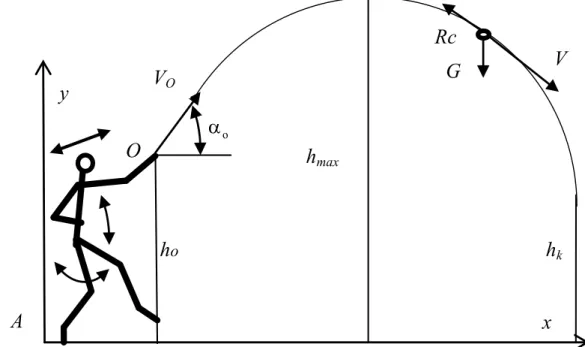
Let us regard calculation diagrams for determination of parameters of height and flight distance, basing on parameters of certain objects flight (see fig.1).
Rc
V
G
hk
O
А
x
y
o
h
o
VO
hmax
Fig. 1. Calculation diagram, for determination of parameters of objects’ flight V0 = VС0 – absolute initial velocity of objects mass centers’ take off,
VоX – projection of velocity of objects’ mass centers take off on axis Ox,
VоY - projection of velocity of objects’ mass centers take off on axis Oy,
V - current velocity of objects’ mass centers.
In projections on axes of Descartes’ absolute system of coordinates:
0cosα ;0 0sinα0
Ox Oy
v v v v
Expression of absolute initial velocity of take off:
2 2
0 0x 0y
v v v
hCо = h0 – height of objects’ mass centers take off in initial time of take off,
α0=αC0 – take off angle of objects’ mass centers,
G – force of gravity of objects,
Variable in time values of coefficients kare determined by calculation.
As far as objects in flight phase move, mainly, in one of anatomic planes, we can compose equation of dynamic of plane-parallel movement in projections on coordinates’ axes:
;
e e
c x c y
mx
P
my
P
.Here
m
- mass of body,X Yc, c- correspond to projections of acceleration of mass centers, ,e e x y
P P - projections of resultant forces acting on objects in flight.
With movement in plane xAy, system of equations can be written in the following way:
;
X Y
c c
mx R my G R
cos ; sin
c c
mx R my mg R
cos xv; sin yv; 2 2 2 2
x y
v v v x y
α – angle between current projections of velocity of body mass center and vector of its velocity, which determines signs of vectors’ projections on axes of coordinates. Solution of this task requires integrating of differential equations of movement.
Let us build graph dependences of distance, flight height of objects considering initial parameters: absolute velocity of mass centers’ take off, angle of mass centers’ take off, height of mass centers, for variable force of air resistance (see fig.2). With it we calculate flight time of objects, which is required for effective fulfillment of certain exercises by a gymnast.
Dependence y1(x1)
Fig.2. Graph dependence of parameters of skipping rope’s flight for time t=3sec.; VС0=17m/sec; αC0 =820;
hCо =0.7m.; m= 0.1kg.
For flight time t=3sec. And received value of flight distance of skipping rope Х1= 5.6 m. Sportswoman fulfils
such elements: throw of skipping rope on side step, two forward rolls and catching of skipping rope with hands or legs with full back turn around frontal axis.
У1 (М)
Dependence y2(x2)
Fig.3. Graph dependence of flight parameters of hoop for time t=3sec.; VС0=16.5m/sec; αC0 =830; hCо
=0.75m.; m= 0.3kg.
For flight time t=3sec. And received flight distance of hoop Х2= 5 m. Sportswoman fulfills such elements: throw
at side step and two forward rolls around frontal axis, cross split and catching of hoop with feet.
Dependence y3(x3)
Fig.4. Graph dependence of parameters of ball flight for time t=2.75sec.; VС0=15m/sec; αC0 =850; hCо
=0.75m.; m= 0.4kg. У2 (М)
Х2 (М)
У3 (М)
Dependence y4(x4)
FDig.5. Graph dependence of parameters of ribbon flight for time t=4.5sec.; VС0=17.3m/sec; αC0 =740; hCо
=0.75m.; m= 0.1kg.
For time of flight t=4.5sec. and received distance of ribbon flight Х4=10.5 m. sportswoman fulfills the following
elements: throw of ribbon, three forward rolls around frontal axis and catching of ribbon with hands in last roll.
Dependence y5(x5)
Fig.6. Graph dependence of parameters of clubs’ flight for time t=3sec.; VС0=21m/sec; αC0 =850; hCо
=0.75m.; 2m= 0.3kg.
For time of flight t= 3 sec. and received distance of clubs’ flight Х4=2.9 m. sportswoman fulfills the following
elements: throw of club, one forward roll around frontal axis and catching of clubs with hands in roll.
Analysis of graph characteristics of trajectories of objects' flights permits to correct movements depending on individual physical features and potentials of sportsmen. Such approach permits to more effectively fulfill appropriate exercises as well as to create conditions for improving of referee’s marks.
Conclusions:
Thus, practical application of bio-mechanical model of a sportswoman’s movements permits to optimize training process. Besides, consideration of sportswoman’s individual characteristics in bio-mechanical model permitted to mark out the most significant kinematic and dynamic parameters of movement. Practical application of results of analysis of
У4 (М)
Х4 (М)
У5 (М)
individual model requires from a coach and sportswoman knowledge of movements’ bio-mechanic principles. When constructing a model special attention should be paid to using of modern equipment and control devices, which permit to register movements’ parameters of athletes in certain kind of sports.
It is recommended to consider results of bio-mechanical analysis of objects’ flights for improvement of referee’s marks and effective fulfillment of certain routines by gymnast during objects flight at certain their trajectories. It is necessary to consider that time, height and distance from a sportswoman at the end of flight are determined with bio-mechanical characteristics, which the sportswoman can realize: absolute initial velocity of take off, take off angle, height of objects’ mass centers.
In the future it is evident that it is necessary to apply modern equipment for video analysis of sportsman’s movements.
References:
1 Adashevskij V.M., Dulevski M., Iermakov S.S. Fiziceskoe vospitanie studentov [Physical Education of Students], 2011, vol.3, pp. 3-7.
2 Adashevskij V.M., Iermakov S.S., Shabashov V.A. Fiziceskoe vospitanie studentov [Physical Education of
Students], 2012, vol.3, pp. 5-10.
3 Andreeva N. Molodizhnij naukovij visnik [Youth science bulletin], 2012, vol.7, pp. 104-110.
4 Andreeva N. O., Zhirnov A. V., Boloban V. N. Fiziceskoe vospitanie studentov [Physical Education of Students],
2011, vol.4, pp. 6–15.
5 Bernshtejn N.A. O postroenii dvizhenij [On the construction of movements], Moscow, 1947, 144 p.
6 Dmitriev S.V. Fiziceskoe vospitanie studentov [Physical Education of Students], 2011, vol.1, pp. 59 - 67. 7 Donskoj D. D. Biomekhanika [Biomechanics], Moscow, Education, 1975, 240 p.
8 Iermakov S.S. Obuchenie tekhnike udarnykh dvizhenij v sportivnykh igrakh [Education technology shock
movements in sports], Kharkov, KSADA, 1996, 292 p.
9 Iermakov S.S. Pedagogika, psihologia ta mediko-biologicni problemi fizicnogo vihovanna i sportu [Pedagogics,
psychology, medical-biological problems of physical training and sports], 2001, vol.17, pp. 40-47.
10 Iermakov S.S., Adashevskij V.M. Fiziceskoe vospitanie studentov [Physical Education of Students], 2010, vol.4,
pp. 26 - 29.
11 Iermakov S.S., Adashevskij V.M., Sivolap O.A. Fiziceskoe vospitanie studentov [Physical Education of Students], 2010, vol.4, pp. 26-29.
12 Iermakov S.S.,Ivashchenko S. N., Guzov V.V. Fiziceskoe vospitanie studentov [Physical Education of Students],
2012, vol.4, pp. 59-61.
13 Zaporozhanov V.A., Borachinski T. Pedagogika, psihologia ta mediko-biologicni problemi fizicnogo vihovanna i sportu [Pedagogics, psychology, medical-biological problems of physical training and sports], 2013, vol.9, pp. 25-28. doi:10.6084/m9.figshare.749693
14 Zaporozhanov V.A. Pedagogika, psihologia ta mediko-biologicni problemi fizicnogo vihovanna i sportu
[Pedagogics, psychology, medical-biological problems of physical training and sports], 2013, vol.4, pp. 21-25. doi:10.6084/m9.figshare.693023
15 Karpenko L.A. Komponenty sportivnogo masterstva i osnovy obucheniia uprazhneniiam khudozhestvennoj
gimnastiki [Components of sportsmanship and learning the basics of gymnastics exercises], Sankt Petersburg, SSAPC Publ., 2002, 40 p.
16 Kozina Zh.L., Iermakov S.S., Pogorelova A.O. Fiziceskoe vospitanie studentov [Physical Education of Students],
2012, vol.3, pp. 53 - 60.
17 Kozina Zh.L., Iagello M., Iagello V. Pedagogika, psihologia ta mediko-biologicni problemi fizicnogo vihovanna i
sportu [Pedagogics, psychology, medical-biological problems of physical training and sports], 2012, vol.11, pp. 43 - 50. doi:10.6084/m9.figshare.97357
18 Kopchikova S.G. Pedagogika, psihologia ta mediko-biologicni problemi fizicnogo vihovanna i sportu
[Pedagogics, psychology, medical-biological problems of physical training and sports], 2014, vol.2, pp. 33-36. doi:10.6084/m9.figshare.923511
19 Korobejnikov G.V., Radchenko Iu.A. Pedagogika, psihologia ta mediko-biologicni problemi fizicnogo vihovanna
25 Nosko N. A. Pedagogicheskie osnovy obucheniia molodezhi i vzroslykh dvizheniiam so slozhnoj
biomekhanicheskoj strukturoj [Pedagogical foundations of youth and adult education movements with complex biomechanical structure], Kiev, Scientific World, 2000, 336 p.
26 Obrazcova N. O. Biomekhanicheskie osobennosti broskov i lovli razlichnykh predmetov v khudozhestvennoj gimnastike [Biomechanical features of shots and catching different objects in rhythmic gymnastics ]. Vsesoiuznaia nauchnaia konferenciia po biomekhanike sporta [All-Union Scientific Conference. biomechanics of sport], Chernigov, 1989, pp. 135–156.
27 Pavelec A.Ia., Ost'ianov V.N., Majdaniuk E.V. Pedagogika, psihologia ta mediko-biologicni problemi fizicnogo
vihovanna i sportu [Pedagogics, psychology, medical-biological problems of physical training and sports], 2013, vol.10, pp. 52-55. doi:10.6084/m9.figshare.775329
28 Parakhin V.A. Osvoenie i sovershenstvovanie slozhnykh gimnasticheskikh uprazhnenij tipa pereletov
[Development and improvement of the complex type of gymnastic exercises flights], Cand. Diss., Moscow, 2011, 20 p.
29 Rukavicyna S.L. Programmirovanie obucheniia uprazhneniiam s obruchem v khudozhestvennoj gimnastike
[Programming training exercises with hoop in artistic gymnastics], Cand. Diss., Minsk, 1990, 20 p.
30 Sidash A.L. Primenenie instrumental'nykh metodov dlia kontrolia vypolneniia peredachi miacha dvumia rukami sverkhu v volejbole [Application of instrumental methods for monitoring performance of passing the ball with both hands on top of volleyball]. Biomekhanika sportivnykh dvigatel'nykh dejstvij i sovremennye instrumental'nye metody ikh kontrolia [Sports biomechanics of motor actions and modern instrumental methods of their control], Malahovka, 2013, pp. 138-143.
31 Stepanova I. A., Karpenko L. A. Tekhnicheskaia podgotovka i osnovy obucheniia uprazhneniiam
khudozhestvennoj gimnastiki [Technical training and learning the basics of gymnastics exercises], Moscow, 2003, pp. 257–265.
32 Sumenkova A., Nakonechnaia I., Rudenko A. Molodizhnij naukovij visnik [Youth science bulletin], 2012, vol.7,
pp. 133-136.
33 Ovchinnikova N. A., Karpenko L. A. Khudozhestvennaia gimnastika [Artistic gymnastics], Moscow, 2003, pp.
320–340.
34 Ilnitskaya A.S., Kozina Zh.L., Korobejnik V.A., Ilnickiy S.V., Cieślicka Mirosława, Stankiewicz Błażej, Pilewska Wiesława. The method of application of health systems Bodyflex and Pilates in physical education of students. Pedagogics, psychology, medical-biological problems of physical training and sports, 2014, vol.2, pp. 25-32. doi:10.6084/m9.figshare.923510
35 Rovnaya O.A., Podrigalo L.V., Iermakov S.S., Prusik Krzysztof, Cieślicka Mirosława. Morphological and functional features of synchronous swimming sportswomen of high qualification. Pedagogics, psychology, medical-biological problems of physical training and sports, 2014, vol.4, pp. 45-49. doi:10.6084/m9.figshare.951916
36 Volodymyr Adashevsky, Sergii Iermakov, Krzystof Prusik, Katarzyna Prusik, Karol Gorner. Biomechanics: theory